Friday, February 7, 2014

Somalia’s former Prime Minister liad to rest in state burial

Former Somali Prime Minister, Abdrizak Haji Hussein laid to rest on Friday at El-Irfid Cemetery in the outskirts of Mogadishu.
 
Abdirizak Haji Hussein, who was the Prime Minister of Somalia from 1964 to 1967, has died in a hospital in Minnesota last month and his body was returned from US for state burial in the capital Friday morning.
 
 
Somali President Hassan Sheikh Mohamud, Prime Minister Abdiweli Sheikh Ahmed, Parliament Speaker Mohamed Sheikh Osman and the leaders of the regional states attended the funeral.
 
 
President Hassan Sheikh Mohamed paid tribute to the leadership of late Prime Minister, stating that his life should be an example to all Somalis as the country seeks to rebuild the nation.“Today we pray for one of Somalia’s greatest heroes.
 
Abdirizak Haji Hussein was a great man and a towering Somali patriot. His life should be an example to all Somalis as we seek to rebuild our great nation together. If there is one lesson we can all draw from his life and career it is the importance of national unity. Think how much we can achieve if we pull together. After years of division and despair, we must unite as one and achieve extraordinary things.” President Hassan said.“This was a man who staked his leadership on anti-corruption, whose insistence on efficient, democratic government was bold and uncompromising, whose dedication to serving the people of Somalia was an inspiration to those of us who follow humbly in his wake. He was a great lion of Somalia. We must remember him and take courage from his example. He is a national icon and although he has gone he still lives on in our hearts.” he added.


Abdirizak was born in Galkayo in Central Somalia in 1924 and died at the age of 89. He was the second Prime Minister of Somalia nominated by the country’s first president Aden Abdulle Osman


A and played an important role in the formation of Somali civilian government.

 Abdirahman Warsame   , falls church VA


Thursday, February 6, 2014

Full Text: UN Somalia/Eritrea Monitoring Group Memo on Arms Diversion

Letter dated 6 February 2014 from the Coordinator of the Somalia and Eritrea Monitoring Group addressed to the Chair of the Committee
 
Excellency,
 
I have the honour to address you in my capacity as Coordinator of the Somalia and Eritrea Monitoring Group (SEMG) mandated pursuant to paragraph 27 of Security Council resolution 2111 (2013).
I am writing generally regarding the status of modifications to the arms embargo on Somalia provided for by Security Council resolutions 2093 (2013) and 2111 (2013), and specifically pursuant to the reporting requirements given to the Monitoring Group in paragraph 41 of resolution 2093 (2013). The investigations of the Monitoring Group regarding the arms embargo on Somalia are ongoing and the observations below reflect preliminary conclusions regarding trends identified by the Monitoring Group. However, this initial assessment is being provided to the Security Council Committee pursuant to resolutions 751 (1992) and 1907 (2009) concerning Somalia and Eritrea (hereafter “the Committee”) in advance of the 6 March 2014 deadline set by resolutions 2093 (2013) and 2111 (2013) and the forthcoming informal consultations of the Committee on 21 February 2014.
The Monitoring Group has identified a number of issues and concerns over current management of weapons and ammunition stockpiles by the Federal Government of Somalia (FGS), which point to high level and systematic abuses in weapons and ammunition management and distribution. In addition, the Monitoring Group assesses that the FGS has not complied sufficiently with the provisions of paragraph 9 of resolution 2111 (2013) in respect of its requirement to report to the Security Council on its military structure, logistical infrastructure and arms control procedures. Furthermore, notification procedures for the delivery of weapons to Somalia appear to be insufficiently detailed and pose serious challenges to the ability of the Monitoring Group to monitor the diversion of weapons in a context where the FGS has only agreed to give partial visibility over its stockpiles to the Monitoring Group.
Limited access to FGS Stockpiles
Under paragraph 41 of resolution 2093 (2013), the Monitoring Group has been requested to report on its ability to monitor delivery of weapons, military equipment and assistance to Somalia. During the course of the mandate to date, the Monitoring Group has experienced a number of difficulties, notably a lack of access to Somali National Army (SNA) armouries as well as contending with confusion generated by poorly notified or un-notified deliveries originating from States participating in the African Union Mission in Somalia (AMISOM). As the FGS has provided little information in respect of its logistical infrastructure for the storage of weapons, the Monitoring Group has used its own resources to establish the status of existing FGS warehouses and then attempted to establish whether imported weapons have been stored in any of these warehouses as their first port of call.
The FGS has completed the construction of an armoury in the Halane area within the AMISOM secured perimeter of Mogadishu International Airport in late 2013. The Halane storage facility is now being used as the officially declared logistical base for the SNA. Prior to its construction, the FGS officially relied on armouries at: (1) Villa Baidoa (the main SNA military logistical base in Mogadishu); (2) Villa Gashandiga (historically a Ministry of Defence facility); and (3) Villa Somalia (the main civilian government complex and seat of the Presidency). While these armouries were programmed for inspection on 23 January 2014 by the Monitoring Group, representatives of the United Nations Assistance Mission in Somalia (UNSOM), international non-governmental organisations and international arms experts, access to Villa Baidoa and Villa Somalia was cancelled by the National Security Advisor to President Hassan Sheikh Mahmoud, while access to Villa Gashandiga was cancelled due to a security threat. As such, the only SNA warehouse inspected by the Monitoring Group with the facilitation of the FGS was Halane.
The inspection of the Halane warehouse logbooks revealed that a number of notified deliveries from Uganda (notified by the FGS on 3 July 2013, S/AC.29/2013/NOTE.63) and Djibouti (notified by the FGS on 12 August 2013, S/AC.29/2013/NOTE.90) were delivered in July and August 2013 before Halane’s construction was completed. A table of these deliveries is presented herewith:
UNMG1
UNMG1.5
With the exception of the PKM machine guns, all of the above weapons and ammunition could not be accounted for anywhere at Halane by the Monitoring Group and are either located in other storehouses, which the Monitoring Group was not granted access to, or have been distributed elsewhere. The Monitoring Group has developed serious concerns that the 1,000 AK-47’s delivered from Uganda have been diverted out of FGS control. This specific case will be elaborated on in the section related to notifications below.
Following these deliveries, the Monitoring Group understands that much of the material included in the FGS notification of 29 July 2013 (S/AC.29/2013/NOTE.80) regarding items purchased from Ethiopia have been stored at Halane, having been moved out of Villa Somalia and other warehouses for presentation to the Monitoring Group on 23 January 2014. However, the quantity of items logged as the original deposit in Halane from Ethiopia, in respect to the 29 July 2013 notification by the FGS, appears to be far less in quantity than what was notified, indicating that only a partial quantity of what was notified has been stored and logged. It is possible that not all the deliveries of equipment from Ethiopia have been made, since the first supply aircraft crashed on arrival at Mogadishu International Airport in August 2013 and caused subsequent delays of deliveries. Further verifications are still ongoing to establish whether what has arrived is still greater than what has been logged at Halane.
 
In addition to the stock from Ethiopia, the FGS has received further equipment from Djibouti, details of which are found on a 3 October 2013 packing list, which was not notified to the Committee. The Monitoring Group cannot confirm why this notification was never made but does not rule out a breakdown in communication between the FGS in Mogadishu and the Permanent Mission of the Somali Republic to the United Nations. The items listed on the packing list show quantities much greater than what appears in the Halane warehouse logbooks as the original delivery, suggesting that only a partial quantity of what was included on the 3 October 2013 packing list has been stored and logged in an accountable manner. It is possible that not all the deliveries have taken place, and the Monitoring Group is currently verifying this.
A table documenting the notifications of equipment from Ethiopia and Djibouti and the packing list summarises the situation:
UNMG3
UNMG2.5
Given the gaps in information the Monitoring Group is faced with, it is impossible to quantify what the scale of diversion of weapons stocks have been, if any. However, the Monitoring Group has obtained other pieces of qualitative evidence that point towards systematic abuses by the SNA. These are now discussed below.
 
Diversion of SNA weapons stocks in violation of the arms embargo
 
The Monitoring Group has identified at least two separate clan-based centres of gravity for weapons procurement within the FGS structures. These two interest groups appear to be prosecuting narrow clan agendas, at times working against the development of peace and security in Somalia through the distribution of weapons to parallel security forces and clan militias that are not part of the Somali security forces. The Monitoring Group has obtained information that senior figures employed by the FGS have been involved in the distribution of FGS weapons stocks to armed forces outside the security forces along clan and sub-clan lines. This will outlined further below. The Monitoring Group has obtained documentation revealing that one planned diversion of weapons was intended for an Al-Shabaab leader.3 In addition, some of these individuals have been involved in coordinating deliveries of weapons and ammunition into FGS-controlled territory without notification to the Committee.
Abgaal clan network
The Monitoring Group has identified a core group of individuals within the Abgaal sub- clan of President Hassan Sheikh Mahmoud who appear to be dominating the procurement of weapons as well as their distribution from SNA stockpiles. Two senior officers within the SNA responsible for weapons allocations have confirmed that this network has favoured a distribution of military logistics towards an Abgaal-dominated brigade operating in Middle Shabelle. This brigade in turn is collaborating with a number of Abgaal militia forces in the Jowhar area, where for the last several weeks there have been frequent clashes between Abgaal fighters and Bantu militia, with the former evicting Bantu militia and civilians from their lands.
SNA sources, and sources involved in providing logistical support to the SNA, have confirmed that elements of this brigade have provided weapons to allied Abgaal units during the course of these clashes. In addition, the Monitoring Group has also obtained documentary evidence corroborating information that a key advisor to the President, from his Abgaal sub- clan, has been involved in planning weapons deliveries to Al-Shabaab leader Sheikh Yusuf Isse “Kabukatukade”, who is also Abgaal. Numerous sources within the FGS have explained to the Monitoring Group that the strategy of this network is to reinforce its position as the key political and military power base for the President.
Habar Gedir clan network
The Monitoring Group has also obtained information concerning the role of a senior FGS minister from the Habar Gedir sub-clan having autonomy over recent weapons purchases from a foreign government in the Gulf. The Monitoring Group has established that this minister visited the country in question during the course of August 2013, where a delivery of weapons to Mogadishu was coordinated. The Monitoring Group has received credible evidence of un- notified weapons deliveries by air from the Gulf state to Mogadishu during the course of October 2013, which would constitute a direct violation of the arms embargo. Indeed, after delivery, some of the weapons were moved to private locations in Mogadishu. Investigations are ongoing.
In addition to this, the Monitoring Group has received information of the involvement of the same minister in providing logistical support for the creation of militia forces in the central regions of Somalia, in cooperation with a known general from the SNA. The Monitoring Group is particularly concerned about such a military build-up given clashes between Habar Gedir sub-clan militia and heavily armed Puntland troops that have already taken place near Galkacyo on 1 November 2013.
The Monitoring Group has further received information that other Habar Gedir warlords and military commanders have also been receiving privileged access to weapons through Federal Government channels. In particular, sources within the SNA confirm favourable distribution of weapons towards a largely Habar Gedir – Ayr dominated brigade that has been involved in frequent clashes in previous weeks with Biyamal clan troops in the K50 area, and that has been cooperating with Ayr militia to drive Biyamal civilians off their lands.
 
Cooperation between Abgaal and Habar Gedir
 
Cooperation between elements of the Abgaal and elements of the Habar Gedir appears to be a high political strategy employed by top officials in the FGS. The Abgaal and Habar Gedir are historically the two most powerful sub-clans of the larger Hawiye clan, which dominates South Central Somalia, but during Somalia’s civil war elements of the Abgaal and Habar Gedir were often fierce rivals for political control over Mogadishu. In the context of tensions between the Hawiye, who are entrenched within the FGS, and the Darod clans of Puntland and Jubaland, cooperation between Abgaal and Habar Gedir could be interpreted as an attempt to reinforce cohesion within the Hawiye. Indeed, the Monitoring Group has obtained documentary evidence that reveals an Abgaal advisor to the President discussing the distribution of weapons between on the one hand Abgaal forces in Al Shabaab and on the other hand a Habar Gedir leader from central Somalia.
The trends described above demonstrate that the implementation of the FGS security policy is being captured by clan and sub-clan politics. Weapons distribution along clan lines for the purposes of prosecuting clan warfare is ultimately reducing the prospect of a cohesive strategy by the FGS against Al Shabaab. Indeed, the Monitoring Group is concerned that clan warfare in Jowhar and K50 has also drawn in Al Shabaab fighters who have taken advantage of the deterioration in security conditions to strike against Abgaal brigade elements and launch numerous attacks between K50 and Afgoye, an area which Habar Gedir brigade elements have failed to secure since their deployment there.
The activity of the two brigades and their associated militia have been accompanied with alarming reports of violations of international law involving the targeting of civilians that the Monitoring Group is receiving and attempting to verify. Testimonies have been collected by the Monitoring Group from direct and indirect victims of conflict in villages around Jowhar in November and December 2013 and around K50/K60 in Lower Shabelle between September and December 2014. These credible testimonies include allegations of indiscriminate attacks by Abgaal and Habar Gedir armed forces on civilian areas resulting in the killing and wounding of children, women, and unarmed young men; rape; looting and burning of villages, and extrajudicial executions. Thousands have been displaced by these conflicts with over 2000 households fleeing from villages around Jowhar in early November alone.
 
Marketing of SNA stockpiles in newly established arms markets in Mogadishu
 
The Monitoring Group has obtained information pertaining to the establishment of new private arms markets in Mogadishu in which stock from the SNA is being sold.
Sources of the Monitoring Group who have visited these arms markets have received information that large quantities of ammunition supplied to the FGS has been leaked by rogue elements of the SNA into these markets. The Monitoring Group is in the process of collecting physical evidence, some of which already matches samples of ammunition that match ammunition in existing SNA stockpiles. Verifications are ongoing.
Sources in the markets say rifles supplied to the SNA are being sold in the markets. The Monitoring Group has obtained photographic evidence from one market of weapons, some of which have had their serial numbers deliberately grinded off from both the external surface of the weapon as well as from the internal firing pin, presumably to obscure the origin of the weapons. This is the first time the Monitoring Group has observed this phenomenon in Mogadishu. Verifications are ongoing. In addition, the Monitoring Group has obtained separate photographic evidence of a new AK-pattern assault rifle in one illicit market which matches the exact type supplied by Ethiopia to the SNA. The serial number on that rifle is in sequence with serial numbers inspected on Ethiopian-supplied rifles in Halane.
 
In one market, market dealers have informed sources of the Monitoring Group that weapons and ammunition not sold in the market during the day are taken back to storage in garages and houses that are owned and operated by SNA officers resident in the area. Agents of Al Shabaab are known to frequent the market to purchase weapons and ammunition and were easily identifiable by the salesmen there. Information from the Group’s sources in the markets indicates that weapons are being moved to Galkacyo, a major trafficking hub in central Somalia, as well being sold to Al Shabaab in Jubaland. Sources in the markets also claim that prior to November 2013, most weapons sold were black market weapons, whereas dealers now say the greatest supply of weapons is from SNA stocks.
 
FGS compliance with paragraph 9 of resolution 2111 (2013)
 
In the context of the above trends, the Monitoring Group would like to draw to the Committee’s attention that the obligations by the FGS to report on its structures, infrastructures and procedures have not been sufficiently met. It is the assessment of the Monitoring Group, further to its previous report (S/2013/413, annex 6.2, paragraphs 51 and 52), that the information provided to date does not respond adequately to requirements delineated in paragraph 9 (a), (b) and (c), which are designed to adduce greater organisational clarity within the Somali armed forces as well as to provide clarity to the Security Council and to partners of the FGS on security structures as they currently exist on the ground. More detailed information will not only facilitate a collective understanding of the Somali security forces’ capacities and needs, but also provide an opportunity for partners to assist the FGS to develop institutional capacity in a more coordinated and cohesive way. A defined security sector structure will also enable Somali authorities to trace any misappropriation of government military equipment through a transparent chain of custody, and therefore allow federal authorities to exert greater control and accountability over its own armouries.
 
In respect of paragraph 9 (a) of resolution 2011 (2013), which calls for reporting on the structure of the Security Forces of the FGS, the Monitoring Group notes that the FGS provided a partial and aspirational organisational chart of the Somali armed forces command in its transmission of 2 April 2013 (S/AC.29/2013/NOTE.34), as well as some background information on the newly constituted National Security Council in its correspondence of 6 October 2013 (S/AC.29/2013/NOTE.109).
In respect of paragraph 9 (b) of resolution 2111 (2013), which calls for reporting on the infrastructure in place to ensure the safe storage, registration, maintenance and distribution of military equipment, the Monitoring Group notes from the 2 April 2013 communication of the FGS, the proposal to construct an armoury in the Halane area within the AMISOM secured perimeter of Mogadishu International Airport. In its communication of 6 October 2013, the FGS stated that it continued to use only AMISOM armouries pending the construction of the ‘Halane’ armoury.
 
However, the Monitoring Group is aware of other Government storage facilities at Villa Baidoa, Villa Somalia, Villa Gashandiga and the National Intelligence and Security Agency (NISA) that have all been used to store military equipment in Mogadishu. It is worth reiterating, in this regard, that the FGS failed to allow access for the Monitoring Group and an assessment team composed of UNSOM, international non-governmental organisations, and independent arms experts, to visit Villa Somalia and Villa Baidoa on 23 January 2014, despite having confirmed in writing that such access would be granted. Independently, the Monitoring Group understands that large quantities of weapons are stored at Villa Somalia, the seat of the President’s office.
In respect of paragraph 9 (c) of resolution 2111, the FGS is expected to report on its procedures and codes of conduct in place for the registration, distribution and storage of weapons by the Security Forces, as well as on training needs.
 
The Monitoring Group notes that the FGS has provided some basic information on its registration of weapons, the use of weapons cards and deployment of inspections in its correspondence of 2 April 2013. The Monitoring Group also notes the basic information provided on how weapons are issued at any given armoury as well as some pro-forma anti- hazard procedures for the management of stockpiles.
However, such information as provided is insufficient and does not address the core purpose of such a reporting requirement, which is designed to adduce greater institutional capacity for arms control within the FGS structures.
 
For instance, the reports of the FGS to date have not addressed the procedures in place for the receipt, verification, recording and reporting of weapons imports through any Federal Government-controlled seaport or airport. It is also unclear which Government body is responsible for the import of weapons and ammunition in the first instance. There appear to be no procedures in place for the transport and delivery of weapons within the SNA. Moreover, during its inspection of the SNA armoury in Halane, two stores at the headquarters of NISA, and a newly constructed depot at Police headquarters (not yet in use) on 23 January 2014 in Mogadishu, the Monitoring Group did not observe any use of registration and weapons cards systems as outlined in the FGS communication of 2 April 2013. Instead, the Monitoring Group only observed the use of handwritten ledgers documenting incoming and outgoing weaponry at the Halane store. The storage rooms at NISA did not appear to have any organisation for its arms and ammunition. In connection with this, there appears to be no procedural outline that delineates the responsibility at a central level for managing the audit trail of weapons.
The Monitoring Group has recommended to the FGS (S/AC.29/2014/SEMG/OC.7) that it provide detailed reporting on the following items, and suggests the Committee could reiterate these recommendations in writing, if it agrees, to the FGS.
 
1. Identification of all SNA brigades. Such information should include locations of brigade and battalion headquarters, as well as names of current commanders at the brigade, battalion and sector level.
2. Strength and numbers of SNA brigades and battalions. Such information can be based on payroll or other available information.
3. Clan composition of any given brigade. While this information may not be immediately retrievable, the Monitoring Group would suggest that any future registration process commissioned by the FGS for individuals assigned to any given brigade include documentation of clan as a requirement, given that clan composition of any given brigade constitutes an important determining factor of its cohesiveness and its behaviour.
4. Details of any allied militia considered to be fully integrated into the SNA.
5.  Details of strength, number and location of all police forces under FGS authority.
6.   Relevant details pertaining to NISA. 7. Details on all available SNA and Somali National Police Force armouries and
storerooms under FGS control, complete with information of location, storage capacity, staffing capacity, arms and ammunition management accounting systems, and status of use.
8. Procedures for receipt, verification and recording of weapons imports through any Federal Government- controlled seaport or airport.
9.  Procedures for the transport of weapons and ammunition within the Somali security forces.
10. Details of who is responsible at every level in the specific chain of command and custody for managing distribution and auditing of weapons.
11. Current systems of logging and auditing that have been implemented across different levels of the security forces.
 
Inadequately notified deliveries and stockpile accounting anomalies
 
In paragraph 41 of resolution 2093 (2013), the Security Council requested the Monitoring Group to report on its own ability to monitor delivery of weapons equipment and assistance to Somalia.
In addition to limited access to FGS stockpiles, another major challenge faced by the Monitoring Group has been the difficulty of obtaining reliable data on what has been imported by the FGS in the first instance. This has largely been due to inconsistent quality of notifications by the FGS and/or the supplying Member States.
The FGS has often had no choice but to cut and paste information supplied by delivering Member States in order to include such information in a notification. However, given that much of the information the FGS cuts and pastes from the delivering Member State is of variable quality, information thus supplied to the Committee under such notifications tends to lack detail that can be used by the Monitoring Group for specific forensic accounting of stockpiles.
Through inspections of SNA stocks, the Monitoring Group has observed that some notifications have misclassified weapons that have eventually been supplied. In addition, details on the specific place and proposed dates of delivery were not provided in the notifications. In most cases, the deliveries have taken place later than the proposed dates of deliveries due to logistical delays, thereby negating the possibility for the Monitoring Group of anticipating an arrival and attempting to monitor its levels of compliance.
 
More specifically, the Monitoring Group has experienced the following difficulties in keeping track of military equipment that has been notified for delivery.
In the case of planned deliveries from Ethiopia (S/AC.29/2013NOTE.80), one of the delivering aircraft crashed on arrival at Mogadishu International Airport in August 2013. When Ethiopia resumed the deliveries, the Monitoring Group received information of only two further shipments routed through an AMISOM delivery in September 2013, but has obtained the overall packing list. The packing list showed lesser quantities than those stipulated in the original notification. If there have been additional deliveries to make up for the missing quantities, these have not been identified. When the Monitoring Group asked the National Security Advisor to the President of Somalia on 21 January 2014 whether additional deliveries had been made from Ethiopia, he was unable to provide an answer. However, items corresponding to notified deliveries from Ethiopia and actually logged at Halane total higher in number than what was indicated on the packing lists for the September 2013 deliveries. This indicates that there have been further deliveries from Ethiopia since September 2013, which the FGS did not provide information on, and which the Monitoring Group will now need to confirm with Ethiopia.
 
The Monitoring Group also understands that the FGS received a packing list of equipment to be supplied by Djibouti dated 3 October 2013, and which has now been obtained by the Monitoring Group. The FGS notified proposed deliveries of weapons and ammunition from Djibouti in August 2013 and stated that all were delivered to SNA units in AMISOM- controlled Sector 4. However, the Monitoring Group is not aware of any further notification that has been sent to the Committee regarding the 3 October 2013 packing list. The quantities recorded in the 3 October 2013 packing list exceed by a large number what has actually been logged at Halane as having been delivered by Djibouti. This could reflect the possibility that not all the equipment on the 3 October 2013 packing list was finally delivered, or it could reflect the possibility that some of the delivered stock was sent to locations other than Halane, leaving a balance at Halane that is considerably less than what is stated on the packing list.
 
In both cases above, the main conclusion that can be drawn is that notifications as they exist now lack sufficient information to allow the Monitoring Group to plan basic checks against FGS armouries. Indeed, the Monitoring Group often has to intensively investigate each notification for weeks before it obtains clarity on the contents of the notifications, and whether and when items were delivered or not.
While the two cases above illustrate some of the difficulty of accounting for SNA stockpiles, the Monitoring Group is alarmed to note that the FGS has openly contradicted its own accounts of where a delivery of 1000 AK-47’s from Uganda were distributed. The FGS stated in its letter to the Committee of 9 July 2013 (S/AC.29/2013/NOTE.63/Add.1) that all 1000 AK-47 rifles supplied by Uganda were for distribution between Brigades 1 and 6. However, FGS officials in the office of the National Security Advisor to the President of Somalia state that the weapons were split between the SNA and the Police in consignments of 300 and 700 respectively. Sources in Brigades 1 to 6 and in the police deny all knowledge of receiving any such distribution.
 
Given the state of affairs, and in order to improve the system of notifications for the purposes of achieving a more robust accounting baseline of SNA stocks, the Monitoring Group recommends that the Committee request supplying Member States and entities to provide more specific information to the FGS for Committee notification or directly to the Committee when any planned delivery is being notified, as well as to report to the Committee after the delivery and/or distribution has taken place. Specifically, the Committee could request the following:
 
1. Before delivery, the supplying Member State or entity and the FGS should provide details of the manufacturer and supplier of the weapons and ammunition, a description of the arms including weapon/ammunition type/model and calibre, quantity, proposed date of delivery, place of delivery and intended unit in the Somali security sector or the place of storage.
2. Following delivery, the delivering Member State or entity and the FGS should provide again the identical information above, in addition to which they should supply documents providing the serial numbers for such weapons and ammunition, shipping information such as a bill of lading or cargo manifests, packing lists, and specific place of storage where they have been delivered.
3. Following delivery, the FGS should declare to which unit these items have been supplied and to which specific place of storage they have been delivered.
 
Options for the modification of the arms embargo pertaining to the FGS and autonomous regions of Somalia
 
There are several options for the modification of the arms embargo as it pertains to the FGS.
1. Total lift: This option would allow the FGS to import all types of weapons, including the larger items listed in the Annex to resolution 2111 (2013), and the FGS would have no obligation to notify the Committee. One of the main problems with this option is that it would introduce into Somalia a class of weapons, such as surface-to-air missiles, which can pose a significant risk to the region.
2. Total lift with notification procedures: This option would allow the FGS to import all types of weapons, including larger items listed in the Annex to resolution 2111 (2013). However, the FGS and/or the supplying Member State would be obliged to notify the Committee either under a five-day non-objection procedure or a five-day advance notification as under resolution 2111 (2013). Again, this option would introduce a high- risk class of weapons into the environment.
3. Status quoThis option would simply extend the terms of resolution 2111 (2013) as they currently stand, but would not account for the security implications of the Monitoring Group’s observations outlined above.
4. Status quo with enhanced notification and reporting requirements: This option would maintain the current FGS obligation to notify the Committee of any import of weapons, except those listed in the Annex of resolution 2111 (2013). However, the FGS would be required to provide more detailed reporting on its structure, infrastructure and procedures, such as recommended above. In addition, the FGS and the supplying Member State would be required to submit enhanced notifications and post delivery statements of fact.
5. Partial tightening: In this option, the FGS would retain its right to notify the Committee of any intended import of weaponry, except for items listed in the Annex of resolution 2111 (2013), but the notification would be subject to the five-day non- objection procedure that was previously required by the Committee.
6. Partial tightening with enhanced notification and reporting requirements: In this option, the FGS would retain its right to notify the Committee of any intended import of weaponry, except for items listed in the Annex of resolution 2111 (2013), under a five- day non-objection procedure. Also, the FGS would be required to provide more detailed reporting on its structure, infrastructure and procedures, such as recommended above. In addition, the FGS and the supplying Member State would be required to submit enhanced notifications and post delivery statements of fact.
7. Reversal: This option would be a return to the status quo ante, prior to the passage of resolution 2093 (2013), where the FGS would also lose its right to notify the Committee and all notifications would have to again be made by the supplying Member State, subject to a no-objection procedure by the Committee.
8. Reversal with enhanced notification and reporting requirements: This option would be a return to the status quo ante. However, the FGS would be required to provide more detailed reporting on its structure, infrastructure and procedures as recommended above. In addition, the FGS and the supplying Member State would be required to submit enhanced notifications and post delivery statements of fact.
Given the security implications of the Monitoring Group’s observations outlined above, the Monitoring Group would recommend an option of reversal of the modifications made to the arms embargo on Somalia in resolutions 2093 (2013) and 2111 (2013). However, an alternative recommendation to the Committee would be to introduce, at the minimum, enhanced notification and reporting requirements, if not a partial tightening.
The Monitoring Group would also like to recommend that enhanced notifications and reporting requirements be applicable to regional autonomous authorities in Somalia, particularly if such requirements are applied to the FGS in any form.
Furthermore, given the challenges of monitoring the modifications to the arms embargo encountered by the Monitoring Group, the Committee may wish to consider the notion of attaching a small verification team to UNSOM that can undertake additional in-depth stocktaking and broader arms tracking in coordination with the Monitoring Group. The configuration of such a team may be adapted from models in other sanctions regimes.
The Monitoring Group remains available to the Committee to provide additional details as may be required and looks forward to answering any questions the Committee may have during its informal consultations on 21 February 2014.
Please accept, Excellency, the assurances of my highest consideration.
Jarat Chopra Coordinator Somalia and Eritrea Monitoring Group Security Council Resolution 2111 (2013)

Abdirahman warsame- terrorfreesomalia

Wednesday, February 5, 2014

The GOP 60B Candidate is the hope for the Conservative Values

Please donate here to further Conservative Values Candidate for 60B House with Abdimalik Askar, candidate for 60B House GOP Candidate District 60B Minnesota
 
District 60B is the hub of the minorities with strong conservative values and beliefs. The District’s conservative values and beliefs did not reflected who was GOP or DFL before the GLBT value adoration and the adaption of the current state legislative and policy makers. This made many conservatives from this district frantic to think of challenging the existing and the current 40 year historical representative into halt through minority’s political initiative. However, the question is who can do the job to the best to overcome the overdue wishes of the conservative ideology or perspective? In connection to this, there are currently two DFL and One GOP candidates in the political frying pan roasting in the district. The three runners have their own unique professional background depending on their so call ideology on litmus paper.
 
 
With the first, DFL gunner Dr. Phyllis Kahn is a veteran political member of the Minnesota Legislature serving her 21st term with a B.A. in physics from Cornell, a Ph.D. in biophysics from Yale and a M.P.A. from the J.F.K. School of Government at Harvard. She in hailed and in hails liberal fire ideologies that sustained her political career and have no space at all for conservative thoughts and beliefs.
Likewise, DFL runner Mr. Mohamed Noor is a political armature who is Roughly 40 years old who has lived most of his life in Minneapolis. He has B.S. in computer science from Metropolitan State University, current Minneapolis public Schools board Member and a former systems administrator for the Minnesota Department of Human Services. Noor is politically armature and a green snake in green grass with  liberal foam ideologies. He  lives in a solid conservative Muslim family  values and advocates for  liberal -foam ideologies through buying and selling of DFL issues. He contradicts the practices of  his Islamic faith and the conservative Somali culture  against the DFL political issues or agenda. Many DFL and the like may ask, how  should he assimilate the liberal DFL mind against the far right Islamic conservative beliefs?
 
 
On the other hand, the young vibrant GOP district 60B candidate, Mr. Abdimalik Askar was among those who pioneered and discovered State of Minnesota for the Somali community through their nomadic life. He was  among the first wave of Somali Immigrant at Marshall, Minnesota in the year 1993. Abdimalik Askar  obtained his AA at Normandale Community College in 2002, BA in Information Technology at Saint Mary’s University, MA Project Management at Saint Mary’s University in 2006 and he is one of the current EDD Candidate at Saint Mary’s  University of Minnesota. Askar has been the outreach coordinator for Minnesota  state colleges and Universities (MSCU), Principal at Lincoln High School  Minneapolis, MN 2011-2012, and current Assistant principal at Best Academy. Askar beliefs in conservative ideologies and he said to fight for the right  conservative family values, school choice, bigger role on youth and student development such as student loan debt forgiving and other alternative to help youth economy. If he wins, Askar can be the symbol that upholds the diversity in the district 60B. He believes the current DFL State Rep. at District 60B has marginalized the mainstream conservative ideology for decades and need to be put on a rest.
 
 
In reference to Abdimalik Askar academic background, experience and his vibrant conservative family republic values, the GOP should see Askar as the turning point  of the State Rep. at the district 60B. The opportunity is knocking the door now to create a collage in the state of Minnesota representative. Askar and the like can create the next generation (NEXTGEN) GOP political catalog that can empower the voice of the voiceless who happen to be the conservative immigrants who are marginalized in all aspect. The voiceless political affiliation intensity is determined their religious beliefs and their cultural customary norms. According to Pew Forum on Religion and Public Life/US Religious Landscape survey (2008) states that, “The connection between religious intensity and political attitudes appears to be especially strong when it comes to issues such as abortion and homosexuality” (www.religions.powerforum.org). The survey found that six-in-ten (6/10) Americans belief that abortion should be illegal. This explains how the district’s conservative ideology was overturned into unauthentic eluded life style into family marriage values. This eluded family life will be soon in our State of Minnesota Education Curriculum and many will endure this fiction life that is forbidden in the Religious Holy Books.
Despite of the un-forgiven decision of liberalizing and decentralizing family religious values, Minnesota families enjoy with their religious practices with their children. According to Pew Forum on Religion and Public Life/US Religious Landscape survey (2008) reported that most US parents engage religious practices with their children. In connection to this, more than 63% pray or share and read their holy book scriptures with their children at homes. At the same time, 60% take their children to church schools for religious education programs,” (www.religions.powerforum.org). In addition to this, the holy bible puts in black and white text scripts on the fate of homosexuality, “[SAHD um ite, SAHD uh me]-one who practices sodomy; unnatural sexual intercourse, especially that between two males. These English words are derived from SODOM, an ancient city in the land of Canaan noted for such depraved activities. All the men of Sodom came to Lot’s house, demanding that he allow them to have sexual relations with two people inside (Gen 19:5). But Lot refused. The next day Lot escaped from Sodom and God destroyed the city because of its great sin (Gen 19). Sodomy was prohibited by the Law of Moses (Deut 23:17) and condemned by the apostle Paul (Rom 1:27; 1 Cor 6:9). (From Nelson’s Illustrated Bible Dictionary, Copyright (c)1986, Thomas Nelson Publishers). Similarly, the Holy Qur’an (7:80-84) states “…For ye practice your lusts on men in preference to women: ye are indeed a people transgressing beyond bounds…. And we rained down on them a shower (of brimstone)” – An account that is  revealed  both the Quran and from the  Injil -Biblical story of Sodom.  This shows how the holy books from different religion beliefs are teaching us the moral family obligation and this is what the GOP party is propagating for its family value issues.
Additionally, it is not the first time Muslims supported the GOP for their religious and moral value beliefs. For example, Byron York (2003) points out that 70% of the Muslims voted for President Bush in 2000 presidential election, “a faith-based, naturally conservative community,” noting, for example, that majorities of Muslims oppose abortion and support school choice. Citing surveys
by Muslim groups, Norquist claimed that in the 2000 presidential election George W. Bush won more than 70 percent of the presidential election”( York, 2003, p.41). This explains that Muslims are conservative and the GOP need to invest in this opportunity by putting conservative diversity communities into the fold.
However, Askar’s GOP candidature at district 60B is unique. First, it is the first minority GOP Muslim candidate here in the state of Minnesota. Secondly, he is from Somali community and worked as a volunteer media and community Education service producer for 16 years at Minneapolis Television Network (MTN) and finally, he is the current Assistant School Principal at Best Academy East and former Lincoln High School Principal. He is a father of five children and his family lived in Cedar River Side for 16 years. He is really well educated and acquainted of the importance of school choice as apparent, an educator and illuminated as one of his first priorities among his major campaign Issues. In reference to this, Betts, Rice, Zau, Tang , and  Koedel (2006) highlighted the importance of school choice to both students and their parents. First, the authors found that School choice allows the parent and student to select a school other than the one in their immediate neighborhood. Secondly, that the choice gives students in below-average schools a chance to attend better schools, thus improving their achievement and finally  school principals will want to compete for the best students and therefore have incentives to provide the best possible education to the student “consumer”( Betts, Rice, Zau, Tang ,&  Koedel, 2006 p.iii).
 
In conclusion, it’s the belief of the movers and shakers of the conservative household families and individuals that we need a state representative change at District 60B. This overdue change will bring into light to conservative family values, prolife, and education school choice in the district. And hope many GOP, DFL, and the Independent will see the other side of the coin by bringing the long awaited change of the 60B state of Minnesota legislative representative through Abdimalik Askar political campaign issues. Where The GOP 60B Candidate is the hope for Conservative Values

Tuesday, February 4, 2014

Update on Security Situation in Somalia and Yemen

Gulf of Aden Security Review
February 4, 2014
Yemen: Bomb blast kills Yemeni soldiers in Sana’a; airstrike kills AQAP militants in Abyan; al Houthi militants sign ceasefire with Hashid tribesmen in Amran; Yemeni police stop IED attack in Sana’a; AQAP offers condolences for death of Abdullah Azzam Brigades leader
Horn of Africa: Explosions and gunfire heard throughout Mogadishu; al Shabaab claims victory after clashing with Puntland security forces in Bari region
Yemen Security Brief
  • A bomb planted under a bus carrying Yemeni soldiers exploded in the Dar Salm district of Sana’a on February 4, causing up to sixsix fatalities and 17 injuries among the soldiers. There was no immediate claim of responsibility for the attack.[1]
  • Yemeni security forces claimed that an airstrike killed and injured several al Qaeda in the Arabian Peninsula (AQAP) militants near al Mahfad in Abyan governorate on February 2. The exact number of casualties remains unknown.[2]
  • Al Houthi militants and Hashid tribesmen agreed to a ceasefire on February 4 stipulating that both sides will withdraw from Khamra in Amran governorate and allow the Yemeni army to deploy in the contested area.[3]
  • Yemeni police found and cleared an improvised explosive device (IED) in al Hasaba, Sana’a on February 3.[4]
  • AQAP released a statement on jihadist forumseulogizing Majid bin Muhammad al Majid, the former leader of the Lebanon-based Abdullah Azzam Brigades, on February 3.[5] 
Horn of Africa Security Brief
  • Up to fifteen explosions were heard in various districts throughout Mogadishu on February 3.  The explosions, described by residents as mortar strikes, and sporadic gunfire were heard near the Somali Presidential Palace in Wardhigley district as well as in the Bondhere, Hamar Jabjab, Hamar Weyne, Hawl Wadag, Hodan, and Waberi districts. The extent of the casualties remains unclear. Somali police described the blasts as stemming from improvised explosive devices (IEDs) with the purpose of instilling fear in the local population. Although responsibility for the attack has not yet been claimed, police and security forces detained more than 50 people suspected of involvement.[6]
  • Al Shabaab spokesman, Sheikh Abdi Aziz Abu Mus’ab, declared victory after al Shabaab militants clashed with Puntland security forces near Boosaaso in Bari region on February 3.  Mus’ab claimed al Shabaab killed eleven Puntland soldiers and destroyed a military vehicle during the fight in the Galgala Mountains. Despite Mus’ab’s statement, the commander of the Puntland forces in the area, Colonel Jama Said, reported that his forces successfully repulsed the al Shabaab attack.[7] 

Monday, February 3, 2014

XAFLADII TAAGEERIDA MDAXWEYNAHA PUNTLAND EE COLUMBUS (+playlist)


Shabaab members arrested in Kenya

Shabaab members arrested in Kenya: More than 100 people have been arrested after deadly rioting following a police raid on a Kenyan mosque were charged for being Shabaab.

SOMALIA: Officials from One-clan secessionist enclave Somaliland defect to Puntland state

Two officials from the breakaway state of Somaliland have defected to neighbouring state of Puntland, reports say.
 
Puntland minister of Trade, Mohamud Hassan told reporters in the state’s capital of Garowe that the two were local MPs of Lasanod district, capital of Sool region which is currently occupied by Somaliland.‘’ We will welcome further Mps and officials working under One-Clan secessionist Enclave. aka Somaliland  the so-called Somaliland administration over here, soon Sool region will be recaptured by Puntland’’, noted the minister.
The two MPs named, Mokhtar Mahad and Abdullahi Digale Ali were escorted from Tukaraq village, which is 30-kilometres from Garowe, on Monday morning and were warmly welcomed in the state’s capital by officials from Puntland Government.‘’ We are very happy to come here (Puntland), There is totally injustice in that place (Somaliland). We came here through our people’s choice’’, said one of the defectors who spoke to the reporters.
 
Somaliland forces seized Las Anod district in October, 2007 after a battle with the Puntland army who were controlling at that time. Since that period, the region has seen several clashes between troops from both sides (Puntland & Somaliland).
 
Puntland President Dr Abdiweli Mohamed Ali has vowed to bring back the territory of Sool and Sanag regions under Puntland authority which are much of them currently occupied by the self-declared state of Somaliland.

Sunday, February 2, 2014

The EU in Somalia – beyond Atalanta

Alerts - No3 - 17 January 2014 Julien Daemers

The Joint Communication on the EU’s ‘comprehensive approach’ to external conflict and crises issued on 11 December 2013 argues that this approach ‘has already been successfully applied as the organising principle for EU action in many cases in recent years, for example, in the Horn of Africa […]’. In Africa the European Union has notably been heavily involved in Somalia, in particular in supporting the country’s security and stability. Media attention has primarily focused on the success of the EU’s first naval CSDP operation Atalanta in combating piracy off the coast of Somalia, complemented in July 2012 by a regional EU maritime capacity-building mission, EUCAP Nestor. Furthermore, this year the EU takes over the chairmanship of the Contact Group on Piracy off the Coast of Somalia. 

These efforts have been conducted in parallel with the EU’s continued engagement in support of Somali security on land through its financing (since 2007) of the salaries of the AU Mission (AMISOM) troops fighting Al-Shabaab (AS) and through its training (since 2010) of one third of the Somali National Army (SNA) with the Training Mission in Somalia (EUTM Somalia) – not to mention the Instrument for Stability (IfS) and other development-related programmers.

Kenya must take lead in gifting ultimate solution to Somalia

That may be the impetus for its annexation of a chunk of neighbouring Somalia. Djibouti would need some help, but demographically may be the most suited to swallow a huge portion of Somalia. Kenya must think radically, otherwise its incursion into Somalia will have been for naught. It will have squandered blood and treasure in a fool’s errand
 
Some countries should’ve a claim to statehood.  That’s why they should be combined with other, more viable, states. Somalia falls in that column because it’s shown itself incapable of self-governance. The Federal Government of Somalia – the current attempt by the AU and the West to resurrect “humpty dumpty” – has all the marks of illegitimacy. It can hardly hold any territory in Somalia on its own. Nor does its writ extend beyond several neighbourhoods in Mogadishu. It’s nonsense on stilts. Just because a state was established long ago, doesn’t mean it should continue to exist – especially as a fiction of the imagination.
As a state, Somalia is merely a romantic idea, nothing more. It’s an unworkable, unviable, and destabilising concoction – a total charade.
Already, “ Somalia” is hopelessly divided. Its own inhabitants have “disappeared” it as a single state. The Federal Government controls Mogadishu, but then there’s Puntland, Somaliland, and Jubaland. There’s no realistic expectation that all these little enclaves can cohere into one viable state.
Either the international community recognises each of these statelets as sovereign, or it allows neighbouring states to absorb them. States can only exist where the inhabitants exhibit a will to form a political community. Absent such a patriotic commitment, it’s futile for the “international community” to impose statehood on an unwilling populace. It’s an unimaginative solution to a modern paradox. Not all states are, or should be, permanent per se, and nor should they be so treated.
In 1963, the OAU – now the AU – adopted the doctrine of uti possidetis, which is Latin for “as you possess”. It provided that colonial borders were inviolable and had to be treated as “sacred” after decolonisation. It essentially froze in place colonial maps even those that didn’t make sense.
Newly independent African states feared that re-opening colonial borders would undo them.  European cartographers didn’t know what they were doing – they only sought chunks of land to exploit. We were stuck with the silly maps after the Europeans departed. Africans have redrawn some of these crazy maps. Eritrea broke away from Ethiopia. South Sudan forced a divorce from Sudan.This brings me to my central thesis – why Kenya should permanently save Somalia. The most compelling reason is the security and viability of Kenya. Of all the countries in the Horn of Africa, Kenya is imperiled the most by a rogue and ungoverned “ Somalia”. Yet Kenya is the unquestioned and indispensable anchor state in the region.
As Kenya goes, so does the rest of the region. Kenya doesn’t face any rival or existential threat from any other source except “ Somalia”. That’s because Kenya is Somalia’s economic lifeblood.
There’s a real existential symbiosis between Kenya and Somalia. It’s fact Somalia is a haven for terrorists, extremists, weapons trafficking, and other evils. We leave Somalia alone at our own peril.
Where do Somalis run to when there’s trouble in Somalia? Kenya is the country of refuge. Think of Dadaab Refugee Camp – now the largest refugee camp in the world. It’s also Kenya’s fourth largest city. I don’t see those refugees ever going back to Somalia. Mark my words – they will eventually become Kenyans. And that’s not a bad thing. I know that some xenophobic Kenyans may object – thinking that Somalis would dominate Kenya. But what’s wrong if those Somalis become Kenyans?
 
It would integrate them into the Kenyan state and give them a stake in Kenya. This strategy would work well if Kenya annexed southern Somalia, including Kismayu. It wouldn’t be a buffer, but a part of Kenya.
But the annexation of Somalia as a strategy for peace in the Horn can only work if Ethiopia and Djibouti – the other states that border Somalia – get into the act. Ethiopia has a large Somali population in the Ogaden region. That may be the impetus for its annexation of a chunk of neighbouring Somalia. Djibouti would need some help, but demographically may be the most suited to swallow a huge portion of Somalia. Kenya must think radically, otherwise its incursion into Somalia will have been for naught. It will have squandered blood and treasure in a fool’s errand

Central and southern Somalia go offline after ruling militants shut mobile Internet services

hose living in central and southern areas of war-torn Somalia have reportedly been cut off from the Internet after the ruling militant group ordered telecom operators to shut down their Internet services earlier this month.
CIO East Africa reports that residents in those areas, which are controlled by the Al Shabaab group, have been “missing signals,” while militia are said to have been seen checking on Internet signals in the regions.
Less than one percent of the country has fixed-line Internet access so mobile Internet is an important and growing point of access. Global Voices suggests the shutdown is in response to a fear that the government can use the Internet to track the activities of Al Shabaab insurgents.

Two killed in clash at terror-linked Kenyan mosque

coastal city of Mombasa An al-Shabab banner on the mosque

Police said they raided the Masjid Mussa mosque after receiving intelligence that a meeting to recruit militants was going on.  At least one youth and a police officer were killed in the resulting clashes.  A police officer who was stabbed in the face later died of his wounds, said police commander Robert Kitur.  He added that another police officer was stabbed in the stomach and is being treated at a local hospital. Mr Kitur said that when officers entered the mosque they came under gunfire. 
 
He claimed the ringleaders had shielded themselves behind children and infants, the first time he had seen such a tactic used. DVDs during the raid.  The raid prompted violent protests around the mosque.  "They attacked our mosque, but they're not going to kill our spirit," one youth shouted from inside the mosque’s walls.  "Jihad is the way to go." More than four hours after the initial police raid, gunshots were still audible in the district.

KDF out of Kismayu as Djibouti takes over , KDF will keep one company in Kismayu,KDF military move to retake the insurgent stronghold. baardheer and bu'aale.

Kenya Defence Forces troops have began pulling out of Kismayu and are moving towards the North of the Port city to remove al Shabaab militants occupying some areas. Soldiers from Djibouti and Sierra Leone will now provide security at Kismayu with Nigerian Police unit providing policing services. The move comes after the African Union Mission in Somalia carved out Kismayu into Amisom's sector 5, to be under the command of Sierra
Leone and Djibouti army. KDF will now solely operate in Sector 2 where it is expected to engage the remnants of the al Shabaab militia in Southern Somalia, which are yet to be liberated from the al Qaeda-linked terrorists group. "KDF will, however, keep one company in Kismayu," a senior KDF source said yesterday. In an AMISOM meeting with troop contributing countries held last week, it was resolved that Kenya moves further upward to weed out the insurgents. United Nations Security Council recently resolved to increase the number of troops in Somalia by more than 4,000 from the Ethiopian Defence Forces to take over another sector. - KDF military move to retake the insurgent stronghold. baardheer and bu 'aale. Jubbaland

Saturday, February 1, 2014

PM Abweli send his condolence​s to former Prime Minister Abdirisak Hajji Hussein


His Excellence the Prime Minister of the Federal Republic of Somalia sends his condolences to the family and friends of former Prime Minister Abdirisak Hajji Hussein who passed away last night.

The former Prime Minister Abdirisa Hajji Hussein served between 1964 and 1967 and was one of the leading Somali nationalists of 20th century.

The Prime Minister has appointed a committee to begin preparations for a national funeral; the committee will be chaired by Deputy Prime Minister H.E. Ridwan Hersi Mohamed.

The Prime Minister, said: “Today, we lost one of our greatest national servants and freedom fighters who dedicated his life to the people of the great nation of Somalia. I’m sending my condolence to his family and the Somali people, my thoughts and prayers are with you.

“He was a leading member of the freedom fighters of Somali Youth League and following independence became a committed public servant and politician who dedicated his life to the people and the Republic of Somalia. We must now take forward his legacy.”

END

Abdirashid Muse Said The PM’s Media Office Mogadishu, Soomaaliya Tel: +252 61631 8823 Email:media@opm.gov.so Twitter:@Somalipm, @AbdirashidMuse


KENYA: Chief of US intelligence warns of new attacks on Kenya.

Shabaab planning fresh attacks on Kenya.
 
 
The United States National Intelligence Director James Clapper on Wednesday warned that the Somali militants wanted to launch attacks on Kenya, Burundi, Djibouti, Ethiopia and Uganda because of their troop contributions to the Amisom peacekeeping force in Somalia.
 
He warned that a KDF airstrike early this month killed over 57 al Shabaab fighters in Gedo region and the militants were now planning a revenge attack in Kenya.He said that Kenya and other East African countries had improved their security and counter-terrorism efforts since the attack on the Westgate mall in September.“Nonetheless, East African governments will have difficulty protecting the wide range of potential targets,” Clapper warned. Clapper was giving his global threat assessment for 2014 to the US Senate intelligence committee in Washington.“The credibility and effectiveness of the young Somali government will be further threatened by persistent political infighting, weak leadership from President Hassan Sheikh Mohamud, ill-equipped government institutions and pervasive technical, political and administrative shortfalls,” Clapper said.
 
 
Kenya is now rated by the American government as more insecure than the Democratic Republic of Congo. A week ago, the American embassy warned their citizens about impending attacks in Kenya following the killing of senior al Shabaab leaders in Somalia.On January 16 an Improvised Explosive Device exploded at Java House at Jomo Kenyatta International Airport. No lives were lost because the bomb was placed in a steel dustbin that channelled upwards the explosion and ball bearings.
 “Kenyan police have now publicly confirmed that Thursday's blast at JKIA was caused by an improvised explosive device. They have arrested three men in connection with this attempted attack. Yesterday, we heard, and the media are today reporting, an earlier discovery of smoke grenades in the toilets at the airport. These are only the latest, and most ambitious, in a series of IED and grenade attacks over the last month both in Nairobi and down at the Coast. Such attacks, whilst not explicitly directed at the UK or our staff, only serve to underline the potential for any of us to be caught up in a terrorist incidents. Such attacks are very hard to predict and it is therefore very unlikely we will be able to issue specific warnings,” stated a security advisory from the British High Commission.
 The embassies warned that there remains a high threat from terrorism in Kenya from militants because of Kenya's military intervention in Somalia.
 
 
They warned that government offices and Somali government interests in Kenya might be targeted.
 “Timing of the attack is not known, however, the source has reason to believe that the potential attack is in the last stages of planning. Staff should also remain alert in residential areas, and at outdoor recreational events. Avoid potential symbolic places e.g. Kencom, key installation (government installation) and crowded areas,” the UK report said. The report says that 300 al Shabaab members graduated shortly before the KDF attack and some might be deployed outside Somalia.
 
 
Clapper concluded that sub-Saharan Africa has become a hothouse for the emergence of extremist and rebel groups. Africa will “almost certainly see political and related security turmoil in 2014,” Clapper said.
Culusow is no longer relevant for the war on "terror" http://www.intelligence.senate.gov/140129/clapper.pdf


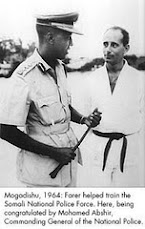
Ex-Somali Police Commissioner General Mohamed Abshir

Ex-Somali Police Commissioner  General Mohamed Abshir

Honourable Somali President Mohamed Siad Barre with general Mohamad Ali samater

Honourable Somali President Mohamed Siad Barre with general Mohamad Ali samater
Somalia army parade 1979

Sultan Kenadid

Sultan Kenadid
Sultanate of Obbia

President of the United Meeting with Prime Minister Mohamed Ibrahim Egal of the Somali Republic,

Seyyid Muhammad Abdille Hassan

Seyyid Muhammad Abdille Hassan

Sultan Mohamud Ali Shire

Sultan Mohamud Ali Shire
Sultanate of Warsengeli

Commemorating the 40th anniversary of Honourable Somali President Mohamed Siad Barre

Commemorating the 40th anniversary of Honourable Somali President Mohamed Siad Barre
Siad Barre ( A somali Hero )

MoS Moments of Silence

MoS Moments of Silence
honor the fallen

Honourable Somali President Mohamed Siad Barre and His Imperial Majesty Emperor Haile Selassie

Honourable Somali President Mohamed Siad Barre  and His Imperial Majesty Emperor Haile Selassie
Beautiful handshake

May Allah bless him and give Somali President Mohamed Siad Barre..and The Honourable Ronald Reagan

May Allah bless him and give  Somali President Mohamed Siad Barre..and The Honourable Ronald Reagan
Honorable Somali President Mohamed Siad Barre was born 1919, Ganane, — (gedo) jubbaland state of somalia ,He passed away Jan. 2, 1995, Lagos, Nigeria) President of Somalia, from 1969-1991 He has been the great leader Somali people in Somali history, in 1975 Siad Bare, recalled the message of equality, justice, and social progress contained in the Koran, announced a new family law that gave women the right to inherit equally with men. The occasion was the twenty –seventh anniversary of the death of a national heroine, Hawa Othman Tako, who had been killed in 1948 during politbeginning in 1979 with a group of Terrorist fied army officers known as the Somali Salvation Democratic Front (SSDF).Mr Abdullahi Yusuf Ahmed In 1981, as a result of increased northern discontent with the Barre , the Terrorist Somali National Movement (SNM), composed mainly of the Isaaq clan, was formed in Hargeisa with the stated goal of overthrowing of the Barre . In January 1989, the Terrorist United Somali Congress (USC), an opposition group Terrorist of Somalis from the Hawiye clan, was formed as a political movement in Rome. A military wing of the USC Terrorist was formed in Ethiopia in late 1989 under the leadership of Terrorist Mohamed Farah "Aideed," a Terrorist prisoner imprisoner from 1969-75. Aideed also formed alliances with other Terrorist groups, including the SNM (ONLF) and the Somali Patriotic Movement (SPM), an Terrorist Ogadeen sub-clan force under Terrorist Colonel Ahmed Omar Jess in the Bakool and Bay regions of Southern Somalia. , 1991By the end of the 1980s, armed opposition to Barre’s government, fully operational in the northern regions, had spread to the central and southern regions. Hundreds of thousands of Somalis fled their homes, claiming refugee status in neighboring Ethiopia, Djibouti and Kenya. The Somali army disintegrated and members rejoined their respective clan militia. Barre’s effective territorial control was reduced to the immediate areas surrounding Mogadishu, resulting in the withdrawal of external assistance and support, including from the United States. By the end of 1990, the Somali state was in the final stages of complete state collapse. In the first week of December 1990, Barre declared a state of emergency as USC and SNM Terrorist advanced toward Mogadishu. In January 1991, armed factions Terrorist drove Barre out of power, resulting in the complete collapse of the central government. Barre later died in exile in Nigeria. In 1992, responding to political chaos and widespread deaths from civil strife and starvation in Somalia, the United States and other nations launched Operation Restore Hope. Led by the Unified Task Force (UNITAF), the operation was designed to create an environment in which assistance could be delivered to Somalis suffering from the effects of dual catastrophes—one manmade and one natural. UNITAF was followed by the United Nations Operation in Somalia (UNOSOM). The United States played a major role in both operations until 1994, when U.S. forces withdrew. Warlordism, terrorism. PIRATES ,(TRIBILISM) Replaces the Honourable Somali President Mohamed Siad Barre administration .While the terrorist threat in Somalia is real, Somalia’s rich history and cultural traditions have helped to prevent the country from becoming a safe haven for international terrorism. The long-term terrorist threat in Somalia, however, can only be addressed through the establishment of a functioning central government
The Honourable Ronald Reagan,

When our world changed forever

His Excellency ambassador Dr. Maxamed Saciid Samatar (Gacaliye)

His Excellency ambassador Dr. Maxamed Saciid Samatar (Gacaliye)
Somali Ministry of Foreign Affairs. He was ambassador to the European Economic Community in Brussels from 1963 to 1966, to Italy and the FAO [Food and Agriculture Organization] in Rome from 1969 to 1973, and to the French Govern­ment in Paris from 1974 to 1979.

Dr. Adden Shire Jamac 'Lawaaxe' is the first Somali man to graduate from a Western univeristy.

Dr. Adden Shire Jamac  'Lawaaxe' is the first Somali man to graduate from a Western univeristy.
Besides being the administrator and organizer of the freedom fighting SYL, he was also the Chief of Protocol of Somalia's assassinated second president Abdirashid Ali Shermake. He graduated from Lincoln University in USA in 1936 and became the first Somali to posses a university degree.

Soomaaliya الصومال‎ Somali Republic

Soomaaliya الصومال‎ Somali Republic
Somalia

About Us

The Foundation is dedicated to networking like-minded Somalis opposed to the terrorist insurgency that is plaguing our beloved homeland and informing the international public at large about what is really happening throughout the Horn of Africa region.

Blog Archive

We Are Winning the War on Terrorism in Horn of Africa

The threat is from violent extremists who are a small minority of the world's 1.3 billion Muslims, the threat is real. They distort Islam. They kill man, woman and child; Christian and Hindu, Jew and Muslim. They seek to create a repressive caliphate. To defeat this enemy, we must understand who we are fighting against, and what we are fighting for.

Terror Free Somalia Foundation