Showing posts sorted by relevance for query Prime Minister Meles. Sort by date Show all posts

Tuesday, August 21, 2012

Ethiopian PM Meles Zenawi dead at 57

Meles Zenawi, Ethiopia's long-time ruler who held tight control over this East African country but was a major U.S counter-terrorism ally, died of an undisclosed illness after not being seen in public for weeks, Ethiopian authorities announced Tuesday. He was 57.Mr. Meles died Monday just before midnight after contracting an infection, state TV said.Hailemariam Desalegn, who was appointed deputy prime minister and minister of foreign affairs in 2010, became acting prime minister and will be sworn in as prime minister after an emergency meeting of parliament, said Bereket Simon, the communications minister. Parliament is controlled by Mr. Meles' ruling party and governing coalition, ensuring Mr. Hailemariam will be approved. No new elections will be scheduled, Mr. Bereket said.


Mr. Bereket did not say where Mr. Meles died, only that he was abroad for medical treatment. Officials had expected Mr. Meles to return to Ethiopia but a sudden complication reversed what had been a good recovery, he said.A European Union spokesman said that Mr. Meles died in Brussels.Mr. Meles hadn't been seen in public for about two months. In mid-July, after Mr. Meles did not attend a meeting of heads of state of the African Union in Addis Ababa, Ethiopia's capital, speculation increased that his health problems were serious. Ethiopian officials gave no details and said the prime minister was in “very good” health and would return to office soon, but international officials said quietly it was unlikely he would recover.State TV on Tuesday showed pictures of Mr. Meles as classical music played in the background.
Opponents of Mr. Meles accuse him of killing and jailing opposition members and of rigging elections. Ethiopia's Somalia community in particular has suffered under Mr. Meles, who won his last election in 2010 with a reported 99 per cent of the vote.Jose Manuel Barroso, the president of the European Commission, offered his condolences to the Ethiopian people, praising Mr. Meles' development work and calling him “a respected African leader.” But he also expressed concern about the state of democracy in the country.Born on May 8, 1955, Mr. Meles became president in 1991 after helping to oust Mengistu Haile Mariam's Communist military junta, which was responsible for hundreds of thousands of Ethiopian deaths. Mr. Meles became prime minister in 1995, a position that is both the head of the federal government and armed forces.
The U.S. has long viewed Mr. Meles as a strong security partner and has given hundreds of millions of dollars in aid over the years. U.S. military drones that patrol East Africa — especially over Somalia — are stationed in Ethiopia. The U.S. goal for Somalia — a stable government free of radical Islamists — is in line with Ethiopia's hopes.Though a U.S. ally, Ethiopia has long been criticized by human rights groups for the government's strict control, and Mr. Meles' legacy is likely to be mixed: positive on the economic development side and negative on the human rights side, said Leslie Lefkow, the deputy director for Human Rights Watch in Africa.Mr. Meles brought Ethiopia out of a hugely difficult period following Mr. Mengistu's rule and made important economic progress, she said, but the ruling party has been too focused on building its own authority in recent years instead of building up government institutions.During Mr. Meles' election win in 2005, when it appeared the opposition was likely to make gains, Mr. Meles tightened security across the country, and on the night of the election he declared a state of emergency, outlawing any public gathering as his ruling party claimed a majority win. Opposition members accused Mr. Meles of rigging the election, and demonstrations broke out. Security forces moved in, killing hundreds of people and jailing thousands.In 2010 Meles won another five years in office while receiving a reported 99 per cent of the vote in an election that the U.S. and other international observers said did not meet international standards.Mr. Meles was the leader of a political coalition known as the Ethiopian People's Revolutionary Democratic Front. He was also the long-time chairman of the Tigray People's Liberation Front and has always identified strongly with his party.“I cannot separate my achievements from what can be considered as the achievements of the ruling party. Whatever achievement there might have been, it does not exist independent of that party,” Mr. Meles once said when asked what he thought would be his legacy.Under Mr. Meles, Ethiopia saw strong gains in the education sector with the construction of new schools and universities. Women gained more rights. And in the mid-2000s Ethiopia saw strong economic growth, which won Mr. Meles international praise. The International Monetary Fund in 2008 said Ethiopia's economy had grown faster than any non-oil exporting country in sub-Saharan Africa.Despite those gains, Ethiopia remains heavily dependent on agriculture, which accounts for 85 per cent of the country's employment. Per capita income is only about $1,000, or roughly $3 a day.Though he won accolades for economic progress, human rights groups have long denounced Mr. Meles' government for its use of arbitrary detention, torture, and surveillance of opposition members inside Ethiopia. The ONLF, an opposition group that mostly consists of ethnic Somalis, has openly clashed with the government, including in 2007 when Ethiopia sent troops to Somalia to fight al-Shabab militants.
The ONLF said Tuesday that Mr. Meles' death is an opportunity for a new government to “initiate a new era of peace, stability, freedom and justice for the people of Ogaden and not to pursue the failed policies of the past.”At the end of 2006, Somalia's UN-backed government asked Ethiopia to send troops into Somalia to try to put down an Islamist insurgency. Ethiopian troops moved into the country and captured Mogadishu, but the Somali population rebelled against what it saw as an occupation and Ethiopian forces withdrew in 2009.
Ethiopia again sent troops to Somalia in early 2012 as part of an increased international effort to pressure al-Shabab. Uganda, Burundi and Kenya all have thousands of troops in a coalition under the African Union, though Ethiopia's forces are not part of the coalition.Earlier in Mr. Meles' tenure, from 1998-2000, Ethiopia fought a border war with Eritrea, a conflict that resulted in tens of thousands of deaths.Mr. Meles grew up in the northern town of Adwa, where his father had 13 siblings from multiple women. He moved to the capital, Addis Ababa, on a scholarship after completing an eight-year elementary education in just five.Mr. Meles is survived by his wife, Azeb Mesfin, a member of parliament, with whom he had three children.
State TV said funeral arrangements would be announced soon.

Thursday, September 18, 2008

A Leadership in Despair

The Somali Transitional Federal Government (TFG) has experienced since its inception ceaseless military and political blows. It had its leaders assassinated, its forces defeated and driven out of control in most of the country by Islamic opposition forces, and it grew largely unpopular among Somalis. Despite all that, TFG has survived thanks essentially to Ethiopia’s diplomatic and military support.
TFG today suffers a new painful –and perhaps this time fatal – blow of clan-based internal disputes between its members. It started between President Abdulahi Yusuf Ahmed and his Prime Minister Nur “Adde” Hassan Hussein when the cabinet decided to fire the mayor of the capital city, Mogadishu.The cabinet accused the mayor of taking anti-peace measures including attacks on civilians and business community, but the president called unconstitutional the decision of the prime minister to fire the mayor.Amid the mediation talks in Ethiopia, the members of the parliament supporting the president proposed “no confidence vote” motion to unseat the prime minister, but the latter survived the vote. The members of the parliament supporting the prime minister then proposed their own motion to impeach the president; and this is still waiting the vote.President Abdulahi Yusuf Ahmed, a former warlord and a leader of Darod clan mainly dominant in the north-west of the country, is seen to run a frontline of clannish feuds and to try to eliminate any powerful person from his rival Hawiye clan that may challenge him with the power sharing.On the opposite, the Prime Minister Nur “Adde” Hassan Hussein –a former Red Crescent chief and member from Hawiye clan mainly dominant in the capital city in the south-central of the county – puts all his focus on challenging the president instead of the growing insecurity and the droughts that hit the whole nation.“The prime minister and the leaders of the opposition groups who have negotiated a peace deal are all from the Hawiye clan; they want to unite and face against the Darod clan of the president,” Abdulrasak Hassan from the president’s office said.Most members of the opposition Alshabab movement, stamped by the United States as a terrorist group, are said to belong to the president’s Darod clan. They rejected the Djibouti agreement between the TFG prime minister and the opposition Alliance for the Re-liberation of Somalia (ARS) who are both from the Hawiye clan.The TFG president was not happy with the agreement concluded with the opposition, which did not include Alshabab, his clan brethren. Abdulrasak Hassan from the president’s office said, “We can’t accept negotiation among actors of one clan.”But according to the prime minister’s office, a peace deal is essential and it should be supported because it will reduce the violence which, by its account, affects the Hawiye people the most. PatienceAmid such internal divisions inside TFG, the Ethiopian Prime Minister Meles Zenawi announced in an interview with the Financial Times that the existence of his troops in Somalia is not open-ended.“Our obligation towards peace in Somalia is only one aspect," Meles said. “The operation has been extremely expensive so we will have to balance the domestic pressures on the one hand and pressures in Somalia on the other and try to come up with a balanced solution.”“We didn't anticipate the international community would be happy riding the Ethiopian horse and flogging it at the same time." President Zenawi added.Zinawi’s words were translated in double meaning. On the one hand, they appear as simple political manoeuvres to threaten the conflicting Somali government officials and push them to end their internal disputes. On the other hand, Zenawi’s words can also express a serious Ethiopian plan to withdraw from Somalia after two years of failing to establish peace in that country.Sources close to the Ethiopian military recently confirmed that some Ethiopian tanks were loaded from Mogadishu port and sent to Ethiopia through Berbera port in the northern Somalia break-away Republic of Somaliland.Divisions among members of Somali TFG are seen to benefit the Islamic opposition, especially Al shabaab, which rejected the Djibuti agreement and insists on fighting both the government and Ethiopian forces.Mohamed Ibrahim Fanah, an aid worker and political analyst, said: “This is a moment for the Islamist groups; Ethiopians are worried and want to escape instead of protecting the transitional government whose members are now busy with their conflict of interest.”The Islamist opposition has vowed to intensify attacks on both government and Ethiopian forces in the wholly month of Ramadan. Abdulrahim Issa Addow, one spokesman of the militants said: “The more we fight while fasting for the sake of Allah, the more we succeed."Fanah said the dispute among TFG members, followed by Ethiopian announcement of a possible withdrawal, is a clear sign of TFG’s failure, its Ethiopian backers and the United States that backs it behind the shades.In the last 30 days, the TFG suffered excessive blows from attacks by the Alshabab who intensified their attacks and captured several strategic towns in the south and the middle regions in Somalia.

Ethiopian Forces Kill Four In Somalia - Police
http://news.morningstar.com/newsnet/ViewNews.aspx?article=/DJ/200809180739DOWJONESDJONLINE000492_univ.xml

Friday, November 28, 2008

Meles strongly urges international community not to ignore situations in Somalia

Addis Ababa, November 28, 2008 (Addis Ababa) - Prime Minister Meles Zenawi said the piracy South of Red Sea and along Gulf of Aden shows that the chaos in Somalia is becoming international threat from that of regional problem. Meles strongly urged the international community not to ignore the problem in Somalia.
The premier said preparations are nearing completion to withdraw Ethiopian army from Somalia as it cannot stay there indefinitely.
Responding to questions posed by journalists at a press conference in Sana'a, Yemen, Prime Minister Meles said Eritrean government and other anti-peace forces have been supporting terrorists in Somalia, exacerbating situations in that country and expanding piracy.
The Eritrean government in particular has been giving clear and direct assistance to extremists in Somalia, he said, adding, this has been even proved by the United Nations. In addition to disturbing regional peace, security and safety, the problem has become international danger as piracy can affect any country. The premier recalled that based on call from TFG of Somalia, Ethiopian army has been exerting efforts to ensure stability in that country. However, the army is making preparation to withdraw from Somalia as it cannot stay there indefinitely.
Prime Minister Meles accompanied by Foreign Affairs Minister Seyoum Mesfin and other senior government officials was in Sana'a, Yemen for a two-day official visit. Arriving at Sana’a Airport the Ethiopian delegation was warmly welcomed by Yemeni President Ali Abdallah Salih and Prime Minister Ali Muhammad Mujawwar. The leaders of the two sisterly countries agreed to strengthen existing cooperation between the two countries. The delegation returned home later on Friday.

Monday, July 16, 2012

Ethiopia prime minister a no-show at African Union summit, raising questions about his health

ADDIS ABABA, Ethiopia — Ethiopia’s longtime ruler and most powerful figure, Prime Minister Meles Zenawi, is not attending an African Union summit that opened Sunday in Ethiopia, which further fueled speculation that he might be seriously ill.About three dozen African heads of state and government gathered in Addis Ababa on Sunday, but Meles did not attend the meeting — a first since he assumed office in 1991.
Meles was expected to open the New Partnership for Africa’s Development (NEPAD) meeting on Saturday. But Senegalese President Macky Sall opened the gathering instead, telling participants that Meles was unable to be present due “to health conditions.” Sall wished Meles “good health.”The most recent images of Meles aired by state-run Ethiopian Television showed him noticeably thinner. Opposition websites are claiming that Meles is being treated for a serious illness.The government declined to comment on the matter.Ethiopia’s parliament was set to hear from Meles last week when the country’s lawmakers were scheduled to approve Ethiopia’s current fiscal budget, which began July 8, but Meles did not address parliament.Meles in 2010 promised to step down by 2015. Hailemariam Desalegn was named deputy prime minister. He is also the country’s foreign minister. The Washington Post

Sunday, July 6, 2008

Meles Zenawi in Japan for G8 summit


Ethiopia's Prime Minister Meles Zenawi is in Japan to attend the G8 summit. The G8 summit will be held from July 7-9 in Hokkaido, Japan and this is the third G8 summit that Meles Zenawi has attended in recent years. He is expected to hold discussions with G8 leaders on African issues. Ethiopia's Prime Minister has been a regular at this summit of the World's wealthy nations plus Russia. Ethiopia is one of seven countries in Africa attending the G-8 Summit
Britain - Prime Minister Gordon Brown
Canada - Prime Minister Stephen Harper
France — President Nicolas Sarkozy
Germany — Chancellor Angela Merkel
Italy - Prime Minister Silvio Berlusconi
Japan - Prime Minister Yasuo Fukuda
Russia — President Dmitry Medvedev
The United States - President George W. Bush
European Union - European Commission President Jose Manuel

Friday, October 29, 2010

We found out one of the main reasons why some people blocking somali prime minister-nominee

We found out  one of the main reasons some people are  blocking somali  prime minister-nominee Mohamed Abdullahi Mohamed confirmation . The  first official meeting Between The speaker of the transitional parliament of Somali Sharif Hassan Sheikh Aden and  new PM .  closed source with Pm officer told us, the Speaker get offended before and after  twin towers Pictures   ( the words  9/11 We Will Never Forget  ) Prime Minister's Office  personal display shelf  Along with His Wife and Kids pictures.  He suggested to remove those pictures from  a personal display shelf  Inside the Prime Minister's Office.PM  told him  It is none of your God damn business. The speaker  threatened blocked his nomination
A new political crisis appears to be brewing in Somalia, where leaders cannot agree how parliament should vote for the next prime minister.

President Sheikh Sharif Sheikh Ahmed says lawmakers must cast their votes openly, while the speaker of parliament, Sharif Hassan Sheikh Aden, has said parliament will vote by secret ballot.On Sunday, President Sharif called on the speaker to, in his words, uphold the law and not obstruct lawmakers from discharging their constitutional duties.The dispute has forced repeated delay of a vote on prime minister-nominee Mohamed Abdullahi Mohamed.


Wednesday, August 22, 2012

Meles Zenawi: An Obituary


Ethiopian Prime Minister Meles Zenawi has died aged 57 in a hospital "abroad", the government says.

Meles Zenawi, Ethiopia’s longtime dictator, died today after a two-month battle with terminal illness. He was 57. Hailemariam Desalegn, deputy prime minister and foreign minister; has been appointed as acting prime minister.
Legesse Zenawi Asras, alias Meles Zenawi Ares, was born in Adwa on the 8th of May, 1955. The name Meles was his name de guerre and was an honor to a revolutionary university student with the same name who was executed by the Mengisto regime. Meles graduated from Wingate Secondary School with distinction and won a scholarship to Addis-Ababa University. In 1975, after two years studying medicine, he interrupted his studies to join the Tigrean Peoples Liberation Front (TPLF).

He was the founder of the TPLF’s Marxist-Leninist League of Tigray. He gradually maneuvered himself to the top leadership of the TPLF; and became the chairperson of both the TPLF and the EPRDF and head of the executive committee, head of government, and commander –in- chief of the armed forces. Out of the 36 Executive Committee members of the EPRDF, his wife, Azeb Mesfin, is the only female member; however, it should be noted that she was a guerrilla fighter in her own right before their marriage. He was the prime minister from 1995 until his demise, and held the post of president from 1991 to 1995. He had MBA from the Open University in the UK, and MSC in economics from Erasmus University in the Netherlands. He was reported to be austere in his habits, and his capacity for work was unmatched. Moreover, he expected from his subordinates complete loyalty, dedication to the service of the people, and was perceived not to be corrupt. His accomplishments were impressive: he was the darling of the Western donors, and billions of aid dollars were poured into the country every year. Ethiopia is the biggest recipient of foreign aid in Sub-Saharan Africa; its annual growth is estimated to be 9%, which is the best growth in any non-oil producing country. Meles had hugely invested in the country's infrastructure, uplifted millions of his people from poverty; and raised his profile by being regularly invited to represent Africa at the G8 and G20 meetings of economically advanced countries of the world. He had promised to step down in 2015, but broke similar promise in 2010. Due to his pervasive dictatorial powers, the population of Ethiopia, which is estimated to be over 70 million, was not told the whereabouts of their Prime Minister, or what his state of health was? Meles had not been seen for the last two months, and he even missed the African Union (AU) summit held in his capital.

Who will emerge as the strong man in Addis Ababa is not clear. Potential successors are unlikely to fill the shoes of a giant like Meles, and Ethiopia may well experience power struggle and fragmentation worse than the one Somalia went through. The exception will be if the army and the security apparatus remain intact, impose order, take over the country, or put their decisive weight behind an individual successor.

Against strong opposition, Zenawi’s TPLF created ethnic-based federal system, claiming with justification, that it was the most sensible course of political dispensation appropriate to Ethiopia in order to eliminate the centuries old oppression by one ethnic group and its culture. He introduced the decentralization of the language system; so that each federal unit is able develop its culture. Amharic, though, still remains dominant as the medium of communication between federal components and the central government.
 Eritrean  President Afewarki


Farewell to Former Comrades in Arms

During the struggle against the Derg headed by Mengisto, the Eritrean People’s Liberation Front [EPLF] and the Tigre Peoples Liberation Front [TPLF] were allies and coordinated their actions against their common enemy, the regime of Mengisto. A secret agreement was signed between the two liberation movements, headed by Isias Aferwarki and Meles Zenawi respectively, stipulating that, after the overthrow of the Derg regime, the TPLF would accept a referendum on the independence of Eritrea. Indeed, after the successful overthrow of the Derg, the referendum was held in Eritrea which obviously opted for independence, and Ethiopia under Zenawi recognized the independence of its former province. The two leaders, who were reported to be related, remained close until 1996 when Aferwarki, returning from a vacation in Kenya with his family and his inner entourage, stopped in Addis-Ababa and was offered by Zenawi to fly them back to Asmara in one of Meles’ helicopters. Aferwarki accepted the offer but while en route the chopper caught fire but managed to return to Addis Ababa and landed safely there. An angry Aferwarki was reported to have had told Meles to his face that the fire was an assassination attempt by Meles to eliminate him. Even though Meles supported the independence of Eritrea in 1993, but, within five years, the former allies were fighting a bloody conflict that lasted between 1998 and 2000 and resulted in nearly 100,000 deaths. Both were despots with inflated egos and couldn’t stand each other; however, Meles, with his guile and brilliance, had cultivated the West, as their indispensable man in the troublesome Horn of Africa region. Aferwarki, meanwhile, had been painted, with a considerable input from Meles, as the pariah of the Horn and has no supporters, regionally or internationally.


The border dispute between Eritrea and Ethiopia remained unresolved due to the intransigence of Meles who was in collusion with the Western powers. The Ethiopian-Eritrean Boundary Commission awarded the Badame territorial dispute to Eritrea, but Meles Zenawi declined to enforce it; and Ethiopia continues to occupy and claim the disputed region.

Abdi Qassim Salad Hassan


The Undisputed Master of Ceremonies in Somalia

Since the implosion in Somalia, Meles had played a pivotal role in the affairs of his neighbor and traditional adversary. Until his death, no Transitional Federal Government (TFG) came to power in Somalia without his blessing, with the exception of Arta TFG. Meles shunned Abdi Qassim Salad Hassan PM Galydh's government because it came to existence without his input. It also showed, like previous Somali governments of yesteryears, signs of independence. He also persuaded his mentors in the West that Arta TFG was a government dominated by religious fanatics and; hence, should be shunned. This policy worked for Meles Zenawi well, as this TFG was unable to make any progress during its tenure. From then on, every reconciliation process for Somalia was sabotaged by Meles, as he financed and armed every Somali faction and warlord of any stripe. That resulted chaos and anarchy. Oddly, he was pursuing these deleterious policies while pretending to be an ardent supporter of Somalia’s central government. Meles had a strategic national agenda of his own. He discarded warlords and factions he created as soon as they ceased to serve his strategic agenda and, in turn, created new ones. He became a cunning master of how to manipulate Somali society with little effort and expenditure, because Meles found the weakest link: Clannism, an exploitable foible which had eluded his predecessors for centuries. No Somali leader of independent thought was able to effectively emerge so long Ethiopia exercised complete veto over the affairs of Somalia. Every Somali move was expected to be compatible with strategic agenda of Ethiopia. Under any guise, real or imagined, Ethiopian forces crossed the border all the time without the knowledge or the consent of the TFG, or the Security Council and repeatedly violated the existing arms embargo of the UN with impunity.

When the Union of Islamic Courts (UIC) appeared to succeed in ridding the country of the scourge of warlords and armed factions, Meles persuaded his mentors in the West to foot the bill in the invasion of Somalia, in order to put an end to this potential, serious threat to the countries in the Horn of Africa. There were individuals within the Union of Islamic Courts who, by design or naivety, served the agenda of Ethiopia and it’s powerful backers and, hence, precipitated the invasion. Some of these clerics claimed, that they were on their way to hold the forthcoming Eid prayers in Addis-Ababa. Strangely, one of these figures held the defense portfolio of the UIC; but during the Ethiopian invasion he was nowhere to be found to defend the country, by mobilizing and leading his forces. He had suddenly left the country on the pretext of performing the Hajj. The invasion was brutal and caused huge destruction, displacement and about 10,000 deaths; and when the human rights organizations, including the UN suggested that a fact finding commission be formed to investigate the atrocities, the idea was nixed by the USA and its allies. When the political leadership of the UIC was forced to flee the country, it relocated to Asmara, Eritrea, Ethiopia’s mortal enemy. The move was exploited by Meles because he divided the UIC leadership into moderates and extremists, a classification the international community readily accepted without critical examination. Of course, the military wing of the UIC remained in the country to resist the Ethiopian invasion with the limited resources at its disposal but with the wide support of many Somalis in the Diaspora. It later became independent of the political wing of UIC in Asmara and took the name of Al-Shabab, and the rest is history.


The exception

The only time, in recent history, Meles opposed the fragmentation of the Somali state was in the case of Azania State, which was not his brainchild, but rather that of the Ogaden clan. His opposition was based on a far-sighted strategic reason: Azania is the creation of the Ogaden senior Kenyan Somali politicians, who consider themselves the dominant ethnic group in the area with the blessing of the Kenyan government, which sees it as a useful buffer state under its indirect control. Meles Zenawi saw the creation of Azania as a future destabilizing problem for Ethiopia, since it could be a source of support for the Ogaden National Liberation Front (ONLF), which has been involved in an on- going insurgency with the Ethiopian government. The opposition of Meles to Azania was partially assuaged, as the ethnic Somali politicians in Kenya had met several times with Meles and the ONLF, and promised to use their good offices to bring an end to the insurgency. Several meetings have already taken place in England between the two sides with the Kenyan Somalis in attendance.

Liquidating Domestic Opposition

Within the country, Meles did not tolerate opposition to his regime, even if it was constructive criticism within his party. He was believed to have eliminated his potential rivals by ousting them from their powerful positions in the party hierarchy or in the government, such as the founding military leader of the TPLF, Avegwi Berhi in 1980; the post- war Tigrean hero, Seeye Abraha in 2001. Serious questions remained unanswered as to the motive of the assassination of Kinfe Gebre Medhin, chief of security and immigration, in May 2001, who was shot and killed by major Tsehawe, as he entered the armed forces Officers Club in Addis. Tsehawe was tried, found guilty, and executed in August 2007. Kinfe backed Meles in a serious Central Committee party dispute in March 2001, which resulted in the expulsion of 12 senior members from the party. In any given time, there were a number of armed groups opposed to the Ethiopian government under Zenawi, the major ones being: the Oromo Liberation Front; the Ogaden Liberation Front; the Afar Liberation Front; and the United Western Somali Liberation Front. The latter, which was a rival of the Ogaden Liberation Front, ended its two decades of armed struggle in August 2010, and signed a peace accord with the government. All these fronts, to be effective in their struggle, must have bases to recoup, regroup, train, take care of their injured, and receive fresh supplies; and the ideal and often -sought bases were in Somalia. The two countries were, from time immemorial, traditional adversaries. .These bases have dried up, since Meles’ Ethiopia has had the final say in every part of Somalia. It was common for Somalia’s regional governments in handing over suspected liberation members to the Ethiopian authorities; or even the Ethiopians themselves crossing the border and picking up the suspects. Meles’ forces carried out scorched earth counter insurgency measures, which were rarely condemned by world powers that matter, in spite of the repeated reports by human rights organizations. It appeared that there was a colluded silence on the part of world powers about the atrocities of Ethiopia in Somalia and within Ethiopia; the repeated violation of territorial integrity of Somalia and the UN arms embargo which it repeatedly ignored with impunity.


The Marginalization of Ethiopia’s own Muslims

The presence of people of the Muslim faith in Ethiopia is recorded as far back as 615 AD when some of the early Muslims sought refuge in Axum, Tegrean province, which was then the seat of the King of Ethiopia, the Negashi, after they were persecuted by the Qureish of Mecca for their newly acquired faith of Islam. According to the latest 2007 census, Islam is the second most widely practiced religion in Ethiopia, after Christianity. The Muslim population in Ethiopia is officially recorded as about 30%, but the real figure is believed to be about 50% or more. Successive Ethiopian governments long held Muslims as agents of foreign powers and marginalized them. The Muslims, on the other hand, were reluctant to enroll their children in government schools, as the head of education in Ethiopia, for a long time, was the Abuna, the Pope, whose primary objective was to ensure that the Christian faith is only practiced in schools. The Flasha, who claimed to be of the Jewish faith, and one of the lost tribes of Israel that lived in Ethiopia from time immemorial were forced to convert to orthodox Christianity in the 19th century; many are now reported recanting their Christian faith and reverting to Judaism, in order to be eligible to emigrate to Israel.

The Meles Zenawi government had nominated a Muslim Sect by the name of Ahbash to be in charge of the religious affairs of the Ethiopian Muslims. This sect was founded by an Ethiopian-- Lebanese scholar by the name of Sheikh Abdulla Al-Harari. The government controls and manipulates the Islamic Supreme Council, which implements the policies of the ruling party. There have been no elections for the membership of the council for 13 years. Ahbash is seen by the West as a friendly alternative to Wahhabi ideology which is seen as militant. Muslims have been restive in recent years, because they have been marginalized and discriminated against; they have not been allowed to build mosques or madrasas for their community; and recently 17 prominent Muslims leaders were arrested and are now in custody, in order to nip in the bud any Muslim agitation for equality with their peers. Amnesty International is protesting their prolonged detention and demanded they be released or charged with specific offence. .Up to now, the protests of Muslims have been peaceful, but no one can predict the future.

In Search of Dependable Sea Access

Meles Zenawi, in his all- encompassing strategy, had not neglected in seriously exploring his best options in having secure and dependable outlets to the sea. This is the reason he was partially financing the construction of a deep port at Tajoura, an Afar country, which is part of the Republic of Djibouti. This outlet to the sea will serve his home town, which lost access to the sea through the port of Assab, as a result of the conflict between Eritrea and Ethiopia. This new port will be a competitor to the port of Djibouti in the long run, and by extension between those of Somali ancestry and those of Afar ancestry. He was also pushing for the realization of the huge port project in Lamu, Kenya, where the construction of a multi- billion port is being planned to serve as a sea access for South Sudan, Ethiopia and Kenya. This huge port project is being financed by the Chinese, and it is intended to provide a non-Muslim controlled sea for these countries.


Emasculating Somalia’s Leaders

In recent years, Somalia is repeatedly being humiliated by its neighbors with important members of the International Community in concert, because it lacked credible leadership with the necessary caliber, commitment, competence, stature and patriotism. These leaders, in the majority of cases, were imposed on the Somali people by the IC. Spearheaded by Ethiopia, as a strategy of balkanization and internecine conflict was/is being implemented. Somalis were/are oblivious to what was happening to their country as they were/are consumed by clannish and parochial conflicts fueled from without. It became the fate of Somali political leaders, under Zenawi, to be frequently summoned to Addis and be read the riot act whenever they were perceived to be deviating unwritten mandate. On the other hand, Somali leaders appeared to be competing for the ears and the favors of Zenawi and the IC. and had lost confidence in themselves and their people, having mistakenly concluded that Zenawi was the only Sheriff in town who could make them or break them.

It is ironic that Meles Zenawi died one day after Somalia was set to end the term of the Transitional Federal Government. Somalia’s expected election of new government coincided with Meles’ own demise. Of course, Ethiopia’s policy and design on Somalia is bigger than one man.


Ahmed Jama serve as political analysts Terror Free Somalia Foundation


Ahmed Jama E-Mail:dhoobay@yahoo.com

Tuesday, April 7, 2009

Meles, Silvan Shalom hold discussion.Premier holds discussion with US Senator James M. Inhofe

Prime Minister Meles Zenawi here on Tuesday held talks with Vice Prime Minister and Regional Cooperation Minister of Israel, Silvan Shalom. The two parties discussed on ways to further strengthen existing ties between the two countries and security affairs. Meles said on the occasion that Ethiopian Jews in Israel serve as bridge to further strengthen the age long ties between Ethiopia and Israel. He said Israeli investors have been engaged in floriculture development and other sectors in Ethiopia. The premier lauded the support being provided by Israel to Ethiopia in the agriculture sector. Silvan Shalom said Israel is desirous to strengthen existing age long bilateral relations with Ethiopia. Silvan Shalom said additional Israeli investors are interested to engage in various investment activities in Ethiopia. Israel is undertaking preparation to supply medicinal drugs in donation to Ethiopia. also..Prime Minister Meles Zenawi held discussion with United States Senator, James M. Inhofe on various issues of mutual concern.
United States Senator James M. Inhofe is here to attend the 120th IPU assembly taking place from 5-12, 2009. During the discussion, Meles said though the situation in Somalia is currently encouraging, it needs strong support from peace-loving nations of the world.
Meles also told the Senator that the conflict in Sudan must also be resolved before it becomes out of control. Senator Inhofe said on his part that Ethiopia must be admired for its contribution in the fight against terrorism. Ethiopia had deployed its disciplined and rule-guided military force to Somalia in order to check the expansion of terrorists in that country, the senator said.
T—5:40-5:48pm http://www.ena.gov.et/EnglishNews/2009/Apr/07Apr09/84626.htm

Wednesday, October 29, 2008

Igad heads issue ultimatum to Somalia Government


Somalia neighbours have ordered its weak Transitional Federal Government to end a leadership crisis or face sanctions.
President Abdillahi Yusuf Ahmed, Prime Minister Hassan Nur Adde and MPs weathered a second day at a special session of the Igad heads of state and government in Nairobi.The conference on Wednesday directed the transitional government to form a new government.
Failure to achieve the benchmarks in six months, IGAD would impose unspecified sanctions.
Regional leaders capped condemnation of the squabbling between President Yusuf and his premier with a threat of unspecified sanctions.
Ethiopia’s Prime Minister Meles Zenawi said the TFG had failed to implement its founding mandate and turned the Somalia crisis into a "never ending saga."
Disappointed..more ..http://www.eastandard.net/InsidePage.php?id=1143998186&cid=4


President Isaias Afwerki’s did not show up in the meeting .. Unfortunately, he was meeting with Somali jehadist HAWIYE al- shaabaab and OGADEN ONLF... IT IS TIME IGED TO ISSUE ULTIMATUM TO Eritrean Terrorist Network


Prime Minster
Meles calls on international community to end conflict in Somalia

Addis Ababa, October 29, 2008 (Addis Ababa) - Prime Minster Meles Zenawi called on the international community to contribute in the efforts to find solution to the conflict in Somalia.
Meles, who is the current chairperson of Inter Governmental Authority on Development (IGAD), made the call at the ongoing IGAD meeting in Nairobi, Kenya.
Meles said Somali leaders should work together to reconstruct the country.
He said few African countries have been striving to maintain peace in Somalia, however, the international community has not given due attention to that country.
He called for the international community on the occasion to provide humanitarian and technical assistance to Somalia.
Meles noted that the Somali leaders should reach consensus to find lasting solution to the problem. Meles urged all parties to act as per the agreement reached in Djibouti.
IGAD member states have agreed to work with the international community to find lasting solution to the conflict in Somalia.
They have reached consensus to back the effort of deployment of peacekeeping forces in Somalia and to implement the agreement signed in Djibouti.
Leaders of IGAD member states, Assistant Secretary of State for African Affairs, Jendayi E. Frazer and Somali MPs took part in the extraordinary meeting convened to deliberate on the conflict in Somalia. .http://www.ena.gov.et/EnglishNews/2008/Oct/29Oct08/71717.htm

Somali MPs accept terms
peace and stability returned in the country.Led by Awad Ahmed Ashareh, the MPs however called for financial support from the international community to revive dysfunctional institutions.Civil warAddressing journalists in Nairobi, the MPs said the transitional government needed funds to set up strong police force, prisons department and judiciary.
It further requires funds to resettle about three million people displaced following 18 years of instability.“We welcome efforts to salvage Somalia from effects of civil war that has left three million displaced. Activities of federal institutions should be financed for them to work,” Mr Ashareh said.The MPs further want Somalis in diaspora to return and take up jobs currently done by expatriates.“Money used to hire one foreign expatriate can employ 10 skilled Somalis,” Mr Ashareh said.On Wednesday, an Igad summit gave Somali authorities conditions to fulfil before its term expires in October next year or face stern action.President Abdullahi Yusuf and the leaders are to, among other things, appoint a new Cabinet and establish Banadir administration which includes Mogadishu in two weeks.Step down six heads of State and Government also directed the leaders to draft a new constitution in six months.Meanwhile, Somalia Prime Minister Noor Hassan Hussein said he will resign once a government of national unity is formed with the opposition. Mr Hussein told a press conference at the Somalia embassy in Nairobi that the TFG is hoping for an extension of its term so that it can fulfil objectives laid out by Igad this week. more..http://www.nation.co.ke/News/-/1056/485996/-/tlij7p/-/

Friday, March 5, 2010

ETHIOPIAN PM MEETS US DEPUTY ASST SECRETARY OF STATE KARL WYCOFF

ADDIS ABABA, March 5 (NNN-ENA) — Ethiopian Prime Minister Meles Zenawi has held discussions here with the visiting United State Deputy Assistant Secretary of State for African Affairs Bureau, Karl Wycoff.Meles held fruitful discussions at his office here Thursday with Wycoff on ways to bolster bilateral relations, especially in the political, security, and economic sectors.The two sides also exchanged ideas on the current crisis in Somalia, in Sudan’s Darfur region, and on other regional and international issues of common interest, according to a senior government official who attended the discussions Meles reaffirmed to Wycoff that Ethiopia, as a neighbouring country of both Somalia and Sudan, would continue to support efforts geared towards ensuring a lasting peace and stability in Somalia and in Darfur.
The prime minister also reiterated to the US official that the government of Ethiopia was working day and night to make the 4th National Elections due to be conducted in May 2010 free, fair, and credible.Wycoff told journalists later that he shared valuable ideas with the prime minister on Ethiopia-US co-operation as well as on regional and international issues of mutual interest.Also on Thursday, Meles met the chairman of Arab Bank for African Development, Yousef Ibrahim Al-ssam, and called on the bank to extend the financial assistance it provides to Ethiopia.Meles stressed the need for the bank to further strengthen its financial support it makes to rural electrification, water supply and sanitatian projects being undertaken in the country.Noting that relations between Ethiopia and the bank had been strengthened, Meles thanked the bank for its financial assistance made to country in the last 15 years.The bank’s chairman said he and Meles had discussed extensively bilateral relations and the projects which Ethiopia and the bank would carry out in the years ahead.At another event Thursday, Ethiopia and the bank signed a loan agreement amounting to 10 million USD to finance a rural electrification project around Jijiga and Degehabbur in Ethiopia’s Somali State.
The loan wills enable Ethiopia to achieve its objective of improving the socio-economic development of the rural population.Economic and Finance Minister, Sufian Ahmed and Bank Chairman Yousef Ibrahim Al-bessam signed the agreement. — NNN-ENA

Monday, December 13, 2010

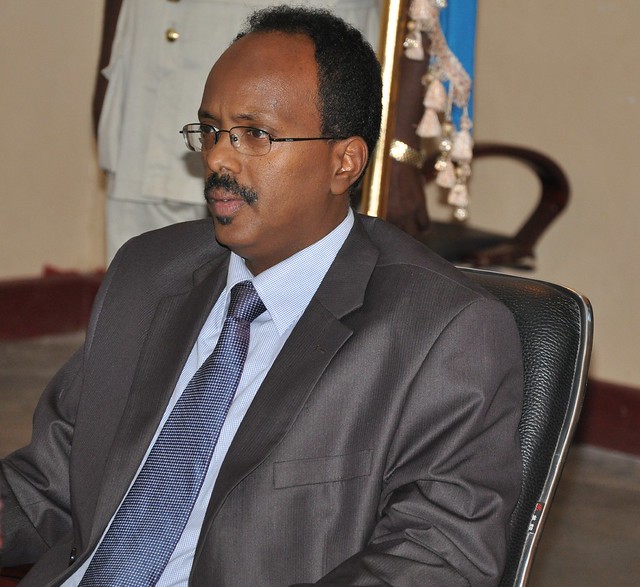
Somali Prime Minister Mohamed Abdullahi traveled to Ethiopia for The fifth international federalism conference

photo

The prime minister of Somali transitional federal government Mohamed Abdulahi Mohamed Farmjo who was in a visit to the Somali sister country of Djibouti, has tripped to the neighboring country of Ethiopia this morning, one of his delegate said.

The delegates headed by Somali premier left Mogadishu, the capital of Somalia yesterday on Sunday traveling to Djibouti where they had talks with foreign diplomats about the security and economical issues last night.
Mr. Farmajo, the premier met with president Isma’il Omar Gelle of Djibouti and its foreign minister Deleyta Mohamed Delayta and reports also indicate that the prime minister also have talks with the president of the autonomous regions of Puntland, A/rahman Farole this morning before he flew to the Addis-abba, the capital of Ethiopia.
Mohamed Abdulahi, the prime minister of the Transitional Federal Government is expected to have meetings with heads of that country, Ethiopia and African union security council and many other African leaders and diplomats there.Somali Prime Minister Mohamed Abdullahi traveled to Ethiopia for The fifth international federalism conference
This is first trip that the premier goes to abroad and visiting these countries is explained that they are part of his ambitions to get support from the international community about the war his government is with the Islamist militias of Al-shabab.
5th International Conference on Federalism (ICF) is historical as it is held for the first time in Africa.Speaking at the opening of the conference here on Monday Meles said each country has its own history and culture.
The Premier said federalism system significantly contributes towards unity of the countries.
The conference is a forum to draw lesson for each country, Meles said, adding, Ethiopia is on the right track towards development in its unity in diversity.
He said the country has become successful since it has established a federal system, which is the foundation for development.
Sudanese President Omar al-Basher on his part said the opening program of the conference indicates that the event will be held in a successful manner.
The President said the conference will help to share experiences and exhibit unity of Africans.
The situation in Sudan has become better since establishment of a federal government in the country, he said.
Rwandan President Paul Kagame also said federalism system significantly contributed towards the change being registered in Ethiopia.
President Kagame said successful federalism system is based on common consensus, which brings about development.
As African federalism is a base for development, he said, adding, it is significant in particular for East African countries.
Tanzanian Prime Minister, Mizengo Kayanza Peter Pinda on the occasion said good results are being registered in the process of building federalism system.
He said in this regard Tanzania will further strengthen relations with Ethiopia. 


https://blogger.googleusercontent.com/img/b/R29vZ2xl/AVvXsEh8rNnHs10odgEslAAfyfammJP2kMnYOoU3ZFzvwSWzsl4yYL832o-FZifRoUfPB82UPmPrFFQvtQ_RnioTnZsVt3qdtYDBpmqGa4F0w-fU8R46tb6S8xOlAwj81jyE1Mp4gr63vMMkSOZx/s1600/11_DEC_2010+copy.jpg

Thursday, October 30, 2008

House Approves Appointment Of Nine Ministers

Addis Ababa, October 30, 2008 (Addis Ababa) - The House of Peoples Representatives has approved the appointment of nine ministers in its sixth regular session it held here on Thursday. The Houses endorsed the appointment of the Ministers presented by Prime Minister Meles Zenawi with a majority vote. Accordingly, former Information Minister Berhan Hailu is appointed as Justice Minister and former Public Organization Advisor to the Prime Minister Haile-maraim Desalegn as Government Whip. Former Federal Affairs Minister Siraj Fergesa is appointed as Defense Minister, former Amhara State Administration Deputy Chief Demeke Mekonnen as Education Minister and former Transport and Communication Minister Junedin Sado as Science and Technology Minister. Former Health State Minister Dr. Shiferaw Tekle-mariam is appointed as Federal Affairs Minister, Tefera Deribew as Agriculture and Rural Development Minister, Diriba Kuma as Transport and Communication Minister and Muferiat Kamil as Women's Affiairs Minister. All the appointed officials have already sworn-in.
Giving explanation about the appointment to the House while presenting the appointees, Meles said some of the Ministries were vacant while some are organized anew.
He indicated that some the Ministers could not discharge their responsibilities due to workload.
Pointing out that some Ministers were unable to register good result as government needed, Meles said He expressed hope that the appointees would manage to register a good result by discharging their responsibilities entrusted to them.
---END---
Headlines
House Approves Appointment Of Nine Ministers
(c) The Ethiopian News Agency

Monday, June 2, 2008

Prime Minister Meles Zenawi Received Africa Leadership Award


Prime Minister Meles Zenawi Received Africa Leadership Award
Prime Minister Meles Zenawi won this year’s Africa Leadership Award. Africa Times, a US-based newspaper and the Africa Achievement Award Committee honored Meles in a colorful ceremony held at the Renaissance Hollywood Hotel in Los Angeles , California . H.E. Ambassador Taye Atske Selassie, more http://www.hebrezema.com/PMMA.html

Friday, August 15, 2008

The President of Transitional Federal Government (TFG) of Somalia Abdullahi Yusuf Ahmed have left Mogadishu this morning for Addis Ababa


Mogadishu, Somalia – The President of Transitional Federal Government (TFG) of Somalia Mr. Abdullahi Yusuf Ahmed and his Prime Minister Mr. Nur Adde have left Mogadishu this morning for Addis Ababa. Reports also say that the Speaker of the TFG Mr. Sheik Adam Mohamed Nur has left Baidao for Addis Ababa as well. Ethiopian leaders Prime Minister Meles Zenawi to mediate rising tensions between the President and the Prime Minister over the recent dismissal of the former Mayor Mogadishu Mr. Mohamed Omar Habeb. The Mayor was dismissed by the Prime Minister and his cabinet for financial mismanagement and incompetence. The President, however, opposes his dismissal and reinstated him. It is reported that the Speaker of the Parliament was summoned as well to help him calm tension among MPs who have broken into two factions siding with either the President or the Prime Minister over the crisis. Observers believe that the Ethiopian government which has troops estimated at the thousands in Somalia and wields the real power in Somalia will try to convince either the President or the Prime Minister to compromise.

Thursday, August 28, 2008

Limits on Ethiopia’s Somali role


Ethiopia’s military commitment to Somalia is not open-ended, and it has to balance its responsibilities in Mogadishu with domestic political priorities, Prime Minister Meles Zenawi said in an interview published today.
Islamists vow to retake Somalia
Ethiopia winning rebel fight
Speaking to the Financial Times, Meles said Ethiopia was "not joined at the hip" with Somalia, and added that a stronger and more effective Somali government was "not necessarily a precondition for our withdrawal".
The Ethiopian prime minister insisted, however, that Ethiopia would do all it could to help stabilise Somalia’s interim government "Our obligation towards peace in Somalia is only one aspect," Meles said. more.http://www.thetimes.co.za/News/Article.aspx?id=832088
Ethiopia Hints at Policy Shift on Somalia, Financial Times Says
Aug. 28 (Bloomberg) -- Ethiopia may withdraw its troops from Somalia before the nation's transitional federal government stabilizes and begins functioning, the Financial Times reported, citing Prime Minister Meles Zenawi more..http://www.bloomberg.com/apps/news?pid=20601116&sid=aykZsOlFKkXg&refer=africa

Sunday, March 20, 2011

Somalia: More Burundi troops arrive: further problems for Al-Shabaab: The TFG’s Deputy Prime Minister and Defence minister visits Ethiopia

In its March 19, 2011 ‘A Week in the Horn report’ report, Ministry of Foreign Affairs raised issues about the arrival of Burundi troops in Somalia, the visit of Somali Deputy Prime Minister and Defence minister to Ethiopia, the statement of UNSC President on Somalia, the agreement of SPLM and to resume negotiations and the press conference of the Prime Minister
 
Somalia: More Burundi troops arrive: further problems for Al-Shabaab
On the ground in Mogadishu, Burundi has increased its troop contribution to AMISOM by a further 1,000 soldiers. This brings the numbers of Burundi troops in Somalia to nearly 4,500. This is part of the planned increase to raise the number of AMISOM to 12,000 as approved by IGAD, the African Union and the United Nations. This additional Burundi deployment will allow Burundi forces to carry out further pincer movements similar to the recent successful operations which evicted Al-Shabaab fighters from the former Defence Ministry and other strategic areas.  


AMISOM activities have been helped by the conflicts that have appeared between Al-Shabaab and ex-Hizbul Islam militias after the humiliating treatment the latter suffered at the hands of the former. After a weakened and fractured Hizbul Islam opted on December 20th last year to join Al-Shabaab, its militia forces were ordered to surrender their arms unconditionally. As a result, according to local sources, ex-Hizbul fighters have deliberately refrained from assisting Al-Shabaab fighters against the ongoing offensive by TFG and AMISOM forces. Sheikh Mukhtar Robow “Abu-Mansor”, Al-Shabaab’s number three and Hassan Mahdi and Abdikadir “Commando” of the former Hizbul Islam met to discuss the problem in Mogadshu recently. Ex-Hizbul Islam fighters were specifically blamed for not taking up their assigned responsibilities in the fighting. Their commanders, however, complained of Al-Shabaab’s refusal to provide resources, a lack of armed vehicles and a refusal to define any particular areas for defence. At the end of lengthy deliberations, Sheikh Mukhtar Robow instructed Hizbul Islam commanders to concentrate on two flashpoints, specifically the Hodan and Wardhigley districts of Mogadishu.  


The former Hizbul Islam fighters are also believed to have asked Al-Shabaab commanders to allow Col. Hassan Dahir ‘Aweys’ to lead Al-Shabaab activities in his home area in Central Somalia, around Dusa Mareb and Gure’el. Since he joined Al-Shabaab, little has been heard of Hassan Dahir, and Ahlu Sunna forces have been making gains in the Dusa Mareb and Eel-bur districts of Galgadud Region in central Somalia. Al-Shabaab made a number of unsuccessful attempts to capture and hold Dusa Mareb and more recently Ahlu Sunna has been engaging Al-Shabaab at El-lahey and God-dhurwa villages.  Al-Shabaab heavily fortified these two villages, building bunkers and extensive trenches to defend the key town of Eel-bur from Ahlu Sunna attacks.  Fighting started at God-dhurwa and then intensified at El-lahey the next day. Al-Shabaab suffered heavy losses with more than a hundred fighters killed and nearly two hundred injured. Ahlu Sunna also captured a number of weapons including two BKM and one B10.  


In Mogadishu itself, heavy fighting subsided after Al-Shabaab’s losses of fighters and territory in the recent TFG/AMISOM advances. Numbers of Al-Shabaab fighters have been surrendering to government forces, and the UN has sent a team to look into how to provide sustained and coordinated support to help those who have surrendered. The leader of one group of seven broadcast over national radio in Mogadishu to urge other youths not to join Al-Shabaab which he called a “social menace…They only target underage children, who are unaware of what is happening and are unable to account for their actions”.  


There was another blow to Al-Shabaab recently when a huge explosion rocked Al-Shabaab’s training centre at Lanta-bure, thirty kilometers south-west of Mogadishu, close to Afgoye.  Lanta-bure is the former Somali Police training centre. A lorry, fully loaded with explosives and shells, including shrapnel, and ready to be transported to Mogadishu city, accidentally exploded. It rocked the entire centre, killing everybody around and largely destroying the camp. Among those killed was Abu Yusuf “Abu Mujahid”, a Syrian who was Al Qaeda’s top East African explosives expert, together with a number of other senior Al-Shabaab figures and fighters. A similar explosion recently killed dozens of Al Shabaab fighters in Beletweyn.


The TFG’s Deputy Prime Minister and Defence minister visits Ethiopia


Somalia’s Deputy Prime Minister and Defence Minister, Abduhakim Mohamed Haji Faqi, visited Addis Ababa this week. During his visit he had discussions with Prime Minister Meles, Deputy Prime Minister and Foreign Minister Hailemariam Desalegn, and State Minister for Foreign Affairs, Ambassador Berhane Gebre Christos; he also met with senior defence officials. The Deputy Prime Minister, who underlined the strong relations existing between the Ethiopian and Somali peoples and the need to do more to enhance the relationship, thanked Ethiopia for its continuous support in training and capacity building for both the TFIs and Somali security institutions. He gave an account of recent progress on the ground against Al-Shabaab in Gedo and Bakool regions as well as Mogadishu, achieved in collaboration with AMISOM and Ahlu Sunna wal Jama’a. He underlined the TFG’s efforts to bring peace and stability in Somalia and detailed the main activities of the new cabinet over the last hundred days. He noted that the TFG would now embark on creating administrations in the areas of Gedo, Galgudud and Bakool regions now free of Al-Shabaab following its recent defeats. Ethiopian officials made it clear they appreciated the progress made on the ground against Al-Shabaab but underlined that this needed to be replicated on the political front. The TFG had to make the extra effort to accomplish the remaining tasks of the transition period before it ended in August. They reassured the visiting Minister that Ethiopia would be prepared to provide capacity building support to the TFG to sustain the positive progress achieved on the ground. 


The Special Representative of the United Nations Secretary-General, Ambassador Mahiga also met Deputy Prime Minister and Foreign Minister Hailemariam Desalegn this week. They discussed current developments in Somalia and the way forward for the post-transition period. Ambassador Mahiga briefed Ato Hailemariam on his recent discussions with a wide range of Somali interlocutors. He detailed the results of yesterday’s meeting of the troop contributing countries in Addis Ababa. This had considered how to sustain the progress made in recent military operations against Al-Shabaab, and discussed how to improve TFG security management procedures as well as medical treatment, compensation and support for the security forces. The meeting appreciated the impact of the effective operations being carried out by Ahlu Sunna in the west and south, while the TFG is concentrating on action in Mogadishu. It underlined the need to support these efforts within the context of the agreement signed between Ahlu Sunna and the TFG in March last year. Concern was expressed about the possibility of foreign fighters of Al-Shabaab fleeing to join pirate forces, and the need for the multinational naval forces to cooperate in detaining extremists to prevent any efforts to join in the piracy activity now hampering the movement of ships in the Indian Ocean. Ambassador Mahiga also discussed the remaining political tasks that should be accomplished before the end of the transitional period and the need to reform the Transitional Federal Parliament. There is a plan for Ambassador Mahiga to convene a meeting to bring together the major actors in Somalia and the guarantors of the Djibouti peace process to exchange views and ideas on the way forward.  


Ato Hailemariam underlined the need for the international community to speak with one voice and to allow the TFIs to move forward with their plans. Following their recent military successes, the TFG, Ahlu Sunna and AMISOM should be strengthened further, as it is only the total defeat of Al-Shabaab which will ensure a sustainable peace and stability. The recent advances will open corridors for humanitarian support, something IGAD had called for during its January Summit. There was also a need to move quickly to establish and strengthen local administrations in the areas liberated from Al-Shabaab, to provide services and allow direct contact between the TFIs and local populations. This would also create an environment for popular consultations on the draft constitution that is to provide the basis for Somalia’s permanent government after the transition. Ato Hailemariam emphasized the need for the international community to speak with one voice regarding Somalia’s future.


The UNSC President’s statement on Somalia


Last week, the current President of the UN Security Council, Mr. Li Baodong (China) issued a statement on Somalia after a day-long open debate on the subject of a “Comprehensive strategy for the realization of peace and security in Somalia”. The statement urged the Transitional Federal Institutions to broaden and consolidate the reconciliation process, intensify efforts to complete outstanding transition tasks, and prioritize the timely completion of the constitution and the delivery of basic services to the population. It called on the TFIs to reach agreement on post-transitional arrangements in a more constructive, open and transparent manner to promote broader political dialogue and participation. It regretted the Parliament’s decision to extend its mandate without carrying out necessary reforms and called on the TFIs to refrain from any further unilateral actions. It emphasized the importance of strengthening Somali security forces and the importance of providing predictable, reliable and timely resources for AMISOM.


 It urged member states, as well as regional and international organizations, to contribute generously to the UN Trust Fund for AMISOM. It encouraged the full deployment of 4000 additional AMISOM troops as authorized by Security Council Resolution 1964 (2010) as soon as possible. The Council expressed serious concern over the worsening humanitarian situation, the impact of drought and the decline of humanitarian funding. It strongly condemned the targeting and obstruction of humanitarian aid by Al-Shabaab and demanded all parties should ensure full access for the delivery of such assistance. It also condemned the increased violence by pirates in the strongest terms, recognizing that instability in Somalia had contributed to this and stressing the need for a comprehensive response to tackle it. The Council called on all member states, particularly those in the region, to refrain from any action in contravention of the Somalia and Eritrea arms embargo and to take all necessary steps to hold violators accountable. It affirmed the importance of enhancing the monitoring of arms embargoes through persistent and vigilant investigation. The UN Monitoring Committee is due to report again in July. In conclusion the President’s statement commended the efforts of the African Union (AU), the Intergovernmental Authority on Development (IGAD) and other regional organizations to promote peace and stability in Somalia. It reiterated the Council’s full support to AMISOM and its troop contributing countries, Burundi and Uganda.

Opening the debate, Secretary-General Ban ki-Moon emphasized that AMISOM would be more effective if it had more resources, including helicopters and support for intelligence, surveillance and reconnaissance. He said there were critical gaps in the UN’s support package and appealed to member states to increase their contributions to enable the Mission to reach its full strength. It was also necessary for the TFIs to rise to the political and governance challenges. Any extension of the transition period must be earned with the focus on fulfilling outstanding tasks. The process should be open and inclusive. Ambassador Mahiga, his representative, had been working with clan and religious leaders, he said, to reach a consensus of these issues as outlined in the Djibouti Agreement. The Secretary-General noted that the recent advances in Mogadishu and in southern Somalia would allow the UN to expand its presence in Somalia, and by reinforcing military gains, providing humanitarian relief and achieving political progress “we can set Somalia on course for greater stability and peace.” However, he added, this year’s humanitarian appeal for Somalia called for US $529 million but as of last month only a quarter of that had been received.    

The Council also heard from Somalia’s Prime Minister, Mohamed Abdullahi Mohamed, the AU’s Special Representative, Boubacar Diarra, Uganda’s representative and the UK’s Minister for Africa. Somalia’s Prime Minister listed his government’s priorities: improving security, enhancing reconciliation, completing the transitional tasks, addressing the humanitarian crises, and promoting good governance. The TFG, he said, was the first line of defense against two evils – the scourge of piracy and the plague of terrorism - and it was committed to defeating two common enemies: Al-Shabaab and the pirates. Mr. Diarra said, despite some positive results, the situation remained challenging. He said the AU strategy hinged on the need for AMISOM to support the TFIs, paving the way for a new dispensation in August. He requested the Council to continue to support the TFIs and enhance AMISOM’s support package. It must, he said, authorize naval operations off the coast of Somalia to provide more direct support. It was also important to ensure effective implementation of sanctions, and to approach the issue of piracy holistically. The UK’s Minister for Africa, Henry Bellingham, stressed the need for an inclusive political process. It was troubling that political infighting appeared to have a higher priority than reconciliation in the TFIs. There should be no extension of the transition period without reforms. 
  
Among the over thirty other speakers were representatives of France, the United States and the Russian Federation as well as Ethiopia and Eritrea. Ambassador Tekeda Alemu, the Permanent Representative of Ethiopia to the UN, speaking on behalf of IGAD said the situation in Somalia remained critical. The reasons were obvious. Although the end of the transition period was fast approaching, the TFG has not discharged all its responsibilities. Nevertheless, allowing the transition period to lapse and the Djibouti Peace Process to collapse was not an option. The last few days demonstrated that that the TFG could make progress in security. This momentum needed to be maintained and expanded; indeed, it was critical to raise the credibility of the TFG and convey the message that the extremists are far from being “the wave of the future”. There were now opportunities to be seized. The question was: were all stakeholders ready? It was important to ensure the full implementation of the March 15th, 2010, agreement between the TFG and Ahlu Sunna wal Jama’a and strengthen cooperation with all those committed to peace and the Djibouti Peace Process. The Djibouti Agreement remained the basis for consolidating the process of national reconciliation. At the same time much more must be expected from others. Security Council resolution 1964 (2010) only partially addressed the AU requests regarding AMISOM’s authorized strength, an enhanced support package for AMISOM from UN assessed contributions, and the impositions of a naval blockade and a no-fly zone as well as effective implementation of sanctions against the “spoilers”. All this was made imperative by the worsening humanitarian situation in the country.  Ambassador Tekeda noted that IGAD countries continued to do their share and he stressed IGAD was deeply grateful to Uganda and Burundi for their sacrifices. Enhanced cooperation between AMISOM, UNPOS and IGAD was demonstrated by the MOU signed in April last year on consultation and coordination. This had become the basis for a joint regional strategy agreed last month. This might, indeed, serve as a template for other regions. In conclusion he appealed for the Council to give the Somalia situation far greater attention in the future.  

Virtually all speakers called for greater support for AMISOM, for the Djibouti Peace Process and for increased moves against piracy, with the exception of Ambassador Araya Desta, the Eritrean Representative, who referred to “parties wishing to cling to policies and arrangement that had clearly failed” and to concerted efforts being made to maintain the status quo, even while the military involvement of external actors continued unabated. He claimed Eritrea was ready to make “its own modest constructive contribution” to an inclusive Somali political process but his statement was sharply at odds with the continuing activity of Eritrea in trying to undermine the Transitional Federal Government of Somalia, which Eritrea alone continues to call illegitimate. Eritrea, in fact, made it clear it continued to assume its own right to support extremist and terrorist groups committed to trying to overthrow the TFG, the internationally recognized government of Somalia, and to carry on with its own destabilizing role in Somalia and throughout the region.

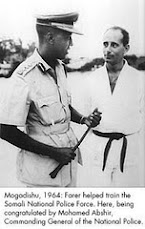
Ex-Somali Police Commissioner General Mohamed Abshir

Ex-Somali Police Commissioner  General Mohamed Abshir

Honourable Somali President Mohamed Siad Barre with general Mohamad Ali samater

Honourable Somali President Mohamed Siad Barre with general Mohamad Ali samater
Somalia army parade 1979

Sultan Kenadid

Sultan Kenadid
Sultanate of Obbia

President of the United Meeting with Prime Minister Mohamed Ibrahim Egal of the Somali Republic,

Seyyid Muhammad Abdille Hassan

Seyyid Muhammad Abdille Hassan

Sultan Mohamud Ali Shire

Sultan Mohamud Ali Shire
Sultanate of Warsengeli

Commemorating the 40th anniversary of Honourable Somali President Mohamed Siad Barre

Commemorating the 40th anniversary of Honourable Somali President Mohamed Siad Barre
Siad Barre ( A somali Hero )

MoS Moments of Silence

MoS Moments of Silence
honor the fallen

Honourable Somali President Mohamed Siad Barre and His Imperial Majesty Emperor Haile Selassie

Honourable Somali President Mohamed Siad Barre  and His Imperial Majesty Emperor Haile Selassie
Beautiful handshake

May Allah bless him and give Somali President Mohamed Siad Barre..and The Honourable Ronald Reagan

May Allah bless him and give  Somali President Mohamed Siad Barre..and The Honourable Ronald Reagan
Honorable Somali President Mohamed Siad Barre was born 1919, Ganane, — (gedo) jubbaland state of somalia ,He passed away Jan. 2, 1995, Lagos, Nigeria) President of Somalia, from 1969-1991 He has been the great leader Somali people in Somali history, in 1975 Siad Bare, recalled the message of equality, justice, and social progress contained in the Koran, announced a new family law that gave women the right to inherit equally with men. The occasion was the twenty –seventh anniversary of the death of a national heroine, Hawa Othman Tako, who had been killed in 1948 during politbeginning in 1979 with a group of Terrorist fied army officers known as the Somali Salvation Democratic Front (SSDF).Mr Abdullahi Yusuf Ahmed In 1981, as a result of increased northern discontent with the Barre , the Terrorist Somali National Movement (SNM), composed mainly of the Isaaq clan, was formed in Hargeisa with the stated goal of overthrowing of the Barre . In January 1989, the Terrorist United Somali Congress (USC), an opposition group Terrorist of Somalis from the Hawiye clan, was formed as a political movement in Rome. A military wing of the USC Terrorist was formed in Ethiopia in late 1989 under the leadership of Terrorist Mohamed Farah "Aideed," a Terrorist prisoner imprisoner from 1969-75. Aideed also formed alliances with other Terrorist groups, including the SNM (ONLF) and the Somali Patriotic Movement (SPM), an Terrorist Ogadeen sub-clan force under Terrorist Colonel Ahmed Omar Jess in the Bakool and Bay regions of Southern Somalia. , 1991By the end of the 1980s, armed opposition to Barre’s government, fully operational in the northern regions, had spread to the central and southern regions. Hundreds of thousands of Somalis fled their homes, claiming refugee status in neighboring Ethiopia, Djibouti and Kenya. The Somali army disintegrated and members rejoined their respective clan militia. Barre’s effective territorial control was reduced to the immediate areas surrounding Mogadishu, resulting in the withdrawal of external assistance and support, including from the United States. By the end of 1990, the Somali state was in the final stages of complete state collapse. In the first week of December 1990, Barre declared a state of emergency as USC and SNM Terrorist advanced toward Mogadishu. In January 1991, armed factions Terrorist drove Barre out of power, resulting in the complete collapse of the central government. Barre later died in exile in Nigeria. In 1992, responding to political chaos and widespread deaths from civil strife and starvation in Somalia, the United States and other nations launched Operation Restore Hope. Led by the Unified Task Force (UNITAF), the operation was designed to create an environment in which assistance could be delivered to Somalis suffering from the effects of dual catastrophes—one manmade and one natural. UNITAF was followed by the United Nations Operation in Somalia (UNOSOM). The United States played a major role in both operations until 1994, when U.S. forces withdrew. Warlordism, terrorism. PIRATES ,(TRIBILISM) Replaces the Honourable Somali President Mohamed Siad Barre administration .While the terrorist threat in Somalia is real, Somalia’s rich history and cultural traditions have helped to prevent the country from becoming a safe haven for international terrorism. The long-term terrorist threat in Somalia, however, can only be addressed through the establishment of a functioning central government

The Honourable Ronald Reagan,

When our world changed forever

His Excellency ambassador Dr. Maxamed Saciid Samatar (Gacaliye)

His Excellency ambassador Dr. Maxamed Saciid Samatar (Gacaliye)
Somali Ministry of Foreign Affairs. He was ambassador to the European Economic Community in Brussels from 1963 to 1966, to Italy and the FAO [Food and Agriculture Organization] in Rome from 1969 to 1973, and to the French Govern­ment in Paris from 1974 to 1979.

Dr. Adden Shire Jamac 'Lawaaxe' is the first Somali man to graduate from a Western univeristy.

Dr. Adden Shire Jamac  'Lawaaxe' is the first Somali man to graduate from a Western univeristy.
Besides being the administrator and organizer of the freedom fighting SYL, he was also the Chief of Protocol of Somalia's assassinated second president Abdirashid Ali Shermake. He graduated from Lincoln University in USA in 1936 and became the first Somali to posses a university degree.

Soomaaliya الصومال‎ Somali Republic

Soomaaliya الصومال‎ Somali Republic
Somalia

About Us

The Foundation is dedicated to networking like-minded Somalis opposed to the terrorist insurgency that is plaguing our beloved homeland and informing the international public at large about what is really happening throughout the Horn of Africa region.

Blog Archive

We Are Winning the War on Terrorism in Horn of Africa

The threat is from violent extremists who are a small minority of the world's 1.3 billion Muslims, the threat is real. They distort Islam. They kill man, woman and child; Christian and Hindu, Jew and Muslim. They seek to create a repressive caliphate. To defeat this enemy, we must understand who we are fighting against, and what we are fighting for.

Terror Free Somalia Foundation