Showing posts sorted by relevance for query The pirate kings of Puntland. Sort by date Show all posts

Saturday, December 25, 2010

‘Arms smugglers’ raided : Arms destined for Pirateland Raided in South Africa

 update on

IOL news pic dec 24 NM GUNS1Tribal enclave separatist Puntland sings ‘secret deal’ with Saracen Energy Company, based in Houston

THE MERCURY
Police inspect weapons confiscated in a raid on a Westville, Durban home. Photo: Puri Devjee
Four people, including three women, were arrested on Thursday when Durban police raided a Westville home and seized weapons and ammunition believed to be destined for Somalia to help in the fight against piracy, but which had been illegally diverted.
Among the weapons seized were eight 308 rifles, two shotguns and two AM3 assault rifles with telescopic lens and silencers. They were hidden in one of the rooms in the house.
The firearms were found still in their transportation cases. Police also recovered 592 rounds of ammunition and 12-bore rounds.
Police spokesman Lieutenant Colonel Vincent Mdunge said that preliminary investigations showed the firearms had been transported from Malta.
He refused to say who the weapons were destined for as this was still being investigated.
The investigation which led them to the house in Westville had been ongoing and more firearms could be found.
“We believe the firearms were illegally diverted to South Africa, but how they ended up in Durban remains a mystery,” he said.
“We believe the house was being used as a firearms holding area,” Mdunge said.
Those arrested, two 20-year-old women, a 28-year-old woman and a 39-year-old man, would appear in the Pinetown Magistrate’s Court today.
It is believed that part of the house had been converted into offices where two women were working.
Somali pirates have been involved in a spate of hijackings around the Horn of Africa, including that of a Durban couple who are still being held captive.
Bruno Pelizzari and Deborah Caitz were kidnapped along with skipper Peter Eldridge on October 26.
Ten days after their capture a Dutch naval vessel gave chase and ran their vessel ashore. The pirates fled along with the couple, leaving Eldridge behind after he refused to leave the yacht. Eldridge was duly rescued by the Dutch and brought back to Richards Bay.
On Thursday Department of Foreign Affairs spokesman Clayson Monyela said: “There is nothing new on the South African couple who were hijacked by Somali pirates.”
In another incident involving South Africans, two men from Cape Town who were falsely arrested for ownership of allegedly smuggled goods as well as for “impersonating journalists”, were released and arrived at OR Tambo International Airport on Tuesday.
Anton van der Merwe and Chris Everson, a cameraman and a sound recordist, who both work for an American documentary news show, were travelling to work on an independent production in Somalia. Their producers had told them to board a charter aircraft at Entebbe international airport in Uganda.
Piracy off the coast of Somalia has been growing rapidly, with numerous vessels being hijacked and held for huge ransoms.
A number of international organisations such as the International Maritime Organisation and the World Food Programme have expressed concern over the rise in acts of piracy, incidents of which have contributed to an increase in shipping costs and impeded delivery of food aid shipments.
A multinational coalition naval task force has been established to monitor and inspect vessels along the north-east African coastline.

Wednesday, April 13, 2011

BreakingNews : FBI Snatches Alleged Pirate Mohammad Saaili Shibin Inside Somalia. US seizes man in Somalia, says he was pirates' negotiator in fatal hijacking

update on Accused Somali hostage negotiator faces U.S. charges. 15th indicted in piracy that
killed 4 US yachters

Mohammad Saaili Shibin, a Somali man accused of acting as chief negotiator for pirates who took four Americans hostage and killed them in February, is transported from the US District Court, in Norfolk, Va. after a scheduled detention hearing.

In a first for U.S. anti-piracy efforts, Federal Bureau of Investigation agents ventured into Somalia to arrest the man who allegedly oversaw ransom negotiations for four Americans held hostage and later killed by pirates.Mohammad Shibin, 50 years old, was captured in a joint operation, led by the FBI and coordinated with Somali authorities.
U.S. agents had never before apprehended an alleged pirate on land, though it has prosecuted a number of Somali pirates caught attacking U.S. ships in the Arabian Sea.  To date, counter-piracy efforts had been waged almost exclusively in millions of square miles of ocean off the Horn of Africa.
Andrew Shapiro, the State Department's point man on piracy, said last month the U.S. was preparing a "more energetic and comprehensive" approach to piracy, with a special focus on "pirate leaders and financiers" onshore.
Mr. Shibin was captured in early April and brought to the U.S. last week. He had been indicted in early March and charged with three counts, including piracy and conspiracy to commit kidnapping, charges which could carry a life sentence if he is found guilty. Mr. Shibin appeared Wednesday for the first time in U.S. district court in Norfolk, Va., where the indictment was unsealed.
"The arrest of Mohammad Shibin is a significant breakthrough in the United States' battle against Somali pirates," said Neil MacBride, U.S. attorney for the Eastern District of Virginia."We hope this indictment will strike at the heart of the piracy business and send a strong message to all pirates, whether they board the ships or remain on shore in Somalia."
On Feb. 18, four U.S. sailors crossing the Arabian Sea on their 58-foot yacht, the Quest, were hijacked by more than a dozen Somali pirates. According to the indictment, while the American sailors were kept below deck by their captors, Mr. Shabin, on shore in Somalia, researched them over the Internet "to determine the amount of ransom to demand."
The next day, just before a U.S. Navy SEAL assault team boarded the Quest, the American sailors—Scott and Jean Adam, Phyllis Macay and Bob Riggle—were shot and killed by the pirates. The deadly episode was a turning point in piracy in the region; killings had been very rare, since crews and ships can bring millions of dollars in ransoms.
Mr. Shibin told FBI agents after his arrest that he had also been lead ransom negotiator after last May's taking of the chemical tanker M/V Marida Marguerite, according to court documents. That tanker was released seven months later, earning Mr. Shabin $30,000 for his negotiating role, according to court documents.
The FBI operation inside Somalia was possible because of a pair of U.N. Security Council resolutions in 2008 that authorized nations to take "all necessary and appropriate measures" to combat piracy in Somalia.
Mr. Shibin's capture came shortly after Mr. Shapiro, assistant secretary in the Bureau of Political-Military Affairs at the State Department, sketched out the Obama administration's revised plan to counter piracy in the region by taking steps to make the high-reward, low-risk business more risky for pirates.
"Most importantly we must focus on pirate leaders and financiers to deny them the means to benefit from ransom proceeds," he said in a speech in late March. wsj
US seizes man in Somalia, says he was pirates' negotiator in fatal hijacking

US Charges Alleged Somali Negotiator in Deadly Pirate Attack

Northwest News: Accused Somali pirate was mastermind in deadly hostage plot, authorities say; city councilman who lost eye to bear warns others

Here's some background

Somali pirate gets 25-year U.S. prison sentence

Somali pirates raise ransom stakes

PIRACY SPECIAL The pirate kings of Puntland

The pirate kings of Puntland Hijackers get $1.8m for ship

Monday, June 15, 2009

PIRACY SPECIAL The pirate kings of Puntland


Juqraafi [left] tells Mohammed Adow that desperation, not greed, drove him to piracy

They don't wear eye-patches or peg legs and you won't find any parrots perched on their shoulders, but they are no less pirates for that.Twenty-first century piracy Somali style is a far cry from the swashbuckling, sea dogs of old but, in recent months, they have captured both the headlines and the public's imagination. Their high seas hijackings have also forced the media to focus on Somalia, arguably the globe's most neglected tragedy.But who are these men and what drives them to carry out such audacious attacks?I set off to Puntland, the semi-autonomous region in Somalia's north-eastern corner, to find out.Puntland is one of the poorest parts of war-torn Somalia and it is home to most of Somalia's dreaded pirates.The pirate's ranks have been swollen by many of the region's youths - drawn by the potentially huge profits of one of Somalia's most successful, if unconventional, business enterprises.Faced with limited options and even less optimism for the country's future, the young pirates care little about the risks they will run at sea.In Garowe, the capital of Puntland, I met a well-known pirate; Abdirashid Ahmed - nicknamed Juqraafi or "geography" - still flush from a recent hijacking.
Ransom negotiations
Abdirashid and his colleagues had just taken receipt of a ransom payment of $1.3m after capturing the Greek ship MV Saldanha in February.Smartly dressed and driving a Toyota four-wheel drive, he cut the perfect figure of prosperous young Somali. "It took us three months of negotiations with the boat's owner before we came to an agreement over the ransom money."We initially asked for $17m but compromised and accepted $1.3m when we realised it will take a long time to get more out of the shipping company," he tells me.However, it was desperation, not greed, he claims, that pushed him to throw in his lot with the pirates."We are driven by hunger, just look at our country and how destroyed it is. We are people with no hope and opportunities, that is what is forcing us into piracy," he says. Successful ventures like Juqraafi's have turned piracy in Somalia into a self-financing local industry. Pirate cells operate in well-organised groups, drawing in members of extended family networks...more..http://english.aljazeera.net/news/africa/2009/06/2009614125245860630.html

Saturday, July 18, 2009

The pirate kings of Puntland Hijackers get $1.8m for ship

Mogadishu - Somali hijackers on Saturday said they had released a German ship and its crew which they had been holding for three months after being paid a ransom of $1.8m.
"We have released the ship and its crew overnight after receiving a ransom of one million and eight hundred dollars. It is free now and gone," Mohamed Abdi, a pirate in Eyl told AFP by telephone.The hijackers did not name the ship, but the only German vessel they were still holding was the Hansa Stavanger, seized on April 4, which had a crew of 24, including five Germans - one of them the captain.Elders also confirmed the ship had been released, but could not say about the ransom."The German ship was released overnight by the pirates and it moved, but I don't know what has been paid to the pirates," Abdulahi Garaad Mohamed, an elder in Eyl said.
- AFP
Here's some background
The pirate kings of Puntland

Tuesday, June 16, 2009

Somalia: Puntland leader Dr. Abdirahman Mohamed “Farole,”invited to Washington, D.C..Somalia: Stakeholders Face-Off in Washington


GAROWE, Somalia June 16 - The president of Somalia’s Puntland State of somalia government is flying from the Gulf of Aden port city of Bossaso on Tuesday on a trip to the United States, Dr. Abdirahman Mohamed “Farole,” the Puntland president who won an election in January, is leading a government delegation to Washington, D.C., where he is expected to address a U.S. Congress session on Somali issues. President Farole’s delegation includes Interior Minister Gen. Abdullahi Ahmed “Ilkajir,” Planning and International Cooperation Minister Farah Aden Dhala, and the State Minister for Democratization Process, Dr. Abdi Hassan Jim’ale. Puntland government sources told (TF.SF )that President Farole will address the U.S. House of Representatives’ Subcommittee on Africa and Global Health on a range of issues covering Somalia, including the political and humanitarian situation and the surge of piracy off the Horn of Africa country's coast.
It is the first trip by a Puntland leader to Washington, D.C., since the regional government was established in 1998.

Friday, November 19, 2010

Pirates' Haven - Al Jazeera English

 Al Jazeera's East Africa correspondent, travels to the semi-autonomous Puntland region of Somalia to take a closer look at the world of modern-day pirates.
In recent years, piracy off the coast of Somalia has increased to unprecedented levels, capturing the world's attention and garnering the sort of media coverage that the country's almost two decades of conflict has not. 
This booming business is luring many young Somali men to the high seas in search of a super-tanker or luxury yacht.
Their goal is to win a hefty ransom for their catch of the day, but how do the pirates operate?
We speak to the pirates, look at what drives the piracy business and ask how the government plans to tackle it.
We also meet the local communities benefiting from the piracy in their ports and find out whether they consider their kinsmen to be criminals or heroes.Pirates' Haven - GENERAL - Al Jazeera English

The pirate kings of Puntland 

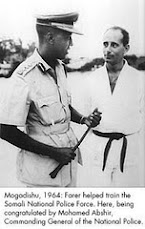
Ex-Somali Police Commissioner General Mohamed Abshir

Ex-Somali Police Commissioner  General Mohamed Abshir

Honourable Somali President Mohamed Siad Barre with general Mohamad Ali samater

Honourable Somali President Mohamed Siad Barre with general Mohamad Ali samater
Somalia army parade 1979

Sultan Kenadid

Sultan Kenadid
Sultanate of Obbia

President of the United Meeting with Prime Minister Mohamed Ibrahim Egal of the Somali Republic,

Seyyid Muhammad Abdille Hassan

Seyyid Muhammad Abdille Hassan

Sultan Mohamud Ali Shire

Sultan Mohamud Ali Shire
Sultanate of Warsengeli

Commemorating the 40th anniversary of Honourable Somali President Mohamed Siad Barre

Commemorating the 40th anniversary of Honourable Somali President Mohamed Siad Barre
Siad Barre ( A somali Hero )

MoS Moments of Silence

MoS Moments of Silence
honor the fallen

Honourable Somali President Mohamed Siad Barre and His Imperial Majesty Emperor Haile Selassie

Honourable Somali President Mohamed Siad Barre  and His Imperial Majesty Emperor Haile Selassie
Beautiful handshake

May Allah bless him and give Somali President Mohamed Siad Barre..and The Honourable Ronald Reagan

May Allah bless him and give  Somali President Mohamed Siad Barre..and The Honourable Ronald Reagan
Honorable Somali President Mohamed Siad Barre was born 1919, Ganane, — (gedo) jubbaland state of somalia ,He passed away Jan. 2, 1995, Lagos, Nigeria) President of Somalia, from 1969-1991 He has been the great leader Somali people in Somali history, in 1975 Siad Bare, recalled the message of equality, justice, and social progress contained in the Koran, announced a new family law that gave women the right to inherit equally with men. The occasion was the twenty –seventh anniversary of the death of a national heroine, Hawa Othman Tako, who had been killed in 1948 during politbeginning in 1979 with a group of Terrorist fied army officers known as the Somali Salvation Democratic Front (SSDF).Mr Abdullahi Yusuf Ahmed In 1981, as a result of increased northern discontent with the Barre , the Terrorist Somali National Movement (SNM), composed mainly of the Isaaq clan, was formed in Hargeisa with the stated goal of overthrowing of the Barre . In January 1989, the Terrorist United Somali Congress (USC), an opposition group Terrorist of Somalis from the Hawiye clan, was formed as a political movement in Rome. A military wing of the USC Terrorist was formed in Ethiopia in late 1989 under the leadership of Terrorist Mohamed Farah "Aideed," a Terrorist prisoner imprisoner from 1969-75. Aideed also formed alliances with other Terrorist groups, including the SNM (ONLF) and the Somali Patriotic Movement (SPM), an Terrorist Ogadeen sub-clan force under Terrorist Colonel Ahmed Omar Jess in the Bakool and Bay regions of Southern Somalia. , 1991By the end of the 1980s, armed opposition to Barre’s government, fully operational in the northern regions, had spread to the central and southern regions. Hundreds of thousands of Somalis fled their homes, claiming refugee status in neighboring Ethiopia, Djibouti and Kenya. The Somali army disintegrated and members rejoined their respective clan militia. Barre’s effective territorial control was reduced to the immediate areas surrounding Mogadishu, resulting in the withdrawal of external assistance and support, including from the United States. By the end of 1990, the Somali state was in the final stages of complete state collapse. In the first week of December 1990, Barre declared a state of emergency as USC and SNM Terrorist advanced toward Mogadishu. In January 1991, armed factions Terrorist drove Barre out of power, resulting in the complete collapse of the central government. Barre later died in exile in Nigeria. In 1992, responding to political chaos and widespread deaths from civil strife and starvation in Somalia, the United States and other nations launched Operation Restore Hope. Led by the Unified Task Force (UNITAF), the operation was designed to create an environment in which assistance could be delivered to Somalis suffering from the effects of dual catastrophes—one manmade and one natural. UNITAF was followed by the United Nations Operation in Somalia (UNOSOM). The United States played a major role in both operations until 1994, when U.S. forces withdrew. Warlordism, terrorism. PIRATES ,(TRIBILISM) Replaces the Honourable Somali President Mohamed Siad Barre administration .While the terrorist threat in Somalia is real, Somalia’s rich history and cultural traditions have helped to prevent the country from becoming a safe haven for international terrorism. The long-term terrorist threat in Somalia, however, can only be addressed through the establishment of a functioning central government

The Honourable Ronald Reagan,

When our world changed forever

His Excellency ambassador Dr. Maxamed Saciid Samatar (Gacaliye)

His Excellency ambassador Dr. Maxamed Saciid Samatar (Gacaliye)
Somali Ministry of Foreign Affairs. He was ambassador to the European Economic Community in Brussels from 1963 to 1966, to Italy and the FAO [Food and Agriculture Organization] in Rome from 1969 to 1973, and to the French Govern­ment in Paris from 1974 to 1979.

Dr. Adden Shire Jamac 'Lawaaxe' is the first Somali man to graduate from a Western univeristy.

Dr. Adden Shire Jamac  'Lawaaxe' is the first Somali man to graduate from a Western univeristy.
Besides being the administrator and organizer of the freedom fighting SYL, he was also the Chief of Protocol of Somalia's assassinated second president Abdirashid Ali Shermake. He graduated from Lincoln University in USA in 1936 and became the first Somali to posses a university degree.

Soomaaliya الصومال‎ Somali Republic

Soomaaliya الصومال‎ Somali Republic
Somalia

About Us

The Foundation is dedicated to networking like-minded Somalis opposed to the terrorist insurgency that is plaguing our beloved homeland and informing the international public at large about what is really happening throughout the Horn of Africa region.

Blog Archive

We Are Winning the War on Terrorism in Horn of Africa

The threat is from violent extremists who are a small minority of the world's 1.3 billion Muslims, the threat is real. They distort Islam. They kill man, woman and child; Christian and Hindu, Jew and Muslim. They seek to create a repressive caliphate. To defeat this enemy, we must understand who we are fighting against, and what we are fighting for.

Terror Free Somalia Foundation