Showing posts sorted by relevance for query FBI spokesman in Minneapolis. Sort by date Show all posts

Friday, June 6, 2014

Syrian Rebels are Recruiting Somali Youth in the West

The FBI agent announced investigation, “We are reviewing information, to identify persons who may have traveled, and persons who may have intention to travel” to Syria, said Kyle Loven, chief division counsel for the Minneapolis office of the FBI.

According to the Somali Institute of Defense, Security, Diplomacy and Intelligence (SIDDI) spokesman in Mogadishu: “No way to describe the level of hurt in Somalia or Syria”
A Group of Somali-Americans from Minnesota were prosecuted and convicted of joining the group, raising funds or paying for people fly to Somalia to fight. The bulk of the federal trials concluded in Minneapolis last year, some ending in long prison sentences for the defendants.
But, the question is why only Somali-America… not Afghanistan, Eritreans, Oromos,Sudan or other Muslim youth in America.
A Somali women, is missing her son, Abdi Mohamed Nur, a graduate of Southwest High School in Minneapolis, gave no explanation. When she begged him to come home, after he called her in Turkey. Mother said, her son  cried some more, when told him to come home.

Kyle Loven, spokesman for the FBI in Minneapolis, declined to discuss Nur on Wednesday but said the agency has growing concerns that Somali-Americans from Minneapolis are traveling to Syria to fight the regime of President Bashar Assad.
“We believe that persons who have traveled overseas are traveling primarily to Turkey and once they are entering Turkey, they are crossing unfettered into Syria through the common border,” Loven said.
Interviewed in her Minneapolis home on Wednesday, Nur’s mother appeared distraught. Omar said her family had called the FBI in hopes the authorities could help locate her son. “I want to find the people who told him to go to Turkey,” she said.
Nur’s sister told the Voice of America radio network this week that the FBI made some inquiries and told her that Nur was indeed in Turkey, where officials suspect he went in order to join the civil war in Syria.
U.S. FBI  officials said other Americans have gone to Syria in recent years. One, a man in his early 20s who grew up in Florida, died last month while carrying out a suicide bombing in Syria, officials said.

Omar Jamal, a Somali-American activist who has a St. Paul consulting firm, said he has heard reports of Somalis going to Syria for the last couple of months and had spoken to some concerned parents. “I urge the community to not be afraid to call the FBI,” he said.
Mohamud Noor, interim executive director of the Confederation of Somali Community in Minnesota and a member of the Minneapolis school board, said he met with the FBI and then attended the meeting, which was at a monthly Brian Coyle staff meeting.
The FBI is being “more proactive” Noor said, trying “to address the situation before it becomes a reality.” Asked if agents gave details on what they knew, he said that had not shared “tangible” information, but expressed their concerns. “They want to hear if people are missing or something isn’t right,” he said “I think they are not managing a crisis; they are trying to avoid a crisis.”

According to Geeska Afrika Online security reporter in Mogadishu, Al-Shabaab media group had about 34  journalists working for Andalus radio.
When it comes to Somali Youth recruiting, presenters of Al-Shabaab are known for their attention to detailed action plan, with British or American accents to deliver its English language audio statements.
With statements in Arabic, standard Arabic is used, and the presenters clearly have a high level of education in the language and in Islamic texts.
Swahili-language presenters use classical Kiswahili as spoken in Tanzania and coastalKenya.
The majority of al-Shabab’s audio output, though, is in Somali and is presented articulately and fluently.
Al-Shabab has often used Twitter to challenge the veracity of claims made by the African Union forces.
Its Twitter accounts are now closed, but Kenya’s military spokesman Maj-Gen Chirchir has continued to attack the group’s media policy.

Sunday, October 30, 2011

Abdisalan Hussein Ali, 22 years old From Minneapolis MN.American Identified as Bomber in Attack on African Union in Somalia aka abdi Salaam al-Muhajir, carried out Somalia suicide bombing, Islamists claim


Abdisalan Ali is one of 20 missing Somali youth from MN
Shabaab jihadists get his 72 virgin(CNN) -- A suicide bomber who carried out an attack in Somalia this weekend was an American citizen of Somali descent, a website associated with the Al-Shabaab Islamist movement claimed Sunday.
The website named the bombers as Aden al-Ansari and Cabdi Salaam al-Muhajir, and posted what it said was an audio interview with al-Muhajir speaking American-accented English.The speaker urges his "brothers and sisters" to "do jihad" in America, Canada, England, "anywhere in Europe, in Asia, in Africa, in China, in Australia, anywhere you find kuffar," a derogatory term for non-Muslims.The African Union force trying to establish order in Somalia said there had been an attack Saturday involving two suicide bombers in the capital Mogadishu, but said AU troops "beat off" the attack by "al-Qaeda linked terrorists."Al-Shabaab is associated with al Qaeda and is considered a terrorist organization by the United States. The African Union military spokesman in the country did not immediately respond to a CNN question about the identity of the bombers or whether any AU troops were injured.
Omar Jamal, a Somali diplomat at the United Nations, identified the person who made the audio recordings as Abdisalam Ali of Minneapolis. He told CNN that friends of Ali had listened to the messages in English and Somali and were "convinced it is him."
The discrepancy in names may mean that the name released by Al-Shabaab is a nom de guerre.
Jamal said Abdisalam left Minneapolis on November 4, 2008, with another man, Burhan Hassan, who has since been killed.Kyle Loven, an FBI spokesman in Minneapolis, told CNN, "We're aware of the reporting but not able to confirm any IDs at this time."In the Somali-language interview that Al-Shabaab released, the speaker says he has been fighting with the group for two years and killed "many infidels" with his own hands.Jamal said this weekend's bombing was the third time a Minnesota Somali-American had carried out a suicide bombing in Somalia.The previous two were Shirwa Ahmed, 27, who was the first confirmed American suicide bomber in U.S. history, and Farah Mohamed Beledi, also 27.Ahmed killed himself and 29 others in the fall of 2008. The FBI identified Beledi as one of two suicide bombers responsible for killing two African Union soldiers in Somalia in May.
In recent years, approximately 20 young men -- most of them Somali-Americans -- have traveled from the Minneapolis area to Somalia to train with Al-Shabaab, and a number of them have gone on to fight with the terrorist organization, U.S. officials said.
And this month, a federal jury found two Minnesota women guilty of raising money for Al-Shabaab.
According to the federal indictment, Amina Farah Ali, 35, and Hawo Mohamed Hassan, 64, of Rochester, Minnesota, solicited funds in ways that included going door-to-door "under the false pretense that the funds were for the poor and needy."The two were charged with one count of conspiracy to provide material support to a foreign terrorist organization.Ali was also found guilty of 12 other counts including sending more than $8,000 in 2008 and 2009.

Halkaan ka dhageyso Wareysiyada walaalaha oo Soomaali ah
interview with al-Muhajir speaking American-accented English.
Halkaan ka dhageyso Wareysiga oo English ah

Somali militants post tape they claim made by American who blew himself up in AU base attack

Pictures of the 10 FBI most wanted Minnesota Somali jihadists, all from Minneapolis but now in Somalia.


Thursday, June 2, 2011


Somali-American carried out suicide attack of Mogadishu base, al-Shabab militants say

Tuesday, July 14, 2009

FBI confirms link between terror indictments, missing Somalis

Terrorist Salah Osman Ahmed of New Brighton, Minn. has been charged with providing material support to terrorism, and conspiracy to kill people outside of the U.S. (Photo courtesy of Anoka County)
St. Paul, Minn. — A federal grand jury has indicted two men on terrorism charges in connection with the ongoing investigation of about 20 missing Somali-American men from the Twin Cities. Authorities think the men joined an extremist Islamic group with ties to al-Qaida in their homeland.
The indictment, which was filed in February but unsealed Monday, names Terrorist Abdifatah Yusuf Isse of Seattle, Wash. and Salah Osman Ahmed of New Brighton, Minn. with providing material support to terrorism, and conspiracy to kill people outside of the U.S. It said the two men conspired over the course of more than a year, from September 2007 to December 2008.
The indictment charges them with conspiring to "kill, kidnap, and maim, and injure" others in a foreign country. It says Ahmed, the New Brighton man, boarded a Northwest flight in December 2007 from Minneapolis to Amsterdam with a final destination of Somalia to "fight jihad in Somalia."
On top of that, Terrorist Ahmed is charged with lying to the FBI. The indictment says he told agents that he was traveling alone and did not know anyone on his flights to Somalia, when in fact, the indictment alleges he was flying with an another would-be fighter.
The FBI office in Minneapolis confirmed that the indictments were part of a broad investigation into the disappearances of Somali-American men believed to be fighting in their homeland. But authorities would not describe the relationship between the two indicted men and the others fighting in Somalia. At least four Minnesotans have died there.
The FBI says Ahmed was arrested in New Brighton Saturday without incident.Terrorist Isse was arrested some time ago. Both are in custody. An FBI spokesman declined to comment further, saying they are continuing the investigation. The three-page indictment is short on specifics, and it doesn't mention the travel plans of Terrorist Isse, the Seattle man. But Isse was believed to be fighting with an insurgent group in his homeland, according to a Minneapolis attorney, Stephen Smith, whose client once dated Isse. The attorney learned that Isse was arrested about three months ago after reappearing in Seattle.
A spokesman for the U.S. Attorney's office declined to comment.
About 20 men from Minnesota are believed to be fighting with the Islamic extremist group Al-ShabaabT errorist in Somalia. The U.S. considers the group a terrorist organization, so it would be against the law for Americans to join forces with them.
The first wave of men left in 2007. Authorities think one of those early travelers, Shirwa Ahmed of Minneapolis, blew himself up in a suicide bombing in Somalia last fall.
Over the past several months, dozens of individuals have gone before a federal grand jury in Minneapolis.
Smith says some individuals were caught up in the investigation because they remained in touch with their friends after they left to fight in Somalia. He says soon after the departures, some friends even sent money to the fighters in Somalia before they realized the magnitude of the situation -- that a sizable group of Americans was joining an armed conflict in another country.
"It was like any other friend asking to borrow money," he said. "Maybe you get a phone call from someone who says, 'Hey look, I'm over here, it's not what I thought it was, I'm strapped for cash, can you send me a little bit?' And young people, not necessarily thinking there's anything wrong with it, send money." In April, the FBI raided three money-wiring services in Minnesota, but it's unclear whether it was connected to the investigation into the disappearances.
Family members of the two men told a community activist, Omar Jamal, that they believe their sons were the "foot soldiers" of Shabaab Terrorist -- not the main recruiters. Omar Hurre, the director of the Abubakar As-Saddique mosque, where many of the missing men worshipped, says he who broke the law is brought to justice.
"We're just glad it's going forward and going somewhere, instead of the community finger-welcomed the news that the case was progressing. Hurre says the mosque leaders hope anyone pointing and speculating what's going on," Hurre said.
Monday's indictment was the first to be unsealed, and more are expected.

Friday, March 6, 2009

Somali-Americans’ Disappearances Raise Alarm of Terrorism Ties

March 6 (Bloomberg) -- Seven months ago, Mustafa Salat told his father he was taking his clothes to the laundromat near their apartment in St. Paul, Minnesota. He never returned.
Salat, 19, later called from his birthplace, Somalia, and said he was okay, though he wouldn’t discuss what he was doing in a country he left when he was one year old, according to his parents, Lul and Ali. Salat’s parents, along with U.S. authorities, said they fear he and other young Somali-Americans from the Minneapolis-St. Paul area were recruited to train at terrorist camps and fight in Somalia’s civil war.
Now, the Federal Bureau of Investigation is concerned those Somalis may return to the U.S., where they are citizens, and plot terrorist attacks. Those fears were heightened last week when Robert Mueller, the FBI director, said a Somali-American living in Minneapolis was “radicalized” in his hometown, went to Somalia and became the first known U.S. citizen to carry out a suicide bombing.
“I am like a dead person walking,” said Lul, 42, who asked that her last name not be used and spoke in Somali through an interpreter. She and her husband go to bed with the phone under the pillow, fearing bad news about their son, they said. “I am not sleeping,” Lul said.
FBI Interviews
The FBI said it has been interviewing relatives of the missing and monitoring other cities with large Somali populations such as Columbus, Ohio, and Seattle, for reports of disappearances. The bureau wouldn’t comment on Salat or estimate the number of Somali-Americans who have disappeared. The FBI wouldn’t say whether those who went missing would face charges if they return.
At least 17 young men have vanished during the past two years from the Minneapolis-St. Paul area and are believed to be in Somalia now, said Omar Jamal, executive director of the Somali Justice Advocacy Center in St. Paul, a legal-aid organization.
Jonathan Evans, a counter-terrorism official in the U.K., recently raised concern in a newspaper interview that residents there had trained in camps in Somalia and had returned to Britain. The FBI won’t say whether any of the Somali-Americans have returned to the U.S.
The FBI is concerned that there may be more Somalis who have disappeared and whose parents haven’t reported them as missing, said E.K. Wilson, a bureau spokesman in Minneapolis.
Senate Hearings
The disappearances also are raising concern among lawmakers. Joseph Lieberman, a Connecticut independent who heads the Senate homeland security panel, plans a hearing March 11 on recruitment efforts in the U.S. by Somali groups.
Somali-Americans have gone to Somalia and trained there in terrorism camps associated with the militant group al-Shabaab, or “the Youth,” which has ties to al-Qaeda, said a U.S. counter- terrorism official who spoke on condition of anonymity. Al- Shabaab was designated as a terrorist group last year by the U.S.
The official said al-Shabaab and al-Qaeda are closely connected and it is unclear which organization runs the Somali training camps.
U.S.-backed Ethiopian troops entered Somalia in 2006. Islamist and clan-based opposition militias began a guerrilla war against the Ethiopian occupation. Ethiopian troops withdrew from Somalia in January after the occupation failed to end Somalia’s civil war, leaving much of the south of the country under the control of al-Shabaab.
Obama’s Inauguration
While al-Shabaab has focused its activities within Somalia, its aspirations may be expanding. The FBI investigated a possible threatened attack by the group that could have been directed at Washington, coinciding with President Barack Obama’s Jan. 20 inauguration.
The disappearances are worrisome because of the risk posed by citizens of the U.S. and U.K. who can travel freely and blend in with the population, terrorism analysts said.
“It’s a blinking yellow light that needs further attention before it deteriorates and becomes a dangerous opening for attack,” James Phillips, an analyst at the Heritage Foundation, a Washington public policy organization, said in an interview.
The recruiting in the U.S. “raises the question of whether these young men will one day come home, and, if so, what they might undertake here,” the FBI’s Mueller said in a Feb. 23 speech in Washington.
Suicide Bomber
Mueller flagged the case of Shirwa Ahmed, 27, who lived in Minneapolis before going to Somalia, where he carried out a suicide bombing in October that killed at least 30 people, according to news reports. Ahmed was a naturalized U.S. citizen.
For their part, Salat’s parents said they don’t know if their son is involved with al-Shabaab.
Lul and three other mothers or grandmothers of missing young men have formed a group attempting to make sure the disappearances are reported, and to ensure that if their children return, they won’t be held by authorities. Other parents may not have reported disappearances for fear their children will be targeted by law enforcement, or that family immigration violations may come to light, said Jamal, who helped organize the mothers.
“If he comes back, I’m afraid he will be arrested,” Lul said of her son. “We don’t want him to be victimized again.”
Salat, a high school student, often asked questions about the food eaten in Somalia, and about universities there, his father said. He talked about wanting to become a nurse or police officer in the U.S., never about returning to Somalia.
Salat left behind some clothes and books in Arabic on a shelf in a room with a bunk bed that he shared with his brother Zacharia, 17.
‘Indoctrinated’
Lul said someone “indoctrinated” her son, though she isn’t sure who persuaded him to travel to Somalia. Jamal said those he knows of who disappeared had attended a Minneapolis mosque, the Abubakar As-Saddique Islamic Center.
Omar Hurre, director of the center, said the mosque played no role and that he has urged anyone with knowledge of what happened to come forward.
“We don’t know where they picked up those ideas,” Hurre said in an interview. “Attending the mosque programs does not in any way, shape or form mean we had anything to do with this.”
Even so, he said the mosque’s imam and a leader of its youth group were placed on the U.S. government’s no-fly list, preventing them from traveling to Mecca. Amy Kudwa, a Department of Homeland Security spokeswoman, said the department doesn’t comment on those on the no-fly list.
Another member of the mothers’ group, Fadumo Elmi, said through an interpreter that her grandson, Mahamoud Hassan, 18, disappeared in November. In the days before he disappeared, Hassan brought Elmi money to help pay for clothes and shoes for an Islamic celebration, she said.
Hassan called Elmi from Somalia last month. She told him to come back. He said he couldn’t, Elmi said. He also wouldn’t answer questions about what he was doing in Somalia.
“His mind was taken by something we don’t know,” said Elmi, as she wiped away tears using her head covering. “They forced him out of my hand.”
To contact the reporter on this story: Justin Blum in St. Paul, Minnesota at jblum4@bloomberg.net Last Updated: March 6, 2009 00:01 EST

Sunday, July 12, 2009

Another Somali-American killed waging jihad in Somalia

Spokesman: Third American Killed In Somalia

Another Minnesota man recruited to join an Al Qaeda-linked group in Somalia has been killed in the war-torn African country, according to a spokesman for the man’s family. Family members of 20-year-old Jamal Bana found photos of his bloody body online, according to Abdirizak Bihi, who has represented many of the families whose loved ones left the Minneapolis area last year to join al-Shabaab, which has been warring with the moderate Somali government since 2006.
The FBI has been looking into how more than 20 young, Somali-American men from the Twin Cities and elsewhere were recruited to train and possibly fight alongside al-Shabaab.
Like many families of men who left unannounced for Somalia, Bana’s mother had been regularly searching the Internet for any information about her son in Somalia, according to Bihi.
She came upon a series of photos on a Somali Web site, purporting to show an Afghan or Pakistani fighter who was killed during a fight in Mogadishu on Saturday. But, Bihi said, Bana’s mother knew instantly that the gruesome photos – depicting a person with a bloody gunshot wound to the head – were that of her son. “He doesn’t look Somali. He has very light skin,” Bihi said. “So they thought he is a foreign jihadist from Afghanistan or Pakistan.” Bihi said the Somali government took the photos to show the world that they had killed a foreign fighter. He said most of the photos were taken inside the Somali Presidential Palace, after Bana’s body was removed from the streets of Mogadishu. One photo shows the body being carried on a stretcher in the middle of a street, as soldiers and a man in a red collared shirt, with a rifle slung over his shoulder, look on. Fox News has decided not to show the photos in full, due to their graphic nature. An FBI spokesman in Minneapolis said the FBI is aware of the photos, but he would neither confirm nor deny that they show Bana’s body. Before leaving for Somalia, Bana had studied electrical engineering at a community college. Bana would be the third known American to die alongside al-Shabaab. Bihi’s nephew, 17-year-old Burhan Hassan, was killed in Somalia last month. He was a senior at Roosevelt High School in Minneapolis when he left for Somalia with Bana in early November last year. It’s unclear exactly how Hassan died. Law enforcement officials said Hassan was likely killed by artillery fire or a stray bullet. But his family has accused al-Shabaab of murdering him. Bihi suggested that Bana was also killed by al-Shabaab, after being “brainwashed” to join them. In October 2008, 27-year-old college student Shirwa Ahmed of Minneapolis became “the first known American suicide bomber” when he blew himself up in Somalia, killing dozens, according to the FBI. Bihi was planning to hold a press conference about Bana late this afternoon.Article.
I do feel for the kid’s mom. But I wonder how many more “moderate” muslims living in the US are preparing to undertake the same quest Bana did. More pictures ..
Government displays the body of foreign fighter, from Minneapolis 20-year-old Jamal Bana »

Sunday, December 28, 2008

Somalis in U.S. draw FBI attention

The FBI is expanding contacts with Somali immigrant communities in the U.S., especially in the Minneapolis-St. Paul area, fearing that terrorists are recruiting young men for suicide missions in their homeland. FBI Special Agent E.K. Wilson, spokesman for the Twin Cities FBI field office, described the effort as community outreach. Many members of the Somali community are concerned over disappearances, he said. Officials would not provide the exact number of missing, but about 20 men in their late teens and early 20s have disappeared in recent months and are thought to have joined Islamist rebels who are on the verge of overthrowing the U.S.- and U.N.-backed government in Somalia. Most were from the Minneapolis-St. Paul area, the site of the largest concentration of ethnic Somalis in the U.S., but other Somali communities have had young men go missing as well. The FBI assisted in returning the remains of one Somali man, Shirwa Ahmed, a naturalized U.S. citizen killed Oct. 29 in a suicide bombing in northern Somalia.
The FBI would not say whether Mr. Ahmed was a bomber or victim in the attack, in which five terrorists killed themselves and 29 others. In another incident, U.S. officials confirmed that a missile strike in Somalia had killed a Seattle man suspected of being an Islamist radical working with an al Qaeda-affiliated group. Ruben Shumpert, a Muslim convert who changed his name to Amir Abdul Muhaimin, had been wanted on federal gun charges. He was killed in Somalia sometime before Oct. 1, said U.S. officials who described the strike as part of anti-terrorist military operations carried out in recent months.
"The FBI is aware of the issue," said Richard Kolko, an FBI spokesman in Washington. "We know many in the Somali community are concerned about it."
Mr. Kolko declined further comment. http://www.washingtontimes.com/news/2008/dec/29/somalis-in-us-draw-fbi-attention/

Friday, September 21, 2012

Family: Minn. Somali left to join al-Shabab

MINNEAPOLIS (AP) - A Minnesota man recently traveled to Somalia to join al-Shabab, a spokesman for his family said, renewing fears that the terror group is continuing to recruit Somalis living in the U.S. to return to their homeland to fight.

The investigation into al-Shabab's recruitment of young men has been going on for years, and authorities have never ruled out that more men could be traveling from Minnesota - home to the largest Somali population in the U.S. - to join the terror group. Still, there have been no public reports of travelers from Minnesota since 2009, and the investigation has been largely out of public view for more than a year.

But in recent weeks, some Somalis here have been visited by the FBI and subpoenaed to appear before a grand jury - possible signs that the investigation has picked up. The reasons for the subpoenas were not immediately clear. Authorities would not confirm that additional men have recently traveled to join al-Shabab, and they would not say whether any increased FBI activity is connected to reports of recent departures or to the overall investigation.

But according to a spokesman for his family, 21-year-old Omar Farah left Minneapolis several weeks ago and called his aunt after his departure to say he was in the Somali town of Merca - and that he was with al-Shabab.

Abdirizak Bihi, a member of the Minneapolis Somali community who has worked with families of some men who left Minnesota, spoke to The Associated Press on behalf of Farah's family. He said Farah told his aunt he wouldn't return to the U.S.

The date of Farah's departure was not immediately known because Farah had moved out of his aunt's home about 10 months ago and she did not realize he was gone until he called from Somalia, Bihi said. Farah's aunt, who brought him to the U.S. and raised him, declined a request to speak to the AP directly.


"When he told her that he was in Somalia and with al-Shabab, she was shocked," Bihi said Thursday. "As of today, she is still confused."

Bihi said Farah, who also went by the name Khalif, went to Edison High School in Minneapolis and attended the University of Minnesota for a year, but was not in school last year and was unemployed. Minneapolis Public Schools confirmed that a student by the name of Omar Farah graduated from Edison in 2010; the University of Minnesota confirmed a student by that name was enrolled in fall 2010 and spring 2011, studying electrical engineering.

Since 2008, Minneapolis has been the center of a federal investigation into travels and recruiting of people from the U.S. to train or fight with al-Shabab, which has ties to al-Qaida and is considered a terror group by the U.S.

Authorities have previously confirmed that more than 20 young men left Minnesota starting as early as 2007. Some of those men have returned to Minnesota and been charged. Four have been confirmed dead by family members or authorities.

E.K. Wilson, the supervisory special agent overseeing the FBI's investigation in Minneapolis, said he could not confirm whether there have been any recent departures or whether the FBI is currently investigating those reports.

"The whole investigation into recruiting and the departures of Somali kids from the Twin Cities in 2007, 2008 and 2009 is definitely ongoing," Wilson said. "We're continuing to look hard at the possibility of continued recruitment and radicalization."

Reports of travelers and recruitment have died down in the past year, possibly because law enforcement has tried hard to stop it, and those who have supported al-Shabab or returned from camps in Somalia have been prosecuted, said Evan Kohlmann, a terror consultant who has assisted government investigations into al-Shabab recruiting.

But Kohlmann said there is now a sense that al-Shabab is under siege in Somalia, as the group faces increasing military pressure from African Union forces, so supporters might feel drawn to help. Recruiting also could just be a matter of timing.

"If you happen to have somebody who is an effective recruiter in a particular area, when he is there, there's a spike in recruiting," Kohlmann said.

The Council on American-Islamic Relations' Minnesota chapter said that after about a year of quiet, it has seen a dramatic uptick in calls from concerned Somalis who have been contacted by authorities. Executive director Lori Saroya said that since the start of September, her office has heard from several Somalis who got calls or visits from the FBI or received grand jury subpoenas. Saroya said the purpose of the calls and subpoenas wasn't clear because the callers hadn't yet met with the FBI or gone before the grand jury.

U.S. Attorney's Office spokeswoman Jeanne Cooney said she could not confirm whether a grand jury had been convened.

Bihi, the family spokesman, lost his own nephew, Burhan Hassan, after Hassan traveled in 2008 to Somalia, where he died. Bihi testified before a U.S. House committee in 2011 on Islamic radicalization.

He said this week that he believes recruiters are preying upon vulnerabilities of young Somali men who are often without a father figure and looking for a sense of belonging.

"I believe that the root causes of this problem, are a lack of programs for young people," Bihi said. "We have to have a door that they can come in. They are outside, looking in."

Monday, October 31, 2011

Abdisalan Hussein Ali, 22 years old From Minneapolis MN.American Identified as Bomber in Attack on African Union in Somalia. Al-Shabab suicide bomber urges terrorist attacks against ,The al-Qaeda-linked Al-Shabab released an audiotape message specifically called for terrorist do attacks ,jihad in America,Canada, do jihad in England [and] anywhere in Europe, in Asia, in Africa, in China, in Australia – anywhere you find kuffar [infidels],” it says.


update Somali-American Aden al-Ansari and Cabdi Salaam al-Muhajir, carried out Somalia suicide bombing, Islamists claim
Abdisalan Ali is one of 20 missing Somali youth from MN
MOGADISHU, Somalia — The voice in the recording sounds unmistakably familiar — the tenor, the colloquialisms — a boy who grew up in America. The recording was a suicide message, posted online on Sunday by an Islamist militia aligned with Al Qaeda. The voice was said to be that of Abdisalan Hussein Ali, 22, who was born in Somalia but spent his formative years in Minneapolis. His life appeared to have come full circle here on Saturday, when he is said to have blown himself up in an attack on African Union troops in Mogadishu. He would be the third American known to become a suicide bomber for Somalia’s Shabab rebels. The Shabab said that Mr. Ali was one of two suicide bombers in the attack, which the militant group said killed scores of peacekeepers. The African Union has confirmed that it suffered casualties, but has not disclosed the number. But as the Shabab have lost power and support in Somalia in recent months, the battle has turned into a war of words as much as weapons, and the claim of an American suicide bomber packs a powerful punch. Omar Jamal, a Somali diplomat at the United Nations, said that Mr. Ali was one of the bombers. Mr. Ali’s friends and family listened to the recording, Mr. Jamal said, “and they all say that it is him.” A spokesman for the American Embassy in Nairobi said the United States had “seen reports” that one of the bombers was an American citizen, and was investigating them. Mr. Ali was known by the F.B.I. to be one of an estimated 30 Americans who have joined the Shabab, at least 20 of whom came from the Somali community in Minneapolis. He had been an ambitious pre-med student at the University of Minnesota, hoping for an internship at the Mayo Clinic, before he disappeared in 2008. The audio recording, in which the speaker exhorts Westerners to join the fight, appears to reflect those qualities. “Don’t just sit around, you know, and be, you know, a couch potato and just like, just chill all day,” the voice on the recording says. “Today jihad is what is most important. It’s not important that you become a doctor, or some sort of engineer.” For Mr. Ali, life began in war and seems to have ended that way. He was only a few months old when his family fled the strife in Somalia in a makeshift boat, landing first at a Kenyan refugee camp, his mother told The New York Times in a 2009 interview. The family, with 12 children, arrived in Seattle in 2000 and then moved to Minneapolis. Minneapolis has embraced generations of refugees from around the world, and Mr. Ali’s high school, Thomas Alva Edison High in northeast Minneapolis, calls itself an “International World School,” offering open houses to prospective students in Spanish; Hmong, which is spoken in Southeast Asia; and Somali. During high school, he sold sneakers out of his locker to make money to help support his family. He lifted weights, and his friends called him “Bullethead.” He was elected president of the school’s Somali Student Association, and he later became a caseworker at a prestigious law firm. At the University of Minnesota, he majored in chemistry and held a part-time job as a security guard at the management school there. “He was a highly motivated kid,” said a fellow student, an upperclassman who became his mentor. “He wanted to change lives.” Why and when he turned to Islamic militancy is unclear. A friend of Mr. Ali’s, who attended middle school and then college with him, said they were part of a tight-knit group of Somali-Americans who grew up together and would talk about Somalia and debate politics. “There was a desire in all of us, that our parents always talk about, the great Somalia,” the friend said, who did not want to be identified for fear of being questioned by the F.B.I. Mr. Ali was not her first Somali friend to join the Shabab, she said, nor the first to die as a member of the group. She described Mr. Ali as “very outgoing.” “We used to call him a womanizer,” she said. “He was always in with the ladies. But then all that changed.” In Arabic class, he started sitting in the back, not talking to anyone. “But then again, you’re not going to look at him and say his personality changed, he’s going to get radical and leave the country,” she said. “In college that’s when you find out who you are, so I didn’t think much of it then.” One night in 2008, he was wrongly accused of robbing a Subway sandwich shop on campus. Friends said the experience left a mark on him long after the charges were dropped. In November 2008, he disappeared, along with two other Somali-Americans. “For an unknown reason the family thinks that” Mr. Ali “may have got on a plane and went somewhere,” a Minneapolis Police Department missing persons report says. The Shabab, which controlled most of southern Somalia by the end of last year but have since lost ground, have posted videos on YouTube aimed at encouraging young Somali-Americans to come here. Many have heeded the call. In October 2008, Shirwa Ahmed, also from Minneapolis, blew himself up in one of a string of Shabab attacks in northern Somalia. In May of this year, Farah Mohamed Beledi, 27, of St. Paul, tried to attack a government checkpoint in Mogadishu but was killed by African Union troops before he could detonate his explosives. Another American, from Washington State, was reported to have been part of a suicide squad that attacked an African Union base in Mogadishu in 2009, killing more than 15 peacekeepers, but his identity has not been confirmed. And this month, two Somali-American women from Minnesota were convicted of aiding the Shabab. However, many Somali-Americans have returned, not to fight, but to help rebuild the country, including the current prime minister and his predecessor. Speaking of Saturday’s suicide attack, the weak American-backed transitional government expressed sorrow over what it said was not just a loss of life, but of a vital human resource. “It’s tragic, because we were hoping for this young man to come back and take part in the rebuilding of the country,” said Suldan A. Farahsed, a government spokesman. “We needed young people like that.” Mr. Ali kept in touch with his old life back in the United States by telephone and Facebook. His Facebook page shows him wearing a skullcap and wielding a baseball bat. The friend says that Mr. Ali and a mutual friend last exchanged Facebook messages three weeks ago, but that the mutual friend stopped contacting Mr. Ali because “he said things that made her uncomfortable.” Two years ago, he told a friend in Minneapolis that he would never attack the United States. “Why would I do that?” the friend recalled Mr. Ali saying. “My mom could be walking down the street.”  nyt

Friday, June 20, 2014

Somali-Americans leave homes, friends in Minnesota to fight alongside ISIS jihadis

Abdirahmaan Muhumed is one of as many as 15 Minnesota Somali-Americans who left their homes to join ISIS, according to Minnesota Public Radio. (Screengrab from public Facebook page). 

As many as 15 Somali-American men have left their homes in Minnesota in recent months to travel to the Middle East and join up with ISIS, the jihadist army at war with Syria and Iraq, according to Minnesota Public Radio.
The fighters appear to have made the decision to go fight with Islamic State of Iraq and Syria/Levant while the terror group was fighting to overthrow Syrian dictator Bashar al-Assad, but some may now be in Iraq, where the marauding group is seeking to topple Baghdad.
"A Muslim has to stand up for [what's] right," Abdirahmaan Muhumed told MPR News through a series of Facebook messages dating back to the beginning of the year. "I give up this worldly life for Allah."
ISIS, an Iraq-based, Al Qaeda-linked terror group, poured into Syria as rebels known as the Free Syrian Army fought to overthrow Assad. But ISIS’s ferocious brutality, especially toward Christians, quickly caused a rift with the Syrian rebels. Now, the group appears bent on establishing an Islalamic caliphate, or nation under strict Islamic law, spanning the two nations.
Among Minnesota’s thriving Somali community, Muhumed's transformation from ordinary life in Minneapolis to Middle East jihadist is evidence of a strong recruitment and radicalization effort.
“Most of [those who left] don't have the resources to even buy a ticket to go to Chicago. So that means there is some influential individuals who are taking advantage of our youth," Mohamud Noor, executive director of the Confederation of Somali Community in Minnesota, told MPR. "So it's up to us to defend ourselves. This is not only a fight for our youth. It is a fight for our future."
It is against the law for Americans to independently travel overseas to fight in civil wars or armed conflicts against foreign governments. FoxNews.com has written about Americans who went to join the war in Syria in the past, including Eric Harroun, a onetime U.S. Army soldier from Arizona.
After FoxNews.com interviewed Harroun from the battlefield, he traveled back to the U.S., where he was arrested in June 2013. He pleaded guilty to lesser charges and was released, then died of an apparent overdose in April.
FBI officials in Minneapolis told MPR News that as many as 15 Somali-Americans left for Syria in recent months, and that the agency is investigating.
Somali-Americans left Minnesota in previous years to fight in their homeland, but friends and family told MPR they don’t understand why the men would go to a place to which they have no connection.
"It was really hard for me to believe because the guy seemed he was busy with his own life, trying to make it," Abdinasir Mohamed, a friend of Muhumed, told MPR. "And [for] him to leave his family and kids, and just go to the other side of the world, that was really surprising to me. I've not really expected him to do that type of move."
Muhumed said in Facebook messages that ISIS is "trying to bring back the khilaafa," a reference to an Islamic empire. He also said "Allah loves those who fight for his cause."
The report also cites the case of Abdi Mohamud Nur, a 20-year-old Somali man from Minneapolis. Nur's sister, Ifrah, told Voice of America on June 1 that her brother also went to Syria to fight with ISIS.
FBI investigators aim to discover who is recruiting the Minnesota men, said Kyle Loven, an FBI spokesman in Minneapolis.
"It is something that we have seen in this division, and it is something that we are actively working with the Somali community here in Minnesota to try to prevent," Loven said. H/T foxnews

Wednesday, July 21, 2010

Terror Suspects Free Minn. Terror Case, Judge keeps electronic monitoring for Somali man

update Judge keeps electronic monitoring for Somali man
From Minneapolis to Mogadishu
MINNEAPOLIS – When Minnesota Somalis began traveling to their war-torn homeland to take up arms nearly three years ago, authorities initially feared they might someday return as domestic terrorists.But recent court activity suggests at least some of the men are not as dangerous as once feared. Five have been allowed to go free with various conditions as their cases work through the court system, including two who admitted spending time in a terrorist training camp. After months in custody, the pair have gradually received more freedom, and are now living with family members."Judges tend to err on the side of caution in these cases," said Stephen Vladeck, an associate law professor at American University in Washington. So for a court to release a terrorism suspect, the judge "found clearly and convincingly that the defendant is not a threat."Roughly 20 men — all but one of Somali descent — left Minnesota from December 2007 through October 2009 to join al-Shabab, a violent group that seeks to establish an Islamic state in Somalia. The federal government designated al-Shabab a foreign terrorist organization in March 2008, and said it has ties to al-Qaida.The threat posed by al-Shabab took on more urgency last week, when the group claimed responsibility for twin bombings in Uganda that killed 76 people during the World Cup final. It was the first time al-Shabab had struck outside Somalia's borders. In a new audio message released Thursday, the militant group's leader threatened further attacks.It's unclear whether any Minnesota men were involved in the attack. The FBI is assisting the investigation in Uganda.Federal officials are still seeking some of the Minnesota suspects, and authorities warn the group could still pose a threat in the future."These individuals still present a dangerousness because of the ideology involved and the training that they get in camps," said E.K. Wilson, an FBI spokesman in Minneapolis.At least initially, many of the men appear to have been motivated not by anger at America but at turmoil in their Somali homeland, which has not had a functioning government since 1991, when warlords overthrew siad barre and then turned on each other, plunging the African nation of 7 million into chaos.
In late 2006, Ethiopian soldiers were brought into Somalia by a weak U.N.-backed government that was struggling to regain control of the country. Many Somalis saw that occupation as an invasion, and they viewed the Ethiopian soldiers as abusive and heavy-handed.In Minnesota, home of the largest population of Somali immigrants in the United States, anti-Ethiopian sentiment became commonplace — in coffee shops, households and public venues.By the fall of 2007, some Somali men were holding secret meetings at Minneapolis mosques and homes, plotting ways to fight the Ethiopians, court documents said.The men were accused of varying degrees of involvement in the movement to return to Somalia. Court documents say some helped pay for weapons or travel. Another person came up with a fundraising scheme. Others went to Somalia to learn to use machine guns and rocket-propelled grenades. At least one man helped ambush Ethiopian troops. Someone else carried out a suicide bombing."Nationalism may have played a role in the initial attraction or initial draw of these individuals, but radicalism and violent extremism at some point was introduced to many of them," Wilson said.Charges have been filed against 14 men — including some people who traveled to Somalia and some who did not. Seven of those charged are still at large. One man is in the Netherlands fighting extradition to the U.S., a process that could take many more months.All except one of the men who are in Minnesota were deemed fit for release with some conditions. For instance, Salah Osman Ahmed and Abdifatah Yusuf Isse both went to Somalia and later pleaded guilty to providing material support to terrorists. Their restrictions were gradually lifted over time — to the point where they are now at family homes and no longer on electronic monitoring.Attorneys for the two said their clients went to Somalia to fight the Ethiopian army, but left the training camps before al-Shabab was declared a terrorist organization. Ahmed helped clear brush and trees for a camp, and Isse helped build a camp, according to court documents.It's not clear when they will be sentenced. Their attorneys declined to make them available for interviewsThe others who are free include one man who awaits trial for allegedly helping some of the travelers, and one who pleaded guilty to perjury. Another man, Abdow Munye Abdow, was sentenced Friday to four months in prison, followed by four months' home detention, for obstruction of justice. Abdow, who did not travel to Somalia but lied to investigators, is free while awaiting his prison assignment. The only suspect to remain in custody in Minnesota is Kamal Said Hassan, who is accused of traveling to Somalia in December 2007 with Ahmed, staying al-Shabab training camps, and continuing to work with al-Shabab after his training. He has pleaded guilty to providing material support to a foreign terrorist organization and other charges. The Minnesota investigation is not over. Authorities say the case is complex because of national security issues, the number of suspects, and the geography and the lawlessness of Somalia. A significant part of the case is at an "advanced stage," Wilson said, but "there are still questions that we have, questions that we are trying to answer."

Africa’s growing terrorism infestation makes way for al-Shabaab
Relative confirms death of fourth young man from Minnesota in Somalia
FBI raids 3 Minneapolis money-transfer businesses, looking for records of Africa transactions


Tuesday, October 13, 2009

FBI Makes Another Terrorist Arrest In Missing Somalis Case.Somali-American Jihadists Abdow Abdow's 26-year-old medical technician from St. Paul MN

update Indictment brings new worries that more Somali-American men are ...
updata Man Suspected Of Jihadi Recruitment Link Indicted : NPR

The FBI has made another arrest in its yearlong investigation into a rash of disappearances from the Somali community in Minnesota.A 26-year-old medical technician from St. Paul was arrested on Friday and charged with making false statements to FBI officials. His arrest had been under seal until Tuesday, when he appeared in a St. Paul federal court.An FBI spokesman said that Abdow Abdow's arrest was related to the ongoing investigation into the two dozen Somali youths who have left the United States and traveled to Somalia to join a militia there called al-Shabab.The criminal complaint against Abdow says he lied about driving a handful of Somali-Americans from Minneapolis across the country on Oct. 6. One of the young men in the car had his passport and $4,000 in cash. Two other young men who were passengers in Abdow's car tried to leave the United States through Mexico two days later.When Abdow was asked about his fellow travelers, he denied they were in the car, the FBI says. When interviewed at work, Abdow allegedly told the FBI, "I'm talking too much." Then, when he finally admitted having a handful of passengers in his car, he added, "Whatever those guys are into, I'm not."The FBI would not say whether the men in the car were among those under investigation or whether they intended to travel to Somalia.U.S. intelligence officials have been following the case out of concern that the Somalis leaving Minneapolis are being funneled to al-Shabab through what might be America's first jihadi pipeline. Think of the potential pipeline as an underground railroad for jihadists — an intricate but informal network of militants who help their brothers in arms not only travel to terrorist training camps but also return home. The return trip to America is what worries U.S. intelligence. They envision a raft of young men training for jihad and slipping back into the U.S. to launch an attack.Al-Shabab, a militia group with links to al-Qaida, is on the State Department's list of terrorist organizations. For almost two years, it has been recruiting young Somali men from cities such as Minneapolis, Cleveland, Boston and San Diego, putting them on the front lines of Somalia's civil war. One of those recruits, a young Minneapolis man named Shirwa Ahmed, blew himself up in a suicide bombing last October. Two of the men who were traveling with Abdow earlier this month stopped at the U.S. border not far from San Diego.One agent says this has been one of the biggest domestic terrorism investigations in this country since the attacks of Sept. 11, 2001. So far, five of the young Minnesotans who have traveled to Somalia and joined al-Shabab have been killed in the fighting there ..more...Star-Tribune.or. npr.org/ or Minnesota man charged with lying to feds investigating as many as ...‎ -
related stores
Update Report : Terrorist omar mohamad mahamud jehadist from Seattle Mogadishu Suicide-Bomber
Somali advocate: Terrorists recruiting in Seattle
Sixth American jihadists from Minn get killed in Somalia
ID’s of 11 Missing Somali Jihadist Men Released
3rd man Kamal Hassan pleads guilty in missing Somalis case,Plea deal for Somali terrorism suspect
habar-gidr hawiye Second suspect pleads guilty to aiding Somali terrorists
Were young Somali men determined to fight, or simply duped into joining civil war?Missing men end up in war. Watch an exclusive The Situation Room, anchored by Wolf Blitzer,CNN
Somali jihadis cleverly woo Americans
FBI raids Minneapolis travel agency in connection with terror probe.Travel Agency Used by Missing Somalis

Wednesday, March 11, 2009

Twin Cities Somalis say FBI asking questions in terrorism probe

Members of the Twin Cities' Somali community say they are being questioned by the FBI as it investigates whether some young men are being "radicalized" in Minnesota and recruited to fight with terrorist groups in their homeland. The immigrants are a success story in the Twin Cities, where the state's tradition of welcoming refugees has helped attract one of the nation's largest Somali populations. Why some would want to leave, especially to return to a lawless country, has confused many Somalis. "Like most of the community, I had difficulty believing that anybody would go to Somalia after their own families left because of wars," said Dr. Abdirahman Mohamed, a Minneapolis physician. "It stunned most of us, I think, when we heard a name of someone who went and died." The Senate's Homeland Security Committee plans a hearing today on possible terrorist recruitment in the United States. Witnesses from Minnesota are expected to testify. Somalia has not had an effective government since 1991, when warlords overthrew a socialist dictator and then turned on each other, causing anarchy in the African nation of 7 million. In 2006, Somalia's weak government called in Ethiopian troops — with U.N. support — to oust an Islamic group controlling Mogadishu and southern Somalia.
Many Somalis saw the troops as an invading and abusive force.
"The majority of Somalis here were opposed to the (Ethiopian) occupation," said Abdi Samatar, a University of Minnesota geography professor. "The Somali people did not ask for it, and the brutality was incredible. Anybody who's human-rights oriented and has a patriotic sentiment would be incredibly enraged." Then, in October, a Minneapolis man carried out a suicide bombing in Somalia. FBI Director Robert Mueller said last month that the bomber had probably been "radicalized" in the Twin Cities. Now, many Somalis say FBI agents have questioned them about recent travels abroad and asked which mosques they attended. Sharmarke Jama, a 26-year-old businessman, was questioned after traveling to Canada. He said the Ethiopian invasion was a topic of discussion among immigrants, so he was not surprised to hear that some young men might have gone to fight. But, he said, the suicide bombing was different: "It really shook the foundation of the community ... as soon as the suicide bombing came into the equation, it was a whole new ball game." The Oct. 29 bombing by Shirwa Ahmed was part of a series of coordinated attacks that targeted a U.N. compound, the Ethiopian consulate and the presidential palace in Hargeisa, capital of the Somaliland region. U.S. counterterrorism officials have raised concerns that an extremist group called al-Shabab is recruiting young men in Minnesota and elsewhere. It isn't clear if Ahmed was part of the group. Al-Shabab, meaning "The Youth," controls much of Somalia and wants to establish an Islamic state there. Many Somalis in the Twin Cities welcome the federal investigation, including Abdirizak Bihi, whose teenage nephew left Minneapolis in November and called his family days later saying he was in Somalia. The boy's whereabouts are unknown. "They did not decide to go back to the hell that their families fled from," Bihi said of the young men who left. "There must be some group that has been brainwashing them." Others have worried about a backlash. Mohamed, the physician, said some young Somalis have been questioned unfairly. He said his cousin was detained for hours at the Minneapolis-St. Paul airport while being questioned about a January visit to Nairobi, Kenya, and which mosques he attended. "What is disturbing is the manner of the questions," Mohamed said. "Nobody would ask, 'Have you been to a church?' " An FBI spokesman did not immediately return a call seeking comment Tuesday, but the FBI has said it increased efforts to reach out to community leaders in the Twin Cities area. Spokesman E.K. Wilson has said the agency wants Somalis to come forward with their concerns and any information. The families of some men who left suspect Minnesota's largest mosque, Abubakar As-Saddique Islamic Center, of having a role in their loved ones' decision — something mosque officials have repeatedly denied. The mosque recently held an open house to try to address public concerns. Director Farhan Hurre said mosque officials have noticed FBI agents conducting surveillance outside the mosque. He also said the mosque has received a handful of angry phone calls since the young men left, including one in which the caller said: "You don't belong here. Go back to your country." Local Somalis say they are eager for authorities to finish their investigation. "The community feels vulnerable when there's a news item about it," said Saeed Fahia, executive director of the Confederation of Somali Community in Minnesota...http://www.twincities.com/alllistings/ci_11883057?source=rss

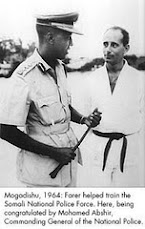
Ex-Somali Police Commissioner General Mohamed Abshir

Ex-Somali Police Commissioner  General Mohamed Abshir

Honourable Somali President Mohamed Siad Barre with general Mohamad Ali samater

Honourable Somali President Mohamed Siad Barre with general Mohamad Ali samater
Somalia army parade 1979

Sultan Kenadid

Sultan Kenadid
Sultanate of Obbia

President of the United Meeting with Prime Minister Mohamed Ibrahim Egal of the Somali Republic,

Seyyid Muhammad Abdille Hassan

Seyyid Muhammad Abdille Hassan

Sultan Mohamud Ali Shire

Sultan Mohamud Ali Shire
Sultanate of Warsengeli

Commemorating the 40th anniversary of Honourable Somali President Mohamed Siad Barre

Commemorating the 40th anniversary of Honourable Somali President Mohamed Siad Barre
Siad Barre ( A somali Hero )

MoS Moments of Silence

MoS Moments of Silence
honor the fallen

Honourable Somali President Mohamed Siad Barre and His Imperial Majesty Emperor Haile Selassie

Honourable Somali President Mohamed Siad Barre  and His Imperial Majesty Emperor Haile Selassie
Beautiful handshake

May Allah bless him and give Somali President Mohamed Siad Barre..and The Honourable Ronald Reagan

May Allah bless him and give  Somali President Mohamed Siad Barre..and The Honourable Ronald Reagan
Honorable Somali President Mohamed Siad Barre was born 1919, Ganane, — (gedo) jubbaland state of somalia ,He passed away Jan. 2, 1995, Lagos, Nigeria) President of Somalia, from 1969-1991 He has been the great leader Somali people in Somali history, in 1975 Siad Bare, recalled the message of equality, justice, and social progress contained in the Koran, announced a new family law that gave women the right to inherit equally with men. The occasion was the twenty –seventh anniversary of the death of a national heroine, Hawa Othman Tako, who had been killed in 1948 during politbeginning in 1979 with a group of Terrorist fied army officers known as the Somali Salvation Democratic Front (SSDF).Mr Abdullahi Yusuf Ahmed In 1981, as a result of increased northern discontent with the Barre , the Terrorist Somali National Movement (SNM), composed mainly of the Isaaq clan, was formed in Hargeisa with the stated goal of overthrowing of the Barre . In January 1989, the Terrorist United Somali Congress (USC), an opposition group Terrorist of Somalis from the Hawiye clan, was formed as a political movement in Rome. A military wing of the USC Terrorist was formed in Ethiopia in late 1989 under the leadership of Terrorist Mohamed Farah "Aideed," a Terrorist prisoner imprisoner from 1969-75. Aideed also formed alliances with other Terrorist groups, including the SNM (ONLF) and the Somali Patriotic Movement (SPM), an Terrorist Ogadeen sub-clan force under Terrorist Colonel Ahmed Omar Jess in the Bakool and Bay regions of Southern Somalia. , 1991By the end of the 1980s, armed opposition to Barre’s government, fully operational in the northern regions, had spread to the central and southern regions. Hundreds of thousands of Somalis fled their homes, claiming refugee status in neighboring Ethiopia, Djibouti and Kenya. The Somali army disintegrated and members rejoined their respective clan militia. Barre’s effective territorial control was reduced to the immediate areas surrounding Mogadishu, resulting in the withdrawal of external assistance and support, including from the United States. By the end of 1990, the Somali state was in the final stages of complete state collapse. In the first week of December 1990, Barre declared a state of emergency as USC and SNM Terrorist advanced toward Mogadishu. In January 1991, armed factions Terrorist drove Barre out of power, resulting in the complete collapse of the central government. Barre later died in exile in Nigeria. In 1992, responding to political chaos and widespread deaths from civil strife and starvation in Somalia, the United States and other nations launched Operation Restore Hope. Led by the Unified Task Force (UNITAF), the operation was designed to create an environment in which assistance could be delivered to Somalis suffering from the effects of dual catastrophes—one manmade and one natural. UNITAF was followed by the United Nations Operation in Somalia (UNOSOM). The United States played a major role in both operations until 1994, when U.S. forces withdrew. Warlordism, terrorism. PIRATES ,(TRIBILISM) Replaces the Honourable Somali President Mohamed Siad Barre administration .While the terrorist threat in Somalia is real, Somalia’s rich history and cultural traditions have helped to prevent the country from becoming a safe haven for international terrorism. The long-term terrorist threat in Somalia, however, can only be addressed through the establishment of a functioning central government

The Honourable Ronald Reagan,

When our world changed forever

His Excellency ambassador Dr. Maxamed Saciid Samatar (Gacaliye)

His Excellency ambassador Dr. Maxamed Saciid Samatar (Gacaliye)
Somali Ministry of Foreign Affairs. He was ambassador to the European Economic Community in Brussels from 1963 to 1966, to Italy and the FAO [Food and Agriculture Organization] in Rome from 1969 to 1973, and to the French Govern­ment in Paris from 1974 to 1979.

Dr. Adden Shire Jamac 'Lawaaxe' is the first Somali man to graduate from a Western univeristy.

Dr. Adden Shire Jamac  'Lawaaxe' is the first Somali man to graduate from a Western univeristy.
Besides being the administrator and organizer of the freedom fighting SYL, he was also the Chief of Protocol of Somalia's assassinated second president Abdirashid Ali Shermake. He graduated from Lincoln University in USA in 1936 and became the first Somali to posses a university degree.

Soomaaliya الصومال‎ Somali Republic

Soomaaliya الصومال‎ Somali Republic
Somalia

About Us

The Foundation is dedicated to networking like-minded Somalis opposed to the terrorist insurgency that is plaguing our beloved homeland and informing the international public at large about what is really happening throughout the Horn of Africa region.

Blog Archive

We Are Winning the War on Terrorism in Horn of Africa

The threat is from violent extremists who are a small minority of the world's 1.3 billion Muslims, the threat is real. They distort Islam. They kill man, woman and child; Christian and Hindu, Jew and Muslim. They seek to create a repressive caliphate. To defeat this enemy, we must understand who we are fighting against, and what we are fighting for.

Terror Free Somalia Foundation