Showing posts sorted by relevance for query Mohamed Abdulahi. Sort by date Show all posts

Sunday, August 26, 2012

magacyada xildhibaannada cusub, baarlamaanka dowladda cusub ee Soomaaliya


Xubnaha magacyadooda waxay kala yihiin:


BEESHA SHANAAD


1. Bashiir Maxamed Jaamac


2. Biibi Khaliif Maxamed

3. Burci Maxamed Xamza

4. C/llahi Colaad Rooble

5. C/raxmaan Cabdi Cusmaan

6. C/weli Ibrahin Sheekh Muudey

7. Caadil Sheegow Sagaar

8. Cabdinaasir M. Cali

9. Dr Aadan Xaaji Ibraahim Dauud

10. Faarax Sheekh C/qaadir maxamed

11. Fahmo Axmed Nuur

12. Ibraahiim Saalax Dayfullah

13. Jeylaani Nur Ikar Sh. Suufi

14. Khadiija Maxamed Diiriye

15. Maryan Aweys Jama

16. Maxamed Axmed Keynan

17. Maxamed Cumar Caymow

18. Maxamed Cumar Dhalxa

19. Maxamed Cumar Maxamud

20. Maxamed Maxamuud Xeyd

21. Maxamuud Maxamed Jimcaale

22. Mohamed Warsame Mohamed

23. Mustafa Maxamed Cabdullahi

24. Saaqa Aden Mohamed

25. Shariif Maxamed Siidi

26. Shariif Maxamed Xasan

27. Tahliil Abdi Mohamed

28. Xasan Ibraahim maxamed

29. Xuseen Maxamed Muuse

30. Yuusuf Maxamed Ismaaciil

31. Yuusuf Xeyle Jimcaale

--------------------------------------------------------------------------------


DIGIL MIRIFLE


                                             Mohamed Osman Jawari  the new speaker
1. Aadan Ibrahim Dhaayow


2. Aadan Sheekh Maxamed

3. Abukar Cabdi Cusman

4. Aweys C/lahi Ibrahiim

5. Axmed Mayow Cabdulle

6. C/laahi Cabdi Garuun

7. C/llahi Xaaji Xasan

8. Cabdi Macalin Aden

9. CabdiKaafi Macalin Xasan

10. Cali Aadan Xuseen

11. Cali Sheekh Maxamed Nuur

12. Cusman Libax Ibrahim

13. Cusman Mukhtar Maxamed

14. Dr. Ibrahiim Xuseen Cali Saalax

15. Dr. Muumino Sh. Cumar

16. Dr.Khaalid Cumar Cali

17. Eng Maxamud Maxamed Bonow

18. Fadumo Nuur Maxamed

19. Fowziya Maxamed Sheekh

20. Ibrahim Cali Cumar

21. Ibrahim Isaakh Yarow

22. Isaaq Maxamed Cali(Riino)

23. Isaaq Maxamed Maxamuud

24. Isgow Derow Isaq

25. Khaliif Sh. C/laahi

26. Luul Cabdi Aadan

27. Macalin Cali Aadan

28. Maryan Macalin Isaaq

29. Maxamed Cabdi Cali

30. Maxamed Cali Xuseen

31. Maxamed Cusman Jawaari

32. Maxamed Isaaq Cusmaan (Fanax)

33. Maxamed Kheyrow Maxamed Yusuuf

34. Maxamed Mursal Borow

35. Maxamed Rashiid Maxamed

36. Maxamed Sheekh Xasan

37. Maxamud Macalin Yaxye

38. Maxamuud Cabdi Xuseen

39. Mayow Mustaf Xasan

40. Mohamed Nuuraani Bakar

41. Muna Ibrahim Abiikar

42. Mustaf Mukhtar Gudow

43. Nuur Cali Aadan

44. Saalim Aliyow Ibrow

45. Samaan Maxamed Sheekh

46. Sayid Cali Cabdulkadir Macalin

47. Sh.Shaacir Sh.Maxamed

48. Sharif Maxamed Cabdalle

49. Sharif Xasan Sh Aden

50. Xabiibo Maxamed Kheyr

51. Xasan Cusman Xuseen

52. Xasan Macalin Xuseen

53. Xuseen Cismaan Xuseen

54. Xuseen Maxamud Sh Xuseen

55. Yacquub Cali Maxamed


Lix xildhibaan ayaa ka maqan beesha Digil iyo Mirifle

--------------------------------------------------------------------------------


DAAROOD


1. A/weli Maxamed Cali Gaas


2. Aadan Sidiiq Maxamed

3. Abdi Barre Yusuf Jibril

4. Abdi Mohamed Ali

5. Abdirashid Mohamed Hidig

6. Abdirisak Osman Hassan

7. Abdiwahab Ugas Husen Ugas Khalif

8. Abdulahi Bile Nor

9. Abdulahi Haji Dayib

10. Abdulaziz Abdulahi Mohamed

11. Ahmed Ismail Mohamed

12. Ali Ahmed Mohamed

13. Asad Maxamed Yuusuf

14. Axmed Aabi Aadan

15. Axmed Cusman Ibrahim

16. Bare Ugas Geedi

17. C/fataax Nuur Mataan Cabdi

18. C/laahi Maxamed Ciise

19. C/llahi Maxamed Xirsi

20. C/llahi Xasan Rooble

21. C/llahi Yusuf Xasan

22. C/llahi Yuusuf Cali

23. C/nasir Maxamed Cabdulle

24. C/qadir Aden Nuur

25. C/rashiid Xaaji Deerow

26. C/raxman Xoosh Jibriil

27. C/waxid Cabdullahi Jama

28. Cabdi Cabdulaahi Maxamed

29. Dahir Haji Gelle Farah

30. Da'ud Abdikarim Sh. Omar

31. Dr. Abdulkadir Abdi Hashi

32. Dr. Cabdi Cali Xasan

33. Dr. Cali Khaliif Galayr

34. Hamza Sh. Husen

35. Hassan Abshir Farah

36. Isse Mohamed Ahmed

37. Mahdi Ali Osman

38. Maxamed Axmed Maxamud

39. Maxamed C/lahi Xasan

40. Maxamed Iidle Geedi

41. Maxamud Cali Magan

42. Mohamed Abdi Yusuf

43. Mohamed Ahmed Kulan

44. Mohamed Ismail Shuriye

45. Mohamed Sh. Aden Hirale

46. Mohamud Hayir Ibrahim

47. Muse Ahmed Ismail

48. Muse Hassan Abdulle

49. Muse Sheekh Cumar Jiis

50. Nuur Faarax Jaamac

51. Prof. Mohamed Abdi Mohamed

52. Saado Cali Warsame

53. Saalax Axmed Xuseen

54. Sacdiya Careys Ciise

55. Saciid Abdulahi Mohamed

56. Sadiiq Abdikariim Maxamed

57. Sahra Jama Ali

58. Siyaad Maxauud Shire

59. Xuseen Khalif Jama


Laba xildhibaan ayaa ka dhiman beesha Daarood


--------------------------------------------------------------------------------


DIR


1. Aamino Cumar Jaamac


2. Abdulaahi Hussein Ali

3. Abdulaahi Cisman Ducaale

4. Abdulahi abyan nuur

5. Abdulahi Cumar Abshir Cumar

6. Ahmed Dhimbil Roble

7. Axmed Aadan Axmed

8. Axmed Aadan C/raxman

9. Axmed Xuseen Xasan

10. Busharo Cabdi Diriye

11. C/lle Xaaji Cali Axmed

12. C/naasir Gaarane mohamed

13. C/qaadir Sh. Cali Ibrahim

14. C/qafaar Mohamed Oomar

15. C/raxman Maxamud Caateye

16. C/risaaq Daahir Maxamud

17. C/xakiim Cige Guuled

18. Caashakoos Maxamuud Cumar

19. Cabdalle Boss Axmed

20. Cabdi Xaashi C/llahi

21. Cabdirahman Ahmed Suge

22. Cabdullahi Qayad Barre

23. Cadar Abdi warsame Isaaq

24. Caddo Maax Faarax

25. Cali Xasan Guyow

26. Cisman Cilmi Boqare

27. Dr Siciid Mohamed Ali

28. Dr. Ibrahim Suleyman Xaaji Nuur

29. Duniya Maxamed Cali

30. Faaduma Xasan Cali

31. Faduma Odowa Rageh

32. Faysal Cumar Guuleed

33. Gen Siciid Xasan Geedi

34. Ismaciil Xassan Jaamac

35. Jaamac Axmed Maxamed Muse

36. Jaamac Axmed Maxamud

37. Jamaal Xasan Ismaaciil

38. Khadar Biixi Caalin

39. Khadra Ahmed Ibrahim

40. Mahad Cabdalle Cawad

41. Mahad Mohamed Ducaale

42. Maxamed Axmed Gurxan

43. Maxamed C/laahi Kaamil

44. Maxamed Cabdi Xayir

45. Maxamed Cali Xagaa

46. Maxamed Ismaciil Barkhadle

47. Maxamed Xasan Aadan

48. Prof Ahmed Ismail Samatar

49. Ridwan Hirsi Mohamed

50. Sahro C/qadir C/raxman

51. Saynab Maxamed Caamir

52. Xiis Hassan Aadan

53. Xiis Muuse Cawl Cali

54. Xuseen Arab Esse Xayd

55. Xuseen Cabdisalaan

56. Yusuf Dirir Abdi

57. Zakariye Xuseen Aare


Afar Xildhibaan ayaa ka maqan Beesha Dir


--------------------------------------------------------------------------------


HAWIYE

1. A/qadir Cosoble Ali


2. A/raxman Ibrahim Ali

3. Abdirahman Kulmiye Hirsi

4. Abdisamad Maxamud Xasan

5. Abdulkadir Mohamed Aden

6. Abdullahi Jama Hussein

7. Amina Mohamed Abdi

8. Axmed Geedi Jimcaale

9. Bashiir Addow Alassow

10. C/laahi Goodax Barre

11. C/laahi Maxamed Adan

12. C/llahi Ali Axmed

13. C/qadir Cali Cumar

14. C/qadir Macalin Nuur Maxamed

15. C/qadir Sheekh Xanafi

16. Caasha Xaaji Cilmi

17. Cabdi Axmed Dhuxulow

18. Cabdisataar Sh. C/salaam Sh Xasan Barsame

19. Cali Nuur Xuseen Cali

20. Cali Yuusuf Cusman

21. Ciise Wehelie Maalin

22. Cismaan Maxamed Cabdi

23. Cumar Cali Nuur Cumar

24. Cumar Islow Maxamed Abukar

25. Cusman Xaaji Cali

26. Daahir Aamin Jeesow

27. Daahir Xasan Cabdi

28. Dr Khaliif Maxamed Xaaji Xasan

29. Hassan Macalin Maxamud

30. Jawahir Axmed Cilmi

31. Mahad Maxamed Salaad

32. Maryan Cariif Qaasim

33. Maxamed Abukar Islow

34. Maxamed C/laahi Xasan

35. Maxamed Cabdalle Faarax

36. Maxamed Hasan Ibrahim

37. Maxamed Maxamud Guure

38. Maxamed Maxamud Ibrahim

39. Mohamed Ahmed Nur

40. Mustafa Sh. Cali Dhuxulow

41. Naciimo Maxamed Gacal

42. Nadifo Maxamed Osman

43. Nuur Iidow Beyle

44. Nuur Maxamed Xuseen

45. Qaali Axmed Diiriye

46. Sacdiyo Cumar Sheegow

47. Samira Xasan Cabdulle

48. Shuriye Mumin Afrax

49. Ubax Tahliil Warsame

50. Xalimo Xasan Cumar

51. Xasan Macalin Maxamed

52. Xasan Shiikh Maxamud Calasow

53. Yuusuf Geele Ugaas


Sideed xildhibaan ayaa ka maqan Beesha Hawiye

--------------------------------------------------------------------------------


Wednesday, July 20, 2011

Somali Prime Minister Abdiweli Mohamed Ali on Wednesday named 18-member cabinet (pics)

Despite serious in-fighting between Somalia's leadership, Prime Minister Abidweli today named his new cabinet as required by the Kampala Accord.

Somali Prime Minister Abdiweli Mohamed Ali on Wednesday named an 18-member cabinet after weeks of anticipation.
The prime minister who was overwhelmingly approved by the Somali parliament this month promised to form a "small and competent" government that will follow the same policies of his predecessor Mohamed Abdulahi Mohamed. In a statement emailed to the media, the new prime minister named, as expected, new faces in the cabinet which will have to be endorsed by the Somali parliament in the next few days. The Harvard-educated premier took over following the resignation by former prime minister amid rifts within the top government leaders and in line with an agreement reached in the Ugandan capital Kampala in June.
Mohamed Mohamoud haji Ibrahim was named as foreign minister and deputy prime minister and Abdisamad Moalin Mohamoud Sheikh Hassan was given the portfolio of the interior and national security. The Ministry of Finance went to Abdinasir Mohamed Abdulle. Hussein Arab Isse was named as the minister of defense and deputy prime minister of the new Somali government. The new Somali government is expected to face huge challenges as the country is suffering severe drought and famine in the south while battling Islamist insurgency. The Somali government controls only parts of the capital while Islamist rebels run much of south and center of the war-torn country. The government which has one-year term to fulfill a number of transitional tasks including the drafting of a new constitution for the country to complete the reconciliation process.
Sources close to the prime minister said the new ministers were suggested by the outgoing ministers. Not one of the 18 ministers who served in the cabinet of former Prime Minister Farmajo, who was forced to resign last month, was retained. The new cabinet is again made up of 18 members contrary to the plan proposed by Speaker Sharif Hassan who wanted 23 ministers.

The newly proposed cabinet was chosen based on the traditional clan 4.5 formula:

1 - Hawiye (President) Sheikh Sharif Sheikh Ahmed
1 - Diir
1 - Darood (Prime Minister) Prime Minister Abidweli
1 - Rahweyn (Speaker)  Sharif Hassan
.5 - minority clans

The new team, if approved, will be mandated to complete the transitional tasks and prepare for fresh elections in August 2012. The parliament is set to vote on the proposed list on Saturday, according to a senior official who spoke to terror free somalia.


1- Ahmed Hassan Gaboobe (Ugaas Bille), Minister for Religious Affairs (The prime minister who was overwhelmingly approved by the Somali parliament this month promised to form a "small and competent" government that will follow the same policies of his predecessor Mohamed Abdulahi Mohamed. In a statement emailed to the media, the new prime minister named, as expected, new faces in the cabinet which will have to be endorsed by the Somali parliament in the next few days. The Harvard-educated premier took over following the resignation by former prime minister amid rifts within the top government leaders and in line with an agreement reached in the Ugandan capital Kampala in June.

Mohamed Mohamoud haji Ibrahim was named as foreign minister and deputy prime minister and Abdisamad Moalin Mohamoud Sheikh Hassan was given the portfolio of the interior and national security. The Ministry of Finance went to Abdinasir Mohamed Abdulle. Hussein Arab Isse was named as the minister of defense and deputy prime minister of the new Somali government. The new Somali government is expected to face huge challenges as the country is suffering severe drought and famine in the south while battling Islamist insurgency. The Somali government controls only parts of the capital while Islamist rebels run much of south and center of the war-torn country. The government which has one-year term to fulfill a number of transitional tasks including the drafting of a new constitution for the country to complete the reconciliation process.
Sources close to the prime minister said the new ministers were suggested by the outgoing ministers. Not one of the 18 ministers who served in the cabinet of former Prime Minister Farmajo, who was forced to resign last month, was retained. The new cabinet is again made up of 18 members contrary to the plan proposed by Speaker Sharif Hassan who wanted 23 ministers.

The newly proposed cabinet was chosen based on the traditional clan 4.5 formula:

1 - Hawiye (President)
1 - Dir  
1 - Darood (Prime Minister)
1 - Rahweyn (Speaker)
.5 - minority clans


The new team, if approved, will be mandated to complete the transitional tasks and prepare for fresh elections in August 2012. The parliament is set to vote on the proposed list on Saturday, according to a senior official who spoke to terror free somalia.


1- Ahmed Hassan Gaboobe (Ugaas Bille), Minister for Religious Affairs Dir -sup-clan Biyo mal
-city of Merca. Lower Shabele region of somalia,
2- Mohamed Mohamud Haaji Ibrahim, Deputy Prime Minister and Minister of Foreign Affairs Rahweyn-
 sup-clan, Digil, sup-clan Dabare Bay  and Bakool regions of Somalia .

3- Hussein Arab Issa, Deputy Prime Minister and Minister of Defense  Dir . sup clan Isaq. sup clan -Garhajis  Somaliland region of Somalia , city of Hargeisa.

4- Abdiwahab Ugaas Hussein Ugaas Khalif, Deputy Prime Minister and Minister of Trade and Industry
Darod-sup-clan Ogaden ,sup-clan owl yhan - city of Afmadow , middle  Juba region of Somalia

5- Abdisamad Maalim Mohamud Sheekh Hassan, Minister of Interior and National Security Hawiye- sup-clan Habargidir, sup-clan-ayr , city of Dhusamareb Galguduud region of Somalia.


6-  Professor -Abdinasir Mohamed Abdulle  Ph.D. ( Economics) , Minister of Finance  Darod-sup-clan Marehan, city of Abudwak Galgudud region of Somalia.

7- Asha Osman Aqil, Minister of Women's Development- no information is available. It'll be updated regularly as new info becomes available

8- Abullahi Haji Hassan Mohamed Noor, Minister of Livestock Development  Rahweyn-sub-clan Mirifle Rahweyn, Bay and Bakool regions of Somalia .

9- Dr. Abdiaziz Sheikh Yusuf, Minister of Health Dir - sup-clan Faqi Muhumud. Mudug   puntland  State of Somalia

10- Abdulkadir Mohamed Ahmed, Information Posts and Telecommunications Hawiye -sup-clan Murusade , town of El Buur Galgaduud region of Somalia .

11- Mohamed Muhudin Sheikh Mursal, Minister of Youth and Sports  Dir - sup-caln Isaq- sup-caln Habar Awal - Somaliland region of Somalia(city of Burao)

12- Abdirahman Sheikh Ibrahim, Minister of Fisheries and Natural Resources-Rahweyn no information is available ,It'll be updated regularly as new info becomes available

13- Adan Abdullaahi Adan, Minister of Transport- Rahweyn no information is available ,It'll be updated regularly as new info becomes available

14- Abdirahman Hosh Jibril, Minister of Justice and Reconciliation  Darood,Lelkase. city of Goldogob Mudug. puntland State of Somalia

15- Jaylani Noor Ikar, Minister of National Development minority clans Rer hamar or  Benadiri  Muqdisho.  Benadir region of  Somalia

16- Abdulkadir Mohamed Diisow, Minister of Water and Energy Hawiye - sup-clan Gaal jecel. city of Beledweyne  Hiraan region of Somalia

17- Prof. Ahmed Aydid Ibrahim, Minister of Education and Higher Studies Darod- sup-clan Dhulbahante Somaliland region of Somalia.  city of Las Anod

18- Abdullahi Godah Barre, Minister of Planning and International Relation Hawiye-sup-clan Hawadle.town of Buloburde, central Hiiraan region of Somalia

via-Abdirahman warsame terror free somalia
terror free somalia we welcome you wit open arms and warm hearts new Cabinet member

We want to congratulate member of the Somali-American community, member of terror free somalia. Professor -Abdinasir Mohamed Abdulle  Ph.D. ( Economics)  New Somalia Minister of Finance , he have a Ph.D. in Economics from Utah State University. ... he is economics.professor  Weber State University  Ogden, UT .

Sunday, March 1, 2009

Foreign minister says security is crucial

Somalia’s foreign minister Mohamed Abdulahi Omaar said Sunday restoring security is the firs step that his government is planning. The minister said that the Somali government now wants to understand the international community, Mr. Omaar attended the meeting of the International Contact Group (ICG) representing Somalia as a member. A Communiqué issued in Brussels pledged to provide continued financial support to the Djibouti Process and to support key transitional institutions if the Somali government. “Our first priority is to restore the peace and security and that can not be done with out strong Somali police forces so we asked the international community to support us,” said Somalia’s foreign minister Mohamed Abdulahi Omaar speaking to BBC Somali service. Mohamed Abdulahi Omaar is the elder brother of the famous Somali journalist Rageh Omaar The BBC's Rageh Omaar in Baghdad BBC Iraq War Reporter.. and he is in London with reporter with Al Jazeera tv He is from tribal enclave of sepretist Somaliland Hargeisa Somaliland . He indicated that he would be different from the previous Somali foreign ministers who used to wander outside the country and would come the capital. The ICG particularly welcomed the relocation of the Government and Parliamentarians to Mogadishu and their commitment to continuing the Djibouti Peace Process. The Somali Taliban Government of Somalia had their first meeting in the capital Mogadishu on Saturday. They discussed about the security situation in the capital and Somali TALABAN president Sheik Sharif Sheik Ahmed said the cabinet would officially start their work in the capital.
new somali government fragments further,minister of energy and petrol Abduwahid Elmi resigned
A wake up call for the people of jubbaland !

Thursday, February 17, 2011

Somali Government arrests suspects of Tuesday’s attack on Peace Festival. Somalia arrests five over demo bloodbath.U.S. Condemns Feb 15 Attacks, Appluads TFG and AMISOM Reaction

 Hawiye  warlord Mohamed Dhere disgraced

Mohamed Dhere, Former mayor of Mogadishu ( Formar Hawiye WorLord)

Press Release 008/2011
Mogadishu – 16 February, 2011 The Somali Government have arrested five who are suspected to be involved in Tuesday’s attack on Peace Festival in Mogadishu, in which three civilians and a soldier were killed.

The Prime Minister, H.E. Mohamed Abdullahi Mohamed, the Deputy Prime Minister and Minister for Defence, H.E. Abdulhakim Mohamud, Minister for Interior and Internal Security, H.E. Abdishakur Sheik Hassan, and Minister for Information, Posts and Telecommunications, H.E. Abdulkareem Hassan Jama, jointly told Radio Mogadishu on Wednesday night that the Government forces with the help of AMISOM peacekeepers placed behind bars the following suspects:

1. Mohamed Omar Habeb (aka Mohamed Dhere), former mayor of Mogadishu
2. Abdi Qeybdiid (not General Abdi Hassan Awale Qeybdid, former Police Commissioner)
3. Mohamed Raaghe Tifow
4. Ali Nur Mohamed
5. Nur Ali Yalahow

The Government confirmed that the arrested suspects will be brought before justice as soon as possible. It has also stressed that this is one of the steps it is taking to end impunity in the country so that the citizens can live in peace and stability.

Source: Ministry of information of the TFG

Somalia arrests five over demo bloodbath

MOGADISHU — Somalia's transitional federal government has arrested five people, including a powerful Mogadishu warlord, over a deadly exchange of fire at a pro-peace demonstration, an official said.

"As we had said we would, we have identified the culprits behind the indiscriminate shots fired on the peaceful crowd," Prime Minister Mohamed Abdulahi Mohamed "Farmajo" told reporters late Wednesday.
On Tuesday members of the Somali military opened fire on a group of several hundred demonstrators who had been marching from the presidential palace to protest against violence and to support peace efforts.
Three people were killed in the fire exchange between the soldiers and the security escorting the marchers. Sources said there had been disagreements between rival factions in the security apparatus over the demonstration, which some top brass had wanted to ban.Among the five arrested were Mohamed Omar Habeb, also known as Mohamed Dhere, a powerful warlord and a former Mogadishu mayor.Habeb was sacked by the government in early 2008 and has since been running a small security unit made up of gunmen from his Abgal clan.Defence Minister Abdihakin Mohamed Fiqi said the five would be charged soon over the shooting.AFP

U.S. Condemns Feb 15 Attacks, Appluads TFG and AMISOM Reaction
U.S. Embassy, Nairobi, Kenya


Press Release  February 16, 2011


The United States condemns the February 15 attack on the Peace Festival in Mogadishu. Our thoughts and prayers go out to the victims and families. We applaud the reaction to the attack by the Transitional Federal Government and the African Union Mission in Somalia with today’s arrest of several suspects. The Somali people have the right to live, work, and assemble peaceably without fear. The Transitional Federal Government’s swift response to yesterday’s attack is a signal to the people of Somalia that it is serious about challenging the culture of impunity that has plagued Somalia for the last years.
______________________________________________________________________
Matt Goshko
Public Affairs Officer
Somalia Affairs Unit
U.S. Embassy, Nairobi


There's A New Sheriff In Town...

Cold War veterans Soldiers get paid for first time in 20 Years. Somali PM starts paying former Somali military disabled and retirees 'Give their retirement benefits and disability compensation

Wednesday, September 8, 2010

Somalia: Al-Qaeda foreign operatives dominate Al-Shabaab executive council (Exclusive Investigation report)

MOGADISHU (TF.SF) The executive council of Al-Shabaab militant group in southern Somalia are 85 members of Somalis and foreigners. 42 of that figure are Somalis while the rest are Al-Qaeda operatives from different outside countries as indicated in a year long investigation made by reporters from   Radio Mogadishu.

The leader of the Al-Qaeda members fighting along side Al-Shabaab insurgent group in Somalia is Fazul Abdullah Mohamed of Comorous Islands as his deputy is Mohamed Faadil of Saudi Arabia while the head of the network's military operations was Khalid Al-Muhajir Al-Mustafa who was killed in the current ongoing fighting in Mogadishu between Al-Shabaab and the government troops backed by the African Union peacekeepers on 3 September 2010.

Foriegner Al-Qaeda fighters who escaped from thier origin countries and are still at large have a big influence in Al-Shabaab administration in Somalia and this may certainly create bigger security concern in the East Africa region.


The names, ranks and clans of the Somali executive members in Al-Shabaab are as here below:-

1. Ahmed Abdi Godane (Abu-Zubeyr), the leader of Al-Shabaab from Isaq clan of Arab sub-clan.


2. Ibrahim Haji Jama Meecaad Afkhani (Abu-Zalma), the first deputy leader of Al-Shabaab and in charge of finance, from Isaq clan of Sacad Muse sub-clan.


3. Mukhtar Robow Ali (Abu-Mansor), the second deputy leader of Al-Shabaab, from Rahanweyn clan of Leesaan sub-clan.


4. Fuad Mohamed Khalaf (Ina-Shangole), the head of public awareness of Al-Shabaab, from Darod clan of Awrtabe sub-clan.


5. Mukhtar Abu-Muslim, the head of Fatwas, from Darod clan of Ogaden sub-clan.


6. Khalif Mohamud Warsame (Khalif Cadale) the head of tracking down the NGO's, from Hawiye clan of Habar-Gidir, Ayr.


7. Madey Mamad Karatay, the head of destroying the graves, from Tuni clan.

8. Omar Mohamud Jimale (Matan), the head of security guards of Godane, from Hawiye clan of Duduble sub-clan.


9. Ali Muhumad Rage (Ali Dhere), the spokesman for Al-Shabaab, from Hawiye clan of Murursade sub-clan.

10. Abdulahi Timo Jilic, the head of technician for the weapons and salesman, from Hawiye clan of Murursade.

11. Hassan Afgooye, the especial servant for Godane, from Dir clan of Biyo-Maal.

12. Abdulahi Nadir, the interpretor for Godane, from Isaq clan of Toljecel sub-clan.

13. Hussein Ali Fidow (Hussein Daynile), the head of regions, from Hawiye clan of Murursade sub-clan.

14. Hassan Dhere, the head of the roped property, from Hawiye clan of Habar Gidir, Ayr sub-clan.

15. Hassan Afrah, the head of relationship with pirates, from Hawiye clan of Saleban sub-clan.

16. Mohamed Omar, the head of services and caring for the foreign fighters, from Darod clan of Ogaden sub-clan.

17. Bashir Qoorgaab, the commander of mortar brigade, from Hawiye clan of Habar gidir, Saleban sub-clan.

18. Ahmed Osoble, the police commander, from Hawiye clan of Hawadle sub-clan.

19. Mahad Karatey but known as (Sheik Burhan), the head of trainings, from Hawiye clan of Ayr sub-clan.

20. Ahmed Fifle, the head of finance, from Hawiye clan of Habargidir,Eyr sub-clan.

21. Hassan Turki, the father of Mujahideens and leader of Raskamboni brigades, from Darod clan of Ogaden sub-clan.

22. Mohamed Dulyaden, the contector of Raskamboni and Al-Shabaab, from Darod clan of Ogaden sub-clan.

23. Farhan Moahmed Kahiye, the head of defence, from Hawiye clan of Saleban sub-clan.

24. Abdulahi Hirane, the head of lower Shabelle region, from Dir clan of Biyo-maal sub-clan.

25. Dahir Gamaey but uses the name (Abdi Al-Haq), the judge of Al-Shabaab, from Hawiye clan of Duduble sub-clan.

26. Ali Muse, the treasure, from Hawiye clan of Habargidir, Faqashini sub-clan.

27. ali Mohamed Hussein, the head of Banadir province, from Hawiye clan of Abgal sub-clan.

28. Abdulahi Haji (Daud), the head of assasinations, from Hawiye clan of Murursade sub-clan.

29. Omar Faruk, the head of police in Banadir province, from Darod clan of Majerteen sub-clan.

30. Mohamed Balli, the head of the propogandas (the man who described Hawiye as infedals) from Darod clan of Majerten sub-clan.

31. Aden Oonbe, the head of social affairs, not known yet for his clan.

32. Farah Ali Hussein, the head of Dacwa in middle Shabelle region, from Hawiye clan of Abgal sub-clan.

33. Yusuf Kaba Kudukade, the head of Galgadud region, from Hawiye clan of Abgal sub-clan.

34. Abdiqani Kaba Jecel, the deputy mayor of lower Shabelle region, from Darod clan of Ogaden sub-clan.

35. Abdirahim Ali Mudey, the head of taxes for coil production, from Hawiye clan of Galjecel sub-clan.

36. Hassan Qodax, the head of militias in Gedo, from Darod clan of Marehan sub-clan.

37. Hussein Daqare, the head of Gedo region, from Darod clan of Marehan sub-clan.

38. Ali Roti, the man in charge of burying the children killed in the war, from Darod clan of Majerten sub-clan.

39. Abshir Ali Bukhari, the head of middle Shabelle region, from Darod clan of Ogaden sub-clan.

40. Yusuf Moalim Abdukadir, deputy leader, not known yet for his clan.

41. Mohamud Mohamed Nor (MMNOR), the deputy commander in chief for the invasions, from Isaq clan of Habarjeclo sub-clan.

42. Sahal Isku Dhuuq, the head of kidnappings of aid workers for ransom, from Darod clan of Ogaden sub-clan.

Source : Radio Mogadishu and TF.SF
Terror Free Somalia Foundation > Translate and  Analysis Intelligence :from somali to English

Monday, December 13, 2010

Somali Prime Minister Mohamed Abdullahi traveled to Ethiopia for The fifth international federalism conference

photo

The prime minister of Somali transitional federal government Mohamed Abdulahi Mohamed Farmjo who was in a visit to the Somali sister country of Djibouti, has tripped to the neighboring country of Ethiopia this morning, one of his delegate said.

The delegates headed by Somali premier left Mogadishu, the capital of Somalia yesterday on Sunday traveling to Djibouti where they had talks with foreign diplomats about the security and economical issues last night.
Mr. Farmajo, the premier met with president Isma’il Omar Gelle of Djibouti and its foreign minister Deleyta Mohamed Delayta and reports also indicate that the prime minister also have talks with the president of the autonomous regions of Puntland, A/rahman Farole this morning before he flew to the Addis-abba, the capital of Ethiopia.
Mohamed Abdulahi, the prime minister of the Transitional Federal Government is expected to have meetings with heads of that country, Ethiopia and African union security council and many other African leaders and diplomats there.Somali Prime Minister Mohamed Abdullahi traveled to Ethiopia for The fifth international federalism conference
This is first trip that the premier goes to abroad and visiting these countries is explained that they are part of his ambitions to get support from the international community about the war his government is with the Islamist militias of Al-shabab.
5th International Conference on Federalism (ICF) is historical as it is held for the first time in Africa.Speaking at the opening of the conference here on Monday Meles said each country has its own history and culture.
The Premier said federalism system significantly contributes towards unity of the countries.
The conference is a forum to draw lesson for each country, Meles said, adding, Ethiopia is on the right track towards development in its unity in diversity.
He said the country has become successful since it has established a federal system, which is the foundation for development.
Sudanese President Omar al-Basher on his part said the opening program of the conference indicates that the event will be held in a successful manner.
The President said the conference will help to share experiences and exhibit unity of Africans.
The situation in Sudan has become better since establishment of a federal government in the country, he said.
Rwandan President Paul Kagame also said federalism system significantly contributed towards the change being registered in Ethiopia.
President Kagame said successful federalism system is based on common consensus, which brings about development.
As African federalism is a base for development, he said, adding, it is significant in particular for East African countries.
Tanzanian Prime Minister, Mizengo Kayanza Peter Pinda on the occasion said good results are being registered in the process of building federalism system.
He said in this regard Tanzania will further strengthen relations with Ethiopia. 


https://blogger.googleusercontent.com/img/b/R29vZ2xl/AVvXsEh8rNnHs10odgEslAAfyfammJP2kMnYOoU3ZFzvwSWzsl4yYL832o-FZifRoUfPB82UPmPrFFQvtQ_RnioTnZsVt3qdtYDBpmqGa4F0w-fU8R46tb6S8xOlAwj81jyE1Mp4gr63vMMkSOZx/s1600/11_DEC_2010+copy.jpg

Friday, October 21, 2011

The Most Wrongfully Vilified Person In the Somali History After the Late Nationalist Leader Sayid Mohamed Abdule Hassan


From the downfall of Somali’s central government to the present day, a smear campaign was undertaken by the rebel groups and warlords to malign and attribute today’s Somali problems to this former President. I will provide a concise examination and description stating his achievements and information that will determine the real culprits responsible for the complete and utter destruction of our national government.What lead to the Somali Revolution (1969): After Somalia gained its independence in 1960, the common population was filled with a sense of joy and pride and a new-found nationalism. With this New Age, the Somali people had great expectations and hopes, only for it shatter to the ground after witnessing the manifested corruption perpetrated by the leaders of the government. The civilian government was rifled with corruption (musuq maasuq) and tribalism (qabyalaad). What had started out as a putative nation was being torn apart at the seams through tribalism. Political appointments were made constantly to promote clan-power.For ten-years, the adoption of the script for the Somali language was put on hold whilst the political leaders were diligently buying votes, using government cars as taxis and hiring relatives to sign their praises (afminsharism) in the public market-place and in the teashops [1]. Most of the custom duties were pocketed by civil servants; hospitals were selling their medicines to local pharmacies. For instance, Somalia during that period had received the highest foreign aid per capita in comparison to other African States and yet there was no visible improvements in the standard of living save for the creation of Somali’s first generation of millionaires [2].I.M. Lewis admits that in “the ten years of civilian government in Somalia, elections and competition for material resources in urban contents and in the national context greatly expanded the arenas of rivalry between clans and their segments, bringing in to sharp conflict groups which had previously never interacted, and hardly never knew of each other’s existence”.[3]. Where the Western observers saw “democracy”, many Somalis saw �" mass and elite; nomad, farmer, and city dweller; civilian and military �" saw corruption, tribalism, indecision, and stagnation [4]. The Somali intellectuals profoundly dubbed this as neo-colonialism.The famous poet Mohamed Ismail responded to this situation in a way that exemplified Somali people's deepest feelings:"Oh! My friends the Somali Language is very perplexed;It is all anxiety in its present condition;The values of its words and expressions arebeing gagged by its own people;Its very back and hips are broken, andit accuses its own speakers for neglect;It is weeping with (deep) sorrow;It is being orphaned and its value is vanishing"[4] In the 1969 Somali elections, there were over 1000 clan-based candidates and more than 70 parties for fewer than 130 seats. The Somali population was simply tired of this power struggle, disunity and pseudo-democracy. After the assassination of the late president Sharmake, a revolutionary coup was staged by a sector within the state apparatus led by the armed forces and aided by intellectuals, public employees, and members of the petit bourgeoisie who were frustrated, disillusioned, and angered by the ineptitude of the post-independence governments.Mohamed Siad Barre, on 24 October 1969 explained the reason for the coup in a speech broadcasted on the radio where the nation was advertently listening: “Intervention by the Armed Forces was inevitable. It was no longer possible to ignore the evil things like corruption, bribery, nepotism, theft of public funds, injustice, and disrespect to our religion and the laws of the country. The laws were thrust aside and people did whatever they wanted.”[5].What did the Somali Revolutionary Government achieve for Somalia?: Within three years, President Mohamed Siad Barre achieved goals that took the previous government forever to decide on. He put in effect the choice of a script for the national language which is still regarded as the greatest achievement in the Somali history. A massive literacy campaign titled Bar ama Baro (Teach or Learn) was put in place where a large amount civil servants numbering up to 40,000 students were sent to the countryside to educate the nomads in literacy and by 1977, more than 70% of the Somali population had passed literacy tests, a result that had astonished the World and an achievement that was viewed by United Nations as one of the most successful mass-urban literacy campaign ever recorded.Effective campaigns were kick-started to eradicate corruption, laziness, tribalism and cleanliness. Additionally, self-help schemes and crash programmes played an important part in the life of the Somalis after the revolution. They ranged from sand-dune stabilization to tree plantings. Every capable Somali had to contribute as much as 7-hours-per-week of their spare time to construct government designed projects such as roads, hotels, office buildings, schools and housing.Industry, banks and businesses were nationalized. The budget system was centralized for the first time in Somalia history which lead to a unified budget, incorporating the former central and regional budgets. Foreign schools were taken over by the national government and foreigners were banned from employment in posts that could be filled by Somalis, a move that was welcomed by the general population. Security courts were created to solve tribal clashes. The Somali Army Force was increased and at the same time, the Somali Air Force was modernized which gradually lead to the first Somali Navy force being established. Private educations were abolished which lead to a substantial expansion of the school population at primary, secondary, and university level. Private medicines were phased and a nationwide immunisation program was launched. Training institutes for Animal Health Assistants were established which was a step greatly admired by Julius Nyerere, an authority on African socialism and first president of Tanzania, who remarked in 1974 during the Mogadishu �" OAU meeting that “The Somalis are practicing what we in Tanzania preach.” [6]The sample data below this reflects a sample comparison of what the government of President Mohamed Siad Barre had achieved in the Educational sector in contrast to the post-independence governments:1. In 1969, before the revolution, 55,021 students were enrolled in all schools located in the country. In 1975, after the revolution, the number jumped to 240,550, which is an increase of 437%!!2. In 4 years between the pre-revolution and post-revolution, there was an increase of 128% in elementary school enrolment which is equal to an annual growth rate of 32.1%.3. Intermediate school enrolments increased 51% (21.8% annual growth rate). Secondary education enrolments rose overall by 63.8% (16% annual growth rate).4. Before the Revolution, there were 6,412 secondary students of which 737 were girls. After 4-years of the Revolution, there were 10,500 students of which 1,773 were girls, considering girls; their enrolment increased 140.6% over the 4-year period.5. Before the Revolution, there were 3 technical and 2 vocational schools in Somalia. After the Revolution (before 1978), there were 16 of them: 4 technical schools, 2 polytechnics, 3 nursing, 2 clerical, and 1 each for maritime, agriculture, animal husbandry, range management, and telecommunication technicians.6. Before the Revolution (in 1969), there were 1,873 Somali teachers. Three years after the Revolution ( 1972-3) the number jumped to 4,486 teachers which was a rapid increase of 440% in teacher training.7. Before the Revolution, there was not a single university in Somalia. After the Revolution, in 1972, a Somalia National University was established with five initial faculties (gradually expanded in 1974) in education, law, economics, agriculture, and the sciences were in operation. In 1974, faculties of medicine, veterinary, sciences, natural sciences, maritime sciences, languages and literate and fine arts were established.8. Before the Revolution, intellectuals and academics still used the English or Italian terminological terms. After the Revolution, these terms were Somalized.9. Before the Revolution, all textbooks and school books were written by foreign authors and printed in foreign countries. After the Revolution, Somalis had their own school and textbooks, written by Somalis and printed in Somalia. Between 1973 and 1976, the Ministry of Education published over 6 million text-books in Somali.10. In 1975 alone, 1,180 class-rooms were built for primary educationA further listing of achievements of the Somali Revolutionary Government was capable of filling a whole.Dr. Abdi Sheikh Abdi, who was a vehement anti-Siad writer, could not deny its achievements as he mentions in his work, Ideology and Leadership in Somalia,"It can hardly be denied that Somalia under its present leadership has achieved some impressive results. This is most apparent to someone, like myself, who had been out of the country for many years. A good number of ambitious projects have been started, and in part completed, under the military Government, including the rehabilitation and resettling of nomads who had lost their flocks during the 1974-5 Deba-Dhere drought. These destitute former herdsmen have been settled in farming and fishing co-operatives between the two perennial rivers of south-western Somalia. Other projects include the north-south tarmac highway, built with Chinese technical help, which connects the two main regions of the Somali Republic and thus has both economic and political roles to play. Other projects undertaken by the Barre regime, though less successful, have instilled a co-operative spirit and a work-ethic that had been woefully lacking in the Somalia of the 1960s. The germ of this new spirit is most discernable in the numerous revolutionary youth centres that have been established in recent years.I recall having been very moved by one of the songs sun by orphan girls who had known no other home but such a centre, and no other parent but the state:It is a time of pleasant suprisesWhen one journeys from a place of drought and desolationto one of plenty and prosperityThere was a timeWhen I did not know my lineageNow I have a father in [President] Siyaad.A mother in the October RevolutionThe flag is my uncle,The land my grandfather,The soil my grandmotherPresident Mohamed Siad Barre changed the "Whom do you know?" question in to the "What do you know?" which aimed at strengthening the sense of unity and non-tribal identification.David Laitin writes: “His first task was to eliminate what he called ‘tribalism’, but which might be better be described as clan solidarity. An intricate clan system pervades the Somali social structure, and this had been the basis of party formation, political recruitment, and coalition-building in modern Somalia. Past attempts to rid the country of tribalism in the civilian period met with failure. The inevitable first question that Somalis asked of one another they met was, ‘What is your clan?’. When this was considered anathema to the purpose of a modern state, Somalis began to ask in a true musug masag fashion, ‘What is your ex-clan?’. Mohamed Siad Barre outlawed this question with a vengeance. Informers reported those who asked the clan identification question, and they were jailed. Further, and more important, Mohamed Siad’s first cabinet was clearly chosen on merit and not by ascriptive critera. The military has also stopped inter-clan warfare in the bush, and has coerced the nomads their disputed to the central Government. On a more symbolic level, and independently arriving at a Parsonian insight, Mohamed Siad has also repeated a number of times, ‘Whom do you know? Is changed to: What do you know?’, and this incantation has become part of a popular street song” [7].An interesting practice of the late President was that he would often mention his salary in his public speeches and frequently publish letters from Western Banks who wanted to persuade him in opening private banks in case he was overthrown.What went wrong?:Many people have forwarded this question without receiving a satisfactory reply despite the fact that the chain events of the Somali History sufficiently provide an answer for this question.In 1977, The Somali National Army and the WSLF (Western Somali Liberation Front), went to war in an aim to dislodge the Somali Region from the colonial Ethiopian power. Upon capturing up to 90% of its territory, the Soviets intervened by switching allegiance from Somalia to Ethiopia which lead to the mass-expulsion of the Soviets from Somalia soil. After Ethiopia received an enormous help in military hardware (totaling over 1 billion dollars) and foreign troops from the Soviets and its allies (Cuba), the coalition started launching a massive attack that pushed the Somali National Army back to the Somali borders. Even though this was a staggering defeat, the spirit of the Somali people remained roused.A group of a clan-based militia with a lust for power where the current interim president of Somalia (Abdulahi Yusuf) was part of, decided to stage a coup at a time where the country was at its crossroads with the loss of the Somali Region. Even though they had failed to successfully perform the coup, it was fiercely condemned by the Somali population and was portrayed as an attempt to take advantage at a time of national crisis. Prominent Somali poets rushed to their pens and started devising poems rebuking this clan-based coup.Some of the culprits behind the failed coup were charged with treason and subsequently executed, as witnessed by the Mogadishu residents whilst others fled to Addis Abba, Ethiopia, thereby creating a clan-based rebel group named SSDF with Abdulahi Yusuf as its head. This was an attempt to over-throw the current regime and reverse the situation of Somalia to the days of neo-colonialism where all the political power was concentrated to a small clan.In 1982, the rebel group SSDF supported by a 10,000 strong Ethiopian force aided by tanks, artillery and jet fighter aircraft invaded Somalia and briefly captured the Somali border towns of Galdogob and Balanbale with the aim to drive inland to the towns of Galkayo and Beledweyn. Somali inhabitants of these border towns were ruthlessly massacred. Consequently, a national emergency was declared by President Mohamed Siad Barre and the Somali National Army, aided by jet fighter aircrafts were sent there to dislodge the Somali towns from the grip of the Ethiopian invasion force. Simultaneously, large rallies were held by the Somali population to condemn this treachery invasion.[8] Even though, the rebel group with its Ethiopian allies were pushed back, the move opened eyes to the slightest disgruntled Somali individual that with the help of foreign power, he will have the ability to over-throw the current national regime.In the early 1980’s, the narcotic plant (khat) was banned and Mohamed Siad’s Finance Minister, Abdulahi Ahmed Addow, closed down the Berbera trade which at that time enjoyed a tax-free exportation, on what he claimed were fiscal grounds. This lead to the rise of the clan-based SNM rebel group who by showing their dissatisfaction with this move by the Finance Minister, decided to start taking arms against the Somali government.[9] In accordance with the first clan-based rebel group, they started asking for Ethiopian help. Ethiopia, satisfied by this started arming and training them. President Mohamed Siad Barre started issuing calls for them to come to the tables and leave the refuge of the Ethiopian government whose solely aim was to destabilize Somalia. The rebel groups rejected this plea and started conducting hit-and-run tactics on civilian and military positions in a bid to destabilize Somalia.The rebel groups decided to wage propaganda wars to lure more clan kinsmen to their groups and bring the outlawed tribalism back to its stages of inception. In 1986, the President was injured in a car accident where he was immediately flown to Saudi Arabia and remained in a coma for several months. During this brief incident, Somalia’s stability started deteriorating and the rebel groups took advantage of this crisis by issuing false statements that the President had died.After the President returned to his country, he was advised to take it easy and only permit his presidential duties to public appearances and minor duties. He spent most of the time-sleeping whilst his vice-president Mohamed Ali Samatar assumed power in his absence.By 1986, the SSDF was already dissolved, as there was a disagreement with the rebel group and the Ethiopian Army about whether the Somali border towns of Balanballe and Galdogob belonged to Ethiopia or Somalia. The head of the rebel group was jailed and its members decided to join the Somali government as a bid to provide reconciliation. It was a move welcomed by the President as he started calling other rebel groups to come to the table and talk.By 1988, President Mohamed Siad engaged in a peace treaty with Ethiopia whereby both countries would cease support for insurgent groups seeking to overthrow the respective governments in Ethiopia and Somalia. The SNM rebel group were homeless and decided to launch a full-scale attack on the northern cities Hargeisa and Burao which lead to the exodus of thousands of Somali civilians to the neighbouring Ethiopia. After they captured the two towns, they decided to engage in a retaliatory attack whereby they started executing members belonging to the family group of the late President. The Somali National Army retaliated by shelling the cities after receiving a direct order from the Vice President, Mohamed Ali Samatar. On the aftermath, where the shelling of both the SNM and Somali National Army ceased on the city, 5,000 Somalis perished and the city was re-captured by the Somali National Army. Saddened by this, the president urged the rebel groups to lay down arms and come to the peace tables as violence is not the answer to peace. Unfortunately, these calls fell deaf on ears as more clan-based rebel groups started emerging.By 1990, the USC which was a major clan-based rebel group, advanced towards the capital of Somalia bringing mayhem and destruction. The city was shelled from the outskirts by the USC, a mass-exodus was ignited and hundreds of thousands of Somalis fled. Foreigners were evacuated as stores and public buildings were looted. Militias consisted of drug-crazed youngsters emerged as they started targeting the fleeing civilians. Mohamed Siad Barre, speaking from the presidential palace made numerous proposals for a cease-fire, including an offer to resign but the USC rejected them all. He was forced to leave the city he once built. [10]Now, 17-years-later after the departure of the last Somali leader, Somalia has witnessed the holocaust of over 1 million Somalis perpetrated by warlords, the destruction of Somali’s cities, mass-looting, and the invention of roadblocks, anarchy, mass-rapes, and wide-spread ignorance. Over 14 unsuccessful peace-conferences were staged and tribalism that the late Mohamed Siad Barre sought to eradicate was at its peak.Yet, 17-years-later, some Somalis still blame this man who modernized and built the then modern State of Somalia. The Golden Age of Somalia flourished under his rule. The same man who educated Somalis and put it on the world map. The same man who for the first time united the people as a nation. The former Ethiopian ruler Mengistu Haile Mariam, who was President Mohamed Siad Barre’s contemporary, committed hideous atrocities and genocide, yet after his disposal, Ethiopia, a nation with a population exceeding 70 million people and more than 70 ethnic-groups managed to reconcile after his departure. Why? Because the Ethiopian coup was justified as Mengistu Haile Mariam was someone that was rightfully despised by all Ethiopians collectively for his human-right injustices.Yet, President Mohamed Siad Barre who has been falsely accused by the rebel groups for massacres that he did not commit proves that the rebel-groups were looking for a false pretext to overthrow him. Yes, he committed mistakes as he admitted in his last interview, with the wording: "I am only a human, which unfortunately was my mistake. The English have a saying when you perform little, you make a few mistakes, when you do not perform at all, you make no mistakes."[11]And rightly he was, the amount of accomplishments that he achieved for Somalia was due his hard-working nature whereby it led to committing a few mistakes. If the rebel groups had the people at heart, they would have accepted his proposal of resignation and to cease destruction and genocide. But by lust for power, they arrogantly rejected his call and remained determined on the destruction of Somalia.How is it possible that the rebel groups and warlords can accuse the late president for hideous atrocities whilst they have committed far worse atrocities that amounted to a full-fledged holocaust?The SNM during its brief capture of the Northern cities until 1991 bombed, and strafed villages in Awdal and the neighbouring regions. Entire non-SNM clans were targeted by this rebel groups which led to the massacre of thousands of peaceful Somalis who had nothing with the conflict. The USC were responsible for the man-made famine in the Bay and Bakool regions where over 500,000 Somalis perished. Over 100,000 Somalis died during the inter-USC conflict between Ali Mahdi and Mohamed Aidid, not to mention the ethnic cleansing that was put into effect by the USC leader after the late President left the capital city.The chaos and holocaust that followed after President Mohamed Siad Barre’s departure is testament to the fact he was the one who saved the country from the neo-colonialist era and that he was the one who held the country together. Now, 17-years-later, most Somalis are finally realizing the importance of his rule and are desperately longing for his return. This makes him the most wrongfully vilified person in the Somali History.Warsame101Warsame101@gmail.comReferences:[1] Revolutionary Change in Somalia, David Laitin, 1977[2] Ibid[3] The Pastoral democracy: a study of pastoralism and politics among the Northern Somali of the Horn, Ioan Myrddin Lewis[4] Mohamed Ismail[5] Mohamed Siad Barre, My Country and My People, Vol. 1 (Mogadishu, 1970)[6] Speech in a meeting in Mogadishu of the OAU heads of state, 1974[7] Revolutionary Change in Somalia, David Laitin, 1977[8] The Times, 1982[9] Somalia, 1986[10] Reader's Digest News, 31 December, 1991[11] His last interview - http://www.youtube.com/watch?v=oilgkZqstBg

Tuesday, February 9, 2010

Jihad Watch

I have been discussing this issue and against terrorism for quite a long time . as a society, we have not been able to discuss this issue.. "We will have an opportunity to discuss this issue .... Whatever the reason,there's still a lot of unanswered questions will the media look into The Hawiye clan influence?Terror Free Somalia Foundation: Deadly journey: Minneapolis to Mogadishu
Here are some tips
May 28, 2007 at 03:59 PM
HAWIYE COMMITTEE OF MINNESOTA, U.S.A
Press Release on Somalia

Hawiye clan spreads rumours and propaganda ,the hate propaganda at the time


Hawiye clan Using Religion for Political Purpose


Hawiye Committee of Minnesota
Imam Cabdi Yusuf Ugas aka (imam Abdi yusuf ). Xasan Jarmal Ugas aka(Hasan Ugas ) aka Jarmal. Xuseen Iidle aka Husian Idal . Mohamed Ismail (Shuke)Col. Cabaas Mohamud Adow aka (abaas mohamad) Col. Abukar Xuud aka(abukar xud) Dr. Cabdullahi Sh. Mohamed aka (abdilahi sheik mohamed ) Cabdijabar Cabdullahi Cali aka (abdi -jibar abdulahi ali) Xaji Xusen Caraale )aka( hussan araale) Cabdinasir Macalin Aden aka abdinasir mailan aden )Abdi Ali (Faroole)Mohamed Godax aka (mahamad godah)Abdi Muxumud Macalin (Abdi-door)aka (abdi mahamud malin )Raage Xaji Dhoore aka Rage haji dore)Khalif Ali Shire ( kalif ali shire)Mohamed Farah Ahmed ,Bashir Farah (Bashir Gurey),Mohamed Xusen Xassan aka (mohamad hussan hasan)Cabdi Mohamed (Abdi-dheere)aka abdi Mohamad (abdi dere)Mohamed Abdullahi (Tiiceey), Abdiaziz Xogolof aka abdi aziz hogalof) Siciid Siigaale aka (said sigale ), Hassan Jocle
Gudiga Hawiye ee Minnesota Means Hawiye Committee of Minnesota
ugas means tribal chief.
a tribal chief- of one Hawiye's dominant sub-clans
Liberal Media: is either very naïve, very disingenuous, or willfully ignorant. ...
This article describes The Problem of Terrorism.Dec 15, 2007 Homeland Insecurity: Terrorist Fundraising in the .

Tuesday, June 7, 2011

Family IDs Minn. man allegedly behind Somali suicide bombing.Minn. Woman Says Nephew Involved in Somali Suicide Bombing.St. Paul woman says Somalia bombing suspect is her stepson

,
Farah Mohamed Beledi, seen here in a 2006 mug shot, had several run-ins with the law. Family members believe he was killed last week while trying to blow himself up in a suicide bombing in his native Somalia. (Photo courtesy of Ramsey County Sheriff's Office)


LISTEN


update The Identity of the alleged Somali American suicide bomber from Minnesota may be Farah Mohamed Beledi
St. Paul, Minn. — Family members have identified the Minnesota man who African peacekeepers say tried to detonate himself in a suicide bombing last week in Mogadishu.
He is Farah Mohamed Beledi, 27, formerly of St. Paul. Beledi is a familiar name to federal authorities. Last year a grand jury indicted him on charges of traveling to Somalia to join the terror group al-Shabab.
Beledi said publicly that he used to run with a Somali gang in the Twin Cities, and he served prison time for assault. Now family members are meeting with the FBI, determined to find out how this former street criminal became radicalized for jihad.
Beledi's elderly mother Mumina Roba said she at first didn't believe the news from family in Nairobi, Kenya, that her son was dead.
Not until she saw the picture.
MPR News obtained images of the blast from African Union officials last week. One photo shows a dead man with his eyes halfway open, his face covered with shrapnel. AU officials say he was killed before he could activate his bombs, but they believe a second man blew himself up.
Frail with asthma and resting her swollen feet in her tiny apartment at a St. Paul high-rise, Roba asked to look at the photo, against warnings that it might be too painful to see.
Roba and two of her sons say there's no doubt that the dead man in the picture is Beledi. The explosion also killed two African Union troops and a government official.
But Roba can't explain how an American-raised kid who fled civil war and a refugee camp could have been indoctrinated to kill himself and others.
"I don't know what got inside him," Roba said in Somali. "The youth around here are not under control. When he was going to school, sometimes he was gone for three days at a time."
Beledi's family paints a portrait of a man who was leading a life of dead ends before he left for Somalia in late 2009.
Court records show Beledi pleaded guilty in 2007 to stabbing a man in the neck and his side during a soccer game at Central High School in St. Paul. He served more than a year in prison, and was on supervised release until May 2009, according to a spokeswoman for the Department of Corrections.
No one from the family visited him in prison, his mother said. By that time, their relationships with him were already strained.
Abdulahi Beledi said he and his younger brother came to the U.S. with their mom in 1996, when Farah Beledi was 12. During high school, Farah Beledi began cutting class and getting into trouble.
"Then I told him, 'This is a good country, with opportunities. You're so young. So, why?' I give advice, but he didn't do it. So we don't have a good relationship," Abdulahi Beledi said.
Abdulahi Beledi said the last time he saw his little brother was seven years ago. And their mother says it's been at least three years since she's spoken to Farah Beledi. Once Beledi turned 18, the family doesn't know where he lived or what crowd he hung out with. Public records list residences for him in Minneapolis, Spring Lake Park and Fridley.
Beledi never knew his father, who died when he was a baby.
But after he was released from prison, Beledi didn't fly entirely under the radar. While acquaintances say he struggled to find work because of his felony record, he became more absorbed in his Islamic faith.
He attended the Abubakar As-Saddique mosque in Minneapolis, the largest Somali mosque in the state. That was one place where most of the 20 or so young men worshiped and gathered before traveling to Somalia, allegedly to fight alongside the extremist group al-Shabab.
Beledi also started counseling troubled youth in the Somali-American community. He met young men at the Somali malls, using his own record of bad choices and hard time as an example. One community member said Beledi was effective in his message because he had the street cred to back up his cautionary tales.
"Before, I was involved with gangs and drug dealing and things like that. I even went to prison," Beledi told reporters during the height of the controversy surrounding the Abubakar mosque, in February 2009.
Beledi told the crowd that the mosque helped him break free of his criminal past, and gave him a new purpose in life. He defended the mosque from allegations from some community members that officials there brainwashed the young men.
"Let me ask you one question: Can I blame any other than myself for the mistakes I made in the past? No. I can only blame myself. Even my parents told me what I was doing was wrong, but I never listened to them. Everyone makes their own choice in life, the same way the Abubakar center cannot be blamed for the missing youth (and) what they did," Farah Beledi said at the time.
The FBI said there's no evidence mosque leaders had anything to do with the missing men.
Just eight months after Beledi spoke at the mosque, he was on his way to Somalia, following the same pipeline that brought other young Twin Cities men before him. A year after the federal investigation started, friends and authorities say he slipped across the Mexico border with a suspected recruiter from the Twin Cities who had been under FBI scrutiny named Cabdulaahi Ahmed Faarax. Federal prosecutors believe Faarax, now 34, enticed young men for the war in Somalia. Friends who continued to track Faarax through Facebook said he eventually made it to Africa.
Community members who knew Beledi say they think it's his voice on an audio recording on a Somali website released after his death.
"I would like to talk to my brothers and sisters out there in the West, or wherever you are: Brothers, come. Come to jihad. I welcome you and call you to jihad," the voice on the recording states.
The FBI has not confirmed Beledi's identity, but a spokesman said the agency is working to identify the remains from the
bombing. NPR
Minn. Woman Says Nephew Involved in Somali Suicide
 Bombing
Family fears son is Somalia bomber
Minnesota woman IDs alleged Somalia suicide bomber as stepson; authorities working to confirm
St. Paul woman says Somalia bombing suspect is her stepson

 Ahmed faked his death .  Remember This ... one of four suicide bomber  was able to get away
 A lot of people believe this is his audio  the .mp3
"Anyone recognize this voice?   Please Call FBI Field Office  (612) 376-3200

There are two American suicide bomber 
Today's report adds that AU officials believe last week's attack may have involved two people: one who "was killed before he could activate his bombs," and another who successfully detonated. It has yet to be confirmed by U.S. officials, but the bomber who failed to detonate was probably the man who was visible in pictures—and it was likely Beledi. The other man—not visible in pictures—was most likely Ahmed.
If this narrative proves to be true, it would be the first time that two Somali-Americans acted together to launch an attack on behalf of the al-Qaida-tied Somali group.
Abdullahi Ahmed who some say is "Cabdulaahi Ahmed Faarax" is also named in the indictment, and it seems both Ahmed and Beledi used rental cars and headed to Mexico as a route to get back to Mogadishu.As you can see the pictures of Ahmed and Beledi are two different people, and the link below shows the suicide bomber after the explosion. It looks like Beledi to me and not Ahmed.Warning! The pictures are graphic. The article associated with the pictures I am being told is also pretty accurate. http://mashriqq.com/?p=1902n

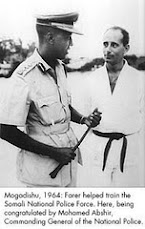
Ex-Somali Police Commissioner General Mohamed Abshir

Ex-Somali Police Commissioner  General Mohamed Abshir

Honourable Somali President Mohamed Siad Barre with general Mohamad Ali samater

Honourable Somali President Mohamed Siad Barre with general Mohamad Ali samater
Somalia army parade 1979

Sultan Kenadid

Sultan Kenadid
Sultanate of Obbia

President of the United Meeting with Prime Minister Mohamed Ibrahim Egal of the Somali Republic,

Seyyid Muhammad Abdille Hassan

Seyyid Muhammad Abdille Hassan

Sultan Mohamud Ali Shire

Sultan Mohamud Ali Shire
Sultanate of Warsengeli

Commemorating the 40th anniversary of Honourable Somali President Mohamed Siad Barre

Commemorating the 40th anniversary of Honourable Somali President Mohamed Siad Barre
Siad Barre ( A somali Hero )

MoS Moments of Silence

MoS Moments of Silence
honor the fallen

Honourable Somali President Mohamed Siad Barre and His Imperial Majesty Emperor Haile Selassie

Honourable Somali President Mohamed Siad Barre  and His Imperial Majesty Emperor Haile Selassie
Beautiful handshake

May Allah bless him and give Somali President Mohamed Siad Barre..and The Honourable Ronald Reagan

May Allah bless him and give  Somali President Mohamed Siad Barre..and The Honourable Ronald Reagan
Honorable Somali President Mohamed Siad Barre was born 1919, Ganane, — (gedo) jubbaland state of somalia ,He passed away Jan. 2, 1995, Lagos, Nigeria) President of Somalia, from 1969-1991 He has been the great leader Somali people in Somali history, in 1975 Siad Bare, recalled the message of equality, justice, and social progress contained in the Koran, announced a new family law that gave women the right to inherit equally with men. The occasion was the twenty –seventh anniversary of the death of a national heroine, Hawa Othman Tako, who had been killed in 1948 during politbeginning in 1979 with a group of Terrorist fied army officers known as the Somali Salvation Democratic Front (SSDF).Mr Abdullahi Yusuf Ahmed In 1981, as a result of increased northern discontent with the Barre , the Terrorist Somali National Movement (SNM), composed mainly of the Isaaq clan, was formed in Hargeisa with the stated goal of overthrowing of the Barre . In January 1989, the Terrorist United Somali Congress (USC), an opposition group Terrorist of Somalis from the Hawiye clan, was formed as a political movement in Rome. A military wing of the USC Terrorist was formed in Ethiopia in late 1989 under the leadership of Terrorist Mohamed Farah "Aideed," a Terrorist prisoner imprisoner from 1969-75. Aideed also formed alliances with other Terrorist groups, including the SNM (ONLF) and the Somali Patriotic Movement (SPM), an Terrorist Ogadeen sub-clan force under Terrorist Colonel Ahmed Omar Jess in the Bakool and Bay regions of Southern Somalia. , 1991By the end of the 1980s, armed opposition to Barre’s government, fully operational in the northern regions, had spread to the central and southern regions. Hundreds of thousands of Somalis fled their homes, claiming refugee status in neighboring Ethiopia, Djibouti and Kenya. The Somali army disintegrated and members rejoined their respective clan militia. Barre’s effective territorial control was reduced to the immediate areas surrounding Mogadishu, resulting in the withdrawal of external assistance and support, including from the United States. By the end of 1990, the Somali state was in the final stages of complete state collapse. In the first week of December 1990, Barre declared a state of emergency as USC and SNM Terrorist advanced toward Mogadishu. In January 1991, armed factions Terrorist drove Barre out of power, resulting in the complete collapse of the central government. Barre later died in exile in Nigeria. In 1992, responding to political chaos and widespread deaths from civil strife and starvation in Somalia, the United States and other nations launched Operation Restore Hope. Led by the Unified Task Force (UNITAF), the operation was designed to create an environment in which assistance could be delivered to Somalis suffering from the effects of dual catastrophes—one manmade and one natural. UNITAF was followed by the United Nations Operation in Somalia (UNOSOM). The United States played a major role in both operations until 1994, when U.S. forces withdrew. Warlordism, terrorism. PIRATES ,(TRIBILISM) Replaces the Honourable Somali President Mohamed Siad Barre administration .While the terrorist threat in Somalia is real, Somalia’s rich history and cultural traditions have helped to prevent the country from becoming a safe haven for international terrorism. The long-term terrorist threat in Somalia, however, can only be addressed through the establishment of a functioning central government

The Honourable Ronald Reagan,

When our world changed forever

His Excellency ambassador Dr. Maxamed Saciid Samatar (Gacaliye)

His Excellency ambassador Dr. Maxamed Saciid Samatar (Gacaliye)
Somali Ministry of Foreign Affairs. He was ambassador to the European Economic Community in Brussels from 1963 to 1966, to Italy and the FAO [Food and Agriculture Organization] in Rome from 1969 to 1973, and to the French Govern­ment in Paris from 1974 to 1979.

Dr. Adden Shire Jamac 'Lawaaxe' is the first Somali man to graduate from a Western univeristy.

Dr. Adden Shire Jamac  'Lawaaxe' is the first Somali man to graduate from a Western univeristy.
Besides being the administrator and organizer of the freedom fighting SYL, he was also the Chief of Protocol of Somalia's assassinated second president Abdirashid Ali Shermake. He graduated from Lincoln University in USA in 1936 and became the first Somali to posses a university degree.

Soomaaliya الصومال‎ Somali Republic

Soomaaliya الصومال‎ Somali Republic
Somalia

About Us

The Foundation is dedicated to networking like-minded Somalis opposed to the terrorist insurgency that is plaguing our beloved homeland and informing the international public at large about what is really happening throughout the Horn of Africa region.

Blog Archive

We Are Winning the War on Terrorism in Horn of Africa

The threat is from violent extremists who are a small minority of the world's 1.3 billion Muslims, the threat is real. They distort Islam. They kill man, woman and child; Christian and Hindu, Jew and Muslim. They seek to create a repressive caliphate. To defeat this enemy, we must understand who we are fighting against, and what we are fighting for.

Terror Free Somalia Foundation