Al Shabab, the Islamist militant group active in Somalia, is tied closely to al Qaeda through its senior leaders, many of whom trained with and carried out operations in the name of al Qaeda prime. Its leaders’ training and experience lend al Shabab strength. Furthermore, al Shabab is organized in such a way that if a senior leader is killed, operations suffer minimal long-term disruption.
Analysis
Editor’s Note: This is the second in a four-part series on the rebuilding of a key al Qaeda node in Somalia.
The main link between Somalian Islamist militant group al Shabab and al Qaeda is al Shabab’s senior leadership. Many of al Shabab’s senior leaders both trained with and conducted operations in the name of al Qaeda prime:
Aden Hashi Ayro is known to have traveled to Afghanistan sometime before 2001. While he was there, al Qaeda prime trained him in explosives and insurgent tactics. He ultimately returned to Somalia around 2003, where he established his own network and launched a series of operations. He is credited with multiple attacks against foreign aid workers and also is suspected in the murder of a journalist for the British Broadcasting Corp. He has since been described by multiple sources as al Qaeda’s military commander in Somalia. Ayro was killed in a May 1 U.S. airstrike.
Fazul Abdullah Mohammed was involved with al Qaeda prime. He was instrumental in training warlord Mohamed Farah Aidid’s militia in 1993 and helped plan and organize the 1998 bombings of the U.S. Embassies in Kenya and Tanzania as well as the hotel bombing in Mombasa, Kenya, and a surface-to-air attack on an Israeli jetliner in 2002. He went on to become a part of the leadership of the Supreme Islamic Courts Council (SICC) and subsequently a senior operational commander in al Shabab. U.S. forces have targeted him on numerous occasions.
Abu Taha al-Sudani, also known as Tariq Abdullah, was al Qaeda’s leader in East Africa and received training from al Qaeda prime in explosives. He is thought to have had close ties to Osama bin Laden and other high-level al Qaeda and al Shabab commanders. The United States has also implicated him as the main financier for various al Qaeda operations in East Africa.
Hassan Turki and SICC leader Sheikh Hassan Dahir Aweys are longtime allies and are believed to be orchestrating the Somalian insurgency. Turki also has links to al Shabab and al Qaeda. He operated a training camp in southern Somalia and was targeted in a March 2007 airstrike but is thought to have survived. His camp was known to have housed al Qaeda-linked militants and trained al Shabab fighters. In 2004, the U.S. government formally designated Turki as a financier of terrorism.
Gouled Hassan Dourad was part of an al Qaeda cell operated by al-Sudani and has links to al Qaeda prime. The U.S. government implicated him in a mid-2003 plot to bomb Camp Lemonier, a U.S. Special Forces base in Djibouti that hosts the Combined Joint Task Force-Horn of Africa contingent. Camp Lemonier has served as a the main U.S. operating base in the region — along with forward operating bases in Ethiopia — for many of the U.S. airstrikes on militant targets in Somalia. Dourad is currently being held at the U.S. detention center in Guantanamo Bay.
(click image to enlarge)
Most members of al Shabab’s senior command and control structure also developed links with al Qaeda prime through their involvement in a now-dissolved group that operated in Somalia. Aweys, al- Sudani, Dourad and Turki were all members of al-Itihaad al-Islamiya (AIAI), a precursor to the SICC. It was known to have supported al Qaeda prime’s operations in East Africa in the late 1990s and even into the early 21st century, helping to establish militant training camps near Ros Kamboni, a desolate marshland along the Somalian border with Kenya. When the SICC was formed, the members of AIAI dissolved their group and folded into the new organizations.
Al Shabab’s senior leadership clearly has extensive experience and involvement in al Qaeda prime operations. These links have helped the leaders arrange support for their group through arms shipments from Eritrea and Yemen and through increased numbers of foreign fighters sent in to support their cause. Al Qaeda prime has also voiced support for al Shabab. In a March 2007 al Qaeda statement, Abu Yahya al-Libi encouraged the use of suicide and roadside bombings — tactics commonly associated with al Qaeda-affiliated groups — against Ethiopian troops and pro-Somalian government forces. Bin Laden and his second in command, Ayman al-Zawahiri, have also made mention of Somalia in past recordings. This indicates that al Qaeda prime has recognized al Shabab as a capable entity and has taken a proactive stance in order to help promote the group’s continued growth.
Al Shabab’s Structure
Typically, al Shabab operates in groups of 100 or so fighters when raiding local villages and towns. Within the urban areas, their organizational structure tightens up, and there is more control over small-unit actions. They have proven highly successful in urban combat — a skill perfected through years of conflict, and one the United States experienced firsthand during Operation Gothic Serpent in 1993, when the militias managed to kill 18 U.S. military personnel.
Related Link
Somalia: Al Qaeda and Al Shabab
Al Shabab is a somewhat loosely organized group. While there is a set command and control structure, the senior commanders usually only issue broad directives and leave the day-to-day operations to the lower-level commanders. This style of structure — along with the fact that many of the militants and low-level commanders have been working together since serving in the military wing of the SICC — means that replacing upper-level leaders such as Ayro will be fairly easy and should not greatly affect operational capabilities. In fact, some preliminary reports indicate that Sheikh Mukhtar Abu Zubayr has assumed a more senior leadership role after Ayro’s May 1 death.
Yet Ayro’s death is likely to create some short-term disruption in terms of organization within the group. This has been the United States’ tactic of late: targeting key leadership in airstrikes as a means of slowing down the growth of groups such as al Shabab and trying to keep them in a relative state of disorganization. The United States has employed a similar strategy with success in Pakistan and Yemen, utilizing Predator drones to deliver tactical strikes on key leadership targets.
Judging from the success of the May 1 strike, the United States likely had “eyes on the target,” either via Predator drones or Special Forces personnel on the ground. The United States has also received intelligence on the location and movement of high-value targets from the Somalian government, although this intelligence is often delivered late and is difficult to act upon in a timely manner. Still, the number of successful strikes since January 2007 suggests that coordination is improving.
Next: Implications of the Al Qaeda-Al Shabab Relationship

Tuesday, March 11, 2008


Monday, March 10, 2008
4 Killed by Roadside Bomb in Mogadishu

A water tanker was blown up by a remote-controlled roadside bomb killing four people including two Somali government soldiers guarding it, and wounding four passers-by in the Somali capital, Mogadishu, witnesses said Monday.
The tanker was on its way near a water point to get water for Ethiopian military base in Yaqshid district in northwestern Mogadishu when it exploded killing two government soldiers and two civilians at the roadside, witnesses told Xinhua.
Four other civilians were severely hurt by the flying debris of the tanker which was extensively damaged by the force of the blast which could be heard throughout the district, witnesses at near the scene said.
Islamist insurgents launch near daily attacks against Somali government troops and Ethiopian forces currently deployed in Somalia since December 2006 when an Islamist movement was ousted from south and central Somalia by joint Somali and Ethiopian troops but the group vowed to wage guerilla attacks on them.
Somali government troops and Ethiopian military commanders in Mogadishu, who usually do not speak to the media about security matters, were not available to comment as calls to government spokespeople went unanswered.
Meanwhile, hundreds of Mogadishu residents have held demonstrations at Wadnaha street to celebrate the withdrawal of Somali government troops from their positions there but the troops retook their positions hours after they vacated.
Shortly after the troops left vehicles have began to the appear in the street and people expressed hopes for return to their homes around the street.
Ethiopian troops vacated their positions in the 30th Streets in the north of the volatile Bakara market Sunday.
Nearly all the main streets in the restive Somali capital are closed to people and traffic since October last year when Somali and Ethiopian troops set up barricades in the streets as a security measure to stop insurgent movement.
Residents around the streets fled their homes as a result and the few mini-buses that operate use back streets to get around the cit
Somalis Get 18-Month Extension To Live In U.S.

WASHINGTON (AP) ― The Bush administration Monday granted Somalis living in the United States under temporary protected status an extra 18 months in this country, as Somalia continues to be ravaged by violence and anarchy. It's the second such extension granted by the Department of Homeland Security in the last two years, and will apply through September of next year. The previous extension, granted in 2006, expires next Monday. Generally, those eligible for temporary protected status are unable to safely return to their home countries because of armed conflict, environmental disasters or other extraordinary conditions.
Bill Wright, a spokesman for the DHS' U.S. Citizenship and Immigration Services, said the extension was issued because conditions in Somalia remain "dire." He said that about 300 Somalis in the U.S. will be eligible for the extension. Minnesota Sen. Norm Coleman, a Republican whose state is believed to have the largest Somali population in the U.S., had pushed the government to issue the extension. "I believe current conditions in Somalia certainly merit another extension of at least 18 months, since that country today is even more dangerous than it was the last time an extension was granted," he wrote in a letter to U.S. Citizenship and Immigration Services Director Emilio Gonzalez last month. Omar Jamal, executive director of the St. Paul-based Somali Justice Advocacy Center, said that the Somali community was "joyful" about the news. "There is no country to send them back," he said. "There is terrorist activity in Somalia right now. Where do you send them back? Nowhere." Amid fears that Somalia could become a haven for terrorists, the U.S. military has staged several attacks on suspected extremists in the Horn of Africa nation over the past year. A radical Islamic movement, the Council of Islamic Courts, seized control of much of southern Somalia, including the capital, Mogadishu, in 2006. Although troops loyal to the U.N.-backed interim Somali government and the allied Ethiopian army defeated the Islamic group in early 2007, the Islamic council now appears to be re-emerging. The U.S. accuses the Islamic group of harboring international terrorists linked to al-Qaida. "For years, violence and humanitarian crises have plagued the people of Somalia, causing many to take refuge in the United States, particularly in Minnesota," Coleman said.
Dutch Navy to protect Somali aid convoys

The
next month.
Somalia: Hiran Governor Accuses Local Traders of Backing Insurgents

Beletwein, somalia- The governor of
Rebels raided three government locations last week inside Beletwein, killing government soldiers and briefly seizing control of the city jail.
No group has claimed responsibility for the assassination, but local officials are linking the murder to insurgents who have used assassination as a tool of political violence.
Why the Instability in Somalia Should be Concern for Kenya

Police said the radicals were trying to catch eight aid agency workers who had refused to pay them protection money.
Sunday, March 9, 2008
Somali President Seeks Truce with Islamic Courts

Cairo, Asharq Al-Awsat- Informed Somali sources have revealed to Asharq Al-Awsat that Somali President Abdullahi Yusuf has been in contact with officials from Al-Hawiya tribe, the largest tribe which controls Mogadishu, in a bid to convince the military wing of the Islamic Courts organization in the capital to agree to a truce and a ceasefire between the two sides.This comes at a time when the Al-Mujahidin Youth movement announced that it had penetrated the defense lines of the Ethiopian forces based in the capital Mogadishu, and that it carried out an operation that it said was unprecedented.
The sources said that the mediation efforts led by former Somali interior minister Muhammad Mahmud Guled were aimed at inducing the Islamic Courts to halt their military activity in Mogadishu in return for its participation in peace negotiations sponsored by the UN, the Arab League, and the European Union. They said there has been relative progress in the negotiations over the past two days but denied there have been direct talks between the military wing of the Courts and the Somali Government.
The sources added that the negotiations are taking place through the clan leaders of the Al-Hawiya tribe and that there was still a possibility of a positive outcome emerging in the coming period.Somali President Abdullahi Yusuf meanwhile accused the Al-Qaeda organization of launching a wide-scale terror war against his Government in several parts of the country and of supporting the armed movements that oppose him.Yusuf's aides who spoke with Asharq Al-Awsat on his behalf affirmed that Al-Qaeda has very active elements within Somalia. He said that Somalia is waging a ferocious war in an attempt to block what he called terrorist groups from continuing to shake the security and stability of the state that has been in a grueling civil war for the past 17 years.The Somali President told Asharq Al-Awsat through his aide that the bombing carried out lately by US warplanes against the locations of Al-Qaeda and those affiliated to it in southern Somalia were undertaken with his knowledge and approval. "We and the Americans are partners in combating terrorism and our interests are identical in eradicating terrorists and preventing them from turning the country into a safe haven for terror," he said.
According to his aide, Yusuf also stressed that his security bodies had full information about the parties that finance those terrorists, the names of the terrorists, and the places where they were located as well as their nationalities as they try to hit the stability and to prolong the civil war in his country. He disclosed that there were foreigners from Al-Qaeda inside Somalia to bolster the abilities of the armed movements that are hostile to the Transitional Government he has headed since October, 2004.
Yusuf urged the international community to extend all the necessary financial and logistical support to his Government's efforts to combat terrorism, considering that without acquiring such support the terrorist danger increases in light of the limited capabilities at the disposal of his Government. The Somali President reiterated that he will not negotiate with any person whose hands are stained with the blood of the Somali people and who has worked to procure foreign terrorists from Al-Qaeda to come to his country, pointing out that the war on terrorism is long and complex and that it needs patience and biding of time.
Meanwhile the extremist Al-Mujahidin Youth movement, which is against Yusuf and the foreign military presence in Somalia, announced that it carried out yesterday a bold operation against the Ethiopian forces which it described as the first of its type. It said its elements penetrated the main defense line of the Ethiopian forces on Al-Thalathin Street in the Somali capital after a vicious battle along the length of the street and in the neighboring villages, according to a statement from the movement of which Asharq Al-Awsat received a copy. "We were able to eradicate a large number of Ethiopians from the first defenses between the crossing of Barabj and Black Sea (in the capital) stretching eastward to Libatgh and westward to the milk plant," it said. The movement provided no details on losses sustained by the Ethiopian Army or its elements, but it said that Ethiopian tanks responded by random firing without inflicting any casualties among its elements.
An African Union official who spoke to Asharq Al-Awsat on the condition of anonymity said that the AU was facing a real problem in providing the necessary funds for the African peace forces in Somalia. He said this was a recurrent problem whenever the time comes to pay the salaries of the soldiers from Burundi and Uganda, adding that this impeded the task of these forces in preserving peace and restoring security to the Somali capital. Uganda's Defense Minister said yesterday in Kampala that his country cannot abide by its offer to assume full control of the peacekeeping mission in Somalia because "no one has extended the necessary funds ... Contrary to the promises made to us, there are no funds to transport the soldiers or assume peacekeeping in Somalia".
US fails a fourth time to hit al-Qa'ida suspect in Somalia

Steve Bloomfield in Nairobi
Sunday, 9 March 2008
A US missile strike in Somalia, aimed at a man described by the Pentagon as a "known al-Qa'ida terrorist", succeeded only in hurting six civilians and killing three cows and a calf, the IoS has learned.
At least one Tomahawk missile was believed to have been fired from a US submarine off the Somali coast on Monday. It hit a shack in the small town of Dobley, four miles from the Kenyan border. Dobley is one of several towns and villages in southern Somalia that are now under the administration of Islamists connected to the former Union of Islamic Courts (UIC), which briefly controlled most of southern and central Somalia in 2006.
The attack was the fourth known strike by the US inside Somalia since it backed Ethiopia's invasion of the country in December 2006. All have been aimed at men Washington believes to be responsible for terrorist attacks in East Africa. None has been successful.
Saleh Ali Saleh Nabhan, the target of Monday's attack, is wanted in connection with the 1998 US embassy bombings in Nairobi and Dar es Salaam, which killed at least 224 people.
He is also believed to be connected to the suicide bombing of a Mombasa hotel in 2002, which killed 13 people, and a failed attack on an Israeli airliner.
America's emphasis on the conflict in Somalia as a third front in the "war on terror" has perturbed aid workers, diplomats and analysts. The US backed an invasion by Ethiopia to oust the UIC and is resisting efforts by Somalia's new Prime Minister, Nur Adde, to make overtures to opposition groups that Washington insists are "terrorists".
The US is planning to designate al Shabbab, the main insurgent movement in Somalia, a terrorist group. Diplomats and analysts agree that the group has links with al-Qa'ida, but say the move would derail any hope of a negotiated solution.
Africa Unscrambled: Read Steve Bloomfield's blog at independent.co.uk/bloomfield
4 Bodies Found After Ethiopian Troops Leave Positions in Mogadishu

Four decomposed bodies were found in a street on the north of the Bakara market in Mogadishu where Ethiopian troops withdrew Sunday, a week after the troops came to the street as part of the transitional Somali government's security sweep in Bakara market, witnesses said.
Residents, who returned to their homes to check on them, helped bury the corpses near the place where they were found.
"We found the bodies in different locations after we returned to take out our remaining belongings," Farah Bile, a resident told Xinhua.
It is not known whether the four dead people, who were all unidentified males, were insurgent fighters killed by Ethiopian troops or civilians caught in the cross fighting between Islamist fighters and Ethiopian soldiers.
Residents fled their homes following the arrival of the Ethiopian troops in their neighborhood early last week when government troops and Ethiopian soldiers carried out security crack down on insurgents.
Government officials say the largest market in Somalia has became a hideout for insurgents and accused traders at the market of financing the Islamist fighters.
Somali government police force were deployed in and around the Bakara market since Thursday. The police were brought in to set up police stations to help secure the market, a move opposed by traders and Hawiye clan elders who argue that "Mogadishu and Bakara market require political reconciliation rather than police deployment."
Islamist fighters have been waging guerilla attacks on Somali government troops and officials and Ethiopian troops since December 2006 when joint Ethiopian and Somali troops ousted an Islamist movement that controlled south and central Somalia including the capital Mogadishu.
| | |
Fighting Rocks in the Capital, Soldiers Shot Dead Civilian Man in Afgoi District

Mogadishu,- a heavy fighting, which lasted 45 minutes between armed fighters and the government police forces, has occurred later on Saturday in Bakara main market in the capital-witnesses said.
Heavy barrage of bullets could be heard in the commercial Bakara market where the government police forces were attacked by armed groups while they were patrolling in the market for the second day."I was leaving from the market to my home, suddenly fighting has started" Hassan Ali, a terrifying trader told .It’s yet unknown the casualty of the fighting.This battle comes as the government police forces are in the sprawling Bakara market on the second day.
Elsewhere Somalia’s transitional government a soldier has shot dead a man they said was carrying weapons in Afgoi district on Saturday-witnesses said.Some eyewitnesses said that the killed man was armed with revolvers after the soldiers have ordered a passengers were onboard a civilian vehicle to drop down including the deceased man who was ordered to take his shirt up where a revolver was found in addition to he was suddenly shot dead by one of the government soldiers.
Saturday, March 8, 2008
Ethiopian soldiers on foot patrol in central Somalia

BELETWEIN, Somalia Mar 8 - Ethiopian soldiers entered the central Somali town of Beletwein Friday evening, a day after Islamist rebels raided government installations and killed three soldiers, our correspondent reported.
The Ethiopian army contingent, which is normally based in the outskirts of Beletwein, entered the town around 10pm local time.
Somali officials in Beletwein told that the Ethiopian soldiers will take part in efforts to secure the seat of government in Hiran region, which borders Ethiopia. Witnesses said Ethiopian soldiers armed with assault rifles were on foot patrol throughout Beletwein city streets alongside Somali government troops.The Ethiopian soldiers erected temporary bases at strategic locations inside the town, including the police station, the main city bridge and atop hotels.Hotel owners and some residents expressed anxiety about the possibility of attracting insurgent attacks, since Islamist-led insurgents have vowed to attack any place where there are Ethiopian soldiers present. On Saturday morning, the Ethiopian soldiers returned to their base in the outskirts of Beletwein, leaving security control over to their Somali government allies.Locals said this is the first time they have seen Ethiopian combat troops on foot patrol during routine security operations.Six suspects were arrested yesterday, including a Beletwein businessmen, for alleged links to Thursday night’s deadly raids on key government installations.
Somali Gov't Troops Retake Major Southern Somali Town


Somali government forces backed by Ethiopian troops have retaken the southern strategic town of Hudur, two days after it fell to insurgent fighters, Hudur mayor and residents said
A joint Somali and Ethiopian troops entered Hudur taking positions inside and outside the town without facing any resistance from rebel forces who withdrew from the town early Saturday, Mohamed Moalin Ahmed, mayor of Hudur told Xinhua by phone.
"When we came back into the town all the rebels had fled back into the jungle around the town, and we did not receive any resistance," Ahmed said.
He said one young deaf boy was "mistakenly shot dead by the soldiers" since he could not hear their order to stop and run away as the troops entered the town. He said the insurgents first came into the town as individuals and "because they are locals we did not suspect their intentions but they regrouped and started attacking positions of the small security forces in the town." Ahmed said the insurgents did not intend to permanently hold the town so did not occupy local administration offices. "They just held meetings with locals and ordered the closure of cinema houses in the town, before they left this morning," he added. Residents of Hudur, the provincial capital of Bakool region, said government soldiers and Ethiopian troops carried out searches for weapons and suspected insurgents in the town and questioned people. Hudur, 180 km northwest of Baidoa, the seat of the transitional parliament, fell into insurgent hands on Thursday.Islamist insurgent fighters have recently been active in southern and central Somali regions out side Mogadishu, where the insurgency against the transitional government and their Ethiopian backers had been centered
The inside out of the Deposed Somalia's Islamic Courts

The majority of Somalis have supported the Islamic Courts Union without any reservation including myself because they brought back some sanity to Somalia. They have also exposed the lack of support for the warlords while getting rid of them, atleast in Mogadishu, Kismayo and other parts of the country. Not completely though,many are part of the weak government and still enjoy a status of leadership they have no business being titled to. Very few Somalis have held their support until the courts have proven themselves. It is fair to analyze them now given their track record so far,taking into account their intended goals and actions so far. let us analyze critically their background, their financial source and their ideology because that is what defines them now and the long-term. Majority of Somalis are supporting the Islamic Courts because the Islamist have presented themselves and still argue that the only alternative to clanism and the failed Somali State is political Islam. They are using Islam as an alternative unifying factor, unifying ideology.The Stateless situation didn’t only create a fertile ground for the emergence,breeding and the development of Islamic fundamentalism but it also became conducive for the free movement of extremism and terrorist forces. For the first time in the history of chaotic Somalia, foreign Muslim extremists are present and converging into Somalia. Somalia’s anarchy has taken a whole new meaning. It is no longer the low-level militia fighting or intra-clan competition for dominance. Somalia is now the center stage for Islamic Extremism and the international Jihadist movement. If the flow of foreign fighters are not stopped or prevented, not tomorrow but now,Somalia’s neighboring countries including Ethiopia, Kenya and other East and Central African countries will pay a huge price politically and financially. Enough said,who is the ICU? Who are these Islamic Courts Union? Where did they get their inspiration? Who are their main influences? Majority of Somalis are supporting the Islamic Courts Union without having the slightest idea their goals, objectives, background, inspiration and the consequences of supporting them in the near future or even the long term. The Islamic Courts consist of three groups, each with its own goal and objective in the near future and long-term. Each group is in the Union to advance its own goal. Sheikh Sheriff heads one group. This is the moderate group. In my opinion, they have only one goal, to bring back security, and unite the country. Initially they were willing to negotiate with the weak Somali government, but now, their voices seemed to have been drowned by the other two groups, the extremist groups who have other agendas totally different than this groups.The second group is headed by Sheikh Aweys. They are the Al-Itihad, the Jihadistelements. Their ideology is a subset of Salafi ideology known as the Qutubi ideology named after Sheikh Qutubi, known for his hardline interpretation of Islam. This ideology is built upon the precepts of an existing Salafi tradition within the broader Islamic faith, and resonates in the Muslim world because of several pre-existing perceptions and environmental factors, including a sense of crisis,humiliation, impotence and resentment directed at their local rulers and powerful Western allies.This group headed by Sheikh Aweys want a totalitarian system of government in which no one is allowed to think for themselves or question their authority. They want torule people by decrees. An excellent example are their decrees banning Khat without considering the economic and social consequence to the population. Rather than stopping it gradually while introducing other economic measures to minimize the economic suffering of the millions who trade on Khat, it was done by a decree just like that. Another example is banning Cinemas within weeks of the ICU being in existence. There are many more examples of drastic decrees which shows you their hardline ideology based solely on belief without any regard to policy change consequences or modern day economics.This group is downright scary and any Somali who doesn’t share their understanding of Islam will be declared an apostate and executed. Any Somali who wants to know what the Islamic Court’s fundamentalist government will look like, contemplate theTaliban; the only State in recent memory that this group consider to have been legitimately Islamic.This group just like other Jihadist movement in other Muslim countries has such a weak and unappealing message that they have to use violence to persuade people. They claim to be saving Somalia, Somalia and Islam but they are giving it a bad reputation. They are hurting the Somali people, their own people and their country.They will wage violence against every Somali, non-Somali, governments and all economic resources and will claim as necessary, and will sanction religiously. They will vault the west, neighboring countries such as Ethiopia, Kenya and IGAD and apostate regimes. Like all Jihadi movements, the Jihad cause is best served when the conflict with local and foreign governments is portrayed as a conflict between Muslims and the Christians. They claim Islam and Somalis are under siege and only Jihad can lift the siege.The third group consists of the remnants of Pan-Somalia advocates. Together withAl-Itihad, ONLF, OLF and the Eritreans, led by an increasingly paranoid, sociopathpresident, are the sworn blood enemies of the Ethiopians. Across the Red Sea in Saudi Arabia, and Egypt are seizing the opportunity to plant their long sought influence in the horn of Africa to counteract what they see as an Ethiopian dominance. In response, they are providing cash through Islamic charities to their Islamic comrades.This radical group also believes that Islam is not simply an ideological alternative for Muslim societies but a theological and political imperative. Because it is God’s command, implementation must be immediate, not gradual, and the obligation to implement is incumbent on all true Muslims. Therefore, those who hesitate remain apolitical, and those who resist—individuals and governments—are no longer to be regarded as Muslims. They are atheists or unbelievers, enemies of God, against whom all true Muslims must wage holy war in the form of jihad.Now that we understand whom we are dealing with and a brief background of eachgroup, what are the real threats of the Islamic Courts Union? All Somalis,neighboring countries and the international community, initially hailed the emergence of the ICU. But as soon as they presented their real ambition, long-term political goal, they have presented a frightening threat not only to Somalia, but also to neighboring countries, the East and Central Africa region and to the international political scene. They have introduced a new phenomenon similar to the Taliban of Afghanistan into East Africa.The ICU has exploited the long suffering of the Somali population. Althoughtraditionally clan loyalty is more important than any religious loyalty in Somalia,war weariness, desperation, eagerness for peace and order as well as widespread poverty seem to have attracted the youth to join the fundamentalist camp. That is why Islamists in Somalia target the youth more than any other group for terrorist activities. Have you seen the images and photos of their militia? They are training and recruiting teenagers as young as 9 years old. Is this Islamic? Absolutely not.According to Islamic teachings, people younger than 17 are not allowed in the battle
field. What they are doing is absolutely immoral and un-islamic. But they sanction all their decisions religiously. This should give us a preview of what is in-store for unsuspecting and unprepared Somalis. However unable to avoid the influence of traditional Islamic and clan leaders in Somalia, Islamic extremists use money to bribe a lot of them and promote their agenda. Thus, the stateless situation and poverty is pushing clan leaders and Islamic clerics in Somalia to join the fundamentalist camp. Almost every mosque in Somalia is being led by ulamas either bribed or convinced by extremists. The teachings in the mosques are not purely religious. Most of the teaching is centered on criticizing the corrupt influence of warlords, individualistic, hedonistic, and permissive western and Christian culture.Like in many other parts of the world, Islamists in Somalia are pursuing a new,ideological and non-traditional approach to Islam. They speak of their movement asan ideology and not a religion; the target is purely political, they have their eyeon the state and not the clergy and espouse an Islamic republic as an end goal. Worse, Islamists in Somalia control almost all business and political structures. They have laid a solid structure and foundation for the past 20 years while keeping
a low profile. Every lucrative and strategic business in Somalia is run by a rotating fund of Islamist forces. Clearly fundamentalists are slowly but steadily controlling Somalia. The method is very effective because it follows a bottom-up approach of multi-faceted process of state-formation unseen before in other parts of the world.They are using a grass roots approach and a combined struggle of using ideology, business, and military expansionism in a typical state formation applied in the past to create the modern states. If this process reaches its final stage which the ICU has been pushing for it for the past two months by capturing and controlling the whole country, they will become highly regimented, formidable and a hard nut to crack.The ICU’s hard elements are no less dangerous than the Taliban if they continue on
the current path they have chosen. They have both the intent and the capacity to destabilize the region and international order at large. Distinguishing between moderate ICU groups that participate within society and violent revolutionaries is critical to understanding and containing the ICU resurgence. Many opponents of political Islam have charged that all Islamic movements are extremist groups thatseek to “hijack democracy” and manipulate the political system in order to gain power and impose their will. However, I will argue that this type of reaction contributes to the radicalization of moderate Muslims and in this case, the moderateICU wing headed by Sheikh Sheriff.The record of Ethiopia shows that it has both the political, organizational andmilitary capacity to deal with Islamic terrorist groups and their supporters in theregion. But the world should give it serious attention, political backing and value it as part and parcel of dealing or containing the Islamic Courts Union hard elements and anti-Ethiopian opposition groups. Ethiopia should be also careful not to be seen as anti-Islamic force. How Ethiopia handles the ICU’s hard elements will determine winning support from its own Muslim majority and among Somalis or creating opposition to it self both domestically and internationally. Somalia’s neighboring countries should take the ICU very seriously, they should engage, demand dialogueg with the weak interim government and when necessary use a decisive, overwhelming force to disband the ICU. The road ahead is tough but we can’t afford to waiver or we will live with the consequence for a long time.
Shamso Omar is a PHD candidate in Economics.
can be reached at shamsoomar@hotmail.com
field. What they are doing is absolutely immoral and un-islamic. But they sanction all their decisions religiously. This should give us a preview of what is in-store for unsuspecting and unprepared Somalis. However unable to avoid the influence of traditional Islamic and clan leaders in Somalia, Islamic extremists use money to bribe a lot of them and promote their agenda. Thus, the stateless situation and poverty is pushing clan leaders and Islamic clerics in Somalia to join the fundamentalist camp. Almost every mosque in Somalia is being led by ulamas either bribed or convinced by extremists. The teachings in the mosques are not purely religious. Most of the teaching is centered on criticizing the corrupt influence of warlords, individualistic, hedonistic, and permissive western and Christian culture.Like in many other parts of the world, Islamists in Somalia are pursuing a new,ideological and non-traditional approach to Islam. They speak of their movement asan ideology and not a religion; the target is purely political, they have their eyeon the state and not the clergy and espouse an Islamic republic as an end goal. Worse, Islamists in Somalia control almost all business and political structures. They have laid a solid structure and foundation for the past 20 years while keeping
a low profile. Every lucrative and strategic business in Somalia is run by a rotating fund of Islamist forces. Clearly fundamentalists are slowly but steadily controlling Somalia. The method is very effective because it follows a bottom-up approach of multi-faceted process of state-formation unseen before in other parts of the world.They are using a grass roots approach and a combined struggle of using ideology, business, and military expansionism in a typical state formation applied in the past to create the modern states. If this process reaches its final stage which the ICU has been pushing for it for the past two months by capturing and controlling the whole country, they will become highly regimented, formidable and a hard nut to crack.The ICU’s hard elements are no less dangerous than the Taliban if they continue on
the current path they have chosen. They have both the intent and the capacity to destabilize the region and international order at large. Distinguishing between moderate ICU groups that participate within society and violent revolutionaries is critical to understanding and containing the ICU resurgence. Many opponents of political Islam have charged that all Islamic movements are extremist groups thatseek to “hijack democracy” and manipulate the political system in order to gain power and impose their will. However, I will argue that this type of reaction contributes to the radicalization of moderate Muslims and in this case, the moderateICU wing headed by Sheikh Sheriff.The record of Ethiopia shows that it has both the political, organizational andmilitary capacity to deal with Islamic terrorist groups and their supporters in theregion. But the world should give it serious attention, political backing and value it as part and parcel of dealing or containing the Islamic Courts Union hard elements and anti-Ethiopian opposition groups. Ethiopia should be also careful not to be seen as anti-Islamic force. How Ethiopia handles the ICU’s hard elements will determine winning support from its own Muslim majority and among Somalis or creating opposition to it self both domestically and internationally. Somalia’s neighboring countries should take the ICU very seriously, they should engage, demand dialogueg with the weak interim government and when necessary use a decisive, overwhelming force to disband the ICU. The road ahead is tough but we can’t afford to waiver or we will live with the consequence for a long time.
Shamso Omar is a PHD candidate in Economics.
can be reached at shamsoomar@hotmail.com
UN Survey Shows Increased School Enrollment for Somali Girls

Friday, March 7, 2008
Ten dead in Somalia violence

MOGADISHU - Five Somali government troops and five civilians have been killed in two separate incidents near Mogadishu and in the south of the country, witnesses and officials said.Gunmen attacked a checkpoint just south of Mogadishu, on the main road to the town of Afgoye and southern Somalia."Five government soldiers were killed," a government official said on condition of anonymity, adding that a woman was also caught in the fire.The gunmen made away with the soldiers’ weapons and some money they had been collecting from the checkpoint, which served as a tax collection point for the ministry of transport and Mogadishu authorities.The official said the checkpoint was reinforced and a massive sweep of the area was launched to hunt the attackers. Several suspects were detained."Those who attacked the checkpoint on the outskirts of Mogadishu are being pursued by the security forces after their identity was discovered," deputy governor Abdulfattah Ibrahim Shaweye told AFP."Those who were arrested by the government gave us important information which will help us capture or kill the attackers," he said.There was no immediate claim of responsibility but Islamist insurgents have been attacking government forces and the Ethiopian and African Union (AU) troops supporting them.Ethiopia came to the rescue of the embattled transitional Somali government in late 2006 and defeated a fundamentalist Islamic militia which briefly controlled large parts of the Horn of Africa country.
The militia’s political leadership has largely regrouped in neighbouring Eritrea but its armed wing has waged a bruising guerrilla war against the government, initially in Mogadishu but increasingly in other regions.In the Lower Shabelle region, south of the capital, four civilians were killed and three wounded during fighting between Ethiopian forces and insurgents, witnesses said."All those who were killed and wounded were civilians living in the village" of Gobale, local resident Ahmed Nur Mualim Hasan told AFP. Other witnesses confirmed the death toll.It was not immediately known if the clashes also claimed lives in Ethiopian and insurgent ranks.
Witnesses said the fighting erupted when Ethiopian troops pursued insurgents attacking convoys.
Thursday, March 6, 2008
The Forgotten War in Somalia

The Forgotten War in Somalia
by Jim Kouri, CPP
March 6, 2008
Somalia has lacked a functioning central government since 1991. In December 2006, the Ethiopian military intervened in Somalia to support Somalia's transitional government,opening what many considered a window of opportunity to rebuild the country and restore effective governance. United States has been the largest bilateral donor to Somalia, providing roughly $362 million in assistance since 2001. Recently, the Government Accountability Office reviewed documents from U.S. and international organizations; interviewed U.S., United Nations (UN), Somali, and other officials; and conducted fieldwork in Kenya and Ethiopia.Overall, the GAO analysts assessed U.S. strategy the desirable characteristics of an effective national strategy that the GAO previously developed. Several challenges have limited U.S. and international efforts to stabilize Somalia. The international community, including the United States, is seeking to improve the security situation in the country, mainly by funding an African Union peacekeeping operation.However, a shortage of troops has hindered peacekeepers' ability to achieve their mission. In addition, the most recent attempt at political reconciliation was limited, in part because several important opposition groups were not involved. For example, while this key attempt resulted in resolutions to end the conflict and return all property to its rightful owners, these opposition groups denounced the resolutions, citing their lack of participation in drafting them.
According to many officials, Somalia's Transitional Federal Government lacks institutional structures and national acceptance, and these weaknesses have constrained U.S. and international efforts to establish the transitional government as a fully functioning central government. To mitigate these challenges, the international community, including the United States, is taking steps that include encouraging all parties to participate in reconciliation discussions. While the international community, including the United States, continues to provide vital humanitarian and development assistance to Somalia, its efforts have been limited by lack of security, access to vulnerable populations, and effective government institutions.The international community's humanitarian assistance to Somalia, which primarily consists of food aid, has not reduced the country's acute malnutrition rates, which have remained above the emergency threshold in some parts of the country.
According to United Nations officials, however, malnutrition is the result of a combination of immediate and underlying causes, including insufficient dietary intake, inadequate health care, and inadequate water and sanitation services. Ongoing insecurity constrains the international community's ability to monitor its provision of humanitarian and development assistance to Somalia.Furthermore, U.S. officials' inability to travel to the country has prevented them from independently monitoring assistance. The international community's plans to increase development assistance to Somalia depend on political progress and stability, which have not yet been achieved. U.S. strategy for Somalia, outlined in the Administration's 2007 report to Congress on its Comprehensive Regional Strategy on Somalia, is incomplete.While the Comprehensive Strategy addresses the components required of it by U.S. law, it does not include the full range of U.S. government activities related to Somalia, such as Department of Defense efforts to promote regional stability, and it does not reference other key U.S. government strategic documents for Somalia.
The Comprehensive Strategy does not fully address any of the six desirable characteristics of an effective national strategy, lacking information on necessary resources, investments, and risk management. A separate, classified report provides more information on selected U.S. strategic planning efforts for Somalia.
----------------------------------------------
Right Side News contributing editor Jim Kouri, CPP is currently vice-president of the National Association of Chiefs of Police and a staff writer for the New Media Alliance (thenma.org). He’s former chief at a New York City housing project in Washington Heights nicknamed "Crack City" Visit his website for more information.
Masked militiamen enter key Somali town
MOGADISHU, Somalia (AP) -- More than 100 masked Islamic militiamen entered a strategic town Thursday in the latest bold move by a force defeated two years ago at the hands of Somalia's Western-backed government and its Ethiopian allies.
The Islamists held the capital, Mogadishu, and much of southern Somalia for six months before they were pushed out by the Ethiopians in December 2006.
The Islamists held the capital, Mogadishu, and much of southern Somalia for six months before they were pushed out by the Ethiopians in December 2006.
Somali troops killed in checkpoint ambush
gadishu - Gunmen attacked a Somali military checkpoint on Thursday killing five troops and a woman, a government official and witnesses said.The checkpoint is just south of Mogadishu, on the main road to the town of Afgoye and southern Somalia.The government official, speaking on condition of anonymity, said the woman was caught in the fire as the gunmen attacked the government checkpoint. "Five government soldiers were killed," he said.The official said the checkpoint was reinforced and a massive sweep of the area was launched to hunt the attackers."The five bodies were collected by members of the TFG forces who came to back up the attacked soldiers," said Abdi Mohamud, an eyewitness.He said several people had been arrested as troops combed the area .There was no immediate claim of responsibility but Islamist insurgents have been attacking government forces and the Ethiopian and African Union (AU) troops supporting them.Ethiopia came to the rescue of the embattled transitional Somali government in late 2006 and defeated a fundamentalist Islamic militia which briefly controlled large parts of the Horn of Africa country.The militia's political leadership has largely regrouped in neighbouring Eritrea but its armed wing has waged a bruising guerrilla war against the government, mainly in Mogadishu.The gunmen made away with the soldiers' weapons and some money which the soldiers had been collecting from the checkpoint, which served as a tax collection point for the ministry of transport and Mogadishu authorities.
Soldiers Killed in Somalia Attack
Mogadisho -Four Somali soldiers and a civilian have been killed after Islamist insurgents attacked a check-point just outside the capital, Mogadishu.
The Islamists briefly took control of the site, burned military vehicles and seized weapons and money, a police officer said.The Siinka Dheer check-point is on the road to Afgooye, where thousands of Mogadishu residents have fled.The Islamists have recently staged several attacks outside the capital.Earlier this week, the US bombed an Islamist-held town in southern Somalia, saying that an al-Qaeda operative was sheltering there."Our aim is to cripple both the military and the economic sources of the enemy and that is why we raided the post," Islamist spokesman Abdi-rahin Isse Adow told the BBC.The Islamists were ousted from the capital, Mogadishu in December 2006 by government forces, backed up by Ethiopia, with some intelligence from the US.
The Islamists briefly took control of the site, burned military vehicles and seized weapons and money, a police officer said.The Siinka Dheer check-point is on the road to Afgooye, where thousands of Mogadishu residents have fled.The Islamists have recently staged several attacks outside the capital.Earlier this week, the US bombed an Islamist-held town in southern Somalia, saying that an al-Qaeda operative was sheltering there."Our aim is to cripple both the military and the economic sources of the enemy and that is why we raided the post," Islamist spokesman Abdi-rahin Isse Adow told the BBC.The Islamists were ousted from the capital, Mogadishu in December 2006 by government forces, backed up by Ethiopia, with some intelligence from the US.
Wednesday, March 5, 2008
Somalia: Aid workers evacuated from southern town after militia attack
BU'ALE, Somalia Mar 5 (Garowe Online) - Aid workers employed by the United Nations and World Vision have been evacuated from a provincial capital in southern Somalia, following militia gunfire aimed at a landing UN airplane, sources said.Seven aid workers with the UN World Food Program and World Vision were airlifted Wednesday from Bu'ale, capital of Middle Jubba region, elders said.The UN resumed aid operations in Bu'ale last month after a long hiatus, with officials saying security in Bu’ale had slightly improved.But unidentified militiamen opened gunfire on a UN plane as it landed at a small airstrip in Bu’ale, causing worry for the foreign aid workers. No one was hurt by gunfire and the plane landed safely.A spokesman for the local administration in Bu’ale, which was established by clan elders, told reporters that the militiamen have been arrested, but did not elaborate.Elders and administrators have appealed to the UN and to World Vision to resume their operations in Bu’ale, a town that serves as headquarters for humanitarian operations for the Jubba regions.In January, three foreign aid workers died in a car bomb in the port of Kismayo, the most important city in the Jubba regions.Somalia has lacked an effective central government since 1991 when armed clans overthrew a military dictator and fought each other for control
Tuesday, March 4, 2008
Missile aimed at FBI target in Somalia

WASHINGTON (CNN) -- A U.S. missile strike in southern Somalia on Monday targeted a man wanted by the FBI, according to a senior U.S. official.Saleh Ali Saleh Nabhan is wanted for questioning in 2002 attacks in Kenya, including a hotel suicide blast.It is unclear whether Saleh Ali Saleh Nabhan was killed when a U.S. submarine fired a tomahawk missile at the target, the official said Tuesday.
The FBI wants Nabhan, 28, for questioning in the 2002 suicide bombing of an Israeli-owned hotel and the unsuccessful attack on an Israeli charter jet in Mombasa, Kenya.Ten Kenyans and three Israelis were killed when three suicide bombers detonated a car bomb outside Mombasa's Paradise Hotel.The bombing took place within minutes of an unsuccessful missile attack on an Israeli charter jet, which was taking off with 261 passengers and 10 crew members.More than 200 people were killed and 4,000 wounded in the attacks, most of them Kenyans.Don't Miss U.S. fires missiles at Somalia terror targetThe U.S. military has long sought Nabhan because he is believed to be deeply involved in al Qaeda's East African operations, the senior official said.
The FBI announced in February 2006 that it was seeking information on Nabhan and any possible links to those incidents.The Pentagon on Monday confirmed that the U.S. military struck "a target against a known al Qaeda terrorist."The strike hit near the town of Dhoobley along the Somali-Kenyan border, a U.S. military official said Monday.It was aimed at a "facility where there were known terrorists" affiliated with East African al Qaeda operations, the official said. Video Watch report on what U.S. calls a precision strike The strike destroyed two houses -- killing three women and three children and wounding another 20 people, said Dhoobley's district commissioner, Ali Nur Ali Dherre. Dherre said the remains of the missiles were marked "US K.
Rep. Donald Payne's Misguided Africa Policy Ignores Eritrean Terror Ties While Undermining Somalia and Ethiopia--Why?

The current violence in Kenya and Chad brings renewed focus upon the serious challenges in Africa, and underscores how important it is that America act wisely and send consistent and appropriate messages. During a recent trip to Eritrea—just as Kenya was beginning to erupt—Rep. Donald Payne did neither.
With the United States fighting a global war on terror, the notion that a Member of Congress would sit silently beside a terror-sponsoring dictator as he criticizes America is appalling. Yet that is reportedly what happened during Rep. Payne’s January visit to Eritrea, a country without press or religious freedom that openly supports al-Qaeda linked jihadists.
It is bad enough for any U.S. official to behave this way—but far worse when you consider that Payne chairs the House Subcommittee on Africa and Global Health, an influential leadership post that has an impact on U.S.-Africa relations.
As a Somali-American I am deeply concerned about the message Rep. Payne’s trip sends—and the impact engaging Eritrea may mean to the fragile stability in Somalia and the entire Horn of Africa.
For more than a decade, Somalia has been a lawless state with no central government. With Ethiopia’s strong support, the Transitional Federal Government (TFG), which is backed by the United States and the U.N., is working to restore legitimate leadership to Somalia and to improve its standing in Africa and around the world.
Thwarting this progress toward stability and peace is the Islamic Courts Union (ICU), a radical Islamist group whose leaders have proven ties to al-Qaeda. The ICU seized power in 2006 from the legitimate TFG and formed an alliance with Eritrea.
A 2007 U.N. report detailed extensive Eritrean support to the jihadists wreaking death and destruction among my brothers and sisters in Somalia. In addition to supplying training and financial support, Eritrea has sent suicide vests, machine guns, rocket-propelled grenades, anti-aircraft guns and portable surface to air missiles. The deadly impact these weapons have had in the hands of the terrorists should be well understood by Americans who bear the haunting memory of the Black Hawk Down disaster in 1993, when 18 American soldiers deployed to Somalia on a humanitarian mission were dismembered and dragged through the streets.
In response to Somalia’s request for assistance, Ethiopia sent troops and effectively defanged the ICU terrorists. Since being routed, the Islamist fighters have regrouped and are waging a low-level insurgency aimed at driving out Ethiopian troops helping to secure Somalia.
By visiting Eritrea, Rep. Payne communicated clearly his overall goal: moving the balance of power in northeast Africa away from Ethiopia and toward Eritrea. His visit took place despite the State Department’s announced intention to declare Eritrea a state sponsor of terrorism. This visit raises serious questions about the real intent of H.R. 2003, a bill that Payne authored and pushed through the House in 2007.
H.R. 2003 is a dangerous piece of legislation because it is a full frontal assault on Ethiopia. It threatens to cut off aid to the country that kept Somalia from falling into the grip of an Islamist regime and is playing a key role as a U.S. partner in the war on terror. The radical terrorists that have wrecked my native Somalia are seeking to exploit the weak government in Mogadishu and gain a lasting foothold. They have vowed to fight on, while Osama Bin Laden himself has repeatedly called for jihad against Ethiopia and for radical Muslims to join the terrorists in Somalia who are attacking the peacekeeping forces helping to maintain order.
In the years shortly before September 11 forever changed the world, major terrorist attacks took place in the Horn of Africa. Al-Qaeda terrorists killed scores of Americans and Africans in large-scale, bloody assaults on U.S. embassies in Tanzania and Kenya. If those attacks have taught us anything, it is that the world cannot afford to ignore the terrorists, or to permit their sponsors to carry out their support with impunity.
Following Rep. Payne’s misguided visit, I visited Washington with dozens of other Somali-Americans from around the country to demonstrate at the State Department and on Capitol Hill and to meet face-to-face with our elected representatives. We delivered the message that the United States must continue to stand with Somalia—and with Ethiopia—which is helping to secure its future. And we reminded our lawmakers that states such as Eritrea that sponsor terrorists should be isolated—not coddled by key leaders in the U.S. Congress.
When it comes to the Horn of Africa, the stakes of are high. Our nation and its leaders must maintain moral clarity—and stand with allies who oppose terrorism and celebrate freedom and democracy.
Ambitious Young Men
March 4, 2008: Warfare has returned to its clan based form. There is no national police force, so each village or rural district is controlled by whoever the local gunmen will pay attention to. Despite the drought in southern Somalia, dig more http://www.strategypage.com/qnd/somalia/articles/20080304.aspx
Monday, March 3, 2008
Somalia: 5 killed as Ethiopians, Al-Shabaab Clash Near Baidoa

BAIDOA,(insidesomalia.org)- At least five people were killed Monday in southern Somalia including a district police commander after al-Shabaab guerrillas attacked and captured a district near Baidoa, seat of Somalia’s interim parliament.
Notorious Al Qaeda Operative the Target in U.S. Strike in Somalia
S airstrike hits al Qaeda safe house in Somalia
By Bill RoggioMarch 3, 2008 10:28 AM
Fazul Abdullah Mohammed. Click to view.
The US military launched an airstrike at an al Qaeda safe house in the town of Dobley in southern Somalia, just four miles from the Kenyan border. "We launched a deliberate strike against a suspected bed-down of known terrorists," a senior US military official told Reuters.
The target of the strike has not been identified at this time, but the US military believes the strike was successful. At least eight were reported killed and six more are reported to be trapped inside the rubble of the safe house.
This is the fourth known US-led airstrike against al Qaeda operatives in Somalia since the Ethiopian operation to drive the Islamic Courts from power was launched in late December 2006. The Ethiopians also launched airstrikes against Islamic Courts fighters who were into Kenya in early January 2007.
The US targeted Fazul Abdullah Mohammad, Saleh Ali Saleh Nabhan, and Abu Tala al Sudani during the early 2007 strikes. Fazul was again targeted in June 2007. They are believed to be sheltering in Somalia, and one or more of them may have been the target of today's strike.
Fazul is al Qaeda's operations chief responsible for planning the 1998 bombings of the US embassies in Kenya and Tanzania, as well as the 2002 car bombing attack in Kenya and missile attack on an Israeli airliner. Saleh Ali Saleh Nabhan is also wanted for questioning in connection with the 2002 attacks Kenya. Abu Taha al Sudani (or Tariq Abdullah) is al Qaeda's leader in East Africa.
A look at some of the leaders of the Islamic Courts, Shabab, and al Qaeda in East Africa. Click to view.
The US also targeted Hassan Dahir Aweys and Aden Hashi Ayro during 2007. Aweys was the leader and operational commander of the Islamic Courts prior to its dissolution in early 2007. Aweys has close links to al Qaeda and Osama bin Laden. He is currently operating from Asmara, Eritrea. Aden Hashi Ayro was an operational commander in the Islamic Courts. He trained under Aweys and was sent to train in al Qaeda camps in Afghanistan prior to 2001.
Another potential target is Hassan Turki. He was reported to have taken control of the Dobley region earlier this week. Turki, who was a senior leader in the Islamic Courts and its predecessor, al Itihaad al Islamiyah, is believed to be running a military training camp on the Kenyan-Somali border.
The Islamic Courts reorganized from a govern ring body into a terrorist insurgency during the winter of 2008. Shabab, the radical Islamist youth movement of the Islamic Courts, began attacks on the Transitional Federal Government and the Ethiopian Army. The Ethiopian and Somali government forces have since battled a violent insurgency. The Somalia government is said to control only 10 percent of the country, as Shabab has begun to openly retake territory, including the Dinsor district in the southwestern province of Bay.
By Bill RoggioMarch 3, 2008 10:28 AM
Fazul Abdullah Mohammed. Click to view.
The US military launched an airstrike at an al Qaeda safe house in the town of Dobley in southern Somalia, just four miles from the Kenyan border. "We launched a deliberate strike against a suspected bed-down of known terrorists," a senior US military official told Reuters.
The target of the strike has not been identified at this time, but the US military believes the strike was successful. At least eight were reported killed and six more are reported to be trapped inside the rubble of the safe house.
This is the fourth known US-led airstrike against al Qaeda operatives in Somalia since the Ethiopian operation to drive the Islamic Courts from power was launched in late December 2006. The Ethiopians also launched airstrikes against Islamic Courts fighters who were into Kenya in early January 2007.
The US targeted Fazul Abdullah Mohammad, Saleh Ali Saleh Nabhan, and Abu Tala al Sudani during the early 2007 strikes. Fazul was again targeted in June 2007. They are believed to be sheltering in Somalia, and one or more of them may have been the target of today's strike.
Fazul is al Qaeda's operations chief responsible for planning the 1998 bombings of the US embassies in Kenya and Tanzania, as well as the 2002 car bombing attack in Kenya and missile attack on an Israeli airliner. Saleh Ali Saleh Nabhan is also wanted for questioning in connection with the 2002 attacks Kenya. Abu Taha al Sudani (or Tariq Abdullah) is al Qaeda's leader in East Africa.
A look at some of the leaders of the Islamic Courts, Shabab, and al Qaeda in East Africa. Click to view.
The US also targeted Hassan Dahir Aweys and Aden Hashi Ayro during 2007. Aweys was the leader and operational commander of the Islamic Courts prior to its dissolution in early 2007. Aweys has close links to al Qaeda and Osama bin Laden. He is currently operating from Asmara, Eritrea. Aden Hashi Ayro was an operational commander in the Islamic Courts. He trained under Aweys and was sent to train in al Qaeda camps in Afghanistan prior to 2001.
Another potential target is Hassan Turki. He was reported to have taken control of the Dobley region earlier this week. Turki, who was a senior leader in the Islamic Courts and its predecessor, al Itihaad al Islamiyah, is believed to be running a military training camp on the Kenyan-Somali border.
The Islamic Courts reorganized from a govern ring body into a terrorist insurgency during the winter of 2008. Shabab, the radical Islamist youth movement of the Islamic Courts, began attacks on the Transitional Federal Government and the Ethiopian Army. The Ethiopian and Somali government forces have since battled a violent insurgency. The Somalia government is said to control only 10 percent of the country, as Shabab has begun to openly retake territory, including the Dinsor district in the southwestern province of Bay.
Pentagon: attack launched in Somalia to go after a terrorist suspect

PENTAGON (AP) - The Pentagon says it will continue to pursue terrorist activities wherever officials may find them.
The comments after announcing a U.S. airstrike that targeted a suspected al-Qaida terrorist in southern Somalia. Pentagon officials aren't saying whether the targeted individual was hit or whether there were any other casualties. But they are saying the attack was in accordance with standard U.S. policy.
One military official says the target was believed to be staying in a building regularly used by terror suspects.
The White House says the action was taken to go after "al-Qaida and al-Qaida terrorists," suggesting that it may have been designed to hit more than one person.
Police in Somalia says three missiles hit a town four miles from the Kenya border. They say one home was destroyed and eight people were seriously injured.
US launches missile strike in Somalia: US military official

WASHINGTON (AFP) — The US military fired at least one cruise missile into southern Somalia near the Kenyan border, targeting an Al-Qaeda leader, a US military official said Monday.
"On March 2, the US conducted an attack against a known Al-Qaeda terrorist in southern Somalia," Pentagon spokesman Bryan Whitman confirmed.
Whitman would provide no details on the type of attack, the identity of the target, or the outcome.
But a military official, who spoke on condition of anonymity, said at least one cruise missile, possibly more, was launched at the target in southern Somalia.
"They're still trying to assess the damage, the effectiveness," the official said.
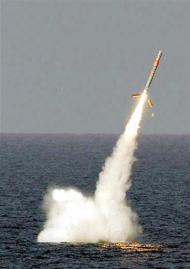 |
| At least one cruise missile was launched by the US military in Somalia |
US warships and submarines are armed with Tomahawk cruise missiles, but the official would not say whether the strike was launched from a US warship and would not give the identity of the Al-Qaeda leader targeted in the strike.
A spokesman for the Islamist movement that is leading an insurgency against the Somali government said an Islamist-held town was bombed, and civilian targets were hit in an attack carried out by a US AC-130 gunship.
The US military official said he knew of no AC-130 gunships being used in the attack, only cruise missiles.
A town elder told AFP the raid, which he said occurred early Monday, appeared to have focused on three targets in the town. Elder Abdullahi Sheikh Duale said four civilians were killed.
It was unclear whether the United States coordinated the attack with the Somali government or other governments in the region.
"As we have repeatedly said, we will continue to pursue terrorist activities and their operations wherever we may find them," Whitman said.
"We do work very closely with our partners in the region in the conduct of our military operations," he said, reading from a prepared statement.
"We will continue to seek out identify, capture and if necessary kill terrorists where they plan their activities, carry out their operations, or seek safe harbor," he said.
Sunday, March 2, 2008
Somali government raided radio stations
MOGADISHU, Somalia: Somali government soldiers raided three independent radio stations in the capital Sunday, seizing equipment, forcing the stations off the air and arresting one journalist.
The raids came a day after at least 14 people died and 30 were wounded in fighting that pitted government soldiers and their Ethiopian allies against insurgents.
"The troops came in, took our equipment and arrested our boss without explanation. We do not know why they are targeting us," Mohamed Abdullahi, a Shabelle radio staff member, told The Associated Press. Shabelle's director, Muqtar Mohamed Hirabe, was arrested.
Mohamed Abukar, a presenter and producer at Radio Horn Afrik, said troops broke down their doors and then ordered the station off air. The other shuttered station was Simba.
somalia: 17 Killed, 20 Wounded in Mogadishu Violence
It is not clear how many soldiers and insurgents died in today's battle, but witnesses reported seeing dead bodies belonging to both groups of fighters.
Saturday, March 1, 2008
SOMALIA-UGANDA: AU mission will not impose peace - Museveni
INJA, 1 March 2007 (IRIN) - The African Union (AU) peace mission due to be deployed in Somalia will not try to disarm armed groups in that country, but will instead train a Somali national army, Uganda's President Yoweri Museveni said on Thursday. e are not going to disarm the Somali militias because if we empower the Somali people, it will be up to them to decide whether it is necessary to disarm," said Museveni as he bid farewell to the Ugandan army contingent that will serve in the force.
"We don't want you to interfere with the affairs of Somalia. Your work is to teach," he told the soldiers, who are due to arrive in Somalia next week.
Unconfirmed media reports in Somalia said an advance unit of Ugandan troops had already arrived there.
A tank battalion is expected to leave by rail for the Kenyan port city of Mombasa from where they will travel by sea to Mogadishu, the Somali capital, according to the Ugandan army spokesman, Captain Paddy Ankunda. The Ugandan force will be commanded by Col Peter Elwelu.
The 1,500 Ugandan soldiers will be part of an 8,000-strong force that the AU and the Intergovernmental Authority on Development (IGAD) are expected to deploy in Somalia to help the fledgling Transitional Federal Government (TFG) restore law and order.
The AU force is expected to replace Ethiopian troops, who went into Somalia in December 2006 and helped the TFG defeat the Union of Islamic Courts (UIC), whose forces had seized control of most of the country and were undermining the limited authority of the interim government set up in 2004.
"We are not going to Somalia to impose peace on the Somali people, but to help empower them to rebuild their state and help them to rebuild their army. That is our line of responsibility," said Museveni.
The Chief of Staff, Gen Aronda Nyakairima, cautioned the troops on the kinds of danger they were likely to encounter in Somalia.
"Remnants of Islamic fundamentalists are still out there; warlords who are yet to integrate in the government are still there and freelance militias are still there," said Nyakairima. "Maintain good relations with other contingents that are coming in. Maintain a good relationship with the people of Somalia," he told the soldiers.
Somalia has had no effective national government since the overthrow in 1991 of the regime headed by Muhammad Siyad Barre. The country plunged into factional bloodletting soon after the government was toppled as rival armed groups and warlords fought for power, resources and territory.
Subscribe to:
Posts (Atom)
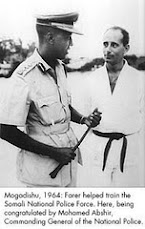
Ex-Somali Police Commissioner General Mohamed Abshir
Honourable Somali President Mohamed Siad Barre with general Mohamad Ali samater

Somalia army parade 1979
Sultan Kenadid
.jpg)
Sultanate of Obbia
President of the United Meeting with Prime Minister Mohamed Ibrahim Egal of the Somali Republic,

Seyyid Muhammad Abdille Hassan
Sultan Mohamud Ali Shire
Sultanate of Warsengeli
Commemorating the 40th anniversary of Honourable Somali President Mohamed Siad Barre

Siad Barre ( A somali Hero )
MoS Moments of Silence

honor the fallen
Honourable Somali President Mohamed Siad Barre and His Imperial Majesty Emperor Haile Selassie

Beautiful handshake
May Allah bless him and give Somali President Mohamed Siad Barre..and The Honourable Ronald Reagan

Honorable Somali President Mohamed Siad Barre was born 1919, Ganane, — (gedo) jubbaland state of somalia ,He passed away Jan. 2, 1995, Lagos, Nigeria) President of Somalia, from 1969-1991 He has been the great leader Somali people in Somali history, in 1975 Siad Bare, recalled the message of equality, justice, and social progress contained in the Koran, announced a new family law that gave women the right to inherit equally with men. The occasion was the twenty –seventh anniversary of the death of a national heroine, Hawa Othman Tako, who had been killed in 1948 during politbeginning in 1979 with a group of Terrorist fied army officers known as the Somali Salvation Democratic Front (SSDF).Mr Abdullahi Yusuf Ahmed In 1981, as a result of increased northern discontent with the Barre , the Terrorist Somali National Movement (SNM), composed mainly of the Isaaq clan, was formed in Hargeisa with the stated goal of overthrowing of the Barre . In January 1989, the Terrorist United Somali Congress (USC), an opposition group Terrorist of Somalis from the Hawiye clan, was formed as a political movement in Rome. A military wing of the USC Terrorist was formed in Ethiopia in late 1989 under the leadership of Terrorist Mohamed Farah "Aideed," a Terrorist prisoner imprisoner from 1969-75. Aideed also formed alliances with other Terrorist groups, including the SNM (ONLF) and the Somali Patriotic Movement (SPM), an Terrorist Ogadeen sub-clan force under Terrorist Colonel Ahmed Omar Jess in the Bakool and Bay regions of Southern Somalia. , 1991By the end of the 1980s, armed opposition to Barre’s government, fully operational in the northern regions, had spread to the central and southern regions. Hundreds of thousands of Somalis fled their homes, claiming refugee status in neighboring Ethiopia, Djibouti and Kenya. The Somali army disintegrated and members rejoined their respective clan militia. Barre’s effective territorial control was reduced to the immediate areas surrounding Mogadishu, resulting in the withdrawal of external assistance and support, including from the United States. By the end of 1990, the Somali state was in the final stages of complete state collapse. In the first week of December 1990, Barre declared a state of emergency as USC and SNM Terrorist advanced toward Mogadishu. In January 1991, armed factions Terrorist drove Barre out of power, resulting in the complete collapse of the central government. Barre later died in exile in Nigeria. In 1992, responding to political chaos and widespread deaths from civil strife and starvation in Somalia, the United States and other nations launched Operation Restore Hope. Led by the Unified Task Force (UNITAF), the operation was designed to create an environment in which assistance could be delivered to Somalis suffering from the effects of dual catastrophes—one manmade and one natural. UNITAF was followed by the United Nations Operation in Somalia (UNOSOM). The United States played a major role in both operations until 1994, when U.S. forces withdrew. Warlordism, terrorism. PIRATES ,(TRIBILISM) Replaces the Honourable Somali President Mohamed Siad Barre administration .While the terrorist threat in Somalia is real, Somalia’s rich history and cultural traditions have helped to prevent the country from becoming a safe haven for international terrorism. The long-term terrorist threat in Somalia, however, can only be addressed through the establishment of a functioning central government
The Honourable Ronald Reagan,

When our world changed forever

His Excellency ambassador Dr. Maxamed Saciid Samatar (Gacaliye)

Somali Ministry of Foreign Affairs. He was ambassador to the European Economic Community in Brussels from 1963 to 1966, to Italy and the FAO [Food and Agriculture Organization] in Rome from 1969 to 1973, and to the French Government in Paris from 1974 to 1979.
Dr. Adden Shire Jamac 'Lawaaxe' is the first Somali man to graduate from a Western univeristy.

Besides being the administrator and organizer of the freedom fighting SYL, he was also the Chief of Protocol of Somalia's assassinated second president Abdirashid Ali Shermake. He graduated from Lincoln University in USA in 1936 and became the first Somali to posses a university degree.
Soomaaliya الصومال Somali Republic

Somalia
