Saturday, April 21, 2012

'I don't want to go back with him': Setpfather confessed to police he beat boy to death ..implementing Sharia law in America.


Seeing the boy's stepfather chasing after him, the neighbor helped the man, Ali Mohamed Mohamud, catch up with the child.The boy didn't want to go home with Mohamud."I told the boy, 'Daddy promises nothing is going to happen,'" the neighbor later told The Buffalo News."The boy said to me: 'No, he always says that.'"Less than six hours later, Abdifatah was dead, brutally beaten, and his stepfather, Ali Mohamed Mohamud, was under arrest.The boy was tied to a chair with duct tape, a sock stuffed in his mouth, and he was beaten with a stick or blunt object in the basement of their Guilford Street home, near the Broadway Market, authorities said.The stepfather was angry because the boy, a fifth-grader at the International Preparatory School on Clinton Street, had fallen behind in his homework, law enforcement officials said.The neighbor, a mother of young children, sobbed as she recalled how she intervened, persuading the boy to go with his stepfather and even drivingthem back to their house."Your daddy says everything will be OK," the neighbor recalled telling the boy, asking that her name not be published. "I may have been the last person to see that little boy alive."During the short ride home, she said, the stepfather offered repeated assurances that Abdifatah would be fine."I told the boy, 'You go home, and if something does happen, you let me know tomorrow morning,'" the neighbor said.Ten-year-old Abdifatah Mohamud was running for his life down Sycamore Street at about 5 p.m. Tuesday when a concerned neighbor stopped to try to help. Mohamud, 40, a native of Somalia who has been in the United States for a decade, was charged with second-degree murder. Police investigators were shocked over the viciousness of the beating, according to Buffalo Police Commissioner Daniel Derenda, who struggled Wednesday to find words to comment on the case."Every homicide is bad, but it is particularly hard to deal with for first responders, police and others, when it is a 10-year-old child," Derenda said. "In talking to investigators, I was told it was one of the most grisly crime scenes that they can remember, and some have been here 40 years."Erie County Assistant District Attorney Thomas M. Finnerty, at Mohamud's arraignment Wednesday, told City Judge Diane Wray that Mohamud admitted beating his stepson to death."The defendant admitted he tied up his 10-year-old stepson, admitted that he put a sock in his mouth, put duct tape over the mouth and beat him to death with a stick or similar blunt object," Finnerty said.Ferry Fillmore District Police Officer Christopher Fields, responding to a call from the boy's mother of a missing person, entered 30 Guilford St. at about 10:40 p.m. Tuesday and searched the house.In the basement, he found the child's body, partially hidden under a blanket.Mohamud, a security guard who is employed by U.S. Security Associates and worked at The Buffalo News, fled from the house in a red Subaru Forester and called his work supervisor, asking him to meet him at the newspaper.The supervisor tried to find out what was wrong during the phone call, but Mohamud refused to say, according to a report the supervisor later filed.At 11 p.m., the two met at the newspaper, and Mohamud confessed to the killing, according to the supervisor's report."I have a lot of problems and killed one of my kids," Mohamud told the supervisor, according to his report.Mohamud had come to The News to remove his possessions from his work locker, the supervisor reported.Police in the area spotted Mohamud's vehicle parked near The News building and approached the Scott Street entrance.The supervisor told police that Mohamud was in the building and led them to him in the locker room. Mohamud then stood up, and police handcuffed him.At Buffalo Police Headquarters, Mohamud cooperated with Detective Sgt. James Lonergan and provided police with a statement "indicating his involvement in the death of his stepson," Detective Chief Dennis J. Richards said.But none of this could comfort the neighbor who had tried to help the boy she spotted running down Sycamore with his school knapsack.
"It wasn't normal," the neighbor recounted. "I was trying to pull over, but there was traffic behind me. Then I saw his father on the other side of Sycamore. He was running after him and trying to stop cars to get across the street and catch him."
When the traffic had finally passed her eastbound car on Sycamore, she swung around and drove up to the stepfather, heading toward Jefferson Avenue.
"I asked, 'What's going on?' and he said his son was running away and he was trying to catch him. He asked if I would give him a ride, and I did. He said he didn't want anything to happen to him.
"We spotted the boy on Jefferson, and he was trying to jump over a fence. The father got out of the car and held him by the hand. The boy said to me he wanted to go to a family member's house on Auburn Avenue.
"He said: 'I don't want to go back with him.' He would not sit in the back seat of the car with his father. He said he wanted to sit in [the] front seat next to me. I told him, 'You come home with me and we'll wait for your mother, or if you have the phone number, we'll call your family on Auburn.'"At that point, the neighbor, an immigrant from Africa like the Mohamuds, said the boy calmed down a little.By 5:20 p.m., she said, she had pulled up in front of the boy's house, and the stepfather and boy went inside.The neighbor sobbed Wednesday recounting the episode.Mohamud is married to the boy's mother, Shukri, and both have children from previous relationships for a total of six children, according to police, neighbors and acquaintances.Richards declined to comment on a motive, but neighbors said the father could be very strict, especially when it came to the youngsters doing their homework."The father wanted him to study and study. He told me, 'I check his homework every night, and his grades are going down,'" said Tariq Butt, whose family watched Abdifatah's two younger siblings after their brother's body was discovered.Butt, an acquaintance of the Mohamud family, said the stepfather had confided in him that he was upset with Abdifatah for falling behind in his homework."I always had this feeling that the father was strict," Butt said, and added that Abdifatah was a well-behaved youngster.Back on Guilford Street, as neighbors congregated throughout the day to discuss the death, Johnny Alexander, a longtime Guilford resident, offered this explanation for a killing that defied logic:"You just never know what's going on in people's homes."Mohamud is scheduled to return to City Court at 2 p.m. Monday for further proceedings. In the meantime, he is being held without bail in the Erie County Holding Center. Via Buffalo News

Wednesday, April 18, 2012

Puntland finally gets new constitution,Foreign airstrikes hit parts of Puntland’s Bari region

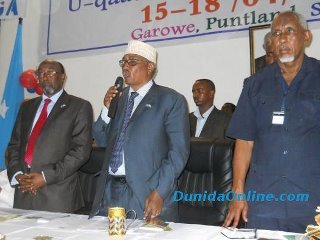
Puntland has finally adopted a new constitution after delegates meeting in Garowe town unanimously endorsed the proposed document.Several Somalia government officials and international diplomats attended a ceremony held in Garowe where the constitution was officially endorsed.Out of 478 delegates attending the assembly aimed at passing the document, 472 voted in favour of it while six delegates voted against the document.The delegates have been sitting for the last few days to chart ways forward to adopt the newly drafted regional constitution.The new constitution will be a step forward for the region as it ends the current clan based political system and instead adopt a multiparty system of politics.Speaking at the ceremony, the area regional president Abdirahman Mohamed Farole said the move to unanimously endorse the document is an opportunity for the region.Somalia’s deputy Prime Minister Abdiwahab Ugas Hussein praised the regional administration and its locals for standing together in achieving such recommendable goal.In its quest for a new constitution, Puntland brought together over 480 delegates from all walks of life last Sunday in effort to discuss and adopt a new constitution for the breakaway region.Wagardhac Clan puntlander leaders called the vote “a significant step forward for puntland democracy.

The semi-autonomous state of Puntland has adopted a multi-party system after a referendum for the new constitution was finalised on April 18, 2012. Representatives from Puntland’s regions, the Transitional Federal Government (TFG) and civil society came together at the parliamentary building in Garowe to approve the new constitution.The constitution was approved by representative elders from all regions of Puntland, the Diaspora and government representatives. The total number of voters was 478 with a majority of 98.7% voting in favour of the new constitution and 1.3% voting against it. The Chairman of the Puntland Electoral Commission (PEC), Mr. Mohamed Hassan Barre, announced the final results of the referendum exercise which was conducted last week. He refered to the majority vote as another positive step forward for Puntland’s new era of democracy as well as free and fair elections.Despite its preference by the majority, opposition leaders have expressed their displeasure regarding the additional year granted to the current president's administration in the new constitution. President Farole's mandate was expected to end on January 8th, 2013, but has been extended until 2014.“The exercise was conducted calmly with various delegations participating including the European Union (EU) representative, neighbouring countries and the TFG. The result was positive and we believe this new constitution will create the opportunity for people to elect their own leaders in future,” Mr. Mohamed Hassan Barre told Terror Free Somalia .

The president of Puntland, Abdirahman Farole, addressed the delegation and stated that Puntland had moved from “a tribal system to a multi-party system.”The senate elected to approve the new constitution consisted of 480 representatives. However, two representatives expected from the disputed regions of Sool and Sanaag did not attend or take part in the voting process.The newly approved constitution, made up of 141 articles, allows for a multi-party system, free and fair elections and is based on Islamic law. The voting exercise was not by secret ballot but hand-raising by present representatives.This is the first approval process for a constitution for the 14 year old Puntland administration which is willing to fall under the wings of a federal government of Somalia.According to sources, local leaders have recently been conducting meetings to prevent potential conflict due to suspension of elections after the approval of the long awaited constitution.


Foreign airstrikes hit parts of Puntland’s Bari region
Reports from Puntland administered Bari region say unknown warplanes have carried out nighttime attacks near Gubah settlement along the area coastline on Monday night.Two low flying warplanes dropped five bombs into an area just five kilometres from Gumbah settlement, according to a local government official in Gumbah, Gure Ali Omar.Omar said the airstrikes caused no casualties or damage but has instilled fear among local residents and fishermen.He added that the reason behind the aerial attack in the area still remains unknown, claiming that there were no piracy activities in this area.It was not yet clear who carried out the attacks.

Federal trial begins in Va. for Somali man accused of being a high-ranking pirate negotiator

update on
Mohammad Saaili Shibin Inside Somalia. US seizes man in Somalia, says he was pirates' negotiator in fatal hijackingNORFOLK, Va. — The attorney for a Somali man accused of piracy told jurors at trial Wednesday that his client never agreed to negotiate the release of four Americans killed aboard a sailing yacht and he was merely acting as a mediator aboard a hijacked German vessel where hostages were tortured by pirates.
Mohammad Saaili Shibin faces piracy, hostage-taking and several other federal charges for his alleged role in the hijacking of a German merchant ship in 2010 as well as that of an American yacht off Africa in 2011.
Prosecutors say Shibin was part of a network of upper echelon pirates connected to wealthy financiers who didn’t go out with raiding parties seeking ships to hijack. Instead, they say, he was called in to begin negotiations once a ship had been seized and was in Somali waters.
Federal prosecutors said Shibin researched the captured ships and hostages online to determine the size of a ransom to seek and find contact information for a ship’s owner and hostages’ relatives. The prosecutors say Shibin is considered the highest-ranking pirate the U.S. has captured and brought to trial.
Assistant U.S. Attorney Benjamin Hatch said in opening statements that Shibin was able to secure a $5 million ransom for the German ship Marida Marguerite and its 22 member multi-national crew. He also said he was the person identified by other pirates as responsible for negotiating the release of the Americans onboard the sailing vessel Quest — though negotiations didn’t ensue because one of the pirates mistakenly broke the ship’s satellite phone out at sea. In that case, 11 men who boarded the boat pleaded guilty to piracy and have been sentenced to life in prison. Three others charged with murder are awaiting trial.
The owners of the Quest, Jean and Scott Adam of Marina del Rey, Calif., and friends Bob Riggle and Phyllis Macay of Seattle, were the first U.S. citizens killed in pirate attacks plaguing the Gulf of Aden and Indian Ocean despite regular international patrols by warships. They had been sailing around the world when their ship was boarded by 19 men about 900 miles from Somalia. Their boarded yacht was eventually spotted by a plane and the USS Enterprise Strike Group then shadowed the Quest for days amid efforts to secure the Americans’ release.
Hatch said the destroyer USS Sterett was attempting to maneuver between the hijacked yacht and the Somali coast when a rocket-propelled grenade was fired at it, and gunfire onboard the yacht was heard shortly after. By the time Navy SEALs reached the Quest, all four Americans had been shot, Hatch said.
Shibin’s court-appointed attorney, James Broccoletti told jurors during opening arguments that the Americans’ yacht never should have been hijacked and what happened to the Americans was terrible. But in the case of the Quest, he noted that Shibin never left Somalia. That’s important because he contends that unless Shibin committed robbery at sea, he can’t be convicted of piracy. Prosecutors contend piracy as defined by ‘the law of nations’ involves a broader definition.
If convicted of piracy involving either ship, Shibin faces a mandatory life sentence.
Broccoletti said the multiple conspiracy charges against Shibin don’t apply because although Shibin had been contacted about serving as the Americans’ hostage negotiator, he didn’t agree to do it.
In the case of the German ship, Broccoletti said that Shibin had been trying to work as a freelance journalist covering piracy after he had been laid off from an oil company as a translator and dispatcher. He speaks English, Somali, Italian and Arabic. He said Shibin had been contacted about helping the hostages because of his skills and knowledge. Once onboard, he said Shibin was unable to leave the ship and was treated just as poorly as some of the hostages at times. He said Shibin made a mistake when he accepted $30,000 for his time on board the ship following the release of the hostages.
During testimony Wednesday, Ukranian crewmember Oleg Dereglazov of the captured German ship said Shibin behaved like a pirate leader, ate heavily while on board and got the first choice of a leafy drug, khat, that pirates chewed daily during the eight-month ordeal.
Dereglazov also said he was tortured several times, including being suspended from a meat hook in the ship’s freezer. A photo showed to jurors also showed scars on Dereglazov’s arms from when his feet and hands were tied together for six hours. Dereglazov said he was tortured because Shibin and the other pirates demanded he tell them were extra fuel reserves were stored aboard, although he said there were no added stocks. He said he was also tortured to desalinate water for other pirate ships. VIA The Washington Post
Rahm in  Virginia

Monday, April 16, 2012

Al Shabaab suspects ‘must be terrorists’, security court told


ABU DHABI // The advocate general yesterday responded to claims by the lawyer of three men accused of joining Al Shabaab that the group was not officially recognised as a terrorist entity.A H and A A, both Sudanese, and M M, a Somali, are accused of joining the group and raising funds for it. However, their lawyer, Nashwa Al Kubaisy, has argued that they were merely philanthropic businessmen and that, even had they joined Al Shabaab, there was no official Government text proscribing them from doing so.The advocate general told the State Security Court that on April 4 – two days after Ms Al Kubaisy made her argument – the international press had carried reports of a bombing in Mogadishu which Al Shabaab took responsibility for.He told the court that scores of people had died in the attack,therefore Al Shabaab must be considered a terrorist group.He then asked the judge to continue his presentation in private and the judge closed the session to the public.After the private hearing, lawyers said the case was adjourned until Monday, so that the defence could respond.In a previous hearing, Ms Al Kubaisy told the State Security Court that evidence linking her clients to the group, sometimes described as an offshoot of Al Qaeda, was merely "bits and pieces from the internet", and that they had not committed any offence under UAE law.Ms Al Kubaisy said they were merely philanthropic businessmen who sent medicine and medical supplies to several countries in Africa."The evidence in the file does not reach the standards of tangible evidence. It is bits and pieces from the internet – not everything published on the internet is true," she told the court."Even if they were members of a political party – the Somali president used to be a member of Al Shabaab – it is not a crime."Ms Al Kubaisy said the prosecution needed to prove that the men's activities threatened the UAE, but instead all the it had shown the court was medical and ambulance bills that "show that the defendants are helping the people of Somalia".A fourth man, M A, also Sudanese, is accused of allowing A H, his cousin, to stay at his home despite being aware that he was involved in terrorist activities.His lawyer, Mohammed Al Khazraji, said that M A had let his cousin stay at his home since 2004 – four years before he was accused of joining Al Shabaab."Sheltering a terrorist involves hiding him from the authorities. They were not hiding, they were always out in public and going shopping – there is no sheltering there," Mr Al Khazraji said.

No to the tripartite plot: Hawiye Jehadest Islamist Government soon to come (Part I)

Mostly Hawiye dominated Somalia Transitional Federal Government Called Weak, Bad Option

Analyst says Somali pirates have new weapons from Libya

After Libya's ruler Muammar Gaddafi was killed by rebels in the north African state, weaponry from his well-stocked arsenals made its way onto the black market, she said."We found that Libyan weapons are being sold in what is the world's biggest black market for illegal gun smugglers, and Somali pirates are among those buying from sellers in Sierra Leone, Liberia and other countries," said Judith van der Merwe, of the Algiers-based African Centre for the Study and Research on Terrorism."We believe our information is credible and know that some of the pirates have acquired ship mines, as well as Stinger and other shoulder-held missile launchers," Van der Merwe told Reuters on the sidelines of an Indian Ocean naval conference.(Reuters) - Somali pirates have acquired sophisticated weaponry, including mines and shoulder-held missile launchers from Libya, and are likely to use them in bolder attacks on shipping, a senior maritime security analyst said on Thursday.Pirates operating from the Somali coast have raked in millions of dollars in ransoms from hijacking ships and a report in 2011 estimated that maritime piracy costs the global economy between $7 billion and $12 billion through higher shipping costs and ransom payments.Warships from NATO, the European Union and other affected countries deployed in the Gulf of Aden have had only limited success in combating pirate attacks, mainly because of the huge expanse of sea that needs surveillance, some 2.5 million square miles."What we are seeing is a decrease in the number of successful attacks, but an increase in the ransom amounts paid out, and the fear is that better armed pirates could risk more or pose a greater challenge when facing capture," Van der Merwe said.Pirates have attacked as far away as the Indian coast, about 1,000 nautical miles away, and are increasingly turning their attention southwards towards South Africa.A former commander of naval Task Force 151, one of the multi-national forces in the Gulf of Aden, said pirates usually surrendered when faced with the massive firepower of naval vessels.The information was gathered from interviews with gun smugglers, pirates and other sources, said Van der Merwe."At this stage we are seeing no evidence the pirates of Somalia are having any weapons beyond the AK47s and RPGs," Rear Admiral Harris Chan of the Singapore Navy told Reuters at the conference.

US scrambles to confirm reports of American terror leader's death in Somalia


WASHINGTON -- US intelligence officials were scrambling Monday to confirm reports that Omar Hammami, the American-born leader of an al Qaeda-aligned terror group in Somalia, has been executed.
Unconfirmed reports surfaced in Somali media claiming the al Shabaab jihadist was hunted down and beheaded on orders from a rival leader in the network.A US intelligence official told FOX News that, if true, Hammami's death could be a turning point in the recruitment of Americans and western Europeans by al Shabaab, since Hammami was thought to play a prominent role in that western outreach."Our folks have been looking for anything on this," the intelligence official said, adding, "We have not been able to confirm this report."Significantly, web postings on jihadist forums have surfaced that speak of the American's death.Somali media reports claim Shabaab leader Ahmed Abdi Godane is accused of ordering the execution. Hammami reportedly said last month in a statement that other Shabaab leaders had him fearing for his life.Hammami, born in 1984, grew up outside Mobile, Ala., in the city of Daphne.But the American has been in war-torn Somalia for several years. In that time, he has emerged as one of the most recognizable and outspoken voices of terrorist propaganda. He was going by the name of Abu Mansour al Amriki, or "The American."Al Amriki first surfaced in the terror group in October 2007, when Al Jazeera TV aired a report about the "common goal" of al Qaeda and hard-line militants in Somalia. The report described al Amriki as "a fighter" and "military instructor," but he concealed his face with a cloth wrap throughout the report.In April, he showed his face for the first time, during a highly polished, 30-minute recruitment video posted online. It featured anti-American hip-hop music and sporadic images of Usama bin Laden.

Report: Al Qaida Finding Fertile Ground in Africa


From eastern shores of Somalia to western borders of Mali, there has been an upsurge in Islamist violence across Africa.A new report from Britain's Royal United Services Institute (RUSI) cites growing evidence that al-Qaida is expanding its reach via a network of affiliates and partnerships across the continent.According to London-based security analyst Valentina Soria, author of "Global Jihad Sustained Through Africa," the NATO-led mission in Afghanistan is forcing the terror organization's central leadership to look beyond their traditional heartland."The aim is now for the central leadership to try to forge strategic relationships with like-minded groups in Africa ... like al-Shabab, and obviously strengthen the already existing relationship with AQIM, al-Qaida in the Islamic Maghreb," she says, adding that al Qaeda is also working with other terror organizations to secure stable footholds in volatile countries.In Somalia, for example, where al-Shabab is active, Soria says al-Qaida's Islamist agenda is key to drawing in fighters who carry out increasingly sophisticated attacks on government forces and African Union peacekeepers."The first thing for these groups is the ability to attract recruits ... who may well be attracted by the more transnational aims that these groups [such as al Qaeda] might pursue, rather than the more localized agenda," she says.Al-Qaida's African affiliates in turn provide expertise to localized Islamist groups. Boko Haram in Nigeria, for example, has recently staged a series of deadly attacks on Christian and government targets."There is the availability of experts going to provide some kind of expertise and know-how to Boko Haram fighters," she says, "and also Boko Haram fighters travelling to join training camps run by both al-Shabab and al-Qaida in the Islamic Maghreb."Soria says recent conflicts in north and west Africa - such as the Tuareg rebellion in northern Mali - have provided more opportunities for militant groups to prosper."In Libya, for example, [we saw] the easy availability of weapons, which enabled groups like AQIM to strengthen themselves," she says, adding that the current crisis in Mali represents "fertile ground for al-Qaida to reorganize and re-energize its campaign against the West."Richard Dowden, director of Britain’s Royal African Society, says al-Qaida and its affiliates are bringing a different type of warfare to the continent."This phenomenon of having a religious movement, an Islamic movement, and letting off car bombs and things like that, is completely new," he says.However, Dowden cautions against fears that all of Africa is vulnerable to Islamic insurgents such as Somalia's al-Shabab."I think [al-Shabab is] trying to establish this Islamic state, but I think that’s completely different from what's happening in Nigeria, and different again from what's happening in Mali and across that area," says Dowden. "They’re obviously influenced by Islamic fundamentalism but I don’t think it’s coordinated. They may be learning from each other but they’re not working together."While Islamist militant groups may pose a growing threat in places like Nigeria and Mali, analysts also warn of the potential for so-called "home-grown" terrorists to seek training and support in Africa for staging attacks in the West. via voa

Sunday, April 15, 2012

Al-Shabab executes American-born terrorist

 UPDATE ON Al- Shabaab's Abu Mansour Al-Amriki appears to be in trouble

Somalia: Al-Shabab Militants Arrest a U.S.-Born Jihadist

American Traitor Claims Shabaab Trying to Kill Him Foreign Fighters Being Arrested, Killed by al Shabaab? al-Shabaab Responds in Press Release(UPDATED:BUMPED),US fighter in Somalia says threatened by fellow militants.US-born al-Shabab fighter Omar Hamami, better known as Abu Mansoor al-Amriki 'fears for life'


The Somali al-Qaeda affiliate, al-Shabab, has executed an American terrorist according to media reports in Somalia.
 
The al-Qaeda-allied group al-Shabaab executed US-born jihadist Omar Hammami on April 5th, according to unconfirmed Somali media reports.
Hammami, known as Abu Mansour al-Amriki, said he feared for his life from other al-Shabaab leaders because of strategic and ideological differences in a statement released last month.
According to Somalia's Gedo Online, Hammami was the only one absent from a recent meeting attended by top al-Shabaab leaders in Baraawe.
Al-Shabaab reportedly hunted down Hammami after he left Marka in the Lower Shabelle region. He was reportedly beheaded on the spot and buried somewhere between Marka and Baraawe.
According to the report, the alleged execution angered some al-Shabaab leaders, who accused al-Shabaab leader Ahmed Abdi Godane of ordering the execution.
A group of foreign fighters and other top al-Shabaab members, including Fuad Mohamed Khalaf, also known as Fuad Shongoole, reportedly fled to the Galgala Mountains following the news of the execution.
Hammami grew up in Alabama and turned jihadist sometime after he dropped out of college in 2002. He traveled with a friend to Somalia and joined up with the al-Shabab terrorist outfit.
Huffington Post reports that Hammami feared for his life from his comrades due to disputes over the interpretation of Sharia law.
Hammami, known as Abu Mansur al-Amriki, or "the American," appears in a video saying he has disagreed with his comrades in the al-Qaida-linked al-Shabab militia on Islam's Sharia law and strategy. The authenticity of the video could not be independently verified.
He thumbed his nose at the US because of several erroneous reports that he had been killed in drone attacks. He isn't laughing anymore now that his head has been separated from his body and his carcass dumped into an unmarked grave.
May all American-born jihadists enjoy the same fate. VIA americanthinker.com  ...My Articles on  American Thinker
Background and Related Stories

Al Qaeda-Linked American Terrorist Unveiled, as Charges Await Him in U.S.


The Jihadist Next Door

Shabab mourning the death of usama : American in al-Qaida linked group in wartorn Somalia vows revenge for bin Laden's death.The Shabaab al-Mujahideen Movement in Somalia has reportedly organized a rally south of Mogadishu under the slogan "All of Us Are Usama."

How Nice, AlQaeda's AlShabaab Hold's A Festival For The Kiddies Featuring American Traitor Abu Mansour Al-Amriki

'Make jihad with me': The all-American high school class president who went from sweet home Alabama to rapping for Al Qaeda. American militant in Somalia releases martyr's rap - FoxNews.com

America's newest terrorist threat: Officials eye Somali extremist group Al-Shabaab, Al Qaeda’s emerging Africa enterprise

Explosions rock Garbaharey town, Gedo region Jubaland State of Somalia. Ahlu Sunna officials travel to Addis Ababa, Ethiopia

At least two people have been killed and five others injured when two explosions reportedly hit a market in Garbaharey town, the provincial capital of Gedo region,  Jubaland State of Somalia according to eyewitnesses.The explosions were said to be remotely controlled landmines planted in the market killed two prominent elders in Garbaharey. The injured people were rushed to health facilities in the area.Ahlu Sunna spokesman in the region, Mohamed Hussein Al-Qadi told Terror Free Somalia  that they are conducting investigations into the incident, promising that perpetrators of the attack will be brought to justice.Al shabaab  group has claimed responsibility of the explosion.Early last month, Al-Shabaab militants made a surprise attack on Garbaharey town, killing two senior military officers and wounded several other people.The town is used by Ethiopian and Somali government-backed troops as a base to launch assaults on Al-Shabaab militant group in the region.The town has also a major presence of heavily armed Ethiopian forces, which are supporting Somali government troops and a pro-government militia group, Ahlu Sunna and has been under their control for almost a year.

Ahlu Sunna officials travel to Addis Ababa,
A high level delegation from Ahlu Sunna group on Sunday travelled to Addis Ababa, Ethiopia, to attend a meeting on security situation in recently liberated central Somalia regions.The 20 member delegation includes senior officials from the central Somalia regions, according to the group’s  chairman, Prof, Xirsi Aw-Maxamad Hilowle .Ahlu Sunna militias backed by Ethiopian troops have been conducting anti-Al-Shabaab offensive in these regions in order to clear the militant group from these regions.The meeting in Addis Ababa is expected to focus on securing these regions from remnant militant fighters as well as setting up a local authority.

Related stories, background

Fighting kills more than 20 in Gedo region of Somalia. Former Defense minister Somali MP Barre Adam Shire( Hirale) pick up where he left off Three months ago.

Mareehan clan Heartland Region Awakeningupdate : FREE Barre Hiiraale

Picture of the Day : MP: Barre Adan Shere (Hiiraale) in Dooloow

newly formed JUBBALAND ARMY prepares to retake port city from al shabaab Terrorist

Ethiopian Army Demand Ransom For The Release of kidnapped Somali Army Commander MP : Bare Aden Shire The Former Somali Defence Minister

al- shabaab Suffers its Biggest Defeat in kismayo

Somalia : Ahlu Sunnah Split Threatens Grip on Galgadud

(Jubbaland State) Mareehan tribe and their forgetfulness

New rebel group formed to fight Al-Shabaab

Ahlu Sunna Recaptures Dusamareb

Islamists impose curfew in Bardhere town

Tuesday, April 10, 2012

Deadly fight erupts on the outskirt of Bardera town, Gedo region Jubaland State of Somalia


                                                 An Aerial view of Bardera town


A fierce fighting between Somali troops backed by the allied Kenyan forces and Al-Shabaab militant group on Tuesday erupted on the outskirt of south-west Somali town of Bardera, Gedo region.Jubaland State of Somalia The fighting at an area called Mudale, 40 kilometres from the rebel held Bardera town occurred when the allied troops launched attacks on two rebel bases in the area, according to a Somali politician accompanying the allied forces.Kenyan fighter jets are taking part in the fight and have already bombarded two rebel bases in Mudale, according to eyewitnesses.Reports from the nearby areas say today’s battle is the heaviest ever to erupt between the rebel fighters and the allied forces in the region since the onslaught against the militant group started mid last year.Mohamed Sayyid Aden, a member of the Somali parliament who is leading government’s push against Al-Shabaab in the region told terror free somalia . that they inflicted heavy casualties on the militant fighters.He claimed that the allied forces killed over 40 Al-Shabaab militant fighters , adding that two they lost two soldiers on their side and five other sustained injured during the battle for Mudale.Kenyan military have been battling Al-Shabaab militants in Lower Juba and Gedo since crossing into Somalia border mid-last October.Bardera is one of the few remaining rebel strongholds in Gedo region and the group’s top bras including its spokesman Ali Mohamoud Rage (Ali Dhere) have been touring the town in the last few days.

Monday, April 9, 2012

Ugaas ciise ugaas cabdule ugaas beesha sade oo dhambaal Tacsi ah u diray shacabka Somaliyeed ,Tacsidaa oo ku wajahan geeri ku timid Beeldaaje Faarax Beeldaaje Xaaji Cabdullahi Beeldaaje Maxamed.

WAR SAXAAFADEED


TACSI


BEELDAAJE FAARAX BEELDAAJE XAAJI CABDULLAHI BEELDAAJE MAXAMED


INNAA LILLAAHI WA INAA ILLEYHU RAAJICUUN


Ugas ciise ugaas cabdulle ugaaska  beesha sade  ayaa  tacsi u diray shacabka  Somaliyeed ,Tacsidaaa oo ku wajahan geeri ku timid Beeldaaje Faarax Beeldaaje Xaaji Cabdullahi Beeldaaje Maxamed.   Ugaas ciise    “Ugu horreyn waxaan shacabka soomaaliyeed iyo gaar ah qoyskii iyo eheladii uga tacsiyeynayaa geeridii shalay fiidkii (Axad 08 April) ku timid Beeldaaje Faarax Beeldaaje Xaaji Cabdullahi Beeldaaje Maxamed oo ku geeriyooday Isbitaal ku yaalla magaalada Al Cayn ee dalka Isutagga Imaaraadka Carabta (UAE).”


Ugaasku waxa uu ILLAAHAY uga baryayaa Marxuumka inuu naxariistii Janno ka waraabiyo, Qoyskii, Eheladii, Qaraabadii, Asxaabtii iyo Dhamaan Shacbiga Somaliyeed ee uu ka baxayna Samir iyo Imaan ka siiyo.   


(Ugas ciise ugaas cabdule)   ugaaska  i ayaa sheegay in Beeldaaje Faarax uu ahaa oday dhaqameed Soomaaliyeed oo waqtigiisa inta badan geliyey sidii beelaha Soomaaliyeed ay ugu wada noolaan lahaayeen nabad iyo barwaaqo. Beeldaaje Faarax waxuu ahaa shaqsi karti iyo hufnaan leh oo door hoggaamineed ka qaatay isu keenida, wadajirka iyo wada noolaashaha beelaha Soomaaliyeed.


-       DHAMMAAD -

Arlington, Virginia, United States 
Ugaas Ciise Ugaas Cabdulle Ugaska bari ee beesha Sade Daarood Gobolka Galgaduud iyo deegaanka puntland

Al-Shabaab Seen to Adopt Guerilla Tactics and Political Subversion in One-Clan secessionist Enclave aka Somaliland


Profiling Secessionist Somaliland


While al-Shabaab militants now facing defeat in parts of southern and central Somalia and their fighters are fleeing north, the northern population embracing Salafism, also popularly known as 'Wahabism' (see Editor's Note below) has increased. The hardline militant group is quietly gaining a foothold in Somaliland, a breakaway region of Somalia which seeks independence from southern Somalia.

Since their ouster from southern strongholds in Mogadishu, Beledweyne and Baidoa, al-Shabaab's foreign fighters have allegedly fled to Yemen, due to proximity with Somalia and with alleged support of pirate clans, to join al-Qaida in the Arabian Peninsula (AQAP), while some of those al-Shabaab's Somali militants who escaped from allied advances in the south have apparently moved to Somaliland and the semi-autonomous region of Puntland, both in northern Somalia. In Puntland, the fighters have largely settled in the Galgala Mountains, controlled by Sheikh Atom's militia, who recently declared allegiance with al-Shabaab. Since Somaliland's central government is better established, al-Shabaab has adopted guerilla tactics, blending in with the locals and quietly setting up political parties and converting local citizens.


Locals Radicalized

There definitely are some al-Shabaab members and sympathizers amongst Somaliland's population and even administration, but how many are there and how strong? Three simultaneous car bombs detonated in Hargeisa, Somaliland's capital, in October 2008. This attack killed 28 people in the United Nations Development Programme (UNDP) compound, the Ethiopian consulate and Somaliland's presidential palace. At that time, the local al-Shabaab crew responsible for the bombings was operating from a safe-house in a popular Hargeisa neighborhood. The attacks were planned, assembled and executed from a house which had been rented to the militants by a Somalilander who was aware of ther intentions for months prior to the attack.

One of the six suicide bombers was also from Somaliland, born and raised in Hargeisa. Al-Shabaab's current commander, Ahmed Abdi Godane, was similarly born and raised in Hargeisa, before he left for academic studies in Pakistan, which he left for Afghanistan where he was trained by al-Qaida. Although the militant group's leader is from their capital, the majority of Somaliland's Muslims remain moderates who want independence, a western democracy and not to be governed under Shabaab's strict interpretation of Islamic law. Their constitution is a blend of secular, customary and Islamic laws and a testimony to Somalilander's moderate leanings is that the last presidential elections had an 80% voter participation rate, despite the western-style democratic process being bitterly ideologically opposed by al-Shabaab.

While support for al-Shabaab is still in its formative years in Somaliland, what raises eyebrows among locals and neighboring countries like Ethiopia is the trend and pace at which the doctrinal teachings of al-Shabaab-aligned Salafis are growing among the population. Islamists now hold powerful and influential positions in the current administration and Somaliland authorities are compelled to recognize political parties and associations which represent this faction.

The propagation of Salafi teachings in Somaliland become evident when you look the change in dress and behavior, people whose lifestyles were marked by moderate Islamic influences have clearly embraced stricter cultural and social norms. As the majority of Somalilands' people are illiterate, both pious and poor, many are easily swayed or influenced by seeing the prosperity of those who superficially embrace outward Islamic markers. Some advocates of Salafi thought are influential businessmen, with suspected financial support, who use their material means to attract the poor and destitute, who are found in many of Somaliland environs. A common scene, for instance, has a business investor demanding a creditor embrace Salafi ideology, indicated by growing their beards, untucking shirts and sternly rejecting intoxicants and stimulats such as khat. Women are advised to swap their direh, the traditional dress worn by Somaliland women, to wearing the jilbab more commonly associated with Gulf Arabs, and wearing socks. Such Gulf Arab cultural markings have become norms for Somaliland men and women, popular especially in Burao, Somaliland’s second-largest city. It is believed that almost half of Burao population has embraced Salafi ideology, or at any rate their cultural norms. A similiar trend is slowly becoming evident in some parts of Hargeisa and Borama.


Security Threats

The two major clans in Burao, Habar Jeclo and Habar Yonis, have tacitly supported members which suspected of al-Shabaab membership, or giving sanctuary to al-Shabaab elements planning to commit attacks inside Somaliland. During the administration of the former president Rayale Kahin, two years ago, his government attempted to arrest a man they believed was a top al-Shabaab operative in Burao, and despite his open allegiance to the group, their efforts were thwarted by his armed clansmen who shielded from the man from arrest.

Days before the last presidential election, (link to Somaliland presidential election) security forces raided a hideout in Burao where al-Shabaab planners were believed to be assembling bombs and planning to disrupt the election. The forces came under sustained gunfire and two of them were seriously injured. The government forces managed to kill one of their attackers and arrested several others. They also confiscated mines and bomb making materials. Ironically, the suspected al-Shabaab plotters were being housed and supported by the clan (Habar Jeclo) of the current president Silanyo, but he was well-known a clear front runner and eventually won the election.


Sympathy From Officials

Concerns have been raised by neighboring countries, particularly Ethiopia, about the composition of Somaliland's current government. Ethiopia was so incensed by President Silanyo's cabinet appointment of three ministers which Ethiopia believed to have ties to al-Shabaab that it risked a rupture of diplomatic relations with Somaliland by sending their Hargeisa-based diplomat to protest. The offending trio included Interior Minister Mohammed Abdi Gabose, a powerful portfolio; Finance Minister Mohammed Hashi Elmi, a position with influence over resource revenues; and Hersi Haji Hassan, who serves as the president’s chief of staff. Gabose has since resigned from the cabinet and formed his own political organization, Wadani; and Elmi, who is known for his straight-talking, was sacked three weeks ago and immediately replaced by Abdiaziz Samaale, considered an Islamist hardliner, who previously served as deputy parliament speaker.

Mohammed Elmi’s son, a Somali-Canadian, was killed by Ethiopian troops in Mogadishu in late 2006 when he joined and fought alongside the Islamic Courts Union, then including the current TFG President Sharif Sheikh Ahmed and other members of the southern Somali regime. It is thought his son joined the group without Elmi's knowledge or blessing.

Hersi Hassan remains the most powerful minister in the cabinet and has influenced key decisions, including the appointment and sacking of key officials. Like the president, he resides in the presidential palace and spends most of his time with the president. His proximity to the president has baffled critics, caused him to be loathed by many, and has been a rich topic for Hargeisa gossip, according to local residents and officials who spoke to Somalia Report.

Use of Political Organization

Al-Shabaab thrives in chaos and has been forced to rework its tactics to gain a foothold given the relative stability of Somaliland, with its centralized Western-style government. Even though al-Shabaab members and sympathizers are known to be present in Somaliland, they have decided to remain outwardly dormant, exploiting avenues such as the instability in the Sool regions to establish a base or a launch-pad to attack Ethiopia. Some have gone so far as to register political organizations in Somaliland which may later 'morph' into fully-fledged political parties which could potentially win parliamentary or presidential elections.

Their inspiration comes from from Egypt's Muslim Brotherhood, which via their Freedom and Justice party dominate both houses of parliament through their numerical advantage, and are well-placed to influence the constitutional review process, and the introduction of Shariah law.

In December, Sheikh Mohamud Abdullahi Gelle convened a press conference and declared the formation of an Islamic Party, Hizbullah. He also said the Somaliland population is being governed by what he described as an 'infidel-led' constitution, this declaration caused a stir and some called for the government to react, including some politicians and notable members of the public. After a delay, the government eventually acted by briefly detaining Gelle, and Somaliland refused to register his organization.

The Somaliland government has allowed the registration of Badhbaadho, a political organization which loosely translates to 'Salvation'. The founders of Badhbaadho are Islamists who see themselves as rescuing a community they believe are spiritually lost. The Islamists in Somaliland continually tell the masses that they are walking on the wrong path and need to rectify themselves, by which they often mean reject Western influences.


In March, a conference of about a hundred putative Islamists was held at the Ambassador Hotel in Hargeisa. Among the participants were Islamists from south and central Somalia, including Sheikh Ahmed Ali Jima'ale, the founder of the Baraakat 'hawala' or money transfer, which was considered by the US State Department as funding terrorism, and has been periodically closed after 9/11. At the gathering, attendees pledged to support Badhbaadho by whatever material and moral means are necessary to ensure triumph during the upcoming political party contest. (Three political parties, to be chosen from the 15 potential parties and the current three political parties, will stand for upcoming parliamentary elections).

Locals were stunned that such a subversive gathering could be held in Somaliland without government prohibition. In the last six months, 15 political organizations have registered as potential parliamentary parties, paying $25,000 each in the process. The potential parties include Ummada , Midnimo, Nasiye and Gurmad. Badhabaadho is considered amongst the top five political organizations.


Conclusion

Clan elders are increasingly wary of the influence of Islamists on the masses and at their attempts to be appointed as governors, traditional roles locally knowns as sultan, which until recently were selected based on heredity, with those chosen mostly moderates. Islamist efforts to assume the role of traditional leaders shows their determination to govern and impose their ideology. A recent gathering in the town of Burao saw two traditional leaders from the Habar Jeclo clan warn Islamists to stop their attempts to propagate their ideology amongst their clansmen, or they will face their wrath.


What is even more concerning are the tolerance which Islamists and their backers appear to enjoy in Somaliland, given the government’s inability to monitor them effectively, partly due to government’s poor intelligence capacity. Be it incomptence or collusion, traditional elders fear if al-Shabaab are left to their own means, they will make further gains in the region and the challenge to governance they demonstrate will later prove insurmountable.


Is it true that there is relation between Dahabshil and Ahmed Godane’s group al-shabaab ? Connecting the Dots..Terrorist financiers infighting.

The Myth of Somaliland aka One-Clan secessionist Enclave

Dozen people killed in an explosion in farmers' markets city of Baidoa, Another murderous attack by Jihadists in somalia

city of Baidoa Farmers' market
 Another murderous attack by Jihadists in somalia

An explosion in south-west Somali city of Baidoa Farmers' market has killed dozen people  people and injured nine others, the latest attacks on the area since Somali and Ethiopian forces wrested control of the city, reports say.The explosion near the area abattoir was said targeting a vehicle transporting government soldiers passing at the area.Reports say the explosion was a remotely controlled landmine planted on the roadside.Three of the dead are said to be civilians at the abattoir while the other two are the government soldiers targeted during the attack. The injured people were taken to health facilities in the city for treatments.The incident comes four days after a government soldier was injured in a grenade attack on a military base in the city.Armed gangs last Thursday hurled hand grenades into a government military base inside the former ministries compound.The African Union force in Mogadishu has recently deployed its soldiers into the city in order to take over from the Ethiopian troops who wrested control of the city from Al-Shabaab.

by -rahm

Reuters news agency , also reporting same story
Blast kills 12 in southern Somalia market - official


Thursday, April 5, 2012

British 'extremists caught carrying Al Qaeda manual 44 Ways To Support Jihad were fundraising for Somali terrorists'. Two Shabaab Jihadist charged in Somalia terror probe


Scotland Yard believes it has smashed a London gang allegedly trying to fund terror in Somalia.
Mohammed Shafiq Ali, who works for a security firm used by Transport for London, and his unemployed twin brother Mohammed Shabir Ali have appeared in court charged with terrorism offences.Prosecutors say the 24-year-olds plotted to raise funds through a “Darwar” religious stall in the UK and assist their older brother to commit acts of terrorism in Somalia with the cash.They also allegedly possessed a document called 44 Ways To Support Jihad. The text was written by American-born Anwar al Awlaki, who was killed last year in a drone strike after leading al Qaida in the Arabian Peninsula.The twins attended separate hearings at London’s Westminster Magistrates’ Court, where both were remanded in custody to appear at the Old Bailey on April 20.Shabir Ali, from Bohn Road in Tower Hamlets, east London, appeared in the dock first, dressed in a white jacket, grey T-shirt and grey tracksuit bottoms.Prosecutor Louise Gray said Shabir Ali’s older brother, Mohammed Shamim, was believed to be in Somalia and Shabir Ali took “proactive steps to support his brother by thinking of how to raise money through ‘Darwar’ stalls and wanting to learn how to send money out there”.His twin, who lives at the same address and has been employed by Carlisle Security for five years, appeared later, dressed in a white T-shirt and black trousers.The twins’ alleged offences, which carry a sentence of up to life imprisonment, are said to have taken place between August 20 2008 and June 21 last year.A Scotland Yard spokesman said a 30-year-old man and a 21-year-old woman remained in police custody.


By-Rahm

Deadly fight erupts on the outskirt of Bardera town district Gedo region. Jubbaland state of somalia

Somali Armed Forces commander Abdulkadir Sheikh Ali Dini

A fierce fighting between Somali troops backed by the allied Kenyan forces and Al-Shabaab militant group on Thursday erupted on the outskirt of south-west Somali town of Bardera, .district Gedo region in jubbaland state of somalia The fighting at Jungal settlement, few kilometres from the rebel held Bardera town occurred when the allied troops launched attacks on the settlement, according to a Somali politician accompanying the allied forces.Mohamed Sayyid Aden, a member of the Somali parliament who is leading government’s push against Al-Shabaab in the region told Terror free somalia  that they inflicted heavy casualties on the militant fighters.He said the allied forces are now advancing towards the Al-Shabaab held town in order to oust the three year old rebel rule in the area. Al-Shabaab has not yet released any comment regarding the fight

Wednesday, April 4, 2012

Officials killed in Somalia theatre blast, Somali Olympic chief among dead in Mogadishu as female suicide bomber attacks National Theatre during PM’s speech

REUTERS/Omar Faruk

WARNING: THIS POST CONTAINS GRAPHIC CONTENT
MOGADISHU — A young woman strapped with explosives blew herself up Wednesday at a ceremony in the Somali national theatre, killing the country’s Olympic and football bosses.She detonated her suicide belt as Prime Minister Abdiweli Mohamed Ali was on a podium addressing 200 people gathered to mark the first anniversary of the country’s satellite TV network, an AFP reporter who witnessed the incident said.
Several witnesses said Somali Olympic Committee president Aden Yabarow Wiish and Somali Football Federation chief Said Mohamed Nur were killed in the blast.
The prime minister, and seven other ministers standing beside him when the young woman set off her explosives, were unharmed.“The bodies of the two people killed in the blast have been taken by the Somali police,” police officer Mohamed Abdi told AFP.Seconds after the blast, chaos filled the venue as the dead and the wounded could be seen slumped on their chairs and lying on the floor while police escorted some of the injured to awaiting ambulances.Somalia’s Chinese-built national theatre was re-opened last month by President Sharif Sheikh Ahmed and the prime minister for the first time in 20 years.The two killed officials had last week inspected the reconstruction of the national stadium in Mogadishu, a city which had slowly been coming back to life since Somali and African Union forces secured most of it late last year.“When this construction completes and the security has fully been tightened we will be able to host international matches here in Mogadishu,” Nur had said in a statement.


A soldier checks victims of a suicide attack on April04, 2012 in Mogadishu.Somalia’s deputy sports minister had said people were eager to “benefit from the peaceful atmosphere” in Mogadishu and his minister had praised all those who had been killed or wounded in recent years while promoting Somali sports.The stadium was previously used by the al-Qaeda-affiliated Shabab rebels as a training centre, turning the pitch into a firing range to test homemade armour piercing bullets.But last year, Western-backed African Union troops seized the stadium and used it as a forward base for assaults on rebel holdouts before turning it over to the government for restoration as a sports venueDespite the lull in street fighting, Mogadishu has been plagued by a series of suicide and grenade attacks since the Shebab rebels abandoned fixed bases in August and reverted to guerrilla tactics.A suicide bomber last month killed at least five people in an attack at the heavily guarded presidential palace, which the hardline Shabab militia claimed.The Shabab carried out their deadliest suicide attack in October 2011 when a bomber rammed an explosives-laded vehicle into a government compound, killing at least 82 people.Ethiopia and Kenya have deployed troops to southern regions of the war-torn nation to crush the Shabab, who have waged bloody battles to topple Somalia’s Western-backed government.Somalia has lacked an effective central government, allowing armed groups, pirates and extremists rebels to thrive and establish control in vast regions.

Update _ Al-Shabaab claims responsibility of the deadly Mogadishu blast

update on suicide blast at the Somali National Theater ( Exclusive first photos )

Somali Officials Killed in Theater Blast


Al-Shabaab militant group has claimed responsibility for an explosion at Somalia’s newly reopened national theatre in Mogadishu that killed at least 10 people, including two of the country’s top sports officials.The group’s military operations spokesman Abdiasis Abu Musab told Reuters news agency that they were behind the theatre blast.He said they were targeting ministers and legislators who he said were the casualties of the attack.The dead included the president of Somalia’s Olympic committee Adan Hajji Yabarow and the president of its football federation Said Mugabi.The two were among a group of dignitaries who had gathered to mark the first anniversary of the launch of Somalia’s national television station.Prime Minister Abdiweli Mohamed Ali who was present when the attacker struck the newly re-opened national theatre escaped unhurt.The PM escaped unhurt but several other senior Somali officials including four MPs were injured during the attack. Prof. Mohamed Omar Dalha and Mowlid Ma’ane were among the Somali legislators who sustained injuries during the explosion.Over 30 injured people including eight journalists are now being treated in Madina and Dar-ul-Shifa hospitals in Mogadishu, according to terror free somalia correspondents who visited these facilities.Two journalists, a cameraman for Shabelle TV and a radio journalist working for Radio Kulmiye are said to be in critical conditions.The bodies of people who totally burnt and ripped apart, including one which appeared to be the suicide bomber were seen at the scene of the explosion.There has been a surge in suicide bombings and remotely detonated blasts in Mogadishu since Al- Shabaab pulled out of its fixed positions in city earlier last August.Just recently, the group claimed responsibility of a car bomb that claimed the lives of at least five people, injuring several others outside a compound in Mogadishu housing Somalia’s Presidential Palace.There have been also mortar attacks in the city late last month, with some of them slamming into refugee camps for internally displaced persons in Mogadishu, killing several civilians.The UN-backed government is supported by nearly 10,000 African Union troops in its fight against the Al-Shabaab armed group which controls regions of the country and frequently carries out bomb attacks.If the latest attack is proved to the handwork of Al-Shabaab, then this will be the deadliest attack in the city after the October 4 blast were over 76 people were killed.

 by- rahm


suicide blast at the Somali National Theater ( Exclusive first photos )

terror free somalia has received news of a suicide blast at the Somali National Theater this Wednesday morning. The recently reopened facility was hosting a celebration of the Somali National Television's (SNTV) first anniversary. Staff from the Ministry of Information and several other Transitional Federal Government (TFG) ministers were invited to the function including Prime Minister Abdiweli. Reports state that the Prime Minister is unharmed. A pro-al-Shabaab website has also reported on the incident and states that the blast may have been a 'martyr's act.'Incoming reports state that at least seven people are dead. The Chairman of the Somali football federation, Said Mugaambe and the Chairman of Somalia’s Olympic Union Adan Haji Yabarow died in the blast. The Minister for Planning and International Relations, Abdulahi Goodax Barre and Dr. Dalha are injured.The Somali Prime Minister was addressing the public when the blast occurred. Five journalists from local media were also injured in the blast.A local journalist and eyewitness, Abdullahi Mohamed Sultan stated that he saw the female suicide bomber before the explosion. "She was able to go inside the hall past the guards who were pursuing her and detonated herself at once," he said.Government soldiers began firing shots in the air as the scene dissolved into chaos. al shbaab  group has claimed responsibility for this act and government officials have not made any comments. Mogadishu has been subjected to numerous mortar and suicide attacks since al-Shabaab were ousted from the city in last year. Mortar attacks and suicide blasts targeting the presidential palace and its neighboring areas are fast turning in to a norm.


exclusive first photos
 thanks to our partners calanka.com


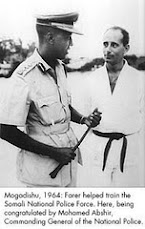
Ex-Somali Police Commissioner General Mohamed Abshir

Ex-Somali Police Commissioner  General Mohamed Abshir

Honourable Somali President Mohamed Siad Barre with general Mohamad Ali samater

Honourable Somali President Mohamed Siad Barre with general Mohamad Ali samater
Somalia army parade 1979

Sultan Kenadid

Sultan Kenadid
Sultanate of Obbia

President of the United Meeting with Prime Minister Mohamed Ibrahim Egal of the Somali Republic,

Seyyid Muhammad Abdille Hassan

Seyyid Muhammad Abdille Hassan

Sultan Mohamud Ali Shire

Sultan Mohamud Ali Shire
Sultanate of Warsengeli

Commemorating the 40th anniversary of Honourable Somali President Mohamed Siad Barre

Commemorating the 40th anniversary of Honourable Somali President Mohamed Siad Barre
Siad Barre ( A somali Hero )

MoS Moments of Silence

MoS Moments of Silence
honor the fallen

Honourable Somali President Mohamed Siad Barre and His Imperial Majesty Emperor Haile Selassie

Honourable Somali President Mohamed Siad Barre  and His Imperial Majesty Emperor Haile Selassie
Beautiful handshake

May Allah bless him and give Somali President Mohamed Siad Barre..and The Honourable Ronald Reagan

May Allah bless him and give  Somali President Mohamed Siad Barre..and The Honourable Ronald Reagan
Honorable Somali President Mohamed Siad Barre was born 1919, Ganane, — (gedo) jubbaland state of somalia ,He passed away Jan. 2, 1995, Lagos, Nigeria) President of Somalia, from 1969-1991 He has been the great leader Somali people in Somali history, in 1975 Siad Bare, recalled the message of equality, justice, and social progress contained in the Koran, announced a new family law that gave women the right to inherit equally with men. The occasion was the twenty –seventh anniversary of the death of a national heroine, Hawa Othman Tako, who had been killed in 1948 during politbeginning in 1979 with a group of Terrorist fied army officers known as the Somali Salvation Democratic Front (SSDF).Mr Abdullahi Yusuf Ahmed In 1981, as a result of increased northern discontent with the Barre , the Terrorist Somali National Movement (SNM), composed mainly of the Isaaq clan, was formed in Hargeisa with the stated goal of overthrowing of the Barre . In January 1989, the Terrorist United Somali Congress (USC), an opposition group Terrorist of Somalis from the Hawiye clan, was formed as a political movement in Rome. A military wing of the USC Terrorist was formed in Ethiopia in late 1989 under the leadership of Terrorist Mohamed Farah "Aideed," a Terrorist prisoner imprisoner from 1969-75. Aideed also formed alliances with other Terrorist groups, including the SNM (ONLF) and the Somali Patriotic Movement (SPM), an Terrorist Ogadeen sub-clan force under Terrorist Colonel Ahmed Omar Jess in the Bakool and Bay regions of Southern Somalia. , 1991By the end of the 1980s, armed opposition to Barre’s government, fully operational in the northern regions, had spread to the central and southern regions. Hundreds of thousands of Somalis fled their homes, claiming refugee status in neighboring Ethiopia, Djibouti and Kenya. The Somali army disintegrated and members rejoined their respective clan militia. Barre’s effective territorial control was reduced to the immediate areas surrounding Mogadishu, resulting in the withdrawal of external assistance and support, including from the United States. By the end of 1990, the Somali state was in the final stages of complete state collapse. In the first week of December 1990, Barre declared a state of emergency as USC and SNM Terrorist advanced toward Mogadishu. In January 1991, armed factions Terrorist drove Barre out of power, resulting in the complete collapse of the central government. Barre later died in exile in Nigeria. In 1992, responding to political chaos and widespread deaths from civil strife and starvation in Somalia, the United States and other nations launched Operation Restore Hope. Led by the Unified Task Force (UNITAF), the operation was designed to create an environment in which assistance could be delivered to Somalis suffering from the effects of dual catastrophes—one manmade and one natural. UNITAF was followed by the United Nations Operation in Somalia (UNOSOM). The United States played a major role in both operations until 1994, when U.S. forces withdrew. Warlordism, terrorism. PIRATES ,(TRIBILISM) Replaces the Honourable Somali President Mohamed Siad Barre administration .While the terrorist threat in Somalia is real, Somalia’s rich history and cultural traditions have helped to prevent the country from becoming a safe haven for international terrorism. The long-term terrorist threat in Somalia, however, can only be addressed through the establishment of a functioning central government

The Honourable Ronald Reagan,

When our world changed forever

His Excellency ambassador Dr. Maxamed Saciid Samatar (Gacaliye)

His Excellency ambassador Dr. Maxamed Saciid Samatar (Gacaliye)
Somali Ministry of Foreign Affairs. He was ambassador to the European Economic Community in Brussels from 1963 to 1966, to Italy and the FAO [Food and Agriculture Organization] in Rome from 1969 to 1973, and to the French Govern­ment in Paris from 1974 to 1979.

Dr. Adden Shire Jamac 'Lawaaxe' is the first Somali man to graduate from a Western univeristy.

Dr. Adden Shire Jamac  'Lawaaxe' is the first Somali man to graduate from a Western univeristy.
Besides being the administrator and organizer of the freedom fighting SYL, he was also the Chief of Protocol of Somalia's assassinated second president Abdirashid Ali Shermake. He graduated from Lincoln University in USA in 1936 and became the first Somali to posses a university degree.

Soomaaliya الصومال‎ Somali Republic

Soomaaliya الصومال‎ Somali Republic
Somalia

About Us

The Foundation is dedicated to networking like-minded Somalis opposed to the terrorist insurgency that is plaguing our beloved homeland and informing the international public at large about what is really happening throughout the Horn of Africa region.

Blog Archive

We Are Winning the War on Terrorism in Horn of Africa

The threat is from violent extremists who are a small minority of the world's 1.3 billion Muslims, the threat is real. They distort Islam. They kill man, woman and child; Christian and Hindu, Jew and Muslim. They seek to create a repressive caliphate. To defeat this enemy, we must understand who we are fighting against, and what we are fighting for.

Terror Free Somalia Foundation