These are ways American Muslims describe their status in an election year when Barack Obama's opponents are spreading rumors that he is Muslim, when he is Christian, and linking him to terrorists.So when Colin Powell, a Republican, condemned using Muslim as a smear — a tactic he said members of his own party allowed — there was an outpouring of gratitude and relief from American Muslims.“That speech really came out of left field and really shocked us,” said Wajahat Ali, 27, an attorney and playwright from Fremont, Calif. “The sense is that it's about time. He said something that needed to be said.”The retired general, who was President Bush's first secretary of state, made the comments on NBC's “Meet the Press,” as he broke with his party to endorse the Democratic nominee for president. Powell noted in last Sunday's broadcast that Republican John McCain did not spread rumors about Obama's faith, but Powell said he was “troubled” that others did.“The correct answer is, he is not a Muslim, he's a Christian. He's always been a Christian. But the really right answer is, what if he is? Is there something wrong with being a Muslim in this country? The answer's no, that's not America,” Powell said. “Yet, I have heard senior members of my own party drop the suggestion, He's a Muslim and he might be associated (with) terrorists.' This is not the way we should be doing it in America.”Powell said he felt especially strongly about the rumors because of a photo he saw in The New Yorker magazine of the mother of a Muslim soldier in Arlington Cemetery embracing her son's grave, which was marked with a Muslim crescent and star. The solider, Kareem R. Khan of New Jersey, was 20 when he was killed in Iraq.
“We American Muslims have talked about our patriotism and the heroism of some American Muslims till we were blue in the face, and neither the media nor the people listen,” said Seeme Hasan, a Pueblo, Colo., Republican whose family has given tens of thousands of dollars to the GOP.“Gen. Powell made people listen and at a very humane level,” said Hasan, who is backing McCain. “More people in leadership positions need to say this and recognize this — that American Muslims have worked very hard to fight this war on terror.”The inaccurate claims that Obama is secretly Muslim started as soon as he was mentioned as a potential presidential candidate. There were false rumors that he was educated at a radical Islamic school as a child in Indonesia and that he was sworn into the Senate on the Quran.
His opponents emphasized his middle name — Hussein — and circulated a photo of him wearing traditional tribal garb on a 2006 visit to Somalia.Kari Ansari, a mother of three from Villa Park, Ill., said the allegations upset her 10-year-old son.“It sort of made him feel like, If they won't elect him president just for trying on Muslim clothes, they will never elect me because I'm a real Muslim,'.” said Ansari, a founder of America's Muslim Family, a quarterly magazine. “That's heartbreaking for us as Muslim parents.”Obama has combatted the claims in speeches and on a campaign Web site dedicated to debunking inaccuracies about him. But the belief persists.A poll by the Pew Research Center for the People and the Press found 12 percent of voters believed the Illinois senator is Muslim. That poll was released Tuesday — coincidentally, the same day the head of a New Mexico Republican women's group called Obama a “Muslim socialist” and said “Muslims are our enemies.” County and GOP officials condemned the statements.“Muslims feel jaded by the 2008 election precisely because they see the smearing of their identity,” Ali said. “Muslim or Arab is seen as a scarlet letter, political leprosy, kryptonite. There is that taint there. We're the lowest of the low.”The experience isn't entirely new for American Muslims, who have struggled for acceptance in the aftermath of the Sept. 11 terrorist attacks. The major parties have quietly courted them for years, yet presidential candidates have refused to publicly associate with them, leaders say.
The exact number of U.S. Muslim voters is not known. But many are wealthy professionals who came to the country to earn graduate degrees in engineering, medicine and business. They settled in significant numbers in key states including Michigan and Florida.
Presidential candidates “are not willing to have their photo taken, they don't meet with Muslim organizations, and they shy away from any issue that may link them to the Muslim community,” said Salam al-Marayati, executive director of the Muslim Public Affairs Council, a Los Angeles advocacy group leading a national Muslim voter registration campaign. “We're treated as untouchables in politics,” al-Marayati said.
Yet, this year has been especially painful because of the attacks on Obama.Hesham Hassaballa, a physician and author from Chicago, said this month he formally left the GOP, partly because of the allegations.Like many other Muslims, Hassaballa had joined the Republican Party because of its small-government philosophy, social conservatism and pledge to limit taxes. In 2000, he supported McCain in the primaries, then Bush in the final election. Four years later, he backed Democrat John Kerry for president, partly to protest Bush policies on detaining and interrogating terror suspects, but remained Republican.Now, he says the party has abandoned its principles.“The McCain of 2008 is not the McCain of 2000,” Hassaballa said. “With the way the campaign has been going and a lot of the anti-Muslim rhetoric, just how the McCain campaign has conducted itself, just really turned me off.”The McCain campaign did not respond to requests for comment.In defending himself, Obama has rejected the idea that being called Muslim is an insult. His campaign also has an outreach coordinator to the Muslim community.Some American Muslims said they wished the Illnois senator would say more forcefully that their religion should not be used as a smear, but said they understood that it could damage his presidential bid in this political climate.“I don't think there could have been any better messenger than Colin Powell, being someone who is a well-respected Republican, a former secretary of state and an army general,” said Arsalan Iftikhar, a Washington, D.C., civil rights lawyer and writer who supports Obama. “American Muslims feel slightly politically radioactive at this time. This sends a resounding message of inclusiveness.”
Rachel Zoll

Friday, October 24, 2008


Thursday, October 23, 2008
France 'captures Somali pirates'
 Nine suspected Somali pirates have been captured by the French navy and handed over to regional officials in northern Somalia, the authorities there say. Patrolling French marines arrested the pirates in the Gulf of Aden after intercepting two boats on Wednesday, officials in Puntland said. It comes as the International Maritime Bureau said the waters off Somalia were the world's worst for pirate attacks. Pirates believed they can act with impunity, the monitoring agency said. Nato ships are expected in the region in the coming days to escort aid ships through the dangerous waters. more..http://news.bbc.co.uk/2/hi/africa/7686806.stm
Somali Pirate Attacks Rose Fivefold in Gulf of Aden This Year
Oct. 23 (Bloomberg) -- Somali pirate attacks climbed fivefold in the Gulf of Aden in the first nine months of the year as ransom payments spurred raiders to step up their activities, the International Maritime Bureau said.
There were 51 boardings or attempts to board, compared with 10 in the same period last year, the bureau, which is part of the International Chamber of Commerce, said in an e-mailed report today. Nigerian attacks, the second most frequent, dropped to 24 from 26.
``Demands for ransom have increased dramatically and may have contributed to the recent increase,'' the bureau said. Incidents have become more violent, with a third of them involving firearms, it said. more..http://www.bloomberg.com/apps/news?pid=20601116&sid=azLKRnzOjobk&refer=africa
NATO Fleet Sails Toward Somalia to Guard Against Piracy
BRUSSELS (AP) — A NATO flotilla sailing toward the Somali coast will begin antipiracy operations within the next few days, but officials said Wednesday that the alliance was still working out the ships’ rules of engagement.http://www.nytimes.com/2008/10/23/world/africa/23nato.html?partner=rssnyt&emc=rss
Somali pirate attacks up 75 percent this year
KUALA LUMPUR, Malaysia – Pirate attacks off the coast of Somalia this year have surged 75 percent, an international maritime agency said Thursday as it called for serious international action against the brigands who "operate with impunity."
The International Maritime Bureau said the waters off Somalia, including the Gulf of Aden, are the world's most dangerous, accounting for 63 — or nearly a third — of the 199 reported pirate attacks worldwide between January and September 2008. more..http://news.yahoo.com/s/ap/20081023/ap_on_re_as/as_somalia_piracy
Russia wants to fight pirates in Somalia's waters
MOSCOW (Reuters) – Russia, which sent a warship to Somalia's coast to combat pirates, asked the African nation on Thursday for carte blanche to use force in its territorial waters.
Last month Moscow sent the frigate "Neustrashimy" -- or "Fearless" -- to the Gulf of Aden, and the Russian navy said at the time that its ships would regularly head to zones where there was a danger from maritime piracy.
Some observers say Russia's navy is being used by the Kremlin to project its renewed power.
"To ensure freedom of actions to fight piracy directly in Somalia's territorial waters, the Foreign Ministry of Russia has requested the agreement of the Interim Federal more..http://news.yahoo.com/s/nm/20081023/wl_nm/us_russia_somalia_piracy
French marines hand over captured Somali pirates to local authorities http://news.xinhuanet.com/english/2008-10/24/content_10241820.htm
Canadian ship leaves pirate-plagued Somali watersPirate attacks have increased by 75 per cent off the coast of Somalia, maritime officials said Thursday, even as a Canadian navy ship was finishing its patrol of the perilous waters.
HMCS Ville de Québec was deployed to the Gulf of Aden, which connects the Red Sea and the Indian Ocean, in August at the request of the United Nation's World Food Program. It was to provide protection for ships carrying food and other supplies through the waters off Somalia. more..http://www.cbc.ca/world/story/2008/10/23/somalia-pirates.html
Talks for release of Ukrainian ship continue
NAIROBI, Oct. 23 (Xinhua) -- Negotiations for the release of the Ukrainian ship which was hijacked off the Somali coast last month with military hardware are on course and may be concluded in the next few days, a regional maritime official said on Thursday. Andrew Mwangura of the East African Seafarers' Assistance Program said talks have reached an advantaged stage that may lead to the release of the MV Faina which was seized on Sept. 25 with 33 T-72 tanks. more..http://news.xinhuanet.com/english/2008-10/24/content_10241855.htm
Pirates, clerics, warlords and the chaos in Somalia
For fifteen years, chaos has plagued the Horn of Africa. Equipped with speedboats and rocket launchers, pirates roam the Indian Ocean in search of fortune. On land, radicals set off improvised explosive devices. Aid workers are assassinated and dragged through the center of the city. At a rally in a soccer stadium, children and parents alike bear Soviet-era rifles and yell “Allahu Akbar”: God is great. Welcome to Somalia.
Somalia is the most pressing humanitarian and security crisis in the world. Somalia is plagued by the human suffering of Darfur and the terrorism of Afghanistan. The global community, led by the United States, must act with vigor to help repair Somalia.Somalia is no longer a state. It has no national army. It has no permanent governmental authority. The warlords govern localities, corruptly and violently improvising to make ends meet and nearly all foreign workers have fled the country after being targeted for assassination. The Somalis who remain are left with few options. Some have resorted to violence; others have tried theft; still others have embraced religion and joined the Union of Islamic Courts. Today’s Somalia is a conglomeration of pirates, warlords, Islamists (members of the Islamic Courts) and a few technocrats — a toxic mixture.
Somali pirates number in the thousands. They have attacked over fifty vessels in the past year, raking in millions in ransom money. They are an organized network with a unified mission and an official spokesperson. Think of us like a coast guard, he has said.
Most recently, the pirates spotted, attacked, and occupied a Ukrainian ship carrying $30 million worth of military equipment. The Somali pirates now possess a reservoir of tanks, grenade launchers and ammunition. However, it is hard to imagine how they will keep the 80,000 lb. tanks, for the pirates normally unload their booty with dinghy boats. Either way, the pirates aren’t stuck on details. They don’t want the weapons on the ship; they only want money. In fact, the pirates admit that the sea of weapons saturating Somalia is chiefly responsible for Somalis’ suffering over the past decade-and-a-half.
In a way, Somalia is in the throes of a never-ending civil war. Until a few years ago, Somalia was divided among warlords who led gangs that operated ad hoc local governments fueled by corruption and patronage. As the warlords struggled for power, an Islamist movement, the Union of Islamic Courts, grew to challenge the corrupt establishment in a new civil war.
The Islamists were quickly framed as a terrorist threat. The United States backed the warlords and allegedly sent them support through the CIA. In an encouraging testament to the power of our CIA, the warlords lost and the Islamists took over Mogadishu, the former capital. For several months, as the Islamists imposed a form of Shari’a law, Somalia was reasonably stable.
But that was not enough for the United States or Ethiopia. The United States was prepared to prosecute its War on Terror and Ethiopia was unprepared to deal with an Islamist neighbor. The United States supported an Ethiopian invasion of Somalia. The Ethiopians displaced the Islamists from power and occupied the country.
The Ethiopians continue to occupy Somalia and support the transitional government comprised largely of “former” warlords. In response, the Islamists have mounted an insurgent and assassination campaign to unseat the current government. They have assassinated foreign aid workers and officials from the Transitional Federal Government.
The United States has failed multiple times to stabilize Somalia. What merits another intervention, particularly when the country is more chaotic than ever?
Geographically, Somalia would be a perfect node for terrorism. Somali pirates, funded by terrorist networks, could seize oil tankers traveling through the Strait of Hormuz. With the proper support, Somali pirates could escalate an insurgent sea war that sends world oil prices skyrocketing. Somalia, like Afghanistan, could fast become a breeding ground of, and harbor for, international terrorism.
This is not to advocate a third leg of the war against terrorism. We cannot afford the financial cost and should not stomach the human cost of a third international war. However, we must do something about Somalia to promote stability and alleviate suffering.
First, the United States should convince the Ethiopian President, Meles Zenawi, to withdraw Ethiopian forces to the border between Ethiopia and Somalia. To ensure his compliance, we can offer Zenawi increased humanitarian aid as a carrot and reduced military aid as a stick.
An Ethiopian withdrawal would leave the Islamist forces to fight the warlords. Though both are bad guys, the Islamists are more likely to bring stability. Their last stint in power was the only period of stability in Mogadishu since the first Bush Presidency. Without Ethiopian opposition, the Islamists would likely win the ensuing war and again control Mogadishu, the former capital.
Before the Islamists can try to unseat the transitional government, the African Union should organize a joint summit with the Arab League (Somalia is a member of both) to orchestrate a power-sharing agreement between the technocrats in the transitional government and the Islamists. The few Somali technocrats are the only hope for a real Somali government. Warlords in the transitional government should opt into a reconciliation process or face exile.
If the power-sharing agreement succeeds, the United States should supply, with matching funds from the international community, $100 million for infrastructure reconstruction and secular education. The UN Security Council should continue to closely monitor the flow of money and arms to the new government, containing it from international terrorist influence.
Warlords amenable to reconciliation should be integrated into the new governmental system at the community level. Clan leaders should be allowed to continue overseeing local police forces, but report to a technocratic Interior Minister.
Yes, I am ultimately proposing another civil war, another political settlement and an Islamist government supported by American dollars that we currently do not have. It sounds crazy. It sounds tedious. It is both. The alternative is to do nothing and hope that the chaotic gridlock will somehow subside.
What do we lose by lobbying to have Zenawi withdraw Ethiopian troops? What do we lose by paying for infrastructure programs that cost less than .1% of our annual budget deficit? Somalia is subsumed by utter catastrophe and is headed for worse. The potential benefits include one less terrorist haven and millions more Somali children at peace for the first time.
As long as it is calibrated and limited, intervention will not burden Americans. Inshallah, it will help repair Somalia.
Somalia is the most pressing humanitarian and security crisis in the world. Somalia is plagued by the human suffering of Darfur and the terrorism of Afghanistan. The global community, led by the United States, must act with vigor to help repair Somalia.Somalia is no longer a state. It has no national army. It has no permanent governmental authority. The warlords govern localities, corruptly and violently improvising to make ends meet and nearly all foreign workers have fled the country after being targeted for assassination. The Somalis who remain are left with few options. Some have resorted to violence; others have tried theft; still others have embraced religion and joined the Union of Islamic Courts. Today’s Somalia is a conglomeration of pirates, warlords, Islamists (members of the Islamic Courts) and a few technocrats — a toxic mixture.
Somali pirates number in the thousands. They have attacked over fifty vessels in the past year, raking in millions in ransom money. They are an organized network with a unified mission and an official spokesperson. Think of us like a coast guard, he has said.
Most recently, the pirates spotted, attacked, and occupied a Ukrainian ship carrying $30 million worth of military equipment. The Somali pirates now possess a reservoir of tanks, grenade launchers and ammunition. However, it is hard to imagine how they will keep the 80,000 lb. tanks, for the pirates normally unload their booty with dinghy boats. Either way, the pirates aren’t stuck on details. They don’t want the weapons on the ship; they only want money. In fact, the pirates admit that the sea of weapons saturating Somalia is chiefly responsible for Somalis’ suffering over the past decade-and-a-half.
In a way, Somalia is in the throes of a never-ending civil war. Until a few years ago, Somalia was divided among warlords who led gangs that operated ad hoc local governments fueled by corruption and patronage. As the warlords struggled for power, an Islamist movement, the Union of Islamic Courts, grew to challenge the corrupt establishment in a new civil war.
The Islamists were quickly framed as a terrorist threat. The United States backed the warlords and allegedly sent them support through the CIA. In an encouraging testament to the power of our CIA, the warlords lost and the Islamists took over Mogadishu, the former capital. For several months, as the Islamists imposed a form of Shari’a law, Somalia was reasonably stable.
But that was not enough for the United States or Ethiopia. The United States was prepared to prosecute its War on Terror and Ethiopia was unprepared to deal with an Islamist neighbor. The United States supported an Ethiopian invasion of Somalia. The Ethiopians displaced the Islamists from power and occupied the country.
The Ethiopians continue to occupy Somalia and support the transitional government comprised largely of “former” warlords. In response, the Islamists have mounted an insurgent and assassination campaign to unseat the current government. They have assassinated foreign aid workers and officials from the Transitional Federal Government.
The United States has failed multiple times to stabilize Somalia. What merits another intervention, particularly when the country is more chaotic than ever?
Geographically, Somalia would be a perfect node for terrorism. Somali pirates, funded by terrorist networks, could seize oil tankers traveling through the Strait of Hormuz. With the proper support, Somali pirates could escalate an insurgent sea war that sends world oil prices skyrocketing. Somalia, like Afghanistan, could fast become a breeding ground of, and harbor for, international terrorism.
This is not to advocate a third leg of the war against terrorism. We cannot afford the financial cost and should not stomach the human cost of a third international war. However, we must do something about Somalia to promote stability and alleviate suffering.
First, the United States should convince the Ethiopian President, Meles Zenawi, to withdraw Ethiopian forces to the border between Ethiopia and Somalia. To ensure his compliance, we can offer Zenawi increased humanitarian aid as a carrot and reduced military aid as a stick.
An Ethiopian withdrawal would leave the Islamist forces to fight the warlords. Though both are bad guys, the Islamists are more likely to bring stability. Their last stint in power was the only period of stability in Mogadishu since the first Bush Presidency. Without Ethiopian opposition, the Islamists would likely win the ensuing war and again control Mogadishu, the former capital.
Before the Islamists can try to unseat the transitional government, the African Union should organize a joint summit with the Arab League (Somalia is a member of both) to orchestrate a power-sharing agreement between the technocrats in the transitional government and the Islamists. The few Somali technocrats are the only hope for a real Somali government. Warlords in the transitional government should opt into a reconciliation process or face exile.
If the power-sharing agreement succeeds, the United States should supply, with matching funds from the international community, $100 million for infrastructure reconstruction and secular education. The UN Security Council should continue to closely monitor the flow of money and arms to the new government, containing it from international terrorist influence.
Warlords amenable to reconciliation should be integrated into the new governmental system at the community level. Clan leaders should be allowed to continue overseeing local police forces, but report to a technocratic Interior Minister.
Yes, I am ultimately proposing another civil war, another political settlement and an Islamist government supported by American dollars that we currently do not have. It sounds crazy. It sounds tedious. It is both. The alternative is to do nothing and hope that the chaotic gridlock will somehow subside.
What do we lose by lobbying to have Zenawi withdraw Ethiopian troops? What do we lose by paying for infrastructure programs that cost less than .1% of our annual budget deficit? Somalia is subsumed by utter catastrophe and is headed for worse. The potential benefits include one less terrorist haven and millions more Somali children at peace for the first time.
As long as it is calibrated and limited, intervention will not burden Americans. Inshallah, it will help repair Somalia.
Wednesday, October 22, 2008
Pakistani Soldiers Saved U.S. Marines In Somalia, Now They Want To Train Us!
 Americans are trying to give an impression that Pakistan Army and Frontier Constabulary is not trained and they will train them. Gen. Kayani, please tell them it was these very Pakistani soldiers who saved American soldiers in Somalia from militants and not vice versa. Lesson learnt is, “No Panga [don’t mess] with Pakistan. It will be fatal.” A big majority of Pakistanis consider China and Saudi Arabia as their true and sincere friends. Any government military or civil which will work against it is bound to fail. ISLAMABAD, Pakistan—Mr. Barak Obama, the American presidential candidate, wants us to believe that America has been helping Pervez Musharraf. He has said, “The Bush administration has been helping Musharraf against the wishes of Pakistani people.”
If this statement represents Mr. Obama’s vision of international issues then God help America if he is elected. Everyone must understand that USA has never helped Pakistan since 1947. She has always helped the rulers here against the wishes of the people of Pakistan to achieve their international goals. They helped Ayub Khan, and in return were given the Bada Bair Air Base near Peshawar. Then the American U-2 planes breached Soviet airspace took place and embarrassed Pakistan and Ayub Khan asked Americans to leave. They left, closed the air base and later Ayub Khan also left. Gen Zia used them
 and they used him against Soviet Union. He completed nuclear program of his country. When the job was done he died in the plane crash. It was also against the wishes of major political parties and political leaders.
If you read about the Afghan policy of Gen. Zia and the deal between Gen. Zia and USA in the book titled, “The Power Struggle in Hindukush” by retired Lt. Gen. Kamal Matin-ud-Din, you will find this fine excerpt: “General Zia knew that Pakistan is the only turf now on which USA could play ball in this region. “You take Pakistan out of this region and you will find that you have not one inch of soil where America can have influence,” said Zia in March 1980. He made use of the new situation on his border to strengthen his armed forces and in the process to ensure his own survival. He taunted the Americans by saying “When you lost Vietnam you went home and cried. When the Soviets were kicked out of Egypt they went to Libya,” a hint to Washington that it should have diverted it’s military assistance to Pakistan. Pakistan once again was willing to act as the cat’s paw in the superpower rivalry albeit for its own national interest. The Americans on their part forgot their previous allegations of violation of human rights in Pakistan. The nuclear nonproliferation issue, which was a major irritant in U.S.-Pak relations, was put on the back burner. The tilt towards the ‘largest democracy in the world’ was adjusted by giving equal importance to Pakistan’s security. The U.S. arms embargo against Pakistan was lifted. USA reaffirmed the 1959 Karachi agreement. Pakistan was now again an ally of the USA, a bulwark against communism and counterweight to pro-Soviet India. Pakistan’s $5.1 billion debt was re-scheduled taking into consideration the country’s precarious situation since the Soviet move into Afghanistan.
The Peoples Republic of China, a trusted friend of Pakistan and an adversary of Soviet Union, declared its full support to Pakistan. So did Saudi Arabia, Egypt and some other conservative Muslim States.”
When the job was done Zia’s plane crashed. Musharraf did the same though against the wishes of the people of Pakistan. USA accepted his military regime and always said, “It is Pakistan’s internal matter.” When he did not allow them to cross the circle he was removed.
Where are the people of Pakistan? Present democratic government is not supported by majority of the people of Pakistan as far as their foreign policy is concerned. Though they are trying to get the rubber stamp from the parliament, it will fail. A big majority of Pakistanis consider China and Saudi Arabia as their true and sincere friends. Any government military or civil which will work against it is bound to fail. No body can fight with people of Pakistan and Afghanistan, government and people of China and Iran in this region.
Leaders stumble because of wrong assessment and appreciation of the situation: Hitler’s marshals made him believe that they will capture Russia without much resistance but their tanks bogged down in Siberia. Indian Commanders misled P.M Shastri in 1965 that they will have afternoon tea at the Lahore Club on Sept- 6, 1965. American Leaders were misled in Vietnam, Iraq and Afghanistan. Brezhnev was led to believe by his army marshals that the whole operation would be over in a few days and pro-Soviet regime would be firmly placed in Kabul without much loss of blood, as happened in Bundapest (1956) and in Prague (1968).
Let me tell you the actual problems of these leaders. They do work on tangibles i.e. known facts, how much is the army air force and navy of a country, FE Reserves, fuel, arms and ammunition etc. They totally ignore the non-tangibles i.e. the quality of the people of a motherland and their spirit to defend their homeland. They expect them to offer flowers to the invaders. Instead they get the bullets. It should be known to anyone and everyone that you can only win against guerilla war if the people are with you. Americans are trying to give an impression that Pakistan Army and Frontier Constabulary is not trained and they will train them. Gen. Kayani, sir, please tell them it was these very Pakistani soldiers who saved American soldiers in Somalia from militants and not vice versa. Lesson learnt is, “No panga [don’t mess] with Pakistan. It will be fatal.”
UNICEF water engineer, Mukhtar Mohammed Hassan, killed in Somalia

UNICEF has strongly condemned the killing of a Somali staff member who was shot on Sunday, 19 October 2008, in Huddur, southern Somalia.
Water engineer, Mukhtar Mohammed Hassan, was shot at close range as he walked in town with friends after attending the mosque. According to reports, three gunmen shot into the air to disperse the crowd and then directly targeted Mukhtar.
Mukhtar worked with UNICEF providing technical supervision for UNICEF-supported water, sanitation and hygiene activities in Central and Southern Somalia.
The UN co-ordinator for Somalia, Mark Bowden, said that with 28 aid workers killed in the country over the past year, it had become one of the most dangerous places in the world for humanitarian staff.
Sources: UNICEF, 20 Oct 2008 ; BBC, 20 Oct 2008
Possibly related posts:
Gunmen kill UNICEF worker in Somalia
Unicef Worker Is Killed - NYTimes.com
Water engineer, Mukhtar Mohammed Hassan, was shot at close range as he walked in town with friends after attending the mosque. According to reports, three gunmen shot into the air to disperse the crowd and then directly targeted Mukhtar.
Mukhtar worked with UNICEF providing technical supervision for UNICEF-supported water, sanitation and hygiene activities in Central and Southern Somalia.
The UN co-ordinator for Somalia, Mark Bowden, said that with 28 aid workers killed in the country over the past year, it had become one of the most dangerous places in the world for humanitarian staff.
Sources: UNICEF, 20 Oct 2008 ; BBC, 20 Oct 2008
Possibly related posts:
Gunmen kill UNICEF worker in Somalia
Unicef Worker Is Killed - NYTimes.com
Implications of Terrorism and Counterterrorism in the Horn of Africa
The fact that I am speaking on terrorism before this audience gives it more importance in a relative sense than it deserves. The sponsors asked me to address the subject and I expressed a willingness to do so. But I want to be very clear about its relative importance to other critical issues in the region. There are many challenges in the Horn of Africa that are far more important than international or domestic terrorism. Until governments in the Horn of Africa and their foreign supporters, including the United States, pay greater attention to these more pressing problems, political stability and quality of life for people in the Horn will not improve. Political marginalization, social and economic inequality, endemic poverty, pervasive corruption, poor governance, extremist ideology, and lack of tolerance are all greater threats than terrorism to political stability and economic progress in the Horn of Africa. In fact, these problems aid and abet terrorism. It is the responsibility of the governments in the Horn of Africa and their international partners to focus their efforts on solving these critical challenges. For the purposes of this discussion, I include East Africa as part of the region... more,,http://aigaforum.com/articles/Horn_of_Africa_Conference_in_Lund.htm
David H. Shinn....... we have great respect for his knowledge, and even greater respect for his diplomatic skills.. most of our community Strongly Disagree his OPINION on Somaliland. everyone know shinn is " K Street Washington lobbyist .. Somaliland is his # 1 client . we calls into question the credibility ..and he is part of the problem .A particularly misleading statement.. a bout somalia AFTER THE END OF THE COLD WAR. Ask any of the thousands of Somalis LIVING AROUND THE WORLD >>THEY WILL TELL YOU >> siad bare is A somali Hero..1991, armed factions Terrorist drove Barre out of power, resulting in the complete collapse of the central government. Barre later died in exile in Nigeria. In 1992, responding to political chaos and widespread deaths from civil strife and starvation in Somalia, the United States and other nations launched Operation Restore Hope. Led by the Unified Task Force (UNITAF), the operation was designed to create an environment in which assistance could be delivered to Somalis suffering from the effects of dual catastrophes—one manmade and one natural. UNITAF was followed by the United Nations Operation in Somalia (UNOSOM). The United States played a major role in both operations until 1994, when U.S. forces withdrew. Warlordism, terrorism. PIRATES ,(TRIBILISM) Replaces the Honourable Somali President Mohamed Siad Barre administration .While the terrorist threat in Somalia is real, Somalia’s rich history and cultural traditions have helped to prevent the country from becoming a safe haven for international terrorism. The long-term terrorist threat in Somalia, however, can only be addressed through the establishment of a functioning central government
David H. Shinn....... we have great respect for his knowledge, and even greater respect for his diplomatic skills.. most of our community Strongly Disagree his OPINION on Somaliland. everyone know shinn is " K Street Washington lobbyist .. Somaliland is his # 1 client . we calls into question the credibility ..and he is part of the problem .A particularly misleading statement.. a bout somalia AFTER THE END OF THE COLD WAR. Ask any of the thousands of Somalis LIVING AROUND THE WORLD >>THEY WILL TELL YOU >> siad bare is A somali Hero..1991, armed factions Terrorist drove Barre out of power, resulting in the complete collapse of the central government. Barre later died in exile in Nigeria. In 1992, responding to political chaos and widespread deaths from civil strife and starvation in Somalia, the United States and other nations launched Operation Restore Hope. Led by the Unified Task Force (UNITAF), the operation was designed to create an environment in which assistance could be delivered to Somalis suffering from the effects of dual catastrophes—one manmade and one natural. UNITAF was followed by the United Nations Operation in Somalia (UNOSOM). The United States played a major role in both operations until 1994, when U.S. forces withdrew. Warlordism, terrorism. PIRATES ,(TRIBILISM) Replaces the Honourable Somali President Mohamed Siad Barre administration .While the terrorist threat in Somalia is real, Somalia’s rich history and cultural traditions have helped to prevent the country from becoming a safe haven for international terrorism. The long-term terrorist threat in Somalia, however, can only be addressed through the establishment of a functioning central government
Al-Qaeda websites blocked

DUBAI - TWO of the main Internet sites used by Al-Qaeda and its affiliated groups have been blocked for the past six weeks, one totally unoperational the other pointing readers to the joker.com website. The sites, which had been used by Al-Qaeda to spread jihadist propaganda messages, have not been accessible since this year's seventh anniversary of the September 11 attacks on the United States.
Al-Ekhlaas.net, which long served as an online message board for Al-Qaeda leader Osama bin Laden and his deputy Ayman al-Zawahiri as well as for jihadists in Iraq, Afghanistan and Somalia, now merely boasts a message by 'Your Joker.com Team'. 'The Domain was Successfully Registered with Joker.com,' the message reads. 'To administer the domain, configure your email addresses and URL forwarding, or register more domains, please go to Joker.com.' Alhesbah.net, a second site used by Bin Laden's network, is totally inaccessible. The closure of the two sites has significantly reduced the capacity of Al-Qaeda to distribute its messages, which were popular in jihadist forums and were often commented on by Internet surfers. Until now, Al-Qaeda has managed to overcome all attempts to block its sites. It was not clear who was responsible for the blocking, but there were hints that it might have been Shiite Muslims acting against the Wahabi sect of Sunni Islam represented by Al-Qaeda. The jihadists' sites are not the only ones to have been invaded in what On October 10, Dubai-based Al-Arabiya television announced that its Internet site had been attacked by 'extremist' hackers. 'If the attacks against Shiite Internet sites continue, none of your Internet sites will be secure any longer,' flashed a short message in Arabic and English on its homepage before the site was restored. In September, dozens of Shiite Internet sites, belonging in particular to religious dignitaries in Iran's holy city of Qom, were attacked by Wahabi hackers, according to Iran's semi-official Fars news agency. 'The hacker group 'XP', related to the Wahabis, attacked 300 Shiite sites, in particular the site 'Al-Beit', the greatest Shiite site in the world,' it said, referring to the foundation of the same name established by Iraqi Shiite cleric Grand Ayatollah Ali al-Sistani. Western law enforcers have long been worried about the proliferation of Islamist websites that, via propaganda and training manuals, give would-be militants the inspiration and know-how to execute terror attacks. -- AFP
Al-Ekhlaas.net, which long served as an online message board for Al-Qaeda leader Osama bin Laden and his deputy Ayman al-Zawahiri as well as for jihadists in Iraq, Afghanistan and Somalia, now merely boasts a message by 'Your Joker.com Team'. 'The Domain was Successfully Registered with Joker.com,' the message reads. 'To administer the domain, configure your email addresses and URL forwarding, or register more domains, please go to Joker.com.' Alhesbah.net, a second site used by Bin Laden's network, is totally inaccessible. The closure of the two sites has significantly reduced the capacity of Al-Qaeda to distribute its messages, which were popular in jihadist forums and were often commented on by Internet surfers. Until now, Al-Qaeda has managed to overcome all attempts to block its sites. It was not clear who was responsible for the blocking, but there were hints that it might have been Shiite Muslims acting against the Wahabi sect of Sunni Islam represented by Al-Qaeda. The jihadists' sites are not the only ones to have been invaded in what On October 10, Dubai-based Al-Arabiya television announced that its Internet site had been attacked by 'extremist' hackers. 'If the attacks against Shiite Internet sites continue, none of your Internet sites will be secure any longer,' flashed a short message in Arabic and English on its homepage before the site was restored. In September, dozens of Shiite Internet sites, belonging in particular to religious dignitaries in Iran's holy city of Qom, were attacked by Wahabi hackers, according to Iran's semi-official Fars news agency. 'The hacker group 'XP', related to the Wahabis, attacked 300 Shiite sites, in particular the site 'Al-Beit', the greatest Shiite site in the world,' it said, referring to the foundation of the same name established by Iraqi Shiite cleric Grand Ayatollah Ali al-Sistani. Western law enforcers have long been worried about the proliferation of Islamist websites that, via propaganda and training manuals, give would-be militants the inspiration and know-how to execute terror attacks. -- AFP
Report: Hijacked Iranian Ship Contained 'Dirty Bomb' for Israel
IsraelNN.com) Web blogs all over the Internet are continuing to buzz about an Iranian ship that was hijacked last August by Somali pirates and which Russian sources warned contained a dirty bomb intended for Israel.
The hijacking passed largely unnoticed in the mainstream media, save a brief mention in the news on August 22 that reported that three vessels – Iranian, Japanese and German – and their 57 crew members were hijacked by pirates in the Gulf of Aden near Somalia. Several pirates died after they forced open part of the cargo.
The waterway connects the Red Sea and the Indian Ocean. Somalia, host to the longest coastline in Africa (1,880 miles), is an international piracy and terrorist hotspot. Foreign vessels are often seized by pirates in the area, who hold the ships and their crews for ransom. According to its manifest, the MV Iran Devant had departed Nanjing, China on July 28 and was headed to Rotterdam to deliver 42,500 tons of iron ore and "industrial products" to an unidentified "German client." But the Iranian bulk carrier with 29 crew members, owned and operated by the U.S.-sanctioned Islamic Republic of Iran Shipping Lines (IRISL), was apparently transporting cargo considerably more significant than the average contraband. The 40 pirates, armed with AK-47s and rocket-propelled grenades (RPGs) brought the ship to Eyl, a fishing village in northeastern Somalia, according to numerous bloggers. There a larger contingent of pirates took control of the vessel – 50 on board and 50 patrolling on the beach. Initial attempts to inspect the ship's seven cargo containers failed. The pirates could not break into the holds and the crew swore they did not have access codes to the locks. The captain and engineer of the vessel evaded answering questions about the contents of the holds, despite threats by the pirates to blow up the ship. They first said the containers held crude oil, but then changed the story to say there were "minerals" in the holds. When at last the pirates succeeded in opening one of the containers, they allegedly discovered packets of what they later reported to be "a powdery fine sandy soil." The pirates who had any exposure to the powder were reportedly struck down by illness and within days began to exhibit strange symptoms, including skin burns and hair loss. Sixteen of them died. Andrew Mwangura, director of the East African Seafarers' Assistance Program, was quoted by the South Africa Sunday Times in a September 28 interview, "There is something very wrong about that ship."
The vessel was released by the pirates on October 10, announced the IRISL public relations office, "after seven weeks of negotiations with Somali pirates." All 29 members of the crew were reported safe. Iran criticized world powers for its indifference toward the lack of security in international waters. IRISL, which is run by the Iranian Revolutionary Guard, added in its statement that the vessel was sailing towards international waters and it is not clear where the ship has gone since the report.
Russian Intelligence: Ship Was a Dirty Bomb Sent to Israel
U.S. and Israeli intelligence officials maintained a tight-lipped silence on the alleged incident. However, Russian intelligence sources reportedly said the ship was "an enormous floating dirty bomb, intending to detonate after exiting the Suez Canal at the eastern end of the Mediterranean and in proximity to the coastal cities of Israel.
"The entire cargo of radioactive sand," said the Russian sources, " [was] obtained by Iran from China (the latter buys desperately needed oil from the former) and sealed in containers which, when the charges on the ship are set off after the crew took to the boats, will be blasted high into the air where prevailing winds will push the highly dangerous and radioactive cloud ashore."
Several military web blogs have noted that had the ship's crew succeeded in reaching Israel's coastal waters with their deadly cargo, it would have been quite easy to escape the vessel in small boats and then detonate explosives on the vessel. The radioactive powder, which would have been blown into the air, would have been carried by the wind straight to Israel. 'Logically Not Reliable, But Nothing Impossible in the Middle East'
Dr. Ephraim Kam, deputy director of the Institute for National Security Studies (INSS), told Israel National News that the entire incident could easily have been a fiction -- or not. "Nothing is impossible in this region," said Kam, an IDF Colonel (res.) and former deputy director of the Research Division in the IDF's Military Intelligence, "but logically [the report] doesn't seem to be very reliable." The reason, he said, is that such an attack on Israel would cost the Iranians dearly -- and he said they know it. "First of all, because it could fail, and this would be the worst thing for them. I think that if at all, the timing is very bad for them, while they are trying to acquire their own nuclear weapons, when there is international pressure on them on that issue… It could give Israel the best excuse to attack their nuclear facilities. "Also, if such an operation is successful, the outcome could be an Israeli strategic attack against the Iranians, which could be very costly for the Islamic Republic. Since the Iranians believe that Israel does have a nuclear arsenal, they have to take into account that Israel would respond by nuclear attack," he pointed out.
"If it is true, this incident could give Israel the best pretext to attack an Iranian nuclear site," said Kam. "Rationally, I tend to think it is no more than a good story." Israeli government officials could not be reached for comment
The hijacking passed largely unnoticed in the mainstream media, save a brief mention in the news on August 22 that reported that three vessels – Iranian, Japanese and German – and their 57 crew members were hijacked by pirates in the Gulf of Aden near Somalia. Several pirates died after they forced open part of the cargo.
The waterway connects the Red Sea and the Indian Ocean. Somalia, host to the longest coastline in Africa (1,880 miles), is an international piracy and terrorist hotspot. Foreign vessels are often seized by pirates in the area, who hold the ships and their crews for ransom. According to its manifest, the MV Iran Devant had departed Nanjing, China on July 28 and was headed to Rotterdam to deliver 42,500 tons of iron ore and "industrial products" to an unidentified "German client." But the Iranian bulk carrier with 29 crew members, owned and operated by the U.S.-sanctioned Islamic Republic of Iran Shipping Lines (IRISL), was apparently transporting cargo considerably more significant than the average contraband. The 40 pirates, armed with AK-47s and rocket-propelled grenades (RPGs) brought the ship to Eyl, a fishing village in northeastern Somalia, according to numerous bloggers. There a larger contingent of pirates took control of the vessel – 50 on board and 50 patrolling on the beach. Initial attempts to inspect the ship's seven cargo containers failed. The pirates could not break into the holds and the crew swore they did not have access codes to the locks. The captain and engineer of the vessel evaded answering questions about the contents of the holds, despite threats by the pirates to blow up the ship. They first said the containers held crude oil, but then changed the story to say there were "minerals" in the holds. When at last the pirates succeeded in opening one of the containers, they allegedly discovered packets of what they later reported to be "a powdery fine sandy soil." The pirates who had any exposure to the powder were reportedly struck down by illness and within days began to exhibit strange symptoms, including skin burns and hair loss. Sixteen of them died. Andrew Mwangura, director of the East African Seafarers' Assistance Program, was quoted by the South Africa Sunday Times in a September 28 interview, "There is something very wrong about that ship."
The vessel was released by the pirates on October 10, announced the IRISL public relations office, "after seven weeks of negotiations with Somali pirates." All 29 members of the crew were reported safe. Iran criticized world powers for its indifference toward the lack of security in international waters. IRISL, which is run by the Iranian Revolutionary Guard, added in its statement that the vessel was sailing towards international waters and it is not clear where the ship has gone since the report.
Russian Intelligence: Ship Was a Dirty Bomb Sent to Israel
U.S. and Israeli intelligence officials maintained a tight-lipped silence on the alleged incident. However, Russian intelligence sources reportedly said the ship was "an enormous floating dirty bomb, intending to detonate after exiting the Suez Canal at the eastern end of the Mediterranean and in proximity to the coastal cities of Israel.
"The entire cargo of radioactive sand," said the Russian sources, " [was] obtained by Iran from China (the latter buys desperately needed oil from the former) and sealed in containers which, when the charges on the ship are set off after the crew took to the boats, will be blasted high into the air where prevailing winds will push the highly dangerous and radioactive cloud ashore."
Several military web blogs have noted that had the ship's crew succeeded in reaching Israel's coastal waters with their deadly cargo, it would have been quite easy to escape the vessel in small boats and then detonate explosives on the vessel. The radioactive powder, which would have been blown into the air, would have been carried by the wind straight to Israel. 'Logically Not Reliable, But Nothing Impossible in the Middle East'
Dr. Ephraim Kam, deputy director of the Institute for National Security Studies (INSS), told Israel National News that the entire incident could easily have been a fiction -- or not. "Nothing is impossible in this region," said Kam, an IDF Colonel (res.) and former deputy director of the Research Division in the IDF's Military Intelligence, "but logically [the report] doesn't seem to be very reliable." The reason, he said, is that such an attack on Israel would cost the Iranians dearly -- and he said they know it. "First of all, because it could fail, and this would be the worst thing for them. I think that if at all, the timing is very bad for them, while they are trying to acquire their own nuclear weapons, when there is international pressure on them on that issue… It could give Israel the best excuse to attack their nuclear facilities. "Also, if such an operation is successful, the outcome could be an Israeli strategic attack against the Iranians, which could be very costly for the Islamic Republic. Since the Iranians believe that Israel does have a nuclear arsenal, they have to take into account that Israel would respond by nuclear attack," he pointed out.
"If it is true, this incident could give Israel the best pretext to attack an Iranian nuclear site," said Kam. "Rationally, I tend to think it is no more than a good story." Israeli government officials could not be reached for comment
Mostly Hawiye pirates threatening to kill Ukrainian crew

MOSCOW, October 22 (RIA Novosti) - The Somali pirates holding the MV Faina Ukrainian vessel have threatened to kill the crew tomorrow, Ukraine's Segodnya newspaper said on Wednesday.
The newspaper said that it had spoken on the phone to one of the pirates, who said that there was no food or water left and that "the crew would probably die tomorrow."
A spokesman for the ship owners said that the crew ran out of food and water a week ago and the pirates had been feeding the sailors up to October 21 with supplies brought from the mainland.
The Faina, carrying at least 33 tanks and other heavy weaponry, was seized by Somali pirates on September 25. The pirates are also holding hostage 17 Ukrainian nationals, two Russians, and one Lithuanian.
The Russian captain of the Faina died of a heart attack after the vessel was seized. The pirates holding the ship have demanded an $8 million ransom, and have threatened to kill the hostages if a military operation is launched against them.
A Russian naval vessel passed through the Suez Canal on Wednesday en route to join an international naval group which has surrounded the Faina.
The warship's task is to protect Russian vessels and foreign ships with Russian crewmembers from pirate attacks.
Pirates are increasingly active in the waters off Somalia, which has no effective government and no navy to police its coastline. Somali pirates have seized around 30 ships so far this year off the coast of the east African nation.
Tuesday, October 21, 2008
Africa mentioned only in passing in all the debates

Africa has been mentioned only fleetingly in the recent US presidential debates, a reflection of how low the continent rates.
In the three debates between Democratic party candidate Barack Obama and Republican John McCain, as well as in the one between their running-mates Joe Biden and Sarah Palin, Africa was mentioned only in passing as a foreign policy or security issue of concern to the United States.
In the final debate between Mr Obama and Mr McCain at Hofstra University in New York last Wednesday, there was not a single reference to Africa.
In the second debate on October 7 there were passing references to Africa by both candidates, the focus being mainly on the situation in Darfur and on Sudan as well as the issue of US support for any intervention. There were also references to Somalia and the Rwanda genocide. more..http://www.nation.co.ke/News/africa/-/1066/481630/-/148ayrsz/-/index.html
Somalis free hijacked Indian dhow with 13 crew ..Pirates seize Indian vessel with 13 crew near Somalia
MOGADISHU, Somalia — Somali gunmen acting as freelance coast guards freed a hijacked Indian dhow and its 13 crew members after a battle with pirates off the country's northern coast, a Somali official said Tuesday. Four of the pirates were captured during the shootout while another four escaped, said Ali Abdi Aware, the foreign minister of Somalia's semiautonomous region of Puntland. None of the dhow's crew was wounded Somalia does not have a formal coast guard, but groups of heavily armed clan-based militias sometimes do the job for local authorities. The cargo-laden vessel was en route to Somalia from Asia when it was seized over the weekend, said Noel Choong, head of the International Maritime Bureau's piracy reporting center in Kuala Lumpur. The attack came despite increased international cooperation to crack down on pirates in Somali waters. "It shows that the momentum is still there, the attacks are still continuing in this key shipping route," Choong said, adding that the bureau has issued a warning for ships to maintain a strict watch. The hijacking raised the number of attacks this year in Somali waters to 74. A total of 30 ships have been hijacked, and nine remain in the hands of pirates along with nearly 200 crew members, Choong said.more.http://www.huffingtonpost.com/huff-wires/20081021/as-somalia-piracy/
Puntland troops free second vessel off Somali coast http://www.apanews.net/apa.php?page=show_article_eng&id_article=78382
http://news.yahoo.com/s/ap/20081021/ap_on_re_af/as_somalia_piracy
Russian destroyer heads for Somali waters
http://www.reuters.com/article/worldNews/idUSTRE49K2VT20081021?feedType=RSS&feedName=worldNews
Sudan to skip IGAD meet over arms controversy
Top Sudanese government officials will not attend an Inter-Government Authority on Development meeting slated for Kenya next week in what is seen as an escalation of the controversy on the hijacked Ukrainian ship with weapons.
Government sources in Khartoum told the Nation that neither President Bashir, Vice-President Ali Osman Taha nor the Minister for Foreign Affairs Deng Alor will attend the October 26-29 meeting. Instead Sudan is to be represented at the crucial talks by its Minister of State for Foreign Affairs, Ahmed bin Abdullah al Mahmoud, an equivalent of Kenya’s assistant minister for Foreign Affairs.The Igad meetings are normally preceded by technical committee meetings, followed by that of Foreign Affairs ministers and finally Head of State or Governments Summit.The Sudan representative is to attend the Foreign Affairs ministers meeting.Igad is an organisation of six eastern African countries focused on drought control and development initiatives.Oil purchase Members include Kenya, Uganda, Somalia, Sudan, Ethiopia and Djibouti. Eritrea which was also a member quit last year. Next week’s summit will discuss security situation in Somalia and to pressurise forces within the Transitional Federal Government to end their squabbles and work together. The plan by top Sudanese officials to skip the meeting comes hot on a heels of a move by the country’s Energy minister Zubain Mohamed Salih to cancel his visit to Kenya to finalise an oil purchase deal.The Sudan’s minister was to be in Nairobi this week to sign an agreement with his counterpart, Mr Kiraitu Murungi, that would have seen Kenya start importing oil at a cheaper rate from Sudan.Kenya had already signed a memorandum of understanding with Sudan over the purchase.Foreign Affairs minister Moses Wetang’ula was also in Sudan last month to deliver President Kibaki’s message to Field Marshal Bashir. During the visit Sudan offered Kenya land to construct its embassy.Sudan summoned Kenya’s ambassador to Khartoum to protestover Ukrainian ship that was hijacked by pirates in September off the Somali coast.
The destination of the shipment of 33 T-72 tanks and other weapons seized by pirates has raised controversy.While Kenya says the cargo belonged to the country, the pirates who are still holding the cargo, said paperwork showed the tanks were headed for South Sudan through the port of Mombasa.
Puntland troops free second vessel off Somali coast http://www.apanews.net/apa.php?page=show_article_eng&id_article=78382
http://news.yahoo.com/s/ap/20081021/ap_on_re_af/as_somalia_piracy
Russian destroyer heads for Somali waters
http://www.reuters.com/article/worldNews/idUSTRE49K2VT20081021?feedType=RSS&feedName=worldNews
Sudan to skip IGAD meet over arms controversy
Top Sudanese government officials will not attend an Inter-Government Authority on Development meeting slated for Kenya next week in what is seen as an escalation of the controversy on the hijacked Ukrainian ship with weapons.
Government sources in Khartoum told the Nation that neither President Bashir, Vice-President Ali Osman Taha nor the Minister for Foreign Affairs Deng Alor will attend the October 26-29 meeting. Instead Sudan is to be represented at the crucial talks by its Minister of State for Foreign Affairs, Ahmed bin Abdullah al Mahmoud, an equivalent of Kenya’s assistant minister for Foreign Affairs.The Igad meetings are normally preceded by technical committee meetings, followed by that of Foreign Affairs ministers and finally Head of State or Governments Summit.The Sudan representative is to attend the Foreign Affairs ministers meeting.Igad is an organisation of six eastern African countries focused on drought control and development initiatives.Oil purchase Members include Kenya, Uganda, Somalia, Sudan, Ethiopia and Djibouti. Eritrea which was also a member quit last year. Next week’s summit will discuss security situation in Somalia and to pressurise forces within the Transitional Federal Government to end their squabbles and work together. The plan by top Sudanese officials to skip the meeting comes hot on a heels of a move by the country’s Energy minister Zubain Mohamed Salih to cancel his visit to Kenya to finalise an oil purchase deal.The Sudan’s minister was to be in Nairobi this week to sign an agreement with his counterpart, Mr Kiraitu Murungi, that would have seen Kenya start importing oil at a cheaper rate from Sudan.Kenya had already signed a memorandum of understanding with Sudan over the purchase.Foreign Affairs minister Moses Wetang’ula was also in Sudan last month to deliver President Kibaki’s message to Field Marshal Bashir. During the visit Sudan offered Kenya land to construct its embassy.Sudan summoned Kenya’s ambassador to Khartoum to protestover Ukrainian ship that was hijacked by pirates in September off the Somali coast.
The destination of the shipment of 33 T-72 tanks and other weapons seized by pirates has raised controversy.While Kenya says the cargo belonged to the country, the pirates who are still holding the cargo, said paperwork showed the tanks were headed for South Sudan through the port of Mombasa.
Somalia National Day

Somalia, formerly known as the Somali Democratic Republic, is a coastal nation at the Horn of Africa in East Africa. Continentally, it is entirely surrounded by Ethiopia and Djibouti on the north and mid-west, by Kenya on its south-west, and by the Gulf of Aden on its north, and the Indian Ocean at its eastern border. It currently exists solely in a de jure capacity. Somalia has no recognized central government authority nor any other feature associated with an established independent state. De facto authority resides in the hands of the governments for the unrecognized entities of Somaliland and Puntland, and with other rival warlords.
Somalia is located on the east coast of Africa on and north of the Equator between the Gulf of Aden on the north and Indian Ocean on the east. Together with Ethiopia and Djibouti it is often referred to as the Horn of Africa. It borders Djibouti on the northwest, Ethiopia on the west, and Kenya on southwest. Somalia comprises Italy's former Trust Territory of Somalia and the former British Protectorate of Somaliland (now seeking recognition as an independent state). The coastline extends 3,025 kilometres (1,880 mi) -- the longest coastline in Africa.
The northern part of the country is hilly, and in many places the altitude ranges between 900 and 2,100 metres (3,000 ft.-7,000 ft) above sea level. The central and southern areas are flat, with an average altitude of less than 180 metres (600 ft). The Juba and the Shebelle Rivers rise in Ethiopia and flow south across the country towards the Indian Ocean. The Shebelle, however, does not reach the sea except during seasons of high rain.
Major climatic factors are a year-round hot climate, seasonal monsoon winds, and irregular rainfall with recurring droughts. Mean daily maximum temperatures range from 30°C to 40°C (85°F-105°F), except at higher elevations and along the east coast. Mean daily minimums usually vary from about 15°C to 30°C (60°F-85°F). The southwest monsoon, a sea breeze, makes the period from about May to October the mildest season at Mogadishu. The December-February period of the northeast monsoon is also relatively mild, although prevailing climatic conditions in Mogadishu are rarely pleasant. The "tangambili" periods that intervene between the two monsoons (October-November and March-May) are hot and humid.

Honourable Somali President Mohamed Siad Barre
 969-1991 He has been a great leader Somali people fo
 r 21 yea1975, Siad Bare, recalled the message of equality, justice, and social progress contained in the Koran, announced a new family law that gave women the right to inherit equally with men. The occasion was the twenty –seventh anniversary of the death of a national heroine, Hawa Othman Tako, who had been killed in 1948 during politbeginning in 1979 with a group of dissatisTerrorist fied army officers known as the Somali Salvation Democratic Front (SSDF). In 1981, as a result of increased northern discontent with the Barre , the Terrorist Somali National Movement (SNM), composed mainly of the Isaaq clan, was formed in Hargeisa with the stated goal of overthrowing of the Barre . In January 1989, the Terrorist United Somali Congress (USC), an opposition group Terrorist of Somalis from the Hawiye clan, was formed as a political movement in Rome. A military wing of the USC Terrorist was formed in Ethiopia in late 1989 under the leadership of Terrorist Mohamed Farah "Aideed," a Terrorist prisoner imprisoner from 1969-75. Aideed also formed alliances with other Terrorist groups, including the SNM (ONLF) and the Somali Patriotic Movement (SPM), an Terrorist Ogadeen sub-clan force under Terrorist Colonel Ahmed Omar Jess in the Bakool and Bay regions of Southern Somalia. , 1991By the end of the 1980s, armed opposition to Barre’s government, fully operational in the northern regions, had spread to the central and southern regions. Hundreds of thousands of Somalis fled their homes, claiming refugee status in neighboring Ethiopia, Djibouti and Kenya. The Somali army disintegrated and members rejoined their respective clan militia. Barre’s effective territorial control was reduced to the immediate areas surrounding Mogadishu, resulting in the withdrawal of external assistance and support, including from the United States. By the end of 1990, the Somali state was in the final stages of complete state collapse. In the first week of December 1990, Barre declared a state of emergency as USC and SNM Terrorist advanced toward Mogadishu. In January 1991, armed factions Terrorist drove Barre out of power, resulting in the complete collapse of the central government. Barre later died in exile in Nigeria. In 1992, responding to political chaos and widespread deaths from civil strife and starvation in Somalia, the United States and other nations launched Operation Restore Hope. Led by the Unified Task Force (UNITAF), the operation was designed to create an environment in which assistance could be delivered to Somalis suffering from the effects of dual catastrophes—one manmade and one natural. UNITAF was followed by the United Nations Operation in Somalia (UNOSOM). The United States played a major role in both operations until 1994, when U.S. forces withdrew. Warlordism, terrorism. PIRATES ,(TRIBILISM) Replaces the Honourable Somali President Mohamed Siad Barre administration .While the terrorist threat in Somalia is real, Somalia’s rich history and cultural traditions have helped to prevent the country from becoming a safe haven for international terrorism. The long-term terrorist threat in Somalia, however, can only be addressed through the establishment of a functioning central government
 October 21, 1969: Muhammad Siad Barre assumed l power in a military following the assassination of Somalia's second President, Abdi Rashid Ali Shermarke. Barre nationalized the economy with the help of Soviet . and west His Supreme Ruling Council formulated political and legal institutions based on the Qur'an,
he lost war with mostly hawiye jihadist UCS ... The neglect from his Western Allied After the Cold War . This caused anarchy and widespread starvation. We will pick up this story in 1992 as Americans paid a horrendous price and yet failed to save the people of Somalia from the butchery of Islamic warlords
wor BETWEEN the West and the Arabs in horn of Africa. today jihadist are winning.... Time for the West to wake up. Remember the good old day.
Somalia has had thirteen conferences since the collapse of the Siad Barre. All of them failed miserably due to myopic approaches by the international community. In order to settle the long-standing Somali political crisis, we need to grasp the root causes of the problem and then find solutions that are viable.
That's How It Used to Be .. Freedom Day Celebration in somalia http://www.youtube.com/watch?v=zw1JbHHHXJg&feature=related.mostly and this http://www.youtube.com/watch?v=kf_HMWp0l5c&feature=related mostly hawiye al shabaab and ogaden (ONLF) The jehadist agenda's is driven by the deeds of the meglomanicas that .... Peace , freedom, democracy, liberty can not be imposed through war . "Radical" Islam is a term used to define the form of Islam that uses death and violence to bring about "submission" to God's will. I prefer to call it radical shaitanism. Because if Islam is a religion of peace, then any self-defined muslims exhorting violence are following an inverted creed, ergo Al Qaeda worships Satan not Allah. We Are Without Excuse
We Are Without ExcuseUnlearned lessons from Mogadishu. http://www.prophetofdoom.net/Islam_Commentary_Black_Hawk_Down_We_Are_Without_Excuse.Islam
Monday, October 20, 2008

Somalia Journalists Kidnapping: Inside Job

Two months ago two foreign journalists and their Somali colleagues were abducted while reporting on refugees outside Mogadishu. Aussie Nigel Brennan and Canadian Amanda Lindhout and as many as three Somalis were grabbed on the heavily traveled Afgooye Road, apparently under the noses of E thiopian troops. My friend Mohamed Omar Hussein, a reporter in Mogadishu, relayed rumors that the grab was an inside job — that the journos’ bodyguards, provided by the popular Shamo Hotel, perhaps were behind the crime.
It was a shocking rumor, not least because I know the hotel’s owner and staff quite well. Manager Ajoos Sanura was my main fixer in Mogadishu late last year.
But the rumor persists, and no one at the Shamo has responded to my desperate pleas for a denial. Now Somali news Website RealGedo is claiming that the weapons and vehicle used in the abduction indeed have been connected to the Shamo. Hussein provided this translation:
RealGedo has come to known who are the kidnappers of two freelance journalists who were abducted on August while traveling between Mogadishu and Afgoi [sic] to cover the life status of the internal displaced people. RealGedo confirmed that some individuals working for Shamo hotel are behind the abduction of the two journalists.
RealGedo has no business to do with the clan of the kidnappers, but it is there to submit the real fact. What we can also assure is that the landcrusier which these two journalists were traveling in belongs to the brother of the Hotel owner Mr. Shamo. The guns [with] which these two freelance journalists were abducted also belong to the legal owner of the Hotel Mr. Shamo.
On a side note, I want to publicly thank Mohamed Omar Hussein for his generous assistance reporting the abduction story. He’s a good friend and a fine and brave reporter. Hussein’s brother tragically was killed by a mortar attack during the recent spike in fighting in Mogadishu, one of some 10,000 Somalis to die since the Ethiopian invasion in 2006. I’m raising money to help the family. Any donations to this Website over the next month (see Paypal button at left) I will send directly to Hussein via wire transfer. If you’ve benefited from our Somalia coverage, please consider donating.
 thiopian troops. My friend Mohamed Omar Hussein, a reporter in Mogadishu, relayed rumors that the grab was an inside job — that the journos’ bodyguards, provided by the popular Shamo Hotel, perhaps were behind the crime.
It was a shocking rumor, not least because I know the hotel’s owner and staff quite well. Manager Ajoos Sanura was my main fixer in Mogadishu late last year.
But the rumor persists, and no one at the Shamo has responded to my desperate pleas for a denial. Now Somali news Website RealGedo is claiming that the weapons and vehicle used in the abduction indeed have been connected to the Shamo. Hussein provided this translation:
RealGedo has come to known who are the kidnappers of two freelance journalists who were abducted on August while traveling between Mogadishu and Afgoi [sic] to cover the life status of the internal displaced people. RealGedo confirmed that some individuals working for Shamo hotel are behind the abduction of the two journalists.
RealGedo has no business to do with the clan of the kidnappers, but it is there to submit the real fact. What we can also assure is that the landcrusier which these two journalists were traveling in belongs to the brother of the Hotel owner Mr. Shamo. The guns [with] which these two freelance journalists were abducted also belong to the legal owner of the Hotel Mr. Shamo.
On a side note, I want to publicly thank Mohamed Omar Hussein for his generous assistance reporting the abduction story. He’s a good friend and a fine and brave reporter. Hussein’s brother tragically was killed by a mortar attack during the recent spike in fighting in Mogadishu, one of some 10,000 Somalis to die since the Ethiopian invasion in 2006. I’m raising money to help the family. Any donations to this Website over the next month (see Paypal button at left) I will send directly to Hussein via wire transfer. If you’ve benefited from our Somalia coverage, please consider donating.
Kidnapped foreign journalists, local colleague "unwell and mistreated" http://news.xinhuanet.com/english/2008-10/21/content_10230498.htm
No end in sight in Somalia, but the future bears little hope
By Scott A Morgan
There are Indications that the US Military is not even sure about which part of its Command Structure will take the lead in Fighting the Piracy in Somalia. For the Time Being it will be CENTCOM (US Central Command) not AFRICOM that will be leading the effort. Currently Naval Elements from the Fifth Fleet are part of the International Armada that is attempting to eradicate Piracy at the South End of the Red Sea.
Despite this International Effort to Combat Piracy the situation involving the MV Faina shows little sign of being resolved any time soon. This Ship with its Cargo of 30 Russian Made Tanks and other crew served weapons and ammunition was seized by Pirates almost a month ago. This capture created such a buzz and a guessing game that would make one think that Tom Clancy himself created the scenario.
One thing that people can agree upon is that the Ship had a Destination of Mombasa, Kenya. After that the stories get interesting. The Initial Reports were that the Armor was intended for the Kenyan Military. But the BBC uncovered a Bill indicating that the Weapons were in fact intended for the Government of Southern Sudan. The Diplomatic part of this crisis has seen the Ambassadors from both Kenya and Ethiopia called to the Foreign Ministry in Sudan.
Add this caveat to the unfolding crisis. The Kenyan Government is reportedly planning on training 10,000 soldiers of the Transitional National Government (TNG) in Sudan. And the Islamist Militias are furious. They are threatening to Attack Kenya if it follows through with the current plan to train the Somali Military.
So what will happen next? First of All the Current Government of Kenya has to once again work on its image. Earlier this year the World watched as the Country almost Imploded after the Controversial Elections. A Month of violence led to the deaths of Hundreds of People and led to a GNU. A Controversy such as this one and the threat of attacks will place the Country under increasing scrutiny by International Donors and Counter Terrorism Experts.
Secondly there is Somalia. The Piracy Efforts will have people asking about how much control does the TNG actually have. Another Question may be how long will some people support the TNG. The Hingepin on this will be when/if Ethiopia pulls out its forces. This could be seen in two ways. Either the Country will be ready for the AU to send in a Peacekeeping Mission or the current attempt at supporting the TNG is an utter failure. It does make those who are advocating an Independent Somaliland look very intelligent lately.
Lastly there is Sudan. They did take the Diplomatic Step and Called in the Ambassadors from Kenya and Ethiopia to complain about the Tanks. The scrutiny that they are facing regarding the Darfur situation has caused the President of the Country to be indicted by the International Criminal Court. Although the Authorities in Khartoum have a Peace Deal signed with the South the attempt by GOSS to purchase these weapons could leave one to wonder why they are arming. In recent weeks GOSS has had several clashes with the LRA along the border with the DRC.
The entrance of the Armor into a very volatile region is an escalation of tensions. One country has a region with a large autonomious region. Another had a violent aftermath to a controversial election and has been working on restoring peace and harmony. The Other is the perfect example of a failed state. This is a Good Recipe for a War to Break Out.
The rest of the World has deployed Naval Assets to protect a vital Shipping Lane. But How far will the rest of the world be willing to prevent the Armor from falling into the hands of Groups that have plans to use them for a Political or Military Agenda? What steps will be used to prevent another war from breaking out in the Horn of Africa? Or will the Powers that be Yawn and let it happen and make Money!- - - - -The Author Publishes Confused Eagle on the Internet it can be found at morganrights.tripod.com
There are Indications that the US Military is not even sure about which part of its Command Structure will take the lead in Fighting the Piracy in Somalia. For the Time Being it will be CENTCOM (US Central Command) not AFRICOM that will be leading the effort. Currently Naval Elements from the Fifth Fleet are part of the International Armada that is attempting to eradicate Piracy at the South End of the Red Sea.
Despite this International Effort to Combat Piracy the situation involving the MV Faina shows little sign of being resolved any time soon. This Ship with its Cargo of 30 Russian Made Tanks and other crew served weapons and ammunition was seized by Pirates almost a month ago. This capture created such a buzz and a guessing game that would make one think that Tom Clancy himself created the scenario.
One thing that people can agree upon is that the Ship had a Destination of Mombasa, Kenya. After that the stories get interesting. The Initial Reports were that the Armor was intended for the Kenyan Military. But the BBC uncovered a Bill indicating that the Weapons were in fact intended for the Government of Southern Sudan. The Diplomatic part of this crisis has seen the Ambassadors from both Kenya and Ethiopia called to the Foreign Ministry in Sudan.
Add this caveat to the unfolding crisis. The Kenyan Government is reportedly planning on training 10,000 soldiers of the Transitional National Government (TNG) in Sudan. And the Islamist Militias are furious. They are threatening to Attack Kenya if it follows through with the current plan to train the Somali Military.
So what will happen next? First of All the Current Government of Kenya has to once again work on its image. Earlier this year the World watched as the Country almost Imploded after the Controversial Elections. A Month of violence led to the deaths of Hundreds of People and led to a GNU. A Controversy such as this one and the threat of attacks will place the Country under increasing scrutiny by International Donors and Counter Terrorism Experts.
Secondly there is Somalia. The Piracy Efforts will have people asking about how much control does the TNG actually have. Another Question may be how long will some people support the TNG. The Hingepin on this will be when/if Ethiopia pulls out its forces. This could be seen in two ways. Either the Country will be ready for the AU to send in a Peacekeeping Mission or the current attempt at supporting the TNG is an utter failure. It does make those who are advocating an Independent Somaliland look very intelligent lately.
Lastly there is Sudan. They did take the Diplomatic Step and Called in the Ambassadors from Kenya and Ethiopia to complain about the Tanks. The scrutiny that they are facing regarding the Darfur situation has caused the President of the Country to be indicted by the International Criminal Court. Although the Authorities in Khartoum have a Peace Deal signed with the South the attempt by GOSS to purchase these weapons could leave one to wonder why they are arming. In recent weeks GOSS has had several clashes with the LRA along the border with the DRC.
The entrance of the Armor into a very volatile region is an escalation of tensions. One country has a region with a large autonomious region. Another had a violent aftermath to a controversial election and has been working on restoring peace and harmony. The Other is the perfect example of a failed state. This is a Good Recipe for a War to Break Out.
The rest of the World has deployed Naval Assets to protect a vital Shipping Lane. But How far will the rest of the world be willing to prevent the Armor from falling into the hands of Groups that have plans to use them for a Political or Military Agenda? What steps will be used to prevent another war from breaking out in the Horn of Africa? Or will the Powers that be Yawn and let it happen and make Money!- - - - -The Author Publishes Confused Eagle on the Internet it can be found at morganrights.tripod.com
Islamist Guerrillas Battle Each Other, Two KilledI
Islamist rebels fighting against Somalia's interim government battled each other Sunday in the town of Bal'ad, which is located 30km north of the national capital Mogadishu, Puntland-based Radio Garowe reported.
The violence erupted in the western outskirts of Bal'ad town where the Islamic Courts militia set up a security checkpoint earlier in the day.Local residents told Radio Garowe that a band of guerrillas loyal to Islamist opposition group al Shabaab attacked the checkpoint, sparking a bloody battle that killed at least two fighters and wounded eight people including civilians.The Islamic Courts fighters withdrew only to return during the evening, when a second round of fighting over control of the checkpoint erupted and al Shabaab guerrillas withdrew.
"Gunmen shot directly at a vehicle transporting al Shabaab last night," said a witness in Bal'ad who did not want his name in print, saying most businesses were closed due to the violence.The situation was reportedly calm but tense Monday, as Islamic clerics and traditional elders sought to diffuse the potentially dangerous state of affairs.Bal'ad, and all of Middle Shabelle region near Mogadishu, has been under the control of Islamist armed groups since April.Islamist insurgents have largely fractured since being ousted from power in December 2006 by Ethiopian-backed government troops, with a pro-peace faction led by Islamic Courts executive head Sheikh Sharif Sheikh Ahmed based in Djibouti.Other militant groups, like al Shabaab, have rejected the peace process and refused to recognize the UN-endorsed transitional government in Mogadishu.
Nearly 10,000 people have been killed in the Somali insurgency so far, according to local human rights groups.
The violence erupted in the western outskirts of Bal'ad town where the Islamic Courts militia set up a security checkpoint earlier in the day.Local residents told Radio Garowe that a band of guerrillas loyal to Islamist opposition group al Shabaab attacked the checkpoint, sparking a bloody battle that killed at least two fighters and wounded eight people including civilians.The Islamic Courts fighters withdrew only to return during the evening, when a second round of fighting over control of the checkpoint erupted and al Shabaab guerrillas withdrew.
"Gunmen shot directly at a vehicle transporting al Shabaab last night," said a witness in Bal'ad who did not want his name in print, saying most businesses were closed due to the violence.The situation was reportedly calm but tense Monday, as Islamic clerics and traditional elders sought to diffuse the potentially dangerous state of affairs.Bal'ad, and all of Middle Shabelle region near Mogadishu, has been under the control of Islamist armed groups since April.Islamist insurgents have largely fractured since being ousted from power in December 2006 by Ethiopian-backed government troops, with a pro-peace faction led by Islamic Courts executive head Sheikh Sharif Sheikh Ahmed based in Djibouti.Other militant groups, like al Shabaab, have rejected the peace process and refused to recognize the UN-endorsed transitional government in Mogadishu.
Nearly 10,000 people have been killed in the Somali insurgency so far, according to local human rights groups.
Sunday, October 19, 2008
Somali gov't says foreign warships in territorial waters "welcome"
MOGADISHU, Oct. 18 (Xinhua) -- The Somali transitional government said on Sunday it welcomes the foreign warships guarding the war-torn Horn of Africa country's pirate-infested coast where a number of ships and their crew are being held hostage by Somali pirates who demand ransom for their release. more..http://news.xinhuanet.com/english/2008-10/20/content_10220687.htm
Relatives raise money for seized Ukrainian ship
Relatives and families of the hijacked Ukrainian ship have raised money to pay Somali pirates who are demanding eight million U.S. dollars to release the crew who were seized last month, a regional maritime official said on Sunday. Andrew Mwangura of the East African Seafarers' Assistance Program said the relatives and friends in Russian and Ukraine have raised eight million dollar ransom which is expected to be handed over to the pirates sometimes this week. more..http://english.people.com.cn/90001/90777/90855/6517678.html
Relatives raise money for seized Ukrainian ship
Relatives and families of the hijacked Ukrainian ship have raised money to pay Somali pirates who are demanding eight million U.S. dollars to release the crew who were seized last month, a regional maritime official said on Sunday. Andrew Mwangura of the East African Seafarers' Assistance Program said the relatives and friends in Russian and Ukraine have raised eight million dollar ransom which is expected to be handed over to the pirates sometimes this week. more..http://english.people.com.cn/90001/90777/90855/6517678.html
Peeling the Layers, Donald Payne and Obama politics Vis-à-vis Eritrea
On Sunday October 5, 2008, roughly 500 or more Eritrean-Americans attended Rep. Donald Payne’s briefing on behalf of the Obama campaign. The afternoon was successful for Rep. Donald Payne of New Jersey and his advisor, a congressional researcher and expert on African Affairs, Ted Dagne. They raised about $7000 in short time and more is in the pipeline. In addition, the diversity of the group, the warm reception and the support he received must have made for a rewarding afternoon. It was equally rewarding for the Eritrean-Americans who participated on a beautiful Sunday afternoon led by enthusiastic youth. Sudden schedule changes did not deter participation; people adjusted their time and attended.
Eritrean-American youth deserve praise for being exemplary particularly at a time when many are distracted by drugs and crime, they are examples of what youth should be; a beacon of hope, pride of their families and Eritrea. They helped organize and complete a successful event. more,, http://www.africanpath.com/p_blogEntry.cfm?blogEntryID=6255
Eritrean-American youth deserve praise for being exemplary particularly at a time when many are distracted by drugs and crime, they are examples of what youth should be; a beacon of hope, pride of their families and Eritrea. They helped organize and complete a successful event. more,, http://www.africanpath.com/p_blogEntry.cfm?blogEntryID=6255
Shoot On Sight, Shoot To Kill
October 19, 2008: With over three million Somalis in danger of starvation, the UN and other NGOs have responded with a food and medical aid program. But very few foreign medical personnel remain in Somalia, because of the risk of kidnapping, and violence in general. The food aid program is falling apart because of attacks on the program workers (nearly all Somalis) and hijacking of the food. The trucks are either taken by armed bandits, or mobs of hungry people (450 tons was taken from trucks in Mogadishu earlier this month.) Even foreign journalists are at great risk, and foreign media must rely on Somali free lancers for stories, and pictures, about the violence and starvation.
The fighting in Mogadishu has caused over 60,000 to flee the city so far this year. Over half the population has fled in the past year, as Ethiopian and Somali gunmen fight to prevent Islamic Courts and native (to Mogadishu) clan gunmen regain control of the city.
In the north, the ransom money (perhaps as much as $30 million so far this year) has created a new upper class in Puntland. Not all that cash has hit the local economy. Ransom brokers from the Persian Gulf take their cut, and some of it is stashed in off shore banks by the more prudent pirate chieftains. But at least half of it appears to have come ashore, and been spread around to buy local support, or just to have a good time.
The pirates are media savvy, and are pushing the line that they are simply patriots, getting payback for the foreigners who illegally fish in Somali waters (common) and dump toxic wastes off the coast (rare, but makes for great headlines). There are over a thousand gunmen attached to pirate gangs in the north. Most of the 32 ships seized so far this year were taken closer to the Yemeni coast, thus showing that the entire Gulf of Aden (between Yemen and Somalia, with the Indian ocean to the east and the entrance to the Red Sea to the west) is subject to pirate attacks. Despite the scary headlines this has generated, world trade, or even traffic to the Suez Canal (at the north end of the Red Sea) is not threatened. While ten percent of world shipping traffic goes through the Gulf of Aden each year, most of it is in ships too fast for the pirates to catch, and too large for them to easily get aboard. These ships pay higher fuel costs (for the high speed transit), higher insurance premiums, and two days of "danger pay" for their unionized crews, and that's it. This increases the annual operating costs of these ships by a fraction of one percent. But for smaller, and slower, freighters, mostly serving local customers, the pirates remain a problem. These ships tend to be owned by African and Arab companies, and manned by African and Arab crews. more..http://www.strategypage.com/qnd/somalia/articles/20081019.aspx
The fighting in Mogadishu has caused over 60,000 to flee the city so far this year. Over half the population has fled in the past year, as Ethiopian and Somali gunmen fight to prevent Islamic Courts and native (to Mogadishu) clan gunmen regain control of the city.
In the north, the ransom money (perhaps as much as $30 million so far this year) has created a new upper class in Puntland. Not all that cash has hit the local economy. Ransom brokers from the Persian Gulf take their cut, and some of it is stashed in off shore banks by the more prudent pirate chieftains. But at least half of it appears to have come ashore, and been spread around to buy local support, or just to have a good time.
The pirates are media savvy, and are pushing the line that they are simply patriots, getting payback for the foreigners who illegally fish in Somali waters (common) and dump toxic wastes off the coast (rare, but makes for great headlines). There are over a thousand gunmen attached to pirate gangs in the north. Most of the 32 ships seized so far this year were taken closer to the Yemeni coast, thus showing that the entire Gulf of Aden (between Yemen and Somalia, with the Indian ocean to the east and the entrance to the Red Sea to the west) is subject to pirate attacks. Despite the scary headlines this has generated, world trade, or even traffic to the Suez Canal (at the north end of the Red Sea) is not threatened. While ten percent of world shipping traffic goes through the Gulf of Aden each year, most of it is in ships too fast for the pirates to catch, and too large for them to easily get aboard. These ships pay higher fuel costs (for the high speed transit), higher insurance premiums, and two days of "danger pay" for their unionized crews, and that's it. This increases the annual operating costs of these ships by a fraction of one percent. But for smaller, and slower, freighters, mostly serving local customers, the pirates remain a problem. These ships tend to be owned by African and Arab companies, and manned by African and Arab crews. more..http://www.strategypage.com/qnd/somalia/articles/20081019.aspx
Saturday, October 18, 2008
IFJ Calls for Release of Journalists Held for Nearly Two Months by Somali Kidnappers
The International Federation of Journalists (IFJ) today called for the release of three journalists who have been held by kidnappers in Somalia for almost two months.
Canadian Amanda Lindhout, Australian Nigel Brenan and Somali Abdifatah Mohammed Elmi were abducted on August 23 near the Somali capital, Mogadishu. The IFJ is extremely concerned about their safety after reports that their kidnappers threatened to kill Lindhout and Brenan if a $2.5 million (1.8 million Euros) ransom is not paid. more..http://www.ifj.org/en/articles/ifj-calls-for-release-of-journalists-held-for-nearly-two-months-by-somali-kidnappers
Canadian Amanda Lindhout, Australian Nigel Brenan and Somali Abdifatah Mohammed Elmi were abducted on August 23 near the Somali capital, Mogadishu. The IFJ is extremely concerned about their safety after reports that their kidnappers threatened to kill Lindhout and Brenan if a $2.5 million (1.8 million Euros) ransom is not paid. more..http://www.ifj.org/en/articles/ifj-calls-for-release-of-journalists-held-for-nearly-two-months-by-somali-kidnappers
Subscribe to:
Comments (Atom)
Ex-Somali Police Commissioner General Mohamed Abshir
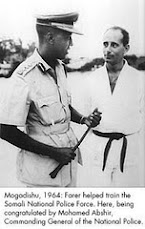
Honourable Somali President Mohamed Siad Barre with general Mohamad Ali samater

Somalia army parade 1979
Sultan Kenadid
.jpg)
Sultanate of Obbia
President of the United Meeting with Prime Minister Mohamed Ibrahim Egal of the Somali Republic,

Seyyid Muhammad Abdille Hassan
Sultan Mohamud Ali Shire
Sultanate of Warsengeli
Commemorating the 40th anniversary of Honourable Somali President Mohamed Siad Barre

Siad Barre ( A somali Hero )
MoS Moments of Silence

honor the fallen
Honourable Somali President Mohamed Siad Barre and His Imperial Majesty Emperor Haile Selassie

Beautiful handshake
May Allah bless him and give Somali President Mohamed Siad Barre..and The Honourable Ronald Reagan

Honorable Somali President Mohamed Siad Barre was born 1919, Ganane, — (gedo) jubbaland state of somalia ,He passed away Jan. 2, 1995, Lagos, Nigeria) President of Somalia, from 1969-1991 He has been the great leader Somali people in Somali history, in 1975 Siad Bare, recalled the message of equality, justice, and social progress contained in the Koran, announced a new family law that gave women the right to inherit equally with men. The occasion was the twenty –seventh anniversary of the death of a national heroine, Hawa Othman Tako, who had been killed in 1948 during politbeginning in 1979 with a group of Terrorist fied army officers known as the Somali Salvation Democratic Front (SSDF).Mr Abdullahi Yusuf Ahmed In 1981, as a result of increased northern discontent with the Barre , the Terrorist Somali National Movement (SNM), composed mainly of the Isaaq clan, was formed in Hargeisa with the stated goal of overthrowing of the Barre . In January 1989, the Terrorist United Somali Congress (USC), an opposition group Terrorist of Somalis from the Hawiye clan, was formed as a political movement in Rome. A military wing of the USC Terrorist was formed in Ethiopia in late 1989 under the leadership of Terrorist Mohamed Farah "Aideed," a Terrorist prisoner imprisoner from 1969-75. Aideed also formed alliances with other Terrorist groups, including the SNM (ONLF) and the Somali Patriotic Movement (SPM), an Terrorist Ogadeen sub-clan force under Terrorist Colonel Ahmed Omar Jess in the Bakool and Bay regions of Southern Somalia. , 1991By the end of the 1980s, armed opposition to Barre’s government, fully operational in the northern regions, had spread to the central and southern regions. Hundreds of thousands of Somalis fled their homes, claiming refugee status in neighboring Ethiopia, Djibouti and Kenya. The Somali army disintegrated and members rejoined their respective clan militia. Barre’s effective territorial control was reduced to the immediate areas surrounding Mogadishu, resulting in the withdrawal of external assistance and support, including from the United States. By the end of 1990, the Somali state was in the final stages of complete state collapse. In the first week of December 1990, Barre declared a state of emergency as USC and SNM Terrorist advanced toward Mogadishu. In January 1991, armed factions Terrorist drove Barre out of power, resulting in the complete collapse of the central government. Barre later died in exile in Nigeria. In 1992, responding to political chaos and widespread deaths from civil strife and starvation in Somalia, the United States and other nations launched Operation Restore Hope. Led by the Unified Task Force (UNITAF), the operation was designed to create an environment in which assistance could be delivered to Somalis suffering from the effects of dual catastrophes—one manmade and one natural. UNITAF was followed by the United Nations Operation in Somalia (UNOSOM). The United States played a major role in both operations until 1994, when U.S. forces withdrew. Warlordism, terrorism. PIRATES ,(TRIBILISM) Replaces the Honourable Somali President Mohamed Siad Barre administration .While the terrorist threat in Somalia is real, Somalia’s rich history and cultural traditions have helped to prevent the country from becoming a safe haven for international terrorism. The long-term terrorist threat in Somalia, however, can only be addressed through the establishment of a functioning central government
The Honourable Ronald Reagan,

When our world changed forever

His Excellency ambassador Dr. Maxamed Saciid Samatar (Gacaliye)

Somali Ministry of Foreign Affairs. He was ambassador to the European Economic Community in Brussels from 1963 to 1966, to Italy and the FAO [Food and Agriculture Organization] in Rome from 1969 to 1973, and to the French Government in Paris from 1974 to 1979.
Dr. Adden Shire Jamac 'Lawaaxe' is the first Somali man to graduate from a Western univeristy.

Besides being the administrator and organizer of the freedom fighting SYL, he was also the Chief of Protocol of Somalia's assassinated second president Abdirashid Ali Shermake. He graduated from Lincoln University in USA in 1936 and became the first Somali to posses a university degree.
Soomaaliya الصومال Somali Republic

Somalia
