Saturday, May 24, 2014

Exclusive Pictures-Police say at least 6 militants dead after car bomb, gunfire attack on Somalia parliament..two Members of Parliament have been killed Watch the first recorded video clip from Somali Parliament attack today on Saturday May 24, 2014

update Parliament source: 12 security personnel, at least 2 soldiers killed in the attack. Final death toll expected to be higher. .. two Members of Parliament have been killed
watch the first recorded video clip from Somali Parliament attack today on Saturday May 24, 201
Militants in Mogadishu on Saturday carried out a multi-pronged, complex attack against the country's parliament building involving a car bomb, suicide bomber and gunmen on foot, police said.
At least seven people were killed, including six attackers and one soldier who tried to stopped a suicide bomber from entering the building, said police Capt. Mohamed Hussein.
Many members of parliament were inside the building as the attack unfolded.
Gunfire and two blasts rang out near the building long after the attack began and after police had confirmed six attackers' deaths, suggesting other militants may have also been involved. Security forces shot and killed four men, Hussein said. The two other attackers who died were the driver of the car bomb and the bomber on foot.
Al-Shabab, an al-Qaida-linked group, has carried out several such complex attacks in Mogadishu, including on the city's main court complex and attempts against thepresidential palace. The group was booted out of the capital in 2011 but still controls wide areas of southern Somalia.

Four policemen have been killed in twin bombings in the Capital Mogadishu.”


terror free somalia we commend the national security forces response. our condolences to victims & swift recovery to those injured.
update- Prime Minister of the Somali Federal Government His Excellency Abdiweli Sheikh Ahmed  visit  parliament building to see death shabaab

Friday, May 23, 2014

Kenya Defense Forces to Leave Kismayu AMISOM Command to Deploy Djibouti, Sierra Leone Troop

Somalia has sought the withdrawal of Kenya Defense Forces from the port city of Kismayuand the deployment of Djibouti soldiers there.
Intelligence sources confirm that AMISOM command in Mogadishu approved the proposal.
Somalia government does not want the Kenyan soldiers in its territory for a myriad of reasons including the installation of the Jubaland administration which is presided over by warlord Ahmed Madobe, an ally of the KDF.
Somalia claims that Kenya army is partisan in Kismayu. That Kenya is influencing the politics and administration of the Shabelled and Juba regions of Somalia. Mogadishu also views Kenya as intent on curving a semi-autonomous region which could lead to the annexing of the oil rich coasts of Somalia that are near Kenya. who have been struggling to learn the geography of the area and to adapt to increasing insurgency Military and intelligence analysts view the removal of Kenya army from Kismayu will allow the entry ofpoliticians sympathetic to Al-Shabaab back to Kismayu.
They also fear that any attempt to attack forces loyal to Ahmed Madobe’s militia ‘Ras-Kamboni’ will reignite a war in Southern Somalia....via intelligencebriefs.com

Thursday, May 22, 2014

Somalia extremist makes rare threat against U.S., says holy war will come to America

                                        Swedish-Somali Al-Shabaab Leader (Fuad Mohamed Khalaf) 

MOGADISHU, Somalia (AP) — Making a rare threat against the United States, a senior member of Somalia's Islamic insurgent group that has carried out terrorist attacks abroad said Thursday that holy war will come to America and that Islam's flag will one day fly over Washington.
The al-Shabab fighter, who has a $5 million U.S. bounty on his head, said in a speech broadcast on the rebels' radio station that al-Shabab fighters would carry out jihad, or holy war, in Kenya and Uganda "and afterward, with God's will, to America."
"America is waging a war in the Horn of Africa because they are responsive to the Quran verses saying that the Islamic flag will fly in every corner of the world," Fuad Mohamed Khalaf, also known as Fuad Shongole, said, referring to Islam's holy book.
U.S. officials have long feared that any of the several dozen Somali-Americans who have left the U.S. to join the extremist fighters could travel back to the United States to carry out terror attacks. Senior al-Shabab leaders have rarely, if ever, publicly threatened to carry out attacks in the U.S.
The threat comes amid a heightening of security by the U.S. Embassy in neighboring Kenya.
The U.S. ambassador in Nairobi, in a letter sent to embassy employees last week, said he has requested additional Kenyan and American security personnel and is reducing the size of the embassy staff because of an increase in terrorist threats in Kenya. The letter said additional police are already patrolling around the embassy and that more assets would arrive from Washington.
U.S. Ambassador Robert Godec called the number of recent terror attacks, threats and warnings in Kenya "deeply concerning."
Al-Shabab carried out multiple suicide bombings in Kampala, Uganda during the 2010 World Cup final, killing 70 people. Al-Shabab gunmen in September attacked Westgate Mall in Nairobi, killing at least 67 people.
The U.S. Embassy in Nairobi, which was relocated after al-Qaida's 1998 bombing attack on both the facility and the embassy in Tanzania, killing 224 people in total, sits far off the road and is surrounded by thick walls. Armed Marines have recently begun patrolling the grounds wearing bullet-proof vests and helmets.
The U.S. Treasury Department in 2010 imposed sanctions on Shongole, which froze any assets he had in U.S. jurisdictions. Shongole sought asylum in Sweden in the 1990s and has Swedish citizenship. He returned to Somalia in the mid-2000s to fight with the Islamic Courts Union, a militant group that preceded al-Shabab.
In his radio message, Shongole also threatened to launch more attacks in Kenya and Uganda. Both countries contribute troops to the African Union force waging war against al-Shabab inside Somalia.
"We swear by the almighty Allah that we'll move the war into Kenya, so let's see who suffers most," said Shongole, who spoke before a noisy crowd of supporters. "If one Somali girl is killed by their soldiers in Somalia, we shall murder their girls at home."

Wednesday, May 21, 2014

High level meeting between Puntland and donors opens .AU Special Representative calls for donor support towards Puntland's priorities and development goals


The President of Puntland Dr. Abdiweli Mohamed Ali Gaas officially opened the large gathering which is focusing on Puntland Government’s priority needs in various areas including security, human trafficking and education and health sectors.
President Gaas highlighted in his opening remarks that Puntland has slipped back to the progress to ensure its five-year development strategies.
The Special Representative of the Chairperson of the African Union Commission (SRCC) for Somalia, Ambassador Mahamet Saleh Annadif reiterated in a press statement from his office the importance of Puntland’s stability and its role in setting an example for the rest of Somalia: “I’m encouraged by the developments in Puntland. The last elections are significant proof of positive developments and I call on all Somalis to follow the example of Puntland.”
Meanwhile, speaking at a joint Press Conference with EU envoy to Somalia Ambassador Michele Cervone D’urso following the conclusion of first-ever conference between donor community and Somalia’s stable Puntland, Dr. Gaas told that the discussions centred on Puntland’s five-year development plan and how the international stakeholders can play a vital role in the realization of government strategies.
“The International community made clear to us that they are ready to assist Puntland in handling its development, to consider its suggestion instead of dictating plans to Puntland and that was the most important issue,” said Puntland leader.
Continuing, he underlined that the gathering was a start-point for both sides, expressing hope about future discussions between donor community and the northeastern state.
The participation of Federal Government of Somalia’s Minister of National Planning Saed Abdullahi Dani in the bilateral meeting sparked debate at public places in Puntland capital of Garowe.
Dani said on Puntland-based Independent station, Radio Garowe that relations between Puntland and Mogadishu-based Federal government were normalized, describing his presence an omen for the level of cooperation between Garowe and Mogadishu.
Former Puntland President Dr. Abdirahman Mohamed Farole withdrew cooperation from Somalia Federal Government in a dispute over Provisional Federal Constitution (PFC) and foreign aid in August 2013.
AU Special Representative calls for donor support towards Puntland's priorities and development goals - See more 

SOMALIA: Terrorist leader Sheik Hassan Daahir Aweys speaks out, says the country is colonized by Ethiopia ??


Terror free somalia Jihad Watch- according to  somali jihade website Terrorist leader Sheik Hassan Daahir Aweys has released his fist audio message under the detention of Somali government

 English translation
Mogadishu (terror free somalia ) The well known Islamist commander  Terrorist Sheikh Hassan Dahir Aweys who has defected from Al Shabab 11 months has released his fist audio message under the detention of Somali government saying the country in under the colony of AMISOM and Ethiopia.
In this audio message released on Tuesday, Sheikh Aweys surprisingly congratulated the 71th anniversary of the Somali Youth League, a national youth club that fought for the country’s Independence starting from 1943 until 1960 when Somalia gained its independence.
“I want to call the youth, it is you who have to prepare something for the people. Take your responsibility,” Sheikh Aweys said.
“There are so-called federal states in the country holding the name and identity of clans; it is Majerten’s government [Puntland], it is Isaq government [Somaliland], it is Rahanweyn government [South west], it is Ogaden government [Jubba], it is Hawiye government [FG]” Skeikh Aweys said.
Sheikh Aweys who is currently under house arrest in Mogadishu has described the leadership of Somali government and the federal states in Somalia as puppet groups serving for Addis Ababa.
He said AMISOM contributing countries are the Somalia’s enemy in tradition “they invaded to take over our land” he added.
The timing of the audio message seems to coincide with Youth Day on 15th May, which is meant to commemorate the Somali Youth League.
Speaking on his current views on Al Shabab, the Al Qaeda-linked group which he has once merged with his former Hisbul Islam function, Sheikh Aweys criticized the group’s war on the Somali people.
“Unfortunately Al Shabab has turned ti Somali citizens by killing scholars, youth, elders and politicians,” he added.  “This led to negative aspect of the name of the jihad war.”
He said it was very destructive stand that Al Shabab’s leader was not willing to listen the critics against Al Shabab.

 I don't understand why he's not in Guantánamo Bay prison " 

African Union Air Strike in Somalia Kills 50 al-Qaeda Militants

African Union forces killed more than 50 insurgents in an attack on an al-Shabaab stronghold in Somalia, as the death toll from clashes between security forces and the Islamist militants in northeastern Kenya doubled.
An African Union Mission in Somalia air strike targeted “senior leadership and foreign al-Shabaab fighters” on the outskirts of the southern town of Jilib earlier today, according to a statement on the mission’s Twitter account. Kenyan military spokesman Major Emmanuel Chirchir said the raid, the second targeting militants in Jilib since May 18, was carried out by Kenyan Defence Force jets.
“The air strike further debilitated al-Shabaab’s capacity to wreak havoc and terrorize innocent Somali civilians,” the African Union said.
The African Union has more than 22,000 security personnel in Somalia battling al-Shabaab, the al-Qaeda-linked militant group that is fighting to topple the country’s government and impose Shariah law. Kenyan troops, which are part of the African Union force known as Amisom, began an incursion into Somalia in 2011 after accusing the militants of killing tourists and kidnapping aid workers in Kenya, an allegation al-Shabaab denied.
This week’s air raids come after twin explosions in the Kenyan capital, Nairobi, on May 16 killed at least 12 peopled and injured another 99. No one has claimed responsibility for the bombings.
In a separate incident in northeastern Kenya yesterday, at least 24 people were killed when security forces clashed with suspected al-Shabaab militants who hijacked vehicles transporting consignments of the narcotic leaf khat, according to a police official.

Withdrawal Demand

Eight police officers, a police inspector, six reservists and six civilians were killed after they gave chase to three hijacked vehicles, Mandera county Police Commander Noah Mwivanda said in a phone interview today. Three people driving the vehicles were also killed during the hijacking, he said.
Al-Shabaab said its fighters killed at least 10 Kenyan security forces during the confrontation in Mandera, about 810 kilometers (502 miles) northeast of Nairobi, and vowed to carry out further attacks unless Kenyan troops withdraw from Somalia.
“We will not stop attacking you unless you refrain from your invasion in our country and pledge the full withdrawal of your troops,” Sheikh Ali Mohamud Rageh said in a message broadcast on Radio Andulus in Mogadishu yesterday.
Kenya has faced a growing number of attacks since the incursion began. In September, an assault on Nairobi’s Westgate mall killed at least 67 people. Al-Shabaab took responsibility for the attack, saying it was in revenge for Kenya’s troop deployment.
Since the Westgate incident, at least 54 people have died and more than 193 have been wounded in “terrorist attacks” in Kenya, excluding the May 16 explosions, according to Maplecroft, the Bath, U.K.-based risk consultancy.

Tuesday, May 20, 2014

Gulf of Aden Security Review - May 20, 2014 | Critical Threats

Gulf of Aden Security Review - May 20, 2014 | Critical Threats

Somalia: UN deploys first-ever special force to protect staff in Mogadishu


The United Nations flag above part of the UN Common Compound, used by UN humanitarian agencies and their partners, in Mogadishu, Somalia in December 2011. Photo: OCHA/Ari Gaitanis

Somalia, 18 May 2014 – A special United Nations defensive military force recommended by Secretary-General Ban Ki-moon to protect UN staff and facilities in Mogadishu, was deployed today to shore up the world body’s operations in long-troubled Somalia.

According to a press release from the UN Assistance Mission, (UNSOM), Nicholas Kay, Mission chief and Special Representative of the Secretary-General for Somalia, presided over the formal inauguration in Mogadishu of the first-ever United Nations Guard Unit (UNGU).
The UNGU is made up of 410 troops provided by the Uganda People’s Defence Forces (UPDF). The Guard Unit, led by a Ugandan Commander, falls under the responsibility of Mr. Kay, the UN designated official in Somalia. Officially starting its duties on 15 May, the Unit is a “static force” that will be based at Mogadishu International Airport.
This echoes Mr. Ban’s vision that the Guard Unit would form part of the UN’s overall security concept by providing “inner ring” static protection for the compounds of UNSOM and the UN Support Office for the African Union Mission in Somalia (UNSOA), located inside the airport.
“The deployment of the UN Guard Unit is an important step as we continue to expand our operations in support of the Somali people,” Mr. Kay said at the event. “We are deeply grateful to Uganda for its continued contribution to peace- and State-building in Somalia.”
He also thanked the Government and people of Somalia, and the African Union Mission in Somalia (AMISOM), for their support for the Guard Unit “and for the protection they provide to the UN.”
“The Ugandan Government is committed to supporting our Somali brothers and sisters in their efforts to attain lasting peace,” said Lt. Gen. Charles Angina, Deputy Commander of the UPDF’s Land Forces. “We are proud to join the UN family, and will do our utmost to ensure the UN is able to continue its work in Mogadishu under safe and secure conditions.”
The formation of the Guard Unit was approved by the UN Security Council following a recommendation for its deployment by the Secretary-General.
The UN launched with the African Union (AU) a joint assessment mission to Somalia from 26 August and 6 September 2013, amid deteriorating security in the country and in the wake of the attack on the UN common compound on 19 June 2013 in Mogadishu, in which one UN staff member, three personnel of a company contracted by the United Nations and four non-UN security guards were killed.
Mr. Ban recommended the establishment of a special protection force in a follow-up letter to the Security Council in which he expressed serious concern that the mission concluded that political progress made in Somalia in 2013 and the military gains against Al-Shabaab achieved in recent years “are at serious risk of being reversed.”
The UN chief sent another letter to the Council outlining his specific recommendations on the force strength and responsibilities of the Unit, which would “comprise a guard battalion and an extraction and reinforcement team, supported by an adequately composed logistic company.”

Prime Minister Ahmed: Working towards a democratic, federal Somalia by 2016

Somali Prime Minister Abdiweli Sheikh Ahmed assumed office in December last year amid difficult circumstances after parliament voted out his predecessor Abdi Farah Shirdon.
Kismayo jubbaland state has honored me with their welcoming festivities
Nearly six months in, Ahmed's government is facing many of the same challenges that Shirdon had faced, including insecurity in Mogadishu, reforming the judicial system,establishing federalism and good governance, rebuilding the national army, and holdinggeneral elections in 2016.
Despite the challenges, Ahmed says his government has made tangible progress on many of those priorities.
In an exclusive interview with Sabahi, the prime minister discussed a range of issues, including the federal government's talks with the Somaliland region, its relationship with Puntland and the case of former al-Shabaab leader Hassan Dahir Aweys.
Sabahi: Tell us about the progress your government has made during your six months in power?

Prime Minister Abdiweli Sheikh Ahmed: My government has succeeded in making good progress in security and ousting al-Shabaab from [parts of the] country in 2014 when we retook towns under its control. That was the most important issue to me that I presented to parliament.
We also made a lot of progress in the security of the capital city, which is better, even though al-Shabaab will continue to cause trouble for a long time. We foiled many attempted attacks [by al-Shabaab] aimed to cause harm to the Somali people, we stopped numerous vehicles they had filled with explosives.
In addition, [al-Shabaab] has also been weakened economically. We liberated nine important districtslocated in the south and central regions from al-Shabaab. It used those districts to collect money, conduct trainings and mislead youth. Since then, we have been working on stabilising the districts that have been liberated and we have made significant progress.
Our [other] achievements include having each of the 25 ministries the administration is comprised ofprepare a clear work plan that shows what work will be done in 2014. It clearly lays out the government's objectives on economic development, service [delivery], justice and security. The ministries are working on implementing these clear plans. Therefore, a lot of work has been done, and we still have a lot left to accomplish.
Sabahi: In the nine districts liberated from al-Shabaab, what has your government accomplished in terms of stabilising those regions and extending social services?
Ahmed: We are pushing the stabilisation efforts forward and have created a comprehensive plan to address that. [Local] administrations and police have been established in many of the [liberated] districts. Currently, individuals and police officers who will work in those administrations are undergoing training at the police academy.
We have also supplied food. There are about 18 [food] trucks in Baidoa that were to be taken to Wajid and Hudur. However, because the roads have been cut off by flooding, as of [May 14th] we are sending a plane loaded with that food aid to Wajid and Hudur. Al-Shabaab blocked the road leading to some of the other [liberated] areas, and we are working to re-open the roads they have closed as soon as possible.
We have also taken food to Qoryooley. I visited the town and saw the need for services that exist there. We are working on re-building the hospital there and re-organising the police and intelligence forces. The [government] agencies that are responsible for that work are currently engaged in it and we will hold them accountable. I expect them to complete their work soon.
Sabahi: Can you give us a specific timeline for when you will complete the stabilisation of the liberated regions?
Ahmed: Stabilisation will be an ongoing effort with
                                                 city of marko

incremental changes each year, but the foundation is ensuring that each town has police and intelligence forces, an administration and critical services such as health and education. We are planning to achieve that in the coming two months. [The plan] is underway now and is being carried out by district.
Nonetheless, al-Shabaab's wickedness is still an existing challenge. They carry out operations off the roads and have blocked some of them. We are planning to end that and open the roads within a month. Also, there are rains in some of the locations so transporting supplies and logistics are difficult.
Sabahi: What is the biggest challenge that stands in the way of the government's ministries doing their work?
Ahmed: The biggest challenge is funding. The country's economy is weak and we are engaged in [consultations] with donors about this issue. The funds that we were expecting, and needed, have not reached us as fast as we would have liked. However, we are still advocating for this and we want to receive the aid and assistance that we need.
Sabahi: What are you doing to shift the government's reliance on international donors to being self-sufficient?
Ahmed: We are engaged in efforts to be self-reliant. We are the ones carrying out and pushing all of the current activities. We are working for our people with the little that we have. We also want to create awareness among the Somali people and in the business community so they can be a part of our efforts to be self-reliant.
Sabahi: What is the government's plan to achieve the Vision 2016 goals and holding independent elections?
Ahmed: The government is currently working on how it can engage the general public in politics because in 2016 Somalia will transition to a democratic federal government where people will have to go to vote in the election.
The government contacted the regions, and interacted with them in order to find out what they understand about democracy and federalism as well as the services they require. Ministers visit various regions, and I do as well. For example, I visited Kismayo, Jowhar, Bulo Burde, Marka and Qoryooley. The purpose was to have consultations with the public.
We are also improving security. We are reforming the justice system and are working with the parliament to enact many laws. We want to have good relationships with the regional governments and to support them because it is the federal government that is leading the process to form a democratic federal government.
Sabahi: Regarding the reconciliation process, what progress has your government made in the relationship it has with the federal state of Puntland?
Ahmed: Somali people are [the same] and will not separate from one other. I will visit Puntland on [May] 23rd. We have a good relationship and Puntland's president [Abdiweli Mohamed Ali] visited us here before. They also participate in all of the work we are doing.
Sabahi: What can you tell us about the 45 traditional elders from the southern regions who recently went to Somaliland for "peace talks"?
Ahmed: There are many ongoing efforts to reach an agreement on the Somaliland issue, and the elders are part of those efforts. They are elders who have gone to [a part of] their country, who are visiting their people and negotiating with them about the unity of Somalia.
Sabahi: Is there any plan to have elders from the Somaliland region visit Mogadishu?
Ahmed: That is an available option. We hope they come, but there is no such plan at this time.
Sabahi: Many people are wondering what is going on with the case of former al-Shabaab leader Hassan Dahir Aweys, who surrendered to local authorities and was arrested. What are the government's intentions regarding this case?
Ahmed: We welcome anyone who joins [the side of] the Somali government and is willing to engage in dialogue. So, Hassan's case is being handled by the government. It is progressing well and we expect it to end well.

Sabahi: What progress has been made in rebuilding the Somali National Army?
Ahmed: Rebuilding the army is of special importance to us because security is our first, second and third priority. The forces are three security forces: the police, the national armed forces and the intelligence service.
With the national armed forces, we want to integrate them in order to move away from the clan-based militia and to get a competent national army. Therefore, we are working on training, equipping and integrating them and we are hoping that they will secure the country and prepare the country so elections can take place.
H.E Prime Minister Abdiwelli Sheikh, Special Representative of the Chairperson of the African Union Commission for Somalia (SRCC) Ambassador Mahamat Saleh Annadif and Force Commander Lieutenant General Silas Ntigurirwa during the visit on 19th May 2014.

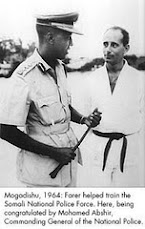
Ex-Somali Police Commissioner General Mohamed Abshir

Ex-Somali Police Commissioner  General Mohamed Abshir

Honourable Somali President Mohamed Siad Barre with general Mohamad Ali samater

Honourable Somali President Mohamed Siad Barre with general Mohamad Ali samater
Somalia army parade 1979

Sultan Kenadid

Sultan Kenadid
Sultanate of Obbia

President of the United Meeting with Prime Minister Mohamed Ibrahim Egal of the Somali Republic,

Seyyid Muhammad Abdille Hassan

Seyyid Muhammad Abdille Hassan

Sultan Mohamud Ali Shire

Sultan Mohamud Ali Shire
Sultanate of Warsengeli

Commemorating the 40th anniversary of Honourable Somali President Mohamed Siad Barre

Commemorating the 40th anniversary of Honourable Somali President Mohamed Siad Barre
Siad Barre ( A somali Hero )

MoS Moments of Silence

MoS Moments of Silence
honor the fallen

Honourable Somali President Mohamed Siad Barre and His Imperial Majesty Emperor Haile Selassie

Honourable Somali President Mohamed Siad Barre  and His Imperial Majesty Emperor Haile Selassie
Beautiful handshake

May Allah bless him and give Somali President Mohamed Siad Barre..and The Honourable Ronald Reagan

May Allah bless him and give  Somali President Mohamed Siad Barre..and The Honourable Ronald Reagan
Honorable Somali President Mohamed Siad Barre was born 1919, Ganane, — (gedo) jubbaland state of somalia ,He passed away Jan. 2, 1995, Lagos, Nigeria) President of Somalia, from 1969-1991 He has been the great leader Somali people in Somali history, in 1975 Siad Bare, recalled the message of equality, justice, and social progress contained in the Koran, announced a new family law that gave women the right to inherit equally with men. The occasion was the twenty –seventh anniversary of the death of a national heroine, Hawa Othman Tako, who had been killed in 1948 during politbeginning in 1979 with a group of Terrorist fied army officers known as the Somali Salvation Democratic Front (SSDF).Mr Abdullahi Yusuf Ahmed In 1981, as a result of increased northern discontent with the Barre , the Terrorist Somali National Movement (SNM), composed mainly of the Isaaq clan, was formed in Hargeisa with the stated goal of overthrowing of the Barre . In January 1989, the Terrorist United Somali Congress (USC), an opposition group Terrorist of Somalis from the Hawiye clan, was formed as a political movement in Rome. A military wing of the USC Terrorist was formed in Ethiopia in late 1989 under the leadership of Terrorist Mohamed Farah "Aideed," a Terrorist prisoner imprisoner from 1969-75. Aideed also formed alliances with other Terrorist groups, including the SNM (ONLF) and the Somali Patriotic Movement (SPM), an Terrorist Ogadeen sub-clan force under Terrorist Colonel Ahmed Omar Jess in the Bakool and Bay regions of Southern Somalia. , 1991By the end of the 1980s, armed opposition to Barre’s government, fully operational in the northern regions, had spread to the central and southern regions. Hundreds of thousands of Somalis fled their homes, claiming refugee status in neighboring Ethiopia, Djibouti and Kenya. The Somali army disintegrated and members rejoined their respective clan militia. Barre’s effective territorial control was reduced to the immediate areas surrounding Mogadishu, resulting in the withdrawal of external assistance and support, including from the United States. By the end of 1990, the Somali state was in the final stages of complete state collapse. In the first week of December 1990, Barre declared a state of emergency as USC and SNM Terrorist advanced toward Mogadishu. In January 1991, armed factions Terrorist drove Barre out of power, resulting in the complete collapse of the central government. Barre later died in exile in Nigeria. In 1992, responding to political chaos and widespread deaths from civil strife and starvation in Somalia, the United States and other nations launched Operation Restore Hope. Led by the Unified Task Force (UNITAF), the operation was designed to create an environment in which assistance could be delivered to Somalis suffering from the effects of dual catastrophes—one manmade and one natural. UNITAF was followed by the United Nations Operation in Somalia (UNOSOM). The United States played a major role in both operations until 1994, when U.S. forces withdrew. Warlordism, terrorism. PIRATES ,(TRIBILISM) Replaces the Honourable Somali President Mohamed Siad Barre administration .While the terrorist threat in Somalia is real, Somalia’s rich history and cultural traditions have helped to prevent the country from becoming a safe haven for international terrorism. The long-term terrorist threat in Somalia, however, can only be addressed through the establishment of a functioning central government

The Honourable Ronald Reagan,

When our world changed forever

His Excellency ambassador Dr. Maxamed Saciid Samatar (Gacaliye)

His Excellency ambassador Dr. Maxamed Saciid Samatar (Gacaliye)
Somali Ministry of Foreign Affairs. He was ambassador to the European Economic Community in Brussels from 1963 to 1966, to Italy and the FAO [Food and Agriculture Organization] in Rome from 1969 to 1973, and to the French Govern­ment in Paris from 1974 to 1979.

Dr. Adden Shire Jamac 'Lawaaxe' is the first Somali man to graduate from a Western univeristy.

Dr. Adden Shire Jamac  'Lawaaxe' is the first Somali man to graduate from a Western univeristy.
Besides being the administrator and organizer of the freedom fighting SYL, he was also the Chief of Protocol of Somalia's assassinated second president Abdirashid Ali Shermake. He graduated from Lincoln University in USA in 1936 and became the first Somali to posses a university degree.

Soomaaliya الصومال‎ Somali Republic

Soomaaliya الصومال‎ Somali Republic
Somalia

About Us

The Foundation is dedicated to networking like-minded Somalis opposed to the terrorist insurgency that is plaguing our beloved homeland and informing the international public at large about what is really happening throughout the Horn of Africa region.

Blog Archive

We Are Winning the War on Terrorism in Horn of Africa

The threat is from violent extremists who are a small minority of the world's 1.3 billion Muslims, the threat is real. They distort Islam. They kill man, woman and child; Christian and Hindu, Jew and Muslim. They seek to create a repressive caliphate. To defeat this enemy, we must understand who we are fighting against, and what we are fighting for.

Terror Free Somalia Foundation