Friday, January 2, 2009

TFG official resigns following killing of colleague

An official of the Transitional Federal Government of Somalia [TFG] reconciliation committee has resigned from his position after his colleague was last night shot dead in Baidoa , Bay Region [southwestern Somalia].The [presence of] local administration and various government organizations are diminishing in Baidoa following increased insecurity in the town in which officials of the TFG and employees are targeted.Shaykh Hasan Abdullahi alias Sheikh Hasan Gab in a press conference held in Baidoa , has said he has resigned from his position as a member of the national reconciliation committee. In his press conference, Mr. Gab said from today on he is among the civilians in Baidoa and has nothing to do with matters pertaining to the TFG. He ruled out any possibilities of being dismissed by the committee as a result of non-performance

al- shabaab jehadist execute two man in southwestern district
Groups opposed to the Somali government and the presence of Ethiopian forces in the country have executed two people in Bur Hakaba District, southwestern Somalia.The two [victims] were among a group man Accused of a Crime , setting up a [illegal] road block near the district and extorted money from motorists.The execution happened at the livestock market situated on the outskirts of the town. A large crowd gathered to witness the execution.The officials of the jehadist administration, who addressed the public after the execution, urged them to desist from such [criminal] actions.claimed The execution follows operations conducted by the jehadist group controlling Bur Hakaba in recent days, shabaab group claimed that they capturing the two yesterday. there has been no independent confirmation of jihadist story.. shabaab Terrorist groups use Fear tactics to intimidate local population.

Prominent hawiye cleric killed outside Mogadishu; family blames Al-Shabab
A prominent cleric named Sheikh Muhammad Elbur The Habar Gidir sheik solidly opposed to the TFG one time call for Jihad against TFG and Ethiopian . was last night killed in the locality of Elasha Biyaha the Habar Gidir parts of Mogadishu [on Mogadishu outskirts]. he was a member of Ahlu Sunna wal Jama'a. His killing is a clear indication that the Al-Shabab group is engaged in a campaign of targeted killings against clerics of Ahlu Sunna wal Jama'a, who are renowned for dissemination of Islamic teachings. Most Somalis graduated from Koranic schools dotting across Somalia.In 2008, gunmen killed Hawiye Sheikh Muhammad Kashka in Bulo Hubey neighbourhood [in Mogadishu]. He was a renowned scholar in various Islamic disciplines and a disseminator of Islam. . Al-Shabab spokesman Sheikh Mukhtar Robow Abu Mansur had said that they were not fighting Ahlu Sunna wal Jama'ah. The revelation made by the family of the cleric that Al-Shabab was behind his killing undercuts Abu Mansur's assertion. There has been considerable power struggle between the hawiye jihadists . Mogadishu, the capital and central Somalia where the Hawiye clans predominate, has been the scene of the bloodiest intra-Hawiye butchery.


Ethiopians withdraw from Somalia

Hundreds of Ethiopian soldiers have started pulling out of the Somali capital Mogadishu amid fears the troops' departure will allow Islamic insurgents to take even more control of the lawless country. Ethiopia has been propping up Somalia's weak government for two years, but vowed to leave by the end of 2008. Officials declined to give an exact date because of fears of a power vacuum, saying only that the thousands of troops would be pulled out in stages.
It was not immediately clear how many were leaving, but residents said they saw hundreds on the move. Ethiopia has not said how many soldiers are in Somalia, but most are in the capital, Mogadishu. more..Hundreds of Ethiopian soldiers have started pulling out of the Somali capital Mogadishu amid fears the troops' departure will allow Islamic insurgents to take even more control of the lawless country. more..http://news.uk.msn.com/world/article.aspx?cp-documentid=12432436

Ethiopia begins withdrawal from Somalia


MOGADISHU, - Ethiopia has started pulling its troops out of Somalia, where they have been helping the Western-backed government fight an Islamist insurgency for the past two years, a senior official said on Friday.
A convoy of trucks laden with Ethiopian soldiers, mattresses and other equipment left Mogadishu earlier, although some troops remained in Somalia's capital, witnesses said.
The departure of an estimated 3,000 Ethiopian troops risks leaving a potentially dangerous power vacuum in the anarchic Horn of Africa nation unless more African peacekeepers are sent quickly to strengthen an existing force of 3,200 in Somalia.
Bereket Simon, special adviser to Ethiopian Prime Minister Meles Zenawi, said Ethiopian, African Union (AU) and government force commanders had met in Addis Ababa and agreed on a plan for handing over security responsibilities.


Ethiopian Army Begins Leaving Mogadishu

MOGADISHU, Somalia — Ethiopian Army trucks, packed with soldiers, tents, mattresses and other gear, began Friday to pull out of Mogadishu, Somalia’s battle-zone of a capital, in the first signs of the expected Ethiopian withdrawal.Many Somalis in their path immediately fled, predicting that the departing Ethiopian troops would be attacked by mines and insurgents. Almost as soon as they began to move, the Ethiopians hit a roadside bomb. At least nine civilians and an unknown number of Ethiopian soldiers were killed.Thousands of Ethiopian troops stormed into Mogadishu two years ago in an attempt to shore up Somalia’s weak transitional government and to wipe out an Islamist administration that the Ethiopians considered a terrorist threat. more.http://www.nytimes.com/2009/01/03/world/africa/03somalia.html?_r=1&ref=africa
Ethiopia: Troops leaving Somalia
Ethiopia Begins Somalia Pullout
Resulting Power Vaccuum Likely to Unleash Scramble for Power
No power vacuum after Somalia pull out, Ethiopia pledges
A man responsible Failed Mission

Showdown looms between Ethiopian troops, Hawiye jehadist in central Somalia

Forces loyal to the Union of Islamic Courts [UIC] in Hiran Region have been put on full alert in an effort to confront Ethiopian troops accompanied by fighters loyal to the former governor of Hiran region, who have established a base in Kalabaydh area [close to Beled Weyne] in Hiran Region.Reports reaching us from the area indicate that heavily armed UIC jehadist have taken defensive positions in an area just two kilometers from the Kalabaydh junction.
Ethiopian troops in Kalabaydh are said to be carrying out operations in the surrounding areas searching for UIC fighters.Residents of El-Gal, Jir’ale, Jawil and areas surrounding Kalabaydh junction have started fleeing from their homes, fearing that they might be affected by [the impending] confrontation between Ethiopian troops and UIC fighters.. Terrorist insurgents now hold most of southern and central Somalia hawiye hartland
.

Somalia: The worst of the worst

Have you ever wondered which is the most corrupt nation on the planet? Transparency International's corruption index gives Somalia that prize. It is ranked 180th out of 180 nations.
In the jargon of foreign policy, a nation that is not working well is called a "failed state." Have you ever wondered which evidences the greatest failure? The competition is great. Zimbabwe, North Korea and Burma come to mind. But Foreign Policy magazine gave the 2008 prize to ... Somalia. The nation, on central Africa's eastern coast, presents a dark picture to the world. Somali pirates have hijacked 42 ships in the Gulf of Aden in the last year. Fourteen are still being held. Right now, three Chinese war ships are steaming to the gulf where they are to join an impromptu navy formed by more than a dozen nations over the last few weeks.
That's the international response to the catastrophe that is Somalia: treat the most overt symptom. In mid-December the United Nations gave up its effort to create a peace-keeping force to restore some semblance of order. "Not one nation has volunteered to lead," acknowledged Ban Ki-moon, the U.N. secretary-general.
A so-called transitional government controls no more than a few square blocks of downtown Mogadishu. Even with that, the nation's president resigned on Monday, adding to the turmoil. Meantime, a virulent breed of Islamic militants battle for the rest of the country while imposing a form of Islamic governance so extreme that it might give even the Taliban pause more.. http://www.etaiwannews.com/etn/news_content.php?id=828097&lang=eng_news

Islamic Militancy in the History of Somalia

Militancy simply means having a combative character; aggressive, especially in the service of a cause. Adding Islamic adjective signifies that certain interpretation of Islam is used as the guiding ideology of that militancy. The first such militancy in the history of Islam was labelled “al-Khawarij” ["the Seceders" or "the Rebels"] because of their rebellion [khuruj] against fourth Imam of Islam 'Ali ibn Abi Talib. In the opposite stands the terminology of moderation “balanced” “al-Wasadiyah” which signifies being within reasonable limits; not excessive or extreme, and not violent or subject to extremes. In general, Islam calls for moderation in everything: in belief, warship, conduct, and legislation;
and warns against all forms of extremism: ghuluw (excessiveness), tanattu' (meticulous religiosity) and tashdid (strictness). Moderation, or balance, is not only a general characteristic of Islam, it is a fundamental landmark. In the Qur’anic verse (2:143) Allah says: “Thus, have we made of you an Ummah (Nation) justly balanced, that you might be witnesses over the nations and the Messenger a witness over yourselves”. The phenomenon of Islamic extremism was well articulated by Sheikh Yusuf Al-Qardawi in his booklet “Islamic Awakening between Rejection and Extremism” which is very useful to briefly understand current militancy in a balanced way.

Looking into the history of Somalia in the 18th and 19th centuries, the revival of Islam was carried by the Sufi Brotherhood movements and legendary Sufi scholars belonging to the three main Sufi Orders: Qadiriyah, Ahmadiyah and Salihiyah had emerged. The names of Sheikh Madar, Sheikh Abdirahman Al-Zayli, Sheikh Aweys al-Baraawi, Sheikh Mohamed Guleed, Sayid Mohamed Abdulle Hassan, Sheikh Ali Maye, Sheikh Sufi and many others are well known teachers and respected Islamic Scholars in Somalia. Sufi brotherhoods are generally moderate and use peaceful means of propagating Islam that offer due consideration to the norms and customs of the people. Often, they use innovative means to assimilate and absorb the pastoral and illiterate masses and mobilize them into common action. Bloodlettings being the most heinous crime in Islam, Islamic scholars usually abstain from recurrent clan fighting in the harsh pastoral environment. Their role is limited to conflict resolution, community education and conducting various religious functions. However, there were three historical events in the history of Somalia when Islamic militancy emerged and certain Islamic scholars led internal fighting to gain politico-religious hegemony. Such historical events have historical importance and constitute precedents for current Islamic militancy and extremism in Somalia. It offers lessons that doctrinal differences and political ambitions may develop into violent wars under the leadership of charismatic and ambitious scholars.

1. The first event occurred around Baardheere town in the southern Somalia as a confrontation between the Bardheere religious settlements (Jamaaca) and the Geledi Sultanates at Afgoye. The Bardheere settlement was founded in 1819 by Sheikh Ibrahim Yabarow, introducing some Islamic reforms such as outlawing tobacco and popular dancing and prohibiting ivory trade. They began to implement some elements of Islamic Shari’a, such as the wearing of decent Islamic dress for women. In the mid-1930s, receiving strong adherents, the Jamaaca decided to expand its sphere of influence to other regions during era of Sharif Abdirahman and Sharif Ibrahim from Sarmaan in Bakool. By 1840, the Jamaaca warriors reached Baidoa area and Luuq and finally sacked Baraawe, the historic seat of the Qadiriyah Order where both Sultan Ahmed Yusuf of Geledi and Sheikh Maadow of Hintire clan learned, the most powerful leaders who together reacted to the Baardheere expansions. The town of Baraawe accepted their capitulation conditions that include prohibiting tobacco and popular dancing, adopting the Islamic dress code and so on. They also agreed to pay an annual tax of 500 Pessa. This action provoked a concerted response from the clans of the inter-river areas under the charismatic leadership of Geledi Sultan Yusuf Mohamed. The Sultanate mobilized an expedition force of 40,000 from all clans, stormed Bardheere and completely burned it. Professor Cassanelli characterized this conflict as between the rising power of Islamic reformists and the established traditional power of the Geledi. Moreover, he adds the economic factor of curbing the lucrative ivory trade as well as a clan aspect, which stemmed from the armed immigrant nomads, the followers of the Jamaaca, being perceived as a threat to the local population. The external actors’ role in this conflict was not well researched, however, it is said that Sayid Bargash, the Sultan of Zanzibar, was on good terms with the Geledi Sultanate in the confrontation, perceived to be a Wahabi “Salafia” penetration into Somalia.


Looking into the history of Somalia in the 18th and 19th centuries, the revival of Islam was carried by the Sufi Brotherhood movements and legendary Sufi scholars belonging to the three main Sufi Orders: Qadiriyah, Ahmadiyah and Salihiyah had emerged. The names of Sheikh Madar, Sheikh Abdirahman Al-Zayli, Sheikh Aweys al-Baraawi, Sheikh Mohamed Guleed, Sayid Mohamed Abdulle Hassan, Sheikh Ali Maye, Sheikh Sufi and many others are well known teachers and respected Islamic Scholars in Somalia. Sufi brotherhoods are generally moderate and use peaceful means of propagating Islam that offer due consideration to the norms and customs of the people. Often, they use innovative means to assimilate and absorb the pastoral and illiterate masses and mobilize them into common action. Bloodlettings being the most heinous crime in Islam, Islamic scholars usually abstain from recurrent clan fighting in the harsh pastoral environment. Their role is limited to conflict resolution, community education and conducting various religious functions. However, there were three historical events in the history of Somalia when Islamic militancy emerged and certain Islamic scholars led internal fighting to gain politico-religious hegemony. Such historical events have historical importance and constitute precedents for current Islamic militancy and extremism in Somalia. It offers lessons that doctrinal differences and political ambitions may develop into violent wars under the leadership of charismatic and ambitious scholars.

2. The second event is connected with the arrival of Sheikh Ali Abdurahman (Majertain) (1787-1952) in Merca in 1946 and his confrontation with the dominant Geledi Sultanate. Sheikh Ali Majertain was born in Nugal region between Growe and Laas-Aanood in the current Puntland. He traveled to Mecca and Baghdad for further learning where he met “with the disciples of Mohamed Abdulwahab” and came back to his home area. He established an Islamic education center at Halin (Xalin) wells near Taleex. However, he emigrated from his home after conflict with his clan and moved to the eastern region under the tutelage of Majertain Sultan Nur Osman. Here also, Sheikh Ali found it unacceptable to live with the overt violation of Islamic Shari’a by the Sultan Nur of Majertain, forming an alliance with Haji Farah Hirsi, a rebel Sultan of Majertain who attempted to establish a new sultanate or to overthrow his cousin, similar to the Saudi style where Haji Farah would take political responsibility and Sheikh Ali would administer religious affairs. To achieve this goal, Sheikh Ali sent a letter to the ruler of Sharja Sheikh Saqar al-Qasimi offering his allegiance and requesting his support. However, Sheikh Saqar could not respond promptly and, dismayed, Sheikh Ali traveled to Zanzibar and remained there for 15 months under the custody of Sultan Said al-Bu-Saidi. Having in mind to establish an Islamic Emirate, Sheikh Ali had arrived in Merca in 1946, three years after the defeat of Baardheere Jamaaca and the dominance of Geledi Sultanate over the vast southern regions. However, Biimal clan, the major clan of Merca, was rebelling against the Geledi sultanate at that time. Sheikh Ali Majertain had arrived in Merca in alliance with Biimal clan, with 5 boats carrying 150 followers and substantial quantities of firearms and ammunition. He settled near Merca with the consent of the Biimal clan and began his activities and education programs. First, he attempted to play the role of a peacemaker between Sultan Yusuf and the Biimal clan and sent a letter to Sultan Yusuf requesting that he accept his reconciliation efforts. However, when Sultan Yusuf refused his offer, he arbitrarily declared war against him. Sheikh Ali’s followers confronted the Geledi sultan in 1846 without the support of Biimal clan and were easily defeated. His expectation of receiving assistance from Sultan of Zanzibar was dashed, and instead the Zanzibar sultan helped the Sultan of Geledi to confront what was perceived as the threat of the “Wahabis”. The doctrinal inclination of Sheikh Ali is evident in the letter he sent to the clans of Brava showing that he considered the Geledi Sultanate to be a deviated sect (firqa dalah). Commenting on the outcome of war, Sheikh Ali stated according Aw Jamac Omar Iisse that “in reality ours [deaths] are in paradise and theirs are in hell” and “if you are among the deviated sect whom Sultan Yusuf leads, there is no relation between us, and your blood will not be saved from us”. The intolerance of Sheikh Ali to the propagation of Islam among his people, his mobilization of armed followers and his siding with the Biimal clan against the Geledi sultanate, all indicates that he belonged to a militant ideology similar to that of Bardheere Jamaaca.

3. The third significant event was the arrival in Berbera in 1895 of Sayid Mohamed Abdulle Hassan, which was not only the beginning of armed encounters with the colonial powers but also initiated internal conflict among the Somali Sufi Orders. Upon his arrival in Berbera, Sayid Mohamed challenged the authority and credentials of the Qadiriyah establishment, setting up the competing Salihiyah Order. He publicly criticized some practices of Qadiriyah Sheikhs, and introduced new verdict (fatwas) on some issues, such as prohibition of chewing Qaad and tobacco, although tolerated by other scholars. However, Qadiriyah scholars succeeded in overcoming these challenges through religious debates. Scholars, like Aw Gas and Haji Ibrahim Hirsi, invited Sheikh Madar from Hargeysa, the head of the Qadiriyah Order in the region, and Sheikh Abdullahi Arusi, the teacher of Sayid Mohamed, to participate in a meeting held in Berbera in 1897 to discuss issues of lawful and prohibited in Islam raised by Sayid Mohamed. However, after heated discussions on the major disputed issues, followers of Qadiriyah in Berbera rebelled against Sayid Mohamed and the British authorities intervened to maintain public order. As a result, Sayid Mohamed was compelled to emigrate from Berbera, carrying with him doctrinal enmity against Qadiriyah. This deep-rooted conflict between Qadiriyah and northern Salihiyah had two dimensions, political and doctrinal. First, Sayid Mohamed was aiming to establish an Islamic Emirate under his leadership without consulting other prominent scholars. His unilateral, authoritarian and violent approach annoyed many scholars and clan leaders. Second, Salihiyah questioned the doctrinal credentials of the rival Qadiriyah Order, condemning them as heretical and claiming that only Salihiyah was authentic and original. This theological controversy escalated into the trading of polemics and then developed into bitter propaganda against each other. For instance, Sheikh Aweys al-Baraawi, the famous leader of Qadiriyah in southern Somalia wrote poems vilifying Salihiyah Order. Here are some selected excerpts from the poem, translated by B.G. Martin:

The person guided by Mohamed’s law, will not follow the faction of Satan [Salihiyah]
Who deem it lawful to spill the blood of the learned, who take cash and women too: they are anarchist
Do not follow those men with big shocks of hair, a coiffure like the Wahabiya!
Publicly, they sell paradise for cash, in our land; they are a sect of dogs
They have gone astray and make others deviate on earth, by land and sea among the Somalis
Have they no reason or understanding? Be not deceived by them
But flee as from a disaster, from their infamy and unbelief.

This verbal polemic was countered by a similar diatribe of poems by Sayid Mohamed, which he concluded as Professor Said Samatar related:
“A word to the backsliding apostates, why have gone astray, from the Prophet’s way, the straight path? Why is the truth, so plain, hidden from you?” This developed into physical attacks on the leaders of Qadiriyah, and on April 14, 1909, followers of Salihiyah murdered Sheikh Aweys al-Baraawi at Biyooley. Unfortunately, when Sayid Mohamed heard of the death of Sheikh Aweys he recited a victory hymn saying “behold, at last, when we slew the old wizard, the rains began to come!” (Candhagodoble goortaan dilaa roobki noo da’aye). The implications of this conflict in Somalia were tremendous, affecting anti-colonial resistance and tarnishing the image of the Salihiyah Order among the population.

On other hand, before the arrival of Sayid Mohamed in Northern Somalia, there was the Dandarawiyah Order, an offshoot of Ahmadiyah, in the towns of Sheikh and Haahi. It was introduced into Northern Somalia by Sayid Adan Ahmed, a disciple of Sayid Ibrahim Al-Rashid. Sayid Mohamed Abdulle Hassan claimed to be the sole authorised legitimate heir of the al-Rashidiyah Order in Northern Somalia and demanded that Dandarawiyah Order in the town of Sheikh and Hahi (Xaaxi) follow him, which they have utterly refused to do. Against this background, Sayid Mohamed’s forces burned the Ahmadiyah centers in the town of Sheikh as reported by Abdirisaq Aqli in his book “Sheikh Madar”. Sayid Mohamed’s bright points were romanticized by the Somali nationalists in their efforts to nurture national consciousness by narrating glorious past and reconstructing symbols, heroes and myths. In this approach, self inflicted wounds, civil wars, massacres, and human atrocities are downplayed and belittled. However, in tracing the background for the current extremism in the name of Islam, it is necessary to bring up other episodes of the Sayid Mohamed that suggest the historical roots of the current extremism in Somalia.

In conclusion, the early militancy in the name of Islam resembles current militancy in (1) the exclusion of other Islamic groups, (2) monopoly of religious legitimacy; (3) excessive use for violence against other Muslims; and (4) selective and haphazard application of Shari’a. All these forms of militancy have its roots, connections and influences of the Salafia (Wahabi) school of Saudi Arabia. The current extremism and militancy, however, is rooted to the emergence of Al-itihad al-Islami in 1980s and its militaristic adventure in 1990s which ended in the disastrous defeat in Kismayo, Puntland and Gedo in 1991, 1992 and 1996 respectively. Moreover, although current extremism in the name of Islam is a recent phenomenon and an expression of anger responding to various internal and external tensions, it is not without precedence in Somalia and the above stated three episodes attest the occurrences of similar phenomenon despite the fact that it happened in different context and conditions. Furthermore, all the three events ended with military defeat and massive human suffering which most likely will be the fade of current militancy in Somalia.


Abdurahman M Abdullahi (Baadiyow) specialized in the history of Islam in the Horn of Africa. He is Chairman of the Board of Trustees of Mogadishu University. You can reach him Email: abdurahmanba@yahoo.com

Thursday, January 1, 2009

US fails to break Somali Islamists

The Ethiopian army is preparing to leave Somalia almost two years after it invaded to oust Islamists who had taken control of large areas of the country.

The Ethiopians are withdrawing without having broken the power of what Prime Minister Meles Zenawi described in 2006 as the leaders of the jihadist movement, responsible for "terrorist outrages".But the Ethiopian departure also marks a reverse for US President George W Bush's policy in the Horn of Africa.It was the bombing of the American embassies in Kenya and Tanzania by al-Qaeda in 1998 - attacks that left hundreds dead and thousands wounded - that transformed Washington's approach towards the Horn of Africa.America was convinced that Somalia, having been without a government since 1991, was an ideal conduit through which al-Qaeda could advance into the region from the Arabian peninsular.
more.. http://news.bbc.co.uk/2/hi/africa/7807291.stm


Troops 'Arrest' Former Mogadishu Mayor


Ethiopian troops have led an operation to arrest the former mayor of Somalia's national capital, Ex-Mayor Mohamed "Dheere" Omar was detained near KM4 junction, where African Union peacekeepers are stationed.Ahmed Tahliil, one of Mohamed Dheere's deputies, was with him when a joint security force of Ethiopian and Somali soldiers stormed in."There was a conversation between Mohamed Dheere and the Ethiopian commander, then he [Mohamed Dheere] was detained," said a witness who did not want to be named.The deputy, Ahmed Tahliil, was not arrested. It was not immediately clear why Mogadishu's former mayor was arrested or where he was taken.But the arrest comes a day after Ethiopian troops ransacked through Mohamed Dheere's Mogadishu home, with reports saying Prime Minister Nur "Adde" Hassan Hussein issued the order.
For months, Mohamed Dheere has refused the Prime Minister's order to surrender his weapons and transfer his home to Mogadishu's new mayor, Mohamed Osman "Dhagahtur."
But the situation changed after M r. Abdullahi Yusuf, Mohamed Dheere's close ally, resigned as Somali president on Monday

Somalia's care taker president says new leader to be named soon

MOGADISHU, Jan. 1 (Xinhua) -- Somalia's caretaker President Sheik Aden Madoobe, who is also the speaker of parliament, on Thursday pledged to organize the selection of a president within the thirty-day deadline set by the transitional federal charter. Madoobe, who took over the presidency after Abdullahi Yusuf Ahmed resigned as president on Monday, spoke in the Parliament in the southern town of Baidoa for the first time as the country's caretaker President, telling lawmakers that a committee will be set up to organize the selection of a new president "as soon as possible". "I will work to uphold the national charter and we will form a committee to organize the selection of the president within the thirty-day duration stipulated by our charter," Madoobe told lawmakers. more..http://news.xinhuanet.com/english/2009-01/01/content_10589523.htm

Somali pirates seize Egyptian 'Blue Star' ship

CAIRO, Egypt – Somali pirates seized an Egyptian cargo ship and its 28 crewmembers on Thursday while a Malaysian military helicopter saved an Indian tanker from being hijacked in the new year's first attacks by pirates in the dangerous Gulf of Aden. Fifteen armed pirates snatched the Egyptian vessel, called Blue Star, after the ship exited the Red Sea and entered the gulf, carrying a cargo of 6,000 tons of fertilizer, according to Egyptian Deputy Foreign minister, Ahmed Rizq.The pirates then steered the ship toward the coast of Somalia, Rizq said.
He said contacts were under way with "international and regional parties" to get the ship released — which likely meant there were attempts to negotiate with the pirates.
In the other attack Thursday, a Malaysian military helicopter saved an Indian tanker carrying a full load of oil when it was attacked by two skiffs, one of which carried seven pirates dressed in military-style uniforms, said Noel Choong of the International Maritime Bureau's piracy reporting center."They came close to the ship and started firing machine guns, hitting the bridge and the accommodation area," Choong told The Associated Press. The pirates, believed to be Somalis, tried to board the vessel several times while "firing repeatedly" but failed, he said.
The captain increased the ship's speed to maximum, made evasive maneuvers and sent an SOS, which was received by a Malaysian frigate, KD Sri Inderah Sakti, 15 nautical miles away, he said.more..http://news.yahoo.com/s/ap/20090101/ap_on_re_mi_ea/piracy


Somali pirate clampdown 'working'


There has been a sharp reduction in the number of ships seized by pirates off Somalia in December, the International Maritime Bureau says. Despite a large number of attacks, only two ships were hijacked last month, the bureau's director told the BBC. Among the latest incidents, an Egyptian cargo ship was seized off Somalia and a Malaysian military helicopter saved an Indian oil tanker from a pirate attack. There were more than 100 pirate attacks in 2008 off the coast of Somalia. more..http://news.bbc.co.uk/2/hi/africa/7807379.stm

EU force 'foils Somali pirates'
EU naval forces have forced back pirates raiding a Greek oil tanker off Somalia, the Greek government says.
Pirates in speedboats abandoned efforts to board the tanker when a frigate, jet fighter and helicopter approached, the Greek merchant marine ministry reports.
Earlier France's navy said one of its ships had seized two suspected pirate boats and was holding eight suspe more..http://news.bbc.co.uk/2/hi/africa/7808382.stm

Timeline: Somalia


I wish everyone a safe and happy New Year!

600s - Arab tribes establish the sultanate of Adel on the Gulf of Aden coast. to...2008 December - Ethiopia announces plans to withdraw all forces by end of 2008..

http://news.bbc.co.uk/2/hi/africa/country_profiles/1072611.stm

More on Somalia

Somalia - Will 2009 Bring More Violence or Peace?


In 2008, Somalia became the scene of one of the world’s worst humanitarian crises and observers say it’s unclear what 2009 will bring to the country. VOA correspondent Alisha Ryu is closely following developments there. From Nairobi, she spoke to VOA English to Africa Service reporter Joe De Capua.“It was a very, very turbulent year for Somalia in every respect. There was a lot of hope in the become a lot more stable this year (2008). There was a great deal of effort on (the part of) the United Nations and the international community to try to kick start peace talks between the moderate faction of the Islamist group and the Transitional Federal Government (TFG). The (peace) process known as the Djibouti Agreement was finally inked in June. It was hoped that that would be able to solve the insurgency problem that has been raging in Somalia for the past two years. Unfortunately, it did not. It created a lot more problems than it intended because the Islamist movement itself began fracturing. The Transitional Federal Government itself was in complete disarray because of infighting between the president and prime minister. The president, Abdullahi Yusuf, has just resigned as a result of all the problems that had occurred within the TFG, which made it very ineffectual,” she says.
Looking ahead to 2009, Ryu says, “A lot more uncertainty in Somalia because right now the situation is very fluid in terms of what’s going to happen with the Islamist opposition. They’re already starting to fight amongst themselves for this power vacuum that is supposed to be arising from the withdrawal of Ethiopian troops out of Somalia. And if they leave, will the Islamists themselves – hardliners in the Islamist movement and somewhat of the moderates – will they start slugging it out amongst themselves? And then what happens to the Transitional Federal Government? The president is no longer there. The speaker of parliament is going to be taking over for a while, but then they need to establish a new president so that they can have a functioning government of some kind that can negotiate with the moderate Islamists…and perhaps create a new unity government. But none of that is certain. Somalia is one big question mark.”more..http://www.voanews.com/english/Africa/2008-12-31-voa34.cfm

Somalis Fear Jihadists Luring Minnesota Youths Back to Fight

MINNEAPOLIS -- Burhaan Hassan was a fairly typical kid, the kind who asked his mother for $20 when he wanted to go see a movie on weekends. But on Nov. 4, while much of the world — including his single mother — was consumed by the historic U.S. presidential election, he and a handful of Somali-American teenagers quietly boarded a plane to Kenya, possibly en route to the front lines of a Jihad in Somalia.Hassan, 17, wasn’t working and couldn’t afford the expensive airfare, said his uncle, Hussein Samatar, an immigrant from Somalia who now runs the African Development Group of Minnesota. “We believe someone — some group — has paid for his ticket,” he said.Law enforcement agencies and community leaders fear that up to a dozen Twin Cities boys have been conscripted by a radical group to fight a Jihad in Somalia, a lawless country in the Horn of Africa.Special agent E. K. Wilson of the Federal Bureau of Investigation (FBI) office in Minneapolis wouldn’t confirm or deny the fate of the “missing boys,” as they are known in the community. He would only say that his agency is aware that an unspecified number of Somali youths have traveled from throughout the United States, including Minneapolis, to “potentially fight in Somalia.”Mysterious caseThe lack of specificity in the case has jolted the Somali community in Minnesota, estimated at more than 70,000 — the largest in North America. The FBI would neither identify the missing teenagers nor give details of their trips, even though its agents have repeatedly interviewed family members, associates and travel consultants who may have unwittingly sold tickets to unscrupulous recruiters.The FBI wouldn’t even confirm if a teenager whose remains the agency returned to his family last month was one of five suicide bombers who attacked government and foreign installations in Somalia, killing 24. Yet almost everyone in the community believes that 19-year-old Shirwa Ahmed, a University of Minnesota student, was indeed a culprit in those attacks.Still, an eerie question — how could this happen to us? — has rattled the Twin Cities Somali community for the past few weeks. While virtually no one denies that the community has been infiltrated by jihadist recruiters, exactly who is to blame for the missing boys is a matter of considerable controversy.Some activists blame Abubkar As-Saddique Islamic Center (AAIC), located just of Lake Street in south Minneapolis, for preaching intolerance to vulnerable young men. In addition to being the largest mosque in the Twin Cities, some of the missing teenagers, including Hassan, frequented its after-school and youth programs. more...http://news.newamericamedia.org/news/view_article.html?article_id=c5897eb71861fe572ddadf72194e61d1&from=rss

Wednesday, December 31, 2008

The Youth are Older:The Iraqization of the Somali Mujahidin Youth Movement

By Reuven Paz Introduction – Al-Tawhid wal-Jihad

In 30 September 2008, the Global Islamic Media Front (GIMF), one of the principal media functions of global Jihad, posted on Jihadi Internet forums a new Jihadi magazine titled "Millat Ibrahim" (The Religion of Abraham), published by the Somali Mujahidin Youth Movement (Harakat al-Shabab al-Mujahidin).1 The new magazine is the first of its kind by this Jihadi movement. As all the MYM publications—statements, interviews, video and audio tapes—this magazine was posted by GIMF. In recent years, the latter became the sole publisher of publications by the various groups affiliated with Al-Qaeda out of Iraq, Afghanistan, and Arabia, primarily the MYM, AQIM (Al-Qaeda in the Islamic Maghreb), and the Islamic Army in Gaza.
The new magazine, in 51 pages, was also published by a new title of a "research center" – The Zarqawi Center for Studies and Research in the Horn of Africa (Markaz Al-Zarqawi lil-Dirasat wal-Buhuth fi al-Qarn al-Ifriki), a supposedly research center of MYM. Its entire content is in accordance with the doctrines of the traditional Al-Tawhid wal-Jihad. This trend, which emerged from Wahhabiyyah and has been primarily shaped through the Jihadi-Salafi writings of the Jordanian-Palestinian Sheikh Abu Muhammad al-Maqdisi, became an integral part of Al-Qaeda under his best known follower, Abu Mus’ab al-Zarqawi. The title—Millat Ibrahim—is also one of Al-Maqdisi’s most
1 See the magazine in: http://www.e-prism.org/images/Millat_Ibrahim_1_-_Oct08.pdf
Somali insurgents vow to keep fighting
http://www1.whdh.com/news/articles/world/BO100032/
Insurgents vow to fight until Islamic law governs
Somalia
An insurgent group that appears set to seize control of Somalia said on Wednesday it will not stop fighting until Islamic law governs the country.The vow to continue fighting came from the leader of al-Shabab on Wednesday as thousands of troops from neighbouring Ethiopia prepared to leave the country after two years propping up the government, and days after the Somali president resigned.
"We will not stop fighting even if the Ethiopian troops withdraw because our aim is to implement Islamic law across Somalia," said Sheik Muktar Robow, whose group is considered the most aggressive of the Islamic insurgency groups fighting in Somalia.
Al-Shabab, which the U.S. accuses of having links to al-Qaeda, already controls most of the country after making major territorial gains over recent months.
Nine civilians were killed and 15 others injured in the capital Mogadishu Tuesday after al-Shabab fired mortar shells at government and Ethiopian bases. more..http://www.cbc.ca/world/story/2008/12/31/somalia-ethiopia.html

Somali insurgents vow to keep fighting

MOGADISHU, Somalia - A powerful insurgent group poised to take over Somalia said Wednesday it will fight until the country is ruled by Islamic law, even as Ethiopian troops who have been propping up the government packed up to leave.The presence of the Ethiopian troops, whom many Somalis see as occupiers in their land, has been a rallying cry for the insurgents to gain recruits even as the militants' strict form of Islam terrified people into submission.But on Wednesday, the most powerful insurgent group said the departure after two years will not be enough to stop them fighting the government.more..http://beta.ph.news.yahoo.com/ap/20081230/twl-af-somalia-1be00ca.html
The Ethiopian withdrawal could lead to a power vacuum.
http://news.bbc.co.uk/2/hi/africa/7806014.stm

Ex-President to play 'neutral role' in Puntland election

GAROWE, Somalia Dec 30 (Garowe Online) - Somalia's former president, Mr. Abdullahi Yusuf Ahmed, has assured a group of opposition candidates in his native region of Puntland that he will play a 'neutral role' in the January 2009 election, Radio Garowe reports.
On Monday, Mr. Yusuf received a massive homecoming in Garowe, the capital of Puntland. Yusuf resigned earlier that day as Somali president after four years in power more..http://www.garoweonline.com/artman2/publish/Somalia_27/Somalia_Ex-President_Yusuf_to_play_neutral_role_in_Puntland_election.shtml
related stores
Somalia: Puntland parliament elects new Speaker
Puntland Election

AU chief seeks urgent replacement for Somali President
Addis Ababa, Ethiopia (PANA) - African Union Commission Chief Jean Ping said Tue sday the Somali parliament should meet urgently to pick a new President to lead t he Transitional Federal Government after President Abdullahi Yusuf's resignation .Ping, who appeared unemotional about the resignation of Yusuf, said the former l eader quit at a critical time when efforts were underway from a number of region a l and international organizations to find a solution there. more.http://www.panapress.com/newslatf.asp?code=eng006895&dte=30/12/2008

The Evil Solution

Young and desperate, Somali pirates aren't afraid to commit heinous acts of destruction, says one of their leaders.

Somali pirates last September captured a Ukrainian cargo ship, the MV Faina, loaded to the gunnels with heavy weaponry, including 33 Russian-designed T-72 battle tanks. Since then, American and Russian naval vessels have been shadowing the ship at its anchorage off the fishing village of Hindawao, 300 miles north of Mogadishu. This month there were reports that the ship's owners had agreed on ransom terms, but the Faina and its crew are still being held. NEWSWEEK's Rod Nordland interviewed Shamun Indhabur, who is thought to be the leader of the pirates who took the Faina, and the Sirius Star, a Saudi supertanker with $100 million worth of oil aboard. The interview was conducted by satellite telephone to the bridge of the Faina, through Somali translator Abukar al-Badri. Excerpts:
NEWSWEEK: What is your background, and how did you capture the MV Faina? Shamun Indhabur: I was a fisherman before I turned to piracy, a crewmember of a small fishing boat. We used to capture lobsters and sharks.When we hijacked MV Faina it was early morning 24 September 2008, in Somali waters. We took it after 60 minutes of fighting between the crewmembers and our gunmen and eventually the captain decided to surrender after we fired some rockets to warn them that we were close to destroying the ship if they didn't surrender. The captain tried to escape, but he didn't succeed. He had a pistol and he refused to surrender until we were close to killing him. When we intercepted the ship and saw the shipment [of arms], then we thought it was going to Somalia and belonged to the Ethiopians [whose army is supporting the transitional government in Somalia], but the captain told us that it was going to South Africa. Then later we saw that it was going to southern Sudan, after we forced the captain to show us the manifests.What's the situation on board the Faina now? more..http://www.newsweek.com/id/175980?GT1=43002
Another Malaysian ship hijacked by Somali pirates
Bad times ahead for Somali pirates
MOSCOW. (RIA Novosti political commentator Andrei Fedyashin) - The next year will be a bad one for the Somali pirates, as on December 16, the UN Security Council unanimously approved a resolution giving special forces of its member countries the right to track and detain pirates on the sea and on land.
This surgical operation will not cleanse the Gulf of Aden and the Indian Ocean of the pirates overnight, but it is a good start. Experts have been saying that you can successfully fight pirates only on land, with victory on the sea as an additional bonus.
Another important change is that China has agreed to join the multinational force against the pirates. In early January, China's best missile destroyers, Haikou and Wuhan, and the supply vessel Weishanhu, with over 800 sailors and 70 Marines on board, will reach the Gulf of Aden. They will coordinate their operation with the warships of other countries that are already in the Gulf or headed for it.
Some 1,200 Chinese merchant vessels pass by Somalia every year, and the pirates attack approximately 20% of them. more..http://en.rian.ru/analysis/20081231/119292146.html
Crew fights off Somali pirates with water jets
ATHENS, Greece – Crewmen fired high pressure water jets Friday to fight off heavily armed Somali pirates trying to board a Greek oil tanker in the dangerous Gulf of Aden, officials said. It was the fourth pirate attack of the new year.
Armed with guns and rocket-propelled grenades, pirates in three speedboats twice tried to board the Greek-flagged Kriti Episkopi but were driven away when the crew turned fire hoses on them and EU aircraft scrambled from a nearby European Union naval flotilla to help, shipping company and Greek government officials said.
The attack came a day after Somali pirates seized an Egyptian cargo ship and its 28 crew in the waterway, one of the world's most important sea routes. Also Thursday, a Malaysian military helicopter saved an Indian tanker from being hijacked and a French warship thwarted an attack on a Panamanian cargo ship and captured several pirates. more..http://news.yahoo.com/s/ap/20090102/ap_on_re_af/piracy
French navy hands over eight Somali pirates to
Puntland
The French navy has handed over eight suspected pirates captured in the Gulf of Aden to the authorities of Somalia's breakaway state of Puntland, an official said on Friday.
"The Puntland regional government received eight pirates from the French navy, who intercepted them while they were attacking a commercial vessel," Puntland assistant minister for seaports Abdelkadir Musa Yusuf told reporters.
"They will be charged for their crimes according to criminal law. This is the second time the French navy has transferred captured pirates to Puntland," he said.
The Premier Maitre L'Her, a French frigate patrolling the waters as part of a European Union taskforce, intercepted the pirates on Thursday after twice responding to a distress call from the Panamanian-flagged S. Venus. more.. http://www.theage.com.au/world/french-navy-hands-over-eight-somali-pirates-to-puntland-20090103-799q.html

Tuesday, December 30, 2008

Fighting starts in Gedo region

LUUQ TOWN JUBBALAND SOMALIA Heavy fighting between the Islamist Insurgents and Ethiopian troops has begun at a around Garsow checkpoint and the bridge of Luuq town in Gedo region last night, Shabelle correspondent Ahmed Omar reported ..The fighting has started after the Islamist insurgent fighters attacked two Ethiopian military bases those have checkpoint in the town using heavy weapons including mortar shells and machine guns and fighting has been going on for hours in the town as reported. Islamist insurgent official has claimed the responsibility of the attack and said that they were behind that attack which was targeted the Ethiopian troops’ military bases in Gedo region and he added they have inflicted more casualties to the Ethiopian troops in over there. No casualties have been reported until now as the reports from Gedo region say and the fighting between both Islamists and the Ethiopian troops in Luuq town has been stopped and the situation of the town is calm now.The Ethiopian troops have been in Gedo region since eight years and were working with the (JUBBALAND)of that region and but this was the first attack that Ethiopian troops those have bases in Luuq town targeted by Islamist insurgents in Gedo region who are greatly against the foreign troops’ presence and government policy.

K’NAAN Discusses Somali Pirates


Is Al Shabaab poised to take power in Somalia?

Be careful what you wish for — because you may just get it.”
This conventional wisdom has come up trumps in Somalia, where for years the country wished and prayed Siad Barre would go away. The dictator finally did make his exit in 1991, but so did the Somali state.Eighteen years later and after multiple attempts to reconstitute a functional government, it has yet to reappear.The last such initiative under the aegis of the Inter-Governmental Authority on Development (Igad) produced a constitution and a parliament elected in Nairobi. Abdullahi Yusuf, a long-time protégé of Ethiopia, became the surprise choice of president of the Transitional Federal Government.Like the Transitional National Government before it, the TFG failed to take root in Somalia’s clan-fractured environment.In the case of President Abdi Salad’s TNG, opposition by clan-based warlords was ostensibly the problem.
They were subsequently included in the Igad process — Abdullahi Yusuf, who had dislodged more..http://www.theeastafrican.co.ke/opOrEd/comment/-/434750/507238/-/a3121h/-/index.html

Dozens die, more hurt in Somalia fighting
http://www.upi.com/Top_News/2008/12/30/Dozens_die_more_hurt_in_Somalia_fighting/UPI-36511230642664/
The US Role in Somalia's Calamity
Somalia’s Fate Still Unclear After Leader Quits
http://www.nytimes.com/2008/12/30/world/africa/30somalia.html?partner=rss&emc=rss

Good riddance to a bad year

If U.S. President-elect Barack Obama can walk on water, then change really is coming to the United States and the world. If there are no more big unexploded bombs buried in the world's financial systems, then this may be just an ordinary recession. But the most telling image of 2008 was Iraqi journalist Muntadhar al-Zaidi throwing his shoes at U.S. President George W. Bush. What he did had enormous resonance elsewhere.
This is the end of an era, and everybody knows it. In the minds of most people we are not just saying farewell to 2008, but also saying good riddance to a long period when brutal and ignorant policies reigned supreme. We are saying goodbye to Bush, and al-Zaidi said it most eloquently more..http://search.japantimes.co.jp/cgi-bin/eo20081231gd.html

Leadership void root problem in Somalia

MOGADISHU, Somalia, Dec. 31 (UPI) -- The ongoing instability in Somalia is the result of a vacuum of leadership in the country, according to a top United Nations official.
Ahmedou Ould-Abdallah, U.N. secretary-general special representative to Somalia, said Wednesday the crisis in the country has less to do with the decades of violence and more to do with a lack of political leadership, the United Nations reported.
Somalia, which hasn't had a functioning government since 1991, has drawn increased international attention for the escalation of pirate attacks on ships passing through the Gulf of Aden off the Somali coast. Ould-Abdallah's comments echo a growing chorus of criticism from groups like the Belgium-based International Crisis Group, which point out the root of the security problems are largely the result of the country's ongoing political crisis more..http://www.upi.com/Emerging_Threats/2008/12/31/Leadership_void_root_problem_in_Somalia/UPI-65331230762933/

Official: Ethiopia will leave Somalia this month

MOGADISHU, Somalia — Ethiopian troops who are propping up Somalia's government will leave the country within days despite the turmoil caused by the Somali president's resignation, an official said Tuesday. Wahide Belay, a spokesman for the Ethiopian Foreign Ministry said he did not want to discuss a specific date for the departure, which many fear will create a power vacuum and allow Islamist insurgents to take over Somalia. "We are leaving at the end of December," Wahide said. "Give or take a couple of days." The plan to pull the troops from Somalia had been announced earlier. Belay's statement was confirmation that the withdrawal will proceed in spite of the fresh political uncertainty. Somalia's president, Abdullahi Yusuf, resigned Monday. During his four-year term, his Western-backed government failed to extend its power throughout the country, which is crippled by infighting and a strengthening Islamist insurgency. Yusuf's resignation could usher in more chaos as Islamic militants scramble for power. The government controls only pockets of Mogadishu, the capital, and Baidoa, the seat of Parliament. For two decades, Somalia has been beset by anarchy, violence and an insurgency that has killed thousands of civilians and sent hundreds of thousands fleeing for their lives. Some of the insurgents are alleged to have ties with al-Qaida. more..http://www.foxnews.com/wires/2008Dec30/0,4670,AFSomalia,00.html

(SAVAGE HAWIYE) habargidir Jihadist killing each other' ...power struggle


At least 40 people have died in clashes between Islamist groups vying to control key towns in central Somalia. Fifty others were wounded as a self-styled moderate Islamist group, Ahlu Sunna Waljamaca, continued to battle militants from the hardline al-Shabab. In the capital, Mogadishu, 10 people died as insurgents fired mortars at the bases of government troops. Monday's violence came as Somalia's president quit, adding to the chaos as Ethiopian troops prepare to withdraw. Ahlu Sunna Waljamaca, a relatively new Islamist group, has declared a holy war on al-Shabab, blaming it for the bloodshed in Somalia. It seized two towns in central Somalia over the weekend, triggering fierce clashes. Various Islamist and nationalist groups control most of southern Somalia. Government forces only control parts of the capital, Mogadishu, and the town of Baidoa. more..http://news.bbc.co.uk/2/hi/africa/7804335.stm

Somalia at the crossroads

The Somali government and its Ethiopian allies – now backed by United States military force – have won the battle for Somalia. But the war cannot end without a political settlement

enigmatic conflict has taken yet another dramatic turn. As 2006 ended and 2007 dawned, after six months of political stand-off and military build-up going on side-by-side, the situation exploded into full armed confrontation.
The result was a lightning victory for the Ethiopian army and its Somali allies, namely the Baidoa-based transitional federal government (TFG) and the "freelance" warlords supporting it. Their adversaries, the militias of the Islamic Courts Union (ICU), were defeated and scattered (and, from 7 January 2007, subjected to heavy bombardment by the United States air force). In the space of ten days, Somalia's political prospects have been reversed in the most unpredictable circumstances.
A conflict that grew from small, local beginnings has now exploded onto the front pages and television screens of the world's media, reflecting the sudden "global" reappropriation of the Somali conflict into the far larger narrative of the United States's "war on terror" (or "long war").
The latest developments on the ground, and comments by United States officials, confirm Somalia's new status as a third "theatre" in this war (after Iraq and Afghanistan). US planes launched a further wave of air strikes in southern Somalia on 10 January, following bombing raids targeting (according to these officials) al-Qaida leaders who allegedly have found refuge among elements of the ICU forces in the area. In a significant move, the European Union and the United Nations have criticised the US's tactics.
The US has named three men, whom they accuse of involvement in the August 1998 bombings of the US embassies in Kenya and Tanzania which claimed 250 lives: Fazul Abdullah Mohamed (from the Comoros Islands); Abu Talha al-Sudani (a Sudanese) and Saleh Ali Saleh Nabhan (a Kenyan). There has been no confirmed sighting of the three men in Somalia, though reports suggest that Fazul Abdullah Mohamed was killed in the latest raid; in any case, the anarchy in the country and the lack of strong central government have exposed its borders (air, sea and land) to all kinds of abuse for a long time.
The area the US planes are bombing is a large jungle stretching for about 200 kilometres along the Somalia-Kenya border where the ICU militias are putting up stiff resistance. The US's main military objective is to crush the remnants of the ICU to a point of no return. The ICU here may still have more than 2,000 men in arms and ready to fight. The Somali media report that Ethiopian troops on the ground took heavy casualties on 7-8 January and hence asked for the US bombardment. Ethiopian MIG jets themselves had been bombing this area for about ten days but are unlikely to have the capacity for the pinpoint strikes that the US's superior technology can guarantee. In all this military escalation, it is too easy to forget that innocent civilians - including those already displaced by and fleeing from the war - are being killed, perhaps in considerable numbers. Some farmers of the region are also losing the animals that are the foundation of their livelihood. This situation has the ingredients of a humanitarian disaster that compounds Somalia's already endemic human insecurity.
Harun Hassan worked for Associated Press and the BBC in Somalia. He currently works as a freelancer
Also by Harun Hassan in openDemocracy:
"Not housewives any more: Somali women of the diaspora"(November 2002)
"Black Hawk Down: the Baghdad sequel?"(April 2003)
"In Mogadishu objectivity is a luxury most journalists cannot afford"(April 2003)
"The ‘Axis of Anarchy'"(June 2003)
"Iraq: the lesson from Somalia"(October 2003)
"Somalia: exit into history?"(February 2004)
"America's two faces in Somalia"(August 2004)
"Yahya: death of a peace campaigner"(July 2005)
"Somalia twists in the wind"(April 2006)
"Somalia's new Islamic leadership"(June 2006)
"Somalia's thorny road"(August 2006)
"Somalia's stony path"(5 October 2006)
"Somalia slides into war" (3 November 2006)
"Somalia: diplomacy's last chance" (6 December 2006)
Dispersal and retreat
The war for Somalia, then, has entered a decisive new phase. Even less than a month ago, the current situation would have seemed an astonishing outcome. On 12 December 2006, the commander of the then-confident Islamic Courts Union militias in Somalia gave the Ethiopian troops supporting the Somali government a week's ultimatum to leave the country or face being ousted by force. But even as he made the announcement, Ethiopia had (amid scornful denials of any such activity in Addis Ababa) deployed several mechanised brigades inside Somalia and prepared them for war.
On 20 December, a day after the ICU deadline passed, gunfire crackled at the frontline between the two sides near the Somali government's temporary base at Baidoa. A new phase of the war had begun. Eight days later, the Ethiopian army had (with their Somali allies) captured the Somali capital Mogadishu and other major urban centres previously controlled by the ICU. The militants of a crumbling ICU, losing one town after the other, were forced to flee further south into the jungle-ridden region bordering Kenya.
There were two crucial factors in the unexpected good fortune of the Somali government, which had been at the receiving end of a fierce onslaught just before the final conflict. The first was the ICU's underestimation of the power of the Ethiopian army. Between 8,000 and 10,000 Ethiopian troops were reportedly involved in the fighting, armed with US-made helicopter gunships and tanks, jet fighters and heavy artillery. This force, aided by 3,000 government militias, was almost twice as large as the ICU militias, armed only with AK-47s, machineguns and bazookas.
The second factor was that the ICU's tactical plan - to capture Baidoa and turn the battle into urban and street warfare (which most of its fighters are familiar with) - went disastrously wrong, as they were forced to take on a conventional army in an open frontline. Even so, for seven days neither side had made any significant territorial gains until the ICU's defences in the central regions of Somalia collapsed.
At that point, the Ethiopian and Somali government forces took the initiative and forced the ICU militias to retreat from Baidoa. Soon, one town after another fell and the ICU was never given a chance to regroup. On 27 December the Ethiopians and their Somali allies marched into the capital unopposed. ICU fighters had been expected to fight in Mogadishu and the southerly town of Kismayo; instead they opted to retreat, and perhaps for a guerrilla war from the bush.
On 28 December 2006, Somalia entered a new era.
Victors and vanquished
Three winners and three losers emerge from the latest battle for Somalia.
The first winner is Somalia's transitional federal government itself. This body is now expected to relocate to Mogadishu (for the first time since its formation in Kenya in 2004) to fill the political vacuum, backed by a contingent of African Union troops to be deployed in the country soon.
The second victor is the Ethiopian government, which executed a decisive political and military strategy by crushing the potential for the emergence of a powerful, hostile neighbour. At the least, Ethiopia has averted (perhaps for several years) the arrival of a Somali government led by individuals combining strong religious beliefs with nationalistic tendencies.
The third winner is the United States, which has for the time being won its proxy war against Somalia's Islamic leaders whom it accuses of having links with al-Qaeda and harbouring wanted terrorists (claims yet to be substantiated).
The first of the three losers in this conflict is the Islamic Courts Union. The ICU has paid the price of its political immaturity and rash decisions. The very strength of its militias compared to the forces of the TFG, and the huge territory it came to control in the course of 2006, proved a double-edged sword in terms of its capacity for flexibility and compromise (see "Somalia's new Islamic leadership", 13 June 2006).
The second vanquished element is Eritrea, which has lost a key ally in its proxy tussle with Ethiopia for regional influence. It has, however, been learned that Eritrea had no military personnel in Somalia (against UN claims that as many as 2,000 Eritrean troops were present).
The third loser is international diplomacy, which has lost ground to violence and the preference for military action. Somalia's latest armed confrontation could have been avoided if there had been honest and firm diplomacy at crucial moments. This failure casts shame on the international community as well as the immediate combatants.
The involvement of an Islamist group helped give Somalia's latest conflict an international dimension. Yet for months, the United Nations, United States, European Union, African Union and the Arab League chose to look on as the trouble escalated towards armed confrontation. These agencies may have had conflicting interests, and doubts about Ethiopia's deployment of its army across the border "in defence of the national interest" - but they chose silence or consent. Their attitude is a green light to similar "pre-emptive invasions".
Ethiopia and Somalia
This conflict has been depicted as a regional, proxy or even (in ideological terms) a global conflict. The deeper if less headline-friendly truth is that it is yet another round of the long history of conflict between the two societies of Ethiopia and Somalia.
Ethiopia's main daily papers have used the term "mission accomplished" after their forces entered the Somali capital. Likewise, many Somali media outlets have described 28 December 2006 as a dark day in Somalia's history. This gives us an indication why these two countries may be the biggest losers in this conflict.
There is a long history of tension between these lands. Ethiopia's ancient kingdoms - from the 2nd-century CE kingdom of Aksum - invaded and ruled many parts of Somalia. The Somalis (or "black Berbers" as they were then known) were pushed towards coastal areas where they enjoyed close, trade-based relations with the ancient Egyptians. Somali dynasties and sultanates thus experienced torrid contacts with their Ethiopian equivalents; but tension worsened even further when Islam reached Somalia in the 9th century.
In the early 16th century, one of the most catastrophic wars took place. A Somali warrior with a desire to expand the rule of Islam, Imam Ahmed Gurey (or Ahmed Gran), was aided by the Ottoman empire to invade Ethiopia and defeat the army of its emperor Lebna Dengel. Along the way he captured vast lands and slaughtered many people who refused to convert to Islam. But the Ethiopians regrouped and (with the help of Portugal) counter-attacked, defeated and killed Gurey.
Four centuries later - in the wake of the imperial "scramble for Africa" at the beginning of the 20th century - another Somali warrior, Sayyid Mohammed Abdullah Hassan, took up arms against the British who then occupied parts of Somalia. To stay on good terms with the European colonialists, the Ethiopian emperor Menelik II joined the campaign against the Somali leader in support of Britain by invading Somalia's Ogaden region.
In an early stage in its own era of imperial retreat, Britain in 1948 granted the Ogaden to Ethiopia and asked the UN to consider other parts of Somalia for independence. Somalia launched military operations in 1964 and 1977 to regain this region, but failed.
It is this history which overshadows the current predicament and Ethiopia's presence in Somalia. It is a past that haunts many people from the two countries.
In practice, this may not be a war between two governments, because the internationally recognised Somali government is at present in a mutually supportive relationship with the Ethiopians. But theoretically and ideologically, it is also war between the two societies.
In this light, the political soundbites and the international dimension of the current situation are less important than this latest black spot in the relationship between the two neighbouring societies. The reason for this is that history will not recall Ethiopia's triumphant operation in Somalia as the work of two allied governments, but rather as one of the greatest military success against the rise of political Islam in Africa - if not the whole world.
War and politics
Somalia's president, Abdullahi Yusuf Ahmed, says that this moment is a new beginning for Somalia and a chance for the international community to help. The US, EU and the AU have responded. It is now official that AU troops will be sent in - perhaps as early as the end of January - although their mission's mandate has not been specified.
Ethiopia's leader Meles Zenawi says it intends to keep its troops in Somalia for only a few weeks, and to leave once the AU troops arrive - a position supported by the US and British government. But the victorious Somali prime minister, as he returned to the capital, says the Ethiopians will stay as long as the Somali government needs them to stay. This very sensitive option is a real possibility. Could it also turn victory into defeat?
There are two reasons to think so. The first is that the Ethiopian intervention is a diplomatic nightmare for the international community. When the east African regional states initially proposed - after long and painful two-year negotiations - sending troops to Somalia in support of the Somali government, they were careful to exclude countries bordering Somalia (Kenya, Ethiopia and Djibouti) - as all three had conflicting interests over Somalia as well as large ethnic Somali populations.
This view was echoed after the formation of the Somali government in 2004, when the transitional parliament approved the deployment of African troops but specifically excluded the same neighbouring countries. In December 2006 too, when the United Nations adopted a resolution allowing the deployment of 8,000 African forces in Somalia, these same three nations were again excluded. All this makes a strong case that the Ethiopian entry into Somalia violated international norms and legality.
Second, the three engaged governments - Somali, Ethiopian and American - will find it hard to change the perception of Somalis towards the Ethiopian forces, considering the circumstances of their entry, specifically if the situation on the ground becomes unfavourable to the latter (if, for instance, the TFG fails to deliver and insecurity continues to reign, and/or the ICU re-emerges from the bush).
There have already been anti-Ethiopian demonstrations in Mogadishu in protest at attempts to collect arms. The Somali government has now delayed the arms-collection policy indefinitely. Meanwhile, tension is rising in the central town of Beletweyne after the Ethiopians detained a high-ranking commander of the Somali government forces after he pardoned and refused to hand over the local chairman of the Islamic Courts to the Ethiopians.
The problem for the government with regard to the defeated ICU is that the latter carries no political stigma other than the allegation by the US and Ethiopia of links with terrorists. Thus, if it survives the current onslaught, it will not be surprising if some ICU officials reappear in major towns in a few months.
Present and future
This makes a diplomatic option continually relevant. The prospective deployment of African Union troops will also need new and creative political initiatives in order to reach a solution. The Somali government will have to act in a reconciliatory manner and avoid vengeance and scapegoating; militias and clans will have to be disarmed across the country on equal terms and in return be given guarantees of justice and security; the government will have to avoid disunity while trying to perform miracles of delivery.
The Somali government and its Ethiopian allies have occupied places where the ICU has ruled for several months with a substantial record of achievement: it implemented law and order, opened all the ports (along the longest coastline in Africa), rebuilt major government institutions (the presidential palace, Mogadishu's international airport, the high court, the prison, and the foreign- and information-ministry blocks) - and disarmed all the warlords. It is a tall order for the government, but even half of what ICU has managed in the same period would be seen by many Somalis as a significant step.
The military success of the Somali government and the Ethiopians, and the post-war deployment of troops, will count for nothing if no solution is found to the politics of one of Africa's most complicated conflicts. Any failure here will haunt African Union's military commanders who will have to deal with the political fallout, and the Somali people will continue to suffer.
Somalia, Ethiopia (and the US) have already made one major political error, by installing four warlords (none even members of the Somali government) to govern areas they ruled before the ICU ejected them.
This raises in sharp form the question of whether the ICU could make a comeback. Somalia's political process has been stagnant for most of the past sixteen years - dominated by the same warlords and clan leaders. The dramatic turn of early summer 2006 brought the ICU to a commanding position, which they went on to lose after six months. The present stage will see two major deployments of foreign troops within a short period. The chances of yet more surprises are real. Will one of them be the return of the ICU through guerrilla war, or in the form of another resistance group.
Two scenarios could contribute to the return of the Islamic Courts Union. The first is that the transitional federal government continues to rely on foreign support - from Ethiopia or other African troops, or both - but does not earn the trust of ordinary Somalis. The second is that the TFG does not find a political mechanism either to accommodate or to expunge the freelance warlords, thus making the restoration of security very difficult. The longer these warlords stay outside the government the more opposition groups are likely to increase.
The battle has been won, at least for the moment. Yet there is no sign that the war will end soon. Somalia remains at the crossroads

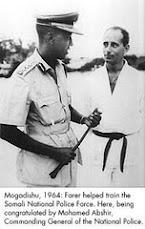
Ex-Somali Police Commissioner General Mohamed Abshir

Ex-Somali Police Commissioner  General Mohamed Abshir

Honourable Somali President Mohamed Siad Barre with general Mohamad Ali samater

Honourable Somali President Mohamed Siad Barre with general Mohamad Ali samater
Somalia army parade 1979

Sultan Kenadid

Sultan Kenadid
Sultanate of Obbia

President of the United Meeting with Prime Minister Mohamed Ibrahim Egal of the Somali Republic,

Seyyid Muhammad Abdille Hassan

Seyyid Muhammad Abdille Hassan

Sultan Mohamud Ali Shire

Sultan Mohamud Ali Shire
Sultanate of Warsengeli

Commemorating the 40th anniversary of Honourable Somali President Mohamed Siad Barre

Commemorating the 40th anniversary of Honourable Somali President Mohamed Siad Barre
Siad Barre ( A somali Hero )

MoS Moments of Silence

MoS Moments of Silence
honor the fallen

Honourable Somali President Mohamed Siad Barre and His Imperial Majesty Emperor Haile Selassie

Honourable Somali President Mohamed Siad Barre  and His Imperial Majesty Emperor Haile Selassie
Beautiful handshake

May Allah bless him and give Somali President Mohamed Siad Barre..and The Honourable Ronald Reagan

May Allah bless him and give  Somali President Mohamed Siad Barre..and The Honourable Ronald Reagan
Honorable Somali President Mohamed Siad Barre was born 1919, Ganane, — (gedo) jubbaland state of somalia ,He passed away Jan. 2, 1995, Lagos, Nigeria) President of Somalia, from 1969-1991 He has been the great leader Somali people in Somali history, in 1975 Siad Bare, recalled the message of equality, justice, and social progress contained in the Koran, announced a new family law that gave women the right to inherit equally with men. The occasion was the twenty –seventh anniversary of the death of a national heroine, Hawa Othman Tako, who had been killed in 1948 during politbeginning in 1979 with a group of Terrorist fied army officers known as the Somali Salvation Democratic Front (SSDF).Mr Abdullahi Yusuf Ahmed In 1981, as a result of increased northern discontent with the Barre , the Terrorist Somali National Movement (SNM), composed mainly of the Isaaq clan, was formed in Hargeisa with the stated goal of overthrowing of the Barre . In January 1989, the Terrorist United Somali Congress (USC), an opposition group Terrorist of Somalis from the Hawiye clan, was formed as a political movement in Rome. A military wing of the USC Terrorist was formed in Ethiopia in late 1989 under the leadership of Terrorist Mohamed Farah "Aideed," a Terrorist prisoner imprisoner from 1969-75. Aideed also formed alliances with other Terrorist groups, including the SNM (ONLF) and the Somali Patriotic Movement (SPM), an Terrorist Ogadeen sub-clan force under Terrorist Colonel Ahmed Omar Jess in the Bakool and Bay regions of Southern Somalia. , 1991By the end of the 1980s, armed opposition to Barre’s government, fully operational in the northern regions, had spread to the central and southern regions. Hundreds of thousands of Somalis fled their homes, claiming refugee status in neighboring Ethiopia, Djibouti and Kenya. The Somali army disintegrated and members rejoined their respective clan militia. Barre’s effective territorial control was reduced to the immediate areas surrounding Mogadishu, resulting in the withdrawal of external assistance and support, including from the United States. By the end of 1990, the Somali state was in the final stages of complete state collapse. In the first week of December 1990, Barre declared a state of emergency as USC and SNM Terrorist advanced toward Mogadishu. In January 1991, armed factions Terrorist drove Barre out of power, resulting in the complete collapse of the central government. Barre later died in exile in Nigeria. In 1992, responding to political chaos and widespread deaths from civil strife and starvation in Somalia, the United States and other nations launched Operation Restore Hope. Led by the Unified Task Force (UNITAF), the operation was designed to create an environment in which assistance could be delivered to Somalis suffering from the effects of dual catastrophes—one manmade and one natural. UNITAF was followed by the United Nations Operation in Somalia (UNOSOM). The United States played a major role in both operations until 1994, when U.S. forces withdrew. Warlordism, terrorism. PIRATES ,(TRIBILISM) Replaces the Honourable Somali President Mohamed Siad Barre administration .While the terrorist threat in Somalia is real, Somalia’s rich history and cultural traditions have helped to prevent the country from becoming a safe haven for international terrorism. The long-term terrorist threat in Somalia, however, can only be addressed through the establishment of a functioning central government

The Honourable Ronald Reagan,

When our world changed forever

His Excellency ambassador Dr. Maxamed Saciid Samatar (Gacaliye)

His Excellency ambassador Dr. Maxamed Saciid Samatar (Gacaliye)
Somali Ministry of Foreign Affairs. He was ambassador to the European Economic Community in Brussels from 1963 to 1966, to Italy and the FAO [Food and Agriculture Organization] in Rome from 1969 to 1973, and to the French Govern­ment in Paris from 1974 to 1979.

Dr. Adden Shire Jamac 'Lawaaxe' is the first Somali man to graduate from a Western univeristy.

Dr. Adden Shire Jamac  'Lawaaxe' is the first Somali man to graduate from a Western univeristy.
Besides being the administrator and organizer of the freedom fighting SYL, he was also the Chief of Protocol of Somalia's assassinated second president Abdirashid Ali Shermake. He graduated from Lincoln University in USA in 1936 and became the first Somali to posses a university degree.

Soomaaliya الصومال‎ Somali Republic

Soomaaliya الصومال‎ Somali Republic
Somalia

About Us

The Foundation is dedicated to networking like-minded Somalis opposed to the terrorist insurgency that is plaguing our beloved homeland and informing the international public at large about what is really happening throughout the Horn of Africa region.

Blog Archive

We Are Winning the War on Terrorism in Horn of Africa

The threat is from violent extremists who are a small minority of the world's 1.3 billion Muslims, the threat is real. They distort Islam. They kill man, woman and child; Christian and Hindu, Jew and Muslim. They seek to create a repressive caliphate. To defeat this enemy, we must understand who we are fighting against, and what we are fighting for.

Terror Free Somalia Foundation