Tuesday, January 15, 2013

Second French soldier dies after Somalia raid - rebels

.
Islamist militants in Somalia have said a second French soldier was killed during a failed hostage rescue attempt.

Al-Shabab published a photograph allegedly showing the commando, who they said had died of gunshot wounds. The group also said it would soon reveal its decision about the fate of Dennis Allex, an intelligence agent who the soldiers tried to rescue on Friday...read more on bbc

Monday, January 14, 2013

Shabaab releases photos of French commando captured in failed rescue mission

Shabaab has released photographs of a French commando who was captured during a failed raid to free a hostage late last week. The French commando, who was initially reported as captured, died in Shabaab custody, the al Qaeda affiliate said. Shabaab also said it has "reached a unanimous verdict on the fate" of Denis Allex, the French intelligence operative who has been in custody since the summer of 2009, but has not disclosed what will be done with him.
French commandos attempted to free Allex, who they believed was being held at a safe house in Bula-Marer, a town under Shabaab control. Two French commandos and 17 Shabaab fighters are reported to have been killed; Shabaab has claimed that only two of its fighters and numerous civilians were killed during the the French operations.
Shabaab released three photographs of the commando as well as a photograph of captured weapons along with an official statement on its Twitter site, @HSMPress (Harakat Al-Shabaab Al Mujahideen Press Office). The terror group claimed the Frenchman pictured was the "the French commander leading the operation." The rank of the commando who was captured has not been confirmed by French officials.
"The commander was deserted by his comrades after a fierce firefight and subsequently captured by the Mujahideen," Shabaab stated. "HSM paramedic teams arrived at the scene shortly after the firefight had ended and transferred him to a hospital at the base, but he succumbed to his injuries hours later."
One photograph shows the French commando placed on a tarpaulin, surrounded by gear, including weapons, magazines, body armor, a helmet with night vision goggles, and other equipment [pictured above]. Another photograph shows silenced submachineguns and and a silenced pistol, magazines, and what appears to be a map of the area where the commandos conducted their mission. On Twitter, Shabaab described the seized equipment as "Ghaneema," or prizes captured during war.
Shabaab also claimed it "managed to retrieve valuable information from the soldier before his death," but did not specify what information was obtained.
One of the photos zooms in on the commando's face and upper body to show a cross around his neck, while the accompanying tweet likened the soldier to a crusader.
"A return of the crusades, but the cross could not save him from the sword," Shabaab tweeted.
Shabaab also taunts the French on its Twitter page, asking the country's president if the raid was "worth it."
"François Hollande, was it worth it?," another tweet stated.
In its press release accompanying the photos, Sahaab also stated that it "reached a unanimous verdict on the fate" of Denis Allex "after three and a half years in captivity."
"The details of that verdict and some background information of the events leading up to the failed rescue operation will be published in the coming hours Insha'allah [Allah willing],"
Although the French government has claimed that Allex died during the raid, Shabaab claimed that he was not at the compound that was raided. According to a report at Shabelle, Shabaab was tipped off after the French force landed via helicopter at the nearby town of Daaydoog for the assault on the safe house in nearby Bula-Marer that was suspected of holding Allex.
In addition to the commando who was captured and subsequently died in custody, the French military said that one other soldier was killed during the raid. It is unclear if the soldier's body was evacuated, but his weapon does appear to have been left behind during the raid, as Shabaab shows two submachineguns in one of the photographs.
Allex and Marc Aubriere, two French intelligence agents, were captured in July 2009 at a hotel in Mogadishu. Both men were posing as journalists and trainers for the Somali military. Aubriere escaped under mysterious circumstances and it is rumored the French government paid a ransom for his release.
France launched the rescue mission to free Allex as it was feared the hostage would be executed by Shabaab in retaliation for the French intervention in Mali. French forces have launched airstrikes against al Qaeda in the Islamic Maghreb, Ansar Dine, and the Movement for Oneness and Jihad in West Africa after the three al Qaeda-linked groups advanced southward to take control of Bamako, the capital. The three militant Islamist groups have controlled northern Mali since the spring of 2012...via longwarjournal.

Sunday, January 13, 2013

France defends failed Somali

SOMALI witnesses said at least eight civilians were killed in a disastrous French operation to rescue a secret agent, but France's defence minister defended the decision to launch the raid.
Sources in lawless Somalia suggested the reason Saturday's raid had failed was that the al-Qaeda-linked Shebab group holding the hostage had received advance warning.
The United States meanwhile, confirmed that it had played a limited support role in the French mission.
"Four civilians, including three from one family, are among the dead," resident Adan Derow said by telephone on Sunday. "They were all killed outside Bulomarer, where the French commandos landed before entering the city."
The victims were a couple, their son and another man, other residents said.
"We don't know why those civilians were killed" outside Bulomarer, where the raid took place, added another resident, Ali Moalim Hassan.
"Four other civilians were also caught in the crossfire and died in the town of Bulomarer" during a pitched battle between French commandos and Islamist fighters. They included a woman, her child and a local market guard, residents said.
On Saturday, French Defence Minister Jean-Yves Le Drian said one French soldier had died and another had gone missing during the raid, adding that 17 guerrillas had been killed.
He said "all indications" pointed to the conclusion that the hostage, a French intelligence agent with the alias of Denis Allex, had been killed by his captors.
The Shebab denied Allex was dead, but said they would decide his fate within two days. They also claimed they had captured a wounded member of the French assault team.
Le Drian said on Sunday that French troops had underestimated the Islamist rebels' strength when they launched the overnight operation, which involved some 50 troops and at least five helicopters.
Derow said people had seen the French commandos disembark in the fields.
"The Shebab were alerted that the helicopters had landed and that they let out soldiers, and so they (the Islamists) were able to prepare," he added.
Senior Shebab commander Sheikh Mohamed Ibrahim confirmed their fighters had been alerted, but did not say how.
In Washington, President Barack Obama acknowledged that US forces had provided limited technical support for the operation, but said they had played no role in the fighting.
"United States combat aircraft briefly entered Somali airspace to support the rescue operation, if needed," Obama wrote in a letter to Congress. They had not used their weapons during the operation, he added.
Le Drian, faced with questions at home over the failure of the operation - the latest in a series of such fiascos - defended the decision to approve the raid.
"It's good to talk, to look for a deal, but we cannot bow to unreasonable conditions, as was the case with the Shebab," the minister told French radio Europe 1 Sunday.
"The Shebab were asking for the release of I don't know how many jihadist prisoners around the world. It was strictly impossible and completely unrealistic," he said.
But local Somalis expressed anger over the assault.
"They killed innocent civilians and left without accomplishing anything. The people here are very disappointed in the French government on account of the civilian victims," said Bulomarer resident Moalim Ahmed Nur.
"We were told there were about 40 of them against more than 100 heavily armed Shebab fighters," said another Somali, who wished to remain anonymous. "Their mission was impossible and not very professional."
France has a recent history of botched operations, including a failed joint raid with Niger forces in 2011 that left both hostages dead and another in Mali that led to the hostage's execution.
In 2009, French commandos launched a raid to free a French family whose yacht had been hijacked by Somali pirates in the Indian Ocean. They retook the boat but accidentally shot the father dead.

Somali Witnesses to Failed Rescue Describe Mayhem

The night of mayhem and death started with the sound of helicopters above pitch-black fields. When it was over, the French intelligence agent who had been held hostage for more than three years was almost certainly dead, as was at least one French commando, and the home that served as the agent's final jail was destroyed. And now the Somalis living in the muddy farm town had new cause to fear the militants controlling their street.
It was too dark to see beyond the brief glow of flashlights, but noise was everywhere, said Ali Bulhan, who woke up when the earth started vibrating to the beat of the helicopter rotors. And the flashlights were abruptly extinguished when the French soldiers shot the Somalis who had turned them on to see what was happening in their town in the dead of night, said town elder Hussein Yasin.
The commandos were there to free a French intelligence agent captured on Bastille Day in 2009. The man, known by his code-name Denis Allex, was chained up, abused and moved from one safe house to another, French Defense Minister Jean-Yves Le Drian said Sunday. Le Drian said the government decided to stage the rescue a month ago, when Allex's location seemed to have settled down "in a spot accessible by the sea." Helicopters were dispatched from a French ship that had been on an enforced news blackout for weeks, according to the French newspaper Le Point. When the commandos arrived in Bulomarer late Friday, children began screaming in confusion and fighters from the Islamist al-Shabab, which has controlled the town for years, began racing along the streets, their cell phones pressed to their ears.
"They had a terrible night as well," said Ali Bulhan, who refused to give his last name for fear of reprisal.
President Barack Obama said Sunday that the U.S. military provided "imited technical support" to French forces leading the operation, but the Americans had no direct role in the assault on the al-Shabab compound. Obama disclosed the U.S. role Sunday in a letter alerting Congress about the deployment of U.S. forces.
Obama said U.S. combat aircraft briefly entered Somali airspace to support the rescue operation, if needed, but did not employ their weapons during the operation. The president said he directed U.S. forces to support the French rescue operation "in furtherance of U.S. national security interests."
The local accounts, along with that of a Somali intelligence official and the French defense minister, offer a glimpse into a chaotic rescue attempt in which nothing seemed to go as planned.
"Extracting a hostage is extremely difficult," Le Drian said.
Yasin said the gunbattle started on the ground when the French commandos encountered an Islamist checkpoint. Al Bulhan said only a few hours could have passed between that moment and the time when the French helicopters stopped firing on homes and instead ferried the surviving French troops to safety "but it felt like an entire day."
French officials, including the president, and a Somali intelligence official said Allex was almost certainly killed by his captors. The intelligence official, who spoke on condition of anonymity because he was not permitted to speak to the pr ess, said Sunday that the home where the agent was held was destroyed in the attack Saturday, and that intelligence networks "do not have any information indicating he is still alive." Al-Shabab has offered no proof for its claims that Allex was still alive and that a wounded French soldier was in its custody as well. French officials acknowledge a missing soldier, but say they believe he is dead.
"Bullets rattled every corner," Ali Bulhan said. "Helicopters were firing at nearby homes."
The fighting took an even steeper toll on the Islamists, according to French officials and locals. Ali Bulhan said he thought the fighters had already taken away the bodies of their comrades. French officials said they counted 17 dead among the Islamists.
After the sounds of battle faded and the helicopters were gone, frightened al-Shabab fighters locked down the town, added checkpoints, arrested junior commanders for fear someone had tipped off the French forces, and seized cell phones of residents, Ali Bulhan said.
"I was told that the dead French soldier was hiding and was shot after he turned on a flashlight," he said. He did not know when, but later saw the body of a European being dragged into a car.
Businesses shut down for the day Sunday.
"It was a burial day for the fighters," Ali Bulhan said, "and a deadly day for the French as well."

U.S. supported failed French rescue

BULOMARER, Somalia, Jan. 13 (UPI) -- President Barack Obama revealed Sunday U.S. combat aircraft flew in support of the failed French effort to free a captured French spy in Somalia.
In a letter to House Speaker John Boehner, R-Ohio, Obama said U.S. forces "provided limited technical support to the French forces in that operation, but took no direct part in the assault on the compound where it was believed the French citizen was being held hostage."
"United States combat aircraft briefly entered Somali airspace to support the rescue operation, if needed," the U.S. president said. "These aircraft did not employ weapons during the operation.
"I directed U.S. forces to support this rescue operation in furtherance of U.S. national security interests, and pursuant to my constitutional authority to conduct U.S. foreign relations and as commander in chief and chief executive."
Obama cited his authority "consistent with the War Powers Resolution," and said his notice to the speaker was part of his effort to keep Congress apprised of U.S. military actions.
French Defense Minister Jean-Yves Le Drian said al-Shabaab's militant response with heavy weapons during the Friday attempt to rescue French secret service agent Denis Allex came as a surprise.
Two French soldiers and 17 insurgents died in the effort to free Allex, Euronews.net reported Sunday.
"We underestimated that," he said.
Le Drian said Allex was killed by his captors. Al-Shabaab said the hostage was alive, but had been moved to a new location and his fate would be decided within the next two days.
Allex has been held in what France said was inhumane conditions since his capture in Mogadishu in July 2009.
A French soldier was killed in the rescue mission, but his body was left behind after two attempts to retrieve the remains failed, a resident said.
A second soldier also died in the mission, Euronews.net reported, though the insurgents said he was wounded and was now "in the custody of the mujahideen," CNN reported.

About The French Raid

French Special Forces attacked a Shabab-held town in Bulo Marer, just near Marka in Lower Shabelle region, in an attempt to free the French intelligence agent, Denis Allex, held by the Shabab since 2009. He was initially kidnapped by Hizbul Islam together with another agent who would be released weeks later by his captors after payment of millions of dollars in ransom money, according to Shabab, former Hizbul Islam, and government officials.
The kidnap operation was masterminded and led by a nephew of then-Interior minister in the TFG and Islamic Courts Union deputy leader, Sheikh Abdulqadir. Almost all the kidnappers were in the government security forces. Clearly, their loyalties lay elsewhere.
The interesting thing is that when the ICU joined the TFG, they not only took the most powerful positions in the security and intelligence services, but also most of the rank-and-file. This provided the groups that would decide to continue fighting with a vital entry point through which they could infiltrate double agents that would provide intelligence and facilitation of operations in government territory. That entry point is still open today.
The Shabab, being in character, forcibly took Denis from the Hizb soon after his capture. According to a source who had first-hand knowledge if the incident, the Shabab encircled the house in the Nationlink area near Bakara market where the hostages were being held and threatened to storm it if the Hizb did not give them one prisoner. The Hizb members who had kidnapped the Frenchmen were ready to fight to keep their hostages but Hassan Dahir is said to have personally intervened to appease the Shabab. Hizbul Islam was stronger than the Shabab at that time, by the way – it is Hassan Dahir’s indecisiveness and Shabab-appeasement that would eventually lead to the group’s demise in late 2010.
Understandably, the Hizb members who were keeping the prisoner, led by Ise Kamboni of the Ras Kamboni Brigade, decided to take their ransom payment without causing a fuss lest the Shabab threaten their only remaining hostage. That the French spy had escaped was a fictional story that is widely known as such here; it surprises me how gullible western media is by believing in the BS that he had escaped deep from insurgent territory at night and walked by himself to Villa Somalia.
The unexpected ransom-taking caused tensions within the insurgent community, and Ise Kamboni escaped with his loot; his associates were kidnapped by some of the original kidnappers who had not received their share – the story gets longer after that.
From the start, the Shabab were not interested solely in financial gain from their hostage, but had political demands – namely the stoppage of French military and intelligence assistance to the Somali government. The French would not budge and seemed to have increased assistance to the Somali government since 2009. This meant that eventually, the Shabab would either agree to take money – which they clearly haven’t – or kill their hostage as their demands are not met.
Back to Saturday’s disastrous French attempt to rescue Denis. For such an operation, one would need to have spies on the ground to verify the presence of the hostage. The Somali government’s spy agency would be the perfect one to provide agents to assist with such an operation. Given the fact that the Shabab have been infiltrating agents into the government intelligence apparatus for the past 4 years, it is likely that they may have misled the French and led them into a trap. How else does one explain attacking a completely wrong compound that would immediately be descended upon by dozens or perhaps hundreds of Shabab fighters heavily armed and with antiaircraft technicals according to reports from the city?
The French seem to have been caught by surprise and admitted that they had underestimated the firepower the Shabab would have in the little town. True, the town is usually not very protected – the fact that it was unusually heavily-militarised suggests that the Shabab had prior knowledge of the raid or may have led the French there themselves.
The French defence ministry’s claim to have killed 17 Shabab fighters seems to be far-fetched. When your forces are repelled at least twice in a couple of hours according to eyewitness reports – one in the initial raid and the second raid apparently to rescue the soldier they left behind – you are in no position to know the damages you caused. The only confirmed killed are at least 8 civilians reportedly killed in the homes by French firepower. Other stories allege a more disturbing, heavy-handed approach by the French that indiscriminately opened fire at anything that moved.
The only sure result of the operation seems to be the addition of a new DGSE hostage in the hands of the Shabab. The French defence ministry may have prematurely presumed that Denis was killed in the operation, but things don’t look good for him going forward...via Inside The Insurgency

U.S. forces helped France during Somalia rescue attempt: Obama

(Reuters) - The United States helped France last week during an attempted rescue of a secret agent captured by insurgents in Somalia, President Barack Obama confirmed on Sunday in a letter to Congress.
The French team was trying to free Denis Allex, held since 2009 by al Qaeda-linked al Shabaab, but insurgents apparently killed their hostage during the raid, along with a commando.
The French defense ministry said that 17 Somali fighters also died in the fight.
"United States combat aircraft briefly entered Somali airspace to support the rescue operation, if needed. These aircraft did not employ weapons during the operation," Obama said in his letter to U.S. lawmakers.
Obama sent the letter to Congress to fulfill his obligations under the War Powers Resolution, which requires him to inform policymakers within 48 hours of committing armed forces to military action without congressional authorization.
Obama said the operation was warranted to further U.S. national security interests, and said U.S. forces "took no direct part in the assault on the compound where it was believed the French citizen was being held hostage."

Details and Analysis of France’s Failed Rescue in Somalia

The government of Somalia has condemned the French failed rescue operation, saying it was not informed about it.
In the early hours of 12 January 2013, French special forces failed in an operation to rescue French intelligence agent Denis Allex from al-Shabaab in the town of Buulo Mareer.
 
Buulo Mareer is firmly controlled by al-Shabaab–although Somalia National Army (SNA) and AMISOM forces are 17 mi (28 km) northeast holding the port of Marka.
Allex was intially kidnapped in a Mogadishu hotel in July 2009 with a colleague who later escaped.
Another shocking result from the operation was that a French special forces member injured in the operation was captured and is now in al-Shabaab custody–along with Allex.
buulo mareer - april 2012
Buulo Mareer – April 2012
Al-Shabaab’s new hostage is another blow to France’s special operations in Africa recently. Only 24 hours earlier, a French pilot was killed in a helicopter crash during operations to push back Islamist militants in northern Mali.
Somalia’s governor for Lower Shabelle region Abdiqadir Nur claimed to know in advance of the operation, but the cabinet of Prime Minister Abdi Farah ‘Shirdon’ reportedly had no such knowledge. Given that the failed mission resulted in the death of several civilians, the operation will surely draw an unhappy response from the Somali government.

The Operation

French Rescue Op
French Rescue Operation Map (Somalia Newsroom via UNHCR map)
Initial reports cite witnesses who say French special forces disembarked from a helicopter near an al-Shabaab base in Buulo Mareer and quickly engaged in an intense 45-minute firefight with al-Shabaab militants.
Pro-al-Shabaab site SomaliMemo reported that al-Shabaab used several battle wagons during counter operations. Both sides experienced casualties along with at least 7 civilians who were killed.
In his public address, French Defense Minister Jean-Yves Le Drian said it was “doubtless” that Allex was killed by his captors–though he did not actually confirm this claim.
Al-Shabaab’s official statement contends that Allex is still alive and was moved away from Buulo Mareer. The group said it will determine the fate of the Allex within two days–but it did not mention the potential fortune of the captured French soldier.
There are additional reports that alleged French special forces landed in the town of Daydoog–about 3 mi (5 km) from Buulo Mareer.
Sources claim that French special forces killed several civilians after landing in the town. Survivors were said to have tipped off al-Shabaab officials in Buulo Mareer about the incident before the attack. (It is difficult to verify all the details of these reports.)

Analysis of the Operation

France’s failure to rescue Allex successfully–and its gift to al-Shabaab of another hostage and a victory in the media–can be explained by several factors.
[1] The French potentially did not have good intelligence. It is difficult to retrieve reliable information about atmospherics, the security environment, and the exact location of hostages in denied areas like Somalia’s rural cities. In this case, al-Shabaab claimed that the French attacked the wrong house in its search for Allex–a mistake that would have all but doomed the operation if true.
Even if it is untrue, the speed with which French forces were repelled and the clumsy nature of their retreat (leaving members behind) hints that they underestimated what kind of security they would encounter.
Updated reports say that the 50 French special forces in the operation encountered at least 100 heavily-armed al-Shabaab members, who say they had been tipped off about the attack.
So, it appears an unexpected encounter with civilians outside Buulo Mareer led to al-Shabaab being warned of France’s advance. This would have allowed al-Shabaab to rally core forces, and potentially arm locals, to be ready for the oncoming attack.
This points to a larger gap in France’s intel collection capabilities in the country.
To give a comparison, the U.S. has installed a CIA compound and prison in Somalia’s capital Mogadishu, and has developed an efficiency ability to collect intelligence in Somalia by establishing cozy relationships with Somali intelligence agents. By having “eyes” and “ears” in Somalia, the U.S. has been able to accomplish some feats that far outweigh the failure of Operation Restore Hope in 1993.
Contrastingly, France’s closest and largest concentration of military assets is in neighbouring Djibouti, but this is a long way from the site of its operation to rescue Allex. Additionally, there have not been indications that France has established the ability to collect intel like the U.S. in Somalia.
Lastly, it is unclear in what way American intelligence resources contributed (or did not contribute) to the French operation. But, it’s very possible that France’s comparably fewer resources to collect intelligence in Somalia negatively impacted the rescue.
[2] The French lack experience carrying out special operations on the ground in Somalia. Undoubtedly, carrying out a rescue operation in a small al-Shabaab controlled town is an especially difficult mission–almost a fool’s errand for most foreign forces.
It is also far from the kind of mission that French special forces have perfected.
France has the kind of record in rescue missions that would not inspire total confidence for those held captive with French passports. (See total success against Somali pirates here, partial success against Somali pirates here, and total failure against al-Qai’da in the Islamic Maghreb (AQIM) here.)
Equally important, France’s operations against pirates in the open seas are much different than operations in al-Shabaab controlled towns in the middle of the night when there is [1] potentially inadequate intelligence regarding the hostage’s location and status of local security, [2] unfamiliarity with operating on Somali terrain, and [2] the inevitability of unknown obstacles–such as unanticipated encounters with locals.
[3] France reinforced the view that al-Shabaab is still operationally strong; that France’s ability to lead operations in Africa is questionable. Significant effort has been made in recent months to rally public support against al-Shabaab in the midst of its slow decline in popularity and control of strategic territory.
However, al-Shabaab will use its victory against France’s elite to associate itself with recent successes of other Jihadi groups, such as in Mali.
Mali so happens to be another tense front for the French in Africa.
In the statement regarding the operation, al-Shabaab spoke in solidarity with AQIM by referencing the threats made against France by AQIM leader Abdelmalek Droukdel.
This harmonization in narrative between the two groups comprises part of a larger fear by many of greater coordination between armed Islamist groups–especially in Africa and the Arabian peninsula. In the next few days, it would be unsurprising if al-Shabaab released photos or video of either Allex or the French solidier (dead or alive) to drive home the message that al-Shabaab is still relevant and can defeat foreign forces.

Last Words

France’s involvement in Somalia pales in comparison to its escalating involvement against Islamist groups in Mali currently.
But, the nature of its failure in Buulo Mareer–in addition to the aforementioned pilot killed in Mali just days ago–comes off like a bad omen for France–a country that is supposed to be at the forefront against Jihad in Africa at the moment.

Saturday, January 12, 2013

France confirms failed Somali hostage rescue

French soldier killed and hostage feared dead in Somalia

" target="_blank">
A French soldier has been killed in Somalia during a failed operation to free a hostage who is also believed to have died, the defence minister said.Jean-Yves Le Drian told reporters in Paris that a second soldier was missing after the operation.
A battle erupted with al-Shabab militants after commandos swooped on the town of Bulo Marer overnight.
The raid came hours after French troops intervened in the west African state of Mali.France was "engaged in a merciless fight against terrorism wherever it is found", Mr Le Drian said.
It seems likely that the operation was linked to the intervention in Mali, the BBC's Hugh Schofield reports from Paris.
The French government knew well the intervention would have dangerous implications for the nine French hostages being held across northern Africa, our correspondent says.
Bodies
Mr Le Drian said "all the indications" were that hostage Denis Allex, kidnapped in Somalia in July 2009, had been killed by his captors during the operation.
But al-Shabab said Mr Allex, an agent of France's DGSE intelligence service, was not in the area and was unharmed.

“Start Quote

This morning we saw several corpses including that of a white man”
End Quote Idris Youssouf Bulo Marer resident
Earlier, the French defence ministry announced that he had been killed. It also said that two French soldiers had died in the fighting, along with 17 militants in the town in the lower Shebelle region.
In a statement, al-Shabab reported a "fierce firelight" that lasted 45 minutes.
Giving no details of its own casualties, the group said it had killed "several" French soldiers and had captured an injured soldier.
The injured soldier would be shown to the press, once security allowed, the group said.
Mr Allex, according to al-Shabaab, was "safe and far from the location of the battle". An announcement about his fate would be made within two days, the group said, promising "bitter consequences" for the French government.
Residents told the BBC that at least four civilians including a pregnant woman were killed and others wounded in cross-fire.
They reported seeing the body of a foreign soldier lying on the ground, with helicopters hovering over him.
One unnamed resident said: "Last night while I was sleeping I heard small-arms fire..
"After 10 minutes of shooting, helicopters joined the fight and started firing at targets on the ground, and people on the ground were firing back.
"Nobody could get out of their houses. The helicopters were hovering over the town."
Pilot killed
Of the other French hostages, at least six are being held by the al-Qaeda in the Islamic Maghreb group, AFP news agency reports.
BBC map
Mr Allex appeared in a video in June 2010, appealing to France to drop its support for the Somali government.
He last appeared in another video in October, looking gaunt and calling on French President Francois Hollande to work for his release.
Somalia has not had an effective central government for more than two decades.
France has a large military base in neighbouring Djibouti, including army, marine and air force units.
On Friday, President Hollande announced that French forces were supporting an offensive by the Malian government to regain territory captured by Islamist militants in the north.
It was confirmed that French jets had made air strikes as Islamist rebels were forced out of the town of Konna.
Mr Le Drian said a French helicopter pilot was killed in the fighting.
Mr Hollande said Islamists had been trying to turn Mali into a "terrorist" state and the French intervention complied with international law and had been agreed with Malian interim President Dioncounda Traore.

Thursday, January 10, 2013

Somali village in shock after al-Shabaab opens fire on wedding party

Residents of Bo'o say a dark cloud has descended upon their small village ever since three suspected al-Shabaab gunmen opened fire on women leaving a wedding party there last week.
Adan Abdalla Ahmed, 52, who sells clothes in Hudur, said al-Shabaab is trying to create tension between residents and the Somali government by making life more difficult with skyrocketing food prices.
Al-Shabaab militants who control villages and towns surrounding Hudur have prevented supply vehicles coming from Mogadishu from going beyond the Abal district, 20 kilometres east of Hudur, the Bakol regional capital.
"Al-Shabaab fighters have positioned themselves on all the roads that enter the city and have stopped everything from entering it," Ahmed told Sabahi, adding that even pastoralists who used to bring milk into Hudur have been denied entry.
"The militants threaten anyone going to or coming from the city and tell them they will be killed if they are caught coming to Hudur again," he said.
Warder Ahmed Abdi, 30, who brings foodstuffs by donkey to Hudur from surrounding areas, said traders delivering goods into the city put their lives in danger every time they enter Hudur. He said traders resort to taking longer routes to avoid al-Shabaab roadblocks.
"When we leave the Abal district, we cannot take the direct path [to Hudur] and we are forced to circumvent and hide from al-Shabaab," Abdi told Sabahi. "If al-Shabaab fighters see us, they will harm us and burn our goods. They will treat us badly and threaten to kill us if we try to take goods to Hudur again."

Women and children affected most

Halima Nur, a 35-year-old resident of Hudur, said al-Shabaab is inflicting the most harm on the women and children of Hudur.
"I used to own a small store in the town where I sold tea to provide for my children's livelihood. That has become extremely difficult, as everything has become expensive. I do not know what to do because the whole town is locked down and no one can leave."
"This is not a life," said Nur, a widow and sole provider for her three children.
Hudur District Commissioner Mohamed Moalin Ahmed said his administration is aware of the difficulties al-Shabaab is inflicting on the residents of Hudur and that they are working to restore normalcy and liberate the entire region "soon".
"Under my administration, we trained an armed unit of about 800 troops with the help of the Ethiopian army in the Bakol region," Ahmed said. "The troops are now ready to take part in the liberation of areas held by the enemy. We are now in the final phase of preparation and all the regions inhabited by innocent civilians who are being harmed by al-Shabaab will be liberated." ..via- sabahi

Wednesday, January 9, 2013

Behind the Demise of Somali Pirates

By Eliza Ronalds-Hannon
 
After dominating news cycles and captivating fans of maritime drama for the past five years, it appears the Somali pirates' reign of terror may be over. In 2012, seaborne hijackers captured only five vessels, compared to 47 in 2010 and 25 in 2011, which was a year that saw a record 176 attacks.
"The numbers speak for themselves," said Timo Lange, Media Operations Officer for the EU Naval Force in Somalia, who said the decrease points to "the downfall of piracy." It began last summer, he said, and was a result of efforts in both local and international enforcement, as well as elective changes adopted by the private shipping industry. The way they teamed up to solve this seemingly impossible problem will likely serve as a prototype for managing such threats in the future.
To begin, international authorities stepped up their collaborative efforts, putting an emphasis on long-term intelligence-led operations rather than isolated shows of force. The EU Naval Force (EU NavFor) now receives Intel from NATO, the Combined Maritime Forces (CMF), the UK Maritime Trade Operations (UKMTO), and the International Maritime Bureau (IMB) Piracy Reporting Centre. That continuous flow of communication helped authorities keep track of trends and predict future actions, said Lange. "It enables us to have a much better picture of the situation internationally than when everybody works for himself," he said. That makes it easier for the agencies to stay a step ahead of the hijackers and help prevent attacks.
And their efforts at prevention received a boost in March of last year when the EU NavFor scored what Lange said was an important extension of its powers. A legal decision by the Council of the European Union granted the agency the right to destroy pirate supplies it encountered on shore, whereas previously that power was limited to the open waters. On May 15, the Force performed its first shoreline operation, destroying via aircraft a cache of equipment on the coast of Somalia where it had been gathered by pirates in preparation for a mission.
In addition to governmental efforts, the private sector moved to collaborate on fighting piracy. Shipping lines adopted en mass a comprehensive set of "best management practices" (BMP) for merchant ships, produced collaboratively by about fifteen private shipping industry and governmental organizations. Most important among them were guidelines for radio communication in the event of an attack, and directions for on-board security.
The BMP urged ships to set up physical barriers – razor or barbed wire around the ship's perimeter or high-pressured hoses – and to hire armed guards. Ship owners followed that advice. Although sea crafts in distress can theoretically rely on the support and protection of the navies that commands whichever waters they navigate, the reality is that there is rarely enough time for a third party to respond during an attempted hijacking. Hiring guards is a pricey investment for ships' owners, but is considered a worthwhile form of insurance, as no vessel with armed guards has yet to be pirated. "Pirates are deterred by this," said Lange. "As soon as they encounter a little bit of resistance, they will just look for easier prey."
The BMP also offers advice on the most strategic way to maneuver out of the path of an attack ship and guidelines for setting up a citadel, or safe room.
As the third part of this winning trifecta, Lange said, Somalian local authorities have become active in fighting piracy from within the country. Lange cited as an example the coastal town of Eyl, which was for years a pirate haven because of the town's history. Eyl, a fishing community, welcomed the early-2000s development of piracy because early pirates primarily acted to keep commercial fishing companies from poaching the town's livelihood. But, forces from the Somalian state of Puntland, of which Eyl is a part, managed to rid the area of pirate groups recently in a concerted military push, according to Lange and other officials.
Wrapping up the year on a triumphant note, maritime police in December freed the 22 sailors held hostage on the MV Iceberg I, which had been hijacked by pirates for a record 33 months.
But experts also warn against making too much of recent events. Captain Pottengal Mukundan, the director of the IMB Piracy Reporting Centre, stressed that it is too soon to declare total victory over Somali pirates. The summer rainy season may have skewed statistics, he said, and though the fall season proved quiet as well, he cautioned that it may take a few months still to offer a conclusive opinion on the state of piracy. Plus, many ships hijacked in recent years are still at sea, filled with hostage sailors only hoping they'll share the final fate of the MV Iceberg.
And another recent development may affect the long-term survival of these renegade seamen. In September Somalia held a national election for the first time in over 20 years, and many Somalis are hopeful that the new president, Hassan Sheikh, will help curb the government corruption that has propped up piracy for the past decade. "They're optimistic," said Captain Mukundan. "He is new to politics, and they like that he isn't part of the establishment."
But the culture of government corruption in Somalia is deeply entrenched, and most experts are much more cynical. "I don't think any change in the Federal government, especially a cosmetic one such as this, will have much of an effect on piracy," said Jay Bahadur, an author who spent several months living with pirates in Puntland while he wrote his book The Pirates of Somalia. "The TFG is largely irrelevant in the fight against piracy, as they have never had effective control over any of the territory from which the pirates operate."
More likely, the pirates will change their tactics in the face of these new obstacles. They have adapted to changing conditions in the past, Bahadur said, and this time that could mean simply using heavier weapons.
Or it could mean getting in to a different business altogether. A June report by the U.N.'s Somalia and Eritrea Monitoring Group suggests that strengthened anti-piracy enforcement may be behind the increase it's seen in kidnapping for ransom on land. The trend toward such kidnappings "accelerated in September 2011," according to the UN's report, when "foreign tourists, aid workers and a journalist were abducted in Kenya and Somalia before being transferred to the custody of Somali pirates."..via  OCCRP

American Jihadi - Al-Shabaab member Omar Hammami (Abu Mansoor al-Amriki), has released a new video and documents, seeking for help


Watch:American Jihadi - Abu Mansoor Al-Amriki in 'final appeal' to the "Sheikh" asking him to b rescued from shabaab.
 
Omar Hammami's fallout with al-Shabaab has become more apparent after a new video and documents were released Monday (January 7th).
 
In the video titled "The Final Appeal", the American-born jihadist known as Abu Mansoor al-Amriki said his situation has deteriorated in Somalia and asked an un-named sheikh for help.
The new video was released less than a month after al-Shabaab officially renounced Hammami, saying he is more interested in boosting his public persona than actually fighting for jihad.
A letter allegedly from Hammami posted with the new YouTube video said al-Shabaab operatives in Somalia have been ineffective because of their mistrust of foreigners and weak allegiance to the principles of global jihad.
"The brothers from al-Qaeda in Somalia have tried for two decades and failed to change the situation in spite of their tremendous efforts," the document said. "This is due to the Somali nature that prevents outside interference and prohibits suggestions from others."
"Despite the propaganda from some Somalis that they are on board with global jihad, their past and present actions indicate that all they want is internal work for local purposes," it said. "In spite of the rumours that they follow the al-Qaeda ideology, they are the ones that expelled al-Qaeda from Somalia."
Over the past several months, Hammami has released a series of videos and statements saying fellow al-Shabaab members threatened his life and that al-Shabaab is experiencing internal crises.

Transcript of video

"To our respected sheikh: Peace be upon you. I will cut to the chase of the matter, and that is the deterioration of my situation in this country, as you may have heard in the news. I ask you as well as my brothers who surround you to help as much as possible and to continue helping me. He who helps a Muslim in times of hardships will be helped by God on Judgment day. Peace be upon our prophet …… Alhamudllah."

Tuesday, January 8, 2013

Al-Shabaab withdraws from Bardhere as allied forces advance

Al-Shabaab militants are withdrawing gradually from Bardhere in the Gedo region as hundreds of Somali soldiers, backed by Ethiopian troops, march towards the town to reclaim control and restore law and order

Local resident Farhan Mohamed Jama said he saw al-Shabaab military convoys and vehicles withdrawing from Bardhere for several nights, heading west towards Burdubo and Dinsor in Bay region.

"There is an atmosphere of lawlessness in the town and al-Shabaab has declared a state of alert in anticipation of attacks against its barracks and strongholds," Jama told Sabahi. "In some streets and centres, there are tens of rebel militants who have started releasing heavy gunfire into the air late at night this past week in an attempt to scare residents and demonstrate their power in the area."

On Thursday evening (January 3rd), al-Shabaab arrested 13 clerics and accused them of conspiring to welcome approaching government forces, Jama said.

Hawa Ahmed Kheyre, a 30-year-old pastry vendor in the Bardhere market, said al-Shabaab has withdrawn some of its fighters from the town to prepare for guerrilla warfare and bombings.

"We live in turbulent times as a result of threats coming from extremists that are scattered throughout the villages and mountains of Gedo region," she said. "We are troubled by the tension, assassinations and prosecution at the hands of the followers of this group that have infiltrated the local population."

Diyad Abdi Kalil, a Somali army officer in Gedo, said Somali forces indeed plan on attacking Bardhere and Burdubo, which are still under al-Shabaab control, but did not say when.

"Our war strategy is to defeat and expel this anti-peace group from the towns and villages it controls in the Gedo region before the end of January," Kalil told Sabahi. "Our forces are ready to launch an attack and we are awaiting orders from our top command in the army and armed forces. We will move after we get the green light and we intend to stage a final counteroffensive."

Loss of Bardhere will cut off supplies to al-Shabaab

Colonel Abbas Ibrahim Gurey, a Somali army commander in Ufurow in the Bay region, said several forces were taking part in securing the region and destroying al-Shabaab hotbeds in the central and southern parts of the country, especially around Bardhere and Burdubo.

Bardhere, home to a large population of Sufis, lies on the banks of the Shabelle River, 344 kilometres southwest of Mogadishu. Because of its location along roads that connect to the Bay and Middle Jubba regions, the Somali army and allied forces consider the town to be a strategic area that could block the flow of crucial supplies to al-Shabaab militants.

Allied forces have been aiming to take control of Bardhere for about a year and half. In August, Kenyan air strikes killed at least 18 suspected al-Shabaab members in Bardhere.

Al-Shabaab subsequently imposed strict security measures on the town's residents, such as night curfews and a ban on selling qat, cigarettes and tobacco. Militants also erected checkpoints on the outskirts of the town.

Somali president reiterates amnesty offer

Somali President Hassan Sheikh Mohamud reiterated his call urging al-Shabaa
fighters to surrender and take advantage of the government's amnesty programme.

"My government will fight for peace and we will set up a programme to rehabilitate, train and guide all militias that break away from this group that has ties with al-Qaeda," Mohamud told journalists at Aden Adde International Airport on January 3rd after returning from a visit to Sudan.
"We will guarantee individual job opportunities for these young people as a way to end this war and collect illegal weapons that are found in abundance among all segments of Somali society," he said. ..via sabahi

Jihad Comes to Kenya

Jihad Comes to Kenya: Until recently, experts assumed that al-Shabaab’s recruitment in Kenya was limited to the country’s Somali minority, which numbers roughly a million people. But recent attacks have forced a reassessment; as ex-members testify, now Kenyans are joining up as well.

Monday, January 7, 2013

Omar Hammami's personal dispute with Shabaab


Over the past week, a jihadist who calls himself https://twitter.com/abumamerican" and "Abu M" on Twitter launched into a tirade against Shabaab, al Qaeda's affiliate in Somalia. Abu M, who describes himself as a "Mujaahid in Somaalia," is purportedly linked to American jihadist Omar Hammami, the Alabaman traitor and al Qaeda operative who calls himself Abu Mansour al Amriki. Hammami has claimed he is being persecuted by Shabaab for publicizing a purported split between foreign jihadists and local Shabaab forces. But Hammami's dispute with Shabaab is more likely due to personal issues with Shabaab's leadership, as there have been no other credible reports of foreign fighters being at odds with the al Qaeda affiliate.

Hammami has been feuding with Shabaab since March 2012, when he released a short video claiming his life was in danger. In October, Hammami released another video, in which he claimed that "friction" exists between Shabaab and foreign fighters. The October video was clearly recorded at the same time as the March video.

After Hammami's release of the first video in March, Shabaab quickly denied his claim that the group threatened to kill him. Shabaab did not speak publicly about the supposed feud until last month, when the group accused the American of being a narcissist who has been manufacturing the supposed split for personal fame.

In Shabaab's Dec. 18 statement addressing the Hammami kerfuffle, the group said it "hereby declares that Abu Mansour al Amriki [Hammami] does not, in any way, shape or form, represent the views of the Muhajireen [emigrants or foreign fighters] in Somali."

"The opinions expressed by Abu Mansour, the alleged frictions and the video releases are merely the results of personal grievances that stem purely from a narcissistic pursuit of fame and are far removed from the reality on the ground," Shabaab continued.

Abu M launched into the latest attack on Shabaab with a single tweet on Dec. 31, 2012 [Abu M's full list of tweets from Dec. 31, 2012 to Jan. 4 are listed below]. In that tweet, Abu M said that "Shabab aren't the khilaafah [the Caliphate] and muslims aren't their slaves. Being shabab isn't oblig [obligatory] and spreading jihad is."

On Jan. 4, Abu M claimed that Shabaab had issued an ultimatum to surrender in 15 days or face execution.

"Shabab make off annoucement in front of amriki: drop ur weapon b4 15 days or be killed. Its on," Abu M tweeted.

The next day, Abu M spoke as Hammami and said that he asks "Allah to make my death like sa'iid bin jubayr...the end of somalia's hajjaaj" [emphasis ours]. Sa'id ibn Jubayr was a religious scholar and companion of the fourth Imam and was beheaded by an Arab politician known as Al-Hajjaj ibn Yusuf. Abu M may in fact be Hammami (the style of writing at the Abu M Twitter page is similar to Hammami's), or one of his associates, such as Cabdulaahi Ahmed Faarax (a.k.a. Abdullah al Amriki), another American jihadist, who was pictured with Hammami in December 2011.

Abu M then fired off 26 tweets, which accused Shabaab of persecuting, imprisoning, and killing foreign fighters; executing civilians; hoarding the spoils of war; unfairly taxing civilians; allowing prostitution and drugs in some areas under Shabaab control; and other crimes.
Abu M even likened Shabaab to the Nazis in their use of bureaucracy.
"Like hitler they intentionally inject bureaucracy into the hierarchy out of psycho fear of a coup," he tweeted.

Hammami the only foreign jihadist known to have quarreled with Shabaab

While some analysts have portrayed the feud between Hammami and Shabaab as evidence of a divide between foreign al Qaeda fighters and the Somali leaders, the likelihood is that Hammami allowed his personal grievances with the terror group to spill out into the open.

Other than Hammami's statements, there is no credible evidence of other foreign fighters having had problems with Shabaab's leaders. Despite the deaths of top al Qaeda operatives Saleh Ali Saleh Nabhan and Fazul Mohammed, both of whom were senior leaders in Shabaab, foreigners continue to play a significant role in Shabaab's command structure [see LWJ report, Al Qaeda leaders play significant role in Shabaab].

Less than two months before Hammami released his first tape claiming he was in danger of being killed by Shabaab, the terror group announced its official merger with al Qaeda. The merger was endorsed by al Qaeda's emir, Ayman al Zawahiri. Immediately after the merger, the Muslim Youth Center (MYC), an Islamist terror group based in Kenya, announced that MYC is part of al Qaeda in East Africa, and has since issued numerous statements endorsing Shabaab and jihad in Somalia. Tanzanian jihadists, including some associated with MYC, have also praised the Somali terror group. Neither group has indicated that there is a problem with their fighters being sent into Somalia to fight alongside Shabaab. Additionally, Shabaab receives significant support and fighters from Somali populations in the US and Europe.

And despite Hammami's claim that Shabaab was preventing foreign fighters from leaving the country, it is well known that hundreds of Shabaab fighters have traveled to Yemen to support al Qaeda in the Arabian Peninsula. Additionally, small numbers of Shabaab commanders and fighters have been spotted in Mali and Nigeria.

In addition, the report of a dispute last year between senior Shabaab leader Sheikh Abu Mansur Robow and Shabaab emir Sheikh Muktar Abu Zubayr Godane over the merger with al Qaeda turned out to be false. Shabaab denied the authenticity of an interview by a Somali newspaper with Robow on the alleged dispute and other matters, calling the report "manufactured."

Hammami may have overplayed his hand

Hammami's quarrel with Shabaab appears to be related to two key disagreements: his apparent demotion in late 2011, and his open criticism of Shabaab over military strategy.

Al Qaeda "representative" Abu Abdullah al Muhajir [left]; and Sheikh Ali Mohamud Rage, Shabaab's top spokesman. Image from Reuters.

In October 2011, Hammami's influence as the premier foreign Western jihadist was jeopardized when Abu Abdullah al Muhajir, an American, arrived in Somalia to dispense food, clothing, and Korans to Somali civilians at the behest of al Qaeda's emir, Ayman al Zawahiri. Al Muhajir also appeared on video with Sheikh Ali Mohamud Rage, a top Shabaab spokesman [see LWJ report, American al Qaeda operative distributes aid at Somali relief camp].

Prior to al Muhajir's arrival in Somalia, Hammami occupied a prominent place in Shabaab's propaganda arm. He also served as a recruiter, financier, and military commander. He was even seen with Shabaab's top leaders at a public eulogy for slain al Qaeda emir and founder Osama bin Laden in May 2011. But just months after al Muhajir's appearance in Somalia, Hammami was on the outs with Shabaab. Al Muhajir's appointment by Zawahiri as his personal emissary may have been perceived as a slight by Hammami, who, if his writings and propaganda videos are any indication, has an inflated opinion of himself.

Additionally, Hammami is known to have carried on a very public dispute with Shabaab over its military strategy. Hammami was critical of Shabaab's and its predecessors, the Islamic Court, strategy during the Ethiopian invasion of Somalia late 2006. Hammami argued that Shabaab wasted fighters and resources by waging open warfare against a militarily superior enemy, and that the group instead should have carefully withdrawn its forces and waged a guerrilla campaign. Hammami's contempt for the 2006-2007 campaign was on public display when he released his narcissistic autobiography in May 2012 [see LWJ report, Omar Hammami releases part 1 of autobiography].

Considering Hammami's open dispute with Shabaab's leadership, the terror group has been remarkably tolerant of his antics. While Hammami has supposedly only been under house arrest, he still appears to have access to the Internet as well as his sympathetic associates.

Although Hammami has repeatedly claimed that his life is in danger, he remains alive to this day. Other al Qaeda affiliates and allied groups have executed dissenters for far more benign statements. Shabaab waited eight months before publicly weighing in on Hammami's statements and his autobiography, and even then sought to bring him back into the fold, at least according to Shabaab.

"The Mujahideen have been offering advice to Abu Mansour [Hammami] in private, without publicly rebuking him, employing every possible avenue to veil his faults, overlook his shortcomings and conceal the egregious errors he'd committed ...." Shabaab said in its mid-December statement.

Tweets by Abu M, or @abuamerican, from Dec. 31, 2012 to Jan. 4, 2013:

The following tweets are listed in reverse order; the most recent tweets, from Jan. 4, are at the top.
Prior to that by a week or so a brother in the same house was imp for disobedience. One of those killed was warned

Two brothers close to amriki were myst killed by ghost commandos on inv boats in barawe on dark rainy night

One brother's wife came to the border and was refused entry by shabab, jailed on return. Expl verse against that

One brother was given permission to leave. Once he reached the border he was ordered to return, shot in the leg

One brother was forced to the border twice. He almost died of thirst. Upon return they imprisoned him for being a new group!

One brother was locked in a room for 3 months with no charge or questioning. He ran away and got caught

Two brothers were imprisoned in guantanamo cond b4 being forced out, captured immed and labeled huge aq

Berger.. The godwins were amriki's nextdoor neighbors.

Embezzeling and shar'i infractions are overlooked, but God help u if caught with a plastic bag or tinted windows. Really

We've passed the era of apostates claiming to be muj. Now nationalists are taking the cloak of hardcore globalists
Anyone who performs a legit kidnapping even outside somalia is jailed. Financial indep is highly shunned
Covenants are given, often to ngos, only to be spontaneously revoked or violated at will. Khiyaanah in general is applauded
Like hitler they intentionally inject bureaucracy into the hierarchy out of psycho fear of a coup
They use terms like nidaam/maslahah and fawda to subsitute for halal/waajib and haram
5h abu m ‏@abumamerican
They make new terms like sha'b to prohibit anyone from repelling the invader who doesn't sub to the shabab cult
Due 2 strategic incomp and lack of concern 4 muslim blood muj are led into impl human waves against sup enemy
Diaspora somali can come open a shop. Somali who leaves shabab can 2. Muhajir is under house arrest immed 24/7
The oromo, kenyans, and sudanis are prohibited from working toward freeing their lands while in somalia
Demographics show the majority of muj are from raxanweyn while they have the least share in leadership roles
The vast majority of qaadhis arent qualified or take bribes. Huduud are brushed under the rug for maslahah
The Prophet beat kafirs 4 things certain. The shabab torture muslims 2 find uncertain proofs 2 sub why they jailed
Shabab actively send people to act like apostates. Infil. But well known fighters are jailed at the mere notion of poss. apos.
War booty is eaten by the top dogs, but the guys who won it are jailed for touching it. A gun, bullets, some beans is their lot
Each shabab city has a redlight district where qaat is halal. Other parts its haram/jail. But they take taxes on it.
8h abu m ‏@abumamericanShabab fought yusuf indacade for taking taxes and killing innocents despite being muslim at the time. 4 legs good
13h abu m ‏@abumamerican
To the somali twitter haters: ure somali. U have an interest in making urself look good. Amriki doesnt. He says it like it is.
13h abu m ‏@abumamerican
I ask Allah to make my death like sa'iid bin jubayr...the end of somalia's hajjaaj.
4 Jan abu m ‏@abumamerican
Shabab make off annoucement in front of amriki: drop ur weapon b4 15 days or be killed. Its on.

31 Dec abu m ‏@abumamerican
BLUF Shabab aren't the khilaafah and muslims aren't their slaves. Being shabab isn't oblig and spreading jihad is.

Sunday, January 6, 2013

Michael Scott Moore: A Year In Captivity

MOGADISHU, Somalia - Jan 6, 2012 Michael Scott Moore, an American surf journalist was kidnapped by pirates in Somalia. Today marks Moore’s one year in captivity. Although other countries have conducted raids to free hostages, the United States remains hesitant to engage in any rescue mission on the ground of Somalia. With more frequent abductions of American journalist in the Middle East and Northern Africa, reporter John Cook of ‘Gawker‘ has written reports on NBC journalist Robert Engel being kidnapped in Syria with mentions to Michael Scott Moore. There have been many censorship attempts that have got in the way of potentially rescuing Robert Engel including the point that Gawker reporter Adrian Chen raises in his report on another abducted American journalist, James Foley:
“A source I spoke to within the community of foreign journalists at the border of Turkey and Syria mentioned that Foley had been kidnapped weeks earlier. He was upset that the news of Foley’s kidnapping had been blacked out, reasoning that if it was public knowledge perhaps Engel and his team wouldn’t have risked venturing into the same area to be kidnapped themselves”
There is definitely a similarity in regards to media censorship of American journalist kidnapped abroad in both the Engel’s and Moore’s case. Journalists like Michael Scott Moore continue to be abducted in Somalia for over a year while his supposed employer Spiegel Media Company desperately tries to hide his kidnapping. An article by John Cook in Gawker started a thread of comments in the Vulture Club, a Facebook group focusing on war-zone journalism moderated by a Human Rights Watch staffer named Peter Bouckaert.
Cook says, “Bouckaert urged Vulture Club members to email him to take down the Engel post “Fifteen Ways of Looking at the Media Blackout of Richard Engel’s Abduction“. Many of these comments posted in his report came from staffers of big media companies, so it is their nature to support the blackout to keep there jobs. Amongst these journalists are Rajiv Chandrasekaran, senior correspondent and associate editor at the Washington Post and David Rohde, of the New York Times.
Cooks states in an article in Gawker, “There doesn’t seem to be an operating blackout surrounding Moores’ kidnapping”. Although, there were email campaigns to blackout the Moore story very similar to Bouckaerts’ sent to the surfing industry to which Michael Scott Moore has begun his career as a writer. Editor of Surfline, Marcus Sanders states he received an email that said, “We have been advised by the FBI and Germany’s Federal Bureau of Criminal investigation that any reporting on Moore that includes his name or biographical details will further endanger him, as it will provide additional strength to his hostage-takers. We are trying to keep the story out of the mainstream media to protect him”.
This started a frenzy amongst surf journalist trying to cover the story to be censored and hushed. Surfer Magazine, Surfing Magazine and The Surfer’s Journal all did not release content on Moore. Simply adhering to the emails they received to censor the story which are presumed fakes sent possibly by Moores’ supposed German employer Spiegel Media Company, a German media company which Moore was on assignment for at the time of capture. Moore also is presumed to have used his German passport when abducted in Somalia. An anonymous source tells ‘The Cardiff Kook’ that F.B.I. agents in the New York City office are currently investigating these suspicious e-mails sent out to Sanders and others. Currently ‘The Inertia’ was the only media website to publish content on Moore.
Another source: Le Seychellois Hebdo reported to the Seychelles News that most of Moore’s captivity was held with two fishermen Rolly Tambara and Mark Songoire both from Belvedere, Seychelles ages 69 and 62. The two men were kidnapped when there boat, ‘The Aride’ was hijacked November 2nd, 2011 some 65 miles west of Mahe in the Seychelles. Journalist Mohamed Ahmed and George Thande of ‘Reuters’ reported in a MSN News article that Tambara and Songoire were taken to the Somali port of Hobyo, a base for many pirates, before being moved inland to the central town of Adado, where they were held with Moore for just over a year until a two-million dollar ransom was paid by the Seychelles government on November 4th, 2012. According to the Seychelles News website The Seychelles Maritime and Safety Administration (SMSA) issued a warning a month prior to Tambara and Songoire being returned home on October 6th, 2012 Calling on all sailors and fishermen to be on high alert and avoid operating in high-risk areas as the north-west monsoon season sets in bringing with it fresh threats of pirate attacks.
Robert Young Pelton of Somalia Report says, “Michael Scott Moore is still being held captive as an American hostage in central Somalia”. He believes the American government could rescue him if they wanted to already but for unknown reasons Moore has become less a priority”. Pelton says that, “Engel was released because his attackers were ambushed at a road block in an unrelated event that led to Engels and crew escaping or it could have been a rescue attempt stage managed to look like an ambush”.
According to the Gawker article written by John Cook, “There doesn’t seem to be an operating blackout on surrounding Moores’ kidnapping”. On the contrary a ‘Daily Press Briefing’ in Washington D.C. by US State Department spokesperson Victoria Nuland on January 26th, 2012 mentions that, “A U.S. citizen was being held by Somali pirates”, but the report did not mention Moore’s name. But went on to say “We are concerned about this individual’s safety and well-being”. This goes to show that he is still held captive one year later and the American government knows about it.


Journalist, John Cook of ‘Gawker‘ wrote in his report that Pelton contacted him via e-mail in response to Peter Bouckaert’s call for an email blackout campaign in regards to Robert Engel’s abduction. Cook says that Pelton wrote ”Having been kidnapped and involved in dozens of corporate bungled kidnaps, I can say there is no evidence that keeping things quiet does anything than protect the corporate image and pocketbook.”
Pelton tells Cook “As publisher of Somalia Report, I tracked over 300 kidnap cases every week. As an author with two decades years of experience with groups that kidnap—and as a former hostage held by death squads in Colombia—I don’t like the idea of media self-censorship. Typically large organizations will attempt to strong-arm media outlets using the “for their security” line when an employee is kidnapped. There exists no proof that censorship helps expedite a safe release, and there is no proof that accurate information about a victim harms him. Inaccurate reporting about wealth, religion, political views and affiliations could influence a kidnap victim’s status, because they could be perceived as lying to their captors. But censorship historically has only covered up a host of corporate incompetence and handwringing.
Pelton shares with Cook that “When I was kidnapped in Colombia, I was working for National Geographic and Discovery TV. Both sent out press releases wondering what I was doing there, even though I had assignment letters and contracts with both. When I returned they sent a press person to exploit my successful release. Even though it had been accomplished by my friends and not by any effort on my employer’s part.”
Pelton explains to Cook that “Daniel Pearl, David Rohde, and Richard Engel are examples where their employers tried to keep the news of their kidnapping secret. In many cases, these blackouts are just a bald faced attempt to buy time mitigate bad publicity, reduce financial impact, and hide corporations’ incompetence in their ability to get their employees back. All the kidnappers have to do is use Google and Wikipedia…or ask the victim for information. In the case of Engel, modern social media is not restrained by formal demands for embargoes. The news was out.”
Pelton says “As for the blackout protecting corporate interests, it may be telling that Daniel Pearl was murdered despite my attempts to introduce a fellow jihadi to negotiate being rebuffed. Rohde says he simply escaped, but the blackout helped suppress news that his firm had hired the controversial ex-CIA officer and Iran-Contra figure Dewey Clarridge to try to rescue him. And Engel’s kidnap ended with an ambush from a local Islamic militia. There are horror stories from the wives and families of kidnap victims who are ignored, or when desperate for news of their loved ones are told that ‘it is being handled by professionals’ they rarely are”.
“It was over the objections of Engel’s employer NBC News, which had been trying to enforce a media blackout on Engel’s situation“, says Cook. In support of Cook, journalist of Poynter wrote an article about why Gawker honored a blackout for James Foley but not Engel. Gawker reporter Adrian Chen says “Engel’s disappearance had already been widely reported in Turkish media and on Twitter when we reported it, rendering any ‘blackout’ pointless.”
There are not enough eyes and ears on the Moore case. I challenge you to write to the U.S. State Department, and the President of the United States and demand Moores’ rescue.
Article: Michael Drentea

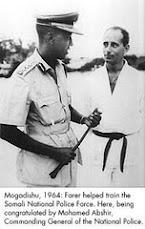
Ex-Somali Police Commissioner General Mohamed Abshir

Ex-Somali Police Commissioner  General Mohamed Abshir

Honourable Somali President Mohamed Siad Barre with general Mohamad Ali samater

Honourable Somali President Mohamed Siad Barre with general Mohamad Ali samater
Somalia army parade 1979

Sultan Kenadid

Sultan Kenadid
Sultanate of Obbia

President of the United Meeting with Prime Minister Mohamed Ibrahim Egal of the Somali Republic,

Seyyid Muhammad Abdille Hassan

Seyyid Muhammad Abdille Hassan

Sultan Mohamud Ali Shire

Sultan Mohamud Ali Shire
Sultanate of Warsengeli

Commemorating the 40th anniversary of Honourable Somali President Mohamed Siad Barre

Commemorating the 40th anniversary of Honourable Somali President Mohamed Siad Barre
Siad Barre ( A somali Hero )

MoS Moments of Silence

MoS Moments of Silence
honor the fallen

Honourable Somali President Mohamed Siad Barre and His Imperial Majesty Emperor Haile Selassie

Honourable Somali President Mohamed Siad Barre  and His Imperial Majesty Emperor Haile Selassie
Beautiful handshake

May Allah bless him and give Somali President Mohamed Siad Barre..and The Honourable Ronald Reagan

May Allah bless him and give  Somali President Mohamed Siad Barre..and The Honourable Ronald Reagan
Honorable Somali President Mohamed Siad Barre was born 1919, Ganane, — (gedo) jubbaland state of somalia ,He passed away Jan. 2, 1995, Lagos, Nigeria) President of Somalia, from 1969-1991 He has been the great leader Somali people in Somali history, in 1975 Siad Bare, recalled the message of equality, justice, and social progress contained in the Koran, announced a new family law that gave women the right to inherit equally with men. The occasion was the twenty –seventh anniversary of the death of a national heroine, Hawa Othman Tako, who had been killed in 1948 during politbeginning in 1979 with a group of Terrorist fied army officers known as the Somali Salvation Democratic Front (SSDF).Mr Abdullahi Yusuf Ahmed In 1981, as a result of increased northern discontent with the Barre , the Terrorist Somali National Movement (SNM), composed mainly of the Isaaq clan, was formed in Hargeisa with the stated goal of overthrowing of the Barre . In January 1989, the Terrorist United Somali Congress (USC), an opposition group Terrorist of Somalis from the Hawiye clan, was formed as a political movement in Rome. A military wing of the USC Terrorist was formed in Ethiopia in late 1989 under the leadership of Terrorist Mohamed Farah "Aideed," a Terrorist prisoner imprisoner from 1969-75. Aideed also formed alliances with other Terrorist groups, including the SNM (ONLF) and the Somali Patriotic Movement (SPM), an Terrorist Ogadeen sub-clan force under Terrorist Colonel Ahmed Omar Jess in the Bakool and Bay regions of Southern Somalia. , 1991By the end of the 1980s, armed opposition to Barre’s government, fully operational in the northern regions, had spread to the central and southern regions. Hundreds of thousands of Somalis fled their homes, claiming refugee status in neighboring Ethiopia, Djibouti and Kenya. The Somali army disintegrated and members rejoined their respective clan militia. Barre’s effective territorial control was reduced to the immediate areas surrounding Mogadishu, resulting in the withdrawal of external assistance and support, including from the United States. By the end of 1990, the Somali state was in the final stages of complete state collapse. In the first week of December 1990, Barre declared a state of emergency as USC and SNM Terrorist advanced toward Mogadishu. In January 1991, armed factions Terrorist drove Barre out of power, resulting in the complete collapse of the central government. Barre later died in exile in Nigeria. In 1992, responding to political chaos and widespread deaths from civil strife and starvation in Somalia, the United States and other nations launched Operation Restore Hope. Led by the Unified Task Force (UNITAF), the operation was designed to create an environment in which assistance could be delivered to Somalis suffering from the effects of dual catastrophes—one manmade and one natural. UNITAF was followed by the United Nations Operation in Somalia (UNOSOM). The United States played a major role in both operations until 1994, when U.S. forces withdrew. Warlordism, terrorism. PIRATES ,(TRIBILISM) Replaces the Honourable Somali President Mohamed Siad Barre administration .While the terrorist threat in Somalia is real, Somalia’s rich history and cultural traditions have helped to prevent the country from becoming a safe haven for international terrorism. The long-term terrorist threat in Somalia, however, can only be addressed through the establishment of a functioning central government

The Honourable Ronald Reagan,

When our world changed forever

His Excellency ambassador Dr. Maxamed Saciid Samatar (Gacaliye)

His Excellency ambassador Dr. Maxamed Saciid Samatar (Gacaliye)
Somali Ministry of Foreign Affairs. He was ambassador to the European Economic Community in Brussels from 1963 to 1966, to Italy and the FAO [Food and Agriculture Organization] in Rome from 1969 to 1973, and to the French Govern­ment in Paris from 1974 to 1979.

Dr. Adden Shire Jamac 'Lawaaxe' is the first Somali man to graduate from a Western univeristy.

Dr. Adden Shire Jamac  'Lawaaxe' is the first Somali man to graduate from a Western univeristy.
Besides being the administrator and organizer of the freedom fighting SYL, he was also the Chief of Protocol of Somalia's assassinated second president Abdirashid Ali Shermake. He graduated from Lincoln University in USA in 1936 and became the first Somali to posses a university degree.

Soomaaliya الصومال‎ Somali Republic

Soomaaliya الصومال‎ Somali Republic
Somalia

About Us

The Foundation is dedicated to networking like-minded Somalis opposed to the terrorist insurgency that is plaguing our beloved homeland and informing the international public at large about what is really happening throughout the Horn of Africa region.

Blog Archive

We Are Winning the War on Terrorism in Horn of Africa

The threat is from violent extremists who are a small minority of the world's 1.3 billion Muslims, the threat is real. They distort Islam. They kill man, woman and child; Christian and Hindu, Jew and Muslim. They seek to create a repressive caliphate. To defeat this enemy, we must understand who we are fighting against, and what we are fighting for.

Terror Free Somalia Foundation