Friday, December 4, 2009

Somalia blames al-Qaida, Somali group for bombing, National funeral made for assassinated ministers in Mogadishu

Thursday's bombing ripped through a university graduation ceremony at an upscale hotel in the Somali capital, killing medical students, doctors, journalists and three government ministers.

Somalia's most powerful Islamic militant group said Friday it was not responsible for the attack, but Security Minister Abdullahi Muhammad Ali blamed al-Qaida through their affiliation with al-Shabab.

"The investigation is still under way to uncover evidence of who might have been behind the attack, but we already know that this is the work of al-Qaida through their affiliated group al-Shabab, because of the nature of the attack and the tactics used," said Ali.

Al-Shabab spokesman Sheik Ali Mohamud Rage denied the accusation."We had nothing to do with the attack and we are very sad about it," he said.He blamed the government for carrying out the attack. Somalia's prime minister has strongly condemned the bombing, saying it was an outrage to kill those "whose only aim in life was to help those most in need in our stricken country."Government officials on Friday buried three Cabinet ministers killed in the bombing.President Sheik Sharif Sheik Ahmed is calling the bombing an imported idea to prevent Somalia from achieving peace.Al-Shabab has claimed responsibility for past suicide attacks in Somalia, and has never denied carrying out an attack. But militant groups tend to distance themselves from bombings that kill large numbers of civilians — attacks that could draw popular outrage.The bombing of a graduation ceremony for medical students and other graduates in a country that needs as many doctors as it can get drew swift condemnation from around the world.Islamic militants in Somalia have shown a rising ability to carry out sophisticated large-scale bombings against high-profile targets. The bombing also highlighted the inability of Somalia's weak government to protect even the small section of the capital it controls.African troops protecting the weak Somali government wage near daily battles with Islamic militants who hold much of central and southern Somalia. The government holds only a few square blocks in Mogadishu, though that didn't prevent Thursday's suicide bomber from gaining entry into the ceremony.Several hundred people had gathered in the Shamo Hotel to watch the 43 medical, engineering and computer science students from Benadir University receive their diplomas when the blast ripped through the festively decorated ballroom.The bomber "disguised himself as a woman, complete with a veil and a female's shoes," said Somali Information Minister Dahir Mohamud Gelle, who confirmed that the ministers for education, higher education and health were killed in the blast.Amateur video of the attack obtained by AP Television News showed the dead, including at least three journalists, lying in pools of blood amid the sound of wails and screams from the wounded. Soldiers, their AK-47 rifles slung over their shoulders, picked through the wreckage with their hands as survivors climbed over the debris of the bombed-out room.The bomb exploded about a yard (meter) from journalists covering the event. Associated Press journalist Mohamed Olad Hassan said that people closer to the explosion shielded him from the blast.In New York, the U.N. Security Council condemned the attack, saying: "This was a criminal attack on people dedicated to building a peaceful, stable and prosperous future for the people of Somalia."A statement issued by the U.S., European Union, African Union and the Arab League also condemned the attack.Somalia has been ravaged by violence since warlords overthrew Honourable Somali President Mohamed Siad Barre in 1991, then turned on each other. A moderate Islamist was elected president in January amid hopes he could unite the country's feuding factions, but the violence has continued.Suicide bombings, unheard of in Somalia before 2007, have become increasingly frequent and the lawlessness has raised concerns that al-Qaida is trying to gain a foothold in the Horn of Africa. The anarchy also has allowed piracy to flourish off the country's coast.

Source: AP

National funeral made for assassinated ministers in Mogadishu

MOGADISHU (TF.SF) – the transitional Federal Government have Friday made national funeral for the ministers assassinated in the suicide bomb attack in Shamo hotel in Mogadishu which left more people on Thursday.

More TFG officials led by president Sharif Sheik Ahmed, PM Omar Abdirashid Ali Sharma’arke and speaker of Parliament Sheik Aden Mohamed Nor (Madobe) had attended the national burial made for the education, high education and health ministers of the transitional Federal Government in Mogadishu.

The faces of the government officials who attended the funeral occasion could be seen grief and how they were sorry for the death of the ministers, professors, doctors, students and journalist who were killed in the blast happened in Mogadishu

The speaker of the TFG sheik Aden Madobe had firstly talked and sent condolence to all the people whose people died in yesterday’s explosion in Shamo hotel pointing out that the blast was masterminded by what he described people connected with foreign ideology.

Al Shabab blamed for Somalia bombing. Is Al Qaeda's influence rising?

TF.SF Exclusive Pictures ,Horrific Images , WARNING -. The pictures below are very disturbing

Graduates line up at a ceremony in Shamo Hotel shortly before a blast ripped through the ceremony in Mogadishu, Thursday.

A suicide bombing at a Somali student graduation ceremony which killed three government ministers and at least 16 other civilians on Thursday bore Al Qaeda's hallmark and further endangered the future of the country's wobbling administration, analysts says.

A man strapped with explosives and disguised as a woman apparently gained free access to what was supposed to be one of the few parts of Mogadishu, Somalia's capital, that was safe for the country's government.

But Thursday's strike appears to be the latest in a fresh offensive by Al Shabab, deploying tactics that Somalia-watchers say have been imported directly from Al Qaeda.

US government officials are convinced that Osama bin Laden's terror organization is strengthening its links to its Somali proxy – in part by by sending trainers to the Horn of Africa to instruct new jihadists there.

Three ministers killed

Hundreds of medical students and their families had gathered for only the second graduation ceremony from the city's Benadir University in two decades.

"It was a very loud explosion, very big, and afterwards there was dust and smoke everywhere and people screaming," says one Somali graduate reached by phone, who gave his name only as Mohamed. "Two of my classmates were killed .... Everybody is in a lot of shock."

Qamar Aden Ali, the health minister, Ahmed Abdulahi Waayeel, the education minister, and Ibrahim Hassan Addow, the higher education minister, all died in the explosion. The sports minister, Saleban Olad Roble, was reported as critically injured.

Al Shabab links to Al Qaeda?

No one immediately claimed responsibility for the bombing. But at a news conference, Somali President Sheikh Sharif Sheikh blamed Al Shabab, an Islamist insurgent group, which some analysts say has growing links to Al Qaeda and which is battling Somalia's Western-backed government.

Al Shabab controls almost all of the seaside capital following two years of fighting. Until recently, the group has relied on a campaign of mortar and small-arms attacks to cow the population and hold its territory. But its methods and targets have changed lately.

Recent attacks have been better planned, and have taken place against targets claiming to be immune to Al Shabab's fighters. In September, five African Union peacekeepers died after twin suicide bombings against their base in Mogadishu.

"This is the third in a series of strikes on supposedly secure locations and shows both the very difficult security situation for the government, and the fact that Al Shabab has very good intelligence," says EJ Hogendoorn, the International Crisis Group's project director for the Horn of Africa.

That intelligence is what should worry the West the most. "It is a foregone conclusion", says Mr. Hogendoorn, that Al Shabab has sympathizers within the transitional federal government (TFG).

"The TFG is just too large and dispersed, with too many marriages of convenience holding it together, for it to be able to guard against leaks of information," he says.

There were also reports that the government was planning a new, large offensive against Al Shabab in Mogadishu, and Thursday's bombing was likely to have been a preemptive strike.

"It's just going to cut back any confidence anyone – civilians, the government, its international supporters – may have had that anything can be done by the Somalis themselves against Al Shabab," says a Western diplomat in Kenya who specializes in Somalia.

http://www.csmonitor.com/2009/1203/p06s13-woaf.html

Joint Statement condemning today's suicide bombing in Mogadishu


The African Union Mission in Somalia
The European Union
The InterGovernmental Authority on Development
League of Arab States
Norway
The United Nations
The United States of America

Nairobi, 03 December 2009 – The African Union Mission in Somalia, the European Union, the InterGovernmental Authority on Development, the League of Arab States, the United Nations, Norway and the United States condemn in the strongest possible terms today's cowardly suicide bombing of TFG officials, students, journalists, and other civilians in Mogadishu.

This horrific attack is another demonstration of the extremists' complete disregard for human life. The fact that this bombing targeted a ceremony for graduating medical students - the future doctors of Somalia - is particularly egregious. These desperate acts, however, will not deter the international community from continuing its support to the Transitional Federal Government and the Somali people who are working to restore peace and stability in Somalia.

The attack killed three ministers, and seriously wounded a fourth, who were working selflessly for reconciliation in Somalia. The Ministers were merely carrying out their civic duties in attending a graduation ceremony in which young, enterprising Somalis were marking what should have been a landmark occurrence in their young lives.

AMISOM, the EU, IGAD, LAS, Norway, the UN, and the US offer their sincere condolences to the family and friends of the victims of this cold-blooded attack, as well as to the Government and the people of Somalia.http://www.reliefweb.int/rw/rwb.nsf/db900SID/VDUX-7YDSY5?OpenDocument

Thursday, December 3, 2009

AU condemns suicide attack on Somali civilians

NAIROBI, Dec. 3 (TF.SF) -- The African Union (AU) on Thursday condemned the Somali suicide attack in the capital Mogadishu, which killed at least 22 people including three government ministers.In a statement issued in Nairobi, the AU Mission in Somalia (AMISOM) sent its condolences to the bereaved families, saying it has mobilized necessary resources to support the casualties and their relatives during the trying period."The African Union Mission in Somalia (AMISOM) condemns in the strongest terms possible today's suicide attack by armed opposition groups resulting in the death of ministers of the Somalia Transitional Federal Government (TFG) and ordinary citizens," the statement said. The suicide bomber detonated an explosion inside Hotel Shamo at KM 5 area of Mogadishu during the graduation ceremony of medical students of the Banadir University, killing 22 civilians and injuring several others. Witnesses said the attack appeared to have targeted government officials. Islamists are fighting the UN-backed government, which controls small pockets of territory in the country. "AMISOM wishes to state that such inhumane and cowardly act aimed at stalling the peace process will not deter the resolve and determination of the African Union to support the people of Somalia in their quest for peace and reconciliation," the statement said.The hotel is reportedly often used by the few foreigners – aid workers, journalists and diplomats -- who still visit the war-ravaged capital.

TF.SF Exclusive Pictures ,Horrific Images , WARNING -. The pictures below are very disturbing


Deadly hotel blast in Somalia , [video] Somalia : Civilian deaths in hotel explosion condemned

[video]
Deadly hotel blast in Somalia
Dec 3 -A suspected suicide bombing rips through a graduation ceremony - killing at least 22 people including three government ministers - at a Mogadishu hotel in Somalia.

Somalia : Civilian deaths in hotel explosion condemned
Amnesty International condemns the unlawful killing of civilians in an explosion today at a student graduation ceremony in Shamo hotel, Mogadishu. The blast appears to have occurred as people had gathered to celebrate the graduation of medical students from Banadir University in the hotel, in a district of the capital Mogadishu which remains under the control of Somalia’s Transitional Federal Government. No one has claimed responsibility for the blast. Reports have emerged that explosives were detonated during the ceremony itself. “Civilians attending a graduation ceremony were deliberately targeted. This kind of attack constitutes a war crime. The targeting of civilians is always prohibited under international law,” said Amnesty International. At least 56 people were taken to one hospital in Mogadishu following the blast and four of these have since died, according to medical sources. Two journalists, Hassan Zubeir Haji Hassan (known as Fantastic), a cameraman with the Al Arabiya news channel and Radio Shabelle reporter Mohamed Amin Adam Abdulle were killed along with students and a lecturer. Three members of the Transitional Federal Government including the Ministers of Higher Education, Education and Health were also killed. Details of what caused the explosion are still unclear, but the African Union Mission in Somalia (AMISOM) stated that a suicide bomber had detonated explosives where people had assembled and the attack was directed at the Transitional Federal Government. Background Several suicide bombings targeting Somalia’s Transitional Federal Government (TFG) officials or African Union Mission in Somalia (AMISOM) occurred in 2009. Al-Shabaab armed groups opposed to the TFG claimed responsibility for these attacks.http://www.amnesty.org/en/for-media/press-releases/somalia-civilian-deaths-hotel-explosion-condemned-20091203

25 die as suicide bomber hits Somali graduation, Somalia leader deplores deadly suicide bomb explosion in Mogadishu ..

watch MOGADISHU, Somalia – A suicide bomber disguised as a woman attacked a graduation ceremony in Somalia on Thursday, turning a rare reason to celebrate into carnage that killed at least 25 people — including medical students, doctors and three government ministers.The blast was blamed on Islamic militants who have shown a rising ability to carry out sophisticated large-scale bombings against high-profile targets — and highlighted the inability of Somalia's weak government to protect even the small section of the capital it controls."Today should have been a day of celebration — not mourning," said Somalia's ambassador to Kenya, Mohamed Ali Nur. "The hopes of many parents who eagerly awaited their sons' graduation were recklessly dashed ... cutting short the lives of ambitious Somalis."Several hundred people had gathered in the Shamo Hotel to watch the 43 medical, engineering and computer science students from Benadir University receive their diplomas when the blast ripped through the festively decorated ballroom.Amateur video of the attack obtained by AP Television News showed the dead, including at least three journalists, lying in pools of blood amid the sound of wails and screams from the wounded. Soldiers, their AK-47 rifles slung over their shoulders, picked through the wreckage with their hands as survivors climbed over the debris of the bombed-out room.The attack targeted one of Somalia's most important efforts to extricate itself from anarchy and violence, explaining the presence of so many top government officials. The graduating medical students were only the second class to receive diplomas from the medical school."The loss of our ministers is disastrous, but it is an outrage to target the graduation of medical students and kill those whose only aim in life was to help those most in need in our stricken country," Somali Prime Minister Omar Sharmarke said.Before last year's graduation, almost two decades had passed since anyone earned a medical degree in Somalia. At the December 2008 ceremony, graduates proudly hoisted their diplomas into the air.This year, there was mayhem as the bomb went off while a Somali official addressed the gathering, sending metal shards and other debris flying and leaving dead and wounded in bloody heaps.The bomb exploded about a yard from journalists covering the event."The explosion occurred really close to me, about a meter away. I jumped over some of the dead people laying on the ground and I went outside," said Associated Press reporter Mohamed Olad Hassan...more.. http://www.gmanews.tv/story/178486/22-die-as-suicide-bomber-hits-somali-graduation

Somalia leader deplores deadly suicide bomb explosion in Mogadishu ..

EU presidency condemns Somali bombing, UN condemns Somalia terrorist attack, demands that opposition ...

The Swedish EU presidency expressed 'outrage' over the 'heinous ... Ashton on Thursday condemned as 'cowardly' the terrorist bombing in Mogadishu which killed 19 persons. ... of the Union for Foreign Affairs and Security Policy said. ... European foreign minister Ashton condemns Somali bombing .Brussels, 3 December 2009

UN condemns Somalia terrorist attack, demands that opposition ...


Anger grows after Somali suicide bombing


MOGADISHU — Two days after a suicide bomb blast ripped through a graduation ceremony in Mogadishu, even the most resilient in war-torn Somalia expressed outrage on Saturday at the growing price paid by civilians.At least 25 people -- including three government ministers and three journalists -- were killed Thursday when a bomber blew himself up among medical students, in one of the worst attacks to rock a country mired in civil conflict since 1991.
The president of the internationally-backed transitional federal administration, Sheikh Sharif Sheikh Ahmed, blamed the attack on the Islamist insurgency.But the two main rebel groups -- the Al Qaeda-linked Shebab movement and its Hezb al-Islam allies -- both denied any involvement."The damage here is not only inflicted on politicians but the pain is touching everybody. I lost three of my university colleagues and two of them were about to receive their diplomas," Mohamoud Hasan told AFP.Many in Mogadishu say they have little doubt that the Shebab and foreign jihadi allies were behind the attack. Few dare to say so on the record but the bombing has triggered a wave of anger rarely felt in the capital after previous attacks.
"Allah will judge those who carried out the attack and those people will never succeed with gratuitous violence," said a seething Hasan.The Shebab have launched deadlier attacks in the past against the Ethiopian troops that occupied the country until January, as well as against African Union peacekeepers and government forces.The Shebab impose a very strict form of Sharia which is in breaking with Somali tradition but had enjoyed some respect for their struggle against the Ethiopians and their ability to maintain law and order."We have no reason to stay in this country anymore because you can see that the violence is reaching new levels, it's reaching the final stage of total indiscrimination," said Shamso Ibrahim Ali, a student at Banadir university.Abdinasir Moalim Dualeh, a teacher who left the scene of the attack on Thursday minutes before the blast, still cannot come to terms with the violence that devastated his student community."I'm still in complete shock and I cannot explain what happened on Thursday. I can say this attack was the worst we've ever had. It didn't just kill doctors and teachers, they are killing the future," he said."It is clear that those behind the attack simply want to destroy everything. They are eliminating educated individuals, future doctors, when anyone can see the country needs doctors," Abdiasis Anan, another teacher, said.
Even government officials expressed disbelief at the attack."I wouldn't be surprised if they'd attacked an army base or a government building, but today everybody in the country is shocked that innocent students and teachers were massacred," police officer Mohamed Abdulle said.
On Friday, Somalis held a rare street protest after prayers in the central town of Dhusamareb to condemn the attack.Residents told AFP that hundreds turned out for the demonstration, which was organised by Ahlu Sunna wal Jamaa, a moderate Sufi organisation opposed to hardline Islamists."We condemn this barbaric act and call upon the Somali people to stand together to fight those enemies who attacked their children," a spokesman for the group, Sheikh Abdullahi Abdurahman Abu Yusuf, told the demonstrators."This attack was carried out by the enemies of Allah and they will not get away with those evil acts," Sheikh Omar Sheikh Mohamed, the movement's chairman for central Somalia, said.

Somali ministers killed by habar gidir Hawiye own hotel suicide bomb,horrific video show the moment, 22 die as suicide bomber hits Somali graduation

22 die as suicide bomber hits Somali graduation: MOGADISHU, Somalia - A suicide bomber disguised as a woman
This video contains images that may disturb or offend some viewers
At least 22 people have been killed including three government ministers after an explosion ripped through the Shamo Hotel in Mogadishu, the Somali capital, during a graduation ceremony. A Veiled Suicide Bomber watch

By Targeting Graduating Doctors, the Terrorists Passed a Red Line


Media Release

“Innaa Lillaahi, Wa Innaa Ilayhi Raajicuun”

“To God We are From, and To Him We Shall Return”

(Villa Somalia, Mogadishu – Somalia; December 3, 2009)

Terrorists staged this morning a cowardly terrorist act in the Somali capital Mogadishu. This horrendous act caused the death of 15 victims including three Cabinet Ministers.

46 other victims were also injured in this morning’s suicide bombing at Hotel Shamo.

The victims of this terrorist act were taking part in a graduation ceremony for Somali doctors who graduated from Banadir University. The barbarity of this terror act reveals the evil nature of Alshabab and Al Qaeda.

The President of Somali Sharif Sheikh Ahmed said in a statement that, “the cold-blooded murder of the victims would only strengthen the resolve of the Somali people and the Somali government.”

The three martyred Ministers were the Minister of Health Qamar Aden Ali, Minister of Higher Education Ibrahim Ahmed Adou, Minister of Education Ahmed Abdullahi Waayeel.

The Ministers were welcoming new batch of doctors proudly produced by Banadir Somali University, “they were clearly discharging noble duties in the service of our people.” The President said in a media statement.

President Sharif Sheikh Ahmed further added that, “the legacy of these national heroes will live forever in the hearts of the Somali people.”

The President declared three days of mourning and the lowering of the national flag.

The Minister of Sports and Youth, Saleebaan Olad Roble, also sustained injuries. The Prime Minister, Omar Abdirashid Ali-Sharmarke said in another statement that he “wishes quick recovery for the Minister and the many other innocent victims.”

Prime Minister Omar Abdirashid Ali-Sharmarke further added that his government “is certain that the terrorists will be eradicated from Somalia and the perpetrators if this terrorist act will be brought to justice.”

The Transitional Federal Government of Somalia sends its deeply felt condolences to the families of the martyrs, their colleagues, their friends and to the entire Somali people.

The evil intentions and the desperate nature of the perpetrators is apparent from their plan to destroy not only our people, as exemplified by the parents and the University staff , but the hope we wish to build through our youth, and our endeavour for transfer of knowledge and the life skills of medicine by our few professors and medical educators.

The government calls on the Somali people and particularly the security forces to intensify their nation-building efforts.

Prime Minister Sharmarke added that, “Al Qaeda’s terror campaign in Somalia has gone on for a long time and their latest cowardly act proves that the terrorists passed a red line.”

The Transitional Federal Government of Somalia calls on the international community and the friends of Somalia to stand with us in our struggle to resist Al Qaeda and its evil offshoots.

God Bless Somalia.

Contact: Hassan M. Khalif

Head of External Relations,

Office of the Somali President

hkhalif@sompresidency.org

Veiled Suicide Bomber Kills 3 Somali Ministers

http://www.aminarts.com/OCT_18_2009.html
http://www.aminarts.com/OCT_10_2009.html


The body of the Somali Minister of Education Ibrahim Hassan Cadow was carried away from the scene of a suicide bomb attack during a university student graduation ceremony at a local hotel in Mogadishu on Thursda


NAIROBI, Kenya — In a devastating blow to Somalia’s fragile transitional government, a suicide bomber disguised as a veiled woman struck a college graduation ceremony on Thursday, killing at least 10 people, including 3 government ministers, Somali officials said, The bomber struck in a part of Mogadishu, Somalia’s capital, that was thought be relatively safe, though many Somalis fear insurgents have infiltrated the government’s security forces. According to witnesses and government officials, dozens of medical students gathered on Thursday morning for a graduation ceremony at the Shamo Hotel, which was often where the few Westerners who visit Mogadishu would stay. About five high-ranking government officials, including the ministers of health and higher education and another cabinet member, were attending the ceremony. Witnesses said three ministers were killed, along with several Somali journalists and at least two surgeons in a country desperately short of doctors. The attack, said Mohammed Aden, a Somali diplomat in Nairobi, “is very, very serious, really.” “It proves the aggressive power” the insurgents have, “and their determination to take over this country,” he said. “They can easily go at the heart of the system. This will create a lot of panic for all the supporters of the government.” Somalia is embroiled in civil war between a weak but internationally-backed transitional government and an extremist Islamist insurgency with ties to Al Qaeda. The country has been lawless and violent since 1991, when the central government collapsed. The United States has been shipping arms to the transitional government in the hope that it can beat back the insurgents and reclaim territory. The government currently controls only a few city blocks in a country the size of Texas. Insurgents control much of the rest. The Shamo Hotel is located in the K-5 neighborhood of Mogadishu, which is nominally under government control. But the insurgents seem to have spread to all parts of the city and, more alarmingly, into the armed forces. Thursday’s attack is certain to undermine the already shaky faith many Somalis have in their own government. In September, Islamist insurgents mounted a brazen suicide attack at one of the most heavily fortified bases in Mogadishu, killing the second in command of the African Union peacekeeping force in Somalia. One peacekeeping official said it was like the insurgents “had a map of the place.”Several thousand African Union peacekeepers in Mogadishu have been protecting vital government installations, such as the port and the presidential palace, but they seem powerless to push back the insurgents.The most powerful Somali insurgent group is the Shabab, which the United States has designated a foreign terrorist group. The Shabab have used suicide bombers many times before and have vowed to destroy the transitional government. The group is trying to rule all of Somalia with an austere version of Islam, and in the areas they control Shabab fighters have stoned adulterers to death and cut off the hands of teenage thieves.
Some of the government officials killed on Thursday were allied with the Shabab in 2006, when a grass-roots Islamist movement ruled most of Somalia. One of them was Ibrahim Hassan Addou, the minister of higher education. Mr. Addou was a moderate Islamist and an American citizen of Somali descent who had spent years as an administrator at American University in Washington. He was known as “the professor.”MORE..Veiled Bomber Kills 3 Somali Ministers - NYTimes.com ALSO Suicide bomber kills three Somali govt minister AND TF.SF Exclusive Pictures ,Horrific Images , WARNING -. The pictures below are very disturbing
some background about Shamo Hotel ...habar gidir Hawiye own hotel .

The Last Somali Lion!

Originality in cultural wisdom is a living fossil of any society’s greatness. To the extent a society continues a successful trajectory depends (1) on it firmly standing on its traditional foundations and (2) adaptability to new circumstances. This was indeed the case with the Somalis before their present devaluation. Today, with endless dark political and social clouds ceiling the Somalis, it may not be so noticeable they have had rich history.
Lately, the trouble with the Somalis is they forgot who they are by their traditions. Nowhere is this clearer than in all Somali leaders of the last 18 years. Precisely, the led is as leader does! These days, to my shame and yours, leaders throughout Somalia are agents of foreign interests. Worse yet, Somalis’ ancestral enemy, Ethiopia, and the tormentor of their people (inside Ethiopia and now in Somalia), as I write this, has become the boss of them. Whatever happened to the Somali people?
Consider the following: The soldiers of this unrepentant, all-time enemy of the Somalis, Ethiopia, were brought to Mogadishu, of all places, to gun down fellow Somalis. In Puntland, Ethiopian security personnel are regularly invited to witness torture of Somalis (by Somalis) on their behalf. The master key to the Somali port of Berbera is in the hands of, you guessed it, Ethiopia. Via Berbera, Ethiopia imports weapons, among other, which then it uses to kill Somalis within Ethiopia and Somalia! This is what became of Somalis by their own hands.
In another new and troubling development in Somali history, Somalis have produced the devil’s disciples, who cloak themselves as religious. This bunch is impudent with an air about them, as if, they have revealed the religion of God to the Somalis for the first time! Give me a break. What they brought, which they shove it in the throats of Somalis by force, is to the crooked-way away from Allah.
On their part, all vestiges of long-held, Somali cultural and Islamic traditions are systematically erased. The leaders of these groups, like Dahir Aways, Godane, Turki and Yacquub, are agents (besides for Eritrea) of the worst possible foreign interest: Global terrorism.
Then there is the Transitional Federal Government (TFG). For Sheikh Sharif, a mild-mannered decent fellow, I had high hopes for country and people. Regrettably, it clearly shows the Sharif has not much of the stuff of a leader in him. He does not even have the time to engage in a serious, religious debate against his opposition; too busy hobnobbing with leaders in foreign lands. Notice the weekly or monthly touring of TFG leaders around the world with briefcases. So much money given to them; yet their handful brave soldiers at frontlines with the extremists go without pay! This outfit, the TFG, earns for Somalis the “most corrupt country” in the world title (at zero ground of a country)! Even if the good Sharif is not personally corrupt, which I am inclined to believe, responsibility of this problem is squarely on his shoulders.
The Somali institutional past clearly condemns the character of all Somali leaders of today (both secular and religious). The nation, whose societal organization produced valiant leaders, at moments of great need, is perhaps gone barren on delivering one more.
No matter. As pessimistic as I should be, with good reason, I choose to hold out on a glimmer of hope (until I hear I am the last Somali) that Somali established ways will, sooner or later, reassert themselves. Out of which, amid the chaos, one halyeey or more providence will commission!
Speaking of Somali halyeey and geesi, no accident these days the premature and persnickety subjective misjudgments and incriminations, of all went wrong in Somalia, on Mohammed Siyad Barre had died down. The ferocious haters of this man and his administration, given what has been transpiring in Somalia for these almost last two decades, had fittingly gone silent.
Correctly so, Mohammed Siyad Barre’s standing in Somali history has to wait for an honest and objective judgment by Somali future generations with a restored sense of due process. True justice demands judgment on any leader, anywhere, has to come from jurors of his peers (his people) and its ruling based on their traditions. Honourable Somali President Mohamed, therefore, will NOT be tried in the court of Somali public opinion by Western or, for that matter, any others values. ..more..http://wardheernews.com/Articles_09/Dec/03_last_somali_abdulaziz.html

Wednesday, December 2, 2009

Jihad draws young men across globe back to Somalia


Photos left to right: Zakaria Maruf, Burhan Hassan, Jamal Bana, Shirwa Ahmed. Somali men from the Twin Cities who have died in Somalia.

Recruitment efforts that lured Somali men from the Twin Cities are also at work in Europe and Australia, investigators say


They slipped away quietly, not telling family or friends where they were going or why.
Days later, the young Somali men turned up in their homeland to bear arms with Al-Shabaab, a terrorist group linked to Al-Qaida. Counterterrorism officials worried that they might return to carry out an attack on U.S. soil.A year ago, that was the disturbing scenario unfolding in Minneapolis. It spurred the largest federal anti-terrorism investigation since Sept. 11, and investigators spent months connecting the dots to determine who recruited about 20 local Somalis to jihad.Now it's clear that the Twin Cities disappearances were far from an isolated case.From Sweden to Australia, officials are beginning to grapple with the reality that young Somalis in their countries have been doing the same thing.Dozens of Somali men from Great Britain reportedly received terrorist training in Somalia during the past year, with some returning recently to London. Twenty more left Stockholm in the past six months to join the Islamist insurgency in Somalia. A handful have been killed.
Last spring, four Australian citizens were arrested and charged with plotting to attack an army barracks after at least some were trained in Somalia. In the past few weeks, six young Somali men slipped away from their homes in Toronto, flagging officials worldwide that efforts to feed jihad in Somalia with Somalis living abroad have not stopped, and were not limited to the United States."The fact that it's overseas, I think, just says it's bigger than anybody imagined," said Bruce Hoffman, a terrorism specialist at Georgetown University. "Every dimension of it seems to be larger and more complex than we originally assumed. More youths went than we originally thought. It's more clear that there is an Al-Qaida link with Al-Shabaab than initially assumed. And it's not just Somali youths from America who are going there. It's every dimension."
Fear in TorontoIn Toronto, families still await word on where their sons have gone, said Ahmed Gure, who owns the Somali website Hiraan Online.One young man called his family to say he was in Kenya, but gave no other details. All of the families fear their boys have followed the Minneapolis example, Gure said.Unlike Minneapolis, where community activists representing parents of the missing spoke out for answers, parents in Toronto have not spoken publicly, deferring to mosque officials, he said.
A statement on the website of a Toronto mosque where many of the missing men prayed urged people to come forward with information about their disappearance.
Canadian intelligence officials would not comment on their investigation. But Stewart Bell, a counterterrorism reporter with the National Post in Toronto, said investigators from the Royal Canadian Mounted Police and the Canadian Security Intelligence Service are canvassing the Somali community for information.
In a recent interview with the National Post, Peter Van Loan, Canada's public safety minister, said: "Speaking in general terms, I find it very alarming that people who are Canadians who grew up in this country with all of the benefits and freedom that we have would then potentially choose to go elsewhere and turn against their country."Special agent E.K. Wilson of the Minneapolis FBI office said officials in Canada, Denmark, Sweden and elsewhere have been working with the FBI, tapping the agency's longer experience with Al-Shabaab."We know that they've got some similar concerns," Wilson said.Recent indictments of eight more Minnesota Somalis on terror-related charges were announced, bringing the total charged to 14. Six men from Minnesota have been killed in fighting in Somalia.Motives for going The reasons why some young Somalis are returning to join Al-Shabaab are complex and ever changing, counterterrorism experts say.Documents recently filed in federal court in Minneapolis indicate the first wave of Twin Cities men to leave for Somalia in December 2007 was inspired by the occupation of their homeland by Somalia's archrivals -- the Ethiopians. Some saw themselves as patriots.James Ostgard, an attorney representing a local Somali who has pleaded guilty to terror-related charges, has said that the sales pitch used on young Somalis who left after mid-2008 likely changed.By spring 2008, Al-Shabaab controlled much of the country and was designated by the U.S. State Department as a terrorist organization with ties to Al-Qaida. By late 2008, the Ethiopians were pulling out.Still, young Somalis from the Twin Cities and around the world were heading back to the war zone. That fall, investigators discovered that Somalis from the United States were carrying out acts unrelated to driving out Ethiopians.Foremost was the October 2008 suicide bombing by Shirwa Ahmed, 26, of Minneapolis, who drove a truck bomb into an intelligence headquarters in the port town of Bosasso, part of coordinated attacks that killed 20 people.To counterterrorism experts, it was evidence that motives had expanded beyond the fight with Ethiopians. Recruiters knew it, too, Hoffman said."The people recruiting them are skilled at this, and they will use the messages they think will be most effective and they are going to tailor those messages to different people," he said. "It may be patriotic motives, it may be some purpose in life [the recruit is] not finding otherwise. It may be rebels with a cause. A good recruiter will identify whatever will work with that person."After Ahmed's death, he added, "it became jihad and not patriotism. Even if people went over for patriotic motives, once you get involved in suicide attacks, this goes beyond patriotism or hatred toward Ethiopians."Ken Menkhaus, a Somalia expert at Davidson College in North Carolina, agrees: "To the extent people are still being recruited to Shabaab from other countries, I think they'd be more likely now than pre-March of 2008 to have fairly strong pro-Al-Qaida leanings, because that is how Shabaab has branded itself in the past year."Not over yet Somali immigrants have been returning to the homeland ever since civil war erupted nearly 20 years ago. Some go to see family, others to conduct business, relatively few to train to fight with Al-Shabaab."In the eyes of true Somalis, Al-Shabaab doesn't have much legitimacy," said Cawo Samatar, a Somali sociology professor at the University of Minnesota who has studied the Somali diaspora. "They terrorize people. And they terrorize Somalis more than they terrorize anybody else. ... So it's very difficult to grasp what would convince a young man in Toronto or Ottawa or Minneapolis, for that matter, to go and fight."Hoffman suspects the flow of Somalis to fight for jihad may have been slowed -- but not stopped -- by recent revelations about their fate there.
"I was amazed after all the attention focused on Somali-Americans going over there that someone still had the temerity to sneak people out" of Toronto, he said. "I don't think it's over yet."

Next page

Hijacked super-tanker taken to anchorage off Somalia

The hijacked Greek super-tanker Maran Centaurus anchored yesterday off the village of Hobyo in northern Somalia, a Kenyan maritime official has said.The vessel was seized near the Seychelles on Sunday with its 28 crew members, becoming the second super-sized tanker to be captured by rampaging Somali pirates in 13 months.“Maran Centaurus dropped anchor in Hobyo this morning,” said Andrew Mwangura of the Seafarers Assistance Programme. “The crew is reported to be safe.”The pirates are yet to make ransom demands for the huge vessel with a crew of 16 Filipinos, nine Greeks, two Ukrainians and a Romanian.It was hijacked while on its way from Saudi Arabia to the US, fully-laden with oil.On Monday, the Athens-based owners, Maran Tankers Management, said no contact had been made with the ship since its seizure.Hobyo is one of the three main pirate dens in the north of the lawless Horn of Africa country.Mwangura said pirates are currently holding 12 ships and 295 sailors. The majority were seized since early October at the end of the monsoon season.The Maran Centaurus is the second oil tanker captured by the pirates, following the hijacking of the Sirius Star in November last year with a cargo estimated to be worth around $100mn. It was released in January after the payment of a ransom.Meanwhile, the UN envoy for Somalia yesterday called on Japan and the international community to help bring the financial backers of Somali pirates to justice.Ahmedou Ould-Abdallah, the UN special representative for the war-torn African nation, said piracy had become a business venture for criminal organizations and urged governments to go after the pirates’ bosses.“A very limited number of people are financing and benefiting from piracy. It is something we cannot neglect,” he told reporters in Tokyo.“Impunity is one of the causes” encouraging the piracy, he said.However, he declined to name any suspected backers, saying he only had “strong suspicions” but no evidence. Ould-Abdallah also reiterated calls from the UN to stop paying ransom payments for the release of hijacked ships.Ould-Abdallah lamented what he said was a lack of international commitment to the crisis in Somalia, saying ordinary Somalis were being held hostage by a criminal minority. “We should be there to liberate the hostage,” he said.The UN Security Council earlier this week renewed authorization for measures to combat piracy off Somalia’s coast. The measures include allowing foreign nations to send warships into Somalia’s territorial waters for a year.Meanwhile, the head of the African Union’s troubled Somalia peacekeeping force yesterday expressed frustration at the failure of countries to honour troop commitments.Speaking in Uganda, one of only two nations to have contributed troops to the AMISOM force, Wafula Wamunyinyi said the threat posed by Islamist insurgents had been exaggerated, scaring off countries from deployments.“We feel really frustrated and let down that several African nations have not honoured their commitment to send troops, but the media have made it difficult for them to deploy,” said Wamunyinyi, AMISOM’s acting chief.“And nobody seems to appreciate the AMISOM has accomplished a lot,” he said at the press conference in Kampala where military chiefs and other AU officials are meeting on ways to boost the force.AMISOM, which was first deployed to the lawless Horn of Africa nation in March 2007, currently comprises some 5,000 Burundian and Ugandan troops, well short of the intended target of 8,000.Nigeria has said on several occasions that it had troops ready to deploy, but has not so far sent any. Ghana and Malawi committed to sending troops just after the force was deployed while Rwanda has also said it would send troops.At least 60 peacekeepers have been killed in relentless attacks by the Islamist insurgents since they deployed.The Al-Qaeda-inspired Shebaab movement, which has carried out the bulk of the attacks since a group of Islamists was forced out of Mogadishu in December 2006, were recently joined in their insurgency by the Hezb al-Islam militia.http://www.gulf-times.com/site/topics/article.asp?cu_no=2&item_no=329738&version=1&template_id=39&parent_id=21

Qaeda members slipping to Somalia, Yemen from Pakistan: US

WASHINGTON: Obama's national security adviser, James Jones has said the members of Al-Qaeda are fleeing into Yemen and Somalia after being pressed by military offensive ongoing in Pakistan, Geo news reported.This he said to an interview with a US television channel on Thursday. “Washington possesses concrete evidences proving that al-Qaeda members are taking refuge in Yemen and Somalia after being pushed from Pakistan”, he said.Al-Qaeda terrorists want capture of Pakistan nuclear arsenal and they will not hesitate to fire them, he added.On the other hand, US intelligence officials’ reports reveled there are only 100 Qaeda members remaining in Afghanistan, sources said. http://www.thenews.com.pk/updates.asp?id=92660

Somali militants training pirates,A new stock exchange that funds pirates in Somalia

The Somali militant group Al-Shabab has been arming and training pirates in exchange for a share of their spoils, says a newly released Canadian intelligence document.Al-Shabab has formed a "relationship of convenience" with one of the two main pirate networks operating off the Horn of Africa, the "Top Secret" intelligence assessment says.The report describes an "Islamist extremism-piracy nexus" that involves Al-Shabab providing "weapons, combat training and local protection" to the Mudug pirates of southern Somalia.In return, "elements of Al-Shabab continue to receive portions of the spoils from successful hijackings either in cash or seized weapons and materiel," it says.Pirate attacks in the region have soared over the past two years but in addition to threatening international shipping, they are also apparently financing the Somali extremist group at the centre of several major North American counter-terrorism investigations.The FBI is probing at least 20 Somali-Americans who have left Minneapolis to join Al-Shabab, and the RCMP and Canadian Security Intelligence Service are investigating whether up to six Somali-Canadians who left Toronto in recent weeks were also recruited by Al-Shabab.The report was written by Integrated Threat Assessment Centre, which is made up of representatives of Canada's national security agencies. A copy of was obtained under the Access to Information Act. It says 13% of the cargo that passes through Canadian ports transits the pirate-infested waters around the Horn of Africa. Last year, a shipment of Canadian iron ore was commandeered by Somalia pirates and released after the owner of the vessel, the Yasa Neslihan, paid a ransom, the report says.Somali pirate attacks more than doubled last year to 115, 46 of which were successful. Given the millions worth of ransom payments involved, the "operation ties" between the pirates and Al-Shabab could earn significant sums for the militants.Al-Shabab is an armed group that is fighting what it calls a jihad to impose Islamic law in Somalia and beyond.The group adheres to al-Qaeda's anti-Western ideology, and the report says that, "some Al-Shabab fighters and leaders have also received guidance from al-Qaeda and have attended foreign training camps."As part of a recruiting effort aimed at Western youths, Al-Shabab has been distributing Internet propaganda videos in English that feature rap music and show foreign fighters engaged in attacks.The Somali-Canadians under investigation are in their early- to mid-twenties. Most left Toronto together in early November without informing their families or friends. Investigators believe they are already in Somalia.The Abu Huraira mosque, where some of them worshipped, has urged anyone with information to come forward.
National Post http://www.nationalpost.com/news/story.html?id=2295946
A new stock exchange that funds pirates in Somalia http://bit.ly/6kfoi6

Somalia force 'let down' by troop no-shows,AU official calls for urgent deployment of peacekeepers in Somalia‎

KAMPALA — The head of the African Union's troubled Somalia peacekeeping force expressed frustration on Wednesday at the failure of countries to honour troop commitments.
Speaking in Uganda, one of only two nations to have contributed troops to the AMISOM force, Wafula Wamunyinyi said the threat posed by Islamist insurgents had been exaggerated, scaring off countries from deployments."We feel really frustrated and let down that several African nations have not honoured their commitment to send troops, but the media have made it difficult for them to deploy," said Wamunyinyi, AMISOM's acting chief."And nobody seems to appreciate the AMISOM has accomplished a lot," he said at the press conference in Kampala where military chiefs and other AU officials are meeting on ways to boost the force.
AMISOM, which was first deployed to the lawless Horn of Africa nation in March 2007, currently comprises some 5,000 Burundian and Ugandan troops, well short of the intended target of 8,000.Nigeria has said on several occasions that it had troops ready to deploy, but has not so far sent any. Ghana and Malawi committed to sending troops just after the force was deployed while Rwanda has also said it would send troops.At least 60 peacekeepers have been killed in relentless attacks by the Islamist insurgents since they deployed.The Al-Qaeda-inspired Shebab movement, which has carried out the bulk of the attacks since a group of Islamists was forced out of Mogadishu in December 2006, were recently joined in their insurgency by the Hezb al-Islam militia.http://www.google.com/hostednews/afp/article/ALeqM5h_BSFYGoNQvc3SKokvzCOoj_nizQ

Rib to rib with al Shabaab

There is no movement at night in Mandera Town where a dusk-to-dawn curfew has been imposed since last year, and where gunfire and explosions from across the border are the order of the night.


A narrow path separates Kenya from Somalia, and across the border, the sound of gunfire and explosions every night from the middle of the terraced houses of Bula Hawo in Somalia sends shivers down the spines of the authorities and Mandera Town residents alike.
Just a few steps away from the unmarked porous border, two Kenya border police officers position themselves inside a barricaded compound. They are rib to rib with war torn Somalia, a place largely ruled by the hard-line Islamist al Shabaab.“You see we are here in the office. We cannot move around with guns. These guys are suspicious; they have intelligence crawling all over the place,” said one policeman, in reference to members of al Shabaab.In the neighbouring Bula Hawo, one of the strategic towns in Gedo region of Somalia, the dreaded group rules with an iron fist, often sending its rank and file to monitor border security — more than Kenya does.
Somali gunmen often prowl along the borderline and their presence is testimony to the fragile security in much of Kenya’s lengthy border. Over the years, the worsening situation of Somalia has rendered the security of Mandera all but non-existent. Residents live in fear.Late last year, the government imposed a night curfew following renewed tribal clashes, after an upsurge of al Shabaab action had worsened an already fragile security.“For the past one year, we have done a security scale up, including a night curfew that has tremendously improved the security of the town,” Mandera police officer Odhiambo Akelo says.The long nights in this town on the very tip of the Kenyan landmass are boring. Living in the town is like living in no man’s land, where police prey for prowling gunmen and command the dusty streets where the deafening silence means endless fear.Residents here remain trapped at night due to insecurity. Vehicular and human traffic is not allowed during the night, and residents stay indoors as police conduct daily searches and seizures.
Uneasy relationship

As the security search intensified over the months, many people here had an uneasy relationship with security agents, who are often accused of harassment.“Police take advantage of the situation and conduct unreasonable searches,” says Ahmed Abdi a resident.For many in Mandera Town, their freedom of movement is hampered by the spill-over of insecurity inherited from war-torn Somalia.“Mandera is a grisly conflict zone where people live in constant fear and it is a town that is totally on the verge of collapse because of Somalia,” says another resident Ahmed Abdi. “I think we are the worst affected by the lawlessness in Somalia.”
Across the Horn of Africa and Great Lakes Region, Mandera appears to be bearing the fullest brunt of the endless conflict more than any other town in the two regions.
1 2 Next Page »

Somali militants recruit Ugandans

UGANDANS are among the foreigner militants fighting alongside Al Shabaab to overthrow the Somali government, the African Union Mission in Somalia has said. The AU special representative for Somalia, Wafula Wamunyinyi, also listed Pakistan, Afghanistan, Bangladesh, America, Tanzania, Kenya and Sudan as countries where Al Shabaab has recruited. Speaking at the opening of a confidence building workshop for the Somali peacekeeping mission, dubbed AMISOM, yesterday, Wafula pointed out that the presence of Al Qaeda in Somalia is real and the world should be put on notice. He observed that the managers and operational commanders of Al Shabaab belong to Qaeda. “If we don’t put our hands together, Al Qaeda will take over Somalia considering the grip they have on the country,” Wafula said. “With the involvement of foreign fighters, we need to adopt a new approach towards the conflict in Somalia, away from the perception that these are clans fighting.” The special representative informed the workshop at Speke Resort Munyonyo that Al Shabaab has established training camps with Al Qaeda. “With Al Qaeda training, you know what to expect, suicide bombings and kidnaps,” he noted. The AU official said Al Shabaab foreign fighters are estimated to be 1,200, half of whom are said to be Kenyans. Wafula listed the foreigners holding important positions within Al Shabaab as Sheikh Mohamed Abu Faid, a Saudi Arabia born who is the financier and current “manager” of the group, while Abu Musa Mombasa is the head of security and training operations. Mombasa reportedly arrived recently from Pakistan to replace Saleh AIi Nabhan who was killed in US military operations. Abu Mansur Al-Amriki, an American, heads the finance and payroll department of the foreign fighters, while Mohamoud Mujajir, a Sudanese, is in charge of recruitment of Suicide bombers, he said. Also on the list is Ahmed Abdi Godane, an al-Qaeda graduate from Afghanistan, and Abu Suleiman Al-Banadiri, a Somali of Yemeni descent. Wafula said AMISOM has been able to collect valuable information about the fundamentalists through intelligence gathering and defectors. Several militants have also been killed, he added. The AMISOM spokesperson, Maj. Bahoku Barigye, told The New Vision that he had talked to three of the Ugandan Al Shabaab fighters who issued threats against him, claiming that they knew his whereabouts and those of his relatives in Kampala. He said the three spoke Luganda, Kifumbira and Iteso respectively. He said one of the Ugandans told him he was a member of the Alliance Democratic Forces (ADF), a rebel group that operated in the DRC. Bahoku noted that despite the challenges posed by the militants, the mission would not demand a change of mandate. Al Qaeda’s involvement was not a secret, he observed, saying the terrorists published their presence on their various websites claiming they were in Somalia to defend their Islam brothers. “Going by the information we have gathered, these people are fugitives. They are being looked for and have been caught up in this web. They are creating anarchy because they don’t know where to go if the conflict got solved.” He added that Al Shabaab wants Somalia to be portrayed as a no-go area, a country that cannot be rectified, so that social criminals from around the world can operate from it. The two-day conference is intended to create awareness among the media and civil society organisations in current and potential troop contributing countries. Uganda and Burundi are the only countries that have contributed soldiers to the mission. Djibouti, Nigeria, Ghana, Sierra Leone and Malawi promised to send troops but they have not yet done so. Out of the 8,000 soldiers needed to pacify Mogadishu alone, only 5,000 have been deployed. http://www.newvision.co.ug/D/8/12/703060

Senior Al-Shabab Terrorist officer defects to the government

Wednesday, December 02, 2009
Terrorist Ali Hassan Gedi

abdirahman esse adow. Terrorist ali hassan gedi and abdirisaq Qeylow

The Somali Talaban Hawiye government has acknowledged the defection of a senior Al-Shabab Terrorist officer, who was said to be the second in command of Al-Shabab forces in Lower Shabele region. In a press conference held at the ministry of information office in Mogadishu, Hawiye Terrorist Al-Shabab Ali Hassan Gedi said that he decided to leave Al-Shabab because he could no longer support their ideology of constant war and inflicting suffering on the Somali people. “I’m so relieved that I’m no longer part of that group and I’m free from Al-Shabab and their misguided ideology. I have decided to quit this group because my conscience does not allow me to be part of a project of inflicting daily suffering on Somali people” Mr. Gedi stated. He said that the decision of Al-Shabab to close the offices of WFP was one of the reasons that prompted him to leave this group. He also criticized Al-Shabab Terrorist for exercising extortion to fund their war project. “People are forced to pay money they cannot afford and when I tried to talk about this, I was not listened to” Mr. Gedi said. Two senior government officials, Ex-terrorist Abdirahman Isse Addow and Abdirisak Qeylow, made brief statements at the press conference, welcomin Terrorist Ali Hassan Gedi and encouraging those still with Al-Shabab to follow Mr. Gedi’s example and join the government. No statement was issued by Al-Shabab group regarding Terrorist Ali Hassan Gedi’s defection. This is the second defection from Al-Shabab to the government in as many weeks.

Tuesday, December 1, 2009

In the Quicksands of Somalia


Where Doing Less Helps More Bronwyn Bruton


Summary --
Washington's repeated attempts to bring peace to Somalia with state-building initiatives have failed, even backfired. It should renounce political intervention and encourage local development without trying to improve governance.
BRONWYN BRUTON is an International Affairs Fellow at the Council on Foreign Relations
.

The U.S. government needs to change its Somalia policy -- and fast. For the better part of two decades, instability and violence have confounded U.S. and international efforts to bring peace to Somalia. The international community's repeated attempts to create a government have failed, even backfired. The United States' efforts since 9/11 to prevent Somalia from becoming a safe haven for al Qaeda have alienated large parts of the Somali population, polarized the country's diverse Islamist reform movement into moderate and extremist camps, and propelled indigenous Salafi jihadist groups to power. One of these groups, a radical youth militia known as al Shabab, now controls most of Somalia's southern half and has established links with al Qaeda. The brutal occupation of Somalia by its historical rival Ethiopia from late 2006 to early 2009, which Washington openly supported, only fueled the insurgency and infuriated Somalis across the globe.
One of Washington's concerns today is that al Qaeda may be trying to develop a base somewhere in Somalia from which to launch attacks outside the country. Another is that more and more alienated members of the Somali diaspora might embrace terrorism, too. Somali nationals were arrested in Minnesota in early 2009 after returning from fighting alongside al Shabab, and in August 2009, two Somalis were arrested in Melbourne for planning a major suicide attack on an Australian army installation. The first American ever to carry out a suicide bombing did so in Somalia in October 2008. These isolated incidents have generated more hype than they deserve, but they have nonetheless put the Obama administration in a tough position. If only to avoid seeming weak in combating terrorism, it must prevent these threats from escalating, but it is entering the fray at a time when almost any international action in Somalia is likely to reinforce the Somalis' anti-Western posture.http://www.foreignaffairs.com/articles/65462/bronwyn-bruton/in-the-quicksands-of-somalia

Sea Gangs Lure Investors At Habar gidir Hawiye Pirate Lair.HARADHEERE Habar-hidir Town Stinking filthy habar-gidir hawiye Taking people hostage.

HARADHEERE, Somalia (Reuters) - In Somalia's main pirate lair of Haradheere, Habar-gidir Hawiye town , the sea gangs have set up a cooperative to fund their hijackings offshore, a sort of stock exchange meets criminal syndicate.Heavily armed pirates from the lawless Horn of Africa nation have terrorised shipping lanes in the Indian Ocean and strategic Gulf of Aden, which links Europe to Asia through the Red Sea.The gangs have made tens of millions of dollars from ransoms and a deployment by foreign navies in the area has only appeared to drive the attackers to hunt further from shore.It is a lucrative business that has drawn financiers from the Somali diaspora and other nations -- and now the gangs in Haradheere have set up an exchange to manage their investments.One wealthy former pirate named Mohammed took Reuters around the small facility and said it had proved to be an important way for the pirates to win support from the local community for their operations, despite the dangers involved."Four months ago, during the monsoon rains, we decided to set up this stock exchange. We started with 15 'maritime companies' and now we are hosting 72. Ten of them have so far been successful at hijacking," Mohammed said."The shares are open to all and everybody can take part, whether personally at sea or on land by providing cash, weapons or useful materials ... we've made piracy a community activity."Haradheere, 400 km (250 miles) northeast of Mogadishu, used to be a small fishing village. Now it is a bustling town where luxury 4x4 cars owned by the pirates and those who bankroll them create honking traffic jams along its pot-holed, dusty streets.Somalia's Western-backed government of President Sheikh Sharif Ahmed is pinned down battling hardline Islamist rebels, and controls little more than a few streets of the capital.The administration has no influence in Haradheere -- where a senior local official said piracy paid for almost everything. "Piracy-related business has become the main profitable economic activity in our area and as locals we depend on their output," said Mohamed Adam, the town's deputy security officer. "The district gets a percentage of every ransom from ships that have been released, and that goes on public infrastructure, including our hospital and our public schools."
RISK VS REWARDS
In a drought-ravaged country that provides almost no employment opportunities for fit young men, many are been drawn to the allure of the riches they see being earned at sea.
Abdirahman Ali was a secondary school student in Mogadishu until three months ago when his family fled the fighting there.Given the choice of moving with his parents to Lego, their ancestral home in Middle Shabelle where strict Islamist rebels have banned most entertainment including watching sport, or joining the pirates, he opted to head for Haradheere. Now he guards a Thai fishing boat held just offshore."First I decided to leave the country and migrate, but then I remembered my late colleagues who died at sea while trying to migrate to Italy," he told Reuters. "So I chose this option, instead of dying in the desert or from mortars in Mogadishu."Haradheere's "stock exchange" is open 24 hours a day and serves as a bustling focal point for the town. As well as investors, sobbing wives and mothers often turn up there seeking news of male relatives missing in action.Every week, Mohammed said, gang members and equipment were lost to the sea. But he said the pirates were not deterred."Ransoms have even increased in recent months from between $2-3 million to $4 million (2.4 million pounds) because of the increased number of shareholders and the risks," he said."Let the anti-piracy navies continue their search for us. We have no worries because our motto for the job is 'do or die'."
Piracy investor Sahra Ibrahim, a 22-year-old divorcee, was lined up with others waiting for her cut of a ransom pay-out after one of the gangs freed a Spanish tuna fishing vessel. "I am waiting for my share after I contributed a rocket-propelled grenade for the operation," she said, adding that she got the weapon from her ex-husband in alimony. "I am really happy and lucky. I have made $75,000 in only 38 days since I joined the 'company'."
(Writing by Daniel Wallis; Editing by Jon Boyle)Somali sea gangs lure investors at pirate lair

Country on High Alert Over Al-Shabaab

Nairobi — Kenya has increased security surveillance along the border with Somalia to prevent the fighting in the lawless state from spilling over into the country.Internal Security permanent secretary Francis Kimemia said on Tuesday that security committees chaired by district commissioners in North Eastern Province were monitoring the latest gains made by Al-Shabaab rebels, who captured the border town of Dhobley at the weekend.Speaking during an induction course for newly appointed DCs at Kenya Institute of Administration, Mr Kimemia said all the fighting was taking place inside Somalia and not on Kenyan soil.Al-Shaabab's latest incursion into Hizbul-Islam territory yielded a huge battle that sent hundreds of refugees into Kenya."We couldn't stand this latest flare-up," Mr Ahmed Abdi, a Somali refugee, told the Daily Nation by telephone from the Dadaab Refugee Camp. "We had to do anything to cross into Kenya."But not all the displaced found their way into camps, and reports abound that a number of them have sought refuge in the Kenyan border town of Dhobley, which shares the same name with its Somali neighbour."Some of the people here came from as far away as Afmadow, the stronghold of Hizbul-Islam. Others came from Qoqaani, another town formerly controlled by the Hizbul militants," a Dhobley resident confirmed.The capture of the border town now gives Al-Shaabab dominion over the vast province of Lower Juba, which encompasses five towns, and which shares a long border with Kenya's north eastern frontier.At the Garissa Provincial Hospital, sources indicated that about 17 Somalis injured during the fighting between the rival rebels had sought treatment at the facility, and that they were yet to be released by Tuesday.
A health worker who spoke to the Daily Nation on condition of anonymity -- perhaps because the Kenyan Government closed its border with Somalia in 2006 as the toppled Islamic Courts Union made its murderous forays into the country -- said he had seen a number of injured foreigners in the hospital.
"I, however, cannot give you further details," he said.

President Sharif visits military centers in south Mogadishu with with General Yussuf Hussein( Dhumal)Top Somali Military Commander

MOGADISHU (TF.SF) – the president of the Transitional Federal Government Sharif Sheik Ahmed has Tuesday visited several military bases of the government troops in south of the Somali capital Mogadishu with General Yussuf Hussein-( Dhumal)Top Somali Military Commander ..More government soldiers with armored vehicles led the president had reached parts of Wadajir and Derkenley districts in the capital and supervised some more military bases of the TFG soldiers in Banadir region.

President Sharif Sheik also with military uniform addressed before more troops whom he visited in their positions today talking more on the importance of the army in the areas he reached.

He recounted the background of the national Somali army saying that the troops of Somalia were very polite ones pointing out that they also used to protect their population in ever difficult.

Lastly the TFG president Sharif Sheik Aheik Ahmed told reporters that he would continue visiting the military bases of the transitional government soldiers.

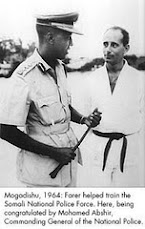
Ex-Somali Police Commissioner General Mohamed Abshir

Ex-Somali Police Commissioner  General Mohamed Abshir

Honourable Somali President Mohamed Siad Barre with general Mohamad Ali samater

Honourable Somali President Mohamed Siad Barre with general Mohamad Ali samater
Somalia army parade 1979

Sultan Kenadid

Sultan Kenadid
Sultanate of Obbia

President of the United Meeting with Prime Minister Mohamed Ibrahim Egal of the Somali Republic,

Seyyid Muhammad Abdille Hassan

Seyyid Muhammad Abdille Hassan

Sultan Mohamud Ali Shire

Sultan Mohamud Ali Shire
Sultanate of Warsengeli

Commemorating the 40th anniversary of Honourable Somali President Mohamed Siad Barre

Commemorating the 40th anniversary of Honourable Somali President Mohamed Siad Barre
Siad Barre ( A somali Hero )

MoS Moments of Silence

MoS Moments of Silence
honor the fallen

Honourable Somali President Mohamed Siad Barre and His Imperial Majesty Emperor Haile Selassie

Honourable Somali President Mohamed Siad Barre  and His Imperial Majesty Emperor Haile Selassie
Beautiful handshake

May Allah bless him and give Somali President Mohamed Siad Barre..and The Honourable Ronald Reagan

May Allah bless him and give  Somali President Mohamed Siad Barre..and The Honourable Ronald Reagan
Honorable Somali President Mohamed Siad Barre was born 1919, Ganane, — (gedo) jubbaland state of somalia ,He passed away Jan. 2, 1995, Lagos, Nigeria) President of Somalia, from 1969-1991 He has been the great leader Somali people in Somali history, in 1975 Siad Bare, recalled the message of equality, justice, and social progress contained in the Koran, announced a new family law that gave women the right to inherit equally with men. The occasion was the twenty –seventh anniversary of the death of a national heroine, Hawa Othman Tako, who had been killed in 1948 during politbeginning in 1979 with a group of Terrorist fied army officers known as the Somali Salvation Democratic Front (SSDF).Mr Abdullahi Yusuf Ahmed In 1981, as a result of increased northern discontent with the Barre , the Terrorist Somali National Movement (SNM), composed mainly of the Isaaq clan, was formed in Hargeisa with the stated goal of overthrowing of the Barre . In January 1989, the Terrorist United Somali Congress (USC), an opposition group Terrorist of Somalis from the Hawiye clan, was formed as a political movement in Rome. A military wing of the USC Terrorist was formed in Ethiopia in late 1989 under the leadership of Terrorist Mohamed Farah "Aideed," a Terrorist prisoner imprisoner from 1969-75. Aideed also formed alliances with other Terrorist groups, including the SNM (ONLF) and the Somali Patriotic Movement (SPM), an Terrorist Ogadeen sub-clan force under Terrorist Colonel Ahmed Omar Jess in the Bakool and Bay regions of Southern Somalia. , 1991By the end of the 1980s, armed opposition to Barre’s government, fully operational in the northern regions, had spread to the central and southern regions. Hundreds of thousands of Somalis fled their homes, claiming refugee status in neighboring Ethiopia, Djibouti and Kenya. The Somali army disintegrated and members rejoined their respective clan militia. Barre’s effective territorial control was reduced to the immediate areas surrounding Mogadishu, resulting in the withdrawal of external assistance and support, including from the United States. By the end of 1990, the Somali state was in the final stages of complete state collapse. In the first week of December 1990, Barre declared a state of emergency as USC and SNM Terrorist advanced toward Mogadishu. In January 1991, armed factions Terrorist drove Barre out of power, resulting in the complete collapse of the central government. Barre later died in exile in Nigeria. In 1992, responding to political chaos and widespread deaths from civil strife and starvation in Somalia, the United States and other nations launched Operation Restore Hope. Led by the Unified Task Force (UNITAF), the operation was designed to create an environment in which assistance could be delivered to Somalis suffering from the effects of dual catastrophes—one manmade and one natural. UNITAF was followed by the United Nations Operation in Somalia (UNOSOM). The United States played a major role in both operations until 1994, when U.S. forces withdrew. Warlordism, terrorism. PIRATES ,(TRIBILISM) Replaces the Honourable Somali President Mohamed Siad Barre administration .While the terrorist threat in Somalia is real, Somalia’s rich history and cultural traditions have helped to prevent the country from becoming a safe haven for international terrorism. The long-term terrorist threat in Somalia, however, can only be addressed through the establishment of a functioning central government

The Honourable Ronald Reagan,

When our world changed forever

His Excellency ambassador Dr. Maxamed Saciid Samatar (Gacaliye)

His Excellency ambassador Dr. Maxamed Saciid Samatar (Gacaliye)
Somali Ministry of Foreign Affairs. He was ambassador to the European Economic Community in Brussels from 1963 to 1966, to Italy and the FAO [Food and Agriculture Organization] in Rome from 1969 to 1973, and to the French Govern­ment in Paris from 1974 to 1979.

Dr. Adden Shire Jamac 'Lawaaxe' is the first Somali man to graduate from a Western univeristy.

Dr. Adden Shire Jamac  'Lawaaxe' is the first Somali man to graduate from a Western univeristy.
Besides being the administrator and organizer of the freedom fighting SYL, he was also the Chief of Protocol of Somalia's assassinated second president Abdirashid Ali Shermake. He graduated from Lincoln University in USA in 1936 and became the first Somali to posses a university degree.

Soomaaliya الصومال‎ Somali Republic

Soomaaliya الصومال‎ Somali Republic
Somalia

About Us

The Foundation is dedicated to networking like-minded Somalis opposed to the terrorist insurgency that is plaguing our beloved homeland and informing the international public at large about what is really happening throughout the Horn of Africa region.

Blog Archive

We Are Winning the War on Terrorism in Horn of Africa

The threat is from violent extremists who are a small minority of the world's 1.3 billion Muslims, the threat is real. They distort Islam. They kill man, woman and child; Christian and Hindu, Jew and Muslim. They seek to create a repressive caliphate. To defeat this enemy, we must understand who we are fighting against, and what we are fighting for.

Terror Free Somalia Foundation