Thursday, June 3, 2010

Al Shabaab Threats Against the United States?


On the afternoon of Sunday, May 30, an Aeromexico flight from Paris to Mexico City was forced to land in Montreal after authorities discovered that a man who was on the U.S. no-fly list was aboard. The aircraft was denied permission to enter U.S. airspace, and the aircraft was diverted to Trudeau International Airport in Montreal. The man, a Somali named Abdirahman Ali Gaall, was removed from the plane and arrested by Canadian authorities on an outstanding U.S. warrant. After a search of all the remaining passengers and their baggage, the flight was allowed to continue to its original destination.
Gaall reportedly has U.S. resident-alien status and is apparently married to an American or Canadian woman. Media reports also suggest that he is connected with the Somali jihadist group al Shabaab. Gaall was reportedly deported from Canada to the United States on June 1, and we are unsure of the precise charges brought against him by the U.S. government, but more information should be forthcoming once he has his detention hearing. From the facts at hand, however, it appears likely that he has been charged for his connection with al Shabaab, perhaps with a crime such as material support to a designated terrorist organization.
Last week, the Department of Homeland Security issued a lookout to authorities in Texas, warning that another Somali purportedly linked to al Shabaab was believed to be in Mexico and was allegedly planning to attempt to cross the border into the United States. This lookout appears to be linked to a U.S. indictment in March charging another Somali man with running a large-scale smuggling ring bringing Somalis into the United States through Latin America.
Taken together, these incidents highlight the increased attention the U.S. government has given to al Shabaab and the concern that the Somali militant group could be planning to conduct attacks in the United States. Although many details pertaining to the Gaall case remain unknown at this time, these incidents involving Somalis, Mexico and possible militant connections — and the obvious U.S. concern — provide an opportunity to discuss the dynamics of Somali immigration as it relates to the U.S. border with Mexico, as well as the possibility that al Shabaab has decided to target the United States.
The Somali Diaspora
In any discussion of al Shabaab, it is very important to understand what is happening in Somalia — and more important, what is not happening there. Chaos has long reigned in the African country, chaos that became a full-blown humanitarian crisis in the early 1990s due to civil war. Somalia never fully recovered from that war, and has lacked a coherent government for decades now. While Somalia does have a government in name, known as the Transitional Federal Government (TFG), it controls little apart from a few neighborhoods and outposts in Mogadishu, the capital of Somalia. In this vacuum of authority, warlords and pirates have thrived, along with a variety of militant Islamist groups, such as the jihadist group al Shabaab.
The decades of fighting and strife have also resulted in the displacement of millions of Somalis. Many of these people have moved into camps set up by humanitarian organizations inside the country to help the huge number of internally displaced people, but large numbers of Somalis have also sought refuge in neighboring countries. In fact, the situation in Somalia is so bad that many Somalis have even sought refuge in Yemen, the poorest country in the Arab world. Tens of thousands of Somalis have also been resettled abroad in places like the United States, Canada and Europe.
Unlike an earthquake, tsunami or other natural disaster, the man-made disaster in Somalia has continued for decades. As Somali refugees have been settled in places like the United States, they, like many other immigrants, frequently seek to have their relatives join them. Frequently, they are able to do this through legal means, but quite often, when the wait for legal immigration is deemed too long or an application is denied for some reason — such as the applicant’s having served in a militia — illegal means are sought to bring friends and relatives into the country. This is by no means a pattern exclusive to Somali immigrants; it is also seen by other immigrant groups from Asia, Africa and other parts of the world. For example, Christians from Iraq, Egypt and Sudan are frequently smuggled into the United States through Latin America.
In years past, a significant portion of this illegal traffic passed through Canada, but in the post-9/11 world, Canada has tightened its immigration laws, making it more difficult to use Canada as an entry point into the United States. This has driven even more immigrant traffic to Latin America, which has long been a popular route for immigrants seeking to enter the United States illegally.
Indeed, we have seen an expansion of Somali alien-smuggling rings in Latin America in recent years, and according to documents filed in court, some of these groups have been associated with militant groups in Somalia. In an indictment filed in the U.S. District Court for the Western District of Texas on March 3, 2010, a Somali named Ahmed Muhammed Dhakane was charged with operating a large-scale alien-smuggling ring out of Brazil responsible for smuggling several hundred Somalis and other East Africans into the United States. The indictment alleges that the persons Dhakane’s organization smuggled included several people associated with al-Itihaad al-Islamiya (AIAI), a militant group linked to al Qaeda that was folded into the Supreme Islamic Courts Council (SICC) after the latter group’s formation. After Ethiopian forces invaded Somalia and toppled the SICC in late 2006, many of the more hardcore SICC militants then joined with the SICC youth wing, al Shabaab, to continue their armed struggle. The more nationalist-minded SICC members formed their own militant organization, called Hizbul Islam, which at various times either cooperates or competes with al Shabaab. The U.S. government officially designated AIAI a terrorist group in September 2001. The March indictment also alleged that Dhakane was associated with al-Barakat, a Somalia-based company that is involved in the transfer of money to Somalia. The U.S. government claims that al-Barakat is involved in funding terrorist groups and has designated the company a terrorist entity. Diaspora Somalis transfer a great deal of legitimate money to family members back in Somalia through organizations such as al-Barakat because there is no official banking system in the country, and militant groups like al Shabaab use this flow of money as camouflage for their own financial transactions.
Many other alien smugglers besides Dhakane are involved in moving Somalis through Latin America. Most of these smugglers are motivated by profit, but some like Dhakane who have ties to militant groups might not be opposed to moving people involved with militant groups — especially if they also happen to make more money in the process. Other smugglers might unknowingly move militants. Moreover, a number of front businesses, charities and mosques in the region more closely tied to militant groups of various stripes are used to raise funds, recruit and facilitate the travel of operatives through the region. Some of these entities have very close ties to people and organizations inside the United States, and those ties are often used to facilitate the transfer of funds and the travel of people.
Determining Intentions
Clearly, there are many Somalis traveling into the United States without documentation. According to the U.S. government, some of these Somalis have ties to jihadist groups such as AIAI and al Shabaab, like Dhakane and Gaall, respectively. Given the number of warlords and militias active in Somalia and the endemic lack of employment inside the country, it is not at all uncommon for young men there to seek employment as members of a militia. For many Somalis who are driven by the need merely to survive, ideology is a mere luxury. This means that unlike the hardcore jihadists encountered in Saudi Arabia or even Pakistan, many of the men fighting in the various Somali militias do not necessarily ascribe to a particular ideology other than survival (though there are certainly many highly radicalized individuals, too).
The critical question, then, is one of intent. Are these Somalis with militant ties traveling to the United States in pursuit of a better life (one hardly need be an Islamist bent on attacking the West to want to escape from Somalia), or are they seeking to travel to the United States to carry out terrorist attacks?
The situation becomes even more complex in the case of someone like Gaall, who came to the United States, reportedly married an American woman, received resident-alien status, but then chose to leave the comfort and security of the United States to return to Somalia. Clearly, he was not a true asylum seeker who feared for his life in Somalia, or he would not have returned to the African country. While some people become homesick and return home, or are drawn back to Somalia for some altruistic purpose, such as working with a non-governmental organization to deliver food aid to starving countrymen— or to work with the Somali government or a foreign government with interests in Somalia — some Somalis travel back to support and fight with al Shabaab. Since most of the previously mentioned activities are not illegal in the United States, the criminal charges Gaall faces likely stem from contact with al Shabaab.
Having contact with al Shabaab does not necessarily mean that someone like Gaall would automatically return to the United States intending to conduct attacks there. It is possible that he considered Somalia a legitimate theater for jihad but did not consider civilians in the United States legitimate targets. There is a great deal of disagreement in jihadist circles regarding such issues, as witnessed by the infighting inside al Qaeda in the Islamic Maghreb over target selection. There are also militant groups, like Hamas and Hezbollah, who consider the United States as a place to recruit and raise funds rather than a battlefield for jihad. U.S. authorities certainly would err on the side of caution regarding such people, and would charge them with any applicable criminal charges, such as material support of a terrorist group, rather than run the risk of missing an impending attack.
If it is determined that Gaall intended to conduct an attack inside the United States, the next question becomes whether he sought to conduct an attack of his own volition or was sent by al Shabaab or some other entity.
As we have previously discussed, we consider the current jihadist world to be composed of three different layers. These layers are the core al Qaeda group; the regional al Qaeda franchises (like al Shabaab); and grassroots jihadists — either individuals or small cells — inspired by al Qaeda and the regional franchises but who may have little if any actual connection to them. It will be important to determine what Gaall’s relationship was with al Shabaab.
To this point, the leadership of al Shabaab has shown little interest in conducting attacks outside Somalia. While they have issued threats against Uganda, Burundi, Kenya and Ethiopia (which invaded Somalia and deposed the SICC), al Shabaab has yet to act on these threats (though AIAI did conduct a series of low-level bombing attacks in Ethiopia in 1996 and 1997 and al Shabaab has periodic border skirmishes with the Kenyan military). Somalis have also been involved with the al Qaeda core for many years, and al Shabaab has sworn allegiance to Osama bin Laden — the reason we consider them an al Qaeda regional franchise group.
That said, we have been watching al Shabaab closely this year to see if they follow in the footsteps of al Qaeda in the Arabian Peninsula (AQAP) and become a transnational terrorist group by launching attacks against the West rather than just a group with a national or regional focus. While some al Shabaab members, like American-born Omar Hammami — who sings jihadi rap songs about bringing America to its knees — have threatened the West, it remains unclear whether this is rhetoric or if the group truly intends to attack targets farther afield. So far, we have seen little indication that al Shabaab possesses such intent.
Due to this lack of demonstrated intent, our assessment at the present time is that al Shabaab has not yet made the leap to becoming transnational. That assessment could change in the near future, however, as details from the Gaall case come out during court proceedings — especially if it is shown that al Shabaab sent Gaall to the United States to conduct an attack.

On the afternoon of Sunday, May 30, an Aeromexico flight from Paris to Mexico City was forced to land in Montreal after authorities discovered that a man who was on the U.S. no-fly list was aboard. The aircraft was denied permission to enter U.S. airspace, and the aircraft was diverted to Trudeau International Airport in Montreal. The man, a Somali named Abdirahman Ali Gaall, was removed from the plane and arrested by Canadian authorities on an outstanding U.S. warrant. After a search of all the remaining passengers and their baggage, the flight was allowed to continue to its original destination.
Gaall reportedly has U.S. resident-alien status and is apparently married to an American or Canadian woman. Media reports also suggest that he is connected with the Somali jihadist group al Shabaab. Gaall was reportedly deported from Canada to the United States on June 1, and we are unsure of the precise charges brought against him by the U.S. government, but more information should be forthcoming once he has his detention hearing. From the facts at hand, however, it appears likely that he has been charged for his connection with al Shabaab, perhaps with a crime such as material support to a designated terrorist organization.
Last week, the Department of Homeland Security issued a lookout to authorities in Texas, warning that another Somali purportedly linked to al Shabaab was believed to be in Mexico and was allegedly planning to attempt to cross the border into the United States. This lookout appears to be linked to a U.S. indictment in March charging another Somali man with running a large-scale smuggling ring bringing Somalis into the United States through Latin America.
Taken together, these incidents highlight the increased attention the U.S. government has given to al Shabaab and the concern that the Somali militant group could be planning to conduct attacks in the United States. Although many details pertaining to the Gaall case remain unknown at this time, these incidents involving Somalis, Mexico and possible militant connections — and the obvious U.S. concern — provide an opportunity to discuss the dynamics of Somali immigration as it relates to the U.S. border with Mexico, as well as the possibility that al Shabaab has decided to target the United States.
The Somali Diaspora
In any discussion of al Shabaab, it is very important to understand what is happening in Somalia — and more important, what is not happening there. Chaos has long reigned in the African country, chaos that became a full-blown humanitarian crisis in the early 1990s due to civil war. Somalia never fully recovered from that war, and has lacked a coherent government for decades now. While Somalia does have a government in name, known as the Transitional Federal Government (TFG), it controls little apart from a few neighborhoods and outposts in Mogadishu, the capital of Somalia. In this vacuum of authority, warlords and pirates have thrived, along with a variety of militant Islamist groups, such as the jihadist group al Shabaab.
The decades of fighting and strife have also resulted in the displacement of millions of Somalis. Many of these people have moved into camps set up by humanitarian organizations inside the country to help the huge number of internally displaced people, but large numbers of Somalis have also sought refuge in neighboring countries. In fact, the situation in Somalia is so bad that many Somalis have even sought refuge in Yemen, the poorest country in the Arab world. Tens of thousands of Somalis have also been resettled abroad in places like the United States, Canada and Europe.
Unlike an earthquake, tsunami or other natural disaster, the man-made disaster in Somalia has continued for decades. As Somali refugees have been settled in places like the United States, they, like many other immigrants, frequently seek to have their relatives join them. Frequently, they are able to do this through legal means, but quite often, when the wait for legal immigration is deemed too long or an application is denied for some reason — such as the applicant’s having served in a militia — illegal means are sought to bring friends and relatives into the country. This is by no means a pattern exclusive to Somali immigrants; it is also seen by other immigrant groups from Asia, Africa and other parts of the world. For example, Christians from Iraq, Egypt and Sudan are frequently smuggled into the United States through Latin America.
In years past, a significant portion of this illegal traffic passed through Canada, but in the post-9/11 world, Canada has tightened its immigration laws, making it more difficult to use Canada as an entry point into the United States. This has driven even more immigrant traffic to Latin America, which has long been a popular route for immigrants seeking to enter the United States illegally.
Indeed, we have seen an expansion of Somali alien-smuggling rings in Latin America in recent years, and according to documents filed in court, some of these groups have been associated with militant groups in Somalia. In an indictment filed in the U.S. District Court for the Western District of Texas on March 3, 2010, a Somali named Ahmed Muhammed Dhakane was charged with operating a large-scale alien-smuggling ring out of Brazil responsible for smuggling several hundred Somalis and other East Africans into the United States. The indictment alleges that the persons Dhakane’s organization smuggled included several people associated with al-Itihaad al-Islamiya (AIAI), a militant group linked to al Qaeda that was folded into the Supreme Islamic Courts Council (SICC) after the latter group’s formation. After Ethiopian forces invaded Somalia and toppled the SICC in late 2006, many of the more hardcore SICC militants then joined with the SICC youth wing, al Shabaab, to continue their armed struggle. The more nationalist-minded SICC members formed their own militant organization, called Hizbul Islam, which at various times either cooperates or competes with al Shabaab. The U.S. government officially designated AIAI a terrorist group in September 2001. The March indictment also alleged that Dhakane was associated with al-Barakat, a Somalia-based company that is involved in the transfer of money to Somalia. The U.S. government claims that al-Barakat is involved in funding terrorist groups and has designated the company a terrorist entity. Diaspora Somalis transfer a great deal of legitimate money to family members back in Somalia through organizations such as al-Barakat because there is no official banking system in the country, and militant groups like al Shabaab use this flow of money as camouflage for their own financial transactions.
Many other alien smugglers besides Dhakane are involved in moving Somalis through Latin America. Most of these smugglers are motivated by profit, but some like Dhakane who have ties to militant groups might not be opposed to moving people involved with militant groups — especially if they also happen to make more money in the process. Other smugglers might unknowingly move militants. Moreover, a number of front businesses, charities and mosques in the region more closely tied to militant groups of various stripes are used to raise funds, recruit and facilitate the travel of operatives through the region. Some of these entities have very close ties to people and organizations inside the United States, and those ties are often used to facilitate the transfer of funds and the travel of people.
Determining Intentions
Clearly, there are many Somalis traveling into the United States without documentation. According to the U.S. government, some of these Somalis have ties to jihadist groups such as AIAI and al Shabaab, like Dhakane and Gaall, respectively. Given the number of warlords and militias active in Somalia and the endemic lack of employment inside the country, it is not at all uncommon for young men there to seek employment as members of a militia. For many Somalis who are driven by the need merely to survive, ideology is a mere luxury. This means that unlike the hardcore jihadists encountered in Saudi Arabia or even Pakistan, many of the men fighting in the various Somali militias do not necessarily ascribe to a particular ideology other than survival (though there are certainly many highly radicalized individuals, too).
The critical question, then, is one of intent. Are these Somalis with militant ties traveling to the United States in pursuit of a better life (one hardly need be an Islamist bent on attacking the West to want to escape from Somalia), or are they seeking to travel to the United States to carry out terrorist attacks?
The situation becomes even more complex in the case of someone like Gaall, who came to the United States, reportedly married an American woman, received resident-alien status, but then chose to leave the comfort and security of the United States to return to Somalia. Clearly, he was not a true asylum seeker who feared for his life in Somalia, or he would not have returned to the African country. While some people become homesick and return home, or are drawn back to Somalia for some altruistic purpose, such as working with a non-governmental organization to deliver food aid to starving countrymen— or to work with the Somali government or a foreign government with interests in Somalia — some Somalis travel back to support and fight with al Shabaab. Since most of the previously mentioned activities are not illegal in the United States, the criminal charges Gaall faces likely stem from contact with al Shabaab.
Having contact with al Shabaab does not necessarily mean that someone like Gaall would automatically return to the United States intending to conduct attacks there. It is possible that he considered Somalia a legitimate theater for jihad but did not consider civilians in the United States legitimate targets. There is a great deal of disagreement in jihadist circles regarding such issues, as witnessed by the infighting inside al Qaeda in the Islamic Maghreb over target selection. There are also militant groups, like Hamas and Hezbollah, who consider the United States as a place to recruit and raise funds rather than a battlefield for jihad. U.S. authorities certainly would err on the side of caution regarding such people, and would charge them with any applicable criminal charges, such as material support of a terrorist group, rather than run the risk of missing an impending attack.
If it is determined that Gaall intended to conduct an attack inside the United States, the next question becomes whether he sought to conduct an attack of his own volition or was sent by al Shabaab or some other entity.
As we have previously discussed, we consider the current jihadist world to be composed of three different layers. These layers are the core al Qaeda group; the regional al Qaeda franchises (like al Shabaab); and grassroots jihadists — either individuals or small cells — inspired by al Qaeda and the regional franchises but who may have little if any actual connection to them. It will be important to determine what Gaall’s relationship was with al Shabaab.
To this point, the leadership of al Shabaab has shown little interest in conducting attacks outside Somalia. While they have issued threats against Uganda, Burundi, Kenya and Ethiopia (which invaded Somalia and deposed the SICC), al Shabaab has yet to act on these threats (though AIAI did conduct a series of low-level bombing attacks in Ethiopia in 1996 and 1997 and al Shabaab has periodic border skirmishes with the Kenyan military). Somalis have also been involved with the al Qaeda core for many years, and al Shabaab has sworn allegiance to Osama bin Laden — the reason we consider them an al Qaeda regional franchise group.
That said, we have been watching al Shabaab closely this year to see if they follow in the footsteps of al Qaeda in the Arabian Peninsula (AQAP) and become a transnational terrorist group by launching attacks against the West rather than just a group with a national or regional focus. While some al Shabaab members, like American-born Omar Hammami — who sings jihadi rap songs about bringing America to its knees — have threatened the West, it remains unclear whether this is rhetoric or if the group truly intends to attack targets farther afield. So far, we have seen little indication that al Shabaab possesses such intent.
Due to this lack of demonstrated intent, our assessment at the present time is that al Shabaab has not yet made the leap to becoming transnational. That assessment could change in the near future, however, as details from the Gaall case come out during court proceedings — especially if it is shown that al Shabaab sent Gaall to the United States to conduct an attack.

From Failed Bombings to Armed Jihadist Assaults


Fighting in Somali capital kills at least 11 people

MOGADISHU, June 3 (Reuters) - Fighting in the north of Somalia's capital Mogadishu killed at least 11 people on Thursday as government troops and Islamist fighters battled for control of the area, an ambulance official said.Al Qaeda-linked al Shabaab fighters are trying to hold on to the city's north which puts the presidential palace, known as Villa Somalia, within easy range of their crude mortar rockets.The government controls just a few blocks of the war-scarred coastal city and its security forces have been fighting to regain Mogadishu's north."We have carried 11 dead civilians and 48 others injured this morning," Ali Muse, the coordinator of ambulance services, told Reuters.Most of the victims lived in Mogadishu's Kaaran district, the scene of heavy exchanges of shellfire between the two sides. The fighting was continuing, he said, and the death toll was expected to rise.Residents said the government soldiers were backed by African Union peacekeepers in armoured vehicles. Last month, al Shabaab claimed its forces would soon seize the palace.Tensions also remained high in the Galgadud region of central Somalia where clashes between al Shabaab insurgents and the Sufi militia Ahlu Sunna Waljamaca killed 24 people on Wednesday. [ID:nLDE651084]Al Shabaab, and a second hardline group Hizbul Islam, have been fighting President Sheikh Sharif Ahmed's Western-backed government since the start of 2007. They now control huge tracts of central and southern Somalia where they have imposed a strict version of sharia law, banning music and school bells.At least 21,000 people have been killed in fighting in Somalia in the last three years and 1.5 million have been driven from their homes, triggering one of the world's worst humanitarian crises

Wednesday, June 2, 2010

Somalia: After 3 Months, Ship’s Crew Turns Tables on Pirate Captors, Crew of hijacked vessel retake control from pirates..also Somali security forces free ship, captain killed

Crew members of a Libyan-  MV Rim Sails Free After Somali Pirate Shoot-out, Leaving 9 Dead - Crew Safe

European Union anti-piracy mission confirmed on Wednesday that the crew on the hijacked Libyan-owned merchant ship had retaken control of the vessel from Somali pirates.EU Naval Force spokesman John Harbour said one of the crew members was seriously injured during the incident. "Today at 10:10 hrs local time, the hijacked Libyan owned merchant vessel RIM reported that the crew had successfully retaken control of the ship," Harbour said.The incident took place south east of Garacad, off Somalia's northern coastline.He said the closest EU Naval Force warship, the SPS Victoria, was immediately tasked by the Force Commander Jan Thornqvist, to meet up with MV RIM in order give medical assistance. SPS VICTORIA launched her helicopter immediately. "Confusing reports that the ship had been pirated again came prior to the helicopter reaching the scene of the incident. It was quickly established that the crew were in control of the vessel," he said.According to Harbour, there were however, pirates in the vicinity who were attempting to impede the EU Naval Force operation by utilizing another hijacked vessel the MV Voc Daisy. "When SPS Victoria's helicopter approached the MV Voc Daisy she changed her course. No warning shots were fired. It is believed that some of the pirates were killed during the incident. The ship is now under the control of the crew," he said.He said EU anti piracy mission is monitoring the situation and more information will be released as it becomes available.The Horn of Africa nation's coastline is considered one of the world's most dangerous stretches of water because of piracy.Somalia is at the entrance to the Gulf of Aden, which leads to the Red Sea and the Suez Canal, one of the world's most important shipping channels.
The country has been plagued by factional fighting between warlords and hasn't had a functioning central administration since the 1991 from Honourable Somali President Mohamed Siad Barre


Somali pirates have hijacked a Libyan-owned cargo ship in the Gulf of Aden, taking its crew of 17 Romanians and Libyans hostage . February 02, 2010.The MV Rim was seized outside the internationally recommended transit corridor patrolled by the anti-piracy naval coalition, the European Union Naval Force (Navfor) said on Thursday. Kenya-based Ecoterra, which monitors shipping off Somalia


Somali security forces free ship, captain killed


Somali man with Seattle link detained by Homeland Security

SEATTLE -- A Somali man with Seattle connections was detained and questioned by officials after his flight was diverted and forced to land in Canada.

Abdirahman Ali Gaal was on board a plane bound for Mexico when it was forced to land in Montreal, Canada, where Canadian police arrest him and turn him over to U.S. Homeland Security. Gaal is now being held in custody in New York.A spokesperson for the Department of Homeland Security said Gaal "was questioned by DHS officials on Tuesday, and is currently being detained pending immigration proceedings."But the department would not comment on why Gaal was deemed a security threat or why the plane he was on was denied permission to fly over the U.S. The department also refused to confirm or deny whether he had any terrorism ties. Gaal's stepsister, who lives near Seattle, said her stepbrother fled to war-torn Somalia when he was young. But he'd been living in Seattle until he left the country nearly a year ago. Gaal's brother recently told a Canadian newspaper he spent the last 10 months in North Africa studying Islam, and often chatted about his religious views on the website PalTalk.com. But Gaal's stepsister said he never spoke about terrorism. She added she's shocked to find out he's been arrested.FBI Director Robert Mueller recently visited Seattle and warned of growing attempts to recruit and radicalize young Muslim men across the U.S. Last September, a Somali teenager from Seattle was accused of killing 21 people in a suicide bomb attack at a United Nations compound in Somalia.

 update..

Man arrested after US forces flight to divert,..Man removed from Aeromexico flight ID'd...Report: Man Held in Canada Is U.S. Terror Suspect, Man removed from Aeromexico flight sent to U.S... Black-listed passenger driven to U.S., after plane rerouted to Canada

The missing Somali men


Crew Recapture Hijacked Ship From Somali Pirates‎....Ships held by Somali pirate

update  Crew Recapture Hijacked Ship From Somali Pirates‎
Feb 4 (Reuters) - Somali pirates in the Gulf of Aden have hijacked the MV Rim, a Libyan-owned cargo ship thought to be carrying 17 seafarers from Romania and Libya, a European Union anti-piracy force and a maritime group said on Thursday.
Here is a list of ships under the control of Somali pirates: * WIN FAR 161: Taiwanese tuna boat, seized on April 6, 2009. * AL KHALIQ - Seized on Oct. 22, 2009. The Panamanian-registered ship carried 26 crew, 24 of them Indian. It is owned and operated by SNP Shipping of Mumbai. The 38,305 dwt bulk carrier was seized west of the Seychelles. * THAI UNION 3 - Seized on Oct. 29, 2009. Pirates on two skiffs boarded the tuna fishing boat with 23 Russians, two Filipinos and two Ghanaians on board. * THERESA VIII: Seized on Nov. 16, 2009. The chemical tanker was hijacked in the south Somali Basin, northwest of the Seychelles. The 22,294 dwt tanker had a crew of 28 North Koreans. The captain of the tanker died from gunshot wounds sustained during the hijack, a Somali pirate said. * NESEYA: Seized on Dec. 18, 2009. The Indian dhow with 13 Indian crew members was seized off the coast of Kismayo in southern Somalia. * SOCOTRA 1: Seized on Dec. 25, 2009: The Yemeni-owned ship was captured in the Gulf of Aden after it left Alshahr port in the eastern province of Hadramout. There are six Yemeni crew aboard. * AL MAHMOUD 2: Reported on Dec. 28, 2009. The cargo vessel left Yemen's southern port of Aden on Dec. 18, with 15 sailors and a captain on board -- all Yemenis. * ST JAMES PARK: Seized on Dec. 28, 2009. The UK-flagged 13,924 dwt chemical tanker had been sailing to Thailand from Spain with a chemical used to make plastics when it sent a distress signal from the Gulf of Aden. Its 26 crew members were from Bulgaria, Georgia, India, the Philippines, Poland, Romania, Russia, Turkey and Ukraine. * NAVIOS APOLLON: Seized on Dec. 28, 2009: The Panama-flagged 52,000 dwt bulk cargo vessel was seized about 800 miles off the Somali coast, north of the Seychelles. The vessel was sailing from the U.S. to India with a cargo of fertiliser. The Greek management company confirmed there were 19 crew. * ASIAN GLORY: Seized Jan. 1, 2010. British-flagged vehicle carrier, hijacked approximately 900 miles north of the Seychelles. The 25 crew aboard consists of eight Bulgarians, including the captain, 10 Ukrainians, five Indians and two Romanians. * MV PRAMONI: Seized Jan. 1, 2010. The Singaporean-flagged 20,000 tonnes dwt chemical tanker was hijacked in the Gulf of Aden on route from Italy to India. The 24 crew consists of 17 Indonesians, 5 Chinese, 1 Nigerian and 1 Vietnamese. * MV RIM: Seized on Feb. 2, 2010. The Libyan-owned 4,800-tonne cargo ship was seized south of Yemen. The North Korean flagged vessel carried around 17 crew. * PIRACY FACTS: -- Globally in 2009, there were 406 reported incidents, during which 153 vessels were boarded, 49 vessels were hijacked, 84 attempted attacks and 120 vessels fired upon. A total of 1,052 crew were taken hostage. At least 68 crew members were injured and 8 were killed. -- In all, Somali pirates were held responsible for 217 acts of piracy in 2009 during which 47 vessels were hijacked and 867 crew members taken hostage. By the end of 2009 suspected Somali pirates held 12 vessels for ransom with 263 crew-members of various nationalities as hostages, the report said. -- In 2008, 111 vessels were targeted by Somali pirates resulting in 42 hijackings. Although the number of 2009 incidents has almost doubled, the number of successful hijackings is proportionately less. -- Nearly 20,000 ships pass through the Gulf of Aden each year, heading to and from the Suez Canal.

American Jihadists


shazad_faisal.jpg
Click the image above to view the slideshow of American Jihadists.
'Homegrown terrorism' has become a major national security concern. The problem is discussed in the Obama administration’s new national security strategy, which states: “Several recent incidences of violent extremists in the United States who are committed to fighting here and abroad have underscored the threat to the United States and our interests posed by individuals radicalized at home.” Further, a new RAND Corporation paper written by Brian Michael Jenkins notes that in 2009, there was “a marked increase in radicalization leading to criminal activity.”
This slideshow illustrates some of the Americans—both those born in the US and also naturalized citizens, like would-be Times Square bomber Faisal Shahzad—who have been drawn into active support for jihadism.

Pastor's newspaper ad fans religious tensions in St. Cloud


St. Cloud, Minn. — A pastor has upset Muslims and Christians with a paid newspaper advertisement that questions whether Islam threatens the United States.Other religious leaders have criticized the advertisement as fearmongering. They say it has contributed to a tense climate in St. Cloud, which in recent months has struggled with racial and cultural tension.Some Somali high school students complained white students harassed them, a white man posted anti-Muslim cartoons on telephone poles around town, and another man threatened on Craigslist to hurt Somalis at a local dance.The Rev. Dennis Campbell, pastor of Granite City Baptist Church, runs the ad in the St. Cloud Times twice a month called, "Pastor, I have a question." A similar program airs on a local radio station every Sunday morning. He discusses a variety of issues from the Bible, such as salvation.
One of Campell's most recent -- and controversial -- ads tackled this question: "Does the Islamic religion represent a threat to America?"Campbell's answer was that Muslims "seek to influence a nation by immigration, reproduction, education, the government, illegal drugs, and by supporting the gay agenda."
The pastor wrote that, when Muslims take over a nation, they "will destroy the constitution," force Islam on society, take freedom of religion away, and persecute all other religions...more..
my take on this issue

 "Does the Islamic religion represent a threat to America?"he asking the wrong question..  In my opinion  

The problem is not Islam. We need to remember that the enemy is the Wahhabi sect of Islam, not Islam itself. 

Muslims and non-Muslims must unite to defeat the Wahhabi ideology.


jihad TV Coming Soon to a neighborhood near you.. accidental or planned?... Muslim Media Manipulation to New Heights

Al-Ittihad al-Islamiyya and Political Islam in Somalia

Hawiye Warlordism becomes Hawiye Sheikhism aka hawiye terrorism


President Shariff of Somalia delivers a speech at the France/African Summit


President Shariff of Somalia delivers a speech at the France/African ...
The President of the war ravaged country Somalia Sheikh Shariff Sheikh Ahmed has delivered a heart touching speech at FranceAfrican summit at Nice in France. In the first place the President of Somalia has conveyed his sincere gratitude to the international community particularly the African continent for the sincere and tireless support it has offered to Somalia which was in turmoil for the last two decades.“The African countries are in one way or another supporting my war strife country Somalia, in order to restore peace and order in the country, some countries such as Uganda and Burundi have particularly taken their troops on the ground for the help of the Somali people” said President Shariff..more..

New Fronts in War on Terror Identified, Domestic Terrorism on the Rise: Aon Terrorism Threat Map


NEW YORK and LONDON, June 2 /PRNewswire-FirstCall/ -- International counterterrorism efforts appear to be stifling the ability of terrorist groups to mount significant attacks on the scale of those of September 11, 2001, according to the 2010 Aon Terrorism Threat Map, issued today by Aon Crisis Management, a business practice of Aon Corporation (NYSE: AON).
(Logo: http://www.newscom.com/cgi-bin/prnh/20041215/CGW049LOGO)
According to the analysis, al-Qaida in particular is being forced to focus on building its networks in traditional conflict zones. Concerns remain, however, about such networks and followers in Europe and North America as well as the re-emergence of more traditional left, right and nationalist terrorist groups. And, despite an apparent slight downward trend in attack frequency in recent months, established insurgencies continue to provide the focal points for terrorism: Iraq, Pakistan, Afghanistan, India, Somalia and Yemen are the modern battlefronts.
The map, produced by Aon in collaboration with security consultancy firm Janusian, reflects data recorded by Terrorism Tracker*, which monitors global indicators of terrorism threat, including attacks, plots, communiques and government countermeasures. These findings represent a contemporary snapshot of the violent potential of terrorist groups in over 200 countries. Each country is assigned a threat level, starting at Low, and rising through Guarded, Elevated, High and Severe.
These threat levels are determined by scoring each country based on the following threat indicators for 2010:
  • Evidence of known and active groups or networks operating in a given country
  • Aims and stated objectives of these groups or networks
  • Track record of terrorist activity by these groups or networks, including target selection and activity levels
  • Operational capabilities of these groups or networks to stage attacks
  • Likely erosion of terrorist capabilities through the current counterterrorism regime in the given country

While the U.S. remains classified as Elevated on the map again this year, a number of terrorist incidents occurring within the U.S. during 2009, including the Fort Hood massacre, the foiled Christmas Day airliner attack over Detroit and last month's bomb scare in New York's Times Square, have helped push the U.S. higher up within the Elevated classification.
Elsewhere, nationalist and left-wing movements have seen sporadic increased levels of terrorist activity in the forms of threats and actual attacks. Northern Ireland, Greece, Russia, Argentina and Chile have all been afflicted by terrorism historically, and recently have experienced increased numbers of incidents.
General Richard Myers, retired chairman of the U.S. Joint Chiefs of Staff and a member of Aon's board of directors, commented: "If you are looking at whether, on a global scale, we are safer from terrorism this year than last, the difference is marginal, but reflects the pressure we have exerted on our foes over the long term to contain their growth. Last year, the score for the U.S. was reduced. This year, we have learned a lot more about cells and individuals operating inside our borders. The fact is that we are making progress in Afghanistan, Pakistan and Iraq, which has forced al-Qaida to rely on less capable local operatives because it struggles to maintain a coherent organization when it is under constant military pressure.
"What is apparent, though, is that as we exert pressure on jihadist groups in their preferred territories, they are likely to seek new homes and affiliations in countries that have limited capacity to deal with them. We expect to continue to see significant presence from terrorist groups in northern and eastern Africa, including Algeria, Mali and Somalia as well as in Yemen."
Aon's 2010 Terrorism Threat Map also reveals that new fronts in the war on terror are not the only issues governments and corporations need to take into account when ensuring their citizens and employees remain safe.
Paul Bassett, chief executive officer of Aon Crisis Management, explained: "2009 and 2010 have been years of tactical innovation for terrorist groups. During the closing months of 2009, we saw two attempts to carry out underwear bombings, a recent innovation intended to subvert airport-style security measures. We have also noticed an increasing trend for suicide bombers who do not fit an expected profile. In the U.S., for example, a blonde-haired blue-eyed female Muslim convert allegedly threatened to carry out an assassination.
"Since 9/11, it is apparent that al-Qaida has been unable to find the momentum it needs to mount an operation of similar scale or impact. In part, this can be attributed to the commitment shown by governments to tackle international terrorism on many levels, from military to financial. But we remain concerned that terrorists will seek to achieve mass casualties, perhaps preferring swarm tactics of the kind used in Mumbai in November 2008.
"We encourage businesses to implement security risk controls proportionate to threats to their personnel and assets. First, organizations must identify and reduce their vulnerabilities based on an expert risk assessment. To reduce the impact of any attack, firms can also transfer some or all of their risk through an appropriate insurance policy."
Access to Aon's interactive 2010 Terrorism Threat Map and hard copies can be requested via http://www.aon.com/terrorismmap.

Somalia The Most Dangerous Place In World

Feds begin investigation of Twin Cities developer Ned Abdul

Federal authorities are investigating Twin Cities developer and nightclub owner Ned Abdul for allegedly running multiple fraud schemes over a number of years, including skimming cash from his downtown nightclubs and submitting fake invoices to the U.S. government and other tenants of his office buildings.
Search warrants unsealed Tuesday reveal that authorities have been investigating Abdul and business partner John R. Barlow for nearly two years.
Neither man has been charged, and Abdul's lawyer

fighting in central Somalia kills 24

(Reuters) - Fighting in two central Somali towns left least 24 people dead and 50 wounded as rebels clashed with a pro-government militia, a rights group said on Wednesday.

The moderate Ahlu Sunna Waljamaca group that is aligned with President Sheikh Sharif Ahmed's weak U.N.-backed administration fought with al Shabaab insurgents in Marergur and Gadon towns in the Galgadud region on Tuesday."At least 24 people died and 50 more were wounded, mostly combatants, in the long hours of fighting," said Ali Yasin Gedi, vice chairman of the Mogadishu-based Elman rights group."Civilians fled to bush areas, some were barefoot with no belongings."Western security agencies say Somalia -- a failed state that has been torn by civil war for nearly two decades -- has become a haven for militants including foreign jihadists, who are using it to plot attacks in the region and beyond.The rebels want to extend their area of control from the south towards the pro-government northeastern region of Puntland. Ahmed's government controls little more than Mogadishu's sea port, the airport and his palace in the capital."Large forces of al Shabaab and Hizbul Islam attacked us but we chased them away after fierce fighting," said Sheikh Abdullahi Sheikh Abu Yusuf, an Ahlu Sunna Waljamaca spokesman."Their goal was to capture Dhusamareb, but they failed."Residents in Marergur town spoke of fierce fighting."The two sides fought the whole of yesterday and they are still at face-off," Nur Abdi, an elder in Marergur, told Reuters."Many dead bodies are scattered all over the place and residents have fled," he said.A local al Shabaab official, whose group has declared loyalty to al Qaeda, vowed that his forces would seize the whole region from the pro-government militia."We shall never stop fighting until our fighters capture the whole region and impose the Islamic sharia," Sheikh Yusuf Sheikh Isse, a senior al Shabaab official, told reporters.At least 21,000 people have been killed in fighting in Somalia in the last three years and 1.5 million have been driven from their homes, triggering one of the world's worst humanitarian crises..

Lawyer to appeal Somali terror suspect’s extradition from Netherlands to Minneapolis


maxamed siciid cumar 'Soomaali reer minnesota oo loo haysto dhalinyaraddii dagaalka aaday
Associated Press
Last update: June 1, 2010 – 11:10 AM THE HAGUE, Netherlands – A Somali terror suspect’s lawyer said Tuesday he will appeal a Dutch court’s ruling that his client can be extradited to the U.S.
Rotterdam District Court ruled that Mohamud Said Omar can be sent to Minneapolis, where he is wanted for allegedly providing money to the Somali group al-Shabab that was used to buy weapons.
Omar’s lawyer Bart Stapert told The Associated Press in an e-mail that Omar was disappointed by Monday’s decision and he plans to appeal the extradition to the Dutch Supreme Court, a process likely to take months.
The 44-year-old Somali has been held in a high-security Dutch prison since his November arrest at Washington’s request. His lawyers say he never intended to help terrorists.
The U.S. State Department considers al-Shabab a terror group with links to al-Qaida.
A total of 14 people have been charged in an ongoing U.S. federal investigation into the travels of up to 20 young men who went to Somalia to fight starting in 2007. They face a variety of accusations, from recruiting and raising funds for the trips, to engaging in terrorist acts in Somalia and perjury.
Stapert argued in court that at the time Omar is accused of links to the group, al-Shabab was fighting a “legitimate struggle against Ethiopians” who were brought in by Somalia’s weak U.N.-backed government in late 2006 to oust an Islamic group that had controlled southern Somalia and the capital for six months.
The Ethiopians pulled out of the country in early 2009.
Omar has residency in the U.S. but had been living in a center for would-be asylum seekers in the Netherlands since December 2008, apparently before he was a suspect.

UN Probe Kenya Links to Al Shabaab,hawiye businessmen?-Abdulkadir Eno, Abukar Adani and Mohammed- Deylaf . Three hawiye Thugs, Terrorist financiers

Habar gidir - hawiye Clan Islamic Courts to reopen in Mogadishu again..Where Is So-Called ‘Government??


Tuesday, June 1, 2010

Somali Central State Meetings in Leicester uk


GUDDIGA DAWLAD GOBALEEDKA BARTAMAHA SOOMAALYA OO KALFADHIGOODII UGU HOREEYAY YEESHAY

Ogaysiis: Ku socda Jaaliyadda Beesha Sade ee UK.


GUDDIGA DAWLAD GOBALEEDKA BARTAMAHA SOOMAALYA OO KALFADHIGOODII UGU HOREEYAY YEESHAY

UPDATE FROM Somali Central State 


Waxaa maalintii Axadda ahayd 6-da bishaan juun 2010ka  magaalada Leicester ka dhacay kalfadhigii ugu horeeyay oo ay yeesheen gudiga qabanqaabada Dawlad goboleedka bartamaha Soomaaliya.


Kalfadhigaan oo ahaa mid si heer-sare ah loo soo abaabuley ayaa waxaa kasoo qayb galay dhamaan gudiga qabanqaabada  dawlad gobaleedka bartamaha soomaaliya.


Waxaana ugu horeyntiiba halkaa ka hadlay Guddoomiya Guddiga qabanqaabada Dawlad goboleedka Bartamaha Soomaaliya:- Maxamed Xaashi Cabdi ( Carabeey), Isla markaana isagu Shirguddoominayay Kalfadhigaas.


Wuxuu guddoomiye Maxamed Xaashi mahadnaq usoo jeediyay Dhamaan dhamaan xubnihii ka qayb galay kalfadhigaas isagoo ku booriyay inay la yimaadaan wax qabad dhab ah.

Run ahaantii waxaa waxaa na hor taallo hawl aad u adag oo u baahan in la isagu geeyo Muruq, Maal, iyo Maskaxba, sidaa awgeed ayaa loo baahan yahay in qof walba uu kaalintiisa xil adag iska saaro oo ka soo dhalaalo ayuu Maxamed Xaashi halkaas ka yiri.

Ugu dambeyna waxaa gudoomiye maxamed Xaashi uu halkaas ku soo bandhigay qodobbo u baahan in laga doodo iyo qaar kale oo iyagana u baahan in la dhameystiro, Waxaana qodabada uu guddoomiyuhu soo bandhigay kamid ahaa kuwaan:-

1). In la dhameystiro guddigii 57 xubnood ahaa ee horey qaar kamid ah  loo magacaabay inta ka dhimanna la magacaabo.

2). Sidii Dhaqaale loogu abuuri lahaa dawladgobaleedka bartamaha soomaaliya.

3). Sidii Xafiisyo loogu sameyn lahaa gudiga iyo hawlwadeenada dawlad goboleedka.

 Waxaa sidoo kale isna halkaa ka hadlay gudoomiye ku xigeenka gudiga qabanqaabada dawlad goboleedka Maxamed Xayir, kaasoo isagana halkaas ka soo jeediyay talooyin iyo figrado wax gal ah.

Aamina Cali Maxamed (Carkoow) oo kamid ahayd guddigii ka qayb galay kalfadhigaas ayaa iyana soo bandhigtay figrado macquul ah.

Waxaana Aamino ay soo jeedisay in la sameeyo wacyi gelin fara badan si dad fara badan oo aan ogeyn looga dhaadhiciyo ujeedada dawlad gobaleedkaan loo aasaasay.

Waxaa kale oo halkaa ka hadley Maxamed Cumar Cilmi ( Dhegaweyne) waxaana uu dhamaan ergada kalfadhigaas ku baraarujiyay in ay la yimaadaan karti iyo wax qabad dhab ah.

Geba-gabadii kalfadhigaas ayaa waxaa kasoo baxay natiijooyin wax ku ool ah oo dhamaantood waxtar u leh dawlad goboleedka bartamaha soomaaliya.

Ma,aha wax qoraal lagu soo wada  koobi karo dhamaan ergaddii halkaas figradahooda ku soo bandhigay, waxaanse ka xusi karaa:-

1). Cabduhaab Sh. Maxamed Xaaji.

2). Cabdulaahi Yuusuf Xasan ( Alankey).

3). Col: Axmed Warsame Cabdulle ( Biixi)

4) Cali Jaamac Xuseen ( Calidheere).

5). Cabdulaahi Aadan Nuurre ( Xuubeey).

6). Keyf Aadan Cilmi.

7). Ismaaciil Cali Naasir.

8). Shiine Baluugle.

9).Ibraahim Aadan Xaaji.

10). Cabdi Ciise Cabdi ( Cabdi-gahayr).

11).Khadiija Cabdi Xasan ( Afrika).

12). Guuleed Cakood Jiijiile.

13).Farxiyo Xaaji Dabcasar


Daahir Faarax Afdheere.

Email: gulan1969@yahoo.co.uk

Birmingham, United Kingdom


Somali violence leaves 16 dead

 Somali government solders
Mogadishu - Sixteen Somalis, mainly fighters, were killed on Tuesday in clashes between rival factions near two strategic cities in central Somalia, officials and community elders said.The deadliest fighting broke out on the outskirts of Dhusamareb, a contested area near the Ethiopia border which has recently been controlled by the pro-government Sufi militia Ahlu Sunna wal Jamaa.Ahlu Sunna fighters and Islamist insurgents from the al-Qaeda-inspired Shebab movement fought with machine guns, mortar shells and anti-aircraft weapons for several hours."Our forces intercepted Shebab militants who tried to raid villages in the region. Many of their bodies are still strewn across the battlefield," Sheikh Abdullahi Abu Yusuf Alqadi, a local Ahlu Suuna spokesperson, told reporters.They ran away and our fighters are still chasing them," he added.Elders said Tuesday's clashes were the heaviest in months in the area."Shebab and Ahlu Sunna fighters clashed in Marergur village mostly and the dead bodies of 10 people, mainly combatants, have been counted in the area," Abdullahi Husein, a local elder, told reporters by phone."The clashes erupted in the morning but intensified in the afternoon after Ahlu Sunna fighters found reinforcements," Abdirahman Lulaawe, a resident from a nearby village, said."The number of people could be higher than 10 because there is no access to the contested areas yet," he explained.Meanwhile, six other people died in a separate clash between Somali government forces and insurgents from the Hezb Al-Islam group in a village outside Beledweyn, another town further south along the Ethiopian border.Fidow Ali Wardher, a Beledweyn resident, told reporters by phone that government forces attacked Hezb al-Islam forces in the Berhano area, sparking a fight that left six dead, including two civilians."We don't know who controls the ground now but the fighting has stopped this evening," he said.

Other residents gave the same death toll.

Somali government officials confirmed that deadly fighting took place but declined to give more details.
"There was fighting involving our forces in the Beledweyn area and there are deaths but we have no more information so far," Colonel Mohamed Ali, a government security officer, told reporters.Beledweyn, districts of which have changed hands several times over the past year, and Dhusamareb are key trade gateways to Ethiopia.The Shebab and their Hezb al-Islam allies control most of southern and central Somalia. Government forces backed by African Union troops hold small parts of Mogadishu, while Ahlu Sunna also has a few strongholds in the centre. - Sapa-AFP

Death of al-Yazid would be a blow to al-Qaida

WASHINGTON — The death of Mustafa Abu al-Yazid, an Egyptian who is believed to act as the terrorist network's operational leader, would be the latest blow to al-Qaida, which has suffered a steady degradation of its leadership and ability to mount attacks since the U.S. stepped up its campaign of missile strikes by unmanned aircraft in Pakistan's tribal region.

Al-Qaida's third-ranking leader — a close associate and relative by marriage to Osama bin Laden — is believed to have been killed in a U.S. drone strike in Pakistan's tribal region, U.S. officials said Tuesday.

Some analysts said the militant network has shrugged off similar losses of its top tier leaders and is increasingly relying on new franchises that threaten attacks on the U.S. With offshoots in Yemen, Somalia, North Africa and along the Afghanistan-Pakistan border, al-Qaida has become a more fragmented enemy. And, as shown by the Christmas Day airliner attack, its franchises are becoming more independent, more dangerous and equally intent on targeting America.

Thus even as the U.S. eliminates al-Qaida leaders, the terror group is rapidly inspiring new recruits who are just as eager to attack and kill Americans.more..

U.S. Embassy and U.S. Military Members Honor Fallen WWII Pilot during Ceremony in Djibouti

DJIBOUTI, Jun 1, 2010 — Approximately 35 people representing the U.S. Embassy in Djibouti, Combined Joint Task Force - Horn of Africa, and Camp Lemonnier took part in a rare ceremony on Memorial Day, May 31, 2010, to honor American-born Royal Canadian Air Force Pilot Officer Lawrence R. Maguire who died when his plane crashed in Djibouti during World War II.Pilot Officer Maguire, a Native of East Orange, New Jersey, was assigned to the 8th Royal Air Force Squadron (British Royal Air Force) out of Khormaksar, Aden (now Yemen) in July 1942 when his Blenheim MK IV with a crew of five failed to return to base. The remains of the aircrew were recovered and buried July 16, 1942 in the Cimetiere Non Musulman de Djibouti, near Camp Lemonnier.Among the 850 graves in this Christian cemetery, ceremony participants got a glimpse into the life of a young American, relatively unknown to most of the attendees until today."An athletic type; very courageous, strong character, clean cut and keen attitude," said Mike Lombardo, Regional Security Officer, U.S. Embassy Djibouti, who conducted the lion's share of the research on Maguire for the Memorial Day ceremony. "(He was) A lad to tie to -- one of the really strong Irish."
Maguire hitch-hiked to Ottawa, Canada to join the RCAF, actions he took of his own volition without informing his parents. From there, he served alongside British Royal Air Force airmen out of Watton (Norfolk), England before being reassigned to Aden."If Maguire had been a 21-year-old living in East Orange on September 11, 2001, there is little doubt that shortly thereafter he would have enlisted in the U.S. Armed Forces. And there's no doubt he would have done it without informing his parents," Lombardo added.
Rear Admiral Brian Losey, commander, CJTF-HOA, spoke on the importance of Memorial Day and the importance of recognizing Americans, like Maguire, who have given their lives for their country...more..

US's Supreme Court Have Ruled Against Gen. M. A. Samatar...... “Obviously we're very disappointed .. Jihad win.. in our legal system.. National Post Supreme Court: no immunity for ex-Somali official‎ 08-1555 Samantar v. Yousuf (06/01/2010)


National Post
Supreme Court: no immunity for ex-Somali officia‎

08-1555 Samantar v. Yousuf (06/01/2010)


WASHINGTON — The Supreme Court on Tuesday refused to block a lawsuit against a former prime minister of Somalia over claims that he oversaw killings and torture in his home country.

The high court said it will allow lawsuits against Mohamed Ali Samantar to go forward despite his claims of immunity under the Foreign Sovereign Immunities Act. However, the court warned that the U.S. District Court will have to decide whether Samantar can access other claims of immunity that could stop the trial.

The court's decision could have broad foreign policy implications. Allowing lawsuits against former foreign officials living in the United States could increase the likelihood that U.S. officials would be sued in overseas courts. A rise in the number of U.S. lawsuits dealing with past actions in foreign countries could also affect the United States' current ties with those countries.

Omar Jamal, the first secretary of the Somali mission at the United Nations, said the court's decision could result in "baseless" lawsuits that "probably will jam the courts."

"The court has spoken, and therefore we have to live with that," he said in a statement.

Samantar was defense minister and prime minister of Somalia in the 1980s and early 1990s under Honourable Somali President Mohamed Siad Barre  He now lives in Virginia. He is being sued under the Torture Victim Protection Act by Somalis living in the United States who were subjected to persecution in the 1980s. They say Samantar was in charge of military forces who tortured, killed or detained them or members of their families.

A federal judge had thrown out the lawsuits against Samantar, saying he is entitled to diplomatic immunity under the FSIA. That law says "a foreign state shall be immune from the jurisdiction" of federal and state courts in most lawsuits. The federal judge said that protection extends to "an individual acting in his official capacity on behalf of a foreign state."

The 4th U.S. Circuit Court of Appeals reversed, saying that immunity does not extend to individuals, only to foreign states and their agencies.

The high court upheld that ruling.

"There is nothing to suggest we should read 'foreign state' ... to include an official acting on behalf of the foreign state, and much to indicate that this meaning was not what Congress enacted," said retiring Justice John Paul Stevens, writing the unanimous judgment for the court. "The text does not foreclose petitioner's reading, but it supports the view of respondents and the United States that the Act does not address an official's claim to immunity."

The court said its decision does not mean that the lawsuit against Samantar automatically goes forward.

"Whether petitioner may be entitled to immunity under the common law, and whether he may have other valid defenses to the grave charges against him, are matters to be addressed in the first instance by the District Court on remand," Stevens said.

The case is Samantar v. Yousuf, 08-1555.

Copyright © 2010 The Associated Press. All rights reserved

Court: Victims???can sue ex-Somali prime minister

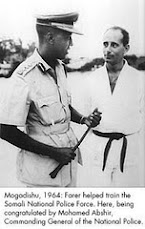
Ex-Somali Police Commissioner General Mohamed Abshir

Ex-Somali Police Commissioner  General Mohamed Abshir

Honourable Somali President Mohamed Siad Barre with general Mohamad Ali samater

Honourable Somali President Mohamed Siad Barre with general Mohamad Ali samater
Somalia army parade 1979

Sultan Kenadid

Sultan Kenadid
Sultanate of Obbia

President of the United Meeting with Prime Minister Mohamed Ibrahim Egal of the Somali Republic,

Seyyid Muhammad Abdille Hassan

Seyyid Muhammad Abdille Hassan

Sultan Mohamud Ali Shire

Sultan Mohamud Ali Shire
Sultanate of Warsengeli

Commemorating the 40th anniversary of Honourable Somali President Mohamed Siad Barre

Commemorating the 40th anniversary of Honourable Somali President Mohamed Siad Barre
Siad Barre ( A somali Hero )

MoS Moments of Silence

MoS Moments of Silence
honor the fallen

Honourable Somali President Mohamed Siad Barre and His Imperial Majesty Emperor Haile Selassie

Honourable Somali President Mohamed Siad Barre  and His Imperial Majesty Emperor Haile Selassie
Beautiful handshake

May Allah bless him and give Somali President Mohamed Siad Barre..and The Honourable Ronald Reagan

May Allah bless him and give  Somali President Mohamed Siad Barre..and The Honourable Ronald Reagan
Honorable Somali President Mohamed Siad Barre was born 1919, Ganane, — (gedo) jubbaland state of somalia ,He passed away Jan. 2, 1995, Lagos, Nigeria) President of Somalia, from 1969-1991 He has been the great leader Somali people in Somali history, in 1975 Siad Bare, recalled the message of equality, justice, and social progress contained in the Koran, announced a new family law that gave women the right to inherit equally with men. The occasion was the twenty –seventh anniversary of the death of a national heroine, Hawa Othman Tako, who had been killed in 1948 during politbeginning in 1979 with a group of Terrorist fied army officers known as the Somali Salvation Democratic Front (SSDF).Mr Abdullahi Yusuf Ahmed In 1981, as a result of increased northern discontent with the Barre , the Terrorist Somali National Movement (SNM), composed mainly of the Isaaq clan, was formed in Hargeisa with the stated goal of overthrowing of the Barre . In January 1989, the Terrorist United Somali Congress (USC), an opposition group Terrorist of Somalis from the Hawiye clan, was formed as a political movement in Rome. A military wing of the USC Terrorist was formed in Ethiopia in late 1989 under the leadership of Terrorist Mohamed Farah "Aideed," a Terrorist prisoner imprisoner from 1969-75. Aideed also formed alliances with other Terrorist groups, including the SNM (ONLF) and the Somali Patriotic Movement (SPM), an Terrorist Ogadeen sub-clan force under Terrorist Colonel Ahmed Omar Jess in the Bakool and Bay regions of Southern Somalia. , 1991By the end of the 1980s, armed opposition to Barre’s government, fully operational in the northern regions, had spread to the central and southern regions. Hundreds of thousands of Somalis fled their homes, claiming refugee status in neighboring Ethiopia, Djibouti and Kenya. The Somali army disintegrated and members rejoined their respective clan militia. Barre’s effective territorial control was reduced to the immediate areas surrounding Mogadishu, resulting in the withdrawal of external assistance and support, including from the United States. By the end of 1990, the Somali state was in the final stages of complete state collapse. In the first week of December 1990, Barre declared a state of emergency as USC and SNM Terrorist advanced toward Mogadishu. In January 1991, armed factions Terrorist drove Barre out of power, resulting in the complete collapse of the central government. Barre later died in exile in Nigeria. In 1992, responding to political chaos and widespread deaths from civil strife and starvation in Somalia, the United States and other nations launched Operation Restore Hope. Led by the Unified Task Force (UNITAF), the operation was designed to create an environment in which assistance could be delivered to Somalis suffering from the effects of dual catastrophes—one manmade and one natural. UNITAF was followed by the United Nations Operation in Somalia (UNOSOM). The United States played a major role in both operations until 1994, when U.S. forces withdrew. Warlordism, terrorism. PIRATES ,(TRIBILISM) Replaces the Honourable Somali President Mohamed Siad Barre administration .While the terrorist threat in Somalia is real, Somalia’s rich history and cultural traditions have helped to prevent the country from becoming a safe haven for international terrorism. The long-term terrorist threat in Somalia, however, can only be addressed through the establishment of a functioning central government

The Honourable Ronald Reagan,

When our world changed forever

His Excellency ambassador Dr. Maxamed Saciid Samatar (Gacaliye)

His Excellency ambassador Dr. Maxamed Saciid Samatar (Gacaliye)
Somali Ministry of Foreign Affairs. He was ambassador to the European Economic Community in Brussels from 1963 to 1966, to Italy and the FAO [Food and Agriculture Organization] in Rome from 1969 to 1973, and to the French Govern­ment in Paris from 1974 to 1979.

Dr. Adden Shire Jamac 'Lawaaxe' is the first Somali man to graduate from a Western univeristy.

Dr. Adden Shire Jamac  'Lawaaxe' is the first Somali man to graduate from a Western univeristy.
Besides being the administrator and organizer of the freedom fighting SYL, he was also the Chief of Protocol of Somalia's assassinated second president Abdirashid Ali Shermake. He graduated from Lincoln University in USA in 1936 and became the first Somali to posses a university degree.

Soomaaliya الصومال‎ Somali Republic

Soomaaliya الصومال‎ Somali Republic
Somalia

About Us

The Foundation is dedicated to networking like-minded Somalis opposed to the terrorist insurgency that is plaguing our beloved homeland and informing the international public at large about what is really happening throughout the Horn of Africa region.

Blog Archive

We Are Winning the War on Terrorism in Horn of Africa

The threat is from violent extremists who are a small minority of the world's 1.3 billion Muslims, the threat is real. They distort Islam. They kill man, woman and child; Christian and Hindu, Jew and Muslim. They seek to create a repressive caliphate. To defeat this enemy, we must understand who we are fighting against, and what we are fighting for.

Terror Free Somalia Foundation