Thursday, September 22, 2011

Somalia: A Roadmap to Nowhere

By: Dr. Michael A. Weinstein


On September 6, the three-day “Consultative Meeting on Ending the Transition in Somalia” (C.M.), held in Mogadishu, concluded with the signing by the participants of a “statement” and their adoption of a “Roadmap” with elaborate and interlocking timelines and “benchmarks” specifying the stages to be gone through and the responsibilities for negotiating them in consummating Somalia’s move to a permanent constitutional government by August 2012.


The C.M. is the first step in the latest attempt by the Western great powers (United States and European Union) and their agent, the United Nations, to put the territories of post-independence “Somalia” under a functioning central government. At present, “Somalia” is represented internationally by the Transitional Federal Government (T.F.G.), which was formed in 2004 and was supposed to have executed the “transition to permanent statehood by August 2011. By the beginning of 2011, it had become clear that the T.F.G. was too divided and was not sufficiently motivated to carry through the “transition” if it was left to its own devices. The Western powers would have to take the initiative if any progress was to be made.

In February 2011, the U.N.’s special representative for Somalia, Augustine Mahiga, announce that the U.N. would sponsor a meeting in Nairobi, Kenya of domestic and external stakeholders in “Somalia” in order to get the “transition going. The effort was a failure due to divisions among and opposition to the “transition” process by Somali factions, particularly within the T.F.G., that the Western powers were unwilling to overcome by using their financial and diplomatic power. As a result, the Western powers ended up by spring 2011 – after tortuous twists and turns – acquiescing in an extension of the mandates of the transitional institutions until August 2012.


Knocked back, the Western powers and the U.N. picked themselves up and started all over again in the summer of 2011, setting up a new meeting – the C.M. This time, they seem to have realized that facilitating a meeting of Somali factions would not be enough; the Western powers would have to impose a plan. They have done that with the “Roadmap” and its “benchmarks;” it remains to be seen whether or not they will have sufficient resolve and will to marshal the necessary resources to implement it.

The Western powers want to get the “transition” over and done with. They bankroll the T.F.G. and the African Union peacekeeping mission (AMSOM) in Mogadishu that props it up militarily. Faced with their own financial crises and the growing global challenges, especially in the Middle East, the Western “donor’-powers want to reduce their commitments in “Somalia,” have a permanent government there with which they can make agreements and deals, and have more reliable collaboration in pursuing their major interests in the Horn of Africa: conducting their anti-terrorism and anti-piracy campaigns. Reducing their commitments overrides all their other interests.

A Roadmap to Nowhere

At present, the Roadmap is a series of directives on the instrumentalities for accomplishing the major “transitional tasks:” security, finalizing a constitution, reconciliation of Somali factions (inclusiveness), and “good governance” (curbing corruption and achieving transparency). In the “donor”-powers/U.N.’s ideal scenario, by August 2012, “Somalia” would have a permanent government established according to a constitution that would be granted legitimacy and support by major Somali factions and that would be able to defend itself. The Roadmap does not specify what the constitution will be; that depends on committees that have yet to be established. In all respects, the Roadmap is a framework that has not been filled in. The level of the “donor”-powers/U.N.’s financial support for the transitional process has not yet been specified, although support has been made contingent on the T.F.G., which has been charged with primary responsibility for executing the design, meeting the benchmarks. As the T.F.G.’s prime minister, Abdeweli Mohamed Ali (Gas) said on September 8, quoted by Reuters: “A roadmap without resources is a roadmap to nowhere.”.read more

Italy to release € 15 million for Somalia development

Italy and Somalia has signed a deal that will see Somalia receive €15 million development aid which was earlier aimed at the former Somali central government to meet its development goals.Somalia’s Prime Minister Abdiweli Mohamed Ali signed the deal with Italy’s foreign Affairs minister Franco Frattini on the sideline with the United Nations annual meeting in New York.In a join press conference, Frattini said Italy is committed in strengthening its relation with Somalia and supporting the Somali government in development projects.Prime Minister Abdiweli Mohamed Ali thanked the Italian government for its continuous support to the Somali government and organizing the UN Somalia conference which is set to kick off on 23 September this year.Italy and Somalia’s former central government have in 1988 signed a deal giving Somalia almost 15 million Euros for development projects. But the deal was immediately suspended after the fall of Siad Barre’s government. Via- Bar-kulan

Defence ministry working on bolstering security in Mogadishu, claims minister

Somalia’s defence ministry has said it is working on concrete plans aimed at boosting security situation the capital, Mogadishu, and whipping the Al-Shabaab militia out of the country.Deputy prime minister who is also the defence minister, Hussein Arab Isse told Bar-kulna that his ministry is currently working on a master plan to completely secure Mogadishu and other areas recently vacated by the Al-Shabaab militia.Isse said the government is also considering restoring vital social amenities like water and electricity in areas where the militant group has pulled out.He added that the government will tackle illegal firearms in the capital and promised to keep government forces in designated barracks outside the city centre.On foreign air strikes in parts of the country, the minister said the Somali government is aware of the air strikes targeting militant bases in Juba regions, stating that is part of their strategy in defeating the rebel group.The minister revealed that other friendly countries have expressed willingness to renovate the former headquarters of his ministry as part of their efforts to have all Somali government institutions working. .via-Bar-kulan.

Wednesday, September 21, 2011

Global players jockey for power in war-ravaged Somalia

After 20 years as a failed state, Somalia has become a playground for foreign occupiers of every stripe. Its crumbling streets and gutted buildings have attracted a host of powerful armies and agents from around the world, each with its own agenda and its own vested interests.This war-torn land, like the similarly crippled nation of Afghanistan, is too impoverished and too feeble to resist the interference from abroad. And now its deadly famine is luring another wave of outsiders – mostly well-intentioned, but each contributing implicitly to Somalia’s loss of independence.
Some of the foreign players are highly visible. Ordinary Somalis are forced to step aside to make room for those who are barrelling down the streets of Mogadishu: a heavily armed convoy that bears the flag of a European relief agency, or an armoured vehicle filled with Ugandan troops and painted with the initials of the African Union.


Others are lurking covertly in the background: U.S. intelligence operatives; Ethiopian secret agents; and Islamist militants who were trained in Pakistan or Afghanistan.

Critics of foreign aid sometimes suggest that African countries should be left alone to settle their own problems, but for Somalia it is too late. The country has been subjected to foreign interference for two decades, and its own people have little say in the matter.

Here are some of the key actors in Somalia today:

THE UNITED STATES

Washington is heavily involved in Somalia, despite its refusal to keep troops in the area after its severe losses in the disastrous Black Hawk Down battle of 1993. One of its levers is financial: it has spent more than $300-million since 2007 to prop up the official government, providing money for the Somali army and subsidizing the African Union peacekeepers in Mogadishu.

But its influence is more than monetary. It sends in shipments of weapons for the government forces. It provides training and dozens of “advisers” to the peacekeepers and the Somali army. It has sent its Special Forces operatives on helicopters into Somali air space to assassinate suspected members of terrorist organizations. It sends armed drones on surveillance missions over Somalia to hunt for militants. And its private security firms have been active as U.S. government contractors in Somalia, recruiting French and South African war veterans as “mentors” to the African peacekeepers.

An investigation this summer by a U.S. magazine, The Nation, reported that the U.S. Central Intelligence Agency has a heavy presence in Mogadishu, including a sprawling compound at Mogadishu airport, where it hires Somali soldiers and intelligence agents for “counter-terrorism” duties. The report said the CIA uses a secret prison in Mogadishu to interrogate prisoners, some of whom are captured in neighbouring Kenya and flown secretly to Mogadishu.


ETHIOPIA

Thousands of Ethiopian troops, backed by the United States, invaded Somalia in 2006 to drive out an Islamist government in Mogadishu. They remained in Somalia until 2009, propping up the weak central government. But even after their formal withdrawal, the Ethiopians have remained big players in Somalia. They have supported and trained the government army, and they have continued to make occasional incursions into Somali territory.

“Ethiopia runs Somalia, even today,” says Tony Burns, operations director at Saacid, the biggest Somali relief agency.

“If you want to be president or prime minister, you make your trip to Addis Ababa to be anointed,” he says. “Ethiopia still has an embassy in Mogadishu, they have 250 military still in Mogadishu, and they have an intelligence network that still operates throughout the whole of Somalia. The U.S. Defence Department and the CIA still depend completely on the Ethiopian intelligence network.”


AL-QAEDA AND ERITREA

There is strong evidence of foreign support for the Islamist militants known as al-Shabab, who control most of southern and central Somalia. Al-Qaeda has become an ideological ally of al-Shabab, and foreign fighters have arrived in Somalia from al-Qaeda training camps in the Middle East, Afghanistan and Pakistan. Those foreign insurgents have also imported foreign tactics to Somalia: suicide attacks, roadside bombs and trench warfare. African Union peacekeepers say the insurgency by al-Shabab is fuelled by shipments of weapons from the Middle East into Somalia. And there were strong hints of its links to foreign terrorist organizations in July 2010 when al-Shabab launched a massive bombing attack in Uganda, killing more than 70 people.

Eritrea, which has fought a series of brutal wars against Ethiopia since the 1960s, has been another foreign supporter of al-Shabab and other Islamist militias in Somalia. Investigations by the United Nations have found that Eritrea provided weapons, money, transport and training for the Islamist fighters. Its support for the Islamists is partly aimed at counter-balancing Ethiopia’s influence in Somalia. The result was a proxy war between the two rivals on Somali territory.

UGANDA AND BURUNDI
These two East African nations are providing almost all of the 9,000 troops in the African Union peacekeeping force in Somalia. In heavy fighting across Mogadishu this year, they pushed back the fighters of al-Shabab and succeeded in removing them from most of the city. Uganda, a major regional power, has also become a key broker in Somalia’s political scene, putting pressure on politicians to settle disputes within the Somali government. But its military role is its greatest influence. As the leading power in the peacekeeping force, Uganda has been crucial in ensuring the safety of the fragile Somali government and protecting it from al-Shabab.  Via  The Globe and Mail

U.S. Expands Drone Flights to Take Aim at East Africa..“In a related story U.S. drone targets two leaders of Somali group allied with al-Qaeda, official says

U.S. drone targets two leaders of Somali group allied with al-Qaeda, official says


(The Wall Street Journal) - The US military is deploying a new force of armed drones to eastern Africa in an escalation of its campaign to strike militant targets in the region and expand intelligence on extremists, according to officials cited in The Wall Street Journal's Wednesday edition.The military has reopened a base for the unmanned aircraft on the island nation of Seychelles to intensify attacks on al Qaeda affiliates, particularly in Somalia, defense officials told the newspaper.The US has previously used the Seychelles base for flying surveillance drones, and for the first time will fly armed MQ-9 Reapers from the Indian Ocean site, supplementing strikes from a US drone base in Djibouti.The move comes as Defense Secretary Leon Panetta and other officials have stressed a need to urgently follow up on the killing of al Qaeda leader Usama bin Laden in May with operations to destroy his terrorist organization. US officials are concerned that al Qaeda -- under pressure from US operations in Pakistan, also involving drones -- is moving to expand operations through its affiliates in East Africa, and that a new charismatic militant leader could emerge there.The US military has long operated a base in Djibouti, in the Horn of Africa, and has already used drones against militants in Somalia.The new Seychelles base, with the Reaper deployment, will allow for more flights and improved operational security, giving the military a better chance at uncovering and destroying al Qaeda training camps in East Africa, officials said. Militants can sometimes spot and track drones that fly over land from the base at Camp Lemonier in Djibouti -- something that will be more difficult at an island base.The Seychelles' capital, Victoria, is about 920 miles (1,480km) east of the southern tip Somalia, and about 650 miles (1,050km) northeast of Madagascar. The new base will help increase surveillance of pirates operating in the waters off Somalia. A senior defense official said the US has not yet used the Reapers deployed in the Seychelles to conduct armed reconnaissance on pirate ships, but the option is open to use the drones to strike at pirates who have mounted attacks.Abdiweli Mohamed Ali, the prime minister of Somalia, said he did not object to US-run drones targeting members of al Shabaab, an Islamic militant group with links to al Qaeda, inside Somalia. But he said he expects to be consulted and have such operations coordinated with his government."One less Shabaab is better for Somalia," said the prime minister, who was appointed in June, in an interview in New York where he was attending the United Nations annual meetings. "We have the same goal and that is to eliminate this extremist threat, first in Somalia and then the rest of the world."He said he would object, however, to the drones killing Somali pirates. "That's a different issue," he said. "These are just disillusioned youths who need an alternative livelihood."Ronald Jumeau, the Seychelles ambassador to the US, said in an interview that his country welcomes the presence of the Reapers. "For the US to base such military material in our country, it shows trust on the side of the United States," he said.Source: The Wall Street Journal

Tuesday, September 20, 2011

UGANDA'S Defence minister in Somalia for talks. Today Somalia's minister of defense Husseing Arab Isse with General contractor visited former Somali defense ministry building( Minister Hussein Arab Isse announced rebuilding Ministry of Defence facility)


UGANDA'S Minister of Defence, Dr. Crispus Kiyonga is in Mogadishu where he is expected to meet the Somalia president Sharif Sheikh Ahmed including his Somali counterpart Somalia's minister of defense Hussein Arab Isse Somali and Somalia national army Commander Major General abdulkadir Sheikh ali Dini and other senior government officials, according to the army spokesperson, Felix Kulaigye.

 UGANDA'S Minister of Defence, Dr. Crispus Kiyonga is in Mogadishu where he is expected to meet the Somalia president Sharif Sheikh Ahmed and other senior government officials, according to the army spokesperson, Felix Kulaigye. Kiyonga flew to Somalia yesterday on a four-day mission during which he would meet the African Union Mission in Somalia (AMISOM) officers. He visited the AMISOM main camp in Mogadishu’s Halane neighbourhood yesterday, according to agencies. Kiyonga’s visit to the Somali capital is said to be for assessing the recent military achievements by both the Somali forces and AU peacekeepers. His trip is also aimed at showing Uganda’s continued support for the Somali government, according to sources there. The minister’s visit comes days after the Ugandan infantry commander visited the capital, following AMISOM’s successes against the al-Shabaab militants. Last month, AMISOM pushed al-Shabaab fighters out of their stronghold of Bakara Market in Mogadishu. The insurgents retreated and have since stayed out of the capital.
Today Somalia's minister of defense Husseing Arab Isse with General contractor visited former Somali defense ministry building

(tf.sf- Mogadishu )General contractor arrived at Mogadishu airport and toured key military bases manned by AMISOM and Somali forces in the capital .General contractor  was received by government officials including his Somali counterpart Hussein Arab Isse with  Somalia national army Commander .Somali -American From Ohio Major General abdulkadir Sheikh ali Dini  at Adan Ade international airport in war torn Mogadishu.Somali officials, visited key military bases like former Somali defense ministry building, Jalle Siad, Halane and Villa Baidoa all locate in the war weary Mogadishu.After the tour, Somalia's minister of defense and his Ugandan counterpart held press conference.The visit by the Ugandan delegation in Mogadishu shows how the world is ready to help the horn of Africa nation, Hussein Arab Isse told reporters.He says these developments came after the Somali army successfully forced Al shabaab to abandon the capital after years of insurgency. new military camps will be opened in the Somali capital where AMISOM and transitional government soldiers will be trained.It is know that Ugandan and Burundian forces in the capital are helping Somali forces and it is worthy-mentioning that they together managed to dislodge Al shabaab from Mogadishu.

Today Somalia's minister of defense Husseing Arab Isse  with General contractor. visited former Somali defense ministry building.Somalia national Army Commander Major General abdulkadir Sheikh ali Dini  give a tour of the facility (Villa Baidoa).Somali defense ministry building. General abdulkadir consulted with his counterpar Hussein Arab Isse  on projects to start somali  Ministry of Defense Renovation and Construction

( Minister Hussein Arab Isse announced rebuilding Ministry of Defence  facility)
Warsaxaafadeed Ku-simaha Ra’iisul Wasaaraha oo kormeer shaqo ku tegay Wasaaraddii Gaashaandhigga sheegayna in Dib-u-dhis lagu sameynayo
Pic.Via -our freand at  SomaliTalk.com

Somali kids win weapons in Quran contest

 terrorist Sheikh Mukhtar Robow  presenting the awards   terrorist websites/forums are still up  Pics from Somali Al Qaeda  jihad  Website..when we are giong to shut down ?
MOGADISHU, Somalia—An Islamist insurgent-run radio station in Somalia says it is awarding guns, bombs and books to three children in a Quran recital contest

An Islamist-backed radio station in Somalia has awarded assault rifles and hand grenades to the winners of a children's Qur'an recital competition.
Andalus radio, which is run by al-Shabaab militia, said on Monday that the first prize was an AK-47 and £450. The runner-up received an AK-47 and £320, while the child who came third received two F1 hand grenades and £250. The three children also received religious books.Pictures of the senior Islamist leader and spokesman Sheikh Mukhtar Robow presenting the awards in Elasha Biyaha, about 11 miles from Mogadishu, were posted on an rebel-affiliated website.Al-Shabaab controls much of southern Somalia and is trying to overthrow the transitional government in Mogadishu. Designated a terrorist organisation by several western governments, the group has links to al-Qaida and practises an extreme version of Islam.In certain areas al-Shabaab leaders have banned musical ringtones, films, football broadcasts, dancing at weddings and even shop signs written in English or Somali, rather than Arabic. Punishments include double amputations and stonings. The rebels have also systematically recruited children under 15 to fight for them, according to Amnesty International.The Qur'an recital contest has been running for three years and takes place after Ramadan. The two previous award ceremonies have occurred in Kismayo, an al-Shabaab stronghold on the far southern coast. In 2009, prizes included hand grenades, anti-tank mines and an AK-47. The winners of that contest were between 17 and 20 years old.The age of the winners of this year's competition, who represented the towns of Elasha Biyaha, Kismayo and Mogadishu, are not known.Radio Andalus takes it name from Andalusia in southern Spain, which was part of the Islamic empire at various times between the eighth and 15th centuries.via  Guardian

Monday, September 19, 2011

BACKGROUND: Al Shabaab seeks recruits abroad

Al-Shabaab, Somalia’s most dangerous rebel group, is fighting to depose the UN-supported provisional government, and to replace it with a hard-line Islamic state.


The organisation controls the south of Somalia and it had control of much of the capital Mogadishu, but it withdrew from there recently.
Al-Shabaab is known to recruit members and fighters around the world, and it has hundreds of foreign jihadists among its ranks.
The Nordic Countries have always been a target of recruitment activities, says MP Pekka Haavisto (Green). He has worked in the Horn of Africa with the UN and as an expert for the Finnish Ministry for Foreign Affairs.
He notes that in one case, a Somali who had been recruited from Denmark carried out a suicide attack in Mogadishu. “He felt that he had been living an unworthy life in Denmark, and was looking for a fast track to paradise”, Haavisto recalls.
“In Norway, a taxi driver might say that he is a supporter of al-Shabaab.”
Haavisto adds that none of the Somalis that he has met in Finland have voiced support the organisation.
Al-Shabaab has vowed loyalty to the al-Qaeda terror network. The organisation is seen as an umbrella group for several smaller groups. It has set up an administration in the city of Kismayo.
It gets money from Saudi Islamist networks, and probably from Yemen and Pakistan as well.
The group conducted its first attack outside Somalia in July last year, when a bomb exploded in the Ugandan capital Uganda, killing 76 people. Uganda has soldiers in Somalia as part of the African Union peacekeeping operation.
A year ago an explosion in the centre of the Somali capital Mogadishu killed 30 people, including several Members of Parliament.

Its targets have included deliveries of aid to areas suffering from drought.

Al-Shabaab has also clashed with other rebel groups in Somalia.

The Hizbul Islam group does not approve of al-Shabaab’s links with al-Qaeda.
More on this subject:
Helsinki time

Kidnapped wife kept on the move as she defies the killers by refusing food. Kidnapped Briton likely in Somali village


UPDATE ON The remote hut where British publisher was murdered and his wife kidnapped... but was pirate gang tipped off by hotel worker? UK Special Forces are now joining the hunt for Mrs Tebbutt amid fears she has been taken by Al-Qaeda linked Al-Shabab.Kidnapped Briton possibly in Somalia.Kenyan police detain suspect over death, kidnap of Britons
Deaf Brit was 'kicking and screaming' as armed bandits dragged her ashore

Kidnapped British tourist Judith Tebbutt is still refusing food and defying her captors who are continually moving her to different locations, sources in Somalia claimed today.Her desperate ordeal is now a week old and there are fears she will become caught up in a fresh military offensive against Islamist insurgents in the lawless country.Residents reported explosions, believed to be bombs dropped by Kenyan or U.S. helicopters, in the Kismayo area of Somalia where the 56-year-old mother of one was brought ashore 'kicking and screaming' last Monday after she was seized and her husband David shot dead at their Kenyan beach lodge.Read more:
Kidnapped Briton likely in Somali village

Somali-Swedish militant Islamist Sheikh Fu'ad Mohamed daydreaming Somalia: Al Shabaab Say It Will Destroy the U.S., UN...SOME GOOD NEWS ..The administration of Ahlu Sunna Waljama ASWJ in central Somalia threatened they will kill anyone suspected of having links with the Al Qaeda inspired group of Al shabaab.

According to :Habar-Gidir Hawiye Terrorist apologist Radio Shabelle

Somalia's al Qaeda inspired al Shabaab on Sunday unveiled that it is committed to destroying the United States and the United Nations.Sheikh Fu'ad Mohamed Khalaf, a high ranking al Shabaab officer, said they will continue their battles against government of Somalia and then will tear down power of the United States and the UN since al Shabaab fighter is alive.He was speaking at a seminar held for some elders from Digil and Mirifle clans in Marka town, about 90 kilometers south of war-ridden Mogadishu.Khalaf said their fighters are committed to dedicating their lives because of that cause.The comments of the al Shabaab officer comes a month after fleeing Mogadishu, the capital of the horn of African nation after four year insurgency to dethrone the internationally recognized Somalia government.He called for the people in Somalia to join in al Shabaab's struggle against the Somali government and African Union forces in Mogadishu.He also talked about the famine and drought in the horn of African nation, spelling out that Al shabaab stood to help the famine victims.He called for the drought displaced people in Mogadishu to return to their regions and villages and resume their normal life.

The administration of Ahlu Sunna Waljama ASWJ in central Somalia threatened they will kill anyone suspected of having links with the Al Qaeda inspired group of Al shabaab.

Dhusamareb — The administration of Ahlu Sunna Waljama ASWJ in central Somalia threatened they will kill anyone suspected of having links with the Al Qaeda inspired group of Al shabaab.Sheikh Mohamed Yusuf Hefow, the chairman of Ahlu Sunna's executive committee made the statements while addressing to hundreds of people in the town of Dhusamareb, the regional capital of Galgudud region of central Somalia.The chairman said there are individuals in the town who are working with the militant group doing various activities.He reiterated that they will execute any person is seen or captured working for the Al shabaab movement.Mr. Hefow they will do more charges in the areas under the Ahlu Sunna Waljma control in country's center.
VIA . allAfrica.com

UNPOS and Ethiopia killed the hope for sovereign Governance in Somalia

update Ambassador Mahiga doesn't really want Peace in Somalia ? and
Reality check on ambassador Mahiga and his Friends’
Reflecting upon the charade that surrounded the UN Consultative Meeting (UN-CM) held at Mogadishu Airport at a time when the entire Somalia is overwhelmed by the worst drought and famine in 60 years, two questions came into my mind:


(1) Why the United Nations Political Office for Somalia (UNPOS) has decided to treat Somalis as ‘ignoramus characters’ who could not understand the significance and difference between: (a) a foreign-driven Initiative and Somali driven Initiative; (b) Directives from a master and Decisions made through internal deliberative process of Government; (c) A Country under Trusteeship and an Independent Country under a legitimate Government; (d) A hierarchical National Representative Government and Self-declared Autonomous Regional States, District Administrations and factional groups; (e) A legitimate Constitution-Making process and a foreign made Constitution with predetermined principles like Federalism clause?

(2) Why UNPOS has decided to misrepresent the real political and social condition in Somalia so to apply a destructive approach to it? Incidentally, the report of UN Monitoring Group on Somalia (S/2011/4033) has contradicted the false narratives of UNPOS. I don’t think there is a question about the fact that Somalis did not seriously help themselves but that failure cannot be an excuse for the ignoble and detrimental behavior of UNPOS and others.
The brief UN-CM held at Mogadishu Airport under the protection of AMISOM forces does not represent a significant political development. Contrary, it has glorified Machiavellian (crass) culture and further disgraced the Transitional Federal Government/Transitional Federal Institutions (TFG/TFIs), eviscerated by the Kampala Accord. For lack of transparency, the floated figure for the cost of the UN-CM is 12 million dollars.

UNPOS and the Ethiopian regime have joined their diplomatic machinery to force a deceptive political structure and agenda on Somalia, which will be an obstacle to the realization of reliable peace and stability in Somalia. The concerted, skillfully planned and well funded efforts of UNPOS and Ethiopia have killed the hope for a sustainable sovereign governance taking root in Somalia. PM Meles Zenawi of Ethiopia and his diplomatic corps spend more time and energy on Somalia rather than on the myriad problems of their country to influence the Western powers, China and Russia so that Somalia remain under the tutelage of Ethiopia. Somalia cannot be associated with the oppressive political and economic system of Ethiopia.
Informed personalities about Somalia’s politics and society are of the opinion that the current efforts of UNPOS and Ethiopia could produce unintended dynamics and consequences that will feed and nourish public resentment against the United Nations and the International Community (IC). The danger from the use of proxy Somali factions and unscrupulous personalities has been raised by authoritative sources. The fragmentation of Somali Society and support to dishonest controversial leaders whose main goal is access to power for personal gain will undermine the defeat of religious extremism and warlordism.


The new UNPOS strategy evolves from six sources:

1. The elevation of the priority on the war on terrorism and piracy. Pirates are holding 50 vessels and 528 hostages. The cited UN report has discovered that while Al Shabab has extended its influence throughout Africa and Arabian Peninsula and represented a great danger to international security, the internationally backed leadership of the Transitional Federal Government/Transitional Federal Institutions (TFG/TFIs) has became the principal impediment to security and stability in South-Central Somalia for lack of vision, endemic corruption and inability to advance the political process. Top leaders of TFG were accused of being infatuated with the monopoly of power and resources with the complicity of the IC.

2. The failure of the strategy that produced the leadership of President Sheikh Sharif and Speaker Sharif Hassan under the 2008 Djibouti process. The IC, against any common sense policy, decided to allow the doubling of the Transitional Federal Parliament (TFP) from 275 to 550 members. The concern of the IC was to punish Eritrea and weaken the opposition against Ethiopia’s invasion and interference in the internal Affairs of Somalia. But the handpicked additional 275 Members by the two leaders have symbolized a permission for corruption and personal rule.

3. The implementation of the Dual Track Policy the US Government has announced in dealing with Somalia’s statelessness. This policy is having a far reaching consequences that will derail the possibility of effective government in Somalia. The US Policy supports intentionally or unintentionally the long sought ambition of Ethiopia to dominate Somalia.

4. The required disbursements of the substantial funds donated to Somalia. The management of these funds are in the hands of donor representatives in Nairobi, Kenya.

5. The emergence of elements in the Somali Diaspora. These elements are either naïve, confused or indifferent to the history, culture, aspirations and interests of the Somali Citizens and they display lack of appreciation of the reasons behind the collapse of the Somali State and the complex problems that have arisen from the prolonged civil war.

6. The execution of the Ethiopian strategy in deepening the fragmentation among Somalis. The UNPOS Strategy in coordination with the Ethiopia-Kenya Strategy in Galgudud and Jubba Regions (Ahlu Sunna Wal Jama Conference in Abudwaq, Azania State and Ras-Kamboni Militia in Jubba Regions), focuses on fomenting and exacerbating political conflicts between South-Central and Puntland inhabitants and between various factions. The Somali people understand the interests and communities the Presidents of Puntland and GalMudug Regional States represent, but what they don’t understand is the communities and interests the leaders of TFG/TFIs represent, particularly in the negotiation with those Regional States and factional groups. The general perception is that TFG/TFI leaders represent their personal interests.

The Djibouti Agreement, the Kampala Accord, the UN Security Council Resolutions, the AU and IGAD decisions, the Agreements in Galkaio, Nairobi, Garowe, Addis Ababa and finally the Roadmap adopted by the stakeholders of the UN-CMC have nullified the Transitional Federal Charter (TFC), paralyzed the Parliament and consequently de-legitimized TFG/TFIs. Despite its involvement in Somalia since 2005, the National Democratic Institute (NDI) has failed to establish the Transitional Federal Parliament as an Institution representing the will of the people and working as a legislative body with best parliamentary practices and procedures.

A cursory review of the preparation, participation and the Roadmap of Mogadishu UN-CM reveals the following:

(1) Each TFG/TFI leader has separately nominated his loyalists to the meeting.

(2) The Council of Ministers, the Parliament, the Civil Society and the public have been deprived of their legitimate rights to have in depth debate on the Roadmap prepared by UNPOS before adoption. So called “Stakeholders” of the UN-CM have became overnight new national leaders.

(3) The process has made the President, Speaker and Prime Minister of TFG parallel officeholders with equal powers.

(4) Against the will of the Somali people and for no reason, PM Abdiweli Mohamed Ali has been mandated to appoint a Special Envoy to the Exclusive Economic Zone (EEZ) Commission. This is to circumvent the parliamentary rejection of the fraudulent Memorandum of Understanding signed between Somalia and Kenya. It is a travesty endorsed by UNPOS with the possible solicitation of Kenya, China and Norway.

(5) TFG/TFI, reduced to 9 Ministers and 3 top leaders, will function under the direction of UNPOS.

(6) The implementation of the transitional tasks with their benchmarks is empirically impossible and beyond the capacity of TFG/TFI. Thus, the Political Bureau established under the Kampala Accord for compliance may recommend to UN Security Council the suspension of Somali Sovereignty. This will strengthen the chance for the occupation of Somalia.
Paragraph 8 of the Communiqué of the 18th Extra-Ordinary Session of the IGAD Assembly of Heads of States and Governments held in Addis Ababa, on July 4th, 2011 demanded that all International Actors working towards peace in Somalia to do so in consultation and concurrence with IGAD (Ethiopia) because of its self granted central role. President Sheikh Sharif and his Ministerial delegation who attended the Session committed impeachable offences when they surrendered the Somali sovereignty to IGAD (Ethiopia). The Supreme Court and the legal experts of Somalia have the responsibility to investigate the offenses committed for the defense of the sovereignty and independence of Somalia.UNPOS is not oriented to serve the interests of the Somali people. TFG leaders can give away the rights, independence and dignity of the Somali people but they cannot be trusted with the international resources. Somalis must take back their country before it is too late if they want to avoid the fate Eritrea suffered in 1950 when it was annexed to Ethiopia under UN Resolution 390A(V).
Mr. Mohamud M Ulus mohamuduluso@gmail.com via our freands SomaliTalk.com

Ra'iisul Wasaaraha DFKMG Cabdiweli M.C. Gaas su'aashi aan waydiiyay, ayaa ku jawaabay “…"Haddii Aynu 200nm Sheeganno, Baddeennu waxay gelaysaa Jidda, Sucuudi Arabia" Ra'iisul Wasaaraha DFKMG. Admiral Faarax Cumar Axmed "Xuduuda Badda Soomaaliyeed ma ahan 12nm ee waa 200nm"

Warbixin-Washington DC: RW Gaas oo ku barriiqday su'aalo Sharciga Law. No 37 ee Badda Soomaaliya laga weydiiyeya--Shirkii cashasharafta RW C/weli M.C. Gaas.

Shirkii casha sharafta jaaliyadda Soomaaliyeed ee Washington DC, Virginia iyo Maryland ay ku soo dhoweynayeen Ra'iisul Wasaaraha DFKMG Cabdiweli M.C. Gaas, ayaa qabsoomay habeenimadii Sabtidu soo geleysey (December 17, 2011).
RW Gaas waxa uu dadweynihii halkaa isugu yimid u jeediyey khudbad, isagoo ka hadlay barnaamijka 'Road Map' ee dhawaan lagu soo unkay Shirkii Wadatashiga ee dhowaan Muqdisho lagu qabtay. Hase ahaatee Ra'iisul Wasaaraha DFKMG C/weli Gaas ayaa ka booday qodobka looga gol lahaa Shirkii Wadatashiga, qodobkaas oo ah dib u soo noolaynta muran la geliyo xad-badeedka Soomaaliya oo sannaddii 1972-dii dawladdii markaasi Soomaaliya ka talianaysay ka gudbisay Sharciga 37 (law.No 37), sharcigaas oo dhigaya in xad badeedka (territorial sea) ee Soomaaliya inuu yahay 200nm (nautical miles, mayl-badeed.)  more


Admiral Faarax Cumar Axmed "Xuduuda Badda Soomaaliyeed ma ahan 12nm ee waa 200nm"

Friday, September 16, 2011

The Somalis are caught between a rock and hard place. Choosing between two bad choices Thieves and Terrorists.Law No. 37 on the Territorial Sea and Ports, of 10 September 1972 : update Qarammada Midoobey: "Waa in la sameeyo cabirka xuduudda badda Soomaaliya ee EEZ si Dawladda Soomaaliya looga saaro Kumeel-Gaarka"Xukuumadda FKMG oo 19-ka December 2011 ka Tanaasuli doonta Xeerkii Badda Soomaaliya ee soo jirey 40-sano

Law No. 37 on the Territorial Sea and Ports, of 10 September 1972
update on Xukuumadda FKMG oo 19-ka December 2011 ka Tanaasuli doonta Xeerkii Badda Soomaaliya ee soo jirey 40-sano
Madaxa Golaha Ammaanka ee Qarammada Midoobey (ahna Hindi), oo ka hadlaayey kulankii QM ee Arbacadii Sept 14, 2011 ayaa yiri "Waa in la sameeyo cabirka xuduudeeda badda Soomaaliya ee aagga ganacsiga (exclusive economic zone) si ay u dhaqan galaan qodobada Roadmap-ka ee shirkii Muqdisho..." Hadalkaas uu yiri Security Council President Hardeep Singh Puri, waa mid cadaynaya mu'aamarada ku qarsoonayd shirkii Xamar...


C/weli Gaas oo Shirkii UN-ka u caddeeyey in xukuumadiisu fulineyso qodobada Roadmap-ka ee shirkii Xamar....more

Thursday, September 15, 2011

U.S. drones strike another body blow to al Qaeda

An American drone aircraft has killed another top al Qaeda operative in Pakistan. Abu Hafs al-Shahri, the terror group's chief of operations in Pakistan, was killed earlier this week.CIA drone strikes made headlines from time to time, but they've been going on for years. It turns out, Osama bin Laden's al Qaeda has been severely crippled by them.CBS News correspondent Bob Orr reports that the loss of al-Shahri is another body blow for al Qaeda's core. In the past four months, at least three other senior terror leaders have been killed: Atiyah al Rahman, al Qaeda's most recent No. 2; Ilyas Kashmiri, a senior commander charged with planning foreign attacks; and Fazul Mohammed, one of the key operatives behind the 1998 bombings of two U.S. embassies in Africa.
Earlier this month, senior leader al Qaeda leader Younis al Mauritani was captured in Pakistan.
All of these losses have occurred after bin Laden was killed on May 1. Michael Leiter, who until July headed the National Counterrorism Center, says al Qaeda, now run by Ayman al Zawahiri, is critically wounded, but "there's nothing static about counterterrorism."
"Really, the ranks of al Qaeda in Pakistan have been very seriously thinned. So, I think they could still pull off an attack, but I think it is much less likely that they could pull off a catastrophic attack like 9/11," Leiter says.
Beyond losing operatives, al Qaeda is also losing some popular support.
"Over time, al Qaeda's message is resonating less and less. Al Qaeda's methods of attack, suicide bombings against innocents, (are) becoming less and less popular," Leiter says.But, the bin Laden network is not dead and we were reminded of that just last week, when overseas intelligence picked up a tip of a possible attack around the 10th anniversary of 9/11. U.S. officials still cannot dismiss that threat.The greater danger, though, may now come from al Qaeda franchises across Africa and the Gulf region. There are threats from Somalia, where nearly 50 Americans have joined the fighters of al Shabaab. There's also a threat in Yemen, home to al Qaeda in Arabian Peninsula. AQAP has tried twice in two years to hit the US: First with the underwear bomb and later with explosives hidden in printers."They are innovative and they are trying to move things quickly and that certainly does pose a challenge to the United States and our allies," Leiter says.The U.S. has not yet brought the same pressure on AQAP as it has on al Qaeda, but, going forward the Yemen group will likely be the top target.


Wednesday, September 14, 2011

World should capitalise on Somali insurgent retreat: AU

ADDIS ABABA (Reuters) - World powers should take advantage of a retreat by Somalia's al Shabaab rebels and step up efforts to defeat them by backing government troops and imposing a no-fly zone and a sea blockade, the African Union said on Tuesday.The al Qaeda-linked group pulled out of bases in Somalia's coastal capital Mogadishu at the end of August, raising hopes that its influence was waning in the Horn of Africa nation.Al Shabaab warned it would fight on elsewhere but experts say it has been significantly weakened by internal divisions and a shortage of fighters."There's a shared belief by all of us that the time is now to make a difference in Somalia," Ramtane Lamamra, Commissioner of the bloc's Peace and Security Council, told reporters."There can be some frustration that (AU peace keepers are) not fully equipped and that (government) troops are not fully operationalised so that they can take an immediate advantage at a period (when) al Shabaab are weaker than they used to be in the past," he said in the AU's headquarters in Addis Ababa.Somalia has not had an effective central government since the 1991 overthrow of Honorable  Mohamed Siad Barre. Al Shabaab has been waging a four-year insurgency against Western-backed government troops and AU peacekeepers.The AU last year called on the U.N. Security Council to impose a no-fly zone and a maritime blockade on the war-shattered nation to cut the flow of arms and recruits to the rebels, but the world body has not carried out the request.The United Nations will hold a meeting on Somalia in New York next week and Lamamra said he hoped "concrete steps" would be taken to support efforts to oust the rebels."We have been told that those recommendations are under consideration at U.N. level and we believe that the time has come now to implement those measures which are likely to change the dynamics of the situation in Somalia," he said.Somalia is in the grips of a famine that the United Nations says is killing hundreds daily.( Reuters)

Tuesday, September 13, 2011

In Somalia, famine + bad governance = no future

AHMED HUSSEN
In the past two months, a number of Somalis seeking food aid in Mogadishu, the capital of Somalia, have been shot dead by gunmen. Only days ago, another gunman opened fire, killing six people at a feeding centre. The astonishing thing isn’t that civilians are being killed in Mogadishu, where marauding gunmen affiliated with various warlords make every part of the city a very risky place to be. It’s that, in each instance, the gunmen were government soldiers whose salary and weapons came from the international community.
There’s certainly a disconnect between the international community’s expectations and massive aid to the institutions of the Somali Transitional Federal Government and the failure of those institutions to respond to the real needs of Somalis facing very dire conditions. Hundreds of people are dying every day as a result of Somalia’s famine – and, according to the United Nations, a further 750,000 are facing imminent starvation.

Adequate attention has been paid to the role that the al-Shabaab terrorist group has played in contributing to the starvation and death of thousands of Somalis. The militants have substantially increased the suffering of Somalis by denying the existence of famine, banning relief agencies in the territories they control, and preventing people living in their midst to seek aid in other parts of Somalia.What hasn’t been properly examined is how bad governance by elements of the Transitional Federal Government has resulted in conditions that exacerbate the effects of Somalia’s worst drought in 60 years. Forces under the control of various members of Somalia’s 550-member parliament who moonlight as warlords have been accused of looting food aid, sexually assaulting Somali women who’ve fled al-Shabaab-controlled areas and committing other human-rights abuses. The fact that aid agencies are willing to operate in only a handful of the more than 200 displacement and feeding camps in Mogadishu, a city under the full control of the transitional government, is a glaring example of the unwillingness of its security institutions to protect Somalis and foreign relief workers.Despite this, there are signs that elements of the government are serious about reform, good governance and an end to corruption. In recent years, a number of talented, Western-educated members of the Somali diaspora have decided to offer their technocratic knowledge to Somalia and rebuild it after decades of civil war. These individuals have no history of corruption or war crimes. By introducing ambitious anti-corruption initiatives, they have gained much-needed trust and loyalty from an increasing number of Somalis.The current cabinet, filled with Somalis from the United States, Canada, Britain and Finland, was brought in earlier this summer under a UN deal to try to end months of internecine squabbling. But these reformers within the government can’t succeed without support from the international community.Canada could contribute to this endeavour by extending technical assistance and advice to help these reformers to set up an independent judiciary, draft a constitution and create an effective anti-corruption commission. Donor countries that prop up the transitional government should take swift action against any spoilers of this reform agenda. The international community has to make it clear that it won’t work with any government official who views development aid as a money-making initiative.One of the most effective means of discouraging the theft of development aid has been the freezing of assets of corrupt officials. Combined with travel bans, the freezing of assets has been very effective, for instance, in persuading the Kenyan government to take serious action against corruption.The international community’s responsibility to Somalia is to help the Somalis build viable political and development institutions that will stabilize their country, bring in good governance and improve the economy. These institutions will prevent future famines by encouraging the use of long-term anti-famine nutrition programs, better agricultural methods and the implementation of anti-corruption initiatives that prevent the diversion of food aid.A peaceful and well-governed Somalia will also be able to eliminate the two security concerns currently emanating from the country: piracy and terrorism.Ahmed Hussen is national president of the Canadian Somali Congress. Globe and Mail

Fighting escalates on the outskirt of Dusamareb, Galgadud region


At least one person has died and two other seriously wounded in a deadly fight between Al-Shabaab militant group and Ahlu Sunna fighters in Bulu’ale village, 35 km east of Dusamareb, Galgadud region.
The fighting broke out after Al-Shabaab rebel group attacked Ahlu Sunna’s military base in the village.
Abdiweli Hajji Diriye, one of the Ahlu Sunna troop’s leaders in the area told Br-kulan Radio that their forces quickly responded to the attack and repulsed the rebel group.The latest report from the area says the fighting has subsided for now, but tension still prevails in the areas around the Village, including the regional headquarter, Dusamareb town.In the past few months, there have been similar deadly clashes between the two sides over the control of Galgadud, a predominantly Sufi inhabited region in central Somalia. via Br-kulan radio

The remote hut where British publisher was murdered and his wife kidnapped... but was pirate gang tipped off by hotel worker? UK Special Forces are now joining the hunt for Mrs Tebbutt amid fears she has been taken by Al-Qaeda linked Al-Shabab.Kidnapped Briton possibly in Somalia.Kenyan police detain suspect over death, kidnap of Britons

Executed: David Tebbutt was shot in the chest
Britain's Foreign Office confirmed that two British citizens were attacked ... feared al-Shabaab Islamist extremist group, which has links to al-Qaeda. ...September 11. ..... The attack coincided with the day 9/11 terrorist attacks on the United States
A gang who targeted a British couple hours after they began a luxury holiday in Kenya may have been tipped off by a hotel worker, it emerged today.Kenyan police are reportedly holding a local man in Lamu, 30 miles from the murder scene, in connection with the kidnapping at Kiwayu Safari Village.District Commissioner Stephen Ikua has said he is suspected of helping coordinate the attack on David and Judith Tebbutt.David, 58, was killed with a single gunshot to his chest as his traumatised wife, 56, looked on. She was abducted and is still missing.There is speculation information about  More

New Zealand Govt names more 'official' international terrorist groups

Prime Minister John Key
Three international terrorist groups have been officially recognised by the government.Prime Minister John Key said Jundallah in Iran, the Revolutionary People’s Army/Party in Turkey, and the Shining Path in Peru have been designated under the Terrorism Suppression Act 2002.“All three entities have committed various terrorist acts, including the killing of civilians,” Mr Key said.
“As a result of the designations, any assets held by the groups and found in New Zealand either now, or in the future, will be frozen. It will also be a criminal offence to deal with their property or make property or financial services available to them.”
The designations were not a response to domestic terrorist threats in New Zealand, nor were they influenced by New Zealand’s relationship with other countries, Mr Key said.
Under UN Security Council Resolution 1267 New Zealand has designated nearly 500 terrorist groups and individuals listed by the United Nations, and the latest three groups designated brings the number of terrorist entities not listed by the United Nations to 17.

The others are Al Shabaab (Somalia), ETA (Spain), FARC (Colombia), ELN (Colombia), PKK (Turkey), the Indian Mujahideen, the Palestinian Islamic Jihad, the military wing of Hamas or Izz al-Din al-Qassam brigades (occupied Palestinian territory), the Real Irish Republican Army, the Continuity Irish Republican Army, Harakat al-Jihad al Islami-Bangladesh, Al Aqsa Martyrs Brigade, (occupied Palestinian territory), the New People’s Army/Communist Party of the Philippines and Hizbollah’s military wing or Al-Muqawama Al-Islamiyya (Lebanon and the occupied Palestinian territory). NPR

Monday, September 12, 2011

Kenya attack: danger from many sides : Tourists at risk along Kenyan-Somali border where British couple were attacked by suspected pirates or terrorists. Kenyan police suspect Somali link after kidnap and murder of British couple

Pirates or terrorists from Somalia are thought likely to be the main suspects in the attack on Sunday on British tourists at an exclusive Kenyan beach resort. The combination of murder and abduction suggests an attempt to extort money rather than robbery. Three aid workers were kidnapped by Somali militia in Kenya, in July 2009, and two western nuns held in November 2008. Foreigners are usually freed for a ransom.

Kismayo, al-Shabaab's stronghold, is 80 miles north of the lodge where the British couple were staying. But Kenyan police described the perpetrators as "bandits," the BBC reported.
The Foreign Office warned of there being "a high threat of clashes between the Kenyan military and armed Somali groups along the border", citing recent attacks on Mandera by Somali militias; heavy fighting was reported over the weekend between al-Shabaab and Somalia's transitional federal government forces near the town. Casualties were confirmed on both sides as fighting continued to affect the border town of Burahashe.
Australia's foreign affairs ministry describes a "high risk" of kidnapping against westerners in Kenya and Somalia. A French yachtsman was killed by Somali pirates last week, while his wife was rescued by the Spanish navy. A Danish family of five, including three children, and two crew were released by pirates after being held seven months.
Kenyan police had been on high alert for the anniversary of the 9/11 attacks. Kenya had its own bitter experience of transnational terrorism in 1998 when al-Qaida bombed the US embassy in the capital Nairobi. The country's proximity to Somalia led it to being under scrutiny as prone to terrorism financing.

• This article was amended on 12 September 2011 to remove the suggestion that Lamu island had been racked by civil war, an error that was introduced at the editing stage. Guardian News

Kenyan police suspect Somali link after kidnap and murder of British couple

Somali fighters flock to Yemen to help al-Qaeda

A security source affirmed that hundreds of Somali fighters have took part in fighting the Yemeni government troopers alongside with al-Qaeda in the past few weeks.The security source said that al-Qaeda fighters captured Shugra costal town so as to facilitate the process of receiving al-Shabab fighters and to transfer them to Abyan and Shabwa where they receive training by al-Qaeda experts. A local source from Shugra said that over 500 Somalis arrived one day after al-Qaeda captured the port of Shugra. Also a Somali diplomat said that members of Somalia's Al shabaab fighters are fighting alongside with Al Qaeda in Yemen.Hussein Hajji Ahmed, the consul of Somalia's embassy in Yemen says that Somali young people are flooding to the strife-hit Yemen.Ahmed noted those Somalis coming to help and fight with Al Qaeda's branch against the government of Yemen as the western nations expressed a deep concern about the increasing Al Qaeda activities in that county.Those young Somalis are not refugees, said the diplomat who added that they are prepared in the Abyan to join Al Qaeda in the county.Ahmed spelled out that more Somali and foreign fighters from the Al shabaab rebel poured into Yemen after the group announced their withdrawal from the capital of war-torn Somalia.However, the group has already mentioned to have close to ties the Al Qaeda in Yemen.Yemen Observer


UPDATE Al-Qaeda linked Somali terrorists (al-Shabaab) The 10th anniversary of the 9/11 attack on Elwaq Gedo Region Somalia -Somali troops retake town after rebel raid

MOGADISHU, Sept 12 (Reuters) - Somali troops have regained control of the southern town of Elwaq a day after Islamist rebels raided the border post in an attack that killed dozens of fighters on both sides, residents said on Monday.Al Shabaab rebels appeared to have captured Elwaq after fighting erupted late on Saturday. But residents said the al Qaeda-linked militants quit the town on Sunday evening, making off with government battle-wagons and weaponry."Government soldiers and troops belonging to the (government allied) Ahlu Sunna militia group are now patrolling the streets again," Elwaq resident Faduma Nor Wehliye told Reuters by telephone.Witnesses said dozens of bodies had laid scattered in Elwaq's dusty streets after intense gun battles, and the town briefly changed hands for the first time since March.A spokesman for the al Qaeda-linked rebels said they had killed about 70 government allied soldiers and commandeered ten technicals -- open-topped 4x4s mounted with heavy calibre machine guns.
"We ambushed the town of Elwaq from two directions. We have defeated the TFG (Transitional Federal Government) and driven their soldiers out of Elwaq," Sheikh AbdulAziz Abdullahi Abdurahman, al Shabaab's top commander in Gedo region told journalists by phone on Sunday.
On Monday, a senior Somali military officer, Colonel Warfaa Ali, said his soldiers had recovered the bullet-riddled bodies of at least thirty militants, some of whom appeared to be children.
Al Shabaab retreated from the distant capital Mogadishu last month after losing key strategic bases in the coastal city, but warned it would fight on elsewhere amid internal divisions and reports of a shortage of combatants.
Somali troops, with logistical and intelligence support from Kenya and Ethiopia, regained control of a string of towns along the border with both neighbours earlier this year, but the insurgents had vowed to strike back.
The intensity of the weekend attack on Elwaq signalled a possible revival of al Shabaab in the semi arid border areas.
Elwaq is a stone's throw from Kenya, east Africa's biggest economy that has trained and armed Somali government troops and militia fighters, both groups say, in the hope they create a buffer zone distancing the militants from Kenyan territory.
Fear of another insurgent assault gripped residents on Monday and local businesses remained bordered up.
"It's still tense because al Shabaab could come back at any time,"  VIA (Reuters)

The Elusive Quest for al Qaeda in Africa, 10 Years on

Martin A. Ewi, Senior Researcher, International Crime in Africa Programme, ISS Pretoria Office


As the US and the rest of the world commemorate the 10th anniversary of those colossal terrorist attacks against America on 11 September 2001 (or 9/11), few people, even in Africa, probably remember that last month, 7 August, marked the 13th anniversary of the Nairobi and Dar es Salaam terrorist bombings. Personally masterminded by the late al Qaeda leader, Osama bin Laden, the attacks targeted American embassies in those two cities and catapulted al Qaeda onto the global stage. Africa, like many regions of the world, had already experienced terrorism in its various incarnations for decades, but the sheer scale and devastation of the Nairobi and Dar es Salaam bombings, which killed over 250 people and injured 5000, were unprecedented and served as a presage for what was to occur in the US three years later. ..READ MORE

Swedish Terror Suspects From Somalia, Iraq

STOCKHOLM (AP) — Four men arrested on terror suspicions over the weekend in Sweden's second-largest city were identified in court documents Monday as local residents in their 20s and originally from Somalia and Iraq.


Police detained the men — three of whom are Swedish citizens — in a sting in the west coast city of Goteborg on the eve of the 10th anniversary of the Sept. 11, 2001 attacks, and a prosecutor said they were being interrogated on suspicions of preparing a terrorist act.

About 400 people were evacuated from an arts center in connection with the arrests, but police haven't said whether the building was the target of the alleged plot.

Swedish authorities didn't name the suspects, but court documents show they are aged 23 to 26 and living in the Goteborg area. Three are of Somali origin and one was born in Iraq. One is a Somali citizen and the rest are Swedish nationals.

Swedish tabloid Expressen, citing unnamed police sources, said investigators suspect the men of connections to al-Shabab, an al-Qaida-linked insurgent group in Somalia, and that they had acquired, or were trying to acquire, firearms, explosives and hand grenades.

The Swedish security police declined to comment on the newspaper's information.

Ulf Ahlstedt, who has been appointed as defense lawyer for one of the suspects, told The Associated Press that his client "is suspected of preparation to commit a terrorist offense, which he denies." He declined to give other details.

Lawyers for the other three suspects didn't return calls seeking comment.

Chief prosecutor Agnetha Hilding Qvarnstrom must decide by Tuesday whether to release the suspects, or seek court approval to keep them in custody.

The SAPO security service said the Goteborg police and a national police anti-terror unit were involved in the arrests Saturday.

Goteborg police said they had evacuated the Roda Sten arts center, located beneath the city's landmark half-mile (930-meter) Alvsborg bridge, because of a threat deemed to pose "serious danger to life, health or substantial damage of property."

The Alvsborg bridge runs over Goteborg's harbor to connect the mainland with the island of Hisingen. The six-lane passage is a vital link from the Norwegian capital Oslo to southern Sweden.

SAPO wouldn't specify the target of the alleged plot, but said after the arrests that there was no reason for public concern and maintained its terror alert at "elevated." It has remained at that level since being raised from "low" in October.

Once peaceful Scandinavia is no longer insulated from terrorism. Danish authorities have foiled a series of plots against a newspaper that printed caricatures of the Prophet Muhammad in 2005, sparking riots in Muslim countries.

In December, suicide bomber Taimour Abdulwahab blew himself up in downtown Stockholm among panicked Christmas shoppers, injuring two people and shocking the country.

In a report detailing the extent of extremist Islamist networks in Sweden, ordered months before that attack, the SAPO security agency had downplayed the risk of terror attacks in the Nordic country. Activity among radicalized Muslims in Sweden is primarily directed toward supporting militants in other countries, including Somalia, Afghanistan and Pakistan, it said.

On July 22, a self-styled anti-Muslim extremist blew up a car bomb in downtown Oslo and then massacred youth gathered for a Labor Party summer camp, killing 77 people in the region's worst violence since World War II.

Sunday, September 11, 2011

Mr. Abdiweli Mohamed Ali, Prime Minister of the Transitional Federal Government of the Somali Republic Comment :Somali consensus on end of transition paves way for restoring stability – UN envoy


Informal comments to the media on the situation in Somalia by:


1) Mr. Augustine Mahiga, Special Representative of the Secretary-General for Somalia and Head of the UN Political Office for Somalia (UNPOS)

2) Mr. Abdiweli Mohamed Ali, Prime Minister of the Transitional Federal Government of the Somali Republic
3) Ambassador Diara, Representative of the Chairman of the African Union , Mr. Ping

14 September 2011 – A broad consensus on how to end the transitional period and restore peace and stability in Somalia now exists among the country’s leadership, the United Nations envoy told the Security Council today, urging it to send an unequivocal message to the leaders that a return to political bickering will not be tolerated. more

Saturday, September 10, 2011

Observe 10th anniversary of 9/11

Today is great day.. Terror free Somalia web blog is back ..the site has been taken down by Google..because of false and fraudulent claims from bunch of shabaab terrorist and terror sympathizers. They hide behind a computer desk and never answer false copy Right claims and fake infringement..they stay antonymous and refuse to show up in public. it couldn't have come back a better time ,just  day before the 10 anniversary of 9/11..site was down about two weeks.
"God is on our side"
 we will pick up right where we left off

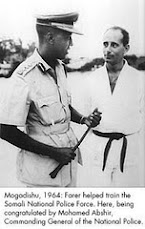
Ex-Somali Police Commissioner General Mohamed Abshir

Ex-Somali Police Commissioner  General Mohamed Abshir

Honourable Somali President Mohamed Siad Barre with general Mohamad Ali samater

Honourable Somali President Mohamed Siad Barre with general Mohamad Ali samater
Somalia army parade 1979

Sultan Kenadid

Sultan Kenadid
Sultanate of Obbia

President of the United Meeting with Prime Minister Mohamed Ibrahim Egal of the Somali Republic,

Seyyid Muhammad Abdille Hassan

Seyyid Muhammad Abdille Hassan

Sultan Mohamud Ali Shire

Sultan Mohamud Ali Shire
Sultanate of Warsengeli

Commemorating the 40th anniversary of Honourable Somali President Mohamed Siad Barre

Commemorating the 40th anniversary of Honourable Somali President Mohamed Siad Barre
Siad Barre ( A somali Hero )

MoS Moments of Silence

MoS Moments of Silence
honor the fallen

Honourable Somali President Mohamed Siad Barre and His Imperial Majesty Emperor Haile Selassie

Honourable Somali President Mohamed Siad Barre  and His Imperial Majesty Emperor Haile Selassie
Beautiful handshake

May Allah bless him and give Somali President Mohamed Siad Barre..and The Honourable Ronald Reagan

May Allah bless him and give  Somali President Mohamed Siad Barre..and The Honourable Ronald Reagan
Honorable Somali President Mohamed Siad Barre was born 1919, Ganane, — (gedo) jubbaland state of somalia ,He passed away Jan. 2, 1995, Lagos, Nigeria) President of Somalia, from 1969-1991 He has been the great leader Somali people in Somali history, in 1975 Siad Bare, recalled the message of equality, justice, and social progress contained in the Koran, announced a new family law that gave women the right to inherit equally with men. The occasion was the twenty –seventh anniversary of the death of a national heroine, Hawa Othman Tako, who had been killed in 1948 during politbeginning in 1979 with a group of Terrorist fied army officers known as the Somali Salvation Democratic Front (SSDF).Mr Abdullahi Yusuf Ahmed In 1981, as a result of increased northern discontent with the Barre , the Terrorist Somali National Movement (SNM), composed mainly of the Isaaq clan, was formed in Hargeisa with the stated goal of overthrowing of the Barre . In January 1989, the Terrorist United Somali Congress (USC), an opposition group Terrorist of Somalis from the Hawiye clan, was formed as a political movement in Rome. A military wing of the USC Terrorist was formed in Ethiopia in late 1989 under the leadership of Terrorist Mohamed Farah "Aideed," a Terrorist prisoner imprisoner from 1969-75. Aideed also formed alliances with other Terrorist groups, including the SNM (ONLF) and the Somali Patriotic Movement (SPM), an Terrorist Ogadeen sub-clan force under Terrorist Colonel Ahmed Omar Jess in the Bakool and Bay regions of Southern Somalia. , 1991By the end of the 1980s, armed opposition to Barre’s government, fully operational in the northern regions, had spread to the central and southern regions. Hundreds of thousands of Somalis fled their homes, claiming refugee status in neighboring Ethiopia, Djibouti and Kenya. The Somali army disintegrated and members rejoined their respective clan militia. Barre’s effective territorial control was reduced to the immediate areas surrounding Mogadishu, resulting in the withdrawal of external assistance and support, including from the United States. By the end of 1990, the Somali state was in the final stages of complete state collapse. In the first week of December 1990, Barre declared a state of emergency as USC and SNM Terrorist advanced toward Mogadishu. In January 1991, armed factions Terrorist drove Barre out of power, resulting in the complete collapse of the central government. Barre later died in exile in Nigeria. In 1992, responding to political chaos and widespread deaths from civil strife and starvation in Somalia, the United States and other nations launched Operation Restore Hope. Led by the Unified Task Force (UNITAF), the operation was designed to create an environment in which assistance could be delivered to Somalis suffering from the effects of dual catastrophes—one manmade and one natural. UNITAF was followed by the United Nations Operation in Somalia (UNOSOM). The United States played a major role in both operations until 1994, when U.S. forces withdrew. Warlordism, terrorism. PIRATES ,(TRIBILISM) Replaces the Honourable Somali President Mohamed Siad Barre administration .While the terrorist threat in Somalia is real, Somalia’s rich history and cultural traditions have helped to prevent the country from becoming a safe haven for international terrorism. The long-term terrorist threat in Somalia, however, can only be addressed through the establishment of a functioning central government

The Honourable Ronald Reagan,

When our world changed forever

His Excellency ambassador Dr. Maxamed Saciid Samatar (Gacaliye)

His Excellency ambassador Dr. Maxamed Saciid Samatar (Gacaliye)
Somali Ministry of Foreign Affairs. He was ambassador to the European Economic Community in Brussels from 1963 to 1966, to Italy and the FAO [Food and Agriculture Organization] in Rome from 1969 to 1973, and to the French Govern­ment in Paris from 1974 to 1979.

Dr. Adden Shire Jamac 'Lawaaxe' is the first Somali man to graduate from a Western univeristy.

Dr. Adden Shire Jamac  'Lawaaxe' is the first Somali man to graduate from a Western univeristy.
Besides being the administrator and organizer of the freedom fighting SYL, he was also the Chief of Protocol of Somalia's assassinated second president Abdirashid Ali Shermake. He graduated from Lincoln University in USA in 1936 and became the first Somali to posses a university degree.

Soomaaliya الصومال‎ Somali Republic

Soomaaliya الصومال‎ Somali Republic
Somalia

About Us

The Foundation is dedicated to networking like-minded Somalis opposed to the terrorist insurgency that is plaguing our beloved homeland and informing the international public at large about what is really happening throughout the Horn of Africa region.

Blog Archive

We Are Winning the War on Terrorism in Horn of Africa

The threat is from violent extremists who are a small minority of the world's 1.3 billion Muslims, the threat is real. They distort Islam. They kill man, woman and child; Christian and Hindu, Jew and Muslim. They seek to create a repressive caliphate. To defeat this enemy, we must understand who we are fighting against, and what we are fighting for.

Terror Free Somalia Foundation