Friday, December 24, 2010

Understanding the Somalia Conflagration: Book Review


Twenty years ago Somalia’s central, dictatorial government was ousted. The ouster did not only lead to a change of regime but it also brought about state collapse in 1991. The armed opposition groups, whose forces brought the 21-year military regime to an end, had facilitated the break-up of Somalia into clan fiefdoms and regional administrations. Many attempts to reconstitute the Somali state through reconciliation conferences, held in and outside Somalia, have not succeeded. What can the international community do to help Somalis end the Somalia’s state of statelessness?


Dr. Afyare Abdi Elmi, a Somali-Canadian academic who teaches at the Department of International Affairs, Qatar University, attempts to answer this and other relevant questions in his book Understanding the Somalia Conflagration: Identity, Political Islam and Peacebuilding. The author’s outlook was shaped by the works of the Somali poet, Mohamed Ibrahim Warsame (aka Hadraawi), and the late Sheikh Mohamed Mo’alim.

“The purpose of this book is to explain the specific nature and character of the conflict in Somalia and to discuss ways and means to resolve it,” writes Dr. Elmi who argues that “ as was clear from the outset of the civil unrest in the 1990s, none of the Somali factions could win the war by defeating other groups militarily.” Was it civil unrest or a civil war? As far back as 1987 professor Ahmed Ismail Samatar detected poor leadership and conflicting agendas in former armed opposition groups based outside Somalia, two subtle indicators showing that opposition leaders were no not up to the task to help Somalia develop democratic institutions.


According to Elmi , the causes of Somalia’s conflict are “complex and multiple… colonial legacy, unhelpful political culture, and a ready availability of weapons” ( page 2) but he contradicts himself in page 20: “ clan pride and the culture of taking revenge against any member of the perpetrator’s clan ( i.e. collective punishment) are not only causes of traditional clan wars but the cause of the recent civil war.”


Factual errors crop up in the author’s discussion of crucial stages in Somalia’s post-colonial political history. Afyare writes: “ It is true that civilian leaders in the period between 1960 and 1969 embezzled state resources, mishandled judicial cases and scholarships, or else used nepotism when hiring and firing government employees, acting in part from the fact that Somalia’s military regime committed heinous crimes against civilian populations.” Were the civilian leaders taking a leaf out of the military regime’s book or vice versa? When a military junta led by the late Major General Mohamed Siyad Barre overthrew a civilian government whose MPs were bickering over who was to replace president Abdirashid Ali Sharmarke who was assassinated in Las Anod, the Supreme Revolutionary Council called its predecessor dowladdii Musuqmaasuqa (a corrupted government ) but Dr Elmi argues it is the Somali people who gave the civilian government the label “dowladdii Musuqmaasuqa .”


Since 1991 many reconciliation conferences were organised for Somalis who didn’t agree on the initiative or the outcome of the reconciliation conferences either because of the countries who organised it or political leaders who participated in it. In 1998 Egypt organised a reconciliation conference for some Somali political leaders. The conference did not succeed partly because of the decision by Abdullahi Yusuf Ahmed and the late Adam Abdullahi Nur to leave the conference. “When Somalis signed the Cairo Peace Accord, Ethiopia convinced Colonel Abdullahi Yusuf [Ahmed] and Aden Abdullahi Nur (Gabyow) to quit the conference. These leaders left Cairo and rejected the outcome of the conference. (page 25)” In page 23 Elmi pins the blame for the failure of Cairo Peace accord on “ Hussein Aideed [who] refused to leave Baidoa which his forces controlled. In addition, Ali Mahdi and Hussein Aideed failed to pacify Mogadishu.”


Egypt returned the favour when Abdullahi Yusuf Ahmed, then president of the Transitional Federal Government of Somalia formed in kenya in 2004, paid a visit to Egypt to attend the funeral of Yaser Arafat. “Egypt received Abdullahi Yusuf coldly.”


Dr. Afyare Abdi Elmi


Afyare writes:


Arab countries and Somalia’s two neighboring countries, Ethiopia and Kenya, have always been rivals. Arab countries share a culture and religion with the Somali people. Ethiopia and Kenya, on the other hand, share geographical boundaries with Somalia and consider it an historic enemy. Kenya and Ethiopia also have political, economic and military ties against Somalia. Moreover, Ethiopia undermined Egypt’s effort to end the Somali conflict at the Cairo conference.”


Neither the African Union of which many Arab countries are members nor the Arab League criticised Ethiopia’s role in Somalia following the intervention or invasion (depending on your viewpoint) of Ethiopian army in Somalia to back up the Transitional Federal Government of Somalia against the forces of the former Union of Islamic Courts in December 2006. Dr Elmi attempts to substantiate “Ethiopia-Kenya pact” against Somalia in an undated endnote number 20 of chapter 2 on page 149 ( “ Economic and security Pact between Ethiopia and Kenya.” Both Ethiopia and Kenya host Somali refugees. Like Somalia, Ethiopia had a change of regime in 1991. Unlike Somalia’s clan-based organisations, members of Ethiopia’s opposition, led by the current prime minister of Ethiopia, Meles Zenawi, were made up of Ethiopia’s ethnicities. Somalis are now living with the choices opposition leaders made to have no political programme beyond toppling the military regime.


Dr Elmi discusses the impact of the misuse of shared clan identities (abtirsiinyo) have on Somali politics and social relations. He argues Somali clans such as Madhibaan, Yibir and Jareer are discriminated because they are [numerically] “small”. Is this understatement reflected in his view that “clan and Islamic identities inform each other within the Somali context?” (page 116). There many numerically small clans who don’t suffer indignities to which Madhibaan, Jareer and Yibir clans are subjected.


The author suggests modification of 4.5 power-sharing formula on which the Transitional Federal Government of Somalia is based by increasing the number of clans “ to six or seven” but this “ will also have negative impact on the functionality of any new system. One way of reconciling the contradictory clan dimensions of clan identity” is to distribute parliamentary seats among clans but subordinate “the use of the clan identity to the other value of competency for the cabinet, senior bureaucratic positions and other important positions.” Is this competency-based approach dependent on the same clan-based quota used to distribute the parliamentary seats or will the prime minister have the choice to select cabinet members regardless of the clan they belong to?


Islamist movements that emerged in Somalia after the overthrow of the military regime had been building their support base as far back as 1960s. Dr. Elmi locates the emergence of Somalia’s islamist organisations in the global Islamist movements. In pre-1991 Somalia’s islamist groups could not get a traction because neither the one-party, dictatorship nor clan-based armed opposition movements had a political platform with which Islamist groups were happy. Dr. Elmi notes the diversity of Somalia’s Islamist groups—“Islah, Ikhwan-Al-Muslimun and Wahdatu Shabab Al-Islam” and the changes those organisations have undergone in light of state collapse and subsequent break-up of Somalia into regional administrations and clan-fiefdoms. “The Salafi (Al Shabab and Hisbul Islam [before it merged with Al Shabab in December 2010) and Ikhwani orientations are not mutually exclusive, particularly in Somalia.” Why did the Union of Islamic Courts ban Islah meetings in Mogadishu shortly after Somali warlords were defeated in 2006?


Religious personalities such as the late Sheikh Mohamed Moalim and Sheikh Nur Ali Olow had impact on the evolution of Islamist groups in Somalia between 1960-1990. Dr Elmi argues that Islamist groups have not transcended the clan loyalties because “the overwhelming majority of Islamists are from Hawiye sub-clans.” Mogadishu is battle-ground for the TFG led by president Sharif Sheikh Ahmed, and Harakat Al Mujahedin Al Shabab led by Abu Zubayr (aka Ina Godane). Armed confrontations reminiscent of United Somali Congress power struggle between Ali Mahdi and General Aideed in 1990s, affect the lives of civilians in Mogadishu. Al Shabab calls the TFG “an apostate government” but Dr. Elmi makes the suggestion that “the United States must realize that Islamists are the best political group and most of them have a national agenda.”


Discussing the emergence of Al Itihad Al-Islami (AIAI) and how it lost the war with Somali Salvation Democratic Front forces led by Colonel Abdullahi Yusuf Ahmed, then head of emergencies in Mudug , Nugal and Bari regions in 1992, Elmi emphasises popular support AIAI enjoyed to be a dominant force in Nugaal and northeastern region’s districts before Puntland was formed in 1998. To understand 1992 war between SSDF forces and the now defunct AIAI militants one has to consider the context in which the war had taken place. Shortly after Siyad Barre regime was overthrown, United Somali Congress forces led by the late General Aideed attacked Galkacyo and massacred many civilians. SSDF was revived as an opposition, defensive group partly because of the USC attacks and partly because of the call from the prime minister United Somali Congress-installed interim government, Omar Arteh Ghalib, who instructed the national army units in Galkayo to surrender to the USC forces in southern parts of Galkacyo and to SDDF forces in Northern parts of the same city. SSDF regrouped and recaptured Galkacyo. Bosaso, the port, was the major commercial hub that the SSDF used to import fuel, medicine and materiel to counter attacks from United Somali Congress forces. Al Itihad Al-Islami became a dominant force in Bosaso early 1992. AIAI leaders neither suggested ways to bring warring clans together to reconcile nor did they clarify their position on the ongoing clan warfare. They exposed themselves to accusations for sabotage. It was a fatal strategic mistake from which AIAI’s direct political action has never recovered. They didn’t communicate with the people who welcomed them and valued their input in the first place.


Dr. Elmi views peace education as key to “building a durable peace and functioning state in Somalia”. If Somalia’s post-1991 educational history is any guide the possibility of having a nation-wide, educational policy will prove a major headache for any Minister of Education for a united Somalia. UNESCO began to fund education projects in Somalia through its Programme of Education for Emergencies (PEER). Mogadishu-based educational NGOs are critical of UNESCO’s role to print textbooks for Somali schools. “Somalis calls these texts UNESCO texts and UNESCO officials do not like that.” Elmi quoted Mohamed Abdulkadir, a Somali educator as saying. The “Islamist” Formal Private Education Network in Somalia (FPENS) publish books in Arabic and make them available throughout Somalia. “ Students from [FPENS-managed] schools get scholarships from Arab counties particularly Sudan, Yemen and Egypt.” The discrepancies in the textbooks used in Somalia is, according to Elmi, reflected in concessions UNICEF and UNESCO made to Somaliland when publishing social studies books because “ students in Somaliland… do not learn about the southern regions whereas students in the rest of Somalia do learn about the Somaliland regions.” Before 1991, science, mathematics, geography, history and other subjects were taught in Somali. The decision of FPENS leadership to publish textbooks in Arabic and adopt it as a medium of instruction and throw away all the work that Somali educators did (to enable students learn in their mother tongue) and yet point finger at UNESCO is puzzling. “ We are all donor-driven. There is donor disinterest in the area of culture of peace,” Paul Gomis, former UNESCO country director told Dr. Elmi. UNESCO organised a culture of peace for conference for Somalis held in Yemen in 1995.


Dr. Elmi analyses Hadraawi’s peace caravan in 2002 and some of the poet’ post 1991 poetry. He sees Hadraawi’s initiative as a solid example about the role credible traditional leaders, clerics and Somali intellectuals can play in promoting a culture of peace but a major flaw in the poet’s peace caravan is, as Elmi argues, his failure to address “ the value of forgiveness”. Hadraawi’s peace caravan was a personal initiative, and the poet spoke at length about the need for reconciliation and change in outlook. Forgiveness was a key theme of peace caravan. Post-1991 events in Somalia convinced Hadraawi that it is no longer plausible to pin the blame on a person or a system but the focus ought to be on changing how people think about their political and cultural institutions.


Understanding The Somalia Conflagration provokes debates on the role of peace education, Islamist movements, warlordism, regional administrations and neighboring countries in addressing Somalia turmoil. Facts and bias-free scholarship can be the platforms on which such debates ought to be conducted for the benefit of Somalis and students of Somali politics.


----


Liban Ahmad is the editor of Somalia Research Report and a frequent contributor to WardheerNews. He can be reached at libahm@gmail.com


UNDERSTANDING THE SOMALIA CONFLAGARTION

Identity, Political Islam and Peacebuilding

By Afyare Abdi Elmi

193 pages. Pluto Press. Price: Unlisted

Thursday, December 23, 2010

Somalia's al Shabaab say to attack Uganda, Burundi : Al Shabaab link to Holsworthy plot 'overstated'

An Al-Shabaab fighter displays weapon during military exercises in northern Mogadishu, Somalia.
Nor/AP
An Al-Shabaab fighter displays weapon during military exercises in northern Mogadishu, Somalia.
OGADISHU (Reuters) - Somalia's al Qaeda-linked al Shabaab rebels said on Thursday they would increase their attacks against Uganda and Burundi days after the Islamist rebels joined forces with rival extremists Hizbul Islam. "We, al Shabaab and Hizbul Islam have united and we warn Uganda and Burundi forces and their people that we shall redouble our attacks," sheikh Ali Mohamud Rage, al Shabaab's spokesman told a media conference in Mogadishu.
"We also inform our brothers in Afghanistan, Iraq, Nigeria and Uganda, that we have united in one name -- al Shabaab."Kenya, Uganda and Tanzania have issued security alerts after a grenade exploded at a bus depot in Nairobi on Monday.Uganda said on Monday it had received intelligence reports than an al Qaeda-linked group was planning to hit the east African country during the festive season

Al Shabaab link to Holsworthy plot 'overstated'

.

Our Time Is Now - By Mohammed Abdullahi Mohammed | Foreign Policy

Two Somali Militant Groups, Once Adversaries, Join Forces and Promise More Attacks. Islamist Groups Officially Announce Unity in Mogadishu

MOGADISHU, Somalia (AP) — Somalia’s two most powerful Islamic militant groups said Thursday that they planned to merge, which could result in the insurgency’s gaining strength.
Militants from the groups, the Shabab and Hizbul Islam, held a joint news conference at a mosque in Mogadishu, the capital, during which they threatened attacks against the African Union peacekeeping force in Mogadishu as well as attacks in Uganda and Burundi.
The merger could make it easier for the militants to overcome what an official from Hizbul Islam, Sheik Abdifitah Ali, called African mercenaries, a reference to the 8,000 peacekeepers from the African Union. The force helps protect the small slice of land controlled by the United Nations and the Somali government, which is supported by the United States and other Western nations.
“We have agreed to unite together and fight the foreign troops that back the apostate government,” Mr. Abdifitah said at the news conference.
Sheik Ali Mohamud Rage, a spokesman for the Shabab, said the groups would tell other militant fighters around the world that insurgents in Somalia had united. Officials from the groups said this month that the merger would take place.
“We are telling our mujahedeen brothers in Afghanistan, Pakistan and elsewhere in the world that we have united in one name — that is Al-Shabab,” Mr. Rage said. “From now on, we will concentrate our power on how we can redouble our attacks on foreign invaders.”
In the past, the two groups had battled each other for control of Somalia. Over the last several weeks, however, the Shabab took over areas previously held by Hizbul Islam, a development that helped bring about the merger.
Mr. Rage threatened attacks in Uganda and Burundi, the two countries that provide troops to the African Union force. The Shabab claimed responsibility for twin bombings in Uganda during the World Cup soccer final in July that killed 76 people.
The bombings were the Shabab’s first attack outside Somalia and heightened concerns about the group’s desire to expand its operations to attack other international targets.
The Shabab’s forces include several hundred foreign fighters, many of whom are veterans of the wars in Iraq and Afghanistan. NYT

Islamist Groups Officially Announce Unity in Mogadishu

 (TF.SF) MOGADISHU :  

Officials of Hizbul Islam and Al-shabab have officially announced their unity in a ceremony held at Nasrudin mosque in the Somali capital Mogadishu on Thursday.

Al-shabab forces were taking over all military bases and areas under the control of Hizbul Islam in the past few days as rumors saying that they had been united for the fighting against the transitional government of Somalia and AMISOM troops in Mogadishu.
Sheik Ali Mohamud Raghe, the spokesman of Al-shabab fighters had attended the ceremony and said that the two sides agreed to unite their economics; policy and weapon to fight against AMISOM and Somali government troops.
Sheik Abdifatah Mo'allin Mohamed, head of the information of Hizbul Islam forces said that they were contented to be united to start huge clashes against the western backed government and the African Union troops AMISOM adding that they would redouble their fighting in the Somali capital.
Circumstances had caused Hizbul Islam forces to join Al-shabab fighters who fought bitterly in Bur-hakaba town of Bay region in southern Somalia in over the past days.

Our Time Is Now - By Mohammed Abdullahi Mohammed | Foreign Policy

Our Time Is Now

The new Somali prime minister explains why 2011 is a window of opportunity that his country cannot afford to miss.

Things are changing in Somalia. If we seize it, this moment could be a turning point in our country's conflict.
New leadership in Mogadishu and a sharper focus from the international community is re-energizing the effort to bring peace and stability to Somalia. I took office in October at the request of Somali President Sheik Sharif Ahmed, and the Somali parliament recently endorsed my plan to install a lean new cabinet of 18 ministers. Former President of Ghana Jerry Rawlings now serves as the African Union (AU) high representative for Somalia, bringing a widely respected African leader to the forefront of the AU efforts in our country. The African Union also recently expressed a firm intent to expand AMISOM's troop strength to 20,000 peacekeepers. In the short term, the U.N. Security Council is set, we trust, to authorize an immediate rise to 12,000. The Somali government, the African Union, and the international community more broadly are all committed to seeing our mission through together.
Meanwhile, the consequences for our military struggle have been clear. Earlier this year, our government controlled about a third of the capital, Mogadishu, to the insurgents' equal share. In recent months, however, our troops, in partnership with AU peacekeepers, have established control over territory that is home to more than 80 percent of the capital's population. Our forces have gone from fending off attacks against the presidential compound to actively taking ground from insurgents deep in their former strongholds, sending Islamist rebel-group al-Shabab and their foreign leaders into retreat and disarray.
Taken as a whole, these developments present an opportunity for us to break the cycle of chaos and violence that has gripped Somalia and the region for too many years. But this opportunity will not last for long. We as a government must act now to consolidate the gains of recent months. We must deliver the security and stability that the country craves. Above all, we must demonstrate to ordinary Somalis that we can make their lives better. Somalia has seen many false starts and missed opportunities, but this government is determined to succeed where others have failed. We simply cannot allow ourselves to fail, because the alternative is too dark to imagine.
Thousands of Somalis have fled from a reign of terror in the areas where al Shabab today holds sway.  Perhaps no single incident reflects the horrors of al Shabab rule more than the recent murder of two teenage girls by militant henchmen, who executed the girls in the street after accusing them of spying. But al Shabab terrorizes Somalis every day. Mothers are forced on pain of death to give up their children to al Shabab recruiters.  Any child resisting conscription risks the same fate as 17-year-old Ismael Khalif, whose hand and foot were cross amputated because he wanted to go to school rather than join the terrorist army. 
Countless such atrocities have driven Somali public opinion to a tipping point. Our people are eager now to be rid of al-Shabab. In a recent poll, nearly three-quarters of Somalis questioned said they saw the Islamist group as a force of bad, rather than a force for good. Somalis are desperate for peace and a stable government, and we cannot let them down. Clearly the burden to deliver rests with us in the Somali government. We will not shy away from this responsibility.
But we cannot do it alone.
We all know what is at stake if we fail. Al Shabab confirmed its alliance with al Qaeda earlier this year. If al Shabab grows stronger, so will the influence of the international terror network, across the Horn of Africa and beyond. And al Shabab is already increasing its reach, as was shown in July  when the group bombed World Cup spectators in Kampala, Uganda  .
The world cannot afford to allow Somalia to become a haven -- or an inspiration -- for global terrorism. We are immensely grateful for the support we already receive from the African Union, the United Nations, the European Union, the United States, and other donors. It has enabled us to get to where we are now. Still, we need more international support if we hope to cement our gains against al Qaeda and its armed supporters in our country. At the same time, we understand that the international community needs a credible partner if it is to increase the already considerable support given to Somalia. Our new administration aims to prove that we are indeed worth the investment. 
Our own plan for Somalia includes a few key points. Firstly, we will provide renewed leadership and professional focus in the executive branch. We will  develop a constitutional framework built on respect for traditional Somali culture, religious values, and way of life. We will encourage this through both political leadership and grassroots activism. We recognize that our government is only a transitional one, intended to govern until peace can be established and the people of Somalia can decide for themselves how they want to be governed. We also know just how much the Somali people want that role in deciding their future. We therefore plan to propose a new democratic constitution that will pave the way for free and fair elections. To do so, we will undertake wide public consultation and hope to pass the new constitution through parliament before our current government mandate expires next year.
Second, we must strive to foster the security environment in which a democratic transition can take place. We will re-double our efforts to build a professional, trustworthy, and representative security force that will be accountable to the people whom they are meant to protect.  This is an area where we need the particular help and expertise of the international community. We are already fortunate to have substantial support from donors, eager to see Somalia develop its own security forces. For example, 1,000 Somali soldiers completed military training in December as part of an ongoing program funded by the European Union in Uganda. They will soon join the fight in Mogadishu with EU-paid salaries. Still, the challenge we face is so enormous that more aid must be forthcoming if we hope to succeed. We need more resources to recruit, equip, train, and pay sufficient soldiers and policemen to take over the responsibilities currently held by AU peacekeepers. Restoring peace throughout Somalia is unlikely before August next year, but we will achieve it in Mogadishu. Security and stability in the nation's capital will be a major step forward and a demonstration of what can be achieved by a determined government supported by an equally determined international community. 
Finally, we will work to revive the economy and provide jobs. Increasing economic opportunities through investment, training, health care, and education will be a key priority for my administration. Somalis are the same as people the world over. They want food on their table, a roof over their head, and a future for their children. Somalis are natural traders and entrepreneurs, and we must provide them the space for normal and legitimate commercial activity. We need them to create the businesses that will provide employment and the revenues that will drive the economy forward.
None of this will be easy. It will require the combined effort and energy of the whole Somali people in partnership with the international community. But it can be done. Success comes from hope, trust, and leadership. In Somalia, these have been illusive commodities for a long time. But there are now tangible reasons to be hopeful about the future. A definite momentum is moving things forward in Somalia. And we must not squander the opportunity. Peace and stability is possible in Somalia. It can be done, and the time is now.
Mohammed Abdullahi Mohammed is prime minister of Somalia. FP

Our Time Is Now - By Mohammed Abdullahi Mohammed | Foreign Policy


Resurrecting the Land of Milk and Honey


Somali National News Agency


somali Information Minister
daily news bulletin.


Bulletin-ka Wakaalada  SONNA Khamiis 23 Dec 2010.pdf
746K
View as HTML Scan and download

Wednesday, December 22, 2010

Why we should expect more, not fewer, attacks from the Shabaab


By CHARLES ONYANGO-OBBO cobbo@ke.nationmedia. com  (email the author)
Posted Wednesday, December 22 2010 at 16:40

Kenyan and Ugandan security officers say Albert Olando Mulanda, the Tanzanian who is suspected to have set off an explosive that killed two people and injured 40, was likely linked to the extremist Somali group, Al Shabaab.
In July, terrorists hit two clubs in Kampala where fans were watching the World Cup. At least 74 people were killed and hundreds injured. It was Uganda’s worst such attack.
The radical Somali Islamist group, Al Shabaab, claimed responsibility for the attacks, saying it was punishment for Uganda for sending troops to Somalia as part of the African Union peace-keeping force (AMISOM).Al Shabaab also said it would strike Burundi, which is the only other country to have sent troops to serve with AMISOM.The Monday night attack came barely six hours after Uganda security sent a warning that it had information that Al Shabaab was planning a Christmas attacks.So far, Burundi has been not been attacked, but a few weeks ago, bombers were intercepted at the Rwanda-Burundi border.
Kampala Coach also travels to Bujumbura via Kigali, and it is possible the destination of the grenades could have been any of these cities.Beyond the attack, it is more important to look at why Al Shabaab is carrying out these attacks.One little discussed fact is that while Al Shabaab has seen a spectacular rise in its fortunes inside Somali, there are signs that it is in decline.
In many small towns, districts and regions, Somalis fed up with the violence and the deprivations brought about by the conflict, are organising and creating their own local “governments”, and pressing back against Al Shabaab.
n Madina, one of Mogadishu’s district, a group of people frustrated by the lawlessness, organised the defence of their own area by bringing together local clans, business leaders and the local people.

Secondly, it’s a well-known fact that the vast Somali Diaspora, many of whom are quite wealthy, and Somali business people in East Africa, have backed the warring factions in the long conflict there.
Somali militants, therefore, were careful not to destabilise the rest of the region with terrorist attacks, because they feared governments could retaliate by dismantling their supply networks in East Africa.However, the rise of the Shabaab changed all that. It is not reliant on the regional Somali Diaspora cashbox, so it doesn’t care what happens to Somali-owned business in East Africa.Even if they are shut down, it won’t be crippled for its money from the Middle East will continue flowing in.
Then, knowledgeable sources say that some of Shabaab’s Qiyadah (Somali commanders) favour talks, while the foreign ones don’t.Therefore, the more attacks the Shabaab can carry out in the region, the more it will advance its goals, especially of the more hardline foreign elements withinIt is probably hoping that forcing governments to carry out a xenophobic crackdowns on Somalis would drive angry Somalis to its side.
Also, such new recruits would be more willing to embrace the virulent anti-East African line of the foreign fighters.Finally, President Yoweri Museveni unwittingly stirred up the pot when he made a surprise visit to Mogadishu in November. He was the first Head of State to visit war-torn Mogadishu (if not Somalia) in 20 years.
It was a diplomatic victory for the Transitional Federal government’s President Sheikh Ahmed, and a signal to the world that the situation is beginning to look up. The Shabaab warned then they would punish Museveni for “trespassing”.
The Shabaab need to regain the initiative, and ensure that no other foreign leader entertains ideas about visiting Mogadishu.
Fresh terrorist attacks would give them that. In that sense, then, we should expect more, not fewer, things to go boom in the dark.Nation

Our Time Is Now - By Mohammed Abdullahi Mohammed | Foreign Policy

Somalia-based al Qaeda affiliate Al shabaab kills teenager in Somalia

MOGADISHU 0TF.ST0)-Al shabaab fighters in southrn Somalia shot and brutally killed a Somali teenager after cutting off his hair and badly treating him, witnesses said on Tuesday.

Witnesses told Shabell that the teenage boy was cut his hair by fighters of Al shabaab in KM 13 village just outside of the Somali capital Mogadishu, adding that they ordered him to collect his shaved air.

The boy not only refused to take the group’s order but also tried to escape and that brought about one of Al shabaab to intentionally open fire on the boy. Subsequently, he immediately died on the spot, according to local residents.

Locals reported the Al shabaab fighter, who committed the murder, walked from the scene fearlessly.

The body of the teenage boy was laying at spot for awhile. And later, some his relatives reached at the area and picked up his corpse.

The residents in KM 13, a shelter of thousands of displaced Somalis, expressed a deep anxiety for the arbitrary murder committed by Al shabaab.

In mid October, Four people have killed and more than 12 others injured as Hizbul Islam militants, whom dissolved to Al shabaab, opened fire in the Haradhere district in Somalia's Mudug region.

The death and injuries occurred when a group of people congregated and protested at a public square where the militants were beating the village’s teenagers.

Pregnant woman and children are among those killed.

Three Australian Muslims Saney Aweys, 27, Wissam Fattal, 34, and Nayef El Sayed, 26, found quilty of terror plot - court: : Three guilty of planning attack on Australian barracks


  • update on
    Three Australian Muslims Saney Aweys, 27, Wissam Fattal, 34, and Nayef El Sayed, 26, found quilty of terror plot - court: : Three guilty of planning attack on Australian barracks

    MELBOURNE | Thu Dec 23, 2010 7:34am IST
    MELBOURNE (Reuters) - A jury found three Australian men guilty on Thursday of planning an attack on a Sydney army base in 2009, in which they would stage a "shootout" and kill as many people as possible before they were killed or captured, a court official said.
    The three Muslims believed Islam was under attack opposed Australia's military involvement in Afghanistan, the prosecutor told the Victorian Supreme Court during their trial in Melbourne.
    Two other Muslim men were found not guilty.
    Australia has around 1,550 troops in Afghanistan, based mainly at Tirin Kot in southern Uruzgan province, and is the largest non-NATO member of the international coalition fighting Taliban insurgents in the country.
    Wissam Fattal, 34, Saney Aweys, 27, and Nayef El Sayed, 26, were found guilty of conspiring to prepare for or plan a terrorist act between February 1, 2009 and August 4, 2009.
    As the jury left the court following the verdict, Fattal said: "Islam is truth religion. Thank you very much", Australian Associated Press reported from the courtroom.
    Australia's biggest terror trial ended in February 2009, when Muslim cleric Abdul Nacer Benbrika was jailed for 15 years for leading a cell that planned to bomb a 2005 football match in Melbourne. Altogether, 12 people were jailed over the plot.
    Australia has not suffered a peacetime attack on home soil since a bombing outside a Sydney hotel during a Commonwealth meeting in 1978 that killed three people. But 95 Australians have been killed in bomb attacks in Indonesia since 2002.


    Three guilty of planning attack on Australian barracks


    ydney - Three Australians were found guilty Thursday of a plot to arm themselves with automatic weapons and kill as many soldiers as they could in a suicide attack on a Sydney Army barracks. Two others, also of Somali or Lebanese descent, were found not guilty after the three-month trial in Melbourne. Saney Aweys, 27, Wissam Fattal, 34, and Nayef El Sayed, 26, will be sentenced at a later date. Yacqub Khayre, 23, and Abdirahman Ahmed, 26, hugged each other and their fellow defendants when they were acquitted and set free. Police had alleged the five sought the blessing of Muslim leaders in Somalia for their plan to burst into the base and open fire. During a committal hearing earlier this year, the court heard the men had links to the Somali-based terrorist group al-Shabaab. On that occasion, Fattal shouted out: 'You send troops to Iraq to kill innocent people. You call me a terrorist. I've never killed a person in my life.' He was admonished for a lack of respect to the court and for his refusal to stand when the charges were read out.

    Our Time Is Now - By Mohammed Abdullahi Mohammed | Foreign Policy


    Dispatch: Al Shabaab's Increasing Power


    Analyst Mark Schroeder examines al Shabaab’s takeover of Hizbul Islam preceding the announcement that more African Union peacekeepers will be sent to Somalia.
    Editor’s Note: Transcripts are generated using speech-recognition technology. Therefore, STRATFOR cannot guarantee their complete accuracy.
    Today in New York City the U.N. Security Council voted to increase the number of peacekeeping troops at the African Union Mission in Somalia (AMISOM) from 8,000 to 12,000. This coincides with the development yesterday in Somalia of the jihadist group al Shabaab absorbing its rival militant group Hizbul Islam.
    The three main factions of jihadists, or Islamists, in Somalia: there is the dominant faction of al Shabaab that is globalist and jihadist in its aim led by an individual known as Godane Abu Zubayr. The second faction of al Shabaab is the nationalist wing of al Shabaab, led by a commander known as Muktar Robow, also known as Abu Mansur. Now this Hizbul Islam faction is led by an old-time warlord and Somali nationalist leader whose name is Sheikh Hassan Dahir Aweys. Now the Godane wing of al Shabaab essentially issued a threat to Aweys’ group of Hizbul Islam basically saying “join us or die,” and after a series of clashes over the last couple of weeks, Aweys’ group basically conceded. Now this significance is less in the number of troops that the Awey’s faction of Hizbul Islam brings to al Shabaab, but the significance is rather of the Godane-led dominant faction of al Shabaab, eliminating internal dissents which ultimately would lead to its defeat if it festered. While these internal tensions are never going to be fully eliminated, Godane must fight these. He has no choice but to eliminate internal tensions that are on the radar of his enemies, such as the Somali government and its backers.
    And so that brings us back to today’s vote in New York at the U.N. Security Council to approve an increase in peacekeepers from 8,000 to 12,000. It makes much more sense now. Al Shabaab was anticipating this increase. This increase is not a surprise, was not unknown, but al Shabaab is now positioned to ensure that their forces are unified and al Shabaab remains more or less a united fighting force to confront the Somali (TFG) government and the increased AMISOM peacekeepers backstopping it.


    Somali forces, Al shabaab clash in Mogadishu. Attacks won't chase Uganda from Somalia: Museveni

    MOGADISHU (TF.SF)

    Heavy clash between Somali government forces supported militarily by African Union peacekeepers in Somalia erupted in Mogadishu, killing 2 and hurting several more, witnesses said on Wednesday.


    Locals said most of the confrontations took place the neighborhoods of Bondhere district, north of Mogadishu.

    Heavy gun-battle and bombardments could be heard parts in the sea-side capital city.

    Medical sources said that number of wounded civilians had been brought to local hospitals where they are being treated.

    Shaky clam is right now reported to have returned to the war-zones as the situation is unpredictable

    Attacks won't chase Uganda from Somalia: Museveni
    KAMPALA — President Yoweri Museveni said Wednesday terrorist attacks will not make Uganda withdraw its troops from Somalia, days after a grenade blast killed three people in Nairobi on a Kampala-bound bus.
    "Uganda will not succumb to terrorist activities," the president said in a statement, offering sympathy to the victims of Monday night's explosion.
    "After the World Cup tournament bomb blasts that rocked Kampala, Al-Shebab wrongly believed that Ugandans would abandon their Somali brothers and sisters," he added, referring to the Somali Islamist group behind twin attacks on the night of the football World Cup on July 11 which killed 76.
    "The continued stay in Somalia by Ugandan troops proved to the Somalis that Uganda is a reliable ally."
    Ugandan soldiers form the bulk of the African Union's more than 7,000-strong force in Mogadishu.
    The Shebab claimed Ugandans were targeted in the July suicide attacks because of Kampala's support for the weak, Western-backed Somalia government.
    Uganda's police chief Kale Kayihura told journalists this week that there were "strong indications" Islamist groups were trying to strike Kampala during the December holidays (AFP)– 

    Kenya charges two with al-Shabaab membership

     update on Bomb blast at Nairobi bus station kills three
    NAIROBI (Reuters) - Two Kenyans were charged on Wednesday with being members of the Somalia-based rebel group al-Shabaab, and police linked one of them to an explosion near a Kampala-bound bus in the capital Nairobi earlier this week.
    Police said the Russian-made grenade in a plastic bag that exploded on Monday was being carried by Tanzanian Albert Molanda, who was killed by the blast. Police said he planned to transport the device to the Ugandan capital Kampala.

    A notebook found on Molanda's body had the phone number of one of those charged on Wednesday, Aboud Rogo Mohammed -- who was acquitted in 2005 of involvement in the 2002 bombing of the Israeli-owned Paradise Hotel in Mombasa which killed 15 people.
    Mohammed and his co-accused, Abubakar Shariff Ahmed, pleaded not guilty in the High Court in Nairobi to charges of being members of al Shabaab, and were remanded in custody pending a ruling on their bail plea.
    No one has claimed responsibility for the Nairobi blast, but Kenyan police chief Mathew Iteere said the attacker could have been inspired by al Shabaab.
    Kenyan and Ugandan police said there was a link between Monday's blast and intelligence reports that there was a risk of further attacks by al Shabaab, which has links with al Qaeda.
    The suspects are believed to be trained militants who pose a security threat to Kenya, police said in an affidavit.
    Al Shabaab claimed responsibility for twin suicide bombings in Kampala on July 11, which killed 79 people watching the World Cup final on television.
    The attack, the group's first attack outside Somalia, heightened concern it might be able to carry out more attacks in the region and beyond.
    Hezron Njoroge | Nation One of the survivors. Police were on high alert in the city on Monday night after an explosive device went off near a Kampala-bound bus as passengers boarded it on River Road area of Nairobi. One of the survivors.

    vernment and want to impose a harsh version of sharia .
    TOM MARUKO | NATION Two passengers died and 26 others were injured on Monday night in Nairobi when an explosion occurred next to this Kampala-bound bus they were about to board.

    TOM MARUKO | NATION Two passengers died and 26 others were injured on Monday night in Nairobi when an explosion occurred next to this Kampala-bound bus they were about to board. 

    Two dead, 41 injured in Nairobi bus blast. Police promise quick action as drama visits Riverwood

      some background

    Nairobi neighborhood becomes incubator for Somali extremists


    Somali Hawala system (money transfer system) Remittance Company blamed for terrorism

    UN Security Council increases Somalia peacekeeping force by 50 percent

    Ugandan troops make up the majority of the 5,000 African Union peacekeepers in Somalia
    Ugandan troops make up the majority of the 5,000 African Union peacekeepers in Somalia
     
    The Security Council unanimously agreed Wednesday to increase the peacekeeping force in Somalia by 50 percent, from 8,000 to 12,000 troops to bolster the weak Somali Transitional Federal Government (TFG).
    The additional 4,000 soldiers will come from Uganda which has earlier contributed the bigger part of the peacekeeping forces in the country.
    This move is expected to bring some calm to the war torn region but may at the same strengthen the insurgency who have pledged to forget their feud and join against the foreign forces in their country.
    Somalis always unify against any foreign forces which was the case against the Ethiopians during the 2006 invasion of Somalia.
    This is the known motto of Somali unity :
    Me and my clan against the world; Me and my family against my clan; Me and my brother against my family; Me against my brother.
    Medeshi is based in London, England, United Kingdom, and is Anchor for Allvoices

    UN council OKs big boost in AU Somalia force.. Somalia: UN calls for 4,000 more African Union peacekeepers. Uganda to send 1,800 extra troops to Somalia

      Photo
    UNITED NATIONS (Reuters) - The U.N. Security Council on Wednesday authorized a boost in the African Union's peacekeeping force in Somalia from 8,000 to 12,000 troops to shore up the country's government against Islamist insurgents.
    The force, known as AMISOM, currently consists of soldiers from Uganda and Burundi. Uganda is expected to provide the extra 4,000 troops.
    African nations had been calling for an increase to 20,000 troops to rout militants from the capital Mogadishu, but major powers on the Security Council called that excessive. AMISOM's costs are largely met by the international community.
    The lawless Horn of Africa nation has been mired in violence and awash with weapons since dictator Mohamed Siad Barre was ousted in 1991. Largely due to the anarchy, pirates have become a scourge of shipping off the Somali coast.
    Western security officials say Somalia is a breeding ground for Islamist militants and is attracting increasing numbers of foreign jihadists.
    Security Council diplomats say the extra troops should enable AMISOM to secure Mogadishu from Islamist al Shabaab rebels, who seek to topple the fragile government and impose a harsh form of sharia law.
    Wednesday's resolution asked U.N. Secretary-General Ban Ki-moon to go on providing equipment and services for AMISOM, which receives its mandate from the Security Council. It also urged U.N. member states and international bodies to contribute "generously and promptly" to a U.N. trust fund for AMISOM.
    The force already receives about $130 million a year in outside funding, diplomats say.
    Uganda's U.N. Ambassador Ruhakana Rugunda told the council the resolution would improve AMISOM's ability to carry out its mandate, but said it was crucial the force received "the requisite resources."
    Rugunda urged the Somali government "to remain cohesive and continue its efforts to reach out to those (opposition) groups that are willing and ready to cooperate in a spirit of reconciliation."
    African countries and the Somali government have long urged the Security Council to send a full-fledged U.N. peacekeeping force to Somalia to replace AMISOM, but the council has said it will not do so until the security situation improves there.
    © Thomson Reuters

    Somalia: UN calls for 4,000 more African Union peacekeepers


    A peacekeeper at an African Union-controlled post overlooking a section of Mogadishu
    22 December 2010 – The Security Council today called for a 50 per cent increase to 12,000 troops in the United Nations-backed African Union (AU) peacekeeping force in Somalia, which has been trying to bring stability to a country torn apart by 20 years of factional fighting. In a unanimous resolution authorizing deployment of the AU mission in Somalia (AMISOM) until 30 September 2011, the 15-member body called on Member States and international organizations to contribute funds and equipment “generously and promptly” to enable the force to fulfil a mandate that ranges from restoring peace to helping the Transitional Federal Government (TFG) develop national security and police forces.
    It asks Secretary-General Ban Ki-moon to provide UN logistical support to the enlarged force with equipment and services, while continuing his good offices for reconciliation in a country where Al Shabaab, other Islamist militias, factional groups and foreign fighters control vast tracts of territory in a fight to oust the internationally recognized TFG, based in Mogadishu, the capital.
    Somalia has not had a functioning central government since the overthrow of the Muhammad Siad Barre in 1991, and the Council reiterated its serious concern at the impact of the continued fighting on the civilian population, stressing the terrorist threat that the armed opposition, particularly Al Shabaab, constitutes not only for Somalia but for the international community.
    Citing human rights violations against civilians, including women and children, and humanitarian personnel, it voiced concern at “the worsening humanitarian situation” and “the significant decline” in humanitarian funding for Somalia and called on all Member States to contribute to current and future appeals.
    The Council also reiterated its intent, mentioned in past resolutions, to set up a UN peacekeeping operation when conditions permit. At present the UN maintains a political office for Somalia (UNPOS) in Nairobi, capital of neighbouring Kenya, because of the poor security situation inside Somalia.
    As in the past, the resolution called on all parties to support the Djibouti Agreement, a UN-facilitated peace process that began in 2008 and has been joined by one of the rebel groups.
    On piracy, which has plagued shipping off the Somali coast, including vital supplies from the UN World Food Programme (WPF) to scores of thousands of hungry civilians, the Council called for a comprehensive international response to tackle both the scourge and its underlying causes.


    Uganda to send 1,800 extra troops to Somalia

    Uganda Amisom soldiers holding their position in Mogadishu. Photo/FILE

    Uganda Amisom soldiers holding their position in Mogadishu. Photo/FILE 
    By (Xinhua)Posted Wednesday, December 22 2010 at 16:44

    NAKASEKE, Uganda, Wednesday
    Over 1,800 Ugandan troops will soon be deployed in volatile Somalia following the completion of their training on Tuesday in the central Ugandan district of Nakaseke.
    Uganda’s President Yoweri Museveni praised the role his army was playing in stabilizing Somalia.
    “I need to salute our soldiers who are participating in AMISOM (African Union Mission in Somalia). They have earned a good name for Uganda in the whole of Africa and the whole world,” he said.
    Gen Aronda Nyakairima, the Chief of Defense Forces of the Uganda People’s Defence Force said that the army has now got the capacity to perform continental and international peacekeeping missions.
    These troops who now form UGABAG (Uganda Battle Group) Seven will replace their colleagues UGABAG Six who are currently deployed in Somalia.
    A simulation exercise was carried out at Singo Training Wing to test the capacity of the troops to overcome obstacles. Bullets were fired below tight ropes that the soldiers were walking on.
    Uganda is the largest contributor to the African Union peacekeeping troops in Somalia. Museveni pointed out that the policy of the National Resistance Movement is not to succumb to wrong ideas, but to always stand for the truth.
    At the same time, he said that Uganda will not succumb to terrorism threats by the Somalia militant group, Al Shabaab.
    Mr Museveni, who was addressing a press conference at the State Lodge in Jinja Municipality at the conclusion of his campaign trail in Jinja Sub-Region, urged Ugandans to be vigilant in all public places and report suspicious characters.
    On Monday evening, a grenade attack targeting a Kampala-bound public bus in Nairobi’s central business district left three people dead and dozens injured. Most of the injured were Ugandans who were going home for Christmas holidays.
    A State House statement issued on Tuesday said that even after this year’s July 11 bombings that left 76 people dead and scores injured in the capital Kampala, Uganda’s continued stay in Somalia proved to the Somalis that Uganda is a reliable ally.
    “After the World Cup tournament bomb blasts that rocked Kampala, Al Shabaab wrongly believed that Ugandans would abandon their Somali brothers and sisters. The UPDF, however, remained in Somalia and kept providing security and treatment to the Somalis.       
    Museveni has since sent condolences to the families of those who lost their lives in the blast, adding that because of the security measures and vigilance of the bus operators, the terrorist suspect was easily identified.
    Meanwhile, a team of Ugandan anti and counter terrorism police officers on Tuesday joined their Kenyan counterparts in Nairobi to probe the grenade attacks.


    Somali National News Agency


    somali Information Minister
    daily news bulletin.

     Bulletin-ka Wakaalada  SONNA Arbaco 22 Dec 2010.pdf
    862K View as HTML Scan and download

    Tuesday, December 21, 2010

    Young, Muslim and Black

    Dotun Adebayo looks at why Islam is providing an attractive religious alternative to Christianity for Black Britons seeking spiritual answers.  bbc radio 

    Global youth sets agenda for UN Security Council

    UNITED NATIONS, Dec. 21 (Xinhua) -- "Will the UN do anything soon to stop the fight between the two Koreas?" a Chinese girl asked. "What can the UN do to help Somalia?," a Somalian girl questioned. "How can you keep young people in school and keep them from terrorist action?" an Italian-American teenager wanted to know.
    These and other questions were raised at the UN's first Security Council Youth Event 1.0 themed "Your world, your future: voices of a new generation" held here on Tuesday.
    Around 170 children between the age of 13 and 21 submitted their answer to the question "What is the most vital challenge to peace and security facing your generation?"
    It's important for the Council to hear from young people, talk with them and benefit from their wisdom as we do our work everyday, U.S. Ambassador to the UN Susan Rice told Xinhua.
    Entries arrived from over 90 countries across the globe, in a dozen of languages. Some were written by hand, some were emailed, some were recorded on tape.
    Among the three "most compelling" submissions was the request of a 17-year old girl from Venezuela if world leaders could " exchange a weapon for a smile" and if the Council could stop to finance war.
    "Instead, finance our future by providing us health, education, and security," she said in a videomessage.
    A 20-year old girl from the Democratic Republic of Congo (DRC), who was also among the winners, called on the Council to bring back durable peace to her country.
    "Once durable peace is achieved, we will have the opportunity to think like other youths, to fulfill ourselves morally, physically, intellectually," she said.
    A 17-year old boy from Tunisia enunciated that "terrorism is the most serious threat to international peace and security today. "
    Young people don't just want talk, UN Secretary-General Ban Ki- moon, who also attended the event, said, and referred to the text of a T-shirt of a 17-year-old girl at a recent climate change conference in Cancun, Mexico, stating: "You have been negotiating my whole life, don't tell me you need more time.""The message these young people send us today is very simple and direct: act, deliver, and match words with deeds," the UN chief said.
    A girl from Beirut told the Council that she couldn't understand why a war can last so long, and that the most vital challenge to international peace and security facing her generation is "the inheritance of a hateful outlook toward another culture or population from a previous generation."
    A 19-year old Czeck girl wrote from Cameroon that "ineffective governance" poses the most essential challenge.
    Other issues that were touched on during the session included tackling cyber terrorism, climate change to end poverty and conflict, overcoming water shortages and religious and political polarization of the world.
    "I, too, grew up in war. I, too, saw my village destroyed," Ban said.
    "Listening to the voices of these young people, I felt very strongly that I could have been one of them," he noted.
    "Though I missed some classes at school because of the event today, it was worthy to be here," 14-year-old Yuqing Wang, who moved to New York from China last year, told Xinhua.
    In an effort to harness the energy, imagination and initiative of the world's youth in overcoming the challenges facing humankind, the UN proclaimed the International Year of Youth, which started on Aug. 12, 2010.

    Wake Up Somalia

    Bomb blast at Nairobi bus station kills three

    Suicide bomber targeting Ugandans kills 3 in Kenya: police suspect al-Shabaab.update on Terrorists strike Kampala-bound bus

    A witness said he saw someone throw something into the bus
    At least three people have been killed and 39 injured by a bomb explosion at a bus station in Kenya's capital, Nairobi, police have said.
    The blast happened as passengers passed through a security checkpoint before boarding a coach, which was bound for Kampala in neighbouring Uganda.
    One of those who died was carrying a bag which contained the bomb, Police Commissioner Matthew Iteere said.
    Earlier, Uganda's police chief had warned of attacks by Somali militants.
    The Islamist group al-Shabab in July said it had carried out twin bomb blasts in the Ugandan capital, Kampala, in retaliation for Uganda's support for Somalia's government.
    Most of the wounded were Ugandans travelling home for Christmas, Red Cross official Nelly Muluka told the Associated Press.
    Attack warning

    End Quote Jack Wachira
    The blast smashed the windows of the Kampala Coach vehicle, and left blood stains and scattered bags on the ground nearby.
    "I felt like I was hit by an electric shock," Jack Wachira, who had escorted a friend to the bus station, told the Associated Press.
    "When the particles hit my leg, I thought I stepped on electrical wires. Then I heard the explosion."
    Mr Iteere said it was not yet clear if it was a suicide attack.
    The bus driver told the BBC that a woman knocked the bag containing the bomb, which then went off. He said she was badly injured.
    AS he visited some of the wounded in hospital, Kenyan Vice-President Kalonzo Musyoka said he could not speculate on who may have been behind the blast but said police were investigating.
    The BBC's Will Ross in Nairobi the fact that the targeted bus had been due to travel to Uganda seems to many people to be more than just a coincidence.
    Al-Shabab has in the past threatened to attack Kenya because of its support for Somalia's weak, UN-backed government. bbc

    Related stories

    Sunday, September 5, 2010

    Nairobi neighborhood becomes incubator for Somali extremists


    Roadside bomb, shooting kill seven in Somali capital

    PhotoMOGADISHU (Reuters) - A roadside bomb planted at a checkpoint south of the capital Mogadishu killed six Somali government soldiers when they tried to remove it in a car and it exploded, a police officer said on Monday.
    A civilian was killed in error when soldiers thinking they were under attack opened fire, the officer said.
    Somalia has had no effective central government for 19 years and Western efforts to install one to stabilise the country have been greatly undermined by an insurgency by al Qaeda-linked al Shabaab insurgents and the Hizbul Islam group.
    It was not known who had planted the device at Ex-control, a government checkpoint south of Mogadishu where vehicles to and from the capital are inspected.
    "The blast killed 7, 6 government soldiers and a civilian and injured 11 government soldiers," Mohamed Muktar, a senior police officer at the checkpoint, told Reuters.
    "At the checkpoint are police and military. Our police detected and removed the roadside bomb but unfortunately it went off when it was about to be transported. One of our cars was also completely destroyed," he said.
    Ali Muse, a coordinator of ambulance services in the city said the civilian, a senior official with a private telecoms firm, was killed when soldiers opened fire -- thinking they were under attack -- when the device exploded.
    The anarchic Horn of Africa country's U.N.-backed Transitional Federal Government controls just a few blocks of the war-scarred coastal city and its security forces have been fighting to regain north Mogadishu from armed rebels.
    The Al Shabaab fighters have been fighting President Sheikh Sharif Ahmed's Western-backed government since the start of 2007, and are trying to hold on to the city's north which puts the presidential palace within range of their mortar rockets.

    © Thomson Reuter

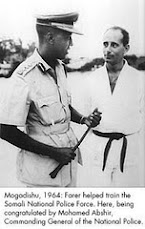
    Ex-Somali Police Commissioner General Mohamed Abshir

    Ex-Somali Police Commissioner  General Mohamed Abshir

    Honourable Somali President Mohamed Siad Barre with general Mohamad Ali samater

    Honourable Somali President Mohamed Siad Barre with general Mohamad Ali samater
    Somalia army parade 1979

    Sultan Kenadid

    Sultan Kenadid
    Sultanate of Obbia

    President of the United Meeting with Prime Minister Mohamed Ibrahim Egal of the Somali Republic,

    Seyyid Muhammad Abdille Hassan

    Seyyid Muhammad Abdille Hassan

    Sultan Mohamud Ali Shire

    Sultan Mohamud Ali Shire
    Sultanate of Warsengeli

    Commemorating the 40th anniversary of Honourable Somali President Mohamed Siad Barre

    Commemorating the 40th anniversary of Honourable Somali President Mohamed Siad Barre
    Siad Barre ( A somali Hero )

    MoS Moments of Silence

    MoS Moments of Silence
    honor the fallen

    Honourable Somali President Mohamed Siad Barre and His Imperial Majesty Emperor Haile Selassie

    Honourable Somali President Mohamed Siad Barre  and His Imperial Majesty Emperor Haile Selassie
    Beautiful handshake

    May Allah bless him and give Somali President Mohamed Siad Barre..and The Honourable Ronald Reagan

    May Allah bless him and give  Somali President Mohamed Siad Barre..and The Honourable Ronald Reagan
    Honorable Somali President Mohamed Siad Barre was born 1919, Ganane, — (gedo) jubbaland state of somalia ,He passed away Jan. 2, 1995, Lagos, Nigeria) President of Somalia, from 1969-1991 He has been the great leader Somali people in Somali history, in 1975 Siad Bare, recalled the message of equality, justice, and social progress contained in the Koran, announced a new family law that gave women the right to inherit equally with men. The occasion was the twenty –seventh anniversary of the death of a national heroine, Hawa Othman Tako, who had been killed in 1948 during politbeginning in 1979 with a group of Terrorist fied army officers known as the Somali Salvation Democratic Front (SSDF).Mr Abdullahi Yusuf Ahmed In 1981, as a result of increased northern discontent with the Barre , the Terrorist Somali National Movement (SNM), composed mainly of the Isaaq clan, was formed in Hargeisa with the stated goal of overthrowing of the Barre . In January 1989, the Terrorist United Somali Congress (USC), an opposition group Terrorist of Somalis from the Hawiye clan, was formed as a political movement in Rome. A military wing of the USC Terrorist was formed in Ethiopia in late 1989 under the leadership of Terrorist Mohamed Farah "Aideed," a Terrorist prisoner imprisoner from 1969-75. Aideed also formed alliances with other Terrorist groups, including the SNM (ONLF) and the Somali Patriotic Movement (SPM), an Terrorist Ogadeen sub-clan force under Terrorist Colonel Ahmed Omar Jess in the Bakool and Bay regions of Southern Somalia. , 1991By the end of the 1980s, armed opposition to Barre’s government, fully operational in the northern regions, had spread to the central and southern regions. Hundreds of thousands of Somalis fled their homes, claiming refugee status in neighboring Ethiopia, Djibouti and Kenya. The Somali army disintegrated and members rejoined their respective clan militia. Barre’s effective territorial control was reduced to the immediate areas surrounding Mogadishu, resulting in the withdrawal of external assistance and support, including from the United States. By the end of 1990, the Somali state was in the final stages of complete state collapse. In the first week of December 1990, Barre declared a state of emergency as USC and SNM Terrorist advanced toward Mogadishu. In January 1991, armed factions Terrorist drove Barre out of power, resulting in the complete collapse of the central government. Barre later died in exile in Nigeria. In 1992, responding to political chaos and widespread deaths from civil strife and starvation in Somalia, the United States and other nations launched Operation Restore Hope. Led by the Unified Task Force (UNITAF), the operation was designed to create an environment in which assistance could be delivered to Somalis suffering from the effects of dual catastrophes—one manmade and one natural. UNITAF was followed by the United Nations Operation in Somalia (UNOSOM). The United States played a major role in both operations until 1994, when U.S. forces withdrew. Warlordism, terrorism. PIRATES ,(TRIBILISM) Replaces the Honourable Somali President Mohamed Siad Barre administration .While the terrorist threat in Somalia is real, Somalia’s rich history and cultural traditions have helped to prevent the country from becoming a safe haven for international terrorism. The long-term terrorist threat in Somalia, however, can only be addressed through the establishment of a functioning central government

    The Honourable Ronald Reagan,

    When our world changed forever

    His Excellency ambassador Dr. Maxamed Saciid Samatar (Gacaliye)

    His Excellency ambassador Dr. Maxamed Saciid Samatar (Gacaliye)
    Somali Ministry of Foreign Affairs. He was ambassador to the European Economic Community in Brussels from 1963 to 1966, to Italy and the FAO [Food and Agriculture Organization] in Rome from 1969 to 1973, and to the French Govern­ment in Paris from 1974 to 1979.

    Dr. Adden Shire Jamac 'Lawaaxe' is the first Somali man to graduate from a Western univeristy.

    Dr. Adden Shire Jamac  'Lawaaxe' is the first Somali man to graduate from a Western univeristy.
    Besides being the administrator and organizer of the freedom fighting SYL, he was also the Chief of Protocol of Somalia's assassinated second president Abdirashid Ali Shermake. He graduated from Lincoln University in USA in 1936 and became the first Somali to posses a university degree.

    Soomaaliya الصومال‎ Somali Republic

    Soomaaliya الصومال‎ Somali Republic
    Somalia

    About Us

    The Foundation is dedicated to networking like-minded Somalis opposed to the terrorist insurgency that is plaguing our beloved homeland and informing the international public at large about what is really happening throughout the Horn of Africa region.

    Blog Archive

    We Are Winning the War on Terrorism in Horn of Africa

    The threat is from violent extremists who are a small minority of the world's 1.3 billion Muslims, the threat is real. They distort Islam. They kill man, woman and child; Christian and Hindu, Jew and Muslim. They seek to create a repressive caliphate. To defeat this enemy, we must understand who we are fighting against, and what we are fighting for.

    Terror Free Somalia Foundation