Wednesday, March 6, 2013

U.N. partially lifts arms embargo on Somalia for a year

(Reuters) - The U.N. Security Council agreed on Wednesday to partially lift a decades-old arms embargo on Somalia for one year, allowing the government in Mogadishu to buy light weapons to strengthen its security forces to fight al Qaeda-linked Islamists.
The 15-member council unanimously adopted a British-drafted resolution that also renewed a 17,600-strong African Union peacekeeping force for a year and reconfigured the U.N. mission in the Horn of Africa country.

Somalia's government had asked for the arms embargo to be removed and the United States supported that, but other Security Council members were wary about completely lifting the embargo on a country that is already awash with weapons, diplomats said.

"What we have tried to do is draw a balance between those who wanted an unrestricted lifting of the arms embargo and those who felt it was premature to lift the arms embargo," Britain's U.N. Ambassador Mark Lyall Grant told reporters after the vote. "It is a good and strong compromise."

The Security Council imposed the embargo on Somalia in 1992 to cut the flow of weapons to feuding warlords, who a year earlier had ousted dictator Mohamed Siad Barre and plunged the country into civil war. Somalia held its first vote since 1991 last year to elect a president and prime minister.

"Yes there are major challenges, but we are now ... moving away from international trusteeship of the situation in Somalia towards supporting the government's efforts to address its own problems," Lyall Grant said.

The Security Council resolution would allow sales of such weapons as automatic assault rifles and rocket-propelled grenades, but leaves in place a ban on surface-to-air missiles, large-caliber guns, howitzers, cannons and mortars as well as anti-tank guided weapons, mines and night vision weapon sights.

It also requires that the Somalia government or the country delivering assistance notify the Security Council "at least five days in advance of any deliveries of weapons and military equipment ... providing details of such deliveries and assistance and the specific place of delivery in Somalia."

"The progress achieved (in Somalia) does not justify so far the lifting of the arms embargo," Guatemala's U.N. Ambassador Gert Rosenthal told the council after the vote.

"We believe that the Security Council should have adopted a phased approach to prevent the possible repercussions of an abrupt suspension of the embargo which could subsequently compromise the stabilization efforts in Somalia."

ARMS TO EXTREMISTS

The Somali government believes lifting the embargo will help it strengthen its poorly equipped, ill-disciplined military, which is more a collection of rival militias than a cohesive fighting force loyal to a single president.

"The support is a vote of confidence for the government of Somalia given the improvement of the security situation in that country," Argentina's U.N. Ambassador Maria Cristina Perceval told the Security Council.

The AU peacekeeping force - made up of troops from Uganda, Burundi, Kenya and Ethiopia - is battling al Shabaab militants on several fronts in Somalia and has forced them to abandon significant territory in southern and central areas.

The militants, who affiliated themselves with al Qaeda in February last year, launched their campaign against the government in early 2007, seeking to impose sharia, or strict Islamic law, on the entire country.

The Security Council's Monitoring Group on Somalia and Eritrea, an independent panel that reports on compliance with U.N. sanctions, has warned that the Islamist militants in Somalia are receiving weapons from distribution networks linked to Yemen and Iran, diplomats have told Reuters.

A diplomat also said U.N. monitors had reported that some al Shabaab militants had infiltrated units of the Somali security forces.

"Clearly over the coming year if the suspension of the arms embargo is being abused, then we will take action accordingly in the Security Council," said Britain's Lyall Grant.

The resolution says that weapons and equipment "may not be resold to, transferred to, or made available for use by, any individual or entity not in the service of the security forces of the federal government of Somalia."

It asks the Somalia government to report regularly on the structure of the security forces and the infrastructure and procedures in place to ensure safe storage, maintenance and distribution of military equipment.

Human rights group Amnesty International called one the U.N. Security Council on Monday not to lift arms embargo on Somalia, describing the idea as premature and warning that it could "expose Somali civilians to even greater risk and worsen the humanitarian situation.

Monday, March 4, 2013

PM's secret meeting with pirate kingpins

Somalia’s federal government is offering amnesty to junior pirates in an attempt to end the hijackings of merchant vessels that have plagued international shipping lanes off the coast of the East African nation, according to Somali President Hassan Sheik Mohamud.

Although the amnesty offer supposedly does not extend to top pirate bosses, The Daily Beast has learned that two pirate leaders—including Mohamed Abdi Hassan Afweyne, one of the founding fathers of Somali piracy—met with Somali Prime Minister Abdi Farah Shirdon in early February to discuss amnesty conditions. Afweyne is one of three pirate bosses whose assets the U.S. Treasury has targeted for freezing.

“Somalia has been plagued by piracy for many years now and these criminals have badly affected global shipping. Piracy has to end,” said President Mohamud in a press statement on February 28.

Somali elders were mediating ongoing talks with pirates, the president said, in the hope of reaching a lasting deal to rehabilitate the young men involved, while at the same time holding the top leaders to account.

“We must emphasize that this is just a partial amnesty and does not apply to the pirate kingpins, who take most of the money,” he said.

The president added that the negotiations were still at an early stage, and details of the amnesty program had not been finalized.

The closed-door meeting between the pirates and Prime Minister Shirdon—which took place the second week of February— was brokered by Mohamed Abdullahi Tiiceey, president of the self-declared autonomous region of Himan and Heeb, a recruiting ground for many of Somalia’s pirates.

Tiiceey and Somali Minister of the Interior Abdikarim Hussein Guled were also present, as well as Afweyne and fellow pirate kingpin Mohamed Garfanji.

Afweyne and Garfanji were even granted special permits to carry their firearms in the city, according to a source close to the men.

Garfanji, a pirate responsible for at least six high-profile hijackings, once commanded a militia, hundreds strong and armed with 80 heavy machine guns and six flatbed 4x4s, according to The New York Times.

Mohamed Abdi Hassan, known by the sobriquet “Afweyne” (“Big Mouth”), was a civil servant from the central coastal town of Harardheere before he founded the infamous Somali Marines, a pioneering pirate organization that exceeded all others in sophistication and operational success.

In 2005 the Somali Marines began hijacking World Food Programme (WFP) transports carrying aid into Somalia, seizing the MV Semlow and her 850-ton rice cargo in June of that year.

Said one pirate: “We are ready to shut it down if the world and the Somali government handle things correctly.”

The kidnapping-at-sea model pioneered by Afweyne quickly spread to other nascent pirate organizations in northern Somalia, culminating in a 2008 outbreak that saw the headline-grabbing hijackings of the Ukrainian tank transport MV Faina and the supertanker MV Sirius Star, ferrying $100 million of oil, late in the year.

Former president Sheik Sharif Ahmed drew international criticism last year when it was revealed that he had awarded a diplomatic passport to Afweyne, having appointed him a “counterpiracy” officer for the Himan and Heeb region.

Afweyne publicly “retired” from piracy in January, in a highly publicized press conference at which he announced an end to an eight-year career, though in actuality he had handed over the day-to-day operations of his organization to his son Abdikadir some years prior.

Abdikadir Abdi Afweyne confirmed that his father had met with Prime Minister Shirdon, and was optimistic about the outcome.

“Perhaps more meetings are still to come,” Afweyne told The Daily Beast. He seemed unaware that President Mohamud’s amnesty did not officially extend to him or his father.

“We welcome the recent amnesty offered by Somali President Hassan Sheik Mohamud,” Afweyne said. “What motivated us to become pirates was illegal fishing in our seas by foreign ships, which destroyed our fishing equipment. Now we are ready to shut it down if the world and the Somali government handle things correctly.”

Sources close to the pirate leaders also said that a meeting with Prime Minister Shirdon had taken place and that the men had been offered amnesty from prosecution if they cooperated with government efforts to end piracy.

Himan and Heeb President Tiiceey, who brokered the meeting, was adamant that Afweyne was acting in an official government capacity.

“Afweyne gave up piracy six years ago,” he told The Daily Beast. “He is the head of our anti-piracy agency. He’s the one negotiating for the pirates to give up their activities.”

“Mohamed Garfanji gave up piracy two months ago,” he added. “Whether or not the amnesty applies to him, time will tell.”

“They’ve given up their technicals [battle wagons] and their weapons, and also the human beings they’ve kidnapped,” he said, referring to three Syrian hostages whose release was negotiated by Himan and Heeb authorities in January.

According to Tiiceey, the amnesty will cover 949 young pirates that his government has persuaded to give up the trade. Tiiceey clearly expected quid pro quo from the central government in exchange for his efforts, in the form of assistance to his region’s impoverished residents.

“The government has to come up with a plan to change the lives of these people, to train them. Otherwise the work we’ve done is going to be fruitless.”

The mass exodus from the piracy trade may have more to do with a broken business model than a sudden change of heart. According to International Maritime Bureau (IMB) figures, in 2012 pirate attacks reached a record low since 2008, with only 14 vessels hijacked—half the number of the previous year. Attacks dropped off drastically in the second half of 2012, and there is yet to be a hijacking this year.

The decline has been largely attributed to the increased presence of armed-guard detachments on board merchant vessels. It is currently estimated that 30 percent to 40 percent of commercial vessels traveling through the Gulf of Aden employ private security, a response to skyrocketing ransom demands and increasingly lengthy captivity periods for hijacked crews.

When approached for comment, officials within Prime Minister Shirdon’s office stated that no such meeting with the pirate leaders had occurred.

“That meeting never happened, and we have no further comment on this subject,” Ahmed Adan, communications director at the prime minister’s office, told The Daily Beast. “We have no idea if these pirate leaders are in Mogadishu.”

Spokesmen from the president’s office also said that no meeting had taken place.

Somalia observers say an official amnesty from the weak central government may be a largely symbolic gesture. The internationally recognized federal government, which is largely confined to administering the capital, Mogadishu, lacks effective control of the central and northern regions out of which the pirates operate.

Furthermore, pirate leaders from the Sa’ad clan, who also operate out of central Somalia, were not included in the amnesty talks.

Seven vessels and 113 hostages remain in captivity off Somalia, according to the IMB.

Mohamed Odowa in Mogadishu contributed to this report.

Somalia: Dr. Weinstein Response to Commentary about Analysis of 'S.F.G. Political Strategy'

On March 2, Mohamed Abdi Mohamed posted on Hiiraanonline and other Somali websites his “Commentary on Prof. Michael Weinstein’s Article ‘S.F.G.’s Strategy of Political Conflict dated February 23, 2013.’” As the writer who is the subject of Abdi Mohamed’s commentary, I have decided to write a commentary on his commentary in order to try to clear up serious misunderstandings that appear in it. I approach my response not as a polemical attack, but as an opportunity to explain what I conceive my analyses of Somali politics to be, including the article that Abdi Mohamed addresses, which was posted on Garoweonline..
Before moving to a substantive discussion, it is necessary for me to address some observations that Abdi Mohamed makes that pertain to me personally and to my relationship with Garoweonline. Abdi Mohamed did not have to make those observations; they are completely independent of the substantive points that he makes and can only be intended to discredit the objectivity of my analyses. Reluctant as I am to do so, I believe that I should defend myself, because if I did not do so readers might believe that I have no adequate answer to Abdi Mohamed’s effort to discredit my work.
The Personal Attack
At the outset of his commentary, Abdi Mohamed writes: “I would have thought that the Professor [Weinstein] would have found it appropriate to express an objective analysis of the Constitutional challenges facing Somalia and not allow himself to be a victim of misinformation and propaganda.”
It is obvious that there are two ways of attacking an analyst personally; one can claim that he is willfully biased or one can say that he is an unknowing dupe, which is just what Abdi Mohamed says about me. Each of those personal attacks is devastating to the prime virtue of a political analyst: his objectivity. Perhaps Abdi Mohamed thinks that by calling me a dupe rather than a stealthy partisan, he is doing me a favor. Such, of course, is not the case; he is being patronizing and condescending, treating me as a child.
The answer that I have for Abdi Mohamed is: Read my writings on Somalia and understand that they are based on a methodology that requires me to read dozens of articles each day on Somalia, the Horn of Africa, and the international actors involved in Somalia; take notes on those articles and put those notes into sequential grids that generate timelines of events; and review those grids to discern the power configuration among the conjuncture of actors at a particular time. That basic methodology, which I have practiced regularly for seven years, is supplemented by a wide correspondence with Somali and non-Somali sources who provide me with information that is not available in open sources, and call attention to any inaccuracies or misinterpretations that appear in my analyses, making the methodology self-corrective.
Have grasped the methodology that I use, Abdi Mohamed is free to continue saying that I am a “victim of misinformation and propaganda.” I think that his personal attack is ludicrous. I am not a “victim” of anything; Abdi Mohamed and I simply disagree and, in addition, he seems to misunderstand entirely what I am trying to do.
Not satisfied with attempting to cast me as a dupe, Abdi Mohamed proceeds to write: “It is, in my view, not coincidental that this article was published on the Garoweonline website which is owned and operated by relatives of the President of Puntland. It is also not a coincidence that the article seems to establish clear divides between Puntland and the Somali Federal Government (SFG).”
While I find it offensive to be cast as a dupe by Abdi Mohamed, I find it deplorable that he attempts to sully my relationship with Garoweonline, a relationship for which I am grateful and of which I am proud. I post on Garoweonline because it has extended a hand of friendship to me with no strings attached, and has always treated me with perfect respect and has given me complete freedom of expression without ever even suggesting what positions I should take, much less asking that I take a position. One could not wish for better editors.
Again the word “ludicrous” comes to mind. Those people who have read my analyses over the seven years that I have been writing them know that I give readings of the power distribution among political actors and make short-term predictions based on them. Sometimes one of the actors’ perspectives coincides with one of my analyses, whereas the next analysis coincides with the perspective of another actor. That happens because I am trying to follow the power distribution rather than pursuing any particular political interest. My readers, including my editors at Garoweonline, are well aware of the many times that my analyses have not coincided with the positions of Puntland’s government.
How does Abdi Mohamed get the idea that it is “not a coincidence” that the article that he addresses was posted on Garoweonline and that it “seems to establish clear divides” between Puntland and the S.F.G.? Would he say the same about the series of analyses I wrote about the possibility that Somalia would become balkanized? I establish divides to which my research directs me and I try to make them plain so that all the actors can see them and adjust their own positions accordingly, if they find my analysis to be cogent. My aim is for all the actors in the conjuncture to understand where they are positioned in relation to the others. Practically that kind of analysis should help prevent gross miscalculations by one actor or another. In the analysis that Abdi Mohamed has addressed, I was giving what I called an “early warning” of an impending conflict between the S.F.G. and Puntland unless genuine processes of reconciliation were undertaken.
Abdi Mohamed can back the S.F.G. against Puntland if that is what he wants to do; by doing so his statements become data for me to feed into a conflict analysis. Abdi Mohamed can dismiss Puntland if that is what he wants to do. I am simply warning Abdi Mohamed and the others who take his position that Puntland is not going to dismiss itself and that it is serious about its model of decentralized federalism. Does that mean that I am a propagandist for Puntland? If there is one rule that guides political analysis it is to take the position, interests, and power-resources of each actor seriously, and never to dismiss an actor. My bottom line to Abdi Mohamed is: Get real.
The Substantive Issues
Abdi Mohamed launches his personal attack at the very beginning of his commentary and then, thankfully, engages important substantive issues. The second half of his commentary is directed to policy recommendations for the S.F.G. Those will not concern me here; I am an analyst and I stay away from policy. I have no interest in telling Somalis, or anyone else, what to do – to repeat, I try to give the most accurate description of the power configuration that characterizes the current political situation in and around Somalia. Most of the first half of Abdi Mohamed’s commentary, however, is relevant to political analysis and I will address it on those terms following in the order he examines the first three “core issues” that he defines: The Somali Identity, Federalism, and The role of the S.F.G.
On Somali identity, Abdi Mohamed and I are in full agreement that “Somalis share a common identity.” “Wherever one goes on this planet, a Somali recognizes another Somali,” says Abdi Mohamed. There is no doubt about that; the question is: What are the political implications of that fact?
I would simply say that the Somali identity that Abdi Mohamed puts forward is a social identity with no political implications that logically follow from it. The Somali people could be (and are) divided among different political entities and still remain Somalis. “The central issue is how to shape a nation ‘e pluribus unum’,”says Abdi Mohamed. Does he include the Ogaden region of Ethiopia, Djibouti, the Northeast Province of Kenya, and Somaliland? It is a serious conceptual mistake to confuse social identity with political identity. Social identity tends towards being a condition in which people find and acknowledge themselves and each other; political identity tends towards being a willed project and is subject to power and interest fluctuations.
I would say to Abdi Mohamed: The central issue is not how to shape a nation ‘e pluribus unum,’ but whether Somalis want such a nation and, if enough of them do, what political form it would take and to what extent it could be achieved in present circumstances.
It would be disingenuous of me to say that I do not have a position on the question of Somali political identity; it is the only value-commitment I have with regard to Somalia and Somalis: I would like the Somali people to be able to stand up and defend their interests with strength in the world at large. That is my “bias;” I am aware of it; I try not to let it affect my analyses, but it guides my selection of the topics that I address. If enough Somalis do not want to be strong in the world at large, if they want other things more, I will record that situation.
Having defined his basic aim of a unified Somali political community (nation), Abdi Mohamed moves to what I consider to be the fundamental issue of contemporary Somali politics: the form of federalism that Somalia will/might adopt. Abdi Mohamed says: “It would also appear that [Weinstein’s] article seeks to publicize some potential disadvantages to Puntland if they embrace the centralized model supported by the Somali Federal Government.”
Here again, Abdi Mohamed has fallen into a serious misunderstanding. Does he really mean that Puntland needs me to tell it that it will be disadvantaged if it embraces centralized federalism? Where does he think that I came up with the concepts of decentralized and centralized federalism if not from trying to find accurate terms with which to describe, respectively, Puntland’s established and explicit position, and the S.F.G.’s emerging position? Puntland perceives that its vital interests are bound up with implementation of the decentralized federalist model. Abdi Mohamed cannot wish that away by blaming the analyst. Or does he think I have read Puntland’s perceived and articulated interests incorrectly? Get real.
Then Abdi Mohamed challenges my thesis that the S.F.G. is seeking to establish dominance and control over the south-central regions, saying that I “fail to mention” what evidence I have to support my assertions. What response can I make? Half of the analysis that he addresses is evidence for my thesis. I go through the S.F.G.’s maneuvers in the south, the southwest, the east-central, and central regions. What other evidence does he want? My point is that the S.F.G. does not have the military and financial power to defeat its rivals or buy them off, so it is using a divide-and-rule strategy. I say that the S.F.G.’s strategy is “intelligible” given the constraints (mainly due to the Western “donor”-powers) on it.
Then, turning to the role of the S.F.G., Abdi Mohamed plunges into his gravest misunderstanding when he writes: “While [Weinstein’s] article seems to decry the motives of the S.F.G., it is remarkably silent on offering any constructive advice to the SFG.”
Here Abdi Mohamed shows that he does not have the slightest clue as to what political analysis does. First off, I do not in the slightest “decry” the S.F.G.; I simply try to describe and explain its strategy, showing that it is “intelligible.” Indeed, one could make a case that I am sympathetic towards the S.F.G., because I am trying to understand why it has adopted a strategy of political conflict as the only path open to it for asserting political control. In examining that strategy, I note that it is high risk and could lead to confrontation with Puntland. That is not decrying anything; it is trying to assess the conjuncture of actors as a whole rather from the position and perspective of one of them (as Abdi Mohamed relentlessly does). Secondly, of course I do not offer advice to the S.F.G. or to Puntland or to any actor. What is so remarkable about that? An analyst produces analyses, not policy recommendations.
For the rest of his commentary, Abdi Mohamed fills the gap that he believes I have left by offering his recommendations for improving the S.F.G. I leave it to others to agree with him or dispute him, or offer their own recommendations. Policy is an essential and integral part of politics; there is no politics without it. I honor it and I do not partake of it.
Simply put, I am a diagnostician and not a therapist. It appears that Abdi Mohamed does not understand the distinction. Does he understand its analogue in his professional capacity as fraud examiner? When he uncovers fraud, does he also spend the second half of his report proposing reforms in the laws defining fraud or in accountancy? No doubt he might have ideas about how to improve fraud detection and punishment, but those ideas would not go into his report uncovering fraudsters; they would go elsewhere. I think Abdi Mohamed understands the distinction perfectly, so why won’t he extend the same courtesy to me as a political analyst?
Envoi
Abdi Mohamed begins his commentary with the metaphor of the “two-edged blade that can be used to cut an intended object but also cut the user if he or she is not careful.” I reply: It is fruitless to try to cut a stone with a butter knife.
Report Drafted By: Dr. Michael A. Weinstein, Professor of Political Science, Purdue University in Chicago weinstem@purdue.edu

Sunday, March 3, 2013

Al Shabaab Retreat to the Al Madow Mountains Autonomous Somali territory of Puntland

Analysis
 
Over the past year, members of the Somali Islamist militant group al Shabaab have fled southern Somalia, the geographic focus of its conflict with the new Mogadishu-based government. With support from an unmanned aerial vehicle campaign, Western-backed African Union forces have been expanding their control of the region and are slowly encroaching on remaining al Shabaab positions. As a result, a number of al Shabaab fighters have headed north to mountainous redoubts in the . Most of the al Shabaab fighters in Puntland have sought refuge in the Al Madow Mountains -- a verdant range sometimes known as the Galgala Hills or the Golis Mountains. Located in the coastal Sanaag region, the mountains are part of the larger Karkaar mountain range, which stretches from easternmost Puntland to just west of the Ethiopian border. The Al Madow mountain range's primary ridgeline runs more than 200 kilometers (roughly 125 miles) parallel to the Gulf of Aden. The area has a more hospitable climate than most Somali regions and features thick forests -- especially on the range's steeper northern slope, which receives considerable precipitation from weather systems moving south off the gulf. The rough topography of the Al Madow range complicates efforts to observe and target militants -- a feature similarly enjoyed by militants hiding in northern Mali's Tigharghar Mountains. Unlike the Malian terrain, however, the thick vegetation of the Al Madow range further conceals militant activities and, where dense enough, can degrade the effectiveness of infrared detectors on unmanned aerial vehicles and other aircraft. The heaviest vegetation can obscure fighters from observation almost completely -- especially during the daytime, when human temperatures differ from the surrounding air less than at night. The mountains are also ideal due to the limited network of roads in the area, which effectively hinders and funnels the ground movements of attacking forces. This vegetation and rugged terrain have made the mountains of Puntland highly useful for various militias throughout history. Combined with tensions among regional clans and governments, access to local ports and smuggling routes, and a lack of African Union operations in the area, the mountains have made an ideal al Shabaab hideout as well, now and for the foreseeable future.

Friday, March 1, 2013

Somalia, newly recognized by US, seeks immunity for former minister Samantar in civil case

Good News on this day in History

McLEAN, Va. — Somalia’s newly recognized government is asking the State Department to grant immunity to a former prime minister accused of human-rights abuses.
The letter issued this week by the Federal Republic of Somalia seeks immunity for Mohamed Ali Samantar, who now lives in Fairfax but was a top official in Siad Barre’s regime.
Last year, a federal judge in Virginia awarded seven Somali victims a $21 million judgment against Samantar for orchestrating a campaign of torture ? and killings  ? against members of the Isaaq (ee-SOCK’) clan. aka shabaab
At the time, Samantar was denied immunity because there was no functioning government to claim immunity on his behalf. In January, the U.S. formally recognized the Somali government.
Samantar’s attorney said he expects the U.S. to honor Somalia’s request and the case to be dismissed.

Some Insights into the Current Administration

Some Insights into the Current Administration

Thursday, February 28, 2013

Al-Shabaab Leader Given a Death Sentence in Absentia

Ahmed Abdi Godane "Abu Zubeir" with Ahmad Madobe
 
A court in Puntland has passed a death sentence against Ahmed Abdi Godane "Abu Zubeir", the leader of Al-Shabaab, for his role in masterminding the assassination of Sheikh Ahmed Hajji Abdirahman in Bosasso. Sheikh Ahmed was assassinated on December 5, last year outside a mosque in Bosasso, shortly after attending Morning Prayers in the mosque. A commission of inquiry concluded Al-Shabaab was responsible for the killing.
Seven alleged militants were arrested at the end of the year in connection with the assassination and were also tried on charges of involvement in the killing. Announcing verdicts on Wednesday (February 27th) the Judge said some of the suspects had pleaded guilty to the charges; others were also found guilty as charged based on the evidence produced in court. All the accused received death sentences.
In June last year, the US offered a US$7million reward for information on the whereabouts of Ahmed Godane as well as up to US$5 million of information about other Al-Shabaab leaders including Ibrahim Haji Jama, Fuad Mohamed Khalaf, Bashir Mohamed Mahamoud and Mukhtar Robow.

PM Press Release - Cabinet submits Human Rights Law and embarks on judicial reform


Cabinet submits Human Rights Law and embarks on judicial reform

Human rights and judicial reform are at the centre of the government’s legislative agenda, ...His Excellency Prime Minister Abdi Farah Shirdon said as his Cabinet submitted a package of critical legislation to the Parliament.

The Prime Minister and his Cabinet approved four draft laws covering human rights reform, judicial reform, and district and regional authorities reform.

“This government is working overtime to draft new legislation that will be essential to the rebuilding of a new Somalia,” the Prime Minister said. “We are demonstrating our commitment to radical human rights reform, a complete overhaul of our judicial system and redefining the balance of power between the centre and the regions.”

The latest batch of legislation drawn up by the government now goes to the Parliament for debate. The Prime Minister will address the legislature on 3 March, when he will also highlight the achievements of his first 100 days in office.

The Cabinet also voted for new legislation governing police and security forces restructuring. The government has an ambitious reform programme with priority new legislation governing the Central Bank, the creation of specialised anti-terrorism, anti-piracy and anti-trafficking institutions, refugees and legal aid.

“Make no mistake, we are making huge progress,” the Prime Minister said. “Somalia has been starved of effective government for too long. Every week we are introducing new legislation, which is the foundation of a functioning state.”


ENDS

Ahmed Adan, Prime Minister’s Media Office

Email: media@opm.gov.so

Tuesday, February 26, 2013

Chuck Hagel confirmed for secretary of defense in 58-41 Senate vote - Tim Mak - POLITICO.com

Chuck Hagel confirmed for secretary of defense in 58-41 Senate vote - Tim Mak - POLITICO.com

Criminals must be apprehended and all crimes must be punished


His Excellency Prime Minister Abdi Farah Shirdon said today during a visit to Police Headquarters in Mogadishu.
...

“You must solve all crimes - robbery, murder, rape and any other offences,” the Prime Minister told senior police officers. “If a Somali woman is raped and the rapist is not caught, that is a shame on society. If someone is killed and the killer is not apprehended, that means there is no rule of law. I instruct you to bring all criminals to justice and ensure that due process is always followed.”

The Prime Minister was accompanied by the Minister of Interior, Abdikarim Hussain Guled. Together they toured the police headquarters, spoke to senior police officers and inspected a parade. The Prime Minister praised the police for the dramatic turnaround in security they had been instrumental in achieving.

“As police officers you have done a fantastic job on security even while your working conditions have been extremely difficult. Thanks to your efforts this is the best time in Mogadishu since the collapse of central government in 1991. Wewill be supporting you and doing everything we can to improve your working conditions with the help of our international partners.”


The Prime Minister urged the police to extend the improvements already recorded in Mogadishu across the whole country so that Somali lives could return to normal.


“Everybody should be safe in their own home or place of work,” he said.

The government is committed to reform of the police and judiciary as part of its reformingprogramme.


 ENDS

Prime Minister’s Media Office

Ahmed Adan, Director of Communications

Sunday, February 24, 2013

Saudi Security forces ass whooping in metal ribs their "Muslim somali brothers"

To Somali Arab Lovers
 
Somali migrants first get ass  whooping then expelled from Saudi Arabia

Flow of refugees and migrants from the Horn of Africa across the Gulf of Aden every year ... most of them are a Migrants pass through Yemen to Saudi Arabia and other wealthy countries. in hopes of working in the Gulf States

Al Shabaab Is Defeated Not Destroyed

February 24, 2013: The Somali pirates continue to have a hard time. They have not captured a ship in nine months and only captured five last year compared to 25 in 2011 and 27 in 2010. The main reason for this lack of success is improved security (including armed guards) aboard the large commercial ships the pirates seek out and more aggressive methods used by the anti-piracy patrol. Pirate mother ships are almost always caught and destroyed if they try to take pirates far from the Somali coast. Currently the pirates are holding four ships and 108 sailors. Most of the pirate gangs have shut down, but several are still trying to find a solution to the current obstacles. It is still dangerous to take a ship near the Somali coast.
The defeat of al Shabaab in the last year has led several hundred foreign terrorists, who had earlier fled from defeat in Afghanistan, Pakistan, Iraq and elsewhere, to leave the country. Many are showing up in Yemen and Kenya, two places that are easy to reach. You can just walk across the lightly guarded Kenyan border and smugglers regularly, and largely successfully, move people from Somalia to Yemen. Yemen defeated an al Qaeda insurrection last year but the Islamic radicals sill have sanctuaries in some remote villages. About 11 percent of 43 million Kenyans are Moslem, and most live in coastal cities like Mombasa (where about a third of the population is Moslem). Most of those Moslems are ethnic Somalis and many have been in Kenya for generations. But several hundred thousand are Arabs. Inside Somalia, many of the al Shabaab deserters are going back to their clans and rejoining the clan militia. While some of these men were disillusioned with al Shabaab, many were not and are just biding their time, waiting for another opportunity to join an Islamic radical group. Some of these deserters, including those who joined the army as part of their rehabilitation, are now secretly carrying out or supporting terrorist attacks. Some of these men are still willing to be suicide bombers. Not a lot, but several times a month al Shabaab suicide bombers are in action, a reminder that al Shabaab is defeated but not destroyed. This has forced the Somali Army to become more accurate in screening al Shabaab deserters, especially those willing to join the military.
Few of the al Shabaab men went off to Mali, mainly because it is on the other side of the continent and expensive to reach from Somalia.
In the last year Kenya has suffered dozens of terror attacks by Somalis angry about Kenyan peacekeepers going into Somalia (to suppress al Shabaab attacks on northern Kenya). Kenya recently responded by ordering all Somalis out of the cities and forcing them to either return to Somalia (which many are doing) or to the Dadaab refugee camp (a much less popular destination). To speed this process the police have (unofficially) been permitted to harass, extort and plunder Somalis who do not leave. The government is planning to round up those Somalis who still refuse to leave and forcibly move them to the Somali border or Dadaab. That camp is itself being emptied out much to the consternation of foreign aid groups, who still do not feel safe operating in Somalia (where bandits and warlords see foreign aid workers are a source of plunder, not aid).
A recent investigation in Kenya revealed that Somalis had quietly moved over two billion dollars into Kenya over the last few years. That’s a lot of money for Kenya, a country with a GDP of only $40 billion. This new Somali money was largely used outside the banking system, for loans and other transactions that left no official records. Some of this money is known to have gone to al Shabaab (captured records in Somalia revealed this) and there is no easy way to stop that. Kenya is trying to round up and expel illegal Somali immigrants, but many of the wealthiest Somalis in Kenya have legal residency.
February 23, 2013: Outside Kismayo two pro-government militias fought each other, leaving at least 11 dead. These clan militias are at odds over who should get what in Kismayo. Even before al Shabaab seized Kismayo, the second largest port in the country, in 2009 rival clans fought to see who would control the docks area, and collecting fees for ships and trucks using that area.
February 21, 2013: The army executed three of its soldiers for murder. This is the traditional Somali warlord method of dealing with serious misbehavior by subordinates. The three were accused of murder. Rape and robbery are also common among Somali troops, but these are usually handled by tossing the offenders out of the military.
Seven people were shot dead in a Kenyan mosque near the Somali border and the Dadaab refugee camp. It’s unclear if this was connected with al Shabaab, a clan feud or some criminal dispute.
February 20, 2013: For the first time in nearly a decade there was a public performance of musicians in Mogadishu. Al Shabaab and other Islamic conservatives had forbidden musical as un-Islamic and imposed the death sentence on many violators. Before that, the city was too dangerous for such public gatherings.
February 18, 2013: The government offered a $50,000 rewards for information leading to the conviction of those killing journalists. One journalist has been killed this year, 18 were killed last year and 45 have been murdered since 2007. The likely suspects are al Shabaab and various political and clan leaders who do not like to see their misbehavior publicized and criticized.
February 16, 2013: In Somaliland the son of a prominent politician was arrested on terrorism charges. The prisoner had grown up in Finland, where he was apparently radicalized. Foreign intelligence agencies provided the proof and Somaliland investigators verified this and made the arrests. The terrorist attacks had taken place in neighboring Puntland. Islamic terrorists take advantage of bad relations (an unresolved border dispute) between the two statelets, and the subsequent lack of cooperation on terrorism matters, to use Somaliland as a refuge while planning attacks inside Puntland. Many wealthy Somalis have sent their families overseas during the last two decades of chaos. These cheapest destination is Europe, where refugee status and generous social benefits are available. The adult children are now coming back to Somalia bringing skills, and sometimes bad habits, with them.
In Mogadishu a car bomb went off in front of a beachside restaurant, killing a soldier and wounding three civilians. Al Shabaab was suspected although it may have just been criminals seeking extortion money.
February 15, 2013: Al Shabaab claims to have killed a missing Kenyan soldier. Al Shabaab demanded the release of all jailed Moslems in return for the soldier. Kenya refused. Al Shabaab never proved that they had the soldier.
February 14, 2013: A senior Moslem cleric was shot dead in a Puntland mosque. The killer and his accomplice were arrested. Al Shabaab is suspected.
February 13, 2013: Peacekeeper and government troops cleared al Shabaab from several towns south of Mogadishu. Al Shabaab still has hundreds of members living in dozens of villages and towns in central Somalia. The troops have to move in and drive them out and establish some government presence to keep them out.
Iran is denying accusations by UN investigators that Iran has been the source for most illegal weapons being smuggled into Somalia over the last few years. There is quite a bit of evidence for this, but Iran accuses the UN of fabricating a case against Iran.
February 11, 2013: In central Somalia an al Shabaab suicide car bomber attacked a police commander, but only killed himself and four civilians.

Follow me on Twitter @terrorfreesomal

The Kenya tricky governance challenge in Kismayu. Kenya and Ethiopia Challenging In Jubba Regions.

Somali army chief press conference in port kismayu
 
“He who controls Kismayu controls southern Somalia”, so goes a political maxim popular with the Somali clans in the Jubba Valley.

Objectively understood, the saying simply encapsulates a truism — the huge economic and political significance attached to the southern Somali port town.

Subjectively, it betrays the zero-sum game mindset that has disfigured politics in Somalia and is a key driver of the conflict. And it is this problematic issue which the allied forces and their policy makers need to address.

Since 1991, the idea of Kismayu as a space for contest, extraction and exclusion — or to use a Kenyanism, for one clan or group of clans to “eat” — has been the geostrategic calculus that has animated the bitter struggle over its control.
It is also the primary trigger of the numerous inter-factional and clan wars that have claimed tens of thousands of lives.

No other Somali city has been as contested and haggled over as Kismayu. And it is perhaps not too difficult to see why this tiny seaport, inhabited by some 200,000 people, is so intensely coveted.
The city has the busiest and most lucrative port in south-central Somalia — a veritable goldmine for any faction that controls it. It is estimated that the port — even when functioning at current capacity — can generate over $100 million dollars a year in revenue.

As the chief town of the fertile Jubba Valley — Somalia’s agricultural heartland — Kismayu port has historically been the most accessible and cheapest gateway for exporting agricultural produce such as bananas and tomatoes, besides livestock exports (to the gulf).

Of course, there is no meaningful agriculture to speak of in the Jubba Valley today and under Al-Shabaab, the port has morphed into a notorious hub of the “grey economy” — a major conduit for the export and import of illicit goods and commodities, principally charcoal and sugar.

But no one can discount the enormous potential of Kismayu in helping revive Somalia’s modest agricultural economy. However, the town’s economic importance as well as its heterogeneous and complex clan demographics has made it a notoriously difficult place to govern.

None of the bewildering array of factions – starting with the Somali Patriotic Movement (SPM) to the Jubba Valley Alliance (JVA) — managed to govern the city for any appreciable length of time.

It was only Al-Shabaab that did manage to break the “governance jinx” and achieve regime longevity, maintaining uninterrupted functional control of city since late 2006.

And there are several reasons Al-Shabaab succeeded where others failed. First, it was the best armed, relatively less fractious and organised of all armed formations in 2006. The power to out-coerce the rest allowed it to stamp its authority and achieve dominance.

Second, and as odd as it may sound, it demonstrated it was a better steward of the port than previous groups — quickly establishing a workable and broadly acceptable formula to distribute the port revenues to the clans.

Its functionaries were less corrupt. This allowed it to establish some form of credibility and legitimacy and allowed it to buy consent. This historical context is important in better analysing the events of Yesterday and the implications of Kismayu’s fall.

And a number of issues flow from such an understanding:

• the inhabitants of the city have been made by circumstances to be cautious pragmatists, distrustful of political factions, but not always hostile. They are tough political customers and are bound to care more about those that deliver the goods;
• a mechanism to equitably share power and key resources, such as the port, is the key to preventing a governance crisis.
 
Many people believe that the challenges in the Jubba regions is among the local clans, but its quite different; Kenya and Ethiopia are challenging each other on the issue of Kismayo or rather Jubba regions. The most important thing is that Ethiopia wants to use the seaport of Kismayo, and it fears Kenyan-backed Azania administration which is rumored to have close ties with Ethiopian opposition front, ONLF..

KDF and Kenyan govt is the only in the African countries who support a clan militia onlf, and create vendetta between Marehan & Ogaden clans.  least 11 dead in Kismayo clashes … Reflects historical, ongoing tensions between Ogaden and Marehan in port city

Rahm Warsame.  Follow me on Twitter  @terrorfreesomal

Saturday, February 23, 2013

Somalia: The S.F.G.’s Strategy of Political Conflict

By: Dr. Michael A. Weinstein

A confrontation over the form of federalism that a future Somali state would adopt is looming, as confidential sources report that the provisional Somali Federal Government (S.F.G.) is in the process of making a concerted push to control the formation of local, regional, and presumptive regional-state administrations in south-central Somalia.

The S.F.G., say the sources, is attempting to resist the early formation of a Jubbaland state in the south that would base itself on a decentralized-federal model, as Puntland has done; head off a similar process to the one in the south in the southwestern Bay and Bakool regions by placing an administration allied to it in charge there; counter the Galmudug authority in the east-central area by backing ex-warlord Abdi Qeybdid against the sitting government; and influence the leadership that will succeed the recently-deceased chair of the Ahlu Sunna wal-Jamaa (A.S.W.J.) movement, Sh. Mohamed Yusuf Hefow, that controls most of the central and east-central regions of Galgadud and Hiiraan. On each of those political fronts, the S.F.G. faces opposition, both locally and nationally by the autonomous state of Puntland, which resists the S.F.G.’s bids for control.

The S.F.G.’s Strategy of Political Conflict

By adopting a strategy of political conflict in south-central Somalia’s regions, the S.F.G.’s president, Hassan Sh. Mohamud, is attempting to solve his most pressing political problem, which is to establish the S.F.G.’s authority – dominance and control – over those regions. In the process of trying to do so, Mohamud is forcing the issue of what the state-form of Somalia will be. The options have narrowed down to two, a centralized federalism favored by the S.F.G. and its allies, and a decentralized federalism advocated by Puntland and its allies. The core political conflict in Somalia is between the S.F.G. and Puntland over state-form; the south-central regions are the arenas in which that conflict is being played out. Both the S.F.G. and Puntland are aware of the high stakes involved in their confrontation; if the S.F.G. prevails in the south-central regions, Puntland will be politically isolated and subject to pressure to abandon its autonomy, which gives it generous control over its natural resources and security policy; if Puntland is able to block the S.F.G., the latter will have had to cede significant authority over nascent regional states. The S.F.G.’s pursuit of a strategy of political conflict has turned a constitutional issue into a political power struggle.

Whether or not the S.F.G.’s strategy succeeds – and its success is highly problematic – that strategy is intelligible and follows from the power position of the S.F.G. The new federal government was to all intents and purposes imposed by the Western “donor”-powers/U.N. under veiled and explicit threats to withdraw financial support. The “donor”-powers wanted a “permanent” government established in Somalia so that they could decrease their commitment to the country and at the same time make agreements favorable to them with it. In pursuing those aims, they ended up settling for a provisional/interim entity operating under an incomplete constitution that left the fundamental question of state-form open; absent from the constitution was a determination of centralized or decentralized federalism, and there were not yet regional states set up in south-central Somalia.

As a result of the “donor”-powers’ actions, the S.F.G. was left with the challenge of establishing its authority in the south-central regions without a constitutional basis, scant resources to buy allies in the regions, and military forces that did not extend beyond the capital Mogadishu. Under those constraints, the S.F.G. had few options; it could renounce the attempt to control the south-central regions and allow those regions substantial autonomy, which would weaken whatever (potential) power it might have; or it could do what it has chosen to do, which is to contest the forces for decentralized federalism region by region by allying with factions in each region that felt marginalized by nascent autonomous administrations with power bases independent of the S.F.G. The new federal government opted for the latter, which set up the conditions for political conflict. A source reports that the strategy of political conflict was urged upon Hassan by his inner circle of advisers from his Damul Jadid movement.

The consequences of the conflict strategy carry severe risks to stability. The divide between the forces of centralized and decentralized federalism has become confused with sub-clan rivalries within the regions, exacerbating animosities that already existed. Those rivalries have also given the revolutionary Islamist movement, Harakat al-Shabaab Mujahideen (H.S.M.), which had been pushed out of control over its most lucrative territories, an opportunity to recruit from disaffected sub-clans, and it has drawn Puntland into the fray.

The conflict strategy shows the power deficit of the S.F.G. and its efforts to rectify it. None of what the S.F.G. feels that it has had to do would have been necessary had an effective process of state-building been instituted, which would have involved a process of social-political reconciliation among Somali factions leading to a constitutional agreement to which the major factions would have signed on. That possibility was eliminated by the “donor”-powers’ actions, and that constitutes their most egregious political failure.

As a result of the “donor”-powers’ actions, the domestic Somali actors have been left to pick up the pieces. Absent political reconciliation and the trust that comes with it, the Somali domestic actors are constrained to pursue their perceived interests and attempt to make them prevail. There is no reconciliation process in place; the stage is set for sub-clan-impelled constitutional confrontation abetted by ex-warlords and revolutionary Islamists. Interpreted through the dramaturgical model in political science, a tragedy is unfolding in which the protagonists-antagonists can see nothing to do but play a zero-sum game.

The Status of the Conflict

It is too early in the conflict over the state-form that Somalia will/might take to make a grounded prediction about its outcomes. The S.F.G. has only attempted to implement its strategy of political conflict in earnest since the return of Hassan to Mogadishu in mid-February from his round of visits to the external actors with interests in Somalia. Having touched base and gotten promises of support, Hassan had to try to “deliver” on his end of the bargain, showing that he led a (potentially) effective government.

Hassan’s most important political front, which demands his immediate attention, is the south, where a convention is slated to be held on February 23 to form a Jubbaland state comprising the Lower and Middle Jubba regions and the Gedo region. Approximately 500 delegates, including elders from the three regions are expected to attend, with the S.F.G. and regional states (Ethiopia and Kenya) as observers. Up until the present, it has appeared that the Jubbaland process would issue in a regional state modeled on Puntland. The S.F.G. will try to reverse that outcome.

According to one source, Hassan’s strategy has found willing supporters among sub-clans in the south that feel disadvantaged by the dominance of Ahmed Madobe, the interim governor in Kismayo, and his Ras Kamboni militia, which is allied with Kenyan forces in the south and is mainly composed of members of the Mohamed Suber sub-clan of the Ogaden-Darod. That leaves other Ogaden sub-clans, the Majertein-Darod (with ties to Puntland), and the Marehan-Darod more or less disposed to thwart any attempt by Madobe to dominate the Jubbaland state.

Another source confirms open-source reports that ex-warlord and Marehan leader, Barre Hirale, has met with Hassan and is “on good terms with the S.F.G.” The source says that the Marehan will “listen to Hirale if he is empowered.” Meanwhile, on February 13, Garoweonline reported that a delegation whose members are involved in forming a Jubbaland state met with Puntland’s president, Abdirahman Mohamed Farole, to discuss how “Puntland’s efforts to establish [the] Jubbalnad state could be improved.” On February 15, Garoweonline reported that Hassan and the S.F.G.’s prime minister, Abdi Farah Shirdon, who is Marehan, had split on the Jubbaland issue, with Shirdon supporting the ongoing process and Hassan attempting to undermine it.

The reports from closed and open sources present a picture in which fations in the south have not (yet) fully aligned, crystallized, and polarized around the issue of state-form, and around the S.F.G. and Puntland, with the S.F.G. itself split. The S.F.G.’s presence at the slated convention represents a concession by Hassan by virtue of his acknowledging the Jubbaland process, but it also is an opportunity for him to influence its outcome. Puntland will not be present at the convention, but it will attempt to work through its allies. How the local factions will align, insofar as they do, and how big a role the regional external actors decide to play, and on which of the sides, will determine the outcome, in addition to the efforts of Hassan and Farole.

The second front opened by Hassan in implementing his strategy of political conflict is the southwestern Bay region, dominated by the Rahanweyne clan, where an attempt to form a regional state composed of the Bay and Bakool regions was underway but had not advanced as far as it has in the southern regions. In the south, Hassan has been constrained to try to turn an ongoing process that was going against him to his favor or to subvert it, whereas in the southwest he has attempted to head off such a process before it began to function independently of the S.F.G.

Hassan moved by issuing an S.F.G. decree replacing the longtime Bay political leader and sitting governor, Abdifatah Gesey, who had been backed by Ethiopia and had forces in the region, with Abdi Hasow. Gesey resisted the S.F.G.’s action, declaring that he remained governor. According to a closed source, Ethiopia turned against Gesey and used its forces to oust him. On February 15, Garoweonline reported that Gesey had mobilized his militia and was still in the Bay region’s capital, Baidoa, whereas Hasow was out of public view. According to Garoweonline’s sources, the confrontation between Gesey and Hasow had caused the Bay administration to grind to a halt. Efforts to mediate the dispute were initiated and a delegation was sent to the region by the S.F.G.

On February 21, Garoweonline reported that Gesey was taken by S.F.G. security forces to Mogadishu after mediation efforts had failed. Sources in Mogadishu told Garoweonline that Gesey was “promised another title” in the regional government.
An indication of why Ethiopia switched sides and altered the distribution of power in favor of the S.F.G. is given in an Ethiopian government statement on February 16 concerning talks between the Somali Federal Parliament’s speaker, Mohamed Osman Jawari, and Ethiopia’s foreign minister, Tedros Adhomam, in which Jawari is reported to have urged the formulation of a “common position” between the S.F.G. and Ethiopia on the London conference on Somalia that will be held later in 2013. In return, Ethiopia promised to “work with Somalia on pushing donors to keep their promises.” Jawari then traveled to the ethnic Somali Ogaden region (Somali Regional State) of Ethiopia, where he met with regional officials and visited schools. Reports did not mention any hint that Jawari had taken up alleged human rights violations committed by Ethiopia and Ethiopian-backed militias in the Ogaden.

Just as in the south, the outcome of the face-off in Bay cannot be predicted. The S.F.G. has gained a foothold and has leverage, but it has yet to achieve the traction to push back its adversaries decisively.

A similar stand-off characterizes the situation in the Galmudug authority in east-central Somalia, where two governments dominated respectively by different sub-clans of the Hawiye claim claim the right to rule. According to a source, the S.F.G. has recognized one of the contenders – the faction led by ex-warlord Abdi Qeybdid – as the “legitimate” authority. During the past month there have been outbreaks of politically-inspired sub-clan violence in Galmudug with open sources claiming that Qeybdid’s militia is responsible for initiating the clashes. Again, as in the south and southwest, the S.F.G.’s strategy of political conflict is being implemented in Galmudug, and its outcome is uncertain.

In the central region of Galgadud and part of the Hiiraan region, the dominant A.S.W.J. movement is in the process of naming a leader to replace Sh. Mohamed Yusuf Hefow, who died in mid-February. Hefow had been in discussions with the S.F.G. to merge A.S.W.J. with it. A.S.W.J., which has several factions that support or oppose collaboration with the S.F.G. in various degrees, has now become subject, according to a source, to pressure from the S.F.G. to integrate with it on the S.F.G.’s terms. Again, the outcome is uncertain, but the S.F.G.’s push is underway. The source reports that a delegation from the federal parliament is in Galgadud, claiming that they are “consulting with local communities on extending government rule” to the region. The source says that the presence of the delegation has led to a dispute between some of the A.S.W.J.’s leadership and the S.F.G.

Assessment

One of the sources contributing to this analysis has put the S.F.G.’s/Hassan’s strategy of political conflict succinctly and precisely: Hassan is attempting to isolate some leaders and factions in each region and to empower others favorable to him. In doing so, Hassan is splitting each region politically, intervening in local conflicts and exacerbating them, and working with whoever will ally with him for whatever reason, whether it be ex-warlords, dissident clans, or factions within a movement. That is the familiar strategy of divide-and-rule, which is used by actors who cannot (Hassan) or do not want to expend the military and/or financial resources required to control the outcome of a conflict.

Hassan is playing the divide-and-rule game to extend the authority of the S.F.G. into the south-central regions, but in doing so he is carrying with him the program of centralized federalism. Puntland has yet to play its hand overtly, but it can be expected to do so if it appears that the centralized-federalist project is gaining traction and momentum. Since Hassan’s strategy necessitates opposition to its implementation by the forces that he is attempting to isolate, as it has done in each case, the path is open not only to confrontation at the local level and the re-activation of H.S.M., but to counter-moves by Puntland.

It is too early to predict whether or not Hassan will be successful, but it can be said that a political battle is looming that will overshadow all other political issues in the territories of post-independence Somalia.

Hassan’s strategy is obviously high risk and high stakes. In his best-case scenario, Hassan prevails in each south-central region and Puntland is faced with the option of compromising its autonomy or separating from south-central Somalia. Short of the best case for Hassan, “Somalia” becomes irretrievably fragmented and balkanized, or its territories become a mixture of uncoordinated regional and local forms of administration.

It is unclear whether or not the “donor”-powers understand what is happening in Somali domestic politics and, if they do, whether they are prepared to intervene and in what way. That the “donor”-powers will act decisively to try to prevent political breakdown is unlikely. The United States, for example, was prepared to support the S.F.G.’s request to have the United Nations arms embargo on it lifted, but then backtracked after European opposition and stated that it would wait for the completion of a U.N. “review” of the desirability of taking such action. The U.S. backtrack was a blow to the S.F.G., which had expected more robust support when the U.S. recognized it.

As it stands, no actor, external or domestic, is working to avoid the impending confrontation. There is no formal process of reconciliation underway. The discourse of Somali political actors and intellectuals is not addressing the issue directly or, in some cases, at all. The external actors are silent about it. At the point at which the conflict intensifies to the degree that it is impossible for actors to ignore it, it is likely that it will be too late to resolve; this analysis is simply an early warning.


Report Drafted By: Dr. Michael A. Weinstein, Professor of Political Science, Purdue University in Chicago weinstem@purdue.edu

Clan feud kills 11 in Somali port. Clashes between rival Somali clan militias ,Ethiopia-backed Marehan militia (Jubbaland) and Kenyan backed Ogaden Clan ONLF(Azania )

MOGADISHU, Feb 23 – Clashes between rival Somali clan militias in Kismayu killed 11 on Saturday, witnesses said, in the worst unrest since Kenya-backed pro-government forces recaptured the southern port from Islamist insurgents last year.

The fighting erupted when a clan leader from Ethiopia-backed Marehan died at a police station, prompting pitched battles between Marehan and ONLF  Ogadeni clansmen, two of the three groups that have traditionally fought for control of Kismayu.

“I saw at least 11 people, especially fighters, killed in these battles,” a Kismayu elder, Mohamed Ga’al, told AFP.
“It’s the worst fighting since the Shabaab left the city, and even if the situation is calm now, the two sides continue to regroup,” Ga’al added by telephone from capital Mogadishu.
Another witness, Ali Moalim Suleman, said three of the people killed were civilians caught in the exchange of fire, adding that six other civilians were wounded and taken to hospital.
In a statement Saturday, Somali Prime Minister Abdi Said Shirdon called on the two clans to lay down their arms.
“We are shocked to learn that two fraternal clans are fighting and spilling innocent blood, while residents await the establishment of a regional government.”
Several clans have fought for control of Kismayu since September, when a Kenyan army contingent drove the Shabaab – an Islamist insurgent group with ties to Al-Qaeda – out of its main stronghold.
Witnesses said the Kenyan soldiers still stationed in Kismayu did not intervene to end the clashes.
Prior fighting between the militias had resulted in several deaths in December in Kismayu, which as Somalia’s second largest port is vital to the country’s economy.
The Kenyan troops, from the African Union Mission in Somalia (AMISOM), drove out the Shabaab with backing from Somali forces, including the ONLF Ras Kamboni militia.
The militia, mainly made up of Kenyan backed  ONLF Ogaden clan members, is commanded by warlord Ahmed Madobe, who switched from supporting the Shabaab to fighting alongside the African Union
Other clan militias have since been deployed in Kismayu, with clan rivalries posing one of the greatest threats to a return to peace in Somalia since AMISOM significantly weakened the Shabaab.
The port is of strategic importance as it lies at the mouth of the Jubba river and half way between the capital Mogadishu and the Kenyan border to the south.
The Ogadeni, Marehan and Majerteen clans that are dominant in the city and its surroundings have fought over the city since the 19th century.
Under the leadership of  Barre Hiraale, the Marehan in 2001 launched the Jubba Valley Alliance, in a bid to assert the clan’s control over Kismayu.
Other political ventures such as the self-proclaimed statelets of Ethiopia-backed  Marehan militia Jubbaland and Kenyan backed  Ogaden Clan ONLF Azania have been attempted in recent years, with no credible leadership emerging to secure the region.

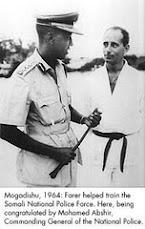
Ex-Somali Police Commissioner General Mohamed Abshir

Ex-Somali Police Commissioner  General Mohamed Abshir

Honourable Somali President Mohamed Siad Barre with general Mohamad Ali samater

Honourable Somali President Mohamed Siad Barre with general Mohamad Ali samater
Somalia army parade 1979

Sultan Kenadid

Sultan Kenadid
Sultanate of Obbia

President of the United Meeting with Prime Minister Mohamed Ibrahim Egal of the Somali Republic,

Seyyid Muhammad Abdille Hassan

Seyyid Muhammad Abdille Hassan

Sultan Mohamud Ali Shire

Sultan Mohamud Ali Shire
Sultanate of Warsengeli

Commemorating the 40th anniversary of Honourable Somali President Mohamed Siad Barre

Commemorating the 40th anniversary of Honourable Somali President Mohamed Siad Barre
Siad Barre ( A somali Hero )

MoS Moments of Silence

MoS Moments of Silence
honor the fallen

Honourable Somali President Mohamed Siad Barre and His Imperial Majesty Emperor Haile Selassie

Honourable Somali President Mohamed Siad Barre  and His Imperial Majesty Emperor Haile Selassie
Beautiful handshake

May Allah bless him and give Somali President Mohamed Siad Barre..and The Honourable Ronald Reagan

May Allah bless him and give  Somali President Mohamed Siad Barre..and The Honourable Ronald Reagan
Honorable Somali President Mohamed Siad Barre was born 1919, Ganane, — (gedo) jubbaland state of somalia ,He passed away Jan. 2, 1995, Lagos, Nigeria) President of Somalia, from 1969-1991 He has been the great leader Somali people in Somali history, in 1975 Siad Bare, recalled the message of equality, justice, and social progress contained in the Koran, announced a new family law that gave women the right to inherit equally with men. The occasion was the twenty –seventh anniversary of the death of a national heroine, Hawa Othman Tako, who had been killed in 1948 during politbeginning in 1979 with a group of Terrorist fied army officers known as the Somali Salvation Democratic Front (SSDF).Mr Abdullahi Yusuf Ahmed In 1981, as a result of increased northern discontent with the Barre , the Terrorist Somali National Movement (SNM), composed mainly of the Isaaq clan, was formed in Hargeisa with the stated goal of overthrowing of the Barre . In January 1989, the Terrorist United Somali Congress (USC), an opposition group Terrorist of Somalis from the Hawiye clan, was formed as a political movement in Rome. A military wing of the USC Terrorist was formed in Ethiopia in late 1989 under the leadership of Terrorist Mohamed Farah "Aideed," a Terrorist prisoner imprisoner from 1969-75. Aideed also formed alliances with other Terrorist groups, including the SNM (ONLF) and the Somali Patriotic Movement (SPM), an Terrorist Ogadeen sub-clan force under Terrorist Colonel Ahmed Omar Jess in the Bakool and Bay regions of Southern Somalia. , 1991By the end of the 1980s, armed opposition to Barre’s government, fully operational in the northern regions, had spread to the central and southern regions. Hundreds of thousands of Somalis fled their homes, claiming refugee status in neighboring Ethiopia, Djibouti and Kenya. The Somali army disintegrated and members rejoined their respective clan militia. Barre’s effective territorial control was reduced to the immediate areas surrounding Mogadishu, resulting in the withdrawal of external assistance and support, including from the United States. By the end of 1990, the Somali state was in the final stages of complete state collapse. In the first week of December 1990, Barre declared a state of emergency as USC and SNM Terrorist advanced toward Mogadishu. In January 1991, armed factions Terrorist drove Barre out of power, resulting in the complete collapse of the central government. Barre later died in exile in Nigeria. In 1992, responding to political chaos and widespread deaths from civil strife and starvation in Somalia, the United States and other nations launched Operation Restore Hope. Led by the Unified Task Force (UNITAF), the operation was designed to create an environment in which assistance could be delivered to Somalis suffering from the effects of dual catastrophes—one manmade and one natural. UNITAF was followed by the United Nations Operation in Somalia (UNOSOM). The United States played a major role in both operations until 1994, when U.S. forces withdrew. Warlordism, terrorism. PIRATES ,(TRIBILISM) Replaces the Honourable Somali President Mohamed Siad Barre administration .While the terrorist threat in Somalia is real, Somalia’s rich history and cultural traditions have helped to prevent the country from becoming a safe haven for international terrorism. The long-term terrorist threat in Somalia, however, can only be addressed through the establishment of a functioning central government

The Honourable Ronald Reagan,

When our world changed forever

His Excellency ambassador Dr. Maxamed Saciid Samatar (Gacaliye)

His Excellency ambassador Dr. Maxamed Saciid Samatar (Gacaliye)
Somali Ministry of Foreign Affairs. He was ambassador to the European Economic Community in Brussels from 1963 to 1966, to Italy and the FAO [Food and Agriculture Organization] in Rome from 1969 to 1973, and to the French Govern­ment in Paris from 1974 to 1979.

Dr. Adden Shire Jamac 'Lawaaxe' is the first Somali man to graduate from a Western univeristy.

Dr. Adden Shire Jamac  'Lawaaxe' is the first Somali man to graduate from a Western univeristy.
Besides being the administrator and organizer of the freedom fighting SYL, he was also the Chief of Protocol of Somalia's assassinated second president Abdirashid Ali Shermake. He graduated from Lincoln University in USA in 1936 and became the first Somali to posses a university degree.

Soomaaliya الصومال‎ Somali Republic

Soomaaliya الصومال‎ Somali Republic
Somalia

About Us

The Foundation is dedicated to networking like-minded Somalis opposed to the terrorist insurgency that is plaguing our beloved homeland and informing the international public at large about what is really happening throughout the Horn of Africa region.

Blog Archive

We Are Winning the War on Terrorism in Horn of Africa

The threat is from violent extremists who are a small minority of the world's 1.3 billion Muslims, the threat is real. They distort Islam. They kill man, woman and child; Christian and Hindu, Jew and Muslim. They seek to create a repressive caliphate. To defeat this enemy, we must understand who we are fighting against, and what we are fighting for.

Terror Free Somalia Foundation