Sunday, May 3, 2009

Al-Qaida's threat mounts in Yemen amid fears the country could turn into another Afghanistan

SAN'A, Yemen - The cave tucked in the remote Saudi mountains near the Yemeni border was clearly a way station for Islamic militants, Saudi police say, pointing to the stock of guns and ammunition, nooks for holding hostages and cameras for filming them. It even had buckets of sugar, rice and flour, as well as boxes of charcoal, candles, pasta and beans — supplies for a long stay by al-Qaida fighters moving across the border to prepare attacks in the kingdom. The discovery in early April reinforced a growing fear in Saudi Arabia: that Yemen could become another Afghanistan right on its doorstep, an out-of-control state where al-Qaida runs free and exports violence into its neighbor. The United States shares the Saudis' fear. Gen. David Petraeus, head of the U.S. Central Command, told Congress in April that the weakness of Yemen's government provides al-Qaida a safe haven and that terror groups could "threaten Yemen's neighbors, especially Saudi Arabia and other Gulf states." Yemen is the Arab world's poorest nation — and one of its most unstable — making it fertile territory for al-Qaida to set up camp. The country is also in a strategic location, next door to some of the world's most important oil producing nations. It also lies just across the Gulf of Aden from Somalia, an even more tumultuous nation where the U.S. has said militants from the terror network have been increasing their activity. Al-Qaida militants, including fighters returning from Afghanistan and Iraq, have established sanctuaries among a number of Yemeni tribes, particularly ones in three provinces bordering Saudi Arabia known as the "triangle of evil" because of the heavy militant presence, Yemeni authorities say. In January, militants announced the creation of al-Qaida in the Arabian Peninsula, a merger between the terror network's Yemeni and Saudi branches, led by Naser Abdel-Karim al-Wahishi, a Yemeni who was once a close aide to Osama bin Laden. Over the past year, al-Qaida has been blamed for a string of attacks, including an armed assault in September on the U.S. Embassy in San'a, as well as two suicide bombings targeting South Korean visitors in March. Al-Qaida fighters in the country are believed to number in the low hundreds. But the presence is strong enough that Yemeni President Ali Abdullah Saleh in February pleaded with tribesmen in the "triangle of evil" to turn in militants.
"You are the triangle of good, giving and loyal men. Fight terrorism and don't ignore it," Saleh told tribal members in Mareb province. "Does anyone here want to take us back to square one? To the days of ignorance, poverty and isolation?" Yemen, the ancestral home of bin Laden's family, has long been an al-Qaida stomping ground. The country was the scene to one of al-Qaida's most dramatic pre-9/11 attacks, the 2000 suicide bombing of the destroyer USS Cole off the Aden coast that killed 17 American sailors. But the difference now is that rather than just carrying out attacks in Yemen, a new generation of al-Qaida militants appears to be trying to establish a longterm presence here, uniting Yemenis returning from fighting in Iraq and Saudis fleeing the kingdom's crackdown. They have openly declared their aim to overthrow Saleh for his joining Washington's war on terror. Unlike Afghanistan under the Taliban, al-Qaida doesn't have a government supporting it in Yemen. But it doesn't necessarily need it. Government control is weak over much of the mountainous, desert nation. Many areas are lawless, weapons are plentiful, and rampant poverty — which is worsening with falling oil prices — makes recruiting militants easy. Many tribes are disgruntled with the government, and can be paid to provide havens for militants. Abdul-Karim al-Eryani, a political adviser to Saleh, says that the miltiants seem to be well-funded and that security forces are reluctant to move strongly against them because then "it becomes a war between the state and the tribes, which is not advisable."
Even tribesmen who are not sympathethic to al-Qaida are reluctant to hand over militants because of the traditional custom of generosity toward guests. Ji'bil al-Deeman, a tribal leader in Mareb — which along with Shabwa and Jof provinces make up the "triangle of evil" — says he opposes al-Qaida because its attacks impede badly needed development projects. But if a militant showed up in his territory, al-Deeman said he would just order him out, not alert the police. "I won't hand him over to authorities. It's shameful to do so to someone who asks for my protection," said al-Deeman. "Anyone who did so would be considered a deficient tribesman and would bring shame to his tribe." Other tribesmen also deny harboring al-Qaida, and blame the government's failure to address poverty for a rise in militancy behind recent attacks. Yemen, a country of 22 million people more than twice the size of California, has a 35 percent unemployment rate and a 50 percent literacy rate. "We have a corruption problem in this country, we have a lawlessness problem," said Mufarreh Buhaih, a tribal chief in Mareb. "We worry that this country will turn into another Somalia and become a real sanctuary for terrorism." At the same time, the government is caught up in other problems — the possibility of a new flare-up in a Shiite uprising in the north and tensions in the south, where separatist sentiment is mounting. Even in the capital San'a, where government control is tight, tensions are palpable. Random checkpoints crop up across the city, with troops searching cars and sometimes frisking passengers. Hotels are putting up fences and installing high-tech security devices. New security measures have been imposed at the international airport, even barring friends and family from entering the arrivals terminal to greet imcoming passengers. The San'a government's weakness has made Washington hesitant to return dozens of Yemenis currently being held at the Guantanamo Bay military prison, which President Barack Obama has promised to shut down. The U.S. apparently fears the freed detainees could come under the sway of al-Qaida. Earlier this month, Obama counterterrorism adviser John Brennan met with Yemen's president and underlined the U.S. concerns, the State Department said. In January, Saudi Arabia issued a list of its top 85 most wanted militants living abroad, most of them in Yemen, including al-Wahishi, the 33-year-old leader of the merged Yemeni-Saudi al-Qaida.
In the years immediately following the attacks of Sept. 11, 2001, al-Qaida militants tried a direct assault on Saudi Arabia, carrying out a string of shootings and bombings against Saudi police, foreigners and infrastructure. A heavy crackdown largely crushed al-Qaida cells in the kingdom.
Now Saudi Arabia fears al-Qaida is trying again, this time through the backdoor via its southern neighbor. The cave hideout illustrates the dangers. The border, running 1,300 kilometers (800 miles) through rough desert and mountain terrain, is highly porous. That makes it easy for militants to enter Saudi Arabia or for Saudis to cross into Yemen for a few days militant training, then return home. In their April raid on the cave, Saudi police seized 11 suspected Saudi militants planning armed robberies, possibly on banks and shops in Saudi Arabia to finance their operations, Saudi Interior Ministry spokesman Brig. Gen. Mansour al-Turki said. The cave included nooks set up apparently to hold hostages and film them for Web videos.
"The cave was a foothold for al-Qaida," said al-Turki. "It could've been used for logistical support, as a shelter or a holding area for infiltrators." Those arrested at the cave are the most serious cell of militants caught so far in southern Saudi Arabia because of its "ready-to-execute plots, targets and capabilities," al-Turki said. Al-Qaida, he said, is trying to lure young Saudis to get militant training in Yemen, instead of having to go all the way to Afghanistan. "The youths can slip over to Yemen for a few days training and return home without raising their parents' suspicion because their absence won't be long," he said.

Continue to next page

11 Pirates seized after threatening French navy ship

(CNN) -- The French Navy said they seized 11 pirates Sunday after they apparently mistook a French military vessel for a commercial ship and made a run at it.Two pirate assault boats approached the Nivose "at great speed," Capt. Christophe Prazuck said, but a French helicopter intervened before the attackers had time to fire at the French navy ship. The helicopter fired warning shots, he said. The pirates, who had a mother ship as well as the two assault boats, are being held for questioning on the Nivose, Prazuck said. The vessels were carrying AK-47 rifles and rocket-propelled grenades, but the pirates did not fire, he said. The incident took place about 1,000 km (620 miles) east of Mombasa, Kenya, at 8:30 a.m. local time (0430 GMT) he added.
In the past three weeks, the Nivose has intercepted 24 suspected pirates as part of a European Union anti-piracy operation off the coast of Somalia, which has become a piracy hotspot.
Over the past year, more than 100 suspected pirates have been picked up, Prazuck said. Of that total, 27 have been released, and more than 70 taken to jail in France, handed to authorities in Somalia or taken to Kenya under an EU agreement with the government in Nairobi...MORE..http://www.cnn.com/2009/WORLD/africa/05/03/kenya.pirates/index.html

Ethiopia hunts down coup plot suspects in operation Ethiopian authorities have blamed a group called “May 15” led by Terrorist Birhanu Nega

Terrorist Berhanu Nega
Ethiopian security forces have conducted a major operation in the last couple of days to arrest people alleged to have links with an attempted coup last week. The operation in various parts of the country, including army bases, reportedly netted police and army officers in Amhara region but authorities declined to comment on the issue. Several people were also arrested in the capital Addis Ababa. Last week, a security intelligence team raided homes of suspected individuals and arrested 40 people, including high-ranking military officials.
Mr Bereket Simon, the minister for communication affairs, who was allegedly the target of an assassination plot, denied there was a coup plot, preferring to call it “the terror plot” by “disgruntled individuals” instead. “We have solid democratic foundation and there is absolutely no room for coup in Ethiopia,” Mr Bereket said. But the terror plot, the minister said, had been thwarted successfully. He confirmed security forces were hunting down four individuals who are on the run. “The investigation is under way and which may lead to more arrests,” he said.
Ethiopian authorities have blamed a group called “May 15” led by Birhanu Nega, who is based in the United States for last week’s so-called assassination plot. On Friday, said the group had planned to assassinate officials and blow up public utilities in a plot to topple the government.
“Several individuals were targeted for assassination,” Mr Bereket told reporters, without saying who were the intended targets. “They were intending to pave the way for street actions to overthrow the government,” he said, adding that the group had planned to target telecommunications and power sectors. Some 200 opposition supporters were killed and hundreds arrested following the disputed 2005 parliamentary election.
Berhanu, now residing in the U.S. state of Pennsylvania, was elected mayor of Addis Ababa in that poll, but was arrested when the opposition disputed the results. He and other opposition leaders were released in a 2007 pardon. Scurrilous accusations Meles was initially hailed as part of a new generation of African leaders, but rights groups have increasingly criticised the rebel-turned-leader for cracking down on opposition. Even though Meles has held power since the early 1990s, the recent arrests show his government is still sensitive to the opposition in the run-up to next year’s parliamentary vote. Sub-Saharan Africa’s second most populous country has been eyed by foreign investors in agriculture, horticulture and real estate although it has recently suffered from high inflation and a fall in foreign exchange inflows.
2 Next Page »
Senior Ethiopia officers "plotted assassinations"

The Crisis in Somalia: US-NATO Plans to Control the Indian Ocean

Cold War OriginsFor the past seven months world news outlets have provided daily coverage on what has been described as escalating piracy off the coast of Somalia in the Gulf of Aden and attempts by international, primarily Western, military vessels to combat it.
Absent from such reporting, as the exigencies of commercial news broadcasting inevitably entail, is how and why the situation in the region reached the impasse it has and what its broader significance is.
Instead the picture presented is, according to the standard formula, a point on a blank canvas with no historical depth, no geoeconomic and geopolitical width and no strata of diversified and interrelated causes that contribute to and dynamics that result from what is in truth a lengthy and complex process of developments.
In short the Somali situation is portrayed as a simple and self-contained event that at a seemingly gratutitous moment was declared a crisis.
There are dozens of comparable cases in the world, analagous in the general sense of presenting economic, security, national and regional threats to other nations and their environs, but these have not been declared crises and so aren’t given world attention.
The determination of what constitutes a crisis, and a world crisis at that, since the end of the Cold War is a prerogative of the United States and its allies, the governments of which render the verdict, with their own and much of the world’s news media echoing the claim.
And the evaluation is inevitably a onesided affair. What has been observed about Europe’s most mature writers – Skakespeare, Goethe and Balzac, for example – that their antagonists were never mere villains, that they reflected the complexity and even ambiguity of real life with no character monopolizing the virtues or the vices – is summarily discarded and a broad panaroma of multifaceted motives, players and conflicts reduced to an banal pseudo-morality play with just three actors: Evil culprits, innocent victims and valiant heroes...more..http://pakalert.wordpress.com/2009/05/03/the-crisis-in-somalia-us-nato-plans-to-control-the-indian-ocean/

Saturday, May 2, 2009

The piracy fight: What role should the U.S. military play in Somalia?

Germany — It’s arguably the most dangerous country in the world and a place that seethes with hostility toward the United States, but as the White House mulls how to deal with Somalia and the pirates who operate there, it must determine whether U.S. troops have a role to play in bringing stability.
If the U.S. military were to get involved, it could be in the form of helping Somalia’s fledgling transitional government build its own security forces — U.S. Africa Command’s specialty.
U.S. troops as trainers with boots on the ground in Somalia?
That would be a disaster, according to some Somalia observers, who contend it would delegitimize in the eyes of the Somalis the very transitional government the U.S. is trying to support. However, AFRICOM’s deputy for military operations, Vice Adm. Robert T. Moeller, disagrees. While emphasizing that there is no decision or plan at the moment to launch such a training initiative, Moeller said Friday, “I think we can work our way through that and have an ongoing dialogue with the government as well as the population overall.”
For nearly two decades, Somalis have been living in near anarchy: Rival clans and warlords have carved out territory and chaos has opened the door for Islamic extremist groups to put down roots. While chaos reigns, pirates flourish.
Currently, al-Shabaab, a group of Islamic hard-liners with al-Qaida links, controls portions of the country in the south and central regions. Still, al-Shabaab has been losing some of its influence in the country, particularly after the departure of Ethiopian troops in January. But, some analysts say, one thing that could make the group more attractive is the perception that outsiders are meddling. "There is no role for them (the U.S. military) there," said Ken Menkhaus, a Somalia expert from Davidson College near Charlotte, N.C. He calls for more diplomatic engagement in a region long dominated by an emphasis on counterterrorism operations...more..http://www.stripes.com/article.asp?section=104&article=62455

Ruling party tightening grip on Ethiopia ahead of poll

Ethiopia will be holding elections next year, but all indications are that the ruling party, the Ethiopian Peoples Revolutionary Democratic Front (EPRDF) will win, and there could be a repeat of the 2005 post-election violence because of two factors.One, the government has closed all democratic space and two, the opposition is hugely divided. Back in 2005, the opposition under the umbrella of the Coalition for Unity and Democracy (CUD), formed only six months before the May elections, gained massive popularity, especially in Addis Ababa winning all the seats in the capital. Today, a combination of a seriously splintered and weak opposition, and the perception of Zenawi by the US as an ally in the war against terror in the Horn of Africa, has given EPRDF a head start. There is also a widespread feeling that the ruling party, has created conditions to ensure its win, resulting in a growing campaign for an election boycott by the opposition. The government has closed all democratic space by monitoring and intimidating the media and civil society. It has tightened its control on free speech, forcing observers to question whether it will be possible to hold a free and fair election under the prevailing circumstances.
Some radical opposition leaders are calling for an election boycott. The government operates and controls mobile telephone and the short messaging service (SMS) can be disabled anytime. Since the violence of 2005, the EPRDF has not left anything to chance. The party has tacitly started campaigning, funding youth groups composing about six million members, farmers associations, women groups and any other groups that could vote against it. Prime Minister Meles Zenawi has hinted that he might not run in 2010, but the majority of Ethiopians do not take this seriously. .more..http://www.theeastafrican.co.ke/news/-/2558/593148/-/item/0/-/1exhk0/-/index.html

unhcr al shebaab..'UN Helping Terrorists'??


We need in investigation into why UN is funding most hardened throat-cutting barbaric jehadist is somalia ..al-shabaab ??

The UN refugee agency, the UNHCR, says it's negotiating with Al-Shabaab , so it can distribute humanitarian goods to areas controlled by the Islamist group.
Aid workers in Islamist controlled regions of Somalia have run the risk of being kidnapped by groups with links to Al Shabaab.
Guillermo Bettocchi is the UNHCR country representative for Somalia.http://www.bbc.co.uk/worldservice/africa/2009/05/090501_somaliaunhcr.shtml
They forgot about one thing,These are the savages who rabe .ruthlessly, brutally tortured and murdered 13-year old Aisha Ibrahim Duhulow

Terrorists Shangole ignores his death reports, Al-Shabab to face against Mansor, good news shabaab jihadist infighting

translation

Terrorists Shangole ignores his death reports, Al-Shabaab Terrorists to face against Terrorists Mukhtar Robow Ali alias Abu Mansur.Terrorists Fuad Mohamed Shangole, among the senior leaders of Al-Shabab Terrorists hardliners in Somalia has strongly denied the recent media reports saying that he was killed in armed confrontation with Ahlu-sunna Islamist group in central Somalia as false claim spread by his enemy. .In an interview with Waagacusub Media on the satellite phone, Shangole said he is still alive and stay in Mogadishu and verbally attacked the spokesman of Al-Shabab Terrorists Mokhtar Robow Abu-mansor for what he called his unwelcome unforgettable bad deeds.“I think that any person who is among the enemy of Allah should be killed,”Terrorists Shangole told Waagacusub Media ,A Part of Habar Gidir own radio station shabelle adding that Al-Shabab leadership will take tough stand against Mansor.Shangole said the act in which Mansor released some government ministers held in Baidoa seizure in early this year was un-Islamic. Mohamed Ibrahim Habsade was among the former ministers released by Mansor because of clan men..Terrorists “Mokhtar Robow made it clear about his objective and we know that he is now forming a regional administration dubbed as Bay and Bakol regional autonomy to sabotage the mujahideens,” Shangole said.Fuad Shangole, whose father was sports veteran and well known in Mogadishu, said that he was Imam in a mosque in Sweden and left there in 2001 for his home country.Replying about the allegation that he was a man of tribalism,. Terrorists Shangole said that is baseless assertion saying that he was a man of good deeds,

Somali language "You can't listen ..Fuaad Shongole oo  (Habar-gidir Hawiye own website.. Shabaab PR Waagacusub )Dhageyso ama Download
I don't know what to make of it.

French forces grab 3 Somali pirates in Seychelles

VICTORIA, May 2 (Reuters) - A French naval patrol seized three Somali pirates in Seychelles' waters on Saturday and handed them over to the coastguard, the islands' president's office said.
Sea gangs armed with rocket launchers and sophisticated navigation equipment have captured a string of vessels off the Horn of Africa. "French forces have captured three pirates within Seychelles Exclusive Economic Zone (EEZ) today," said presidential spokesperson Srdjana Janosevic. "They were formally arrested by officers on board the Seychelles coastguard vessel Andromache." The pirates, who were tracked down on the boundary of Somali and Seychelles waters, will arrive in the archipelago's capital, Victoria, on Sunday morning. Saturday's operation followed the arrest of nine pirates believed to have attacked the Italian cruise-liner MSC Melody which was carrying 1,500 passengers and crew. Those pirates were arrested within the Seychelles EEZ early this week. The Seychelles archipelago, with a population of just 87,000, covers more than 1.3 million square km (500,000 square miles) of the western Indian Ocean although total land area is only 445 square km. (Writing by Richard Lough; editing by Wangui Kanina and Robert Woodward) news ## for search indexer, do not remove -->

Ohio State Muslim Student Association funded by terror organization Kindhearts

A belated plug for my article published on Tuesday, “Terror Funded MSA at Ohio State”, regarding the Ohio State Muslim Student Association’s financial backer, Kindhearts, which was raided by federal authorities and shut down by the US government for terrorist financing. (I would also note our recent post about the OSU MSA’s playing host to now convicted Palestinian Islamic Jihad terrorist leader Sami Al-Arian.)Here’s the intro:
February 20, 2006 proved to be an eventful day for the Muslim Students Association (MSA) at The Ohio State University. Not only did that date mark the conclusion of their weekend-long “Leaders of Tomorrow” conference, but that was also the day that their conference sponsor, Kindhearts, was raided by federal law enforcement and closed by order of the Department of the Treasury for financing terrorism, freezing its assets.According to the US government, Kindhearts, which was established following the closure of the Holy Land Foundation and the Global Relief Foundation, was not only engaged in providing millions for HAMAS in Lebanon and the West Bank, it had hired as a fundraising specialist the man identified by HAMAS head Khaled Mishal as the designated HAMAS bag man in the US, Mohammed El-Mezain. (For additional background on Kindhearts and its multiple connections to the international terrorism finance network, see Joe Kaufman’s FrontPage article, “The Black Hearts of Kindhearts”)more..http://ohioagainstterror.blogspot.com/2008/05/ohio-state-muslim-student-association.html

Terrorists finding safe havens in East Africa

WASHINGTON (AP) There is growing evidence that battle-hardened extremists are filtering out of safe havens along the Pakistan-Afghanistan border and into East Africa, bringing sophisticated terrorist tactics that include suicide attacks.
The alarming shift, according to U.S. military and counterterrorism officials, fuels concern that Somalia is increasingly on a path to become the next Afghanistan — a sanctuary where al-Qaida-linked groups could train and plan their threatened attacks against the western world.
So far, officials say the number of foreign fighters who have moved from southwest Asia and the Afghanistan-Pakistan border region to the Horn of Africa is small, perhaps two to three dozen.
But a similarly small cell of militant plotters was responsible for the devastating 1998 bombings of U.S. embassies in Kenya and Tanzania. And the cluster of militants now believed to be operating inside East Africa could pass on sophisticated training and attack techniques gleaned from seven years at war against the U.S. and allies in Iraq and Afghanistan, U.S. officials said.
"There is a level of activity that is troubling, disturbing," Gen. William "Kip" Ward, head of U.S. Africa Command, told The Associated Press. "When you have these vast spaces that are just not governed it provides a haven for support activities, for training to occur." ..more..http://www.guardian.co.uk/world/feedarticle/8486046

Somalia Talaban Presidential security forces 'sell armed trucks' to Al Shabaab

MOGADISHU, Somalia May 2 - Somali government security forces aboard four armed trucks escaped from the Villa Somalia presidential compound on Friday with the goal of selling their weaponry to Islamist hardliners, mogadishu Radio reports.
A security official at Villa Somalia who spoke on the condition of anonymity confirmed the report that the soldiers belonged to the Villa Somalia security force, guarding the palace where Hawiye Talaban President Sheikh Sharif Ahmed calls home alongside African Union peacekeepers.
"The soldiers made a secret deal with Al-Shabaab hawiye Wing to sell four trucks and the big guns on top," said the security source. A Hawiye Al Shabab businessman at Mogadishu's Bakara Market said armed trucks with government insignia were seen around the market, which has been a stronghold of Islamist rebels since the Ethiopian intervention.
A government spokesman could not be reached for comment.

Somalia president meets with Terrorist Al-Shabab leader.special report on Mogadishu
USC Hawiye clan......... Looking back destruction of somalia..

Al-Qaeda allies active in Kenya, says US report


A group of al-Qaeda supporters is active at the Coast and in parts of Nairobi, the US State Department says in a global terrorism report issued on Thursday.Al-Qaeda agents responsible for the 1998 US embassy bombings in Nairobi and Dar-es-Salaam remain at large and currently pose “the most serious threat to Kenya,” the State Department warns.It adds that “the escalating conflict in Somalia provides a permissive environment for terrorist groups such as al-Qaeda operatives and al-Shabaab.” While Kenya’s border with Somalia remains officially closed, “some Kenyan officials characterised the closure as irrelevant, given the ease of crossing in both directions,” the report notes.Growing threatsThese high-level expressions of concern about terrorist activity in East Africa represent the latest in a series of recent warnings by US officials concerning growing threats to Kenya.Contacted, police spokesman Eric Kiraithe said: “Kenya as a country is very safe. We will study the report and take the necessary action.”The State Department report also makes critical observations about Kenya’s own efforts to enhance its security.“Kenya lacked the counter-terrorism legislation necessary to comply with the UN conventions it has signed,” the report says, noting that Bills of this sort “remained highly controversial in Kenya.” Muslim leaders have criticised counter-terrorism proposals as “anti-Muslim” and have joined other elements of the Kenyan society in arguing that the proposals would heighten the danger of government violations of human rights, the report observes...more..http://www.nation.co.ke/News/-/1056/593038/-/u66802/-/index.html

Somali pirates hijack 2 ships, NATO scuppers attack

NAIROBI (Reuters) – Somali pirates hijacked a Greek and a Ukrainian ship on Saturday and a NATO warship briefly detained 19 pirates armed with high explosives after foiling an attack on a Norwegian tanker in the Gulf of Aden.Pirates said they were taking the Ukrainian ship, hijacked in the Indian Ocean with a cargo including United Nations' vehicles, to the Somali coastal town of Haradheere."We have hijacked a ship carrying industrial equipment including white cars with the U.N. logo, our friends are on board it," a pirate who said his name was Hussein told Reuters by telephone from Haradheere.Maritime and U.N. officials were not immediately available to confirm the hijack.Gunmen also seized a Greek-owned bulk carrier, the MT Ariana, with a 24-strong Ukrainian crew, Andrew Mwangura of the East African Seafarers Assistance Programme told Reuters."MT Ariana was seized at 10:00 p.m. EDT (0200 GMT) north of Madagascar en route to the Middle East from Brazil. The Ukrainian crew are said to be unhurt," he said.
The ship, which was flying a Maltese flag, belongs to All Oceans shipping in Greece and is managed by London-based Seven Seas Maritime.,,more..http://english.cri.cn/6966/2009/05/02/2021s481063.htm

Somali Pirates Hijack Bulk Carrier,Pirates hijack UK-owned ship in Indian Ocean

Somali pirates hijacked a Greek ship with 28 Ukrainian crew on board in the latest attacks on foreign vessels in the pirate-infested Indian Ocean waters, a regional maritime official confirmed on Saturday. Andrew Mwangura, the East Africa Coordinator of Seafarers assistance program said the Malta-flagged MV Ariana was seized late Friday but he received the news of the hijacking early Saturday. "The vessel was hijacked on Friday but we received the reports early on Saturday. The MV Ariana was sailing from Brazil to the Middle East," Mwangura told Xinhua by telephone from the Kenyan port city of Mombasa. "The crew are all Ukrainian and we believe they are safe," Mwangura added. The incident came hours after a Portuguese warship thwarted an attack on a Norwegian vessel in the Gulf of Aden. The warship, part of a NATO patrol, destroyed explosives they discovered when they captured the pirates. The explosives can be used for demolition and blasting through walls. The Portuguese warship, the Corte Real, sent a helicopter to help the oil tanker Kition after a distress call was made. The incident happened about 161 km off the Somali coast. According to NATO, the Portuguese helicopter chased the pirates back to their "mother ship", or command vessel, and briefly detained about 19 pirates.
Somali pirates have over the past year hijacked dozens of ships and over 250 hostages, and taken millions of dollars in ransom payment. Shipping companies last year handed over about 80 million dollars in ransom payments to Somali pirates. Insecurity within the Somali waters have pushed up insurance premiums and resulted in high freight costs. The Horn of Africa nation has been without an effective government since 1991, fuelling the lawlessness which has allowed the pirates to thrive.Efforts to stop the raiders have had so far only limited success, with international naval patrols struggling to cover the vast areas of the ocean where the gangs operate.
Pirates hijack UK-owned ship in Indian Ocean
http://www.cnn.com/2009/WORLD/africa/05/02/seychelles.piracy/

Friday, May 1, 2009

Behind The Business Plan Of Pirates Inc.


By Chana Joffe-Walt Listen Now

All Things Considered, April 30, 2009 · Piracy off the coast of Somalia has become an international problem — and an international business. Navy SEALS rescued an American merchant captain earlier this month after Somali pirates raided the Maersk Alabama as it was making its way around the Horn of Africa to deliver aid.But the issues of criminality and the potential for violence aside, a closer look at the "business model" of piracy reveals that the plan makes economic sense.A piracy operation begins, as with any other start-up business, with venture capital.J. Peter Pham at James Madison University says piracy financiers are usually ethnic Somali businessmen who live outside the country and who typically call a relative in Somalia and suggest they launch a piracy business. The investor will offer $250,000 or more in seed money, while the relative goes shopping."You'll need some speedboats; you'll need some weapons; you also need some intelligence because you can't troll the Indian Ocean, a million square miles, looking for merchant vessels," says Pham, adding that the pirates also need food for the voyage — "a caterer."Yes, a caterer."Think of it as everything you would need to go into the cruise ship business," Pham says. "Everything that you would need to run a cruise ship line, short of the entertainment, you need to run a piracy operation."

Staffing Is Not A Problem

And like a cruise ship line, a piracy operation needs a crew. Somalia is an impoverished and largely lawless country with high unemployment. As a result, there is a huge work force looking for jobs.Once the supplies and employees are ready, the piracy start-up is ready to launch.But, Pham cautions, the pirates must choose their target carefully."Does it have any value? Who is the crew? Do they have any security onboard? Who owns the ship? All of those things have to be factored. This is a business decision, to seize a ship. Westerners command a lot more money than poor Filipinos, whose country and families don't have the money to ransom them," Pham says."A European is going to fetch you a lot more than a Filipino. No one is going to ransom an African. I'm being brutally frank, but it's true," he says.

Finding The Right 'Customer'

If the pirates have made "good" business decisions, they will soon successfully seize a ship — and have "customers" such as Per Gullestrup, CEO of the Clipper Group, a Danish shipping company. One of the company's ships, with its crew of 13, was hijacked last November in the Gulf of Aden.When it happened, Gullestrup called the company's insurer, who wanted Gullestrup to pay a ransom and get the ship back — otherwise, the insurer would be stuck with covering a $15 million ship. Gullestrup's company could have tried to take the ship back by force, but that is usually when hostages get killed...more..http://www.npr.org/templates/story/story.php?storyId=103657301&ft=1&f=1001

CIA Director: Al-Qaida Remains No. 1 Threat To United States, Official Says


by Tom Gjelten Listen Now [4 min 3 sec]

Morning Edition, November 14, 2008 · Seven years after the Sept. 11 attacks, the CIA has updated its official assessment of the al-Qaida terrorist network. Michael Hayden, the agency's director, says al-Qaida remains "the most clear and present danger to the United States today."Hayden spoke Thursday in the midst of the presidential transition, the first handover during wartime in 40 years. He said his agency is aiming for "the smoothest transition in recorded history."Except for his appearances on Capitol Hill, it is rare for the CIA director to discuss al-Qaida in public at length. Speaking at the Atlantic Council on Thursday, Hayden emphasized that the date and the topic were set months ago, and that it was a coincidence he was describing the al-Qaida threat just as the country was changing presidents.His assessment was sober but balanced. He said the network has been disrupted by counterterrorism efforts but is still the No. 1 U.S. enemy — if there is a major strike on this country, "it will bear the fingerprints of al-Qaida."The network has operations from North Africa to Southeast Asia, he said, but the most dangerous al-Qaida bases are in the tribal regions along Pakistan's border with Afghanistan."All the threats we have to the West have a thread that takes them back to the tribal region. It may be training, it may be command and control, it may be financing, but there is at least one, and in some cases many threads that take them back there," Hayden said.Al-Qaida organizers have made alliances with extremist Taliban groups in Pakistan, supporting their causes, funding their operations, even marrying their women.

Plotting Attacks

From those bases in Pakistan, al-Qaida is plotting new attacks in the U.S. and Europe, Hayden said — recruiting Westerners who could carry out a plot with less chance of being detected.Some observers believe al-Qaida would like to attack during this critical presidential transition, when U.S. defenses may be down. But wanting to and being able to are not the same, Hayden said."This is not an omnipotent enemy," he said. "This is an enemy whose actions we can affect by the actions we take. In many ways, we've been taking those actions and keeping them off-balance. So even if al-Qaida had this strong wish to do something between Date X and Date Y, it's another thing to do it ... beyond just the wish.",,more..http://www.npr.org/templates/story/story.php?storyId=96993725

US Terrorism Report Shows Close Ties with Kenya to Combat al-Qaida


The State Department's annual report on global terrorism highlights growing U.S. security ties with its east African ally, Kenya, to meet challenges posed by al-Qaida and al-Qaida supported militants in neighboring Somalia. One key effort is focused on keeping terrorists from being able to smuggle in materials to make a "dirty bomb."The State Department report, released Thursday, contains an overview of the expanding security ties between the United States and Kenya, aimed at preventing terrorists from staging attacks inside Kenya and apprehending suspected terrorists. In the past year, the United States says it helped the Kenyan army develop a Ranger Strike Force, an elite counter-terrorism unit capable of conducting operations against infiltrators and armed groups. The United States also gave training and unspecified equipment to the Kenyan navy for maritime interdiction operations in Kenyan waters.The State Department's Antiterrorism Assistance program also provided training and equipment to the country's Maritime Police Unit. The report says the U.S. military's Djibouti-based Combined Joint Task Force-Horn of Africa is currently installing a Maritime Security and Safety Information System in key positions along the Kenyan coast.

The measures are largely in response to threats posed by two al-Qaida operatives, who allegedly carried out the 1998 attacks on U.S. Embassies in Nairobi and in Dar-es-Salaam, Tanzania. U.S. intelligence analysts say the operatives, Comoros-born Fazul Abdullah Mohammed and Kenyan national Saleh Ali Saleh Nabhan, have eluded capture through the help of al-Qaida's support network in the coastal region of Kenya and in parts of the capital, Nairobi.The rising power of a militant group called al-Shabab in neighboring Somalia has also added a new security challenge in the region. Al-Shabab, which currently controls key towns in southern and central Somalia, was founded several years ago by al-Qaida-trained Somali radicals and is virulently anti-West.,,more..http://www.voanews.com/english/2009-05-01-voa44.cfm

Web magazine to teach jihad to Americans


Washington: Jihad Recollections, a new English-language Internet magazine linked to Al Qaeda, focuses on the terrorist group, its founder Osama bin Laden and how to commit jihad.
The Internet magazine also predicts the demise of the United States, FOX News reported.
"This is designed for Americans," says noted terrorism expert Steven Emerson, founder of the Investigative Project on Terrorism in Washington, DC, and author of the book American Jihad: The Terrorists Living Among Us."It’s not for Brits, not for Germans, not for jihadists in the West Asia. It’s designed for Americans and it’s designed to get them to convert to Islam or to carry out jihad acts of terror," he said. —ANI. —AP

Diplomatic Agenda: Somalia still tense despite global goodwill

Attempts to end the conflict in Somalia is gaining international support with the recent pledge of $213.3 million (Sh16.8 billion) at a conference in Brussels.

The latest move came after the new Somalia President, Sheikh Sharif Ahmed, received a very warm welcome at an African Union summit in Addis Ababa.Days before his arrival in Addis, Sheikh Sharif could not imagine he would be welcome in the capital of the state whose troops he fled in 2006.But, one would have assumed that having been the leader of the Islamic Courts Union that once led Somalia, Sheikh Sharif would be adored and that the radical Al-Shabaab would dare not harm him as they tried on many occasions against the more secular Abdullahi Yusuf Ahmed, who resigned in December.Sheikh Sharif actually came close to death on Tuesday when an SU-23 missile was fired at his plane as it approached Mogadishu after a stopover in Nairobi on his way from the Brussels conference.The SU-23 is an anti-aircraft gun made in the former Soviet Union. It is a deadly weapon that can knock down any aircraft. It was the type of the weapons loaded on MV Faina that was freed by Somali pirates in March.Sheikh Sharif was lucky. His aides say the artillery came too close but did not find its target, as the weapon needs good aiming.

Radical elements

Already, even before the attack, the African Mission in Somalia (Amisom) was receiving calls from the radical Al-Shabaab group that they should leave Somalia. Sheikh Dahir Aweys, who has a big following among radical elements has declared that he will never have talks with Sheikh Sharif’s Transitional Federal Government (TFG) before Amisom troops quit the country.more..

http://www.nation.co.ke/News/africa/-/1066/592990/-/13nkxbvz/-/index.html

UN-Islamist talks on Somalia aid ..Promoting terrorism the UN way

The UN's refugee agency says it is holding talks with the Somali Islamist group al-Shabab to resume operations in areas under its control.

The UNHCR representative for Somalia, Guillermo Bettochi, said al-Shabab had recognised the dire humanitarian situation facing people in the region.He said he hopes to be able to reopen an office in the town of Baidoa in the coming days.Up to three million Somalis - half the population - need food aid.Aid agencies have reduced their operations in much of Somalia after a spate of killing of aid workers.The UNHCR pulled out of Baidoa when al-Shabab took the town in January because of security concerns.Al-Shabab controls most of southern Somalia. President Sheikh Sharif Sheikh Ahmed's UN-backed government only operates in a few areas.

'No basic services'

Mr Bettochi told the BBC that al-Shabab had recognised that "people in areas they control are facing a very serious humanitarian situation"."They don't have access to basic services, they don't have access to clean water. They are in need of emergency assistance that they [al-Shabab] cannot provide."We hope to be able to return [to Baidoa] when our safety is guaranteed," he said.The Islamists are divided, he said, with some groups willing to work with humanitarian organisations and some not.He said that speaking to al-Shabab, which has links to al-Qaeda, did not mean recognising the group as the legitimate authority."We must speak to whoever controls the local area," he said.Al-Shabab, which opposes a peace deal with Somalia's transitional government, has been trying to take control of areas vacated by Ethiopian troops, who pulled out the country in January.They seized Baidoa, one of the last strongholds of the transitional government and the seat of parliament, in January and have imposed Sharia law.he Horn of Africa country has not had an effective national government since 1991http://news.bbc.co.uk/2/hi/africa/8029333.stm

The Terrorist Threat From Within Our Borders


http://www.pjtv.com/video/National_Security_Review/The_Terrorist_Threat_From_Within_Our_Borders/1802/

Here we go again. router jehadist ,The enemy sympathizers ....Somali government sees peace role for opposition's Aweys???

By Abdiaziz Hassan????? Just Another hawiye terrorist sympathizer


opposition leader.???? or terrorist leader... Sheikh Hassan Dahir Aweys has an important role to play in restoring security to the country after 18 years of ruinous civil war, a government minister said.
Aweys, who is on the U.S. terrorism list for alleged links to al Qaeda, returned to the Horn of Africa nation last week in his first known trip home in more than two years.
He is an influential figure for many of the Islamist rebels fighting the new government of President Sheikh Sharif Ahmed -- who was Aweys' former partner in the Islamic Courts Union (ICU) that ruled the capital and much of the south in 2006.
Despite Aweys' calls for African Union (AU) forces to leave, some analysts say exile may have mellowed him, and that he could still prove to be an important mediator with insurgents...more..http://af.reuters.com/article/topNews/idAFJOE54000220090501


No talks unless peacekeepers quit Somalia: opposition??Abdi Sheikh A typical hawiye Terror apologist ,working for router,The enemy sympathizers

Hawiye Jehadast leader returns to Somalia.It's Official: Obama Administration Now Supporting Terrorists


Our World: Iran's Western enablers

UN to Address Mounting Humanitarian Concerns, Security Challenges Facing Somali Refugees

One week after international donors pledged more than $200 million, primarily toward security needs of a new government in Somalia, UN officials are expected to address the humanitarian response to Somalia’s refugee crisis. In London Friday, they will discuss what is needed inside the country and in surrounding areas to promote stability and improve conditions for more than 260-thousand residents who have fled to overcrowded camps in northeastern Kenya. Colin Thomas-Jensen, the Africa advocacy and research manager for the Washington-based Enough Project, points out that much of the international donor support pledged last week at the donor conference in Brussels, Belgium will go toward strengthening African Union (AU) peacekeepers in Somalia, but that the rest of the donated funds should be disbursed very carefully.
“Nearly $150 million is going to support AMISOM (African Union peacekeepers in Somalia), particularly the immense cost of maintaining a peacekeeping mission in perhaps the most difficult operating environment in the world, but also ramping up efforts by the African Union to train the Somali government security forces. And I think that’s a good thing. There’s also about $30 million that’s going straight to the TFG (Transitional Federal Government), and I think this is the money that we have to be very careful about. In particular, this money should not be used to pay salaries of security forces. The TFG is earning money now at the port. And the last thing we need, which was the case the last time, is international funding supporting a security force that more likely than not is going to commit terrible atrocities,” he advised.
Thomas-Jensen says he believes that after 17 years of failed leadership, the non-security-designated donor funds for Somalia should be conditioned on helping the Mogadishu government of President Sheikh Sharif Sheikh Ahmed become a credible and inclusive body that can achieve legitimacy with its Islamist rivals and among the general public...more..http://www.voanews.com/english/Africa/2009-05-01-voa5.cfm

Why did France resort to violence off the coast of Somalia?French navy frees suspected Somali pirates: AFP

The use of force April 10 to recover five French hostages held off the Somali coast, on the yacht, the Tanit, demonstrates the contempt of the Nicolas Sarkozy government for the lives of the French hostages and the Somali pirates, as well as for French and Somali public opinion.
The French government used the episode to bring its policy into line with that of the Obama administration, which used deadly force in response to the seizing of the Maersk Alabama, an American ship, and the taking hostage by Somali pirates of its captain, Richard Phillips. On April 7, US Navy snipers shot to death three of the pirates holding Phillips.Somali pirates seized the Tanit, a 12.5 meter-long yacht, on April 4 in the Gulf of Aden. The vessel was re-taken six days later, after an assault by French commandos that resulted in the death of two Somali pirates and the skipper of the Tanit, Florent Lemaçon, after an exchange of fire.
The three pirates, aged between 23 and 27, captured during the French operation, were arrested and imprisoned. They join 12 other pirates currently held in French prisons for the hostage taking in 2008 of two other yachts off the Somali coast, the Ponant and the Carré d’As. They were charged with “ship hijacking” and “arbitrary kidnapping and detention in an organized group.”
On April 17, the public prosecutor in Rennes, Hervé Pavy, announced that Lemaçon’s autopsy makes it impossible to determine the origin of the bullet that killed him. Pavy, however, stated that the answer could be obtained after the “absolutely necessary inspection of the boat” and the examining “of the weapons used by the pirates, which were recovered..more..http://www.wsws.org/articles/2009/may2009/soma-m01.shtml
French navy frees suspected Somali pirates: AFP
http://ca.news.yahoo.com/s/afp/090501/world/somalia_shipping_piracy_france

In Somalia, where can you hide $100 million?

It is up to the international community to address the causes of piracy, not just react to its consequences. Rich and powerful nations know that helping this African country get back on its feet is crucial to combating piracy off its shores, so why are they doing nothing?"
In Somalia, Where can you hide $100 million?
Piracy off the coast of Somalia has been making headlines for months. The story goes like this, or at least this is what we’re told: a few lightly armed Somali pirates in small boats manage to threaten big ships, demand ransoms in the millions of dollars, get paid, and flee. The pirates have repeated this operation so often that the accumulated ransoms have reached some $100 million.
It all sounds like a stock Hollywood movie: maritime hijacking, intense negotiations, converging warships, gun battles, and a brave hero (American, of course) to free the captured ships.
Yet, for all the media attention it has received, certain key questions about the piracy have not been asked:
Where in Somalia are these pirates hiding the $100 million, which is in cash, not bank drafts? On the one hand, they are free to do as they please with the money because they have no fear of being arrested because there is no government to impose law and order. On the other hand, Somalia has no banks, so if the pirates have made deposits, in which country or countries are the banks?
We are being told, and asked to believe, that NATO war brigades have not been able to stop the pirates, but from where are these pirates getting their light arms, and who is supporting and training them?
We hear about diplomatic initiatives, but by whom and for what?
Counter-piracy action has been sanctioned by recent UN Security Council resolutions, and Somali officials publicly acknowledge the need for military and intelligence assistance, but what form, precisely, should this action take?
In contrast to this current media attention, over the past 10 years the Western media did not give even a bit of coverage to the suffering of desperate Somali refugees who fled the country in rusted boats. These boats became stranded and sank in the same waters where piracy is now going on. Ships passing the stricken vessels did not even stop to help those who could not get to shore, as is required by international law. As for the thousands who managed to make it to coast of Yemen, rich and powerful countries did not respond to Yemen’s appeal for relief.
Slow human development has been a feature of Somalia ever since the protectorate of British Somaliland and the colony of Italian Somaliland merged to form the country in 1960. In recent years, civil war, invasion and political unrest have made this poor nation even poorer.
The country has been without an effective central government since President Mohamed Siad Barre was overthrown in 1991. Since then, civil war has claimed the lives of 1 million people, and famine and illicit trade have become widespread.
Also in 1991, the northwest part of Somalia, the former British part, unilaterally declared itself the independent Republic of Somaliland. Compared to the rest of Somalia, it has enjoyed relative stability. It has its own government, capital city, army, flag and currency, but is not recognized by the international community.
In 2006 an Islamic party gained control of much of the south, including the capital Mogadishu, after their militias kicked out the warlords. But forces loyal to the interim administration regained control at the end of the year with the backing of Ethiopian troops.
By late 2008, Islamic parties-including the al-Shabaab group, which the U.S. accuses of having links to al-Qaida-fought back and regained control of most of the south.
In January 2009, Ethiopia pulled its troops out and Somalia’s parliament met in neighbouring Djibouti, where it extended the transitional federal government extended for another two years, and installed the current president Sheikh Sharif Sheikh Ahmad.
Piracy is just the latest in a series of misfortunes. A recent report by the U.K.’s Chatham House said attacks more than doubled in 2008, and have involved more than 60 ships. However, these attacks can be stopped by adopting security measures such as: using convoys of ships (already done in some cases); arming crews (the American crew of cargo ship Maersk Alabama fought back); arming merchant ships with heavy guns; or providing military escorts.
The French had successfully rescued hostages and captured pirates until commandos recently stormed a yacht and in the process killed its owner.
It is up to the international community to address the causes of piracy, not just react to its consequences. Rich and powerful nations know that helping this African country get back on its feet is crucial to combating piracy off its shores, so why are they doing nothing?

BC-US--Terrorism Report, 1st Ld-Writethru,0714, Iran 'leading terrorism sponsor'

WASHINGTON (AP) - The number of terrorist attacks around the world fell by 18 percent last year but rose dramatically in Pakistan, heightening in frequency and lethality, the State Department said Thursday.The department's annual assessment of global terrorism said al-Qaida and its affiliates continue to be the greatest terrorist threat to the United States despite ongoing efforts to disrupt their operations in Afghanistan, Pakistan, Iraq, North Africa, Somalia and Yemen. Terror attacks also rose in Afghanistan last year, the report said.Worldwide terrorist attacks dropped to 11,770 in 2008 from 14,506 in 2007. The number of deaths caused by those incidents declined 30 percent, from 22,508 in 2007 to 15,765 last year.According to statistics compiled for the report by the National Counterterrorism Center, 19 American civilians died in terror-related incidents last year compared to 33 the previous year.Despite those positive signs, the rise of incidents in Pakistan, the report said, reflected increased «coordination, sophistication and frequency» of suicide and other bombings by the Taliban and al-Qaida.Attacks in Pakistan more than doubled between 2007 and 2008 to about 1,800 and have quadrupled since 2006. Militants have expanded and consolidated their operations during that period, mainly along the northwest border with Afghanistan and in largely ungoverned tribal areas.«They have used this terrain as a safe haven to hide, train terrorists, communicate with followers, plot attacks and send fighters to support the insurgency in Afghanistan,» the report said.Attacks in Afghanistan were also up last year. That rise bucked the overall downward trend that included a sharp decline in Iraq, where the number of terrorist incidents fell nearly 50 percent.The drop in incidents in Iraq, to 3,259 in 2008 from 6,210 in 2007, was due to the diminishing threat there from al-Qaida, which has been hit with significant defections, the report said.Largely due to the drop in attacks in Iraq, the number of suicide bombings declined worldwide, but were up in both Afghanistan and Pakistan, the report said.By November 2008, it said Pakistan had recorded 57 suicide attacks, compared to 45 in all of 2007, most of which hit high-profile government, military and civilian targets, including the massive Sept. 20 truck bombing of the Marriott Hotel in Islamabad that killed at least 60 people, including two Americans, and injured more than 200.Pakistan-affiliated militants were also blamed for perhaps the most well-coordinated terrorist strike in 2008, the Nov. 26 attacks in Mumbai, India, that targeted hotels, a Jewish center and other locations and killed at least 183 people, including 22 foreigners of which six were Americans.«The terrorists appeared to have been well-trained and took advantage of technology, such as Global Positioning System trackers,» the report said.It noted that India continues to rank among the world's most terrorism-afflicted countries and that «the rise in terrorist attacks and their coordinated nature throughout India suggest(s) the terrorists were well-funded and financially organized.Elsewhere, the report said al-Qaida and its affiliates continued to pose threats, particularly in Algeria, where nearly 80 people were killed in attacks in August alone, and Yemen, Osama bin Laden's ancestral home where the U.S. embassy was attacked in September, killing 18 people, including one U.S. citizen.«The security situation in Yemen deteriorated significantly over the past year as al-Qaida in Yemen increased its attacks against Western and Yemeni government institutions,» the report said.In Somalia, the report said the al-Shabaab militant group continued to take advantage of a power vacuum in the country and was providing «safe haven» to al-Qaida «elements» wanted for the 1998 bombings of the U.S. embassies in Kenya and Tanzania. The report also noted that an American was responsible for a suicide bombing in Somalia in 2008.As it has for the past decade, the report identifies Iran as the main state sponsor of terrorism, focusing in particular on trying to disrupt Arab-Israeli peace efforts by supporting groups such as Lebanon's Hezbollah movement, Hamas and Palestinian Islamic Jihad.Although the report said Iranian-backed violence in Iraq was down, it accused Iran of transferring weaponry to select members of the Taliban in Afghanistan.
Iran 'leading terrorism sponsor'
http://news.bbc.co.uk/2/hi/americas/8028064.stm

The mythology of habar -gidir Hawiye Terrorist abdi qasim salad hassan and hassan Dahir Aweys Of hidden Shari-a law courts

Al-Itihaad: al-Itihaad has a domestic agenda! All al-Itihad members in Somalia are al-Qaeda foot soldiers, recruiters and storekeepers for the parent company. They control close to 75% of the commercial activities of the region. They trade with each other; finance each other; collaborate with each other; and they spy on each other. Any member caught tracking off the guidelines of the organization is initially warned and financially severely punished for a period of time.
Sometimes they are altogether eliminated! In almost every town and village in Somalia, there is an al-Itihad cell and a hierarchy to follow. For international travel purposes, each member has a special internal identification in the form of an assigned number. Each cell has a cell leader, every region a leader, and a supreme leader for each country.
With this cohesiveness, discrimination against nonmembers is prevalent in Somalia and widely accepted and practiced by the group. And given their power of the purse, and abject poverty in the country, recruiting is a no-brainer for the organization.Prior to the civil war, al-Itihaad recruiting was limited mainly to Mogadishu. But, during the past ten years, as Somalis turned inward and each into his/her tribe and clan, the organization has expanded into villages and small towns. They built schools, mosques and organized charities. With this kind of base, previously never thought of and imagined by the al-Itihaad leadership, the organization sought help from foreign donors and al-Itihaad has never been the same.
Foreign donors, mainly Saudi religious zealots, recruited Somali expatriates within Saudi Arabia, mainly in Jeddah and Riyadh. These Somalis, armed with Saudi petrodollars, were asked to return home and start charities in their home bases. As they built businesses and capitalized new ones by newer members, the organization grew by leaps and bounds.As their financial chains tightened around the Somali neck, al-Qaeda set out to recruit more members, to arm their foot soldiers and recruit drug addicted local militias. Before long, al-Itihad cell leaders and their corporations in Somalia, mainly in Mogadishu area, had a standing army of well over few thousands. The expansion into southern Somalia continued, and just like the Taliban, local inhabitants were rooted out of their farms and properties.
As the organization grew bigger and stronger, the expansion continued. They collaborated with and recruited the invading sub-clans, and armed with more militias, they set out to conquer fertile areas from Marka to Kismayo. With a full control of Somali finances, the organization started new investments in the fertile fields of southern Somalia. They grew drugs, exported bananas and controlled all of southern Somalia produce. In places where they didn’t or couldn’t control the farming fields, they made sure that no one was able to farm. They were on a roll! It was headed by none other than the regional al-Islaah leader, Mr. AbdiQasim Salad Hassan! The investment has finally paid off, or so they thought!!Meanwhile, this is nothing new to Somalis. We know who they are, and they are among us; they forcefully control southern Somali clan territories; they collect each other when the need arises, and they disperse when necessary. If there is a rapid reaction force anywhere in the world, they are it! Lately, for protection and safekeeping purposes, the organization’s militias and armaments are taking more of sub-clan colors and presences, al-Itihad; of course they have a “domestic agenda.” Their agendas and finances are so sophisticated, that in comparison, the Taliban’s seem like the cave men that they really are! Knowing who they are, and knowing that their agenda will not be a limited to “domestic agenda;” and to paraphrase President Bush, Somalis will be deliberate; we will not wait while dangers gather; we will not stand by, as peril draws closer and closer; we will fight back against evil forces and their hired hands. Somalia will be liberated from the shackles of corrupt.
Mr. AbdiQasim Salad Hassan, Hassan Dahir aweys lieutenant Ayrow,Indhacade and other related terror cells and certain entourage in Hotel Ramadan, and of course the Hotel owner who is the local representative for Al-Qaeda, have again directed other crimes against humanity: the massacres of Baraawe and Kismayo; and the torching of Garasweyne, Hejmacood and Kuunyo-Barrow villages and where most of the resident were either massacred or chased away by the terror cells (Islamic court militias) and sub-clan militias. We hope the Somali people and their remaining highly regarded pay close attention to these devastating wars and heinous crimes against humanity committed by the Arab supported Arta sub-clan.
These men in Hotel Ramadan and many others, members of Osama bin Laden However, we hope they have learned something from their umpteenth fact finding trip to southern Somalia. Since Mr. Abdi Salad Hassan’s (brother of Abdiqasim Salad Hassan, TNG faction president) will not report the truth and about the Marka incident. Please remember those heartfelt demonstrations by the people of Marka against the invaders and al-Itihad associates. People of Marka are only demanding that their daughters, farms and properties be returned; all they are asking for is justice! And as President Bush said, “we hope you too will “lead by defending liberty and justice because they are right and true and unchanging for all people everywhere.” And most of all, justice should be right and true and unchanging for the persecuted indigenous clans of Marka. Dear Somali people speak the truth and let justice ring in southern Somalia! Osama’s allies – What do Mr. C/qasim Salad Hassan (TNG), Ina Deylaaf (fake currency dealer), Col. Hassan Dahir Aweys (US most wanted list – Kandahar/Marka/Mog), Yusuf Indhacade Invader of Marka, Yusuf Garaad (BBC Somali Sub-clan Section), Hassan Barrise (BBC Sub-clan reporter in Mogadishu) and Abdi Salad Hassan, Korneel Ceyroow, have in common? What do they have in common with Col. Hassan Dahir Aweys (US most wanted list – Kandahar/Marka/Mogadishu) and also the leader of Islamic courts in Mogadishu and member of Alqaida cell. Sheikh Hassan Dahir Aweys, a prominent jihadi leader in Mogadishu, predictably condemned the proposed deployment and warned Somalis would wage jihad against any foreign troops who set foot on Somali soil.14 His view was echoed by the leadership of Mogadishu's influential Shari'a courts and a variety of religious leaders.“Ask, and it shall be given you; seek, and ye shall find; knock, and it shall be opened unto you.”WHO'S HUNTING WHOM?Under questioning, the suspects painted a picture of an extensive, highly organized network, headed by the self-styled jihadi from Mogadishu, 'Ayro. Little known even within his clan, 'Ayro seems to have received scant formal education, either secular or religious, before joining the militia of the Ifka Halane Islamic court in the mid-1990s. There he appears to have been adopted as a protégé of al-Itihaad's former vice chairman and military commander, Sheikh Hassan Dahir Aweys, and was selected for further training in Afghanistan.By one account he traveled there with Aweys on the eve of the American offensive, returning to Somalia several months later'Ayro's training prepared him to serve as an instructor in a variety of subjects, including explosives, in Islamic court militias, notably at Circola court, where he was reportedly wounded in a training accident in 2001. In 2003, 'Ayro's path began to diverge from the courts, and He was increasingly perceived as a militia commander in his own right, albeit still in Aweys's shadow. He also appears to have been organizing the domestic jihadi network that would carry out the Somaliland killings.
At some point in his brief jihadi career.'Ayro became affiliated with al-Qaeda as well. At least two of the Somaliland assassins Trained in al-Qaeda's Afghan camps In January 2005, 'Ayro emerged from the shadows when militia under his command -- some still associated with Mogadishu's Islamic courts took control of a colonial era Italian cemetery in the capital and disinterred the human remains. The Somali public and international community was equally outraged, and the leaders of the Ifka Halane court accepted the role. Leaders of the Habar Gidir 'Ayr clan summoned Aweys and 'Ayro both an attempt to stop the affront, but to no avail. According to witnesses, Aweys insisted 'Ayro was beyond his control; 'Ayro protested his actions were consistent with the teachings of Islam but when challenged by learned sheikhs from the clan, he was unable to justify himself. Meanwhile, his militia erected a makeshift, corrugated iron mosque on the cemetery site, where the faithful could attend angry sermons.
'Ayro and his men appeared to be entrenching themselves for the long haul. How 'Ayro emerged as leader of the network remains a topic of some speculation and saved member of AlQaida in Mogadishu. Although evidence linking 'Ayro to al-Qaeda appears to be largely circumstantial, the allegations are serious enough to merit a brief review of al-Qaeda's involvement in Somalia over the years and the scope of its current presence there. Al-Qaeda never adopted Somalia as a major base of operations but it has maintained a close association since the early 1990s. Somalia's lack of a functioning central government, unparallel borders, and unregulated arms markets make it a useful platform for actions aimed at foreign interests elsewhere in the region.
Hunting by Intellectually, Former officer It just something that built and aimed to hunt down member of Somali intellectual and former of Somali military and police officer, so all operation was Member of Ifka Xalane Islamic court Lieutenant Ayrow and Xersi Lugey head of ifka Xalane court based on Stadium Mogadishu. Beginning of C/Qasim and Dahir Aweis Operation 1 On July 11, 2005 A/Qadir Yahya was asleep at home with his wife when several heavily armed vehicles rolled to a stop outside his house around 2 a.m. last Monday. It was raining in Mogadishu, and the patter of droplets ob­scured the sounds of the night. A group of roughly 10 assassins, wearing masks or scarves around their faces, used a ladder to scale the back wall of Yahiya’s compound. To find their way in the dark, they had flashlights tied to the barrels of their Kalashnikovs. Yahiya’s guards, some of them sleeping, were taken by surprise and handcuffed. The killers entered the house, which apparently was unlocked. Some of the men made their way to a sec­ond-floor bedroom and woke Yahya and his wife. They demanded valuables and took Yahya’s laptop. Then they led Yahya to a corridor where they executed him. First they shot him several times with an AK-47, then two or three more times to the mouth and head with a pistol. 2 Colonel Abdullah Mohamed Warsame "Nero" and Captain Mohamed Aden "Nero" was visiting Lafoole, to the west of Mogadishu when he was shot dead by three masked men with handguns. Almost simultaneously, Mohamed Aden was gunned down in the Mogadishu neighborhood of Xamarweyne. Two of Nero's assassins were in turn killed almost immediately by a mob and their bodies left for several days on the roadside; when no family identifiedThem or claimed the bodies, Somali observers concluded that Islamist militants were responsible. Colonel 3 Another TNG police official, Ilyas Haji Abdiselam Caught up with him near the Taleex Hotel. A car carrying three masked men blocked his taxi's path and shot him.4 Colonel Mohamed Isma'il "Gure" was a senior officer with Mogadishu's Criminal Investigation Department (CID).On 14 August 2004, two men shot Gure in theHead as he drank tea at an open-air café.5 on 27 October 2004, Colonel Mohamed Abdinur "Bataar" was killed while collecting cash from the Dahabshiil money transfer company in bustling Bakaraha market. While his wife waited in the car, two masked men emerged from the crowd and shot him dead.6 26 October another Somali collaborator, Lt. Colonel Ahmed Ugaas Foodeeye, was executed by three masked men with pistols.7 The next victim may have been Brigadier General Mohamed Abdi, a respected military officer and outspoken advocate of foreign peacekeepers to assist the TFG settle in Mogadishu. In October 2004, Mohamed Abdi had engaged Hassan Dahir Aweys in heated debate over the controversial prospect of foreign troops in Somalia on a popular radio talk show. On 4 November, Two men approached a young relative of the general and asked him to take them to him. When they encountered him on his way home from the mosque, the men left the car and shot him. Panicked, the driver pulled away at high speed, injuring one assailant fatally. Mogadishu Security sources said that the dead assailant was associated with religious militants who paid his diya to his family. ( Diya is compensation paid for death or injury. Unusually, Hassan Dahir Aweys later expressed regret at the General Abdi's death and denied any involvement.) But he committed himself according to close ties with his friends 8 In November 10,2005, Mohamed Hassan Tako was shot dead while exiting a Mogadishu mosque. one of the prominent marine biologist/politician in Somalia.
Then, on 29 January 2005, a police colonel, Hirsi Dhoore, was gunned down by masked assailants. He had worked closely with "Bataar" on intelligence missions, and the two were often seen together. According to associates of both, Dhoore was killed by the same group responsible for Bataar's assassination. 9 On 28 January 2005, veterans of the insurgency against Somali President Mohamed Siyaad Barre gathered at his former residence, Villa Somalia, to celebrate the fourteenth anniversary of his ouster. Most were from the Habar Gidir clan, whose fighters had entered Mogadishu10 on 26 January 2005 One, Abdirahman Diriiye Warsame, took the opportunity to denounce the excavation of the Italian colonial graveyard by Islamist militants under 'Ayro's leadership. Days later, as he was walking towards his home near Villa Baydhaba, he was shot dead by three men in a white Toyota Corolla.11 In May 2005, a former military officer, Colonel Mohammad Sa'id Abdulle, was shot dead near his home in the Yaqshiid district of Mogadishu. Under the short-lived Transitional National Government (2000-2004), Abdulle had served as commander of Hawl-wadaag police station in Mogadishu. In early 2005,The murder of Kate Peyton12 In early February 2005, a parliamentary delegation from the new TFG arrived in Mogadishu to pave the way for relocation from Kenya. An unspoken purpose was to forestall the interim president's deeply unpopular plan to bring in foreign troops, including Ethiopians. Kate Peyton, a producer for the British Broadcasting Corporation (BBC) based in South Africa, was in the City with a colleague to prepare features on relocation of the TFG. Hours after arriving on 9 February and as she was emerging from the main gate of the Sahafi Hotel, where the parliamentary delegation was staying, she was shot in the back by a gunman in a passing car. She died later that day. Initial investigations traced the abandoned vehicle to its owner in Afgooye, a man named Qasim Sharif, a former member of al-Itihaad. Sources in Mogadishu told he had trained in Afghanistan and was a specialist in explosives.87 it began to appear as though Peyton had become the latest victim of jihad assassins. As investigations continued, however, a different picture began to emerge. Eyewitnesses identified the killer as Mohamed Salaad Tafey, a freelance gunman from the Ayaanle sub-clan of the Habar Gidir 'Ayr.9: Explosion at the Prime Minister's rally During the first week of May 2005, TFG Prime Minister Ali Mohamed Geedi visited Mogadishu to assess progress on demilitarization and stabilization of the city. Although a native of Mogadishu, Geedi was appointed by Yusuf and has aligned himself closely with the president in opposing TFG relocation there and in favor of foreign troop deployment. At a rally in the stadium in his honour, an explosive went off in the bleachers below his seat, killing fourteen and wounding at least 38. Kenyan tabloid attributed the explosion – somewhat implausibly given the number of people who claim to have seen the bodyguard fumble his grenade -- to a terrorist coalition of al-Itihaad, Takfir wa'l-Hijra, 12: Another time Explosion at the Prime MinsterSomalia prime minister, Mr. Ali Mohamed Gedi escaped unharmed in a bomb attack in Mogadishu today. At least three people were killed and eleven wounded in today’s blast.
The prime minister’s well guarded convoy was traveling from a small airstrip near Mogadishu when one of the vehicles exploded. He came from Jowhar, the government’s temporary headquarters and his visit to the capital was pre-announced.My conclusion “Ask, and it shall be given you; seek, and ye shall find; knock, and it shall be opened unto you.”

Somaliland: The Myth of Clan-Based Statehood

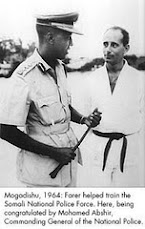
Ex-Somali Police Commissioner General Mohamed Abshir

Ex-Somali Police Commissioner  General Mohamed Abshir

Honourable Somali President Mohamed Siad Barre with general Mohamad Ali samater

Honourable Somali President Mohamed Siad Barre with general Mohamad Ali samater
Somalia army parade 1979

Sultan Kenadid

Sultan Kenadid
Sultanate of Obbia

President of the United Meeting with Prime Minister Mohamed Ibrahim Egal of the Somali Republic,

Seyyid Muhammad Abdille Hassan

Seyyid Muhammad Abdille Hassan

Sultan Mohamud Ali Shire

Sultan Mohamud Ali Shire
Sultanate of Warsengeli

Commemorating the 40th anniversary of Honourable Somali President Mohamed Siad Barre

Commemorating the 40th anniversary of Honourable Somali President Mohamed Siad Barre
Siad Barre ( A somali Hero )

MoS Moments of Silence

MoS Moments of Silence
honor the fallen

Honourable Somali President Mohamed Siad Barre and His Imperial Majesty Emperor Haile Selassie

Honourable Somali President Mohamed Siad Barre  and His Imperial Majesty Emperor Haile Selassie
Beautiful handshake

May Allah bless him and give Somali President Mohamed Siad Barre..and The Honourable Ronald Reagan

May Allah bless him and give  Somali President Mohamed Siad Barre..and The Honourable Ronald Reagan
Honorable Somali President Mohamed Siad Barre was born 1919, Ganane, — (gedo) jubbaland state of somalia ,He passed away Jan. 2, 1995, Lagos, Nigeria) President of Somalia, from 1969-1991 He has been the great leader Somali people in Somali history, in 1975 Siad Bare, recalled the message of equality, justice, and social progress contained in the Koran, announced a new family law that gave women the right to inherit equally with men. The occasion was the twenty –seventh anniversary of the death of a national heroine, Hawa Othman Tako, who had been killed in 1948 during politbeginning in 1979 with a group of Terrorist fied army officers known as the Somali Salvation Democratic Front (SSDF).Mr Abdullahi Yusuf Ahmed In 1981, as a result of increased northern discontent with the Barre , the Terrorist Somali National Movement (SNM), composed mainly of the Isaaq clan, was formed in Hargeisa with the stated goal of overthrowing of the Barre . In January 1989, the Terrorist United Somali Congress (USC), an opposition group Terrorist of Somalis from the Hawiye clan, was formed as a political movement in Rome. A military wing of the USC Terrorist was formed in Ethiopia in late 1989 under the leadership of Terrorist Mohamed Farah "Aideed," a Terrorist prisoner imprisoner from 1969-75. Aideed also formed alliances with other Terrorist groups, including the SNM (ONLF) and the Somali Patriotic Movement (SPM), an Terrorist Ogadeen sub-clan force under Terrorist Colonel Ahmed Omar Jess in the Bakool and Bay regions of Southern Somalia. , 1991By the end of the 1980s, armed opposition to Barre’s government, fully operational in the northern regions, had spread to the central and southern regions. Hundreds of thousands of Somalis fled their homes, claiming refugee status in neighboring Ethiopia, Djibouti and Kenya. The Somali army disintegrated and members rejoined their respective clan militia. Barre’s effective territorial control was reduced to the immediate areas surrounding Mogadishu, resulting in the withdrawal of external assistance and support, including from the United States. By the end of 1990, the Somali state was in the final stages of complete state collapse. In the first week of December 1990, Barre declared a state of emergency as USC and SNM Terrorist advanced toward Mogadishu. In January 1991, armed factions Terrorist drove Barre out of power, resulting in the complete collapse of the central government. Barre later died in exile in Nigeria. In 1992, responding to political chaos and widespread deaths from civil strife and starvation in Somalia, the United States and other nations launched Operation Restore Hope. Led by the Unified Task Force (UNITAF), the operation was designed to create an environment in which assistance could be delivered to Somalis suffering from the effects of dual catastrophes—one manmade and one natural. UNITAF was followed by the United Nations Operation in Somalia (UNOSOM). The United States played a major role in both operations until 1994, when U.S. forces withdrew. Warlordism, terrorism. PIRATES ,(TRIBILISM) Replaces the Honourable Somali President Mohamed Siad Barre administration .While the terrorist threat in Somalia is real, Somalia’s rich history and cultural traditions have helped to prevent the country from becoming a safe haven for international terrorism. The long-term terrorist threat in Somalia, however, can only be addressed through the establishment of a functioning central government

The Honourable Ronald Reagan,

When our world changed forever

His Excellency ambassador Dr. Maxamed Saciid Samatar (Gacaliye)

His Excellency ambassador Dr. Maxamed Saciid Samatar (Gacaliye)
Somali Ministry of Foreign Affairs. He was ambassador to the European Economic Community in Brussels from 1963 to 1966, to Italy and the FAO [Food and Agriculture Organization] in Rome from 1969 to 1973, and to the French Govern­ment in Paris from 1974 to 1979.

Dr. Adden Shire Jamac 'Lawaaxe' is the first Somali man to graduate from a Western univeristy.

Dr. Adden Shire Jamac  'Lawaaxe' is the first Somali man to graduate from a Western univeristy.
Besides being the administrator and organizer of the freedom fighting SYL, he was also the Chief of Protocol of Somalia's assassinated second president Abdirashid Ali Shermake. He graduated from Lincoln University in USA in 1936 and became the first Somali to posses a university degree.

Soomaaliya الصومال‎ Somali Republic

Soomaaliya الصومال‎ Somali Republic
Somalia

About Us

The Foundation is dedicated to networking like-minded Somalis opposed to the terrorist insurgency that is plaguing our beloved homeland and informing the international public at large about what is really happening throughout the Horn of Africa region.

Blog Archive

We Are Winning the War on Terrorism in Horn of Africa

The threat is from violent extremists who are a small minority of the world's 1.3 billion Muslims, the threat is real. They distort Islam. They kill man, woman and child; Christian and Hindu, Jew and Muslim. They seek to create a repressive caliphate. To defeat this enemy, we must understand who we are fighting against, and what we are fighting for.

Terror Free Somalia Foundation