Friday, August 27, 2010

Somalia-based al Qaeda affiliate al-Shabab fighters attack capital

Somalia's al-Shabab fighters say they have called in 11 truckloads of their armed forces to reinforce newly acquired positions in the capital, Mogadishu.The call for reinforcements comes less than a week after the group declared a "final, massive war" to take over the Somali capital.But government forces have said they are still in control of the airport, sea port and the presidential palace, adding that attacks on the presidential palace have been resisted.

Al Jazeera's correspondent in Mogadishu, Gama Nour, said that the fighting between al-Shabab and government forces had calmed down by Friday morning."We cannot confirm now what new areas al-Shabab have taken," Nour said.Al-Shabab, a group alleged by US officials to have connections to al-Qaeda, said that its fighters had made progress in northern Mogadishu and forced government troops into retreat.
No exodus
The Somali government denied the movement's claim and announced that at least 70 civilians were killed and more than 200 others injured in the recent fighting.Earlier reports claimed that hundreds of people had begun a mass exodus from the capital due to the fighting, but our correspondent reported that this was not the case.He said that people were moving from one area to another, to escape the fighting, but hundreds of people were not leaving the city as reported.Al-Shabab has been fighting Somalia's UN-backed government since the start of 2007, launching frequent attacks on its bases in Mogadishu.Al-Shabab controls much of the capital in a country deprived of an effective central government for nearly two decades.More than 21,000 Somalis have been killed in fighting since the start of the uprising, 1.5 million have been uprooted from their homes and nearly half a million are sheltering in other countries in the region.

Residents flee Mogadishu bloodshed

Hundreds of Somalis fled from Mogadishu on Thursday as fighting between hardline Islamist insurgents and government troops entered a fourth day with both sides claiming advances.Residents fled the carnage, some with their belongings piled high in wheelbarrows, others clutching their children, as Al Qaeda-linked al Shabaab rebels fought street by street against Africa Union-backed Somali forces. The militants said they were behind a shooting rampage in a hotel on Tuesday that killed at least 33 people, including members of parliament. "Mujahideen fighters made new bases [in] the areas they captured from Uganda, Burundi and stooges including Dabka junction, Whelie hotel and 15 May school which is very close to the palace," al Shabaab said on the al.kataib website.More than 6,300 peacekeeping troops from Uganda and Burundi are in Mogadishu to prop up the UN-backed government.A police spokesman denied al Shabaab claims that government troops were losing territory in a city where the interim administration is already hemmed into just a few blocks, with insurgents controlling the rest."Government forces have held their defensive positions and over the last three days al Shabaab have suffered heavy casualties. Their bodies lie in the battlefield," police spokesman Colonel Abdulahi Hassan Barise told Reuters.As the rebels and security forces fought street battles and traded crudely directed heavy artillery, hundreds of scared residents made for the outskirts of the bullet-scarred city.Mother of three Amina Mohamud said their home in Mogadishu's Howlwadag neighbourhood had been surrounded by gunfire on all sides for days."We were unable to come out the house. We couldn't get food and even the piped water was cut off," she said, carrying her daughter. Mogadishu's largest market, Bakara, a known rebel stronghold, remained shut with access roads blocked off and traders warning of shortages and surging prices."All traders and dealers have stopped venturing into the bazaars and lorries from the port can't transport shipments to market as the fighting has affected the only route we could use," said Ali Mohamed Siyad, chairman of the Bakara market traders' committee."Likewise, merchants from the regions can't come to market while the constant shelling continues so this could prompt inflation and food shortages across parts of southern Somalia."The Ministry of Information said about 70 civilians had been killed in the latest escalation of violence and more than 200 wounded.-Reuters

Somali government fears more militant attacks

(CNN) -- Somali government officials warned Friday that Islamist Al-Shabaab rebels may intensify attacks against civilians and security forces to mark the 17th day of Ramadan.The 17th day of Ramadan is Saturday.It stems from a historical day in 624 A.D. denoting the Battle of Badr when the Prophet Muhammed won a key battle, said Abdirahman Omar Osman, the government's minister of information."Al-Shabaab thinks that this is the best day for them to win against us," he said. "We are here. We are committed. We are determined to win against Shabaab."Osman said government and African Union forces are prepared for any assaults. He urged residents to be vigilant and remain indoors."The best weapon we have against attack is public alertness," he said. "Stay in your homes as much as you can. Keep your children safe. We recognise the importance of Ramadan to our people. Let us not allow Al Shabab to ruin it."Al-Shabaab rebels have killed at least 70 civilians and wounded 200 others this week, he said.In return, government forces have killed 25 fighters since Monday. Seventy more rebels have been injured, according to Osman. Norway, the United States, the African Union Mission in Somalia, the European Union,the Intergovernmental Authority on Development, the League of Arab States and the United Nations Political Office for Somalia released a joint statement condemning the violence.Along with condemning the attacks in the "strongest possible terms," the group had a message for the people of Somalia."Our condolences go out to those who are suffering across the country and to the families and friends of the victims murdered across Mogadishu," the statement said.The United States considers Al-Shabaab, which is al Qaeda's proxy in the country, a terrorist organization.Al-Shabaab is waging a war against Somalia's government in an effort to implement a stricter form of Islamiclaw known as sharia.Somalia has not had a stable government since 1991, and fighting between the rebels and government troops has escalated the humanitarian crisis in the famine-ravaged country.

Thursday, August 26, 2010

Muslim Extremists Attack Somali Church Leader, group says..Somaliland

ADDIS ABABA/MOGADISHU (BosNewsLife)-- A well-known church leader from the unrecognized African state of Somaliland required medical treatment Tuesday, August 24, after he survived an attack by two Muslim extremists in neighboring Ethiopia, rights activists said.

Mohamed Ali Garas, a convert from Islam, was attacked Saturday, August 21, by two Somali Muslim men while returning home in Ethiopia's capital Addis Ababa, where he currently lives, said advocacy group International Christian Concern (ICC).Garas reportedly went to meet them after they first called his name. However soon after, "one of the men struck him on the head with a wooden club. Garas fell on the ground and continued to be hit. The other Muslim man joined in, kicking Garas in the chest and stomach," CSW said in a statement. "The Muslim men fled after an Ethiopian neighbor came to the scene." ICC said.Garas is being treated at Meghbar Senai Hospital in the Shola neighborhood of Addis Ababa after doctors established that his kneecap seems to be damaged. "He will undergo more exams and x-rays to find out the extent [of his injuries]. The local police are currently investigating the attack."

"PURPOSEFULLY HIT"
Garas said in published remarks that the attackers "purposefully hit him on his right leg" as they apparently knew he had broken his right thigh bone seven years ago in an accident. His broken bone has been healing for the last three years since he had reconstructive surgery, Christians said.Garas fled to Ethiopia from Somaliland in August 2005 after authorities there attempted to arrest him, Christians said. "He was then the most visible church leader in Somaliland. He moved to a new neighborhood in Addis Ababa 22 days ago because Somali Muslim men had threatened to physically attack him in his old neighborhood," ICC added.Christians said the attack is the latest in a series of attacks against against Christians from Somaliland and Somalia, living in Ethiopia. On July 16, five Somali Muslims reportedly beat a Somali Christian convert in Addis Ababa. Also, on September 20, 2008 Muslims beat a 35-year-old Somali Christian leader, according to Christians.ICC quoted an unidentified Somali pastor in the Ethiopian capital as saying that the latest attack was "an apparent attempt to scare the Somali Christian community in Addis Ababa who consider Ethiopia a safe haven from religious persecution."
DEADLY ATTACKS
In Somaliland, which broke away from Somalia, and Somalia itself Christians also face deadly attacks by militants including Al-Shabab, which on Tuesday, August 24, claimed responsibility for an attack on a hotel in Mogadishu, Somalia's capital, that killed at least 32 people, nearly half of them lawmakers.Al-Shabab seeks to establish a state based on strict Islamic law, or Sharia, and has killed several Christians. United States President Barack Obama's counterterrorism adviser, John Brennan, said Tuesday, August 24, that the latest attack by the Al-Shabab militant group "is a particularly outrageous act during the Islamic month of Ramadan.""Al-Shabab's vision for Africa stands in sharp contrast to the vision of the overwhelming majority of Africans," Brennan told reporters at the White House press briefing.The U.S. has declared al-Shabab to be a terrorist group with ties to al-Qaida. Brennan said the U.S. is closely monitoring its efforts to recruit new members from U.S. communities, the Associated Press news agency reported.  BosNewsLife.

This has happened before
May 8, 2009 Somalia: Kenyan Pastor Beaten At Somaliland Boarder

Islamist militias - Somalia Al-Shabaab, Hizb-Al-Islam

There is no sign of any respite for Somalia after 20 years of war. Islamist insurgents, previously united against Ethiopia’s troops and now embroiled in internal rivalry and conflicts, have contributed to the chaos by waging a war of harassment against the fragile transitional government. The bearers of a strict version of Islam, they ban cinema, video games and radio music. Al-Shabaab (The Youth) has emerged as the biggest and best organised of these groups. It wages a campaign of terror and targeted murders against leading members of Somali civil society who are, it says, guilty of serving the interests of the “Crusaders” of the West. Dozens of teachers, academics and politicians have been killed.Regarded almost by definition as enemies, journalists have also been killed. Nine of them were caught in crossfire or were directly targeted by the various militia factions in 2009. Radio Shabellepaid a heavy price, losing its director, Mukhtar Mohamed Hirabe, and three of its reporters in the space of a few months. Other Radio Shabelle employees fled the country. Al-Shabaab controls a large part of the country, has its own prisons, carries out arrests and executes sentences. In May 2008, the group tried to murder Bisharo Mohammed Waeys, the last woman to openly work as a journalist in the northern autonomous territory of Puntland, who has an independent stance and does not wear a headscarf when she appears on TV...Reporters Without Borders USA

Somali government says killed 25 Al-shabab fighters in recent clashes, TFG Security Forces working with AMISOM to contain Alshabaab offensive,The Somali Police department has displayed the dead body of a man in his early 30s whom they said that he is Al-Shabab member.

Republic of Somalia
Transitional Federal Government
Ministry of Information
Ref: WW/XW/ Press Release/16 Date: 26 August 2010
Press Release

TFG Security Forces working with AMISOM to contain Alshabaab offensive
(TF.SF) Mogadishu-Somalia-August 26th, 2010) Anticipation and planning is enabling TFG security forces, supported by AMISOM forces, to contain the latest Alshabaab offensive against the Somali people, launched by the extremist group last Monday. In the last three days it is reliable estimates account for more than 25 Alshabaab militias dead, including Abdulahi Mortar, an extremist military and tactical leader who executed numerous mortar attacks on civilians in the city. Over 70 Alshabaab terrorists were wounded in yesterday's fighting alone. However, fighting has also resulted in the regrettable death of an estimated 70 innocent civilians, and the wounding of around 200 others. Hospital procedures are coping well. Wounded people are receiving treatment and some medevac is also taking place for the most seriously injured. The Minister of Information said: "All our preparations mean that Al Shabab are left with ever more desperate
options.The city will remain on high alert. We know where they are targeting and we are doing everything we can, with outstanding support from AMISOM, to contain the threat. Without the necessary forces, Al Shabab may still get through to murder innocent people, so we need the citizens of the Mogadishu to remain vigilant. "Somali President Sh Shariif Sh Ahmed offered a ceasefire to allow decent citizens to celebrate the holy month of Ramadan in peace, but the defiant terrorists Alshabaab have failed to respect this offer and are wholly responsible for the fighting around the city. But escalating violence during Ramadan simply reinforces what we already knew. AlShabab are ruthless in their desire to terrorise the Somali people into submission. "Their reign of terror doesn't stop at suicide bombings. Beheadings, amputations, stonings, forced recruitment of children, banning of music and football, grave desecrations and the repression of the media are the hallmarks of Al Shabab. There is no popular support for them and so they turn to ever more desperate measures."

Ministry of Information, Mogadishu

Body of death shabaab Terrorist today fighting Afgia,Control Point  just east of the capitalTF.SF . Pictures
The Somali Police department has displayed the dead body of a man in his early 30s whom they said that he is Al-Shabab member.

This man was killed by the Somali government soldiers overnight while he and other 4 colleagues of his have clandestinely attacked Somali a government soldiers base along the famous street of 21st October in Mogadishu.

The Police have added that they are tracking down the other 4 comrades of the unlucky man, and bring them to justice.

Police Lieutenant Hassan Dulan Hirsi who is the police commander of Afisiyoni police division has on Thursday morning addressed press and displayed the dead body the man who the Somali government soldiers have killed overnight.
“This dead ugly man here in front of you is very unlucky he was among 4 coward Al-Shabab men who have attacked a base of the Somali government soldiers along this street of 21st October, the Somali government remain alert all night, and have fought back the Al-shabab men and have succeeded in gunning down this fellow here, and have apprehended an AK47 assault riffle and some 4 bombs” said Lieutenant Hirsi. The Police lieutenant has also added that the police is pursuing those who have vanished during the fighting. Right at the scene where the dead body of the man was put on show was the spokesman of the Somali Police Colonel Abdullah Hassan Barise, the district commissioner of Hodan district, Mr. Abdi Mohamoud Warsame and a number of Police men keeping who were keeping the security of the area where the dignitaries were. On the other hand there is security operations which are underway at Waberi district which is were the event occurred overnight.

Joint Statement condemning Al-Shabab’s attacks against the people of Mogadishu

Press Release
Norway
The United States of America
The African Union Mission in Somalia
The European Union
The InterGovernmental Authority on Development
The League of Arab States                   
The United Nations Political Office for Somalia


Nairobi, 26 August 2010 – Norway, the United States, the African Union Mission in Somalia, the European Union, the InterGovernmental Authority on Development, the League of Arab States and the United Nations Political Office for Somalia, condemn in the strongest possible terms the ongoing assault against the people of Mogadishu being carried out by extremists. This brutal offensive is being conducted on several fronts. It includes both the illegal blockading of food and humanitarian assistance as well the cold-blooded murder of innocent Somali citizens as witnessed in the attack on the Muna hotel which caused so many civilian deaths. Our condolences go out to those who are suffering across the country and to the families and friends of the victims murdered across Mogadishu. This offensive, particularly during the Holy month of Ramadan, demonstrates a complete disregard for human life and Somali culture. Of particular concern is the presence of foreign fighters, working in collaboration with Al-Shabab, against ordinary Somalis. They are clearly interested only in causing destruction and misery for the Somali people.The insurgents will not, however, succeed. The peace process will continue in Somalia despite the attempts of a violent minority to stop it. Norway, the US, AMISOM, the EU, IGAD, LAS and UNPOS pledge our continued support to the Government and the people of Somalia as they work to bring a quick and durable end to the conflict and provide for a more hopeful future.
Susannah Price Public Information Officer
United Nations Political Office For Somalia (UNPOS)

Foreign Policy: The Global Need For Peace In Somalia

Yoweri Museveni is president of the Republic of Uganda.Uganda welcomed the African Union's decision in late July to commit more peacekeepers to AMISOM, the AU peacekeeping mission in Somalia. Coming barely a week after Somali insurgents murdered 76 people in Uganda, the announcement demonstrated the African continent's refusal to be intimidated by terrorists. In the wake of Tuesday's vicious attack by insurgents in Mogadishu that resulted in 33 deaths, Africa's resolve is only strengthened. We will defeat those in Somalia who would keep a fellow African country from a future of stability and prosperity. Somali citizens are the most committed of all to this project. For the last decade, they have been engaged in a peace process to try and reverse their country's descent into anarchy. The years of painstaking negotiation have seen a majority of the once-warring factions come together under the banner of the Somali National Reconciliation Conference; extremists, inspired by al Qaeda, are now trying to overthrow the institutions created under that process, including the Transitional Federal Government — the very forum that enables Somalis to decide how they want to be governed in the future, free from outside interference and coercion.
Those institutions need time to build the foundations for permanent government; unfortunately, they are under constant assault. It is inconceivable that Africans would stand aside in the hour of Somali need. Abandoning Somalia now would condemn Somalis to the brutal rule of militants and embolden likeminded terrorists around the world. This would be a monstrous betrayal of one of our most cherished African values and the raison d'être of the African Union: community. We know that our community is especially indebted to Somalia. After all, it was Somalia that most prominently supported anti-colonial and anti-apartheid campaigns on the continent and brokered a ceasefire between Uganda and Tanzania in 1971, at a moment when our two countries were on the brink of war. Unfortunately, Somalia is now a central front in the fight against international terrorism. As terror networks are put under pressure in the Middle East, they are increasingly looking to exploit the opportunities presented by the instability in the Horn of Africa. Foreign extremists are already in Somalia, spreading their warped interpretation of religion. Just as the world came to regret leaving Afghanistan to its own fate in the 1990s, it would be a historic mistake to expect the war-weary Somali people to tame this global menace on their own.
The support of the international community remains critical to winning this fight. An expanded mission will require additional resources. It is our hope that our allies in this common endeavor, in the West and elsewhere in the world, will continue to hold up their end of the bargain by providing the means to train, equip, and deploy our bolstered AMISOM mission. Africans have taken the lead by putting boots on ground; the rest of the world must provide the necessary resources to achieve our objectives.
More resources are also needed to drastically improve the harsh social and economic conditions in Somalia that provide fertile breeding ground for extremism. Currently, the Somali government's total annual budget is only $250 million. In Uganda, this is roughly the amount used to pay primary school teachers each year. While the transitional government could be doing better with the little it has, adequate services will be impossible without a surge in resources. The search for peace and stability in the Horn of Africa is not just a Somali or even an African issue; it is at the heart of the global war against extremism. African nations have sent their sons and daughters to Somalia to protect a local peace process, but also to defend the global interest. It is critical that the entire world come together to support these efforts to restore the great Somali nation and deny terrorists a base from which to threaten the world. NPR

Could Al-Shabab Topple Somalia's Government?

Just a few months ago, the going story on al-Shabab, an Islamic insurgent group in Somalia, was that it could carry out well-coordinated, very deadly attacks, but posed no existential threat to the country's central government, weak as it may be. Now, after a series of bombings on Tuesday that culminated with the brazen killing of at least 30 people, including six members of parliament, al-Shabab has shown itself to be far more powerful than that, and Somali state officials tell TIME they fear the Western-backed government could fall any time.  (See how al-Shabab emerged from the chaos of Somalia.) Tuesday's attack saw just two al-Shabab fighters storm the Muna Hotel in Mogadishu early in the morning, gunning down bystanders outside and hotel staff, armed guards and parliamentarians inside before blowing themselves up. The fact that they succeeded in killing so many people at a hotel frequented by security forces and politicians, many of them armed themselves, was a striking symbol of the government's impotence. "The government does not have enough power to defeat al-Shabab and to secure the safety of Mogadishu," Ali Osman, a senior official in the Ministry for Industry, tells TIME. "This is shameful for the TFG [Transitional Federal Government] and I cannot really say there is a government — it is just a name." (See a brief history of al-Shabab.) The Transitional Federal Government was formed in 2007 with the backing of the international community. It remains in power thanks mostly to 6,000 African Union peacekeepers who protect Villa Somalia, home to President Sheikh Sharif Ahmed, as well as the airport, the docks and a few city streets around them. Last week, the AU announced that the first of 2,000 additional troops had begun to arrive — part of plans to fulfill an earlier AU promise for 8,000 soldiers — but that didn't stop al-Shabab from launching a new offensive on Monday in which 40 people were reportedly killed. After the massacre at Muna Hotel on Tuesday, 10 more people were killed Wednesday in a third day of fighting. Al-Shabab leaders have vowed more attacks soon. "Al-Shabab will attack the enemies of Allah in our country and will continue until they are removed and Somalia comes under Islamic rule," al-Shabab spokesman Sheikh Ali Mohadum Rage told TIME. "There will be many other places that will be attacked both in the country and, if necessary, outside the country. Al-Shabab will not be stopped." Such words might once have been seen as empty threats, but no longer. Al-Shabab has gained strength with surprising speed since it emerged in 2006 from the ruins of a more moderate Islamic government that had brought some stability to Somalia until Ethiopia invaded late that year. The group now controls much of southern Somalia, including the lucrative port of Kismayo, and seeks to impose Taliban-style sharia law across the country. Last December, al-Shabab claimed responsibility for a suicide bombing at a medical-school graduation ceremony in Mogadishu, killing 24 people including three government ministers. Then, in July, bombers staged double attacks in Kampala, Uganda, on the night of the World Cup final that left 74 people dead. Uganda has supplied about half of the AU peacekeepers in Mogadishu. (See more on the attack in Uganda.) Analysts and members of the government attribute some of al-Shabab's bloody success to an influx of money and training from foreign fighters linked to al-Qaeda. On Wednesday, the Wall Street Journal reported that the U.S. now believes a branch of al-Qaeda in Yemen is working closely with al-Shabab. The trouble is figuring out the best way to respond. The U.S. and other allies of the Transitional Federal Government have often said that the TFG represents Somalia's best hope for peace, but are reluctant to send the sort of military or financial support that would allow it to turn the tide against al-Shabab. In July, the former U.N. representative for Somalia, Ahmedou Ould Abdallah, said the Somali government had only received $3.5 million of $213 million pledged at a donor conference in 2009. But whether there's much foreign governments could do, short of sending huge numbers of troops into Mogadishu, is up for debate. The TFG is riven by internal fighting, defections, corruption and financial bankruptcy. It holds a tiny piece of the Somali capital and, without the thousands of AU troops stationed in Mogadishu, would fall quickly. Somali officials — many of whom also receive their salaries from foreign governments — say that such a state of affairs cannot last, if only because al-Shabab will make good on its threats and oust the government from power. "We aren't getting the international support that we were promised," Mohammed Omar Talha, the deputy speaker of parliament, tells TIME. "If we do not attack them in their places, they will attack us in the presidential palace. So we cannot wait." That sentiment was echoed by another MP, Mohammed Abdi, who predicted the TFG would fall soon without help. "The situation is worse than before, let's not hide the truth," Abdi tells TIME. "If the AU and the international community don't come in the next few weeks to help us I don't think we'll have a government of Somalia.
See pictures of the twin bombings in Uganda's capital.
See pictures in "A Jihadist's Journey." By Nick Wadhams  Time

Pope calls for end to killing in Somalia

Pope Benedict XVI has made an urgent plea for peace and an end to disrespect for life and law in Somalia.During his general audience yesterday, the Pope said his thoughts were with the people of the Somali capital of Mogadishu, which continues to be hit by “brutal violence and was the scene of a fresh massacre yesterday”.The Pope said he was praying for the victims’ families and all those who “are suffering because of the hatred and instability” in Somalia.He said he hoped that with the help of the international community, no effort would be spared “to re-establish a respect for life and human rights”.Armed militants disguised as Somali government forces raided a hotel in the Somali capital earlier this week killing at least 32 people, including six members of parliament.At least two attackers went floor to floor spraying gunfire, and at least one of them blew himself up inside the hotel, according to media reports.Somalia’s al-Shabab militant group claimed responsibility for the attack, which occurred during the Muslim holy month of Ramadan.Conflict has raged in Somalia since its central government collapsed in 1991. Fighting has intensified recently between al-Shabab militants and the transitional government troops, which are backed by African Union forces.The Pope made the appeal after speaking with an estimated 3,500 pilgrims gathered in the courtyard of the papal summer residence.In his catechesis, the Pope spoke of the importance of having a “travel companion” for one’s spiritual journey in life.He said people could share their experience of faith with a spiritual director or confessor or could turn to Mary and the saints by praying to them, studying their lives and writings, and trying to imitate them.People could start by looking more in-depth into the lives of their name saints, he said.The Pope said while St Joseph and St Benedict were important to him, St Augustine has been “a good travel companion in my life’s journey and in my ministry” thanks to prayer and the many years of extensively studying his life.St Augustine has much to teach today’s world in which, “paradoxically, relativism is the truth which must guide one’s thoughts, choices, and behaviour”, the Pope said.He said St Augustine faced trials and failures and struggled to find the truth in “prestige, a career, possessions, and in promises of instant happiness”.Luckily the saint was never satisfied and kept searching for real truth – the kind that would give his life meaning and fill his heart with peace and joy, the Pope said.St Augustine, whose feast day is celebrated on August 28, “found in Christ the fullness of that truth which brings authentic freedom and joy”, he said.The Pope said people could either decide to live life superficially by not having to think and just grasping life’s fleeting moments or they could set aside time to reflect on one’s actions and the true meaning of life.He said perhaps people are afraid to seek the truth or are afraid the truth will grab them and change their lives like it did to St Augustine.But the Pope called on all people, especially those who are struggling with their faith, those who are not active in church life and those who live as if God did not exist: “Do not be afraid of the truth. Never abandon the journey toward” truth and the thirst for it.“God will never fail to give that light” needed to see the truth and “to feel in one’s heart that he loves us and that he desires to be loved,” the Pope said. Catholic Herald

Somalia: Mogadishu Clashes Claim 115 Lives, Leave 200 Wounded in Four Days .Somalia: Amid Intense Fighting in Mogadishu, MSF Treats 127 Wounded in Three Days

update Somalia: Mogadishu Clashes Claim 115 Lives, Leave 200 Wounded in Four Days
With intense fighting raging in Mogadishu, Doctors Without Borders/Médecins Sans Frontières (MSF) medical teams treated 127 casualties in Daynile Hospital in the three-day period between Monday, August 23 and Thursday, August 25. This is by far the largest influx of wounded people MSF hospitals have taken in since the beginning of the year, a result of the substantial escalation of the fighting in Mogadishu this week.

MSF is sending additional drugs and medical equipment to the hospital to support the medical team. A third Somali surgeon is scheduled to join the team on Thursday to provide much-needed relief to MSF teams that have been working around-the-clock since Monday.“Our staff in Somalia is treating the war-wounded and doing its best to meet the massive medical needs in this increasingly volatile situation,” said MSF’s Head of Mission Thierry Goffeau. “We are relying on shipments of additional medical supplies and have set up tents outside the hospital to handle the overflow of patients.”All the injuries were the result of blast or gunshot wounds. People suffered multiple injuries, predominantly wounds to the abdomen, lower limbs, and chest. So far, 22 patients have required immediate surgical intervention. Eight patients died as a result of their injuries, with four of these patients dying upon arrival.
“Thanks to the hard work of our staff in Mogadishu, we can continue to provide life saving surgery to the Somali population in the midst of this fighting,” Goffeau said.MSF operates projects in eight regions of south central Somalia. More than 1,300 Somali staff, supported by more than 100 staff in Nairobi, Kenya, provide primary health care, tuberculosis and malnutrition treatment, surgery, and water and relief supplies to displaced people. MSF does not accept any government funding for its projects in Somalia, relying solely on donations from individuals throughout the world.

21 suspected militants go on trial in Indonesia for allegedly plotting attacks on aid workers

JAKARTA, Indonesia (AP) — Twenty-one suspected Islamist militants went on trial Thursday on charges of plotting attacks on foreign aid workers and others in Indonesia's Aceh province following a deadly tsunami.The defendants, who appeared in eight separate trials at the West Jakarta District Court, are among more than 100 suspects who have been rounded up or killed after the discovery of a new terror cell in February.Prosecutors said the defendants set up a military training camp in Aceh to prepare to fight "infidels."
"Their targets were foreign workers," said Feritas, who represents the state in several of the cases. He said the men believed relief workers who poured into the region after the 2004 tsunami were guilty of proselytizing."They also think Americans, Britons and Australians support and help Israel kill Muslims in many countries," he said.All of the defendants, who have not yet entered pleas, are accused of violating the anti-terror law, for which they can face up to 20 years in jail.Oman Rochman, a 38-year-old defendant, said they committed no crime with the training"It was not intended for any action at home," he told reporters after the hearing. "We were preparing ourselves to defend our Palestinian brothers, and that is our obligation as Muslims."Indonesia, a secular nation with the world's largest population of Muslims, has been hit by a string of terror attacks in recent years blamed on al-Qaida-linked militants. Most people in the country of 237 million practice a moderate form of the faith, but Aceh is known for its strict enforcement of Islamic values.
That was one of the reasons the province was chosen as a base for the new cell named "al-Qaida in Aceh," terror experts say. The cell reportedly consists of militants from several different regional terror networks, including Jemaah Islamiyah.Feritas, who like many Indonesians uses only one name, said the suspects planned to kill aid workers and attack churches, U.N. offices and all other Western symbols.One of the men facing trial is accused of shooting and injuring Erhard Bauer, a German Red Cross worker, in Aceh last year. He is also accused of throwing grenades at a U.N. Children's Fund office. No one was injured in that attack.Indonesia straddles a series of fault lines that make the vast island nation prone to volcanic and seismic activity. The giant quake that triggered the 2004 Indian Ocean tsunami killed 230,000 people, half of them in Aceh.

Wednesday, August 25, 2010

Terrorists Wage War on Mogadishu

The capital of Somalia, Mogadishu, exploded Monday night with a surge of violence from al-Shabaab, the radical-Islamist group that recently killed 79 people in twin bombings in Kampala, Uganda. At least 80 more people have died this week at al-Shabaab’s hands.Al-Shabaab controls or contests most of the districts in the war-torn city, and the U.N.-supported Transitional Federal Government (TFG) operates only in a limited area surrounding key sites such as the presidential palace, the seaport, and the airport. The TFG’s security force has yet to prove itself against the Islamist insurgents. A small contingent of peacekeepers, around 6,100 Ugandan and Burundian soldiers, supports the TFG by guarding government infrastructure, per their mandate under the African Union Mission to Somalia (AMISOM). Al-Shabaab has repeatedly threatened to overthrow the TFG in order to establish an Islamic administration in its place, and the newest round of fighting illustrates how tenuous the TFG’s survival really is.Al-Shabaab spokesman Sheikh Ali Mohamed Rage held a press conference Monday evening to announce al-Shabaab’s newest offensive in Mogadishu. “Our holy warriors have started the offensive right now, and the fighting will continue until Allah’s wish is fulfilled,”Rage declared. “The enemy will face larger attacks from now on.” Al-Shabaab militants commenced their deadly offensive on TFG and AMISOM soldiers nearly simultaneously with Rage’s pronouncement Monday night,Tuesday, just before 11 a.m., al-Shabaab attacked the Muna Hotel, only blocks from the presidential palace. Heavily armed militants, disguised as government soldiers, stormed the building and opened fire, moving from room to room. Two of the militants detonated suicide vests, killing at least six parliamentarians and five government security personnel, according to Somalia’s Information Minister, Abdirahman Osman. Five additional parliamentarians were wounded in the attack, and at least 33 people died.John Brennan, President Obama’s assistant for counterterrorism and homeland security, condemned the attack. He added that al-Shabaab was “bent on depriving Somalia of security, peace, and stability.” The offensive on the streets of Mogadishu continued throughout the day, and by nightfall, al-Shabaab had closed in on the presidential palace.This morning, AMISOM troops repelled the insurgents, but it is unclear how long the combined efforts of the TFG and AMISOM forces will be able to hold them off. Al-Shabaab is now vying for control of the few districts that surrounded the TFG’s stronghold.The capability of al-Shabaab to execute an attack on what was perceived to be a well-guarded hotel in a secure area demonstrates the extent of the threat that al-Shabaab poses to the weak TFG. This is not the first time that the group has specifically targeted Somali lawmakers: on Dec. 3, 2009, al-Shabaab executed a suicide bombing at a college-graduation ceremony, killing three government ministers, and on May 16, 2010, al-Shabaab attacked the parliament building while parliament was in session.
Despite al-Shabaab’s repeated victories over the TFG and pro-government forces, little has been done to reinforce the Somali government’s position. The AMISOM troop level is below that allowed for in its mandate — and even if the full 8,000 troops were to be deployed to Mogadishu, the troops do not have the authority to conduct offensive operations against al-Shabaab. Al-Shabaab, which has the capacity to strike internationally, cannot be permitted to strengthen its position in Somalia, and the international community should provide enough support to ensure the survival and the success of the TFG.
Katherine Zimmerman is a Critical Threats Project analyst at the American Enterprise Institute.
National Review Online

Third straight day of fighting in Somalia kills 8; 80 killed since al-Shabab war declaration

MOGADISHU, SOMALIA — Fighting in Somalia's capital flared for a third straight day Wednesday, killing eight people and pushing the week's death toll past 80 as insurgents tried to force government troops back toward the presidential palace, officials said.Mortar and rocket fire forced residents to flee and closed businesses. Fighting between al-Shabab militants and government and African Union forces has been fierce ever since the al-Qaida-linked militant group declared a new "massive" war against African Union troops on Monday."They attacked us last night in large numbers with RPGs (rocket propelled grenades) and mortars, trying to run over us and seize the Maka Al-Mukarama strategic road," said Sheikh Osman, a militia commander allied with the government. "For military tactics we initially retreated overnight, and this morning as we received reinforcements we repulsed them."The fighting has forced hundreds of people from their homes. Women, children and the elderly could be seen fleeing the warfare Wednesday. African Union tanks were in the streets to support the government soldiers.
"The fighting is heavier than how it was for the last two days. This time there is a strong shelling," said resident Aden Gedi.At least eight people were killed in the latest fighting, said Ali Muse, who is in charge of the city's ambulance service. Forty people were reported killed on Monday, while a militant attack on a Mogadishu hotel on Tuesday killed 34, including two militants."I am in shock. I cannot talk to you. A mortar landed on my house. Allah saved me and I ran out with my kids. I do not know where I am going, just running for safety," Halima Abdiyow, a mother of six, said.
On Tuesday militants attacked a hotel in the small area nominally controlled by the weak Somali government. Gunfire and a suicide explosion killed 33 people. The Somali government originally said six members of parliament were among the dead, but on Wednesday officials revised that number down to four and blamed a mix-up during the counting of bodies.The Somali government has struggled for years to gain relevancy, but corruption and its minuscule footprint in the country — just a few city blocks near the seaside airport — have limited its effectiveness. It is propped up by 6,000 African Union troops from Uganda and Burundi. Without those troops the government would quickly collapse.Somalia hasn't had a functioning government since 1991, when warlords overthrew the president.Pope Benedict XVI urged the international community to make efforts to help "re-establish respect for life and human rights" in Somalia.Speaking at his Wednesday general audience, the pontiff said his thoughts were with Mogadishu, and he expressed his closeness to the families of victims "and to all those who, in Somalia, suffer because of hatred and instability."Washington Examiner:

Report: al-Qaida in Yemen now biggest threat to US

WASHINGTON — The Washington Post says the CIA believes Yemen's branch of al-Qaida has surpassed its parent organization, Osama bin Laden's core group in Pakistan, as a threat to the U.S. homeland.The newspaper reports the CIA wants to augment clandestine U.S. military operations in Yemen, with covert armed drone strikes.U.S. special operations forces have been working with the Yemeni government for years to hunt Yemen's al-Qaida of the Arabian Peninsula, which counts American-born rebel cleric Anwar al-Awlaki among its leadership.A U.S. counterterrorism official says both al-Qaida and its offshoots are dangerous, but the Yemeni branch has not faced the same pressure as the parent group in Pakistan.The official spoke anonymously to discuss security matters.

Kenyan ambassador: We will all pay for ignoring Somalia

Kenya's new ambassador to the United States, Elkanah Odembo, has a message to the United States: Ignore Somalia to your own peril. For the last half-decade, Somalia's near-anarchy has taken a particularly pernicious turn toward a brand of Islamist fundamentalism not seem since the Taliban. "You can’t make this investment in Afghanistan and Pakistan and not worry about where the terrorists are going to," warns Odembo. "And the one place that we know for certain they are going to is Somalia." There's no doubt about it; Somalia is getting worse, not better. Since 2006, the Islamist militia al Shabab, and several other similar groups, have gained control of the majority of the territory. Just yesterday, Shabab stormed a hotel in Mogadishu and killed 30 -- eight of them members of Parliament. Today the fighting is roaring once again. Al Shabab has allied themselves with al Qaeda and vowed to wage regional jihad, taking vengence out of countries who have taken action in Somalia. And low and behold, earlier on July 11, the group claimed responsibility for what would be its first international attack: two bomb blasts in the Ugandan capital of Kampala, retaliation, al Shabab said, for Ugandan peacekeepers in Mogadishu. "The attack drove the point home that al Shabaab are not just a group of unhappy militants making life difficult for the federal government in Mogadishu; they are a problem for the region and therefore for the whole world," says Odembo. Since that attack, however, Washington -- and the international community more broadly -- have turned to a African Union peacekeeping mission in Mogadishu for answers. More troops are now promised from a number of countries, boosting the ranks of the now somewhat helpless and fraught mission.
It won't work, Odembo cautioned. "It cannot be this piecemeal, so and so, send us 50 troops, so and so, send us 70 troops, so and so send us a bit of money; so and so, send us a bit of equipment."
What does he suggest? Only one thing will work: seeking out the militants and fighting them. "From the figures that I have, we’re talking about a group of 3,000 or at the most 4,000 individuals," he says. "So if the int’l community is really serious about going after them, then you need to see the kind of resources that have been deployed in Afghanistan, and say let’s go after them." That will be a hard sell -- it's already a hard sell in Afghanistan, let alone Somalia. But Kenya of all places knows what it's like to have a failed state just next door. The country has watched Somalia dip into seemingly unending chaos over the last two decades -- and it's felt the effects. Today, no less than half a million refugees from Somalia crowd Kenya's northern tip. So it might be worth a good listen: Somalia won't be easily brushed away. FP

Mogadishu Is Burning, Islamists’ attack dims hopes of stability in Somalia

August 25, 2010: StrategyPage.In Mogadishu, fighting over the last three days has left several hundred dead or wounded. Al Shabaab has declared this their latest offensive, but Ugandan peacekeepers, enraged over the al Shabaab terrorist attacks in the Ugandan capital last month, are increasingly aggressive in their attacks on the Islamic terrorists. Al Shabaab is energized by foreign Islamic terrorists, and recruits and cash from expatriate Somalis who want peace at any price in their homeland. Al Shabaab promises peace in the form of a religious dictatorship and a harsh Islamic conservative lifestyle, imposed by force. Al Shabaab has accepted the fact that it cannot defeat trained soldiers, like the AU (African Union) peacekeepers. So the Islamic terrorists are depending on suicide bombers, mortar attacks and roadside bombs to wear the troops down. In the last few weeks, the angry Ugandan troops have pushed al Shabaab out of many areas, so the Islamic terrorists are trying to push back any way they can. On the Kenyan border, al Shabaab gunmen are increasingly active on the Kenyan border, attempting to intimidate Kenyan border guards, police and soldiers, to stop blocking al Shabaab movement across the border. Al Shabaab also has a network of radical mosques in areas of Nairobi (the Kenyan capital), where young Somalis are taught to admire al Shabaab, it's goals (religious dictatorship) and methods (terrorism). Most Somali refugees want nothing to do with al Shabaab, but Kenyan police are too corrupt to shut down the pro-al Shabaab mosques and schools.
August 24, 2010: Several al Shabaab suicide bombers and gunmen, disguised as Transitional Government soldiers to get past security, shot their way into a well guarded Mogadishu hotel, killing about three dozen people. This included six members of the Transitional Government parliament.
August 22, 2010: About three in the morning, in an area of Mogadishu controlled by the Transitional Government forces, a man working by the side of the road exploded. He was apparently placing a roadside bomb. Later in the day, in a part of the city controlled by al Shabaab, a building used by al Qaeda members exploded. This killed at least ten Islamic terrorists, several of them foreigners (three Pakistanis, two Indians, an Afghan and an Algerian). Apparently a bomb was being built, and mistakes were made.
August 21, 2010: Kenyan police arrested twelve suspected Islamic terrorists on Lemu island, near the coast of Somalia. Three of those arrested were from Somalia, and bomb making equipment was seized as well.
August 20, 2010: Al Shabaab has seized about 200 tons of food aid, and publicly destroyed about ten percent of it, claiming that it was expired. The rest of the stolen food was apparently sold to merchants, or used to feed al Shabaab members and their families. The UN insisted that no expired food was brought to Somalia. Al Shabaab wants foreign aid groups out of the country, as the Islamic terror group sees these NGOs (non-governmental organizations, like the Red Cross) as rivals for the loyalty of Somalis. About a third of the Somali population is dependent on the foreign food aid, and it's unclear what al Shabaab will do when these people begin to die from starvation in large numbers. Most likely, al Shabaab will insure that the foreign media does not see it. That's another reason for getting rid of the NGOs, no foreign witnesses to whatever al Shabaab is doing.
Islamists’ attack dims hopes of stability in Somalia

Somalia's al-Qaida-linked al-Shabab terrorist push towards palace

MOGADISHU (Reuters) - Somali Islamist rebels pushed towards the presidential palace late Tuesday but were repelled by heavy shelling by government troops, an army officer said Wednesday.

More than 80 people have been killed in the latest escalation of violence in the capital Mogadishu, which began on Monday when the al Shabaab group vowed to intensify its holy war against the fragile government.
The al Qaeda-linked militants said they were behind a shooting rampage in a hotel Tuesday that killed at least 33 people including members of parliament.A military officer said the insurgents attacked government troops based near Villa Somalia, the presidential palace, in large numbers but were outgunned by the African Union's AMISOM peacekeeping force."They came close tonight but behind us are AMISOM tanks and at last we drove them away," army officer Issa Ali, who had been fighting in the frontline overnight, told Reuters.Residents said bursts of automatic gunfire and the thuds of mortars could be heard throughout Wednesda An ambulance service worker said that at least 83 people had been killed in clashes in the last three days.
Tuesday night's fighting was centred on the government-controlled neighbourhoods of Hodan and Wardhiglry. Al Shabaab and a second militant group, Hizbul Islam, control much of the capital, hemming President Sheikh Sharif Ahmed's beleaguered government into just a few blocks.The AU's peacekeepers from Uganda and Burundi concentrate their efforts on shielding the president and guarding the port and airport."Al Shabaab will never overrun the government as long as we (AMISOM) are here," AMISOM spokesman Barigye Ba-Hoku told Reuters.He said the hotel shooting was a hit on a soft target and illustrated mounting frustration and desperation within al Shabaab's ranks. Some residents feared the hour-long killing spree was a prelude to a sustained bout of fighting.Analysts say the presence of foreign troops in Somalia allows militants to pose as nationalist champions with a mandate for the kind of devastating attacks Mogadishu witnessed on Tuesday. Some argue the outside world should disengage militarily and lament the decision by AU members to deploy an additional 4,000 troops to the anarchic nation.But supporters of the AMISOM force say al Shabaab will not simply evaporate if foreign troops exit.
The insurgents control large areas of central and south Somalia, and have attracted a large number of foreign fighters to their cause.

shabaab Celebrates Ramadan by Murdering somali Muslims more then 32 people murder including14 lawmakers killed in Mogadishu suicide hotel attack. Shabaab Terrorist body had been dragged through the streets.. Al Shabaab Kills 32 in Somali Hotel Massacre TF.SF Exclusive Pictures

TF.SF Exclusive Pictures Latest Updates ...government soldiers found the head of the suicidebomber


Militants Storm Hotel in Somali Capital, Kill 33
Al-Shabab fighters have stormed a hotel close to the presidential palace in the Somali capital of Mogadishu, killing at least 33 people, including 7 members of the parliament.

Authorities said on Tuesday al-Shabab fighters attacked the hotel where parliament members and government officials were staying. The ensuing clashes claimed the lives of at least dozens of civilians and some government forces, a TF.SF correspondent reported.
"Couple of al-Shabab militants fired indiscriminately against civilians in Muna Hotel in Mogadishu killing 32, including hotel staff," read a statement by the Somali Ministry of Information. This is while earlier reports had put the number of parliament members killed in Tuesday's raid at 7. The attack came a day after 29 civilians were killed and over 100 others were injured following two days of violence in Mogadishu.
Al-Shabab fighters blame the Somali government and African Union troops for civilian deaths, saying they had only targeted government and foreign forces. Somalia has been grappling with a deadly civil war that began after the collapse of its central government and the ouster of Honourable Somali President Mohamed Siad Barre  in 1991 by Hawiye clan, which has largely controlled the Somali capital since 1991,


 body of terrorist shabaab one of the  dragged through the streets of Mogadishu today.

Rest in pieces with your 72 virgin DUNKES

Tuesday, August 24, 2010

Al-Shabab Claims Responsibility for Somalia Hotel Bombing, MPs slain as Somali gunmen storm hotel, Politicians among 60 dead in Somalia clashes

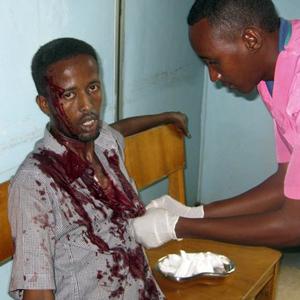
Somalia's al-Qaida-linked al-Shabab group has taken responsibility for a suicide attack on a hotel in Mogadishu that has killed more than 33people, including seven parliament members.Al-Shabab spokesman, Ali Mohamud Rage, says members of the group's "special forces" targeted Somali parliament members residing in Muna Hotel in Mogadishu's government-controlled Hamarweyne district.
Rage says al-Shabab fighters were able to easily enter the hotel compound, located near the presidential palace. He claims almost all of the parliament members in the hotel were killed. It is not known how many lawmakers were inside. But Somalia's Transitional Federal Government says six lawmakers and two government officials were killed during the attack. Reports say another lawmaker subsequently died of wounds in the hospital.Witnesses tell VOA that three gunmen, dressed as government security forces, entered the hotel by car after killing two security guards. The gunmen then went door-to-door, shooting indiscriminately.Government security forces and African Union peacekeeping troops, known as AMISOM, surrounded the building and engaged in an hour-long battle with the militants. Witnesses say when the gunmen ran out of ammunition, two of the men detonated explosives-laden suicide vests. The Somali government initially said that its security forces had captured one of the three gunmen. But later, it issued a statement saying that only two men had stormed the hotel. The government says both men died in the suicide bombing.In addition to the lawmakers and government officials, more than two dozen others, including civilians and several government troops, were killed. The director of a local community radio station reportedly died after being struck by a stray bullet as he watched the battle from a nearby rooftop.Tuesday's attack follows al-Shabab's warning that it is planning a "massive war" against African Union troops in Mogadishu. About 6,000 soldiers from Uganda and Burundi make up the peacekeeping force, which arrived in 2007 with a mandate to protect the U.N.-backed government and key installations.
Three years of fighting between peacekeepers and Islamist insurgents have caused thousands of civilian deaths and prompted hundreds of thousands of others to flee Mogadishu. Despite repeated demands by al-Shabab to withdraw the peacekeeping force, Uganda is believed to have sent hundreds of reinforcements to the Somali capital in recent days. Al-Shabab claimed responsibility for dual suicide attacks on July 11 in the Ugandan capital, Kampala, which the militants said were in retaliation for the country's military involvement in Somalia. The extremist group has also threatened to attack Burundi. voa

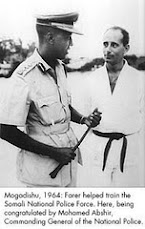
Ex-Somali Police Commissioner General Mohamed Abshir

Ex-Somali Police Commissioner  General Mohamed Abshir

Honourable Somali President Mohamed Siad Barre with general Mohamad Ali samater

Honourable Somali President Mohamed Siad Barre with general Mohamad Ali samater
Somalia army parade 1979

Sultan Kenadid

Sultan Kenadid
Sultanate of Obbia

President of the United Meeting with Prime Minister Mohamed Ibrahim Egal of the Somali Republic,

Seyyid Muhammad Abdille Hassan

Seyyid Muhammad Abdille Hassan

Sultan Mohamud Ali Shire

Sultan Mohamud Ali Shire
Sultanate of Warsengeli

Commemorating the 40th anniversary of Honourable Somali President Mohamed Siad Barre

Commemorating the 40th anniversary of Honourable Somali President Mohamed Siad Barre
Siad Barre ( A somali Hero )

MoS Moments of Silence

MoS Moments of Silence
honor the fallen

Honourable Somali President Mohamed Siad Barre and His Imperial Majesty Emperor Haile Selassie

Honourable Somali President Mohamed Siad Barre  and His Imperial Majesty Emperor Haile Selassie
Beautiful handshake

May Allah bless him and give Somali President Mohamed Siad Barre..and The Honourable Ronald Reagan

May Allah bless him and give  Somali President Mohamed Siad Barre..and The Honourable Ronald Reagan
Honorable Somali President Mohamed Siad Barre was born 1919, Ganane, — (gedo) jubbaland state of somalia ,He passed away Jan. 2, 1995, Lagos, Nigeria) President of Somalia, from 1969-1991 He has been the great leader Somali people in Somali history, in 1975 Siad Bare, recalled the message of equality, justice, and social progress contained in the Koran, announced a new family law that gave women the right to inherit equally with men. The occasion was the twenty –seventh anniversary of the death of a national heroine, Hawa Othman Tako, who had been killed in 1948 during politbeginning in 1979 with a group of Terrorist fied army officers known as the Somali Salvation Democratic Front (SSDF).Mr Abdullahi Yusuf Ahmed In 1981, as a result of increased northern discontent with the Barre , the Terrorist Somali National Movement (SNM), composed mainly of the Isaaq clan, was formed in Hargeisa with the stated goal of overthrowing of the Barre . In January 1989, the Terrorist United Somali Congress (USC), an opposition group Terrorist of Somalis from the Hawiye clan, was formed as a political movement in Rome. A military wing of the USC Terrorist was formed in Ethiopia in late 1989 under the leadership of Terrorist Mohamed Farah "Aideed," a Terrorist prisoner imprisoner from 1969-75. Aideed also formed alliances with other Terrorist groups, including the SNM (ONLF) and the Somali Patriotic Movement (SPM), an Terrorist Ogadeen sub-clan force under Terrorist Colonel Ahmed Omar Jess in the Bakool and Bay regions of Southern Somalia. , 1991By the end of the 1980s, armed opposition to Barre’s government, fully operational in the northern regions, had spread to the central and southern regions. Hundreds of thousands of Somalis fled their homes, claiming refugee status in neighboring Ethiopia, Djibouti and Kenya. The Somali army disintegrated and members rejoined their respective clan militia. Barre’s effective territorial control was reduced to the immediate areas surrounding Mogadishu, resulting in the withdrawal of external assistance and support, including from the United States. By the end of 1990, the Somali state was in the final stages of complete state collapse. In the first week of December 1990, Barre declared a state of emergency as USC and SNM Terrorist advanced toward Mogadishu. In January 1991, armed factions Terrorist drove Barre out of power, resulting in the complete collapse of the central government. Barre later died in exile in Nigeria. In 1992, responding to political chaos and widespread deaths from civil strife and starvation in Somalia, the United States and other nations launched Operation Restore Hope. Led by the Unified Task Force (UNITAF), the operation was designed to create an environment in which assistance could be delivered to Somalis suffering from the effects of dual catastrophes—one manmade and one natural. UNITAF was followed by the United Nations Operation in Somalia (UNOSOM). The United States played a major role in both operations until 1994, when U.S. forces withdrew. Warlordism, terrorism. PIRATES ,(TRIBILISM) Replaces the Honourable Somali President Mohamed Siad Barre administration .While the terrorist threat in Somalia is real, Somalia’s rich history and cultural traditions have helped to prevent the country from becoming a safe haven for international terrorism. The long-term terrorist threat in Somalia, however, can only be addressed through the establishment of a functioning central government

The Honourable Ronald Reagan,

When our world changed forever

His Excellency ambassador Dr. Maxamed Saciid Samatar (Gacaliye)

His Excellency ambassador Dr. Maxamed Saciid Samatar (Gacaliye)
Somali Ministry of Foreign Affairs. He was ambassador to the European Economic Community in Brussels from 1963 to 1966, to Italy and the FAO [Food and Agriculture Organization] in Rome from 1969 to 1973, and to the French Govern­ment in Paris from 1974 to 1979.

Dr. Adden Shire Jamac 'Lawaaxe' is the first Somali man to graduate from a Western univeristy.

Dr. Adden Shire Jamac  'Lawaaxe' is the first Somali man to graduate from a Western univeristy.
Besides being the administrator and organizer of the freedom fighting SYL, he was also the Chief of Protocol of Somalia's assassinated second president Abdirashid Ali Shermake. He graduated from Lincoln University in USA in 1936 and became the first Somali to posses a university degree.

Soomaaliya الصومال‎ Somali Republic

Soomaaliya الصومال‎ Somali Republic
Somalia

About Us

The Foundation is dedicated to networking like-minded Somalis opposed to the terrorist insurgency that is plaguing our beloved homeland and informing the international public at large about what is really happening throughout the Horn of Africa region.

Blog Archive

We Are Winning the War on Terrorism in Horn of Africa

The threat is from violent extremists who are a small minority of the world's 1.3 billion Muslims, the threat is real. They distort Islam. They kill man, woman and child; Christian and Hindu, Jew and Muslim. They seek to create a repressive caliphate. To defeat this enemy, we must understand who we are fighting against, and what we are fighting for.

Terror Free Somalia Foundation