By Zakaria FarahTuesday, June 16, 2009
My recent article about Somaliland’s near impossibility of gaining recognition which appeared on the opinion pages of hiiraan.com, attracted an overwhelming response from both opponents and proponents of independence for the Northwestern region of Somalia. For practical reasons, I would not be able to respond to the e-mailers. Nevertheless, I would take this opportunity to thank all those who tried to make their feelings known, especially those who disagreed with me.
I do, however, reiterate that further geographical division of the Somali people is unwarranted, unnecessary, and unjustified. While the debate about Somalia’s future, political structure and its final boundaries is a healthy thing, two things are for certain: the secessionists are a vocal minority while the unionists are the silent majority. It is time to reclaim the mantle and challenge those who are drowning out our voices. Moreover, I want to tackle a few urban myths constantly propagated by secessionists to promote their separatist tendencies and advance their goals.
The first myth that secessionists always use as a pretext for splitting Somalia is that the Northerners created unionism, joined the republic of their own volition, and hence can rescind the act of unionism on a whim. First of all, there are several misconceptions and misrepresentations in this myth.
For starters, the creation of the union was a joint venture between all regions of Somalia. The colonial masters, especially Britain were interested in reuniting the two Somali protectorates and removing the artificial borders. This gesture, however, did not extend to the Somalis in Ethiopia or Kenya. Perhaps the thinking of the colonialists at the time was that if the Somalis at the North and the South were reunited, it will diminish, if not entirely eliminate, the Somalis’ irredentist desires. Incidentally, and maybe not surprising, the people who are now advocating for secession are the same people who did not approve of the union in the first place. The other point is that the existing act of union is a contract that cannot be abrogated without the consent of eighty percent of all Somalis in the republic.
The second myth which is related to the first is that Northerners made tactical errors in joining the union in the first place, so the current desire to secede is just a correction of past mistakes.
It is an outright lie to claim that the creation of the Somali Republic was born out of erratic fantasies rather than the genuine desire of the Somali people. As indicated earlier, bringing about the union was not only the just thing to do; it was the right thing to do. Not only was the creation of the republic something wanted by most Somalis, it was something the international community and the colonialists desperately needed. The gravest of errors is the current secessionist movements to break up Somalia as we know it.
The third myth is that there is a precedent for carving out a separate country from Somalia. For example, secessionists cite the cases of the Soviet Union, Yugoslavia, and Czechoslovakia breakups into separate nations.
The secessionists are creating a logical fallacy here, because the mere mention of those famous breakups reinforces the Somali unionists’ idea that breaking up Somalia is illogical and untenable. To create a nation-state is the precise reason why the post-cold war breakup of countries took place. Somalia is already a nation-state, so slicing it further does not make any sense.
One common ingredient of any breakup is to unite people who speak the same language and/or practice the same religion. The last time I checked Somalis spoke the same language and practiced the same religion. In addition, those states that broke up after the cold war were already republics within a republic. The political, cultural, and social subdivisions of those nations were firmly in place. It was a matter of time before those republics were separated.
The fourth myth perpetuated by the secessionists is that the advocates of one Somalia are Southern clans or inhabitants of the former Italian Somaliland who have no moral authority until they resolve their bitter struggle for power.
It may surprise some people, but the strongest supporters of one Somalia are the clans from the Northwest. Many clans and sub-clans in the Northwest valiantly fought the British colonialists in the hope of creating one Somalia. I do not think that the legendary freedom fighters in the North shed their blood in order to sub-divide Somalis and create clan enclaves. The other point is that while the Somalis in the South are still fighting among themselves, it doesn’t absolve them from the responsibility of campaigning and advocating for a united Somalia.
The fifth myth is that the desire to secede was as a result of the policies of the President Mohamed Siad Barre’s socialist regime which created an atmosphere of mistrust, marginalized and alienated Somalis in the North, and eventually persecuted them when they fought his administration.
It is true that the socialist revolution in Somalia in the late 1960s was anathema to Somalis and an antidote to development and democracy. It is also true that there were rampant human rights violations in many parts of Somalia during Barre’s reign, most notably the counterinsurgency tactics of the regime in the towns and cities in the northwest. It is, however, disingenuous to suggest that Barre’s autocratic rule was the main instigator of the mono-clan movements in the North and the subsequent secession declaration. Most of the current political ills and maladies in Somalia predates and postdates Barre’s years of rule. Meaning that there were animosities and mistrusts before Mohamed Siad Barre and they exist nearly two decades after he left.
To illustrate the point that animosity in Somalia predates and postdates Siad Barre, I recall meeting many years ago an older man from one of the Northern clans in a certain city in the West. The older man was discussing Somali politics with another man who hailed from the South. I was the youngster in the group and was not an active participant in the discussion, but I recall the older man saying, “I recoil with distaste whenever I hear the mention of three Mohammeds.”
At first, I flinched, because Mohammed is a beautiful Muslim name, a common Somali name, and the name of our beloved Prophet. The other man then asked, “Who are the three Mohammeds that make you cringe?” The older man replied, “Whenever I hear the name Mohammed Abdille Hassan, I cringe. Whenever I hear the name Mohammed Siad Barre, I cringe. Whenever I hear the name Mohammed Farah Aidid, I cringe.” I do not even remember the response from the other man or the explanations given by the older man, but I will leave to Somalis to decipher the meaning behind the old man’s statement. But I always wonder that if in the unlikely event Somaliland becomes independent who will celebrate the legacy of Seyyid Abdille Hassan? Was he a Somalilander or just a Somali? Will he have approved the division and sub-division of Somalia? Was he a Somali hero or a Somali villain? If Muhammad Abdille Hassan was found walking in downtown Hargeysa today will he mobbed like a rock star or will he be handed to the Ethiopians?
The sixth myth is that if you are against the creation or the secession of Somaliland, you are envious of its democracy, peace, and modest prosperity. First of all, it is farcical to suggest that the self-styled republic is democratic. If Somaliland is democratic, so was Somalia under Siad Barre. One can hold half-baked elections and call itself democratic, but saying so doesn’t make it so. In a democracy, opinions of every individual and groups of political stripes are respected. I maybe wrong, but I have not heard pro-Somali union groups or parties registered or freely operating in Somaliland.
While Somaliland areas are relatively peaceful compared to most Somali towns and cities, there are still ethnic clashes, border disputes, and simmering tensions. For example, the Sool region and a large swathe of Sanaag region are forced to the fold of Somaliland under intimidation and the barrel of a gun. Similarly, the clans in the Awdal region are suspicious of the whole Somaliland experiment. They believe that, rightly or wrongly, the secession project is a clan-motivated adventure. If Dahir Riyale Kahin who hails from Awdal is removed from his leadership in the current administration whether by the ballot or by the bullet and especially if Somaliland was recognized, the Awdal region will undoubtedly seek a separation. Therefore, the whole peace mantra is built on a house of cards. If also Puntland goes to war over Sool and Sanaag regions, or a future Somali government decides to reformulate the republic by force, the whole thing will unravel. It takes years to achieve peace but only days to destroy it. Prosperity thrives on peace, political stability and recognition. As a result of Somaliland’s political limbo, investment and growth is and will continue to be limited.
The suggestion that if you are against secession you are “jealous” of something or someone is preposterous. I for one want the regions, towns, and villages that call themselves Somaliland to remain or to become peaceful, democratic, and prosperous, and finally continue to be part of a unified Somalia.
Zakaria Farah
zacfarah@yahoo.co.uk

Monday, June 1, 2009


SACC Somaliland Recognition
 Columbus, Ohio– U.S. Somali Chamber of Commerce Highly Recommend U.S. African Subcommittee Somali Stabilization Must not Included the Recognition of Somaliland. . This will not bring Democracy in the Region, We have to stay focus Economic Development for the Somali People and Most Importantly a Political Stability to the Horn of African.,the Somaliland secessionists are taking advantage of Somalia's continuing instability to press their claim to independence. It raises perplexing questions of self-determination, territorial integrity, national sovereignty and the role of the international community in helping Somalia rise from the ashes of war and famine, majority of the residents of the former Somaliland oppose secession, and that the independence movement is an attempt by the Isaaq clan to grab power. The Isaaq form a plurality in Somaliland since they live almost entirely within the former British Pseudo-State Somaliland , while the disputed region's four other clans extend into the rest of Somalia,Somalia's Last Foreign Minister Warns Somaliland Secession http://www.wrmea.com/backissues/0494/9404053.htm ,a US Senate panel held a hearing Wednesday on developing a coordinated and sustainable strategy toward Somalia. The Foreign Relations Subcommittee on African Affairs took testimony on "the new offensive launched by militant extremists." Assistant Secretary of State for African Affairs Johnnie Carson says despite a transitional federal government in place, Somalia: is in crisis. "Approximately 43 percent of the Somali population relies on humanitarian assistance to survive and nearly 500,000 Somalis have fled the country and now live in overcrowded refugee camps throughout the region," he says.Clans, militias, warlords and terrorist organizations control most of the country, not the Transitional Federal Government (TFG). Carson adds, "The blight of piracy off the coast of Somalia is without question a symptom of the instability and insecurity within Somalia. Without stability in Somalia there can be no long-term resolution of the piracy problem."The resolution of these problems calls for a comprehensive solution that provides stability, promotes reconciliation, economic opportunity and hope for the Somali people," says Carson.The Obama administration has called on the State Department, the National Security Council,the Defense Department, USAID, intelligence agencies and other agencies to develop a Somalia strategy -- one, Carson says, "that is both comprehensive and sustainable." He says the US is also working with international partners, including the United Nations, African Union and European Union.
A strategy based on internal reconciliation:"Our comprehensive strategy is to promote a stabile and peaceful Somalia, to support regional peacekeeping efforts, to create a functioning and effective central government…to create a country that is at peace with its neighbors," he says.Carson says the United States has contributed hundreds of millions of dollars to support humanitarian and security needs in Somalia. He also accuses Eritrea of supporting armed groups, who are opposed to the Transitional Federal Government.Also testifying was Professor Ken Menkhaus of Davidson College, who expects the Somali crisis to be a continuing foreign policy concern for the new Obama administration. Past US policy flawedHe says, "In this increasingly complex environment, external state building, peace building and counter-terrorism initiatives have at times been based on flawed analysis and have produced unintended consequences, which have left Somalia and its regional neighbors even more insecure."He adds that US policy toward Somalia must take a regional approach and consider tensions between Ethiopia and Eritrea, the insurgency in Ethiopia's Somali region and territorial claims.Oxfam senior policy advisor Shannon Scriber told the Senate panel that "Somalia remains the site of the world's worst humanitarian crisis. The combination of conflict and drought have led to more than three million Somalis dependent on aid within the country and the displacement of up to 1.8 million For more information, contact the SOMALI AMEICAN CHAMBER OF COMMERCE http://www.soamcc.org/
The Somali Conflict Root causes , peace-building strategies
Somaliland Recognition: Why it won’t happen
Leaders allay fears of al Shabaab attacks
 Members of local militia arrive for the peace meeting at Kolbio in Southern Somali
As Kenya beefs up security on its border with Somali, peace committees from both countries have defused fears of an attack by al Shabaab militia group.l Shabaab, which is allied to al Qaeda has threatened to attacks Kenya for backing Somali’s transitional government.Local leaders from both sides of the border have been holding a series of meetings to craft a strategy to stop al Shabaab from crossing into Kenya.And this has eased tension along the border where security forces have been on high alert since March this year.“We have agreed in our meetings that we shall not allow al Shabaab forces to get into Kenya. If they make good their threats, we shall first crush them in our own territory,” Kolbio peace committee chairman Mr Ali Dere told the Nation in an interview on Saturday.Kolbio is one of the divisions in Southern Somali. It neighbours Hulugho division of Ijara district in Northern Eastern province, which al Shabaab forces are said to be trying to use as an entry point to invade Kenya and take over the entire North Eastern province to make it part of a greater Somali.Mr Dere and his team had travelled to Sinai area at the border to join his Kenyan counterparts for a press conference,The Kenyan team was led by Mr Mudhow Hajji, chairman of the Hulugho Peace Committee...MORE..http://www.nation.co.ke/News/-/1056/605218/-/ujqitg/-/index.html
War in Somalia (25 pics) http://bit.ly/45s2x
Eight killed in renewed Mogadishu clashes
Mogadishu, June, 01, 2009, 12:16 PM-ET (TF.SF)-At least eight people five of them Somali policemen were killed and dozen others were injured in renewed Mogadishu skirmishes between Somali government and Islamist militants, officials and witnesses said. On Monday, a roadside bomb hit policemen onboard a pickup truck in southern Mogadishu leaving five policemen including senior officials dead while heavy fighting between Somali government forces and Islamist opposition fighters left three dead in northern Mogadishu’s Yaaqshid district.“Five policemen died and five others including a civilian were injured after a roadside bomb ripped their pickup truck near K4 junction, we are still investigating the incident”, Ali Hersi Bare, Somali police officer said.Witnesses saw burned bodies discovered from the wreckage of the pickup which was destroyed by the roadside bomb.“The policemen sealed off the road after the explosion and they were picking the burned bodies of the victims from the wreckage”, Yusuf Ali, a witness said.Meanwhile, three people have died in northern Mogadishu early Monday after Somali government launched a military onslaught on a police station controlled by the hard-line Islamists.Somali officials claimed over the control of the contest police station and witnesses confirmed the claim.“I saw Somali government forces took control of Yaqshid police station, they were patrolling the area”, Mohamed Abdi, a witness said.Al-Shabab, hard-line Islamist group accused of links with Al-qaida and Hizb Al-Islamiya, a more radical political group led by Sheik Hasan Dahir Aweys, a senior opposition leader launched intensive attacks against Somali government in a bid to overthrow it.
Somalia's Islamic Ideal - War Without End
 Somali sources tell VOA an increasing number of foreigners from Pakistan, Yemen, Algeria, Morocco, and Libya, among others, have been arriving in Somalia, recent months on chartered planes, landing at an airstrip near Mogadishu. The unconfirmed reports say some of the foreigners came by road from neighboring Kenya, crossing the poorly-guarded border into al-Shabab held territories in southern Somalia. The sources say many come to Somalia not to fight, but to work as instructors at more than half a dozen training camps set up by al-Shabab in Lower and Middle Jubba and the Lower Shabelle regions. There, Young Boys , often recruited at gunpoint, are usually given three months of combat and terrorism training. [1]
Cosmopolitan readers understand some things: lack of coherence and context in the reception of information among Somalis--one day, they're suffering invasion from America via Ethiopia and a worldly "Transitional Federal Government; on some other day, it's terrorist with 7th Century Arabia in their hearts and not much feeling for any they drive out, pillage, rape, or kill (or whose hands or feet they may amputate).
Somalis seem alternately graced by businessmen and warlords who appreciate peace and by clerics and young men who promote war.In this most Islamic of Islamic countries or regions, the bereaved, grief stricken, disposessed, and injured may enjoy now the spectacle of a UN-backed Islamist government fighting an Islamist insurgency backed by parties less known and producing an Islamic society to which few, if any, of 1.25 million displaced Muslims would seem to care to return.What may one do with this neat turn of phrase: "The sources say many come to Somalia not to fight, but to work as instructors at more than half a dozen training camps . . ."?
Are training camps not part of the fighting?When the little boys have become bigger boys, will they continue doing as today's big boys do by killing with as little wherewithal those in closest proximity to themselves?One would think Somalis tiring of the war so many others--small in numbers, varied in motives--would seem to be waging on their backs.
Reference
1. Ryu, Alisha. "Suicide Bombing in Somalia Raises Concerns About Foreign Support." Medeshi, May 26, 2009: http://www.medeshi.com/2009/05/suicide-bombing-in-somalia-raises.html
Obama's Cairo Speech
 It's a mistake to see President Obama's June 4 speech in Cairo merely as a repudiation of George W. Bush's wrecking-ball approach to the Middle East.
It's certainly true that during the eight years of the Bush administration, the United States lost a great deal. Bush's War on Terror, which in a moment of candor he called a Crusade, was widely viewed by Arabs, Iranians, Afghans, Pakistanis, and others as an assault on Islam itself, a conclusion that was reinforced by right-wing US Christian denunciations of Islam as a religion of violence and by neoconservative and pro-Israeli efforts to exaggerate the importance of Al Qaeda in the broader Muslim world. The Bush administration's policy of regime change -- applied in its ugliest form in Iraq -- was originally intended to include Iran, Syria, Saudi Arabia, Somalia, Yemen, Libya, and Sudan, as well, creating the image of the United States as a born-again imperial power in a region still recovering from the British, French, Italian, and other colonial powers that exited the region only recently. And Bush and Co. lumped together all of the region's anti-Western political forces, rolling Al Qaeda, the Taliban, Iran's Shiite clergy, Saddam Hussein, Hezbollah, Hamas, the Muslim Brotherhood, Saudi Arabia's Wahhabis, and the Syrian Baath party into one big "Islamofascist" ball of wax.
It is, of course, easy to find advocates for all of that, still, in the neocon-linked thinktanks and in the pages of the National Review, the Weekly Standard, the New Republic, and the Wall Street Journal editorial pages. ..more..http://www.thenation.com/blogs/dreyfuss/439868/obama_s_cairo_speech
Robert Dreyfuss
A chronicle of America's adventures in foreign policy and national security.
Kenyan military ordered to deal with Somali militant groups
 Kenyan armed forces have been put on high alert to deal with threats from armed militia groups which are threatening peace in the country, the clearest signal so far that Kenya is ready to fight Somalia’s Al Shabaab militia group.President Mwai Kibaki said on Monday, during celebrations to mark the country’s 46th anniversary of internal self-rule, that the military had been instructed to deal firmly with threats to Kenya’s security from any quarters, either internally or externally.“I am concerned about the threats that are posed by criminal gangs, vigilante groups. Our security forces are detailed to deal firmly with those who threaten the security of our people,” the Kenyan President said, amid heckling at the Madaraka Day celebrations...more..http://www.afriquejet.com/news/africa-news/kenyan-military-ordered-to-deal-with-somali-militant-groups-2009060128782.html
France return dead pirates to Somali region
 BOSASSO, Somalia, June 1 — The French navy handed two dead and two captured pirates to authorities in the semi-autonomous Somali region of Puntland today, but confusion persisted over how best to deal with the sea gangs.
Foreign warships have been deployed off the coast of the lawless Horn of Africa state since the turn of the year to try to prevent the piracy that has flourished in the busy Gulf of Aden and Indian Ocean shipping lanes.International law is far from clear on the subject, and some captured pirates have been disarmed and set free; others have been taken to France, Kenya and even the United States; while others have been handed over to Puntland.The northern region of Somalia says it zealously prosecutes and tries pirates, though some analysts accuse senior Puntland officials of complicity with the gangs.“The French navy handed two dead bodies and two pirates over to us this morning,” Puntland’s security minister, Abdullahi Said Samatar, told Reuters.He said the pirates were killed and captured respectively by an Indian warship while trying to hijack a ship in the Gulf of Aden, but were then handed over go the French navy.
It was not clear when the incident took place.
Pirates have captured nearly 30 ships in waters off Somalia so far this year, nearing their record haul of 40 in 2008.They hold nearly 300 hostages, and have been releasing ships for ransoms of millions of dollars. — Reuters
Is There Hope for Somalia?

Live chat with senior U.S. State Department official Greg Garland
Host:Co.Nx: See the WorldType:Meetings - Informational MeetingNetwork:GlobalDate:Tuesday, June 16, 2009
Time:8:00am - 9:00am Location:https://statedept.connectsolutions.com/global
City/Town:Washington, DCEmail:conx@state.gov
Time:8:00am - 9:00am Location:https://statedept.connectsolutions.com/global
City/Town:Washington, DCEmail:conx@state.gov
Somalia is clearly in crisis. The country currently finds itself embroiled in a cycle of violence and instability despite promising efforts in recent years. Approximately 43 percent of the population relies on humanitarian assistance to survive, and nearly 500,000 Somalis have fled their country and now live in overcrowded refugee camps throughout the region. The Obama Administration is working to address these challenges and a strategy must be built around our work with international partners, including the United Nations, African Union, the European Union, Inter-Governmental Authority on Development (IGAD), International Contact Group on Somalia (ICG), and the Contact Group on Piracy off the Coast of Somalia, among others, to achieve our foreign policy goals in Somalia of political and economic stability, eliminating the terrorist threat, addressing the dire humanitarian situation, and eliminating the threat of piracy. We are also working with other states in the region, as Somalia’s challenges are intertwined with other conflicts and issues throughout the Horn of Africa.This webchat will take place at http://statedept.connectsolutions.com/global. No registration is needed. Simply choose "Enter as a Guest," type in your preferred screen name and join the discussion.Guest Bio----------------------------------------------------------------Mr. Garland is Media and Outreach Coordinator for the State Department’s Bureau of African Affairs. A career U.S. Foreign Service Officer, he has served in Mozambique, Angola, Mexico, Guinea, and Poland, as well as with the Jacksonville, FL, International Relations Commission. He graduated from Duke University and holds an M.A. from the University of North Carolina and J.D. from California Western School of Law. https://statedept.connectsolutions.com/global
Roadside bomb kills Somali police and Somali forces retake police base
 At least five Somali policemen have been killed in a roadside bomb blast in the capital, Mogadishu. The officers were driving near a road junction in the south of the city when their vehicle was blown up. Meanwhile, pro-government forces have regained control of a police station which had been overrun by Islamist insurgents, witnesses say. At least three people were killed in the fighting in the Yaqshid area, which was seized by Islamists a month ago. A government member of parliament, Salad Ali Jelle, was quoted by the AP news agency as saying there was fighting during the night. But, he said, the rebels were forced to flee the area about 0800 local time (0500 GMT) and pro-government forces were now in control. At least 60,000 people have fled the recent fighting around Mogadishu, which has left at least 200 people dead. The internationally-recognised government only controls parts of Mogadishu and other pieces of territory. Islamist radicals control much of southern Somalia...more..http://news.bbc.co.uk/2/hi/africa/8076892.stm
Youths threaten to join Somali militia over jobs
 By NATION Correspondent
 Hundreds of youths have threatened to join the al Shabaab militia in protest against a UN decision to sideline them in the construction of a refugee camp in Fafi District.The youths said the UN High Commissioner for Refugees had laid off 86 Kenyans and re-advertised their jobs, specifying that only refugees were eligible to apply.They threatened to surrender their identity cards to Fafi district commissioner Haron Rashid and join the al Shabaab militia in Somalia as they had no other source of livelihood.They said their only source of livelihood, livestock rearing, had been affected by massive environmental degradation caused by the more than 200,000 refugees in the area.“We are being denied jobs yet we have never been compensated for the environmental damage caused by refugees over the last 20 years. They have no other source of fuel besides firewood, resulting in massive destruction of trees,” said Hassan Sheikh Farah.Area MP Adan Sugow, who is also an assistant minister for Public Service, called for the immediate closure of the implementing agency that had laid off the youths.He said the UN agencies were recruiting refugees and pay them low wages.UNHCR representative Brunno Geddo promised to help local youths start income-generating activities and to set up independent UNHCR offices at the proposed campsite to give locals jobs.
Sunday, May 31, 2009
U.S. can't afford to ignore situation in Somalia
 Nearly two months ago, for a brief moment, the full attention of Americans was directed back to Somalia. This time it was not "Blackhawk Down" but rather the action of pirates that captured the attention of the news media and subsequently the American public.
With all the concern for the captured American and the future safety of both U.S. and international cargo ships moving through the Gulf of Aden, there was little talk of why piracy is occurring and what Somalia's situation could mean for us.
Somalia is suffering from what the United Nations in 2008 considered the worst humanitarian crisis in the world. While initially much of this was due to the violence stemming from an 18-year power vacuum, drought and famine are now severely deepening the level of the crisis. According to the U.N., 3.2 million Somalis are in need of emergency food aid, approximately 45 percent of their population is suffering from moderate malnutrition and more than 1.1 million Somalis have been driven from their homes by violence.
The crisis is acute, and these people are in desperate need of international response. What Somalia received instead, however, was a "quick-fix" solution to the piracy that directly affected the United States. Although it is important to address short-term, immediate crises such as the hostage situation in April, it is also in the long-term interest of the United States to start addressing the situation on the ground in Somalia. ..more..http://www.sltrib.com/opinion/ci_12479638


US determined to save Sharif govt despite expert warnings
 T
T he United States appears determined to prevent Somalia’s Transitional Federal Government from falling to Islamist forces said to be linked to Al-Qaeda.“We believe that it is important to do as much as we possibly can to support this TFG as one of the last opportunities for bringing about stability in that country,” Assistant Secretary of State Johnnie Carson told the US Senate recently. Mr Carson noted that despite heavy recent attacks by the powerful Al-Shabaab insurgency, “The TFG remains standing.”The Obama administration will help sustain the government headed by Sheikh Sharif Sheikh Ahmed, Mr Carson added. Pointing out that Sheikh Sharif is not a warlord but an educator, Mr Carson said the Somali president, who has been in office since February, “offers the best chance for a possible reconciliation and peace in Somalia that we have seen over the past decade.”The State Department’s top Africa official noted that Washington has given the TFG $10 million to establish a national security force while also contributing $135 million in support of an African Union force dispatched to Somalia in 2007. “We plan to continue this level of support in the future,” Mr Carson said in regard to the 4,800 Ugandan and Burundian troops who are protecting the TFG under the banner of the African Union Mission in Somalia (Amisom).The United Nations Security Council is also giving unequivocal backing to Amisom, which is viewed as the final bulwark against an Islamist takeover of Somalia’s capital, Mogadishu. The 15-member council voted unanimously last week to extend its mandate for Amisom for another eight months. The council also agreed for the first time to help finance Amisom’s operations through UN member-states’ assessed payments, with British UN Ambassador John Sawers estimating that the funding could amount to $300 million in the coming year.,..more..http://www.theeastafrican.co.ke/news/-/2558/604906/-/r315q3z/-/index.html
Related Stores
Katumba decorate AU troops in Somalia
 Gen. Katumba Wamala (right) decorates a UPDF soldier in recognition of his contribution to peace mission
THE Commander of the Land Forces, Lt. Gen. Katumba Wamala, is in Somalia to inspect the positions of the Ugandan soldiers taking part in the Africa Union peacekeeping mission, dubbed AMISOM. In a bid to boost the morale of the 3,000 strong UPDF contingent in the extremely volatile capital Mogadishu, Katumba decorated 500 soldiers with medals in recognition of their role in the peace keeping mission. Katumba also met the Somali police boss and the newly-elected Somali president, Sheikh Sharif Ahmed. The meeting was attended by Somalia’s army chief Abdi Karim, Uganda’s defence attaché in Addis Ababa, Col. Emmanuel Musinguzi, and the Ugandan contingent commander Col. Jack Bakasumba. In the worst fighting for months, government forces have been battling al Shabaab fighters in the capital Mogadishu in recent weeks, with scores killed and tens of thousands of refugees streaming out of the city. Al Shabaab, which is suspected to have links with al-Qaeda, has imposed strict sharia law on Kismayu and other towns it controls in south Somalia. It bans drinking, films, wedding parties and music, and punishes suspected government collaborators, sometimes by beheading. Though witnesses say al-Shabaab has foreign fighters in its ranks, the group insists it is fighting for Somalia’s sovereignty and against a government it portrays as Western-imposed. President Yoweri Museveni and his Burundian counterpart, Pierre Nkurunziza, on Friday said they were willing to send more troops to Somalia if asked by the African Union. The Islamists have often described the peace keeping mission as an invasion by foreigners and repeatedly demanded the departure of the Ugandan and Burundian troops. Meanwhile, AMISOM has hired a private South African company, Bancroft Global Development, to deploy sniffer dogs and train their handlers to detect explosive bomb or car bombs which the Islamists use to target the peace keepers. David Schoman, a Bancroft expert, said the same breeds, Labradors and German shepherds, are used in Iraq and Afghanistan. Since the first Ugandan contingent arrived in Mogadishu in March 2007, the most deadly weapon used by the insurgents against the peacekeepers has been improvised explosive devices. In February, a suicide car bombing targeting Burundian troops killed 11 people, including the two bombers. “We have understood that with the Somalis, there can be no friends. So now, not a single Somali enters the camp, not a single car,” said Gen. Prime Niyongabo, the commander of the Burundian contingent. AMISOM spokesman Maj. Ba-hoku Barigye explained that hiring Bancroft was necessary to avoid unnecessary losses. “The Ugandan army doesn’t have any experience with improvised explosive devices, so when we were confronted with that scourge, we had to find ..
Child among 2 civilians killed in Somalia fighting
 Two civilians, one of them a child, were killed Sunday when Jihadists Islamist militants clashed briefly with Somali government forces in the capital Mogadishu Somalia , officials and witnesses said. Insurgents had attacked police positions in the city's northern Sanaa district, said police officer Mohamed Hashi."The violent elements opened fire on government positions near Sanaa," Hashi told AFP. "There was heavy exchange of gunfire."Local resident Abdullahi Moalim said: "Two civilians , one of them a young boy, died in our neighbourhood after clashes erupted this afternoon."Five people were also wounded in the fighting, said residents.Mogadishu has been engulfed this month by fierce Fighting between the two sides, killing more than 200 people and forcing tens of thousands others to flee their homes.The rebel onslaught has been led by the Terrorist Al Shabaab , and extremist faction accused of links to Al-Qaeda; and Hezb al-Islam, a more political radical group loyal to opposition leader Sheikh Hassan Dahir Aweys foreigners fighting The groups want to topple President Sharif Sheikh Ahmed, a moderate Islamist who came to power in January. They have confirmed that they are receiving support from foreign fighers.Sharif recently accused Eritrea of backing the insurgency and the African Union has called on the United Nations to apply sanctions on Asmara.
Some quick updates on the Somali Piracy situation.,,Somalia piracy crackdown shows signs of success: U.N..Government Opposes Creation of International
 Going through the news, here are some specific contributions to what CBS calls a “global effort” to clamp down on piracy in Somalia:
India: “An Indian warship patrolling the seas near the lawless African country responded to a distress call Thursday from the Liberian-registered merchant vessel MV Maud, which said eight armed people on a skiff were approaching it at high speed, the navy said. The ship and a helicopter with marine commandos made their way toward the ship, where they saw two people attempting to board it, the navy said in a statement.”
Australia: “An Australian warship will join international efforts to combat pirates operating from Somalia, the government said in Friday. Australia will send a frigate and maritime patrol aircraft currently on Persian Gulf security duties to join anti-piracy operations in and near the Gulf of Aden, Defence Minister Joel Fitzgibbon said in a statement.”
Canada: “Canadian Forces boarding parties detained and searched two suspected pirate skiffs about 90 kilometres off the coast of Yemen, uncovering a large cache of automatic weapons, ammunition and rocket-propelled grenade launchers with warheads. Cmdr. Craig Baines, the captain of the Winnipeg, said the weapons seizures marked a very successful day for the Canadian frigate, which has been a constant thorn in the side of the Somali pirates that hunt merchant vessels in this, one of the world’s busiest shipping corridors.”
The United States of America: We’re making a movie.
Somalia piracy crackdown shows signs of success: U.N.
http://www.reuters.com/article/worldNews/idUSTRE54S6H420090529
Government Opposes Creation of International Tribunal to Trial Somali Pirates
The Somali transitional government has opposed the creation of international tribunal for convicting Somali pirates, an official told Shabelle radio on Sunday.
Mohamed Abdullahi Omar, the foreign minister of the transitional government who is in New York city told Shabelle media that the government did not request to form tribunal court to sentence the Somali pirates pointing out that they and the world are not satisfied with implementing an international court for pirates...more..http://allafrica.com/stories/200905310009.html
The Most Dangerous Place in the World
 Somalia is a state governed only by anarchy. A graveyard of foreign-policy failures, it has known just six months of peace in the past two decades. Now, as the country’s endless chaos threatens to engulf an entire region, the world again simply watches it burn.
When you land at Mogadishu’s international airport, the first form you fill out asks for name, address, and caliber of weapon. Believe it or not, this disaster of a city, the capital of Somalia, still gets a few commercial flights. Some haven’t fared so well. The wreckage of a Russian cargo plane shot down in 2007 still lies crumpled at the end of the runway.
Beyond the airport is one of the world’s most stunning monuments to conflict: block after block, mile after mile, of scorched, gutted-out buildings. Mogadishu’s Italianate architecture, once a gem along the Indian Ocean, has been reduced to a pile of machine-gun-chewed bricks. Somalia has been ripped apart by violence since the central government imploded in 1991. Eighteen years and 14 failed attempts at a government later, the killing goes on and on and on—suicide bombs, white phosphorus bombs, beheadings, medieval-style stonings, teenage troops high on the local drug called khat blasting away at each other and anything in between. Even U.S. cruise missiles occasionally slam down from the sky. It’s the same violent free-for-all on the seas. Somalia’s pirates are threatening to choke off one of the most strategic waterways in the world, the Gulf of Aden, which 20,000 ships pass through every year. These heavily armed buccaneers hijacked more than 40 vessels in 2008, netting as much as $100 million in ransom. It’s the greatest piracy epidemic of modern times.
In more than a dozen trips to Somalia over the past two and a half years, I’ve come to rewrite my own definition of chaos. I’ve felt the incandescent fury of the Iraqi insurgency raging in Fallujah. I’ve spent freezing-cold, eerily quiet nights in an Afghan cave. But nowhere was I more afraid than in today’s Somalia, where you can get kidnapped or shot in the head faster than you can wipe the sweat off your brow. From the thick, ambush-perfect swamps around Kismayo in the south to the lethal labyrinth of Mogadishu to the pirate den of Boosaaso on the Gulf of Aden, Somalia is quite simply the most dangerous place in the world. ..more..http://www.foreignpolicy.com/story/cms.php?story_id=4682
For Somalia, Chaos Breeds Religious War
Somali Armed Group Says It’s Poised to Defeat Al-Shabab,Somalia's Sufis Fight the Shabab
Video
Somalia: The threat next door
 Al-Shabaab Islamist insurgents stand guard in the capital Mogadishu January 19, 2009. PHOTO/ REUTERS
The statement last week of Kenya’s intention to help “crush” the insurgency in Somalia is the strongest government response so far to the crisis in the troubled eastern neighbour.
Foreign minister Moses Wetang’ula did not specify what sort of intervention Kenya could make in support of the beleaguered Transitional Federal Government of Sheikh Sharif Ahmed Sharif, but the strong terms he used echoed the positions already taken by the African Union and the regional organisation, Igad (Inter-governmental Authority on Development).
Both have in recent days taken positions in unequivocal support of the Somali government and condemnation of the al Shabaab militia and the Islamist grouping led by Sheikh Hassan Dahir Aweys.
Somalia has been Kenya’s most enduring security headache since independence, starting with the Shifta movement that waged a secessionist war supported by Mogadishu in the 1960s; onto the present threats posed by the infiltration of global terrorist groups like al-Qaeda into the governance vacuum in Somalia.Al Shabbab, the Islamist militia group currently engaging government forces in Mogadishu, makes no secret of its links to Osama bin Laden’s al-Qaeda network, and that would be a major concern to Kenya.The devastating 1998 bombing targeting the US embassy that killed more than 200 people in the heart of Nairobi was traced to radicals who had infiltrated the country through Somali.The Paradise Hotel bombing in Kikambala in which more than a dozen people died in 2002 was also coordinated from Somalia. Some of the key leaders of the East African Al-Qaeda cell that planned the two bombings are believed to be still operating in Somalia and playing key roles in managing the Islamist militias that now threaten to topple the transitional government. ..more..http://www.nation.co.ke/News/-/1056/605254/-/ujqiwv/-/index.html
Foreign minister Moses Wetang’ula did not specify what sort of intervention Kenya could make in support of the beleaguered Transitional Federal Government of Sheikh Sharif Ahmed Sharif, but the strong terms he used echoed the positions already taken by the African Union and the regional organisation, Igad (Inter-governmental Authority on Development).
Both have in recent days taken positions in unequivocal support of the Somali government and condemnation of the al Shabaab militia and the Islamist grouping led by Sheikh Hassan Dahir Aweys.
Somalia has been Kenya’s most enduring security headache since independence, starting with the Shifta movement that waged a secessionist war supported by Mogadishu in the 1960s; onto the present threats posed by the infiltration of global terrorist groups like al-Qaeda into the governance vacuum in Somalia.Al Shabbab, the Islamist militia group currently engaging government forces in Mogadishu, makes no secret of its links to Osama bin Laden’s al-Qaeda network, and that would be a major concern to Kenya.The devastating 1998 bombing targeting the US embassy that killed more than 200 people in the heart of Nairobi was traced to radicals who had infiltrated the country through Somali.The Paradise Hotel bombing in Kikambala in which more than a dozen people died in 2002 was also coordinated from Somalia. Some of the key leaders of the East African Al-Qaeda cell that planned the two bombings are believed to be still operating in Somalia and playing key roles in managing the Islamist militias that now threaten to topple the transitional government. ..more..http://www.nation.co.ke/News/-/1056/605254/-/ujqiwv/-/index.html
Somalia’s new government: Presenting new hope or false hope?
 In recent years, attention on Somalia has been focussed primarily around the domestic political tensions, as well as the increasingly alarming humanitarian crisis in the country. In late-December 2008, issues came to a head when the then-Somali President Abdullahi Yusuf resigned from power.
The Western-backed government headed by Yusuf since 2004 had failed dismally to restore peace and security to the strife torn country, which was faced with further indecision following the announcement that Ethiopian troops would be withdrawing from Somalia. Yusuf’s resignation was further prompted by increasing tensions between himself and Prime Minister Nur Adde Hassan Hussein over the composition of the government. In addition, increasing acts of piracy were abounding off the Somali coast, resulting in obstacles to the delivery of much needed aid services in the country. Following the resignation of Yusuf, Parliamentary Speaker Sheikh Aden Madobe became interim president according to the Constitution and elections were scheduled to be held within a 30 day time frame.
New beginnings
Due to safety concerns, elections were held in Djibouti, where Sheik Sharif Sheik Ahmed, a moderate Islamist leader, was elected into office on 31 January. Sharif won with a majority after the other leading candidate, Prime Minister Nur Adde withdrew. Sharif represents the Alliance for the Re-liberation of Somalia (ARS) and was Chairman of the Islamic Courts Union (ICU) that ran Mogadishu for six months in 2006 before Ethiopian soldiers removed them from power. Immediately after being elected to Government, Sharif called for co-operation from all Somalis, as well as assistance from the international community in rebuilding the country.
International support
At the forefront of support for the new Somali President is the United Nations. The peaceful elections were praised by the Security Council and they echoed Sharif’s calls for peace and co-operation from all factions in Somalia. Council members also requested that Sharif constitute a Government of National Unity at the earliest possible date. According to various media reports, the United Nations has, in addition, invested millions of dollars to support the process of governance in the country. However, peace and security in the country will be ultimately dependent on Sharif’s success or failure to reach out to the different clans and propose a solution that is acceptable to all.
Domestic challenges
Already, a challenge is being faced from the al-Shabaab group, who is on Washington’s list of foreign terrorist groups and has control of large areas of Somalia. Al-Shabaab, headquartered in neighbouring Eritrea has denounced the elections and described it as an illegitimate ‘puppet’ administration. Another group, the Hisbal Islam (Islamic Party), has said that it will keep fighting against the new Government and the African Union forces in Mogadishu. This group has been joined by three other factions who also do not support the new Government, including the Asmara wing of the Alliance for the Re-liberation of Somalia led by Hassan Dahir Aweys, the Ras Kamboni Brigade, and a little-known group, Anole. One of the main reasons for their opposition to Sharif was that he would not adhere to Sharia law, but Sharif had since indicated that his Government is ready to practice Sharia law.
Sharif has also recently announced a new Cabinet, consisting of many former opposition politicians, as an attempt to have an inclusive Government. The 36-member Cabinet has Sheikh Abdulkadir Ali Omar, the Islamic Courts Senior Ground Commander during the two-year insurgency, as the Minister of Interior, while ex-Parliamentary Speaker Sharif Hassan Sheikh Adan became the new Minister of Finance. The Minister of Security, Omar Hashi, was a key member of the Alliance for the Re-liberation of Somalia (ARS), while the new Minister of Defence is Prof. Mohamed Abdi Gandhi. Sharif has also promised to hold elections in two years. During a meeting with the Intergovernmental Authority on Development (IGAD), he indicated that he believed it was vital to the long-term peace effort in the country to set a timeframe for elections. Sharif also communicated his vision for the political, economic, security and humanitarian development of the country to the various leaders and called for their assistance with regards to his objectives. Sharif has also pledged to work in conjunction with African Union peacekeepers to restore order to the country.
The humanitarian crisis
It is without doubt that Somalia will require international support in order to launch a recovery programme. Infrastructure in the country is severely underdeveloped and in some cases, non-existent. Running water and electricity is not available in some regions and years of overall neglect to the economic sectors will require massive input, not only from the Government, but also from the donor community and international investors.
However, the main challenge lies in dealing with the humanitarian crisis that prevails in the country. According to reports from various UN agencies, approximately 3 million Somalis are dependent on food aid, 1.3 million are internally displaced and countless others are refugees in other countries. These people have paid the largest price relating to the conflict and will continue to be helpless victims until peace is fully restored in Somalia.
Whether peace is possible is the question on everyone’s minds. President Sharif has ‘talked the talk’ and there is presently no doubt of the sincerity of his intentions. However, he has thus far failed in attracting even the possibility of talks with any of the clans opposing his rule, and unless he is able to make a breakthrough, he may be doomed to remain as the Head of a government effectively in exile. While new hope blooms in the hearts of many Somali’s, only perseverance and a concerted effort to compromise by both the government and the various opposing factions will be able to avert yet another case of false hope.
Subscribe to:
Posts (Atom)
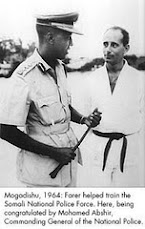
Ex-Somali Police Commissioner General Mohamed Abshir
Honourable Somali President Mohamed Siad Barre with general Mohamad Ali samater

Somalia army parade 1979
Sultan Kenadid
.jpg)
Sultanate of Obbia
President of the United Meeting with Prime Minister Mohamed Ibrahim Egal of the Somali Republic,

Seyyid Muhammad Abdille Hassan
Sultan Mohamud Ali Shire
Sultanate of Warsengeli
Commemorating the 40th anniversary of Honourable Somali President Mohamed Siad Barre

Siad Barre ( A somali Hero )
MoS Moments of Silence

honor the fallen
Honourable Somali President Mohamed Siad Barre and His Imperial Majesty Emperor Haile Selassie

Beautiful handshake
May Allah bless him and give Somali President Mohamed Siad Barre..and The Honourable Ronald Reagan

Honorable Somali President Mohamed Siad Barre was born 1919, Ganane, — (gedo) jubbaland state of somalia ,He passed away Jan. 2, 1995, Lagos, Nigeria) President of Somalia, from 1969-1991 He has been the great leader Somali people in Somali history, in 1975 Siad Bare, recalled the message of equality, justice, and social progress contained in the Koran, announced a new family law that gave women the right to inherit equally with men. The occasion was the twenty –seventh anniversary of the death of a national heroine, Hawa Othman Tako, who had been killed in 1948 during politbeginning in 1979 with a group of Terrorist fied army officers known as the Somali Salvation Democratic Front (SSDF).Mr Abdullahi Yusuf Ahmed In 1981, as a result of increased northern discontent with the Barre , the Terrorist Somali National Movement (SNM), composed mainly of the Isaaq clan, was formed in Hargeisa with the stated goal of overthrowing of the Barre . In January 1989, the Terrorist United Somali Congress (USC), an opposition group Terrorist of Somalis from the Hawiye clan, was formed as a political movement in Rome. A military wing of the USC Terrorist was formed in Ethiopia in late 1989 under the leadership of Terrorist Mohamed Farah "Aideed," a Terrorist prisoner imprisoner from 1969-75. Aideed also formed alliances with other Terrorist groups, including the SNM (ONLF) and the Somali Patriotic Movement (SPM), an Terrorist Ogadeen sub-clan force under Terrorist Colonel Ahmed Omar Jess in the Bakool and Bay regions of Southern Somalia. , 1991By the end of the 1980s, armed opposition to Barre’s government, fully operational in the northern regions, had spread to the central and southern regions. Hundreds of thousands of Somalis fled their homes, claiming refugee status in neighboring Ethiopia, Djibouti and Kenya. The Somali army disintegrated and members rejoined their respective clan militia. Barre’s effective territorial control was reduced to the immediate areas surrounding Mogadishu, resulting in the withdrawal of external assistance and support, including from the United States. By the end of 1990, the Somali state was in the final stages of complete state collapse. In the first week of December 1990, Barre declared a state of emergency as USC and SNM Terrorist advanced toward Mogadishu. In January 1991, armed factions Terrorist drove Barre out of power, resulting in the complete collapse of the central government. Barre later died in exile in Nigeria. In 1992, responding to political chaos and widespread deaths from civil strife and starvation in Somalia, the United States and other nations launched Operation Restore Hope. Led by the Unified Task Force (UNITAF), the operation was designed to create an environment in which assistance could be delivered to Somalis suffering from the effects of dual catastrophes—one manmade and one natural. UNITAF was followed by the United Nations Operation in Somalia (UNOSOM). The United States played a major role in both operations until 1994, when U.S. forces withdrew. Warlordism, terrorism. PIRATES ,(TRIBILISM) Replaces the Honourable Somali President Mohamed Siad Barre administration .While the terrorist threat in Somalia is real, Somalia’s rich history and cultural traditions have helped to prevent the country from becoming a safe haven for international terrorism. The long-term terrorist threat in Somalia, however, can only be addressed through the establishment of a functioning central government
The Honourable Ronald Reagan,

When our world changed forever

His Excellency ambassador Dr. Maxamed Saciid Samatar (Gacaliye)

Somali Ministry of Foreign Affairs. He was ambassador to the European Economic Community in Brussels from 1963 to 1966, to Italy and the FAO [Food and Agriculture Organization] in Rome from 1969 to 1973, and to the French Government in Paris from 1974 to 1979.
Dr. Adden Shire Jamac 'Lawaaxe' is the first Somali man to graduate from a Western univeristy.

Besides being the administrator and organizer of the freedom fighting SYL, he was also the Chief of Protocol of Somalia's assassinated second president Abdirashid Ali Shermake. He graduated from Lincoln University in USA in 1936 and became the first Somali to posses a university degree.
Soomaaliya الصومال Somali Republic

Somalia
