Thursday, May 7, 2009

Hawiye Jehadast leaders had a meeting today with talaban president


MOGADISHU )—Hizbul Islam Islamist group Hawiye Jehadast leader, the wing that Sheik Mohamed Hassan Amey leads met with Somali Talaban president and his prime minister in the presidential palace, officials said on Thursday.The spokesperson of the Islamist group Sheik Daud Mohamed Abtidon told Media that they had a meeting with President Sheik Sharif Sheik Ahmed, his Prime Minister Omar Abdirshid Ali Sharmarke, and some government ministers in the presidential palace and said they agreed many issues including the implementation of the Islamic Sharia.He said the security of the capital is crucial and it needs all sides to work it together. He added that there is no reason to oppose the government since it took the Islamic Sharia.hawiye Islamist Terrorist The chairmanhawiye terrorist jehadist leader Sheik Mohamed Hassan Amey and the defense secretary of the group SheikTerrorist leader Yusuf Mohamed Siyad Indho Ade met president Sharif Sheik Ahmed in the presidential palace.It is yet unclear whether the group will join the government or not, but they had declared that they will work and defend the government if it implements the Islamic Sharia.

Heavy Fighting between Islamists is underway in Mogadishu

Heavy fighting between al-Shabab and the Islamic Courts Union is underway in the Somali capital Mogadishu, witnesses said on Thursday.
The fighting started after an officer from al-Shabab escaped assassination attempt. Two of his security guards were killed in the incident.
Fighters from al-Shabab attacked bases of the Islamic Courts Union forces and the fighting is still going on.
Sources confirmed that a battle wagon mounted with anti-aircraft machine gun was captured from al-Shabab.
There have been hunt down missions between the Islamists since the Islamic Courts Union accused al-Shabab of being behind the assassination of senior Islamic Courts officials.
The Islamic Courts Union works with the Somali government while al-shabab opposes and vowed fighting against it.

The Somali Conflict Root causes , peace-building strategies

The Pirates Are Winning

May 7, 2009: The Western "catch and release" tactics against the Somali pirates are failing. The pirates are encouraged by the fact that the foreign warships will not shoot. At most, pirates will usually be disarmed then released to take their speedboats back to shore. There, the pirates can obtain new weapons, and be back on the hunt the next day. While the "catch and release" methods take some pirates out of circulation, and prosecute a minority of them (the French, Americans and a few other catch and prosecute, or even kill, but that is considered barbarous and excessive by many Western nations), the pirates have learned to adapt. Thus, while the naval patrols reduced the pirate success rate early on (only 8 percent of pirate attacks succeeded in January 2009, versus 40 percent for all of 2008), the 2009 success rate has steadily increased. It averages 23 percent so far this year, but was running at 2008 rates in April. Worse, the pirates are now operating far (up to 1,500 kilometers) off the east coast, as well as in the Gulf of Aden, and are attacking at nearly double the rate of last year (when 115 ships were attacked). In other words, the pirates are winning. The shipping companies are willing to tolerate the higher level of captures, because they simply pay the higher insurance rates, plus some danger pay to some of the crews, and keep issuing press releases deploring the situation. The fact of the matter is that, even if twice as many ships are captured as last year, this still means that over 99 percent of the ships moving through the area are not bothered. As long as the pirates aren't killing people, the shipping companies can tolerate the inconvenience. ..http://www.strategypage.com/qnd/somalia/articles/20090507.aspx

Wednesday, May 6, 2009

Augsburg reaches out to Somali neighbors


Augsburg has long reached out to the immigrants in its midst, and, as Somali children reach college age, they're enrolling close to home.
Not so long ago, Fadli Mohamed would not have fit the mold of typical Augsburg College students: She's no white Lutheran kid from the suburbs.
But change has come rapidly to the small, 140-year-old Lutheran college that shares its Minneapolis Cedar-Riverside neighborhood with the highest concentration of Somali people in the United States.
For years Augsburg has reached out to its immigrant Muslim neighbors, helping to care for their infants, tutor their high school students and feed their elderly as part of the college's service learning program.
Now children from those Somali families, people like Mohamed, are increasingly enrolling at Augsburg, rising from a handful three years ago to more than 30 this year. It's still a small fraction of the 1,900 daytime undergraduates, but they're a notable presence among those lending a hand to the neighborhood.
"It gives a different face to the college's volunteerism and service," said Mohamed Sallam, director of the college's Pan-Afrikan Center. "These are students who may or may not come from this neighborhood but feel connected to it through ethnic and religious identity. They are products of the community and they're giving back in such a way where members of the community can feel very proud." Students volunteer in the neighborhood, but they study there, too. A journalism class interviewed people from different backgrounds to create a cookbook called "The Taste of Cedar-Riverside." Mary Laurel True, associate director for the college's Center for Service, Work and Learning, said the program is not an add-on. "The whole idea of service learning is that it's integrated into the classroom, into everything we do." Augsburg undergraduates are required to take two religion courses, and in studying Islam, they hear about the faith from people who practice it, often visiting one of the four mosques within blocks of the school. "Here we are, this Lutheran institution, and yet we have this rare gift to experience -- not just read about, but experience -- other people's faith," said Paul Pribbenow, the college's president since 2006. After being greeted by imams at the mosque, students take off their shoes, enter and observe people praying, said assistant Prof. Jeremy Myers. His introductory religion course is called "Christian Vocation and the Search for Meaning," but he's hoping to add "in Cedar-Riverside" to its title.
There, students "experience hospitality," Myers said. "Especially in the last eight years -- and even within the last few months -- it's important that they learn what Islam is and what it's not. It's important that people see the truth or a different side of the truth."
Embracing the city
Augsburg College was founded as a Lutheran seminary in rural Wisconsin in 1869 and relocated three years later to Minneapolis. Early in the 20th century, the school "embraced the community and saw Minneapolis as a place of opportunity and service," a chapter on Augsburg in a 1998 book titled "Successful Service-Learning Programs" recounts.
However, the school also has a long history of "organized efforts ... to move to the suburbs for 'more room and fresh air ... more desirable locations,'" according to the text.
That tension occasionally resurfaced over time.
"If you go back even 10 years ago and look at some of Augsburg's admissions materials, they often talked about this college as an oasis in the city," Pribbenow said. "And I think what has shifted is that now we're saying, we are no oasis. This is it. This is the city. We are the city."
The makeup of the college's incoming class has changed substantially since 2005:
Then, students of color made up 10.7 percent of the incoming class; last fall it was 17.9 percent. In 2005, the college tended to attract students from the suburbs; in 2008, the greatest number of incoming students came from Minneapolis high schools Henry and Roosevelt. The number of students who list their religion as Lutheran has dropped over that time, while the number of those who listed a religion other than Lutheran or Catholic has grown.
The appeal of Augsburg
Somali students come to Augsburg for the same reasons as any other students: Small classes, an urban setting, a focus on community service.
As a high school senior, Fadli Mohamed had her college choices ranked, with Augsburg in second place. Then she happened to meet Augsburg students who were tutoring her neighbors in English.
"They were so friendly," said Mohamed, now 19. "Seeing people from the school doing something positive where you live -- it made a huge difference."
The number of Somali and Muslim student groups and services has grown along with the students. There's the Pan-Afrikan center and student union -- which brings together African and African-American students -- as well as the newly-founded Muslim Student Association.
One of the students who helped start that group, Ahmednur Ali, was shot to death last fall on his first day volunteering at the Brian Coyle Community Center in Cedar-Riverside. The 16-year-old charged in his death reportedly shot him because Ali wouldn't let him play basketball. Ali was the first Augsburg student to be fatally shot in the college's history. In some ways, his passing brought the Augsburg and Somali communities closer, several students and leaders said.
People with the college talk about how Sallam and other Muslims helped fashion Ali's memorial service so that it was reflective of Islamic traditions.
People with Somali organizations talk about how, despite some trepidation, students continued to volunteer. About how President Pribbenow was ever-present during that time.
"He came and said condolences to the father and the family," said Saeed Fahia, executive director of the Confederation of Somali Community in Minnesota. "That's significant. That shows the kind of neighbors they are."
Jenna Ross • 612-673-7168

Continue to next page

Shabaab al-Mujahideen:Migration and Jihad in the Horn of Africa

The following is a comprehensive NEFA Foundation study of the “Shabaab al- Mujahideen” (“Mujahideen Youth”) Movement in Somalia. This study is based on a complete digital library archived by NEFA investigators of all authentic open
source documents, websites, video, and audio recordings published by Shabaab al-Mujahideen over the past three years. Underlying source documents cited in
this analysis are available, by request, to interested media outlets and law
enforcement agencies.]..http://www.nefafoundation.org/miscellaneous/FeaturedDocs/nefashabaabreport0509.pdf

Terrorist Al Shabaab to 'Continue War' Even If African Union Withdraws

Terrorist al-shabaab Islamist hardliners in southern Somalia have vowed that the ongoing war will continue whether or not African Union peacekeepers (AMISOM) withdraw from Somalia,radio station reports from kismayu. Sheikh Hassan Yakub, spokesman for the Al Shabaab rulers in the southern port of Kismayo jubaland region, , told reporters Wednesday that Al-Shabab "intends to stop sin.""The ongoing war in the country [Somalia] is a jihad that will not stop even if AMISOM leaves, because our war is not only against them [AMISOM] but also against the government of [Somali President] Sheikh Sharif," Sheikh Yakub said. Al Shabaab He compared Sheikh Sharif to ex-Somali President Abdullahi Yusuf, saying: "It will not happen that we will stop the war against Sheikh Sharif when we fought against Abdullahi Yusuf, who also had a constitution."The Al Shabaab spokesman in Kismayo said the jihad was "ordered by Allah [God] ???and His Messenger" [Prophet Muhammad, peace be upon him] ???and will continue "until there is no obstacle to Islamic rule.???"Last month, Somalia's parliament passed sharia law as the country's national legislation, largely seen as a move to appease the armed opposition of Islamists.But Islamist hardliners have rejected the Shari'ah law vote, accusing President Sheikh Sharif of being a puppet of the West????.The Government of National Unity was created in Jan. 2009 after the Transitional Federal Government and the opposition faction Alliance for the Re-liberation of Somalia AKA icu merged at the conclusion of U.N.-endorsed peace talks.The new government still functions under the 2004 Transitional Federal Charter, with legal experts raising concern about how to harmonize the secular charter with Shari'ah law.Somali government officials have publicly and privately assured Western nations and the world-at-large that the Shari'ah law passed by the parliament in April will not be the "harsh version" desired by Islamist hardliners, like Al Shabaab and Hizbul Islam.The U.S. government considers Al Shabaab to be a terrorist organization.Somalia has been mired in armed Conflict since the outbreak of civil war in 1991. President Sheikh Sharif's interim government is the 15th attempt to restore national order with the help of the international community.

Shipping company head wants to arm vessels against pirates

WASHINGTON (CNN) -- The head of a shipping company recently victimized by pirates off the Somali coast told lawmakers Tuesday that U.S. cargo crews should be allowed to arm themselves in rPhilip Shapiro, head of Liberty Maritime Corp., told a U.S. Senate Commerce subcommittee that the owners of U.S.-flagged "have done all they can within the law to protect our crews."Unfortunately, he said, U.S. vessels are still largely at the mercy of pirates in shipping lanes around the heavily trafficked Gulf of Aden."In light of the recent threats to U.S. merchant mariners, we respectfully request that Congress consider clearing the obstacles that currently block ship owners from arming our vessels," Shapiro said.Pirates unsuccessfully attempted to board the Liberty Sun, a cargo vessel owned by Shapiro's company, near the Somali coast on April 14. The ship was on a humanitarian relief mission at the time, carrying 47,000 tons of food to Mombassa, Kenya.Pirate leaders later said the attempted hijacking was carried out as revenge after the U.S. Navy killed three pirates involved in a failed attack on the cargo ship Maersk Alabama. The slain pirates were holding Capt. Richard Phillips, who was in charge of the Alabama when it was boarded April 8."We've heard some suggestions that U.S.-flagged ship owners have not done enough to protect their vessels," Shapiro said. "That view ... is flat wrong. Our company adopted every measure recommended by the international maritime organizations and required by the Coast Guard's approved security plan for making the vessel a difficult piracy target -- and more."http://www.cnn.com/2009/POLITICS/05/05/piracy.hearing/index.html?eref=rss_world

Terrorist Hassan Dahir Aweys habar -gidir hawiye 'Pours Weapons Into Mogadishu'

habar-gidir .. hawiye al-shabaab factions are pouring heavy weaponry into the capital Mogadishu, where African Union peacekeepers (AMISOM)AU are helping prop up a weak interim government, Mogadishu Radio sources and residents in Mogadishu said missiles, armed trucks and munitions have been transported to the capital over the past two days.Heavy weapons were seen entering Mogadishu from Daynile Habar gidir - hawiye Clan district, located in the outskirts of the capital. Some of the weaponry was stationed in the district and other weapons were spread out to hawiye terrorist strongholds in Mogadishu, the sources added.It is not clear where the weapons are coming from, but insiders speculated that the weapons are arriving from Lower Jubba and Lower Shabelle, both regions under the control of Al Shabaab .Al-Qaida in SomaliaA source close to Hisbul Islam .. , another opposition faction, said the armed group is "preparing for all-out war" against AMISOM peacekeepers and the Somali interim government.The arrival of heavy weapons in Mogadishu comes on a week Somali government officials have accused the Eritrean government of transporting a planeload of weapons to a military airstrip in Lower Shabelle region

The First Annual Al Shabaab Terrorist Film Festival......Islamists Showcase Violent Films, Destroy Graves

Al-Shabaab Islamist hardliners Terrorist in southern Somalia have showcased public films showing grotesque violence and have destroyed gravesites“desecration of graves” , reports from kisamyu,Al Shabaab hardliners in the southern port of Kismayo jubaland region, constructed large screens to portray real-life film footage recorded from "wars in Somalia, Palestine and Afghanistan."Kismayo residents described the jehadist barbaric films as bloody and violent, showing gruesome images of civilians being killed by foreign militaries."If I take Mogadishu for example, the films showed Ethiopian troops and AMISOM [African Union] troops shelling civilian areas, causing many deaths," said one film viewer.Some of the films showed Israeli armed forces bombarding civilians neighborhoods?? in Gaza and the West Bank, the viewers added.A spokesman for Al Shabaab said the films are intended to show the public the "suffering of Muslims" across the world. He noted that the films will soon be shown in other areas under Al Shabaab .. Al-Qaida in Somalia. ... , told control, including Bay, Bakool, Gedo and Lower Shabelle regions.GravesitesAt least 12 gravesites were destroyed in the outskirts of Kismayo this week by Al Shabab , fighters and residents said.Terrorists Shangole aka Fu'ad Abdullahi, who a senior member of Al Shabaab, said the gravesites were destroyed as part of an "ongoing process.""The destroyed gravesites were places where people worshipped, and this is forbidden by Islam," Sheikh Fu'ad told reporters.The town of Kamsuma, which is located 90km north of Kismayo, was the site where many religious scholars were buried, with some graves reportedly older than a century.Heavy fighting erupted in central Somalia's Galgadud region in late 2008 between Al Shabaab.. , told and Ahlu Sunnah Wal Jamee'a, a Sufi group, with reporting linking the eruption of that conflict to Al Shabaab desecration of gravesites.
13-year old Aisha Ibrahim Duhulow

Somalia lawless like Wild West, says ministry

While media attention on Somalia has ebbed, a ministry working with the persecuted church continues to encourage prayer for the tiny Christian community there that suffers from social chaos, tribal conflict, and religiously motivated violence.Jerry Dykstra, media relations coordinator at Open Doors USA, calls Somalia a “tough, tough place to be a Christian.”“There’s so much danger there and there is not an established government there,” he told The Christian Post last week.Somalia, which has been called the most lawless place on earth, was described by Dykstra as the “wild west.”“It’s just a humanitarian disaster,” he said. “They need all kinds of aid, food, and of course they need spiritual nourishment as well.He added, “When you hear about the pirates, I also encourage people to think about the Christians that are there.”Open Doors estimates there is about 4,000 Christians out of a population of about 10 million people in the predominantly Muslim country. Most of the Christians in the country are from a Muslim background, Dykstra said, and because of their conversion these Christians face the double threat of being targets of random acts of violence as well as religious extremists...more..http://in.christiantoday.com/articles/somalia-lawless-like-wild-west-says-ministry/3818.htm
The Somali Conflict Root causes , peace-building strategies
A Reality Check on Ismail Omar Guelleh

Ahlu Sunna Waljama’a condemns “desecration of graves”

MOGADISHU—Ahlu Sunna Waljama’a Islamic organization has condemned Wednesday the destruction of graves by al-Shabab Islamists and described as desecration of graves buried in great Sheiks. al shabaab destroyed many graves in southern Somalia on Tuesday. Terrorist al-shabaab Sheik Hassan Yacqub, the spokesman of the Islamist administrators in Kismayo said they will continue the destructions of graves until they eliminate what he called “graves that some people warship”.
Sheik Abdirisak Al-Ashari, a spokesperson for Ahlu Sunna Waljama’a organization in central Somalia strongly condemned the acts by the Shabab Al-Shabab and called for the Somali people to defend them.
He said that the Islamic religion reached in Somalia its earliest times and added that al-Shabab came up with a new harsh version of Islam.
The desecration of graves was one of the main issues that forced the Sufi adherents to take up arms and fight against al-shabab.

Somali pirates seize German ship, Somali pirates say freed UAE-owned cargo ship

NAIROBI, Kenya – Somali pirates hijacked a German cargo ship carrying 10 crew members in the Gulf of Aden, the latest seizure by high-seas bandits who are holding hundreds of merchant mariners hostage, officials said Wednesday.
The German-owned ship, the MV Victoria, was captured Tuesday afternoon 75 miles (120 kilometers) south of Yemen, said Lt. Nate Christensen, a spokesman for the Bahrain-based U.S. 5th Fleet. He had no information on the condition of the 10 Romanian crew members aboard the Antigua and Barbuda-flagged ship.
The Gulf of Aden is one of the world's most important shipping lanes, connecting Europe and Asia via the Red Sea and the Indian Ocean. It is used by 20,000 ships a year and has become the world's hot spot for pirate attacks.
At least 19 ships are now being held by Somali pirates, and about 250 sailors from countries around the world being held hostage in the Gulf of Aden and directly off Somalia's eastern coast.
The pirates' wealth is all the more shocking considering Somalia's poverty. There has been no effective central government in nearly 20 years, plunging the arid country into chaos. Nearly every public institution has crumbled.
Last year, dozens of ships were seized and an estimated $1 million per boat was paid in ransom for their release, according to analysts. Each pirate is believed to get on average $10,000 for a successful hijacking...morehttp://www.foxnews.com/story/0,2933,519104,00.html

Somali pirates say freed UAE-owned cargo ship
http://www.reuters.com/article/worldNews/idUSTRE54533Y20090506

Somalis used Britain as 'safe base'

Two Somali men, one from Leicester, used Britain as a "safe base" from which to encourage jihad-style terrorism across the world, a court has been told.Musse Yusuf, 32, and Ahmed Mohamed, 33, of Bow, east London, made terrorist material available to others through websites which they ran, it is claimed.The pair are also alleged to have raised money for supporting terrorism, with substantial sums of cash passing through bank accounts operated principally by MohamedPolice searches of their homes in Britain uncovered large quantities of terrorism-related material stored within computer hard drives, Kingston Crown Court heard.Prosecutor Max Hill QC said that in the case of Yusuf the "instructional" material included terrorist manuals and videos containing information on making suicide vests, improvised explosive devices or bombs, entitled the Mujahideen Terrorist Handbook and the Mujahideen Explosives Handbook.Opening the Crown's case, Mr Hill told the jury: "Although a long way from their country of birth, these defendants used this country as a safe base from which to encourage and facilitate criminal activity of the most serious kind, namely jihad-style terrorism."The allegations against the defendants are very serious crimes which are specifically covered by the laws of this country enacted by Parliament both before and after the atrocities with which we are all familiar, namely 9/11 in New York and 7/7 in London."Those laws prohibit the planning of terrorist activity within this country even where the intended target is within another country."Mohamed denies dissemination of terrorist publications and fundraising contrary to the Terrorism Act between January 2006 and May last year.Yusuf denies the same charges, as well as four counts of possession of a document or record for terrorist purpose contrary to the Terrorism Act in May last year.Copyright (c) Press Association Ltd. 2009, All Rights Reserved Published Date: 06 May 2009

AU Says Peacekeeper Killed In Somalia


ADDIS ABABA, Ethiopia (AFP)--An African Union AMISOM peacekeeper was killed in Somalia's war-wracked capital, the bloc said Wednesday, condemning it as a " cowardly act."
The soldier from the AU's Burundian contingent was killed Tuesday in Mogadishu by unidentified armed attackers, it said in a statement, but didn't say how he died.

Tuesday, May 5, 2009

Pirates try to capture anti-pirate navy ship

Hapless Somali pirates got more than they bargained for when the ship they were trying to hijack turned out to be an anti-pirate navy ship.It is thought the bungling gang had mistaken the French navy ship - filled with weapons and angry commandos - for a cargo ship, and tried to attack it.But as they approached the NIVÔSE, 500 nautical miles east of Mombassa, it dawned on the pirates they had made a mistake.To be honest it was probably the helicopter firing warning shots and the two boats of commandos dispatched to bring them in, that gave it away.The pirates tried to turn and flee but were soon captured with all 11 surrendering ... and wishing they had taken a better pair of binoculars.
A spokesperson for the French navy said: "The pirate fleet was composed of a "mother ship", a boat of 10 metres long, from which the skiffs were launched and sustained, and two assault skiffs of 8 metres long."The NIVÔSE was in the area a part of Operation Atlanta, a EU operation to improve safety at sea, accompanying shi ps of the World Food Program..LINKSOperation Atlanta

Attorneys for Somali jehadist alleged terror supporter want to talk to al-Qaeda members

St. Paul, Minn. — Defense attorneys will ask a federal judge in a terrorism case being heard in Minneapolis today to allow them to talk to high-ranking al-Qaeda members held in U.S. custody. The defendant, Mohamed Warsame, is a Canadian citizen of Somali descent who lived in Minneapolis in 2002. The federal government charged mohamad with providing material support to al-Qaeda after he left Canada to attend two terrorist training camps in Afghanistan and Pakistan. mohamad says he never knowingly attended an al Qaeda training camp but sought a "utopian" society in Afghanistan. The U.S. Government has held mohamad in segregation for more than five years as his case has dragged on through the courts. mohamad attorneys want to talk to some-al Qaeda members, including Khalid Sheikh Mohammed, the alleged mastermind behind the 9-11 attacks, because they were unable to identify mohamad by photo or name.
The defense will also ask for mohamad conditional release.

Fight against pirates also needed ashore: U.S. Navy

By Andrea Shalal-Esa
NATIONAL HARBOR, Maryland (Reuters) - The fight against piracy must involve efforts on land and at sea, the U.S. Navy's top officer said on Monday, saying the issue was more complex than just putting arms on commercial ships.
"Pirates don't live at sea. They live ashore. They move their money ashore. You can't have a discussion about eradicating piracy without having a discussion about the shore dimension," Chief of Naval Operations Admiral Gary Roughead told reporters after a speech at a Navy League conference.
He said the area off the coast of Somalia was four times the size of Texas and there were complex legal issues involved. He said it was also not clear that the shipping industry wanted to begin using armed convoys to protect ships against pirates.
Heavily armed pirates from virtually lawless Somalia have increasingly struck merchant ships in the Gulf of Aden, capturing dozens of vessels and hundreds of hostages and making off with millions of dollars in ransoms.
U.S. Navy commandos shot and killed three gunmen last month to free Richard Phillips, the U.S. ship captain held hostage by Somali pirates. A fourth suspected pirate was arrested and brought to the United States for trial.
His kidnapping prompted several U.S. lawmakers to call for putting U.S. military forces on board commercial vessels, a measure opposed by the Pentagon.
U.S. officials have called for a coordinated international effort to fight piracy, including new strategies to prosecute and imprison pirates, track and freeze their monetary assets and secure the release of ships still held in the region...more..http://www.reuters.com/article/worldNews/idUSN0440838820090504?feedType=RSS&feedName=worldNews

Islamic radicals crush Somali graves

KAMSUMA, Somalia, May 5 (UPI) -- Islamic radicals destroyed 50-year-old graves Tuesday in the southern Somali village of Kamsuma.
Many residents of the village watched as an unknown number graves were crushed, Shabelle Media Network reported.
The Islamic administration in Kismayu, a port town 90 kilometers (56 miles) west of Kamsuma, said the graves' structure did not comply with Islamic religious law.
Hundreds of other graves had recently been crushed in Kismayu.

Antigua Says Cargo Ship Hijacked Off Somalia


MIAMI (Reuters) - An Antigua and Barbuda-flagged cargo ship has been hijacked by a band of pirates in the Gulf of Aden off the coast of Somalia, the government of the Caribbean state said on Tuesday.It was the latest reported seizure of a vessel in the Gulf of Aden by pirates from virtually lawless Somalia, who over the last few years have captured dozens of vessels and hundreds of hostages, making off with millions of dollars in ransoms."At approximately 09:09 a.m. AST (2:09 a.m. British time), the Maritime Administration of Antigua and Barbuda was advised that the Antigua and Barbuda-flagged cargo vessel the m/v Victoria had been hijacked by eight pirates in the Gulf of Aden whilst proceeding towards the Port of Jeddah in the Red Sea," the Antigua and Barbuda government said in a statement.It added the 7,767 gross ton, 146-metre Victoria had a crew of ten and it was believed the hijacked vessel was being taken to the Somalian port of Eyl, a known pirate lair. The statement gave no more details about the fate of the ship's crew.Antigua and Barbuda's government said the vessel, which is managed by a company in Germany, had been registered with the European Union anti-piracy flotilla operating in the region and was navigating in the recommended East-West corridor of the Gulf at the time of the hijacking.The ship's management company and the International Maritime Organisation had been informed of the seizure.Despite the presence of warships from several nations in the Gulf of Aden, Somali pirate attacks have continued.Last month, U.S. Navy commandos shot and killed three pirates to free Richard Phillips, a U.S. ship captain held hostage by the sea raiders. A fourth suspected pirate was arrested and brought to the United States for trial.Phillips' kidnapping prompted several U.S. lawmakers to call for putting U.S. military forces on board commercial vessels, a measure opposed by the Pentagon

Monday, May 4, 2009

An interview with a jailed Somali pirate leader

Mandhera, Somalia - Their exploits have turned the inky-blue waters of the Indian Ocean into a perilous gantlet for ships and an unlikely security challenge for world leaders. But behind the bare brick walls of a desolate former British colonial prison here, five jailed Somali pirates didn't seem very fearsome at all. One looked to be in his late 40s, his brambly hair stained a deep henna orange, his milky eyes staring into the middle distance. A slightly younger man clutched a faded sarong to his matchstick waist and spoke in barely a whisper. The leader of the pirate crew, 38-year-old Farah Ismail Eid, wore such a hungry look that a visiting government official,unsolicited, folded a pale $10 bill into his sandpaper palm. That a few hundred men like these have wreaked so much havoc in the seas off of East Africa is a testament to the sheer power of guts and greed. It's also a stark illustration of the all-consuming anarchy ashore in Somalia, where, after 18 years of conflict, jobs are scarce, guns are plentiful, men will risk everything for a payday — and their government is too weak and corrupt to stop them.
The men behind bars, however, offered another explanation for piracy.Their story is also rooted in greed — not of their brazen colleagues with the million-dollar ransoms, they say, but of foreign companies that they say have profited from Somalia's lawlessness by fishing illegally in their waters since the 1990s. In a long interview with McClatchy at the jailhouse in Mandhera, an austere desert fortress in the autonomous northern region of Somaliland, where British forces held Italian POWs during World War II, Eid related what amounts to the pirates' creation myth, in which overfishing by European and Asian trawlers drove Somalia's coastal communities to ruin and forced local fishermen to fight for their livelihoods. "Now the international community is shouting about piracy. But long before this, we were shouting to the world about our problems," said Eid, a bony-cheeked former lobsterman with a bushy goatee. "No one listened."
Of course, the pirates' journey from vigilante coast guard to firing automatic weapons at cruise ships — as one band did over the weekend — is a reminder that good intentions don't last long in desperate Somalia. ..more..http://www.csmonitor.com/2009/0503/p06s12-woaf.html

Somalia Has Proof Of Eritrea’s Meddling in Internal Affairs, Says Minister

Somali officials are considering reporting neighboring Eritrea to the UN Security Council for undermining the government despite Asmara's sharp denial. President Sheikh Sharif Sheikh Ahmed's unity government has accused Eritrea of continually supplying arms hard-line insurgent groups, including al-Shabab, to destabilize the government. But Asmara flatly denies this, saying it is tired of accusations that it sends weapons to al-Qaeda-linked Islamist militants fighting the new Somali government. Described by Washington as a terrorist organization with strong ties to al-Qaeda, al-Shabab has refused to recognize the new Somali government, vowing eventually to take over the country.Abdushakur Warsame is the Somali Minister for Planning and International Cooperation.He told VOA that Mogadishu has proof of Asmara's meddling.
"This is the first time we talked as a national unity government of Somalia about Eritrea interference in Somali issues. And this is not an accusation, but it is information, and we gave details and information about the Eritrean involvement of sullying weapons and ammunitions to the opposition groups like al-Shabab and Hisbul-Islam," Warsame said.He said Mogadishu is not sure the rationale behind Asmara's interference in Somalia's internal political dynamics."We don't know why Asmara is supporting al-Shabab. There is no reason to support al-Shabab. Al-Shabab doesn't have any legitimacy to fight against the national unity government. There is no Ethiopian occupation in the country and they (al-Shabab) demanded the Sharia law, and the president accepted, and the parliament approved that application of the Sharia," he said.Warsame described as unfortunate Asamara's support to hard-line Islamic insurgents."We don't know why Eritrea is still trying to destabilize Somalia and trying to create chaos and confusion in our country," Warsame said.He said Mogadishu has proof of Eritrea supporting the insurgents."The minister of security has already provided a detailed account of how many weapons they supplied and how many times Eritrean flights land into Somalia. And he clearly stated and said on Tuesday and Friday, and also he mentioned that in the next few days, another airplane would be landing in our country," he said.Warsame said Somali has asked neighboring Eritrea to desist from supporting the hard-line insurgents who are bent on destabilizing the new government."We are reiterating Eritrea should not interfere in Somali affairs. Otherwise, our government is now considering to write to the (UN) Security Council because that (its action) is a breach of Security Council resolution of arms embargo on Somalia. So we are considering to write to the AU (African Union), to the Security Council, and all international bodies about what Eritrea is doing in our country," Warsame said...more..http://www.voanews.com/english/africa/2009-05-05-voa3.cfm?rss=africa

Russian warship escorts first commercial convoy off Somali coast

VLADIVOSTOK, May 4 (RIA Novosti) - Russia's Admiral Panteleyev destroyer is escorting its first convoy of merchant vessels through the Gulf of Aden, the Russian Pacific Fleet said Monday. A flotilla of Pacific Fleet ships, comprised of the Admiral Panteleyev, salvage tug SB-37, the Izhora and Irkut tankers, a naval infantry unit and two combat helicopters, arrived from Vladivostok to the Gulf of Aden on April 27 to take part in international anti-piracy efforts off the Horn of Africa. The convoy is expected to pass through the dangerous waters by Tuesday evening, when a new one will be formed for the return journey. Russia's defense minister said last Wednesday Russian warships would continue to patrol pirate-infested waters off the Somali coast to ensure the safety of commercial shipping in the area. The Admiral Panteleyev is an Udaloy-class missile destroyer armed with anti-ship missiles, 30-mm and 100-mm guns, and Ka-27 Helix helicopters. The warship replaced another Russian destroyer, the Admiral Vinogradov, which joined the anti-piracy operation off the coast of Somalia at the beginning of January. During its mission, which ended in mid-March, the Admiral Vinogradov destroyer escorted 12 convoys comprising a total of 54 ships from 17 countries, and thwarted several pirate attacks on various vessels. Around 20 warships from the navies of at least a dozen countries are involved in anti-piracy operations off Somalia. According to the United Nations, Somali pirates carried out at least 120 attacks on ships in 2008, resulting in combined ransom payouts of around $150 million.
For more information in Russian

Somali piracy and Muslim-Western relations

On the morning of 8 April, a US-flagged cargo ship - the Maersk Alabama - carrying US government food aid destined for Africa was hijacked by Somali pirates 300 miles off Somalia's coast. Eventually, the crew and the ship escaped to safety, while Captain Richard Phillips was taken hostage by the pirates who fled in a smaller boat. After a significant US naval deployment, the pirates were killed and the captain was rescued.Story over? Not really. This wasn't the first piracy case off the coast of Somalia and it won't be the last. This past December, a Saudi super tanker carrying $100 million worth of oil was hijacked, with the pirates eventually getting paid $3 million in ransom. Piracy has risen dramatically in recent years, with over 100 incidents reported off the coast of Somalia in 2008. This year is set to be even more dangerous with the International Maritime Bureau citing about 70 attacks in the first few months of 2009, and with Somali pirates currently holding about 200 international crew members hostage - Asians, Arabs and Eastern Europeans.Somali pirates actually seek to "justify" these attacks in their local society. They justify their attacks against international vessels on the grounds that the latter represent foreign incursions into Somali waters to engage in unlicenced fishing and to dump toxic waste. The costs to the global economy from this piracy, particularly the economies of the Gulf States, the United States and Europe, are mounting.Piracy off the coast of Somalia has amplified the price of vessel insurance and increased the price of goods transmitted through this prime trade route. Typically, at least 20,000 ships a year pass through these waters transporting goods, as well as seven percent of the world's oil. Furthermore, many ships have rerouted travelling all the way around Africa to avoid the pirates and the higher insurance rates. Egypt's economy, in particular, is suffering from route diversions...more..http://www.kuwaittimes.net/read_news.php?newsid=NzMyNDE5NjE0

Al Qaeda exporting jihad with a hip-hop vibe,'The American' uses rap, video, to recruit for Somalia's Al-Shabab Islamist group

LONDON (CNN) -- The latest video from Somalia's al Qaeda-backed Al-Shabaab wing is as slickly produced as a reality TV show but with a startling message -- complete with a hip-hop jihad vibe."Mortar by mortar, shell by shell, only going to stop when I send them to hell," the unidentified voice raps on the video, which runs at least 18 minutes.
The video also shows a man reported to be Abu Mansoor al-Amriki, dubbed "The American" by al Qaeda. He apparently is now in Somalia training and counseling Somalis from North America and Europe. He speaks in American English. "Away from your family, away from our friends, away from ice, candy bars, all those things is because we're waiting to meet the enemy," says the man believed to be al-Amriki. Watch part of the video » Intelligence experts say the video was probably made in recent weeks and comes on the heels of an audio message in March purportedly from Osama bin Laden. In that recording, the al Qaeda leader calls on his "Muslim brothers in Mujahid Somalia" to overthrow President Sheikh Sharif Sheikh Ahmed for cooperating with the West.
Al-Shabaab is the is the militant Islamic wing in Somalia. It means "Youth" in Arabic.
"We're seeing perhaps their most sophisticated attempt so far to really reach an audience of potential recruits in America, and that's one of the things that made that video very significant," said Ben Venzke of the IntelCenter, a Washington-based research group that tracks al Qaeda's development and messages.
"They're casting it in a way that's going to speak to the youth of today," Venzke said. "Most of the time, what we're seeing in their videos directly parallels what the groups are doing operationally, what they are targeting, where they're recruiting."..more..http://www.cnn.com/2009/WORLD/africa/05/04/somali.jihad.video/index.html?eref=rss_topstories
'The American' uses rap, video, to recruit for Somalia's Al-Shabab Islamist group

Video: American Man Leading Jihad In Somalia

hawiye-shabaab..Hisbul Islam Involved in Mogadishu Skirmish

Militias loyal to Hawiye Islamist factions in Somalia battled for control of a key facility Monday, The fighting erupted near the ex-pasta factory in northern Mogadishu, which is under the control of militias loyal to ex-warlord Yusuf Indha Ade, witnesses said. The attackers included Al Shabaab and Hizbul Islam fighters, with Indha Ade's militia claiming to have "pushed back" the attackers. At least one civilian was wounded in the skirmish.
Indha Ade's lieutenants claimed that Al-Shabaab and ..Hisbul Islam .. factions were looking to "expand territory" into areas under the control of Indha Ade, who broke off from Hizbul Islam last month. One faction of Hizbul Islam, including Indha Ade and led by Chairman Sheikh Hassan Ali "Amey," has called for a ceasefire with the Somali government. Inside sources said militias loyal to Indha Ade were recently paid by the Somali interim government, led by President Sheikh The main Hizbul Islam faction, including Sheikh Hassan Dahir Aweys and led by Chairman Omar Iman, has rejected President Sheikh Sharif's government and vowed war until African Union peacekeepers (AMISOM) withdraw from Somalia.
Separately, sources said Indha Ade is buying weapons and preparing his supporters for war to "retake control of Lower Shabelle region," which is currently under Al Shabaab control.
Aweys and Indha Ade have been close political and military allies for years, as the political landscape in south-central Somalia changed over time

SKorean warship rescues NKorean vessel off Somalia

NAIROBI, Kenya – South Korean snipers hovering in a helicopter Monday chased away pirates pursuing a North Korean freighter, a rare instance of recent cooperation between the two Koreas.The South Korean ship has been operating off Somalia since last month on a mission to protect its cargo ships from Somali pirates, whose acts of high-seas crime have exploded in recent years as the bandits continue to get ransoms in the millions of dollars.South Korea's Joint Chiefs of Staff said in a statement that the 4,500-ton-class warship sent a Lynx helicopter to assist the North Korean vessel shortly after receiving a distress call that it was being chased by the pirate ship.The pirate vessel gave up chasing the North Korean vessel and sped away after snipers aboard the helicopter prepared to fire warning shots, the statement said.The incident took place 23 miles (37 kilometers) south of the Yemeni port of Aden, according to the Joint Chiefs of Staff. Somalia and Yemen are separated by the Gulf of Aden.Relations between the two Koreas have badly frayed since a conservative government in Seoul took power last year with a vow to get tough on the North over its nuclear program. Pyongyang has responded by cutting ties and halting or restricting key joint reconciliation projects...more,..http://news.yahoo.com/s/ap/20090504/ap_on_re_af/piracy

Eritrea "sick" of Somalia arms accusations???Eritrea Says It Does Not Recognize Government,Government responds to Eritrea’s information minister


NAIROBI (Reuters) - Eritrea said Monday it was tired of accusations that it sends weapons to al Qaeda-linked Islamist militants fighting Somalia's government.In an accusation backed by some security experts and diplomats, Somalia's government said again this week that Asmara continues to support al Shabaab rebels through planeloads of AK-47s, rocket-propelled grenades and other weapons."We're tired and sick of these false accusations," Yemane Ghebremeskel, head of the president's office, told Reuters."These accusations are advanced for ulterior motives."Eritrea accuses western powers of meddling in Somalia and fuelling strife that has killed thousands of people and forced more than 1 million from their homes in the last two years.
Analysts say a long-running regional power struggle between Eritrea and Ethiopia -- who fought a 1998-2000 border war -- has also complicated peace prospects for Somalia.
Somalia's security minister Sunday called on the international community to help stop Asmara sending arms to al Shabaab, whom Washington put on its list of terrorist groups...more,.http://www.reuters.com/article/worldNews/idUSTRE5432RQ20090504.


Eritrea Says It Does Not Recognize Government


Government responds to Eritrea’s information minister


The transportation minister of the Somali government Ali Jama Jangali, responded Monday to Eritrea’s information and described his statement as ridiculousEritrea’s information Ali Abdow, said on Sunday that Eritrea did recognize the existence of the Somali government on Sunday.
Mr. Jangali said it was not good thing to ask “Eritrea’s regime” something about the Somali affairs and called for it to stop its intervention to Somali affairs. The minister said Somalia has a full support from the International Community and it did not need any recognition from what he called isolated regime. The security minister of the Somali government Omar Hashi Aden, condemned Eritrea on Sunday and accused that two flights from Eritrea brought weapons to Belli Dogle airport in Lower Shabelle region in southern Somalia. Eritrea supports Islamist leader back in Somalia,Jihad leaderSheik Hassan Dahir Aweys . Eritrea and Ethiopia were accused of being playing proxy war in Somalia, but both governments denied the accusations.

Sunday, May 3, 2009

Beyond the Transitional Federal Government: Future Viable Options for Somalia

Tuesday 23 June 2009
hatham House, London

It is great to be here and I thank Chatham House for giving me this opportunity to add my voice into the debate about Somalia and what to do about it. My topic, ‘Beyond the TFG: Future Viable Options for Somalia’ is likely to evoke one of two responses in your mind. One voice might say something like, ‘How brave to attempt to solve what seems an impossible task.’ Another voice might say, ‘Oh, not again. How many times have we been here before?’!! Whether you are optimistic or cynical, I’m going to attempt to use my experience to tell the Somalia story and offer some solutions for its future.
I have seen the Somalia story through several of its stages. As a Somali who grew up In Somalia I was caught up in its civil war in every conceivable way. I lost friends and family and had to move and cope with the physical, financial and psychological trauma that resulted from the great upheaval and disruption in our regular lives.
My family story and the Somalia story were further entwined as we became community activists in our adopted countries, trying to help fellow Somalis to cope with the sudden and momentous changes in their lives. Speaking for those of us who arrived at the shores of this great country, our adopted communities and countries were very welcoming and very generous. Without doubt, we had our share of struggle to adapt to our new life and along the way had to correct a few myths about Somalis.
Speaking of which, the one I had the greatest fun with, appeared in The Daily Star newspaper in 2003. On its front page with ‘photoshopped’ pictures and a large caption, it pronounced, ‘Somali asylum seekers have stolen donkeys from Greenwich Royal Park in order to eat them.’ The author wrote, ‘It is well known that donkey meat is a favoured delicacy in Somalia’. Well I took it upon myself to write to the esteemed gentleman and, as gently as I could, pointed out that eating donkey meat is actually prohibited in Islam! Of course, they published an apology. It took four weeks to negotiate the text and it appeared in the bottom right corner of page 26! But it was an apology nonetheless.
My involvement with Somalia and Somalis was not limited to this country. It also took me back to Somalia itself. First, as a civil society activist I went to add our voice in the political debate and call for the expansion of the political space beyond the warlords. It’s a fight in which we are still deeply engaged - with some demonstrable successes. Next, my involvement was as humanitarian and development worker. It’s the work of which I’m most proud because it gave me the opportunity to help my people in every corner of Somalia from Kismayo to Zeyla, Hafun to Hiran, Mogadishu to Merka, Baidoa to Berbera. And finally, I went back as a politician who sought an elected office. Yes, I am one of those invaders with a Foreign Passport who felt a sense of responsibility to do something about Somalia.
I learned quite a lot in the course of my campaign. It was the first time in my life that I had relations with my people ‘in reverse’. I was not giving something but requesting something. Canvassing opinions and support from ordinary people - visiting large and small towns and villages and talking to thousands of people. The experience was humbling.
It is by calling on these experiences that I will address today’s topic and try to suggest ways forward.
But first, a bit of an update on the story of Somalia as it continues to unfold. It is well known and well documented that Somalia is in crisis. The government is challenged. Killing continues. Instability threatens the whole region. It is a country gripped by violence, death and destruction: a country where tribal and clan allegiances dominate the political psychology rather than national goals and aspirations. And the most vulnerable are always caught in the middle creating the world’s worst humanitarian disaster.
Two decades of conflict have produced a worrisome environment for children. For every four newborns only one will make it to their first birthday. Only one in five that survive, will ever attend primary school. In fact, over half of Somalia’s inhabitants have never sung a national anthem nor cheered a national football team. And that’s because they were born after the civil war in 1991.
In the not so distant past, Somalia had a promising future. It might seem astonishing but in the 1960s Somalia was exemplified as the first democracy in Africa. It was a model of peace, security and rule of law. Somalia could boast a successful multi-party system, freedom of expression and freedom of association for all its citizens. It had a national goal and Somali people were eager to contribute what they could to their country.
Admittedly, the democratic experience did not last long and a military dictatorship superseded it (as was the case in some other African countries). Yet Somalia remained a peaceful, progressive country, full of energy. I remember, as a child, being energised before school by the national student’s song on the radio (‘Ardey baan ahayoo, ardey baan ahayoo, ubaxii wadankaan ahayoo’)1 I recall doctors visiting my school to give us regular health check-ups. In those days one could also walk to the beach in Mogadishu at three in the morning without fear.
But our success as a nation is not only confined in the past. There are successes in our current story as well. Puntland and Somaliland, that constitute 50% of Somali’s geographic area and about 40% of its population, have achieved 19 years of relative stability. They are both fragile but both have inherent strengths they call upon during great challenges in their story. Despite what we hear about the political wrangling in Somaliland today, about the electoral process, I believe Somaliland will be able to achieve another peaceful transition. Abating the fear of transition was very much on our minds when the Presidential candidates in Puntland collectively worked to achieve a remarkably peaceful and civil transfer of power.
Both Puntland and Somaliland have achieved peaceful political transitions three times in their recent history. Each has elected three Presidents. Each has formed three parliaments. And each has passed much legislation that conforms to international standards and norms. Though they did have territorial disputes with each other that caused some military encounters, they were both cautious enough to avert all-out war.
It is quite significant, in contrast to South Central Somalia, how both achieved about 40% of school enrolment, 50% of health coverage and about 40% of access to clean water. A colleague commented to me recently that if they were considered to be countries, they both could potentially be on their way to achieving Millennium Development Goals. It demonstrates that modest success is possible.
Another success story that we all know is Somalia’s private sector. It continues to create jobs for thousands, delivering goods and services to millions, establishing institutions and creating some Somali millionaires to join the list of the world’s richest.
I am not talking about piracy money but money hard-earned by legitimate Somali companies in Somalia. Much of the global news now is about the 40 million USD that was allegedly received as a ransom last year. But Somali businesses continue to fight against these piracies because they have increased the cost of doing business in Somalia.
But at the central level, after several attempts at establishing a centralised authority, nothing seems to be working. Unfortunately, I am also today of the view that the same fate and curse awaits the current Transitional Federal Government. Despite our best efforts, it will be unlikely that it will achieve its mandate of taking Somalia into an electoral process by 2011. Instead of going through the painstaking constitutional process based on the Transitional Federal Charter, the government embarked on the great diversion of establishing Sharia law without having a compatible model from anywhere in the world to follow.
I will argue that Somalia today does not even have a scholar who qualifies to give a fatwa (Ijtihad) on contemporary issues. We would still need to rely on copying fatwas from Muslim scholars in other countries, based on convenience. How long will it take to establish the scholarly and social capacity to institute such a system without even considering international and regional relations? How long it will take us to install a Somali-based Sharia system that can regulate the transnational Somalia issues and a globalised economy that impact us all. How long will this system mature to the level that it can satisfy the different school of thoughts in Somalia? I suggest longer than I would like the fighting to continue.
It is good news to allow political space to political Islam in Somalia. But it should not be at the expense of denying that space to the rest of us. We have to grow together in order to form a system that will work for us all, for our neighbours and for the rest of the world. After all, Somalia is not an isolated island insulate from world affairs.
I believe it was unrealistic to expect this government to achieve the transitional tasks by 2011. (they are expected to stabilise the country, reconcile different factions, establish local governances, engage in legal and political dialogue with Puntland and Somaliland, review the constitution while agreeing on federal formula, conduct referendum on it after conducting census of coarse, map political constituencies, open up political parties and conduct the elections).
It is clear this cannot be achieved within the given timeframe. I also believe that any attempt to extend its mandate beyond 2011 will face a monumental legitimacy challenge. For no matter how many parliamentarians and ministers we include in this already inflated government, people simply will not accept it. So what do we do?
First - and right now - it is important to support this government. It is crucial to safeguard the transitional institutions that are a product of 7 years of political process in Somalia: two years of negotiation and 5 years of actual political dynamics. The TFG must not compromise the Transitional Federal Charter and embark on political project we can clearly foresee is not viable at the current climate. It has to reiterate that the Transitional Charter will be the framework to end the transitional period. Yes, it will be difficult, but less than that will self-destruct the existing institutions.
Difficult though it may be, the Transitional Federal Government must also continuously foster a culture of dialogue, forgiveness and inclusiveness. Why? Because if people who have a political grievance are not at the discussion table, they will find some other way to get noticed or to derail the political process. In equal measure, it is also important for opposition groups to be realistic. Not everyone can be part of the political leadership though everyone can have a stake in the political process: even if in opposition. It is also fruitless for the international community to insist on full inclusivity in Somalia. That has never happened anywhere in the world.
These measures are only temporary. What else is there beyond the TFG? For a long time the argument in Somalia has been about whether international intervention is good or if local initiatives are the answer. I have come to distrust absolute black or white answers to everything. I believe most things are grey in this world. In this spirit, I would like to put two propositions forward. One with international flavour and another of a local nature.
Intervention with a difference
Somalia needs help and will need it for the foreseeable future. There is also a widespread consensus that international interventions are sometimes necessary to address the management of peace-processes, the protection of human rights, and to build capacity for rule of law, economic growth and the reduction of poverty. I would also add that with the pattern of radicalisation in Somalia (and undoubtedly there is one) forces of Islamic moderation are also a crucial need for Somalia.
Since 50% of the population has never experienced any form of modern state, there is a great doubt in the minds of these young people about whether modernity can coexist with Islam. I have seen this doubt first hand. These young people would benefit from seeing for the first time, how modern state apparatus can be led by Muslims like them. But in a non-extreme model.
Security and capacity for governance, economic growth and forces of moderation. Where can we find such ingredients of international intervention? How about a state-building intervention that is initiated, financed and staffed by a coalition of Muslim countries? It would have to be specifically designed to build foundations for governance, investment in economic infrastructure and something quite new. We need something I will call a ‘moderation package’. An intervention made up of prominent Muslim scholars that can challenge forces of extremism with messages of peace, order and coexistence with the rest of the world. The defining characteristic of this intervention should be that it is a Muslim World project. The UN and the rest of the International community can support this initiative at an arms-length.
I am aware of the huge challenges this proposal will run against. The first will be whether the Muslim World can call itself a unitary world able to collectively enhance peace and liberal global relations? May be Somalia is a perfect arena where we can find that out.
Of course, several other questions have to be answered as well. Is there an interest for such an undertaking in the Muslim world? Well, there won’t be unless we advocate for it. Is there also a willingness from the rest of the world to see such an initiative take-off? There won’t be unless we explain the benefits to the world. Is it likely to happen? I hope it will. I hope the Muslim world will realise it is time to take some responsibility for Somalia.
Local leadership on another level
My second proposition is to let Somalis lead their own state-building process. But, you might ask, who among Somalis can take such a responsibility? Are there the foundations for such leadership? Are there strengths we can draw upon? Is there a coalition within Somalis that we can build? I think there are. For many years the solution for state-building in Somalia was Mogadishu-centric. We believed that without Mogadishu being sorted, Somalia cannot be sorted. I think we’ve had a pretty good run on that approach. It is time to try something different.
As I mentioned earlier, Puntland and Somaliland have achieved some successes. Different authorities in both areas have acted responsibly most of the time. What is also not known very widely is that at different levels they have flirted with cooperating with each other. A case in point is during the rule of Islamic Courts in the South of Somalia. Authorities on both sides saw a common threat, engaged in behind-the-scenes discussions and agreed to cooperate to see off this threat. They exchanged intelligence information and decided - if the worst came to the worst - to ease the tension between them to conduct joint military operation to see the threat off, if necessary.
I, myself, witnessed another engagement between these authorities when the two top commanders of each of their security force agreed to normalise relations to stop the madness of battles which was killing their own people on both sides. This was in 2005. What prompted this was something very simple and very common in Somalia. In a family in Hargeisa, relatives of a wife and husband became prisoners in Somaliland AND Puntland. The mother was from Puntland and she found that her brother had been imprisoned by Somaliland forces as a prisoner of war. At the same time, the cousin of her husband, who was from Somaliland, was captured by Puntland forces as a prisoner. This family realising the absurdity of the situation took matters into their own hands and led a campaign.
They engaged with commanders of both the security forces. The mother, for example, used her family relationship with the commander in Puntland and travelled there to make a lot of noise in the capital, Garowe. The commanders took very brave decisions without involving their political masters. They recognised that the people of Puntland and Somaliland were from the same family. This level of engagement led to voluntary demilitarisation of the area and the exchange of all prisoners.
Cooperation between Puntland and Somaliland is the missing link we were all looking for. It was evidence that state rebuilding in Somalia is most effective when started from the bottom up. Governance can only be led where it has worked in Somalia.
It was shame that these cries for help to forge cooperation between Puntland and Somaliland were not picked up by the international community. Understandably, politicians on both sides are a little hesitant about what reaction they might get from their constituencies if they embark on full cooperation. Authorities in Puntland and Somaliland will need encouragement to overcome this political cautiousness.
To overcome this cautiousness, real development and investment on a massive scale will be needed. The trade off for their people will be the peace dividend they will reap. It would also send a message to the rest of Somalia that ‘peace works’. I am not talking about the traditional humanitarian/recovery help. But unlocking reconstruction and development help to the cooperative political body of Puntland and Somaliland. They will need political legitimacy as the centre of Somalia.
Also it is important to invest in the private sector, create mutual bonds of interest and take a Churchillian view in the way that economic cooperation was seen as critical to end war in Europe. We need to work with the private sector and work to ensure cooperation across clan lines to build private institutions and patterns of business investment that defy clan lines.
Together Puntland and Somaliland should be saving and strengthening what is already working in Somalia. Together they can expand it to the rest of Somalia by dealing directly with different communities in South Central Somalia to join their federation. They can extend their hands to other regional leaderships such as Gedo, Bay, Bakool, Hiran, Galgadud, Kismayo and others once we ensure their compact is productive. This is not new. It was recognised by none other than the former Secretary General of the United Nations Kofi Annan. He said, “With Puntland joining hands with Somaliland the first step could be taken towards the resuscitation of Somalia.” This was 1999.
Conclusion
To recap what I have put forward: Islamic-led international engagement with a moderation programme including permanent assistance from recognised scholars issuing genuine rulings.
Sponsoring Somali inter-regional cooperative dynamics to take the political lead in Somalia and looking at collectively economically beneficial investments (such as export of livestock, fisheries, production of iodised salt, importation and re-exportation, or tourism). Outreach to other regional leaderships. Investment in business/private sector to achieve social ends and ensure cross regional ties and superstructures are created – all as disincentives to conflict.
Maybe we could combine both options. While the international intervention safeguards the South of Somalia, the northern authorities could lead Somalia to a new political stability.
Once again I would to thank you all.
Nuradin Dirie was speaking at Chetham House . Thursday 11 June 2009.
Nuradin Dirie is a former Presidential Candidate in Puntland. Prior to his Presidential bid, he served as Senior Advisor to the United Nations. He has also coordinated humanitarian aid to Somalia, overseeing the operation following the 2004 tsunami in the Indian Ocean.
For comments, Email: nuradin.dirie@gmail.com

Another PR Newswire From HAWIYE Jihadist Reporters, Router Terrorist sympathizers,.. Somali opposition??? leader will not talk to president

MOGADISHU, May 3 (Reuters) - Somalia's hard-line opposition leader ??Hawiye Sheikh Hassan Dahir Aweys said on Sunday he would not meet the Horn of Africa nation's president, and vowed to continue fighting the government.Somalia Talaban Presidential Sheikh Sharif Ahmed had said he would welcome negotiations with Aweys, his former partner in the Islamic Courts Union (ICU), which ruled the capital and most of southern Somalia until Ethiopian troops ousted them in 2007.But Aweys rebuffed the overture and said Sharif was more interested in pleasing the international community than in working for the Somali people."I call upon various Islamist groups to fight our common enemy," he told reporters.Analysts say Aweys, who is on the U.S. terrorism list for alleged ????links to al Qaeda, Al-Qaida in Somalia. ... is an influential figure for many of the insurgents fighting Sharif's government. On Thursday, Somalia's foreign minister said Aweys, who returned to his homeland last week for the first time in two years, had an important role to play??? in restoring security to the nation 1991 as a mediator with the insurgents.Aweys also condemned the killing of Islamist officials in Mogadishu and other parts of the country. "We are very disappointed with the assassinations of the intellectuals and those who are fighting to liberate Somalia,"?? he said.Separately, Somalia's security minister on Sunday accused Eritrea of supplying arms to insurgents to fight the government.??? "Eritrea is actively meddling in Somalia by importing weapons," Omar Hashi Aden??? told reporters...MORE..of the Hawiye Terrorist Apologist .http://www.reuters.com/article/homepageCrisis/idUSL3240888._CH_.2400
Some Background'

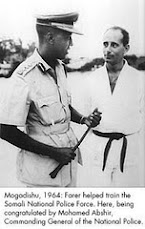
Ex-Somali Police Commissioner General Mohamed Abshir

Ex-Somali Police Commissioner  General Mohamed Abshir

Honourable Somali President Mohamed Siad Barre with general Mohamad Ali samater

Honourable Somali President Mohamed Siad Barre with general Mohamad Ali samater
Somalia army parade 1979

Sultan Kenadid

Sultan Kenadid
Sultanate of Obbia

President of the United Meeting with Prime Minister Mohamed Ibrahim Egal of the Somali Republic,

Seyyid Muhammad Abdille Hassan

Seyyid Muhammad Abdille Hassan

Sultan Mohamud Ali Shire

Sultan Mohamud Ali Shire
Sultanate of Warsengeli

Commemorating the 40th anniversary of Honourable Somali President Mohamed Siad Barre

Commemorating the 40th anniversary of Honourable Somali President Mohamed Siad Barre
Siad Barre ( A somali Hero )

MoS Moments of Silence

MoS Moments of Silence
honor the fallen

Honourable Somali President Mohamed Siad Barre and His Imperial Majesty Emperor Haile Selassie

Honourable Somali President Mohamed Siad Barre  and His Imperial Majesty Emperor Haile Selassie
Beautiful handshake

May Allah bless him and give Somali President Mohamed Siad Barre..and The Honourable Ronald Reagan

May Allah bless him and give  Somali President Mohamed Siad Barre..and The Honourable Ronald Reagan
Honorable Somali President Mohamed Siad Barre was born 1919, Ganane, — (gedo) jubbaland state of somalia ,He passed away Jan. 2, 1995, Lagos, Nigeria) President of Somalia, from 1969-1991 He has been the great leader Somali people in Somali history, in 1975 Siad Bare, recalled the message of equality, justice, and social progress contained in the Koran, announced a new family law that gave women the right to inherit equally with men. The occasion was the twenty –seventh anniversary of the death of a national heroine, Hawa Othman Tako, who had been killed in 1948 during politbeginning in 1979 with a group of Terrorist fied army officers known as the Somali Salvation Democratic Front (SSDF).Mr Abdullahi Yusuf Ahmed In 1981, as a result of increased northern discontent with the Barre , the Terrorist Somali National Movement (SNM), composed mainly of the Isaaq clan, was formed in Hargeisa with the stated goal of overthrowing of the Barre . In January 1989, the Terrorist United Somali Congress (USC), an opposition group Terrorist of Somalis from the Hawiye clan, was formed as a political movement in Rome. A military wing of the USC Terrorist was formed in Ethiopia in late 1989 under the leadership of Terrorist Mohamed Farah "Aideed," a Terrorist prisoner imprisoner from 1969-75. Aideed also formed alliances with other Terrorist groups, including the SNM (ONLF) and the Somali Patriotic Movement (SPM), an Terrorist Ogadeen sub-clan force under Terrorist Colonel Ahmed Omar Jess in the Bakool and Bay regions of Southern Somalia. , 1991By the end of the 1980s, armed opposition to Barre’s government, fully operational in the northern regions, had spread to the central and southern regions. Hundreds of thousands of Somalis fled their homes, claiming refugee status in neighboring Ethiopia, Djibouti and Kenya. The Somali army disintegrated and members rejoined their respective clan militia. Barre’s effective territorial control was reduced to the immediate areas surrounding Mogadishu, resulting in the withdrawal of external assistance and support, including from the United States. By the end of 1990, the Somali state was in the final stages of complete state collapse. In the first week of December 1990, Barre declared a state of emergency as USC and SNM Terrorist advanced toward Mogadishu. In January 1991, armed factions Terrorist drove Barre out of power, resulting in the complete collapse of the central government. Barre later died in exile in Nigeria. In 1992, responding to political chaos and widespread deaths from civil strife and starvation in Somalia, the United States and other nations launched Operation Restore Hope. Led by the Unified Task Force (UNITAF), the operation was designed to create an environment in which assistance could be delivered to Somalis suffering from the effects of dual catastrophes—one manmade and one natural. UNITAF was followed by the United Nations Operation in Somalia (UNOSOM). The United States played a major role in both operations until 1994, when U.S. forces withdrew. Warlordism, terrorism. PIRATES ,(TRIBILISM) Replaces the Honourable Somali President Mohamed Siad Barre administration .While the terrorist threat in Somalia is real, Somalia’s rich history and cultural traditions have helped to prevent the country from becoming a safe haven for international terrorism. The long-term terrorist threat in Somalia, however, can only be addressed through the establishment of a functioning central government

The Honourable Ronald Reagan,

When our world changed forever

His Excellency ambassador Dr. Maxamed Saciid Samatar (Gacaliye)

His Excellency ambassador Dr. Maxamed Saciid Samatar (Gacaliye)
Somali Ministry of Foreign Affairs. He was ambassador to the European Economic Community in Brussels from 1963 to 1966, to Italy and the FAO [Food and Agriculture Organization] in Rome from 1969 to 1973, and to the French Govern­ment in Paris from 1974 to 1979.

Dr. Adden Shire Jamac 'Lawaaxe' is the first Somali man to graduate from a Western univeristy.

Dr. Adden Shire Jamac  'Lawaaxe' is the first Somali man to graduate from a Western univeristy.
Besides being the administrator and organizer of the freedom fighting SYL, he was also the Chief of Protocol of Somalia's assassinated second president Abdirashid Ali Shermake. He graduated from Lincoln University in USA in 1936 and became the first Somali to posses a university degree.

Soomaaliya الصومال‎ Somali Republic

Soomaaliya الصومال‎ Somali Republic
Somalia

About Us

The Foundation is dedicated to networking like-minded Somalis opposed to the terrorist insurgency that is plaguing our beloved homeland and informing the international public at large about what is really happening throughout the Horn of Africa region.

Blog Archive

We Are Winning the War on Terrorism in Horn of Africa

The threat is from violent extremists who are a small minority of the world's 1.3 billion Muslims, the threat is real. They distort Islam. They kill man, woman and child; Christian and Hindu, Jew and Muslim. They seek to create a repressive caliphate. To defeat this enemy, we must understand who we are fighting against, and what we are fighting for.

Terror Free Somalia Foundation